

INTRODUCTION
Ghana is the second largest producer of cacao (Theobroma cacao L.) globally after the Ivory Coast, and the crop generates some 30 to 40% of foreign exchange for the economy, providing employment to nearly a million people (Adu-Acheampong, Reference Adu-Acheampong2009; Baah and Garforth, Reference Baah and Garforth2008). Species of Fusarium and Lasiodiplodia are important pathogens of cacao, causing substantial yield loss in most cacao producing countries in West Africa and inducing symptoms commonly referred to as dieback disease (Crowdy, Reference Crowdy1947; Padi et al., Reference Padi, Downham, Farman and Sarfo2001; Williams, Reference Williams1953). The dieback disease, detected in Ghana in 1908 (Dungeon, Reference Dungeon1910), is initiated by systemic growth of causal fungal pathogens via mirid feeding wounds (lesions) to the stem, where canker develops, and causing tree death in more severe cases (Crowdy, Reference Crowdy1947; Entwistle, Reference Entwistle1972; Owen, Reference Owen1956).
Conventional dieback disease management strategies target mirids, which has relied heavily on application of insecticide. After more than a century experience of controlling dieback disease, the ideal control regime is still to be found. The past decade has seen rising problems associated with insecticide use and misuse, including contamination of ground water supply, high pesticide residues and the destruction of natural agro-ecosystems in rural farming communities (Adu-Acheampong and Ackonor, Reference Adu-Acheampong and Ackonor2005; Padi et al., Reference Padi, Downham, Farman and Sarfo2001) subsequent to the Government of Ghana's 2001 policy to carry out nation-wide disease and pest control for smallholder cacao farmers. The large-scale use of conventional insecticides has already led to the evolution of insecticide resistance in some mirid populations targeted by these insecticides. Moreover, there is a worldwide demand for reducing the use of chemicals in agriculture and therefore a need to find economic, social and environmentally sound alternatives.
Few studies have been carried out on host resistance for dieback disease control in cacao since Owen (Reference Owen1956) observed differences in susceptibility among different cacao types to F. decemcellulare (Adu-Acheampong, Reference Adu-Acheampong2009). However, Owen's (Reference Owen1956) collection did not consistently demonstrate worthwhile resistance. Although he suggested further testing of the Amelonado and Upper Amazon cacao types, these genotypes, which have been grown for over half a century in West Africa, have continuously suffered severe damage.
As many cacao farmers are reluctant to rely on insecticides, the potential for alternative and sustainable control methods needed to be investigated. Integrating host–plant resistance into conventional dieback management programme in cacao would reduce use of insecticide. Moreover, interest has recently turned towards the production of organic cacao because of increasing demand from import/export markets. The availability of improved and dieback-resistant clones would benefit and improve farmers’ livelihoods, as it could contribute to vegetative vigour, high yield, early maturity and reduction in pesticide use so that cacao farmers can make substantial gains in their net income.
MATERIALS AND METHODS
Plant material
Detached stems from 29 clonally propagated cacao genotypes (AMAZ 15/15, AMAZ 3/2, AMAZ 5/2, AMELONADO, BE 2, CATIE 1000, CRU 100, CRU 124, EET 272, EET 59, GU 123/V, GU 125/C, GU 136/H, ICS 43, LCTEEN 37/F, LCTEEN 37/G, LCTEEN 37/I, MXC 67, NA 149, PA 107, PA 120, PA 137, PA 7, POUND 7/B, SC 20, SC 9, SCA 6, T85/799, UF 677) with similar vigour, and intact seedlings of 15 genotypes (AMELONADO, CATIE 1000, EET 59, ICS 1, ICS 95, IMC 67, LCTEEN 37/A, LCTEEN 37/F, LCTEEN 37/G, MXC 67, PA 7 [PER], PNG 418, POUND 7/B [POU], SAN MIGUEL [CHA], T85/799) were evaluated in this study. All plant materials were obtained from the field unit of the International Cacao Quarantine Centre (ICQC) based at the University of Reading, UK. Lower Amazon Forasteros, more commonly called Amelonado, represented the more widely cultivated cacao in West Africa in the 1950s.
Laboratory evaluation of 29 cacao genotypes
Approximately 5-cm stem segments (diameter 4–5 mm; four replicates each) were cut from the detached branches. These were washed with distilled water and surface sterilised for 10 s in 0.5% sodium hypochlorite solution, followed by four 1-min rinses in sterile distilled water. The control consisted of Amelonado, which is susceptible to dieback disease. All stem segments were maintained at room temperature (23 to 27 °C) with 12 h of light per day under fluorescent tubes, which were placed 2 m above the segments. Two Lasiodiplodia isolates designated as AC371 and AC845 and one isolate of Fusarium decemcellulare (IMI380504) obtained from diseased plants were selected for the detached stem in vitro assay. Isolates AC371 and AC845 were collected as part of the current study, while the third was originally isolated from a Ceiba tree by CABI, Biosciences, UK. The three isolates were chosen for this study on the basis of their previously determined differences in greenhouse pathogenicity tests.
The fungal inocula were maintained as pure cultures in vitro on Potato Dextrose Agar (PDA) at 4 °C in the laboratory at Silwood Park. Prior to inoculations, all cultures were transferred from storage onto new PDA plates and incubated under a 14-h light:10-h dark photoperiod at 30 °C to allow renewed growth and conidia formation. From these actively growing cultures, conidia were collected and suspended in distilled water for preparing inoculum following the method given by Stack (Reference Stack1989) with the resultant spore suspension adjusted to 1 × 10⁶ conidia per millilitre using a haemocytometer.
• Inoculation was done by making several punctures on the upper surface of each detached stem segment and then the wounded end of the stem was immediately dipped into a fungal spore suspension in 0.025% Tween-20. One inoculation was given to each stem. These stems were incubated vertically in humid plastic chambers lined with moist paper towels. The lesion length was recorded with a calliper 14 days after inoculation, and the lower portions of the stems were sampled for fungal isolation. Prior to sampling, the epidermis was removed and the stems cut transversely were opened with a sharp, sterile scalpel. Small wood sections were cut out at different lengths below the point of inoculation and plated on PDA to obtain the fungal colonisation profile within the stem. A clone was considered resistant if it showed necrosis only at the site of inoculation or within <2 mm from this point, while susceptible genotypes were those with browning >4 mm from the point of inoculation, recognised by the presence of dark brown lesions and viable mycelium when cultured on PDA. The experiment was repeated once and was arranged in a simulated split plot design with four replicates. Each genotype was an experimental unit with isolates as the main plot factor and cacao genotype randomised within isolates as sub-plots.
Greenhouse evaluation
Amelonado cacao seeds were germinated, transplanted and grown in a 2:2:1 mixture of multi-purpose compost, loam and sharp sand in 17-cm deep × 18-cm diameter, ≈1.5 L capacity plastic pots. Fourteen genotypes were vegetatively propagated on Amelonado rootstock using the T-budding technique when the seedlings were two weeks old and maintained at 20–30 °C. Amelonado variety was included as a susceptible check for comparison. Some clones used in the laboratory could not provide suitable scion for use in the greenhouse. Fertilisation, watering thrice a week and weed control was made according to nursery practices for cacao.
One month after budding, five of each clone were randomly selected and artificially inoculated with either F. decemcellulare isolate IMI380504 or Lasiodiplodia isolate AC371 adapting the inoculation procedure given by Sacristan (Reference Sacristan1982). At the inoculation site, a wound was made with a sterilised scalpel knife and a 10-μL spore suspension adjusted to 1 × 10⁶ spores per millilitre in 0.025% Tween-20 was applied and sealed with Para film M (Pechiney Plastic Packaging, Chicago, IL). The Para film was removed two weeks after inoculation. Control plants were inoculated with water only. Following inoculation, the plants were placed in a translucent polyethylene enclosure, sprayed with water and returned to the greenhouse benches, where they were arranged in a randomised complete block design. Data were dieback severity (by visual damage rating 12 weeks after inoculation), percentage cross-sectional area of necrosis in the stem and distance of fungal colonisation determined by culturing of wood fragments on PDA.
Statistical analysis
Analyses were done separately for each resistance trait. Percentage area of necrosis was transformed by arcsine square root (Sokal and Rohlf, Reference Sokal and Rohlf1995). The Kruskal–Wallis non-parametric ANOVA was used to assess differences in disease severity scores. Analyses of other variables were done for treatment combinations averaged across replicates: isolate × clone. General Linear Model Analysis of Variance (GLM ANOVA) procedure for SAS (SAS Institute, 2007) was done on measurement data. Replications were considered as random factors whereas genotypes and fungal isolates were considered as fixed effects. To find the best indicator of resistance among genotypes and to determine the relationships among the resistance variables, correlation coefficients were estimated among the resistance traits. Comparison of means of lesion sizes among genotypes was made by Fisher's least significant difference (LSD) at p = 0.05 (Sokal and Rohlf, Reference Sokal and Rohlf1995). The cacao genotype responses to Fusarium or Lasiodiplodia were compared by employing Pearson's product–moment correlation analysis.
RESULTS
Pathogenicity of fungal isolates, lesion development and variation in susceptibility of different genotype in vitro
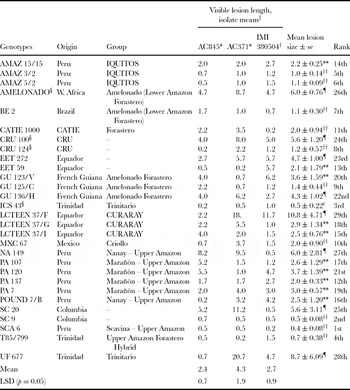
Cacao genotypes displayed varying levels of resistance between the tested fungal isolates. ANOVA of the data detected significant differences among genotypes (p < 0.001; Table 1). Moreover, there was significant genotype × isolate interaction. In terms of the size of necrotic lesions, isolate AC845 of Lasiodiplodia theobromae was more pathogenic than other isolates on six genotypes (BE 2, GU 125/C, LCTEEN 37/I, PA 107, PA 120 and SC 9), while isolate AC371 caused largest lesions on as many as 11 genotypes (Amelonado, CATIE 1000, CRU 100, CRU 124, GU 136/H, LCTEEN 37/F, MXC 67, NA 149, PA 7, SC 20 and UF 677). Isolate IMI380504 of Fusarium decemcellulare caused largest lesions on nine clones (AMAZ 15/15, AMAZ 3/2, AMAZ 5/2, EET 59, GU 123/V, ICS 43, PA 137, POUND 7/B and T85/799).
Variation in the severity of necrosis (visible lesion length [mm]) caused by two Lasiodiplodia* isolates and a standard F. decemcellulare † isolate on inoculated cacao genotypes in vitro 14 days after inoculation.

* Lasiodiplodia isolate.
† Fusarium decemcellulare isolate.
‡ Data points are means calculated on four replicates.
§ Amelonado = P30 = West African Amelonado; CRU = Cocoa Research Unit, Trinidad; ICS = Imperial College selection (from Imperial College of Tropical Agriculture, Trinidad).
¶ Susceptible group.
** Intermediate group.
†† Resistant group.
Mean lesion in the control group was 0.4 mm.
Inoculation with AC371 caused the largest stem lesions in vitro (mean = 4.33 mm, SE = 0.97, minimum = 0.25 mm, maximum = 20.7 mm), while isolate AC845 caused the smallest lesions (mean = 2.41 mm). After 14 days of inoculation, considerably larger lesions were observed in genotypes UF 677 and LCTEEN 37/F than in many other clones. The lesion lengths for clone LCTEEN 37/F were 2.2, 18.5 and 11.7 mm against isolates AC845, AC371 and IMI380504, respectively. The lesion lengths for clone SCA 6 against three isolates were, respectively, 0.5, 0.5 and 0.2 mm. Eight genotypes were placed in one group as they represent the lowest level of resistance in this trial (mean lesion across isolates > 4 mm). Eleven genotypes (AMAZ 3/2, AMAZ 5/2, BE 2, CATIE 1000, CRU 124, GU 125/C, ICS 43, MXC 67, SC 9, SCA 6 and T85/799) that showed the best performance with lesion sizes <2 mm were placed in another group, while the intermediate group included 10 genotypes (Table 1).
Fungal colonisation of detached stem segments
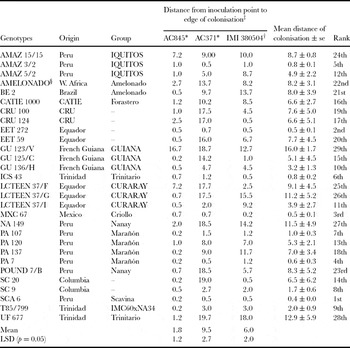
Colonisation occurred in all 29 screened cacao genotypes and there were differences between the fungal isolates for the degree of spread in the stem of the cacao genotypes (Table 2). Mean colonisation distance from the point of inoculation across genotypes was 1.8, 9.6 and 6.0 mm for isolates AC845, AC371 and IMI380504, respectively. On genotypes PA 137, PA 7, SC 20, SCA 6 and T85/799, isolate AC845 colonised the least distance (0.3 mm) compared with other isolates. Isolate AC845 of L. theobromae progressed only slightly on BE 2, EET 272, EET 59, GU 136/H, LCTEEN 37/I and SC 9 (0.5 mm) and AMAZ 3/2, AMAZ 5/2, CRU 100 and PA 120 (1.0 mm). Growth of isolate AC371 was severely restricted on AMAZ 3/2, PA 7 and SCA 6 (0.5 mm) but it developed extensively on UF 677, POUND 7/B and GU 123/V among others. Least fungal colonisation across isolates was found in genotypes SCA 6 (0.4 mm), EET 272 (0.6 mm) and MXC 67 (0.6 mm) whereas the most colonised genotypes were NA 149 (11.6 mm), UF 677 (12.9 mm) and GU 123/V (16.1 mm). Genotypes CRU 124, EET 272, ICS 43, SC 20 and SCA 6 were similar with respect to their response to isolate IMI380504 (0.5 mm). Isolates within the same genus, AC845 and AC371, differed in amount of colonisation except on genotype MXC 67, for which no significant difference between the two isolates was detected. In SCA 6, isolate AC845 was detected only in 0.3-mm-long section next to the inoculation point, while isolates AC371 and IMI380504 were detected 0.5 mm away. On clone GU 123/V, the respective distances of isolation of three fungi were 16.8, 18.8 and 12.8 mm.
Variation in the distance of spread of viable mycelia (colonisation [mm]) of L. theobromae* and F. decemcellulare † in the stem of cacao genotypes in vitro 14 days after inoculation.

* Lasiodiplodia isolate.
† Fusarium decemcellulare isolate.
‡ Data points are means calculated on four replicates.
§ Amelonado = P30 = West African Amelonado.
Comparison of lesion length and fungal colonisation in inoculated stem segments in vitro
Pearson's correlation coefficients between lesion length and distance of colonisation for different isolates were positive and significant. This suggests that a general increase or decrease of lesion length in stems was associated with either an increase or a decrease of colonisation. The observation from this trial has to be interpreted cautiously because while the results of some clones were consistent across the three fungal isolates (for both necrotic lesion and colonisation assessment methods), there was no definite trend on other genotypes. For example, SCA 6 ranked first (most resistant) based on small lesion size and tissue colonisation methods. AMAZ 3/2 also consistently expressed partial resistance in both methods, ranking the fifth most resistant genotype. Other genotypes, such as UF 677 and Amelonado, were consistently ranked as susceptible in both evaluations. On the contrary, genotype EET 272 showed good resistance by the tissue colonisation method, but high susceptibility in the lesion size method. Among the evaluated clones, the study has identified a few that developed only small necrotic lesions; SCA 6, SC9 and ICS 43 seemed to be the most promising genotypes as judged by the detached stem evaluation method. Some clones did not display strong visual symptoms but the distances of colonisation were relatively high (e.g. IMI380504 on NA 149 and UF 677), which suggests latent and symptomless growth of fungi in host tissues. However, in other combinations (e.g. isolate AC371 on POUND 7/B and isolate IMI380504 on LCTEEN 37/F) the reverse was the case.
Greenhouse evaluations
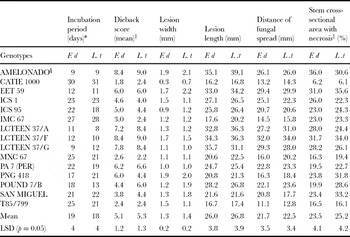
Under greenhouse inoculation, cacao genotypes did not show significant differences between the two fungi in lesion sizes and dieback scores (Table 3). The incubation period ranged from 8 to 30 days, during which time drooping and wilting of the leaves became visible. After the initial disease symptoms, the most susceptible plants were dead after 12 weeks. Disease scores varied between cacao clones and ranged from 1.8 to 9.0 (Table 3). On CATIE 1000 and T85/799, only four out of 10 plants developed foliar symptoms with an average disease index of 1.8–2.4, while the remaining plants had no or barely detectable expression of dieback. The five populations from LCTEEN 37/A, LCTEEN 37G, LCTEEN 37/F, SANMIGUEL and POUND 7/B developed the most severe symptoms, which were similar to those shown by the infected Amelonado control (Table 3). Between these extremes, the populations from PA 7 and IMC 67 had intermediate levels of symptoms. When plant sections from cacao germplasm with symptoms were tested for the presence of the fungi, colonies were detected, although the density of viable hyphae decreased from the point of inoculation. This observation was true even in symptomless plants. Despite this, F. decemcellulare or Lasiodiplodia was still recovered from stem tissues 12 weeks after inoculation. These fungi were likely to have come only from within the necrotic region around the point of inoculation, where the fungi were confined by the host defence response. Neither the xylem in necrotic areas of stems nor any other tissues were seen to be filled with fungal hyphae, but they rather appeared to be filled with gummy substances. This material probably contained phenolic compounds that were produced as a host defence response.
Assessment of factors of resistance to F. decemcellulare (F. d) and L. theobromae (L. t) in 15 cacao genotypes in greenhouse.

* Days after inoculation to first visual symptoms; means rounded to the nearest one day.
† Mean dieback scores recorded using a 9-point disease scale (1 = no visible symptoms, 9 = dead plant).
‡ Real figures; analysis was done after arc sine transformation.
§ Susceptible variety.
Pathogen incubation period in the greenhouse
The clones used in the study expressed reasonable consistency in different resistance components that were measured. Incubation period decreased distinctly from resistant to susceptible clones. The apparently resistant clone CATIE 1000 had the longest incubation period of 30 days compared with 8 days for LCTEEN 37/A.
Dieback assessment on cacao genotypes in the greenhouse
The dieback scores for the two batches of genotypes, one receiving isolate AC371 and the other isolate IMI380504, were compared. The individual scores are recorded in Table 3. Isolate AC371 gave comparable average dieback scores as IMI380504 and therefore the dieback susceptibility of the 15 tested cacao genotypes was not significantly different between the two isolates used in the study (p ≤ 0.05). The maximum disease was recorded on Amelonado, LCTEEN 37/F and LCTEEN 37/G with a mean score of 9.0 followed by EET 59, PA 7 and PNG 418 with disease scores ranging between 5 and 7. Four clones CATIE 1000, IMC 67, MXC 67 and T85/799 had scores below 3.0. Two clones, Amelonado and LCTEEN 37/F, exhibited maximum susceptibility against L. theobromae, while minimum disease incidence was observed in CATIE 1000 against F. decemcellulare.
Distance of fungal spread (colonisation) on cacao genotypes in the greenhouse
The distance of colonisation measured by fungal re-isolation by Fusarium decemcellulare (IMI380504) on the 15 genotypes (21.7 mm) did not differ from distance of colonisation by Lasiodiplodia (isolate AC371; 22.5 mm). The response of the susceptible check (Amelonado) to both isolates was that of high susceptibility. LCTEEN 37/F was highly colonised by both pathogens, while T85/799 and CATIE 1000 were the least colonised genotypes.
Assessment of necrotic lesions on cacao genotypes in the greenhouse
All cacao genotypes were susceptible to the two fungi on the basis of necrotic lesions. Inoculation with isolate AC371 appeared to have caused a greater across-genotype mean lesion length than isolate IMI380504, but the difference was not significant (p = 0.159). Generally, the across-isolate lesion dimensions were smaller on CATIE 1000 and T85/799 than on other clones. Genotype × isolate interactions were not significant (p > 0.05) for lesion length, lesion width and the cross-sectional area of stem necrosis. Overall, there was significant correlation between the results from two isolates (r = 0.8). Amelonado, EET 59, LCTEEN 37/A, LCTEEN 37/F, LCTEEN 37/G and SANMIGUEL had the biggest lesions in comparison with smaller lesions on CATIE 1000, T85/799 and MXC 67. Lesion sizes on the nine cacao genotypes (Amelonado, CATIE 1000, EET 59, LCTEEN 37/F, LCTEEN 37/G, MXC 67, PA 7, POUND 7/B and T85/799) tested both in laboratory and greenhouse were correlated (r = 0.56), but this was not significant.
Comparison of stem lesion and colonisation in laboratory and greenhouse studies
Results for two pathogens, isolates AC371 and IMI380504, from the greenhouse studies were analysed separately even though they were not significantly different (p > 0.05). The across-genotype and the across-isolate mean lesion sizes were smaller in the laboratory-detached stem trial compared with the greenhouse experiment possibly because of methodological variation (Table 1). Inoculation with isolate AC 371 caused significantly longer lesions than isolate IMI 380504 in the laboratory, but in the greenhouse their effects were virtually the same.
Relationships between resistance traits in cacao genotypes
The relationships among resistance traits showed that lesion width was by far the most important variable that accounted for the observed measurements of necrosis within the stem. When lesion width was less than 0.7 mm, lesion length was the next most important variable. The proportional stem cross-sectional area with necrosis was 5% when both lesion length and width were small. When lesion width was high and lesion length was low, the distance of colonisation (spread) became important. There was a strong correlation between most of the resistance components evaluated (Table 3) as well as between the results of the two fungal isolates (Table 3). There was also a close correlation of dieback scores against some of the other resistance variables (Table 3), which is biologically plausible, because both shorter incubation period and larger lesion size reflect the activity of the pathogen. The inward growth of lesions (estimated from the percentage area of necrosis) was positively correlated with other resistance components, which were positively correlated with one another but negatively correlated with the incubation period. Within the approximations made, the mean dieback score for the less susceptible clones was less than 3.0 for the two fungal isolates. Amelonado was the only clone rated most susceptible against isolate IMI380504, whereas two other clones, LCTEEN 37/F and LCTEEN 37/G, were similar to Amelonado when inoculated with isolate AC371.
DISCUSSION
Resistance in cacao genotypes to dieback disease has been determined in the current study as a step in the genetic improvement of cacao varieties. Cacao genotypes were assessed both in laboratory and greenhouse using various resistance traits; and we found good agreement between the two methods.
Previous studies have documented the lack of suitable criteria for assessing dieback resistance in cacao (Owen, Reference Owen1956). In the current study where a number of resistance traits were analysed, good correlations were determined amongst the traits.
Different cacao genotypes showed differences in the sizes of necrotic lesions and the degree of tissue colonisation by the two fungal isolates. These fungi presumably produced toxic metabolites within the host tissue that might have a role in the expression of dieback symptoms. In the laboratory-detached stem evaluation, necrotic lesions occurred within the stem of all genotypes primarily near the point of inoculation with symptom expressed as a brown streak along the vertical axis of the stem. The average size of lesions in different cacao stem segments was larger than reported previously (Owen, Reference Owen1956). The larger sizes of the lesions found in the present study might be related to the age of the budded plants (3 months), which was younger than the seedling age of 2–3 years reported in the infection studies done by Owen (Reference Owen1956). On the other hand, the necrotic lesions in this study had a similar elliptical shape to those reported by Crowdy (Reference Crowdy1947) and Owen (Reference Owen1956). Large necrotic lesions did not develop in some clones, for example NA 149 against IMI380504, but the plants did show substantial colonisation. For the evaluation of stem segments of different cacao genotypes, SCA 6 was one of the most resistant genotype.
In the greenhouse study, the greatest distance of spread (15–20 mm) in the stem tissues caused by F. decemcellulare and Lasiodiplodia theobromae was recorded on Amelonado and LCTEEN 37/F, and the least (5–10 mm) was recorded on CATIE 1000. These pathogenic fungi induced comparable amount of dieback disease. Thus, control strategies developed against either of the two pathogens may be able to perform to the same degree as against the other. The fungi can be easily distinguished, but it will be difficult to associate dieback disease with any particular species when a mixture of different fungal pathogens that cause similar injury attack plants. It is important to note that in the current study greater stem colonisation (fungal spread) led to severer dieback symptoms in the susceptible cacao genotypes (p < 0.001). Therefore, this should be factored into any dieback resistant assessment.
The study did not evaluate the effects of temperature and relative humidity on the development of disease in these genotypes, but rather provided environmental conditions conducive for disease development. The assumption was that under natural field conditions cacao could be infected throughout the year if conducive weather conditions existed at that time. Notwithstanding, some of the observed variations in dieback severity could have been caused by environmental conditions, as the greatest peaks in dieback (in Ghana) occur during the peak rainy season – June–September, which coincides with times when mirid populations were increasing.
It is often difficult to compare dieback tolerance between cacao genotypes; and comparison between studies is difficult because plants are not tested at the same age. Besides, damage evaluated under natural infection includes damage caused by several fungi all occurring in the same plant causing similar damage. Owen's (Reference Owen1956) method against F. decemcellulare was limited because he only assessed necrotic lesions to determine resistance. Several factors, e.g. necrotic lesions, dieback symptoms, internal colonisation, incubation period or a combination of these factors, as examined in the current study, can modulate resistance in cacao genotypes. In fact, cacao genotypes with little fungal colonisation were resistant to dieback because the pathogens may have more difficulty in destroying the conducting tissues. Moreover, clones with large lateral necrotic lesions tended to be more susceptible to dieback, whereas clones with small lateral lesions showed some tolerance. The reaction of different cacao clones to F. decemcellulare or Lasiodiplodia differed under the greenhouse conditions and there were few replicates that showed no dieback disease symptom. The implication of this observation will require further work, as these plants may have escaped infection. The traditionally cultivated West African Amelonado variety and some of the newer clones were most susceptible to dieback and symptoms closely reflect natural field infection. When necrotic lesion size, which is by far the most widely used criterion, was compared with foliar symptoms, a clear distinction between susceptible and resistant interactions was observed. Incubation period and fungal colonisation were as good indicators as necrotic lesions for assessing resistance in different cacao genotypes as there were clear linear relationships between them. To avoid the limitations of earlier studies that were based on undefined mixtures of fungal isolates, a large number of cacao accessions were screened with single conidial isolates. The use of single conidial isolates in the current study was important to avoid mixed host responses resulting from combinations of compatible and incompatible interactions.
There are several physiological, genetic and biochemical mechanisms by which cacao genotypes tolerate fungal infection (Brownlee et al., Reference Brownlee, McEuen, Hedger and Scott1990; Capriles et al., Reference Capriles de Reys, Schulz and Munoz1964; Capriles and Reys, Reference Capriles de Reys and Reys1968; Cooper et al., Reference Cooper, Resende, Flood, Rowan and Beale1995; Resende et al., Reference Resende, Flood, Ramsden, Rowan, Beale and Cooper1996). Resistance to vascular wilt in cacao is associated with production of phytoalexins (phenolic compounds, tannins, polymeric procyanidins and elemental sulphur) in response to infection, and these have a variety of biological functions, including inhibition to disease progression (Cooper et al., Reference Cooper, Resende, Flood, Rowan and Beale1995). Nojosa et al. (Reference Nojosa, Resende, Aguilar, Bezerra and Anhert2003) showed that oxidative enzymes influenced cacao genotypes’ resistance to the frosty pod pathogen, Crinipellis perniciosa. Likewise, ongoing research on cacao by Verica et al. (Reference Verica, Maximova, Strem, Carlson, Bailey and Guiltinan2004) has shown that defence responses are activated via endogenous signalling molecules, such as salicylic acid, jasmonic acid and ethylene, through changes in the expression of a number of genes. Thevenin et al. (Reference Thevenin, Umaharan, Surujdeo-Maharaj, Latchman, Cilas and Butler2005) suggested that witches’ broom resistance in some cacao genotypes was most likely physiological, and broom development was possible when the point of infection was near to the meristematic region. Many studies, including those of Evans and Bastos (Reference Evans, Bastos and 1975) and Danquah (Reference Danquah1986), have shown that basidiospores have slower germ tube growth in extracts from SCA 6 than extracts from susceptible germplasm. Surujdeo-Maharaj et al. (Reference Surujdeo-Maharaj, Umaharan and Butler2004), working with 14 cacao genotypes (SCA 6, SCA 12, ICS 1, ICS 84, ICS 95, IMC 57, IMC 67, JA 6/4 [POU], JA 5/19 [POU], JA 5/41 [POU], UF 11, Hybrid 19, M 8 and West African Amelonado), also reported a decline in witches’ broom development in the SCA and IMC clones through delayed colonisation of meristematic tissues.
In the present study, plants were inoculated once only, at a single point and at a young stage of growth, contrasting with a real cacao farm in which multiple inoculations occur through mirid feeding punctures. Although the results demonstrate that differences in plant response exist among different cacao germplasm, the range of values for disease obtained in this trial may not adequately reflect what is possible under field conditions. Nine out of 10 CATIE 1000 seedlings used in the current study survived for up to 12 months; moreover, this is the only genotype with a damage score of less than 2.0 against F. decemcellulare and so it can be classified among the most tolerant genotypes. The report from Capriles et al. (Reference Capriles de Reys, Schulz and Munoz1964) about the high resistance of clone IMC 67 to Ceratocystis fimbriata correlates weakly with its response to the pathogens used in the current study, emphasising the importance of knowing precisely the pathogen that one is dealing with. Until now, breeding for resistance to dieback has yielded very little success. Thus, CATIE 1000, T85/799 and MXC 67 could be used as valuable sources to obtain resistant cacao varieties to F. decemcellulare and L. theobromae or as donors of resistance to other wilt causing fungal pathogens.
Acknowledgements
The authors thank Dr. Gary Samuels of USDA-ARS, Beltsville for providing the Fusarium decemcellulare isolate used in this study. Also, thanks go to Prof. Paul Hadley and Dr. Andrew Daymond of School of Plant Sciences, University of Reading, UK for supplying cacao genotypes, Dr. Francis Padi for information on the origin of genotypes and Janet McLennan for helpful comments on an earlier version of this paper. This paper was approved for publication by the Executive Director of Cocoa Research Institute of Ghana.