Introduction
While marriage between people who are genetically related is relatively uncommon in most Western societies, in many parts of Asia and Africa and among emigrants from these regions 20–50+% of marriages are consanguineous, defined as marriage between individuals related as second cousins or closer and equivalent to a coefficient of inbreeding (F) ≥0.0156 (Bittles & Black, Reference Bittles and Black2010). Concern over the potential public health implications of marriages between biological relatives has spurred research into the incidence of childhood mortality and genetic illness in the offspring of such unions. This research has important policy implications, as legislation curtailing consanguineous marriage may conflict with traditional beliefs. Parents who arrange consanguineous marriages for their children may also reap socioeconomic benefits, such as delayed dowry payments or better treatment of their daughters by their husbands’ family.
Genetic research indicates that marriage to a close biological relative should result in a higher incidence of genetically related illness in their offspring due to the expression of rare, detrimental, recessive genes (Bittles & Neel, Reference Bittles and Neel1994; Hamamy et al., Reference Hamamy, Antonarakis, Cavalli-Sforza, Temtamy, Romeo and Kate2011; Bittles, Reference Bittles2012; Sheridan et al., Reference Sheridan, Wright, Small, Corry, Oddie and Whibley2013; Bishop et al., Reference Bishop, Small, Mason, Corry, Wright and Parslow2017). Since first cousins co-inherit 12.5% of their genes from a common ancestor, the risk that both carry identical copies of a detrimental gene – and therefore the risk of that gene being expressed in their offspring – is increased. Medical and genetics research has found that besides early childhood mortality (Bittles et al., Reference Bittles, Mason, Greene and Rao1991; Grant & Bittles, Reference Grant and Bittles1997; Khan et al., Reference Khan, Wojtyniak and Shaha1997), consanguinity may be associated with a diverse range of complex disorders, ranging from congenital heart disease (Shieh et al., Reference Shieh, Bittles and Hudgins2012) to adult-onset conditions such as male infertility (Inhorn et al., Reference Inhorn, Kobeissi, Nassar, Lakkis and Fakih2009), hypertension, myocardial infarction and stroke (Rudan et al., Reference Rudan, Rudan, Campbell, Carothers, Wright and Smolej-Narancic2003a, Reference Rudan, Smolej-Narancic, Campbell, Carothers, Wright, Janicijevic and Rudanb; Ismail et al., Reference Ismail, Jafar, Jafary, White, Faruqui and Chaturvedi2004), cancers (Rudan et al., Reference Rudan, Rudan, Campbell, Carothers, Wright and Smolej-Narancic2003a) and schizophrenia (Mansour et al., Reference Mansour, Fathi, Klei, Wood, Chowdari and Watson2010; Bener et al., Reference Bener, Dafeeah and Samson2012). Recent studies suggest that past estimates of the negative health effects of cousin unions have been exaggerated, largely because of inadequate controls for the socioeconomic correlates of such unions (Hamamy et al., Reference Hamamy, Antonarakis, Cavalli-Sforza, Temtamy, Romeo and Kate2011; Bittles, Reference Bittles2012).
Resolution of this issue is complex, since variables correlated with both the propensity to marry consanguineously and with child health outcomes – such as attitudes towards modern medicine or household preferences regarding the trade-offs between health and social or economic goals – may be unobservable and/or difficult to measure. This study’s instrumental variable (IV) approach (to be discussed in the Methods) extracts the variation in consanguinity attributable to (random) differences in cousin availability, and uses it to estimate the causal effect of consanguinity on child health outcomes through a two-stage least squares (2SLS) model (Bowden & Turkington, Reference Bowden and Turkington1990; Angrist et al., Reference Angrist, Imbens and Rubin1996; Heckman et al., Reference Heckman, Urzua and Vytlacil2006). The present study deals exclusively with first cousin marriage (F=0.0625).
Additionally, the study explores socioeconomic outcomes associated with cousin marriage and household attitudes towards consanguinity, to examine why it remains popular. Previous research on social causes of consanguinity mainly relied on case-studies and descriptive evidence rather than rigorous large-sample quantitative evidence. The economics literature is beginning to explore the role of consanguineous marriage as an institution having important economic and social impacts, particularly in regard to information problems in marriage markets. Mobarak et al. (Reference Mobarak, Kuhn and Peters2013) found that consanguineous marriage was associated with lower dowries in Bangladesh, and that families that experienced a positive wealth shock were less likely to marry their daughters to relatives. Do et al. (Reference Do, Iyer and Joshi2013) obtained empirical support from a dataset from Bangladesh for a theoretical model that dowries and consanguineous marriage were substitutes in mitigating the time-inconsistency problem regarding post-marital investments by in-laws. Jacoby and Mansuri (Reference Jacoby and Mansuri2010) studied the related rural marriage institution of watta satta or bride exchange in Pakistan. Watta satta marriages are often also consanguineous, although not necessarily so. They found that the practice was associated with better marriage outcomes for women in rural Pakistan.
Methods
Data
Data for the present study came from in-depth household questionnaires conducted in 2006–07 in Bangladesh and 2009–10 in Pakistan. Pakistan has one of the highest known rates of cousin marriage in the world, with 48.5% of ever-married women being related to their husbands as first cousins, and another 7.9% as second cousins (National Institute of Population Studies & ICF International, 2013). In Bangladesh, estimates of the prevalence of consanguinity vary by source and by region, but most data indicate that, at least in rural areas, between 10 and 20% of couples are first cousins (Durkin et al., Reference Durkin, Khan, Davidson, Huq, Munir, Rasul and Zaman2000).
Data for the sampling frame for the Bangladesh survey came from the International Centre for Diarrhoeal Disease Research, Bangladesh (ICDDR,B), which maintained a longitudinal surveillance of vital events and migrations in the Teknaf region of Bangladesh from 1976 to 1988. All couples who experienced a pregnancy (either a live birth or stillbirth/miscarriage) between 1st January and 31st December 1985 were eligible for inclusion in the study. The year 1985 was chosen because it was the first year in which questions on consanguinity were included in the ICDDR,B survey, and thus data on the consanguinity status of each couple were available. A total of 618 families were selected from this sampling frame to be interviewed for the current study. The research team purposefully over-sampled families in which the head of household and his wife were first cousins, to achieve a rate of 50% consanguinity in the sample. These consanguineous couples were then matched with non-consanguineous couples based on the mother’s level of education and her occupation, to complete the sample. In the analysis, adjustment was made for the over-sampling of consanguineous couples using the appropriate population weight.
Since consanguinity already approaches 50% in the population of Pakistan, no over-sampling based on consanguinity was needed; instead, a geographically stratified sample of the Pakistani population was surveyed, covering 1020 families. While there was over-sampling of districts based on literacy, the analysis controlled for parental education.
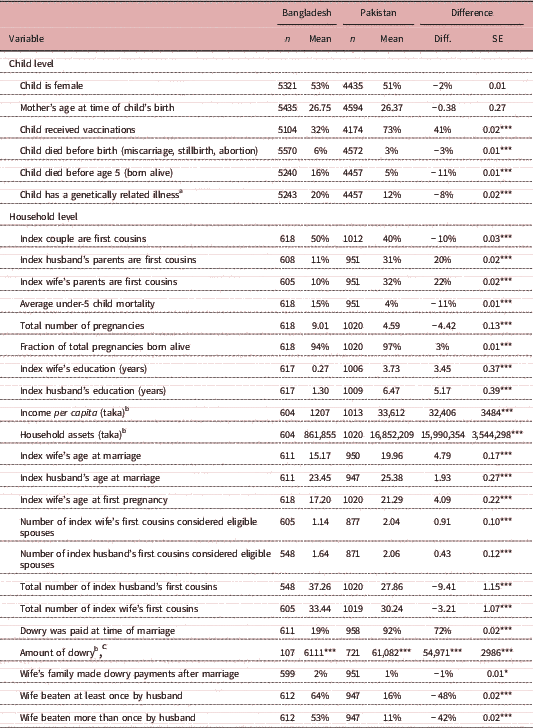
Descriptive statistics for both the Pakistan and the Bangladesh data are presented in Table 1, along with differences in the means between the two countries. In general, respondents from Bangladesh were poorer, less educated and tended to marry younger. They also had higher levels of child mortality and illness. Because of these stark differences, the data from each country were analysed separately.
Summary statistics of the study sample

a Dummy variable with a value of 1 if the child has suffered from any of the following: abnormally small at birth, anaemia, floppy/poor muscle tone as an infant, visible disability, cannot perform activities at same level as peers, blindness, deafness, cleft lip or palate, trouble sitting upright, trouble walking, mental disability, lethargy, weakness, seizures.
b Asset, income, and dowry values in Pakistani Rupees were converted to Bangladeshi taka for ease of comparability between the two countries, using the average exchange rate for Jan–Dec 2007 (the time the surveys were conducted). At this time, the taka averaged Tk67.2 to the US dollar.
c Amount of dowry defined only for families who paid dowry at the time of their daughter’s marriage.
***p<0.01, **p<0.05, *p<0.1.
Analysis
Socioeconomic and demographic research relating to consanguinity indicates that spouses who are biological relatives may be systematically different from other couples in the same population, in ways that affect the likelihood of disease and mortality in their offspring. Researchers have related consanguinity to a range of such factors, including education, literacy, wealth and fertility (Hussain & Bittles, Reference Hussain and Bittles1998, Reference Hussain and Bittles2000; Bittles, Reference Bittles2012; Bhopal et al., Reference Bhopal, Petherwick, Wright and Small2014). Without adequate controls for socioeconomic correlates of child mortality and health status, estimates of adverse health effects due to close kinship between parents are likely to be conflated, reflecting a combined effect of consanguinity and these other factors (Bittles, Reference Bittles1994). Thus, families who are carriers of one or more detrimental recessive gene may have experienced the ill-effects of consanguinity in previous generations, discouraging consanguineous unions in the present generation and effectively under-estimating the influence of consanguinity on ill health. Estimates may therefore be biased in either direction. When studies include controls for observable socioeconomic factors, estimates of morbidity and early childhood mortality rates as a result of consanguineous marriage tend to be revised down (Bittles, Reference Bittles2012).
If all confounding factors were observable (e.g. family income), then controlling for them in a multivariate regression would yield correct estimates of the causal impact of consanguinity on child health outcomes. If, however, any of these factors were unobservable (e.g. the family’s appreciation of the genetic basis for disease, or fertility preferences), then estimates of consanguinity on health would still be biased. In the absence of an ethically acceptable experimental alternative, the causal effect of consanguinity in the present study was approximated by using an instrumental variable (IV) strategy, based on exogenous variation in the availability of marriageable cousins of the opposite gender.
The estimation strategy started with the following thought experiment. Consider two men seeking women to marry. One has female unmarried first cousins of marriageable age, while the other does not. All other considerations being equal, the first person would have a greater likelihood of marrying consanguineously by comparison with the second, since a consanguineous union would only be possible if a cousin of the right age and gender was actually available. Using primary data on consanguinity, first cousin availability and health outcomes collected from 1638 couples (10,142 pregnancies) in Pakistan and Bangladesh, two groups of statistically comparable couples were created, one with a greater propensity to opt for a consanguineous union than the other, due to a difference in the availability of marriageable first cousins. This difference in cousin availability in turn stemmed from the random chance of more first cousins of marriageable age and the opposite gender in the first set of families, as opposed to same-gender cousins in the second set. This variation was used to estimate the causal impact of consanguinity of both child health and socioeconomic outcomes for families.
In Pakistan and Bangladesh, marriages are typically arranged by relatives and there is a strong preference for consanguineous marriage. Of 1345 consanguineous parents interviewed in the present study, 1127 listed parents’ choice as one of the reasons why they married consanguineously. An index constructed to represent opinions on the effect of consanguinity on the overall quality of marriage, with 0 representing a neutral belief, was significantly positive in both countries, even among non-consanguineous couples. Among the women interviewed in Pakistan, fewer than 10% reported that they did not want their children to marry consanguineously.
Given these preferences, the availability of eligible marriageable cousins was relevant to the ability of families to marry their children into consanguineous unions. Since the average year of birth for the women interviewed was 1968, and eligible cousins were those who were born around the same time as the index couple, it would have been difficult for the parents of these couples to plan the gender of their offspring in order to make consanguineous marriage more likely. It is asserted, therefore, that the gender of those cousins born around the same time as the index couple was plausibly random. Because the gender of one’s cousins was random, one could reasonably expect that the gender mix of one’s cousins, and therefore the availability of opposite-gender, marriage-eligible cousins, was exogenous to consanguinity status. In addition, the analysis controlled for fertility preferences of the extended family by including the total number of cousins (as well as squared and cubic terms).
For the child-level health indicators, the first stage of the 2SLS model followed the following specification:
 $$\eqalignno{ {\rm Consang}_{{i,j}} {\equals} & \alpha {\plus}\beta _{1} {\rm EligCous}\_M_{j} {\plus}\beta _{2} {\rm EligCous}\_F_{j} {\plus}\beta _{3} {\rm TotCous}\_M_{j} {\plus}\beta _{4} {\rm TotCous}^{2} \_M_{j} {\plus}\beta _{5} {\rm TotCous}^{3} \_M_{j} \cr &{\plus}\beta _{6} {\rm TotCous}\_F_{j} {\plus}\beta _{7} {\rm TotCous}^{2} \_F_{j} {\plus}\beta _{8} {\rm TotCous}^{3} \_F_{j} {\plus}\gamma X_{{i,j}} {\plus}\delta V_{j} {\plus}{\varepsilon}_{{i,j}} $$
where Consang i,j is a dummy variable indicating if the parents of child i in household j are first cousins, α is a constant term, EligCous_M j is the number of eligible cousins the child’s mother had at the time of marriage, EligCous_F j is the number of eligible cousins the father had, TotCous_M j is the mother’s total cousins and TotCous_F j is the father’s total cousins. TotCous2 _M j , TotCous3 _M j , TotCous2 _F j and TotCous3 _F j are squared and cubed terms, included in order to control in a more flexible way for the possibility that poorer families were larger and more apt to engage in consanguineous marriage. The term X i,j is a vector of child-level controls, which included the child’s birth order and gender, the mother’s age at the time of the child’s birth and dummy variables for whether the child was vaccinated, whether the mother’s previous pregnancy survived and if the child was the first born. The term V j is a vector for household-level variables, including household assets and income, and mother’s and father’s education levels; ε i,j is a child-specific error term.
Eligibility of cousins was determined by the answer to the question ‘Was this person considered an eligible bride/groom for you?’, asked about each cousin the index wife and husband had. For Bangladesh, the total number of eligible cousins was used. In Pakistan, however, the number of cousins and the rates of consanguinity were so high that this did not result in a strong instrument. Therefore, the ratio of available cousins of the opposite gender to rival cousins and siblings of the same gender was used.
The predicted values of Consang i,j were then used to estimate the second stage of the analysis:
 $$\eqalignno{ {\rm Health}_{{i,j}} {\equals} & \lambda {\plus}\theta \widehat{{{\rm Consang}}}_{{i,j}} {\plus}\kappa _{1} {\rm TotCous}\_M_{j} {\plus}\kappa _{2} {\rm TotCous}\_F_{j} {\plus} \kappa _{3} {\rm TotCous}^{2} \_M_{j} {\plus}{\rm }\kappa _{4} {\rm TotCous}^{3} \_M_{j} \cr& {\plus} \kappa _{5} {\rm TotCous}^{2} \_F_{j} {\plus}{\rm }\kappa _{6} {\rm TotCous}^{3} \_F_{j} {\plus}\rho X_{{i,j}} {\plus}\varsigma V_{j} {\plus}v_{{i,j}} $$
where Health i,j represents various measures of health outcomes for a child i from household j. The measures of child health considered were prenatal mortality, under-5 mortality and a vector of genetically related diseases. Since the right-hand-side variable of interest, consanguineous marriage, was a choice made at the family level, errors were clustered by family.
For the household-level social indicators, including household decision-making, domestic violence and dowry payments, the 2SLS model was as follows:
First stage:
 $$\eqalignno{ {\rm Consang}_{j} {\equals} & \alpha {\plus}\beta _{1} {\rm EligCous}\_M_{j} {\plus}\beta _{2} {\rm EligCous}\_F_{j} {\plus}\beta _{3} {\rm TotCous}\_M_{j} {\plus}\beta _{4} {\rm TotCous}^{2} \_M_{j} \cr &{\plus}\beta _{5} {\rm TotCous}^{3} \_M_{j} {\plus}\beta _{6} {\rm TotCous}\_F_{j} {\plus}\beta _{7} {\rm TotCous}^{2} \_F_{j} {\plus}\beta _{8} {\rm TotCous}^{3} \_F_{j} {\plus}\delta V_{j} {\plus}{\varepsilon}_{j} $$
Second stage:
 $$\eqalignno{ {\rm Social}_{j} {\equals} & \lambda {\plus}\theta \widehat{{{\rm Consang}}}_{j} {\plus}\kappa _{1} {\rm TotCous}\_M_{j} {\plus}\kappa _{2} {\rm TotCous}\_F_{j} {\plus} \kappa _{3} {\rm TotCous}^{2} \_M_{j} {\plus}{\rm }\kappa _{4} {\rm TotCous}^{3} \_M_{j} \cr &{\plus} \kappa _{5} T{\rm otCous}^{2} \_F_{j} {\plus}{\rm }\kappa _{6} {\rm TotCous}^{3} \_F_{j} {\plus}\varsigma V_{j} {\plus}v_{j} $$
Results
First stage regressions
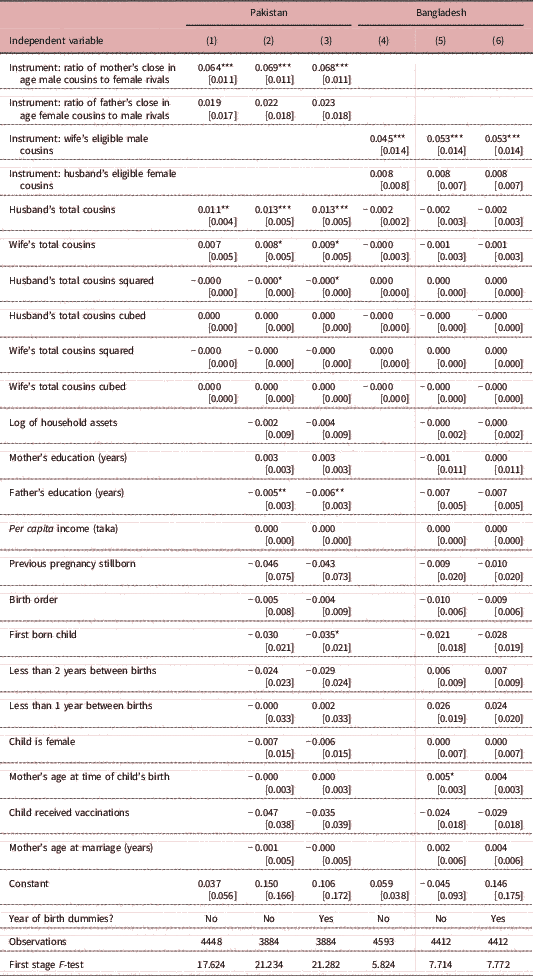
The first stage results (Table 2) indicated that each additional eligible male cousin increased a woman’s likelihood of marrying consanguineously by about 5 percentage points in Bangladesh. In Pakistan, an additional eligible cousin (relative to same-gender rivals) increased the probability of marrying a cousin by 6–7 percentage points on the woman’s side. The instruments were jointly statistically significant, and a test of over-identifying restrictions showed that they were valid in most specifications. Following Bound et al. (Reference Bound, Jaeger and Baker1995) and Murray (Reference Murray2006), the full results in Tables 3 and 4 include first stage F-statistics on excluded instruments and Hansen’s J-statistic. In several specifications (particularly in Bangladesh), the instruments proved to be weak; however, the main results are taken from the models that had the greatest power in the first stage.
First stage regression results for health variables: effects of instruments on consanguinity rates

Robust standard errors in brackets.
***p<0.01; **p<0.05; *p<0.1.
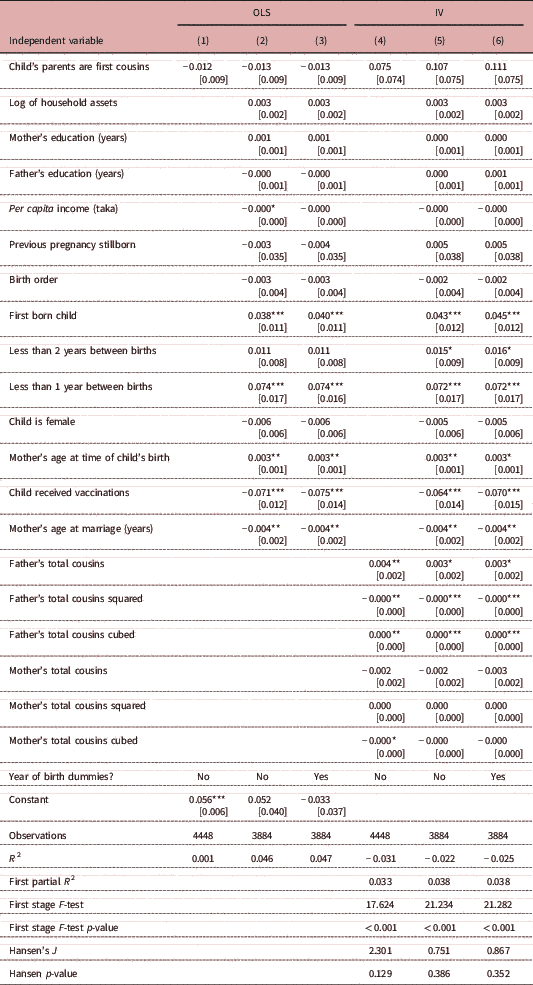
Effects of consanguinity on under-5 mortality: Pakistan

Robust standard errors in brackets.
***p<0.01; **p<0.05; *p<0.1.
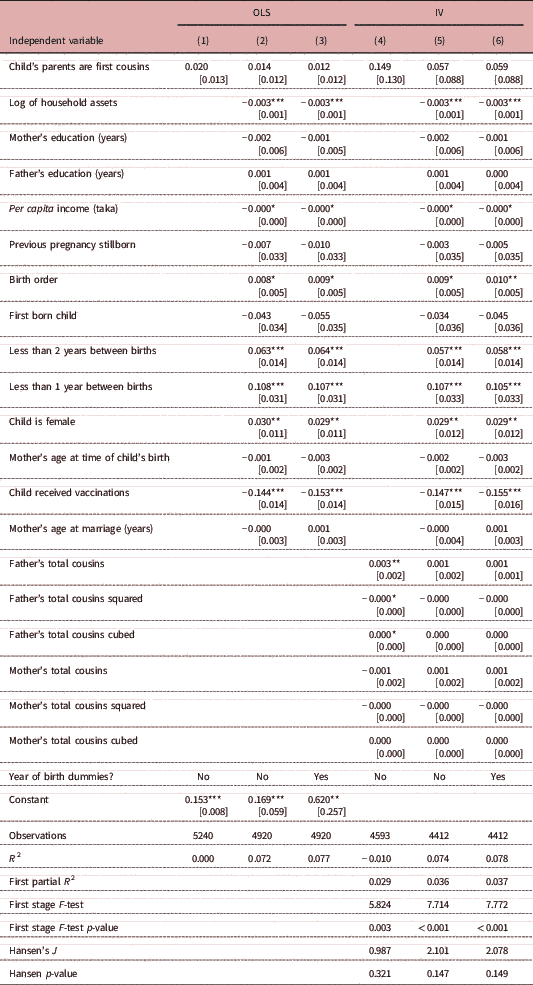
Effects of consanguinity on under-5 mortality: Bangladesh

Robust standard errors in brackets.
***p<0.01; **p<0.05; *p<0.1.
Impacts of consanguinity on child health
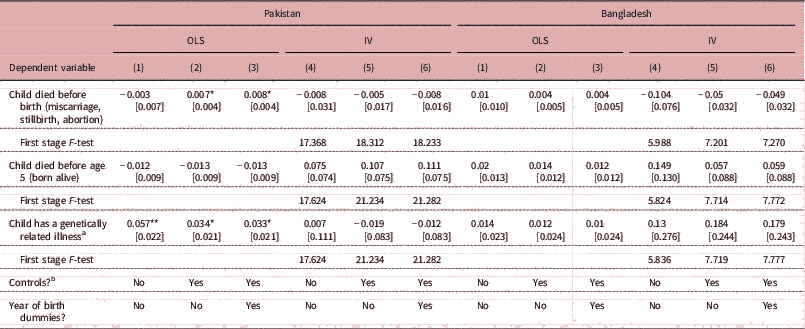
Table 5 presents results for the effect of consanguinity on prenatal mortality, under-5 mortality and the incidence of genetic disease. Only the coefficient on the indicator for ‘cousin marriage’ is shown, while full regression results for under-5 mortality are included in Tables 3 and 4. Columns 1–3 of Table 5 present the results generated through ordinary least squares regression (OLS). The analysis found no statistically significant effect on under-5 mortality levels, and the effects generally became smaller once controls for birth order, conditions at birth, vaccinations, mother’s age, education, etc. were added. In Pakistan, the results show that the children of consanguineous parents had rates of genetic illness that were 5.7 percentage points higher than those of their non-consanguineous peers, but this effect was reduced to 3.3 percentage points once socioeconomic controls were added. The finding is consistent with estimates generated by previous researchers (Hussain & Bittles, Reference Hussain and Bittles2000). The analysis also found a very small but statistically significant increase in prenatal mortality in Pakistan in the OLS specifications. However, after controlling for non-random sources of selection into consanguineous marriage through the instrumental variables (shown in columns 4–6), the effect on prenatal mortality and genetic illness disappeared in the Pakistan sample and was no longer statistically different from zero.
Effects of consanguinity on child healthFootnote a

a Table presents the coefficient and standard error on an independent variable equal to 1 if the child’s parents are first cousins.
b Dummy variable with a value of 1 if the child has suffered from any of the following: abnormally small at birth, anaemia, floppy/poor muscle tone as an infant, visible disability, cannot perform activities at same level as peers, blindness, deafness, cleft lip or palate, trouble sitting upright, trouble walking, mental disability, lethargy, weakness, seizures.
c Controls include: log of household assets, income per capita, mother’s education, father’s education, child’s birth order, child’s gender, mother’s age at the time of the child’s birth, mother’s age at marriage, and dummy variables for whether a previous sibling died, whether the child is the first born, whether there was an interval of less than 2 years between this child’s birth and the birth of their previous sibling, whether there was an interval of less than 1 year between this child’s birth and the birth of their previous sibling and whether the child has been vaccinated. In the IV specifications (columns 4–6), additional controls are included for the number of father’s total cousins, number of father’s total cousins, along with squared and cubed terms of each.
Robust standard errors, clustered at the household level, in brackets.
***p<0.01; **p<0.05; *p<0.1.
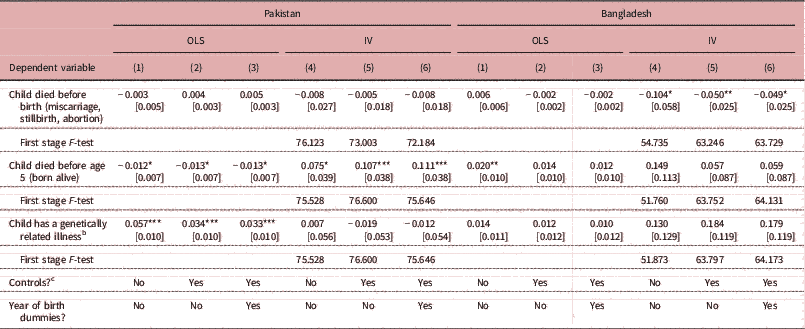
The effects of consanguinity on under-5 mortality levels were quite large and positive, but were not statistically significant. Earlier studies have often failed to cluster standard errors at the level of the couple or household. Since health outcomes for two children from the same household are likely to be correlated, not clustering by household could provide a false sense of statistical precision. In the present study, adjustment for this possibility was made by clustering (and therefore inflating) standard errors. While the authors cannot say with certainty that the direct effect of consanguinity on under-5 mortality is zero, it seems probable that the levels of statistical significance reported by many previous studies were artificially elevated. To examine this issue, effects without any clustering are presented in Table 6. The resultant decrease in the standard error demonstrates that the calculated coefficients were indeed statistically significant, although they should not be interpreted as such.
Effects of consanguinity on child health, without clustered standard errorsFootnote a

a Table presents the coefficient and standard error on an independent variable equal to 1 if the child’s parents are first cousins.
b Dummy variable with a value of 1 if the child has suffered from any of the following: abnormally small at birth, anaemia, floppy/poor muscle tone as an infant, visible disability, cannot perform activities at same level as peers, blindness, deafness, cleft lip or palate, trouble sitting upright, trouble walking, mental disability, lethargy, weakness, seizures
c Controls include: log of household assets, income per capita, mother’s education, father’s education, child’s birth order, child’s gender, mother’s age at the time of the child’s birth, mother’s age at marriage, and dummy variables for whether a previous sibling died, whether the child is the first-born, whether there was an interval of less than 2 years between this child’s birth and the birth of their previous sibling, whether there was an interval of less than one year between this child’s birth and the birth of their previous sibling, and whether the child has been vaccinated. In the IV specifications (columns 4–6), additional controls are included for the number of father’s total cousins, number of father’s total cousins, along with squared and cubed terms of each.
Robust standard errors in brackets.
***p<0.01; **p<0.05; *p<0.1.
The analysis did not find any statistically significant relationship between consanguinity and adverse childhood outcomes in the Bangladesh data, even in the OLS estimates. In generating the Bangladesh sample, consanguineous couples were matched with non-consanguineous couples who shared similar socioeconomic characteristics. It is therefore likely that, through this matching process, much of the variation in child outcomes was already absorbed that might otherwise have been attributed to consanguinity, leading to a (correct) estimate of zero effect.
Social and economic impacts of consanguinity
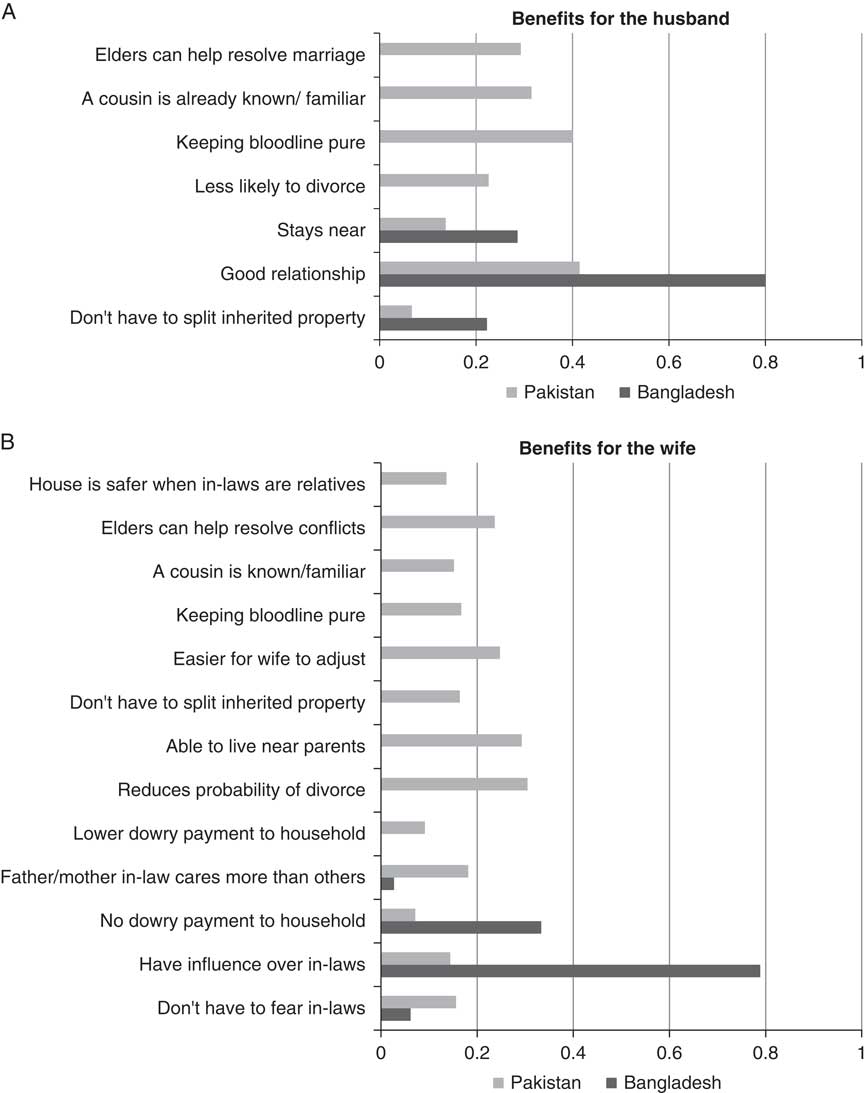
The study next turned to an analysis of the social and economic benefits of consanguinity, to identify the underlying motivation for marrying a biological relative. It has been hypothesized that a woman marrying her cousin is already familiar with her in-laws, and her family of origin may be better able to monitor her husband’s and husband’s family’s actions, supporting her in the case of abuse (Hussain, Reference Hussain1999; Jacoby & Mansuri, Reference Jacoby and Mansuri2010; Bittles, Reference Bittles2012). Qualitative evidence from the surveys indicated that husbands and wives believed that there were positive benefits for both men and women to marrying consanguineously, including a lower likelihood of divorce and a better relationship between spouses (see Fig. 1).
Men’s and women’s responses to the question ‘Does marrying consanguineously have any benefits for the husband/wife?’ Discrepancy between Bangladesh and Pakistan data is due to the fact that a broader array of options was presented in the Pakistan survey.

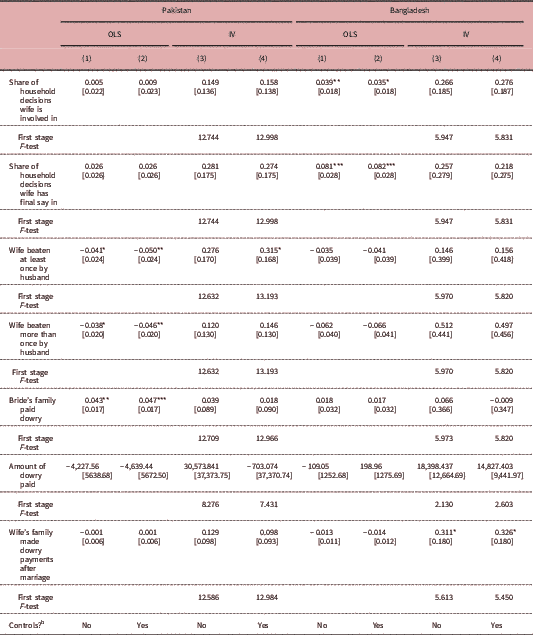
As with child health, the IV approach was again used to estimate the causal effect of consanguinity on marital quality. Abbreviated results on the variable of interest (consanguinity) are presented in Table 7. In both the Bangladesh and Pakistan samples, the results show that women were involved in a higher percentage of final decisions when they were in consanguineous relationships, though this was not statistically significant. However, the likelihood of domestic violence actually increased with consanguinity, once selection into consanguinity was corrected for in the IV model. It should be noted that consanguinity is a factor that is not yet incorporated regularly into analyses of marital quality (Sanawar et al., Reference Sanawar, Islam, Majumdar and Misu2018).
Effects of consanguinity on socioeconomic marriage outcomesFootnote a

a Table presents the coefficient and standard error on an independent variable equal to 1 if the child’s parents are first cousins.
a Controls include household income per capita, the natural log of household assets, the wife’s education, the husband’s education, the wife’s age at marriage and the husband’s age at marriage.
Robust standard errors in brackets.
***p<0.01; **p<0.05; *p<0.1.
Next, the analysis explored the socioeconomic benefits of consanguineous marriage. It has been argued that consanguinity and dowry payments at the time of marriage are two ways in which a bride’s family can commit to post-marital investment in their daughter in a patrilocal marriage market (Do et al., Reference Do, Iyer and Joshi2013). Similarly, Mobarak et al. (Reference Mobarak, Kuhn and Peters2013) found that households that had difficulty in meeting up-front dowry payments due to liquidity- or credit-constraints needed to promise to pay in the future, and such promises were more credible and enforceable within a consanguineous union. In effect, consanguinity substituted for a credit market failure in these theories.
To test these hypotheses, the last rows of Table 7 present results on dowry payments both before and after marriage. In Bangladesh, the families of women married consanguineously were 31–33 percentage points more likely to have made dowry payments to the husband’s family after marriage. While these results were only weakly significant, they were consistent with the existing theories (Do et al., Reference Do, Iyer and Joshi2013; Mobarak et al., Reference Mobarak, Kuhn and Peters2013). Furthermore, the effect was more prevalent in Bangladesh, the much poorer of the two study populations, where liquidity constraints were more likely to bind.
Discussion
This study did not find any robust statistically significant relationship between consanguineous marriage and negative health outcomes for children in this sample of couples in Bangladesh and Pakistan once the non-random selection into consanguinity was accounted for. The analysis, however, identified an impact of consanguinity on the timing of dowry payments. This finding supports the theory that marrying a daughter to a cousin allows the girl’s family to defer dowry payments, which is valuable in settings where households are liquidity- or credit-constrained and cannot easily provide a dowry at the time of marriage. The analysis found mixed evidence regarding the impact of consanguinity on marital quality; there was some evidence that domestic violence was increased in these unions.
Sheridan et al. (Reference Sheridan, Wright, Small, Corry, Oddie and Whibley2013), using data from the Born in Bradford study in the UK, found a 3.1 percentage point increase in fetal anomalies to first cousin marriages, primarily among families of Pakistani origin. The present study obtained an almost identical estimate (3.4 percentage point increase in genetic disease) in a similar specification, but statistical significance fell when errors were correctly clustered at the household level and the effect disappeared when the analysis controlled for non-random selection into first cousin marriage. The Born in Bradford study did not correct for either of these statistical issues. The Born in Bradford study was also unable to control fully for different rates of medical terminations that may have been correlated with observables including ethnicity, in particular since subjects were recruited at a gestational age after which prenatal testing typically occurs. The authors noted that administrative records on abortions did not point to this explanation, but they could not fully correct for this possibility.
For the most part, researchers are unable to study the outcomes of a single generation of cousin marriage by itself, since study populations are typically the product of multiple generations of consanguineous unions. In addition, endogamous marriage within clan groups (biraderi) can create genetically isolated populations, which also contribute to the build-up of recessive genes (Small et al., Reference Small, Bittles, Petherwick and Wright2017). The Born in Bradford study admitted this possibility as well. In this light, the generalization of the results of these studies to cousin marriage in general is problematic.
Even if one were to give credence to the doubling of fetal anomalies associated with consanguineous parents in the Born in Bradford and other studies, Sheridan et al. (Reference Sheridan, Wright, Small, Corry, Oddie and Whibley2013) found that being born to an older mother had a similar impact (estimated at around 1.8 times the chances of anomaly for maternal age 35+ among the White British as compared with the 20–34 age group). If public health officials are unwilling to discourage older mothers from conceiving, the same standard should apply to consanguineous parents. At the same time, consanguineous marriage may become a less common arrangement over time on its own, as declining fertility in the Middle East is expected to reduce the availability of cousins of marriageable age in coming generations (Bittles, Reference Bittles2012; Barakat & Basten, Reference Barakat and Basten2014).
Consequently, public health policy should focus more on increasing vaccinations, since the results show that vaccination status reduced under-5 mortality to a greater extent (and with greater statistical significance) than first-cousin marriage potentially increased it, according to the preferred IV specifications. Vaccinations reduced under-5 mortality by 6.5 to 15.5 percentage points (significant at 1 per cent level).
The data have two key weaknesses. First, the measurement of the incidence of genetic illness was based only on reports by parents, rather than medical diagnosis, and only diseases that appeared before the child was 5 years old were included. Thus, genetic disorders that were not readily identifiable, e.g. visible to the naked eye, or which presented later in life, are not captured. Indeed, Bishop et al. (Reference Bishop, Small, Mason, Corry, Wright and Parslow2017) noted that a substantial number of anomalies are diagnosed on or after the first birthday. Second, the study used an indicator for cousin marriage measured across just two generations, rather the cumulative coefficient of inbreeding (F), or genomic measurement of homozygosity, which can account for consanguinity in multiple successive generations (Bittles, Reference Bittles2012).
In conclusion, this study’s results suggest that the relationship between consanguineous marriage and offspring health is not as statistically precise as previously claimed in studies that failed to account for (a) non-random selection into consanguinity, and (b) correlations in health outcomes across offspring of the same union. Additionally, the results show that liquidity-constrained families who arranged a consanguineous marriage for their daughters may have benefitted by being able to postpone dowry payments. Socioeconomic conditions and constraints thus affect the decision to marry consanguineously, and research that fails to account for such sources of selection may report biased and falsely precise estimates of the links between consanguinity and health. The methodology adopted in the present research provides a tool with which to begin to disentangle issues of causality, and suggests that revised approaches and much larger samples are required to more precisely answer this question. The IV tool derived and the conceptual framework developed should also be valuable in addressing other questions in public health genetics.
Acknowledgments
The authors gratefully acknowledge the help of Dr Mehak Ejaz and Usman Sikander for their translation and pre-testing of the Urdu survey, and thank Dr Murat Iyigun for his assistance in the early stages of study design and implementation.
Ethics Approval
Informed consent was received from all subjects interviewed for the study, and the study was approved by the relevant institutional review boards.
Conflicts of Interest
The authors have no conflicts of interest to declare.
Funding
Funding for this study was provided by the National Science Foundation Human and Social Dynamics (Grant No. SES-0527751) and the Lahore School of Economics.