Introduction
Traumatic brain injury (TBI) is the leading cause of injury-related death and disability world-wide, affecting 69 million people.Reference Lozano, Naghavi and Foreman1 Despite its frequent occurrence, TBIs often go under-recognized.Reference Dewan, Rattani and Gupta2 Patients with TBI can have improved outcomes with prompt evaluation and early emergency management in the prehospital setting.Reference Chowdhury, Kowalski, Arabi and Dash3 Management is challenging for these patients and requires resources often difficult to obtain in low- and middle-income countries (LMICs), like in Africa, leading to worse outcomes.4
In Sub-Saharan Africa, there is a paucity of accurate data on the contribution of head injury to trauma-related mortality, especially in the prehospital setting. In Nigeria, 31% of all trauma deaths were attributable to severe head injury.Reference Nnadi, Bankole and Fente5 Road traffic crashes were the leading cause of TBI in Tanzania (59%).Reference Boniface, Lugazia, Ntungi and Kiloloma6
In Kigali, the capital city of Rwanda, TBIs are responsible for approximately 16% of injuries presenting to the University Teaching Hospital of Kigali (CHUK), with severe TBI patients having a mortality rate as high as 58%.Reference Krebs, Gerardo and Park7,Reference Kim, Byiringiro and Ntakiyiruta8 This made head injury the most common diagnosis in injury-related deaths in 2012.Reference Kim, Byiringiro and Ntakiyiruta8 The most common etiology of TBIs was found to be road traffic incidents (RTIs), which commonly involved motorcyclists and pedestrians.Reference Krebs, Gerardo and Park7 In Kigali, Rwanda, TBIs represent a large burden of disease, yet little is known about management or care in the prehospital setting.Reference Krebs, Gerardo and Park7
Many of the injured patients treated by Service d’Aide Medicale Urgente (SAMU), Rwanda’s public prehospital Emergency Medical Service, have a TBI. This suggests the need for understanding the incidence, causes, risk factors, and clinical management for TBI in the prehospital setting in Kigali, Rwanda. The aim is to describe the patients with TBI seen and treated by SAMU in the prehospital setting in Kigali, Rwanda.
Methods
Study Context and Setting
Rwanda has a population of 13 million people, but only six neurosurgeons and a single neurosurgery training program. This represents a massive shortage. The Study on Surgical Services for the United States (SOSSUS) recommends one neurosurgeon for every 100,000 people, or at least 120 neurosurgeons in Rwanda.Reference Zuidema9-Reference Ubelacker11 As a branch of the Ministry of Health, SAMU is a public service that provides prehospital management of TBI in Rwanda. The capabilities have been previously described.Reference Scott, Nyinawankusi and Enumah12 Patients use the service through a public 912 toll-free number, which accesses the country’s central ambulance dispatch center in Kigali. There is no formal paramedic training program in Rwanda, but a portion of SAMU nurses and non-physician anesthetists receive short courses in emergency trauma, medical, pediatric, obstetric, and neonatal care, as well as Advanced Cardiac Life Support (ACLS) and Basic Life Support (BLS) certification. Ambulances from SAMU normally dispatch a BLS-trained driver, a nurse, and a non-physician anesthetist to the scene to provide emergency services. There are several private, regional, and district hospitals in Kigali, as well as smaller health centers. The major private hospital is King Faisal Hospital, the teaching hospital is CHUK, and Kibagabaga is the largest district hospital in Kigali.
Data Collection and Patient Sample
This is a retrospective analysis of a pre-existing database of patient encounters by SAMU. The SAMU run sheets contain information demographics as well as injury or disease-related variables such as Glasgow Coma Score (GCS), affected body region, mechanism, type and time of injury, vitals, and information regarding treatment administered by SAMU staff in route to a health care facility.
All data from clinical run sheets are entered retrospectively into an electronic database using Research Electronic Data Capture (REDCap; Vanderbilt University; Nashville, Tennessee USA) software.Reference Harris, Taylor and Thielke13 The database was created in 2013 through a partnership with Virginia Commonwealth University (Richmond, Virginia USA) and Harvard University (Cambridge, Massachusetts USA) previously described in detail.Reference Scott, Nyinawankusi and Enumah12,Reference Enumah, Scott and Maine14 Those entering the information into the electronic database have been trained to do so and include members of the prehospital care team, residents, and medical students. In order to prevent missing or incorrect data, daily meetings with the prehospital care team are held to discuss cases from the previous day prior to entry into the database. An audit is performed routinely, comparing paper run sheets to the electronic database. Due to resource limitations, however, every run sheet has not been audited. For this study, a retrospective data analysis of all patients was performed with a primary indication of TBI due to any cause captured in the database from December 2012 through May 2016. This represents the most recent data available.
Variables
Traumatic brain injury was defined as a history of trauma to head with or without altered consciousness. The GCS was calculated in the standard fashion with 13-15, 9-12, and 3-8 representing mild, moderate, and severe GCS, respectively.Reference Teasdale and Jennett15 The Kampala Trauma Score (KTS) injury severity was calculated using respiratory rate, systolic blood pressure, age, neurologic status, and number of severe injuries. The KTS scores of 9-10, 7-8, and ≤6 were classified as mild, moderate, and severe in line with the modified KTS scoring system.Reference Weeks, Stevens and Haider16 Only patients with values recorded for each variable were included in the KTS scoring. Urgency status of each patient was determined by SAMU responders using a triage system which classifies injuries as “Absolute,” “Relative,” or “No Urgency” based on mechanism, clinical presentation, and vital signs. Shock Index (SI) is an additional injury severity characteristic and calculated as heart rate divided by systolic blood pressure.Reference Terceros-Almanza, García-Fuentes and Bermejo-Aznárez17 Hypoxia was defined as oxygen saturation less than 90%. Tachypnea was defined as a respiratory rate greater than 20 breaths per minute. Hypotension was defined as systolic blood pressure less than 90mmHg. Tachycardia was defined as heart rate greater than 100 beats per minute.
Primary transportation was defined as movement of patients by SAMU to the patient’s initial health facility, while secondary transportation referred to transfer of patients between health facilities. Transport destinations included referral hospitals (highest level of care), district hospitals (mid-level care), and health centers (primary care).
Data Analysis
Descriptive analysis was used to describe demographic characteristics, injury mechanisms, and management strategies regarding TBI patients. The data were analyzed using SPSS version 25 (IBM Corp.; Armonk, New York USA). Patients were included in the analysis only if they had recorded values for a given variable. All percentages refer to the percentage of all TBI patients with a given variable, unless otherwise stated.
Ethical Consideration
Institutional Review Board approval was obtained through the Ministry of Health of Rwanda, CHUK, and Virginia Commonwealth University. This project falls under a formal Memorandum of Understanding between the Ministry of Health of Rwanda and Virginia Commonwealth University to facilitate trauma and emergency systems capacity development in Rwanda.
Results
Demographics
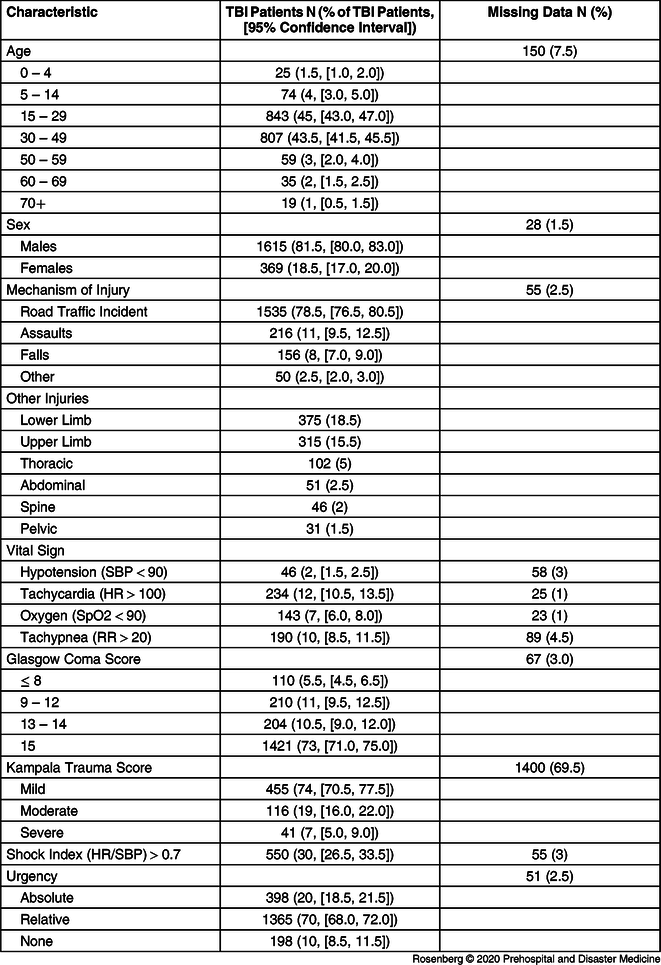
From December 2012 through May 2016, SAMU responded to a total of 11,161 patients. There were 2,012 patients with a TBI, which represented 18.0% of all SAMU patients. The average age of a patient treated by SAMU for head injury was 30.5 (SD = 11.5) and 81.5% (n = 1,615) were male (Table 1).
Patient Demographic and Injury-Related Information

Injury Characteristics
The most common causes were RTIs (n = 1,535, 78.5%), followed by assaults (n = 216, 10.7%), and falls (n = 156, 7.8%). The incidence of TBIs amongst RTIs was 330 per 1,000 collisions. Most frequently, TBIs resulted from RTIs involving motorcycles (n = 854, 42.4%) followed by four-wheeled vehicles (n = 719, 35.7%).
A number of vital signs were recorded upon SAMU arrival at each call (Table 1). The most common vital sign abnormality was tachycardia (n = 234, 11.6%), followed by tachypnea (n = 190, 9.4%). The severity of injury was assessed using KTS, SI, and GCS. There were 41 (6.7%) patients with a severe KTS and 550 (30.0%) with a SI greater than 0.7. Additionally, 110 (5.5%) patients had a GCS ≤8 (Table 1).
Responders from SAMU determined the urgency status of each patient based on vital signs, injury severity, and overall clinical picture. Urgency status was classified as “Absolute,” “Relative,” or “No Urgency” (Table 1). Patients with TBI had 3.8-times (3.2, 4.5) the odds of being assigned an urgency level of “Absolute” compared to all other trauma SAMU patients (P <.001).
Patients with TBI often presented with additional injuries. The most common were lower extremity (n = 375, 18.5%), upper extremity (n = 315, 15.5%), and chest (n = 102, 5.1%) injuries.
Treatment and Transportation
Ninety-six percent of SAMU head trauma patients were transported to a hospital and four percent were treated on-site without the need for transfer to a health care facility. One percent of patients (n = 20) died before SAMU arrival or in route to a hospital. In 67.0% of all mortalities seen by SAMU, TBIs were involved. However, SAMU is not contacted if a bystander finds someone already dead. Most patients underwent primary transportation (n = 1829, 90.9%). Most patients (56.0%) were taken to CHUK, followed by Kibagabaga District Hospital (22.0%) and King Faisal Hospital (3.0%). Ambulances traveled an average of 17km (SD = 14) to a hospital.
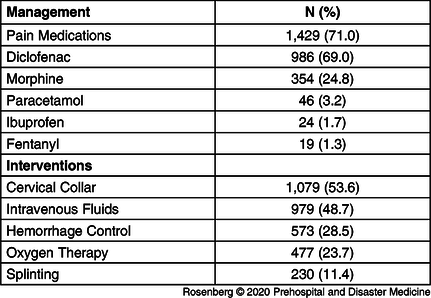
The most common interventions provided by SAMU were immobilization with cervical collars (n = 1,079, 53.6%), administration of fluids (n = 979, 48.7%), and hemorrhage control (n = 573, 28.5%). The majority (n = 1,429, 71.0%) of patients received medications for pain relief, with the most common medications being Diclofenac (n = 986, 69.0%), Morphine (n = 354, 24.8%), and Paracetamol (n = 46, 3.2%; Table 2).
Management and Interventions

Discussion
This is the first descriptive analysis of TBIs in the prehospital setting in Rwanda, and one of the first studies on prehospital management in Africa.Reference Stassen and Welzel18,Reference Sobuwa, Hartzenberg, Geduld and Uys19 In total, TBI accounted for 18% of prehospital trauma care in Kigali. The most common etiology of TBIs were RTIs. Although the majority of TBIs were mild or moderate, patients with TBIs were more urgent than patients that sustained other injuries.
In Kigali, TBIs were most commonly caused by RTIs, which is similar to prior studies from neighboring countries.Reference Boniface, Lugazia, Ntungi and Kiloloma6,Reference Qureshi, Ohm and Rajala20 Other Sub-Saharan African countries, however, have reported lower rates of head injuries associated with RTIs.Reference Nnadi, Bankole and Fente5 A possible cause for the high incidence reported in the study is the rapid urbanization of Kigali, which is bringing more vehicles onto the road.21 This has led Rwanda to be one of the most densely populated countries in the world.22 Vulnerable road users such as pedestrians and bicyclists bear a disproportionate share of the injury burden.23 Thirty-five percent of RTIs in Kigali involved a pedestrian. Increasing road safety initiatives for pedestrians and drivers may prevent an increase in TBIs with more cars coming on the roads. The Rwandan government has been working on revising the country’s laws on road conduct. Regulations introduced include the mandatory use of seat belts, enforcement of speed limits, and control on blood-alcohol concentrations.Reference Brown24 Additionally, non-governmental organizations have created educational initiatives to teach road safety to both drivers through organized training courses and students through school-based workshops.25 Early data from the Rwanda Ministry of Transportation show that new laws and programs have helped reduce the number of deaths from RTIs by 30%.Reference Brown24 Follow-up studies based on the SAMU database will further detail the impact of these initiatives.
In Rwanda, a significant portion of TBIs were mild (84%). This could be due to the government mandating the use of helmets for drivers and passengers riding motorcycles. This is strictly enforced, and compliance is now close to 100%. This is markedly different from other African countries where helmet use is substantially lower, ranging from 24% to 34%.Reference Oginni, Ugboko and Adewole26,Reference Ackaah and Afukaar27 The discrepancy might explain the reduced severity of TBI seen in the patient population. Despite widespread helmet use, 61% of TBI cases managed by SAMU involved a motorcycle. One area of research that is being pursued by some of the authors is to investigate the quality of helmets and optimizing design to account for force sustained during collisions.
The most common interventions performed by SAMU in the field were the placement of cervical collars, administration of fluids, and provision of pain-relieving medications. The use of cervical collars has been classified as a prioritized procedure and advocated for by multiple standard prehospital guidelines in the treatment of TBIs.28,29 Despite these recommendations, cervical collars were placed in only 54% of cases. This may be due to resource limitations and issues with supply chains. Previous quality improvement initiatives have found that there have been problems with stocking adequate supplies amongst SAMU ambulances, which may have deterred some providers from placing cervical collars on patients with mild GCS. New supply chains have been established based on these reports. Furthermore, providers have undergone additional training regarding the importance of cervical collars and when to use them in field management.
The management of unsafe airways has also been affected by resource limitations in Rwanda as only 67 patients were intubated in the field. There are 12 ventilators in SAMU’s ambulance fleet, as well as suction machines and endotracheal tubes. All SAMU team members are trained in intubation. Though more patients likely needed intubation based on their GCS score, the lack of ventilators within hospitals in Rwanda may have prevented providers from intubating patients in the field. Prehospital providers often wait until reaching the hospital for intubation to be certain a ventilator is available. The major hospitals in Rwanda, however, seldom have enough ventilators to care for all the patients in need, which prevents SAMU from intubating patients in the prehospital setting. This information has been discussed with the Ministry of Health of Rwanda, and plans have been made to acquire much needed supplies and workforce to improve care of patients with unsafe airways.
Limitations
This study has various inherent limitations. The REDCap database and run sheets may have data entry and collection errors. The database undergoes periodic audits of randomly selected run sheets in which paper forms are compared to database entries by reviewers. All patient encounters, however, are not audited. Prehospital staff may not collect all the data due to patient care and time constraints. Furthermore, while SAMU manages thousands of patients in Kigali annually, many patients routinely access health care through private transport. This population is not included in the study. This may lead to selection bias and potentially an over-estimation of acuity in this study. Lastly, SAMU largely services Kigali City, and therefore this study cannot speculate on the need for and management of TBI in the remainder of the country where 80% of the population lives.
Conclusion
Traumatic brain injury is common in the prehospital setting in Rwanda based on the records of care provided by SAMU. These injuries are most commonly caused by RTIs with patients requiring urgent treatment. Rwanda has implemented several initiatives to reduce the incidence of TBI with a specific emphasis on road safety, but further efforts are needed. Furthermore, the most common interventions performed by SAMU in the field include the placement of cervical collars, administration of fluids, and provision of pain-relieving medications. All LMICs seeking to develop prehospital care capacity should consider training prehospital health care providers to perform these management strategies.
Conflicts of interest/funding
None of the authors have any conflicts of interest. This work was supported by the National Institutes of Health (NIH; Bethesda, Maryland USA) R21:1R21TW010439-02, NIH P20: 1P20CA210284-01A, and Rotary Foundation (Evanston, Illinois USA) Global Grant #GG1749568.