

Introduction
Occasional smokers, or those who use tobacco less than daily, are a growing proportion of the population of smokers; yet, little is known about the process of smoking cessation among these smokers. In the United States, up to one third of smokers now smoke less than daily (Shiffman, Reference Shiffman, Ferguson, Dunbar and Scholl2012; Tindle & Shiffman, Reference Tindle and Shiffman2011). Evidence suggests that long term occasional or light smoking still has negative health effects (Schane et al., Reference Schane, Glantz and Ling2009), suggesting that occasional smoking is an important target for tobacco control (Hughes & Carpenter, Reference Hughes and Carpenter2006).
A number of studies have examined quitting behaviour among occasional smokers. While nondaily smokers are more likely than daily smokers to quit smoking (Hyland et al., Reference Hyland, Borland, Li, Yong, McNeill and Fong2006), most nondaily smokers, both those who converted from daily smokers and those who were continuously occasional smokers, are ultimately unsuccessful in their quit attempts (Tindle & Shiffman, Reference Tindle and Shiffman2011).
Further, little is understood about the role of dependence in quitting among occasional smokers. Studies have found that consumption, the number of cigarettes smoked, is important in understanding addiction. Falba, Jofre-Bonet, Busch, Duchovny, & Sindelar (Reference Falba, Jofre-Bonet, Busch, Duchovny and Sindelar2004) and Okuyemi, Thomas, Warren, Guo, & Ahluwalia (Reference Okuyemi, Thomas, Warren, Guo and Ahluwalia2010) found that daily smokers who reduced consumption first were more likely to stay abstinent. Yet, Shiffman, Ferguson, Dunbar, and Scholl (Reference Shiffman, Ferguson, Dunbar and Scholl2012) point out that models of dependence requiring frequent nicotine administration are insufficient to explain ongoing occasional smoking. Furthermore, Hughes et al. (Reference Hughes, Oliveto, Riggs, Kenny, Liguori and Pillitteri2004) found that measures of nicotine dependence based on cigarette per day criteria, DSM criteria, and PA were only modestly correlated with each other and suggested that the criteria tap different dimensions of nicotine dependence.
For occasional smokers, who smoke less than daily, consumption-based measures of nicotine dependence may not capture all aspects or components of addiction or dependence. Although some have found meaningful variation in nicotine dependence among occasional smokers (Shiffman et al. Reference Shiffman, Ferguson, Dunbar and Scholl2012; Sledjeski et al. Reference Sledjeski, Dierker, Costello, Shiffman, Donny and Flay2007), occasional smokers have also been shown to have difficulty quitting that is not reflected in their patterns of consumption (Herd & Borland, Reference Herd and Borland2009). Most common measures, such as the Heaviness of Smoking Index (Chaiton et al., Reference Chaiton, Cohen, McDonald and Bondy2007; Heatherton, Kozlowski, Frecker, Rickert, & Robinson, Reference Heatherton, Kozlowski, Frecker, Rickert and Robinson1989) and the Fagerström Test for Nicotine Dependence, (Heatherton, Kozlowski, Frecker, & Fagerström, Reference Heatherton, Kozlowski, Frecker and Fagerström1991) rely on cigarettes per day or time to first cigarette to determine addiction. These measures are meant to proxy objective, quantitative indicators of addiction; yet, they have physiological and environmental limitations. For instance, pharmacokinetic and genetic studies suggest that the same number of cigarettes smoked per day can result in different blood levels of cotinine (Ho & Tyndale, Reference Ho and Tyndale2007). Different smoking topography (i.e., how the smoker smokes) and variations in cigarette design, such as level of ventilation, can affect nicotine yield so that the impact of smoking one cigarette may vary from person to person (West, Hajek, & McRobbie, Reference West, Hajek and McRobbie2011).
Because of a nondaily pattern of use, occasional smokers score low by definition on consumption measures and these measures may be incommensurable between daily and nondaily users. Measuring consumptions require different sets of questions to ascertain for daily and nondaily smokers. For instance, number of cigarettes per day can be measured a single item for daily smokers but may require two or more items to calculate for occasional smokers. Moreover, it is not self-evident that number of cigarettes per day reflects the same construct for both groups.
Measures of dependence, however, include multiple dimensions beyond consumption (Baker et al., Reference Baker, Breslau, Covey and Shiffman2012). One dimension of particular interest is that of PA. Eiser, Sutton, & Wober (Reference Eiser, Sutton and Wober1977; Reference Eiser, Sutton and Wober1978), Eiser (Reference Eiser and Eiser1982), and Eiser, van der Pligt, Raw, & Sutton (Reference Eiser, van der Pligt, Raw and Sutton1985) showed that many smokers described themselves as addicts and used this label to explain their difficulty in quitting smoking or resistance to trying to quit. While there are a number of other one-item measures such as self-efficacy, confidence in quitting, and belief that quitting is difficult, understanding how PA is associated with quitting among occasional smoking may be able to inform our understanding of addiction among occasional smokers in relation to daily smokers.
Shiffman et al. (Reference Shiffman, Ferguson, Dunbar and Scholl2012) suggest that more research is needed to understand occasional smokers’ progression to cessation. Further, most previous research on occasional smoking and cessation is limited by cross-sectional designs or non-representative populations. In this study, we use a longitudinal population representative cohort study to investigate whether self-perception of addiction predicts quit attempts and cessation for occasional smokers, on its own and after adjusting for other measures.
Methods
Data used for this analysis came from participants in the OTS longitudinal sample of current smokers with at least one follow-up (Bondy, Victor, & Diemert, Reference Bondy, Victor and Diemert2009). Study recruitment was based on an inclusive definition of smoking behaviour, which produced a large sub-population of occasional smokers. The OTS longitudinal panel consists of six population-representative telephone survey samples of Ontario adults (18 years of age and over) totalling 4,501 recent smokers contacted initially from July 2005 to June 2008. Panel study participants who had smoked within the past six months at baseline were subsequently interviewed every six months for up to three years. Daily smokers were those who smoked daily or almost every day in the past month while occasional smokers were those who smoked at least once in the past month but not daily or almost day. Included in this sample were 3,823 daily smokers and 678 smokers who reported being current occasional smokers at any time point and who had at least one follow-up; of these, 308 occasional smokers and 2,433 daily smokers reported a quit attempt. Survey data for the OTS were collected by the Survey Research Centre (SRC) at the University of Waterloo using computer-assisted telephone interview (CATI) technology.
Ethical approval for the OTS initiative was received from the Human Subjects Research Ethics Committees of the Universities of Waterloo and Toronto. Methodological reports on the OTS are publicly available (Diemert et al., Reference Diemert, Victor and Chaiton2010).
Measures
PA was assessed through self-report. Smokers were asked, “How addicted are you?” Response categories were very addicted, somewhat addicted, or not very addicted.
A serious quit attempt was defined using the response to “In the past 6 months, did you try to quit smoking completely?” as a measure for self-reported serious quit attempt. Time to relapse was defined as the reported longest duration of quit attempt in days. Only those who reported quit attempts were included in the long-term cessation analysis. Smokers who had relapsed at the first follow-up subsequent to their quit were asked for the longest duration of abstinence. To be categorised as having continued quitting at subsequent follow-ups, participants must have reported not smoking even a single cigarette since the last follow-up, and were asked how long it had been since the last cigarette.
Analysis
Demographic characteristics of all smokers by PA were assessed at baseline. Point estimates in all analyses were weighted to reflect the population sampling probabilities and target population of Ontario smokers. Variance estimates and bivariate tests of significance reflected the complex survey design using the Taylor-series linearised method using Stata version 12 (Statacorp).
The ability of PA to predict making a quit attempt was assessed using Generalised Estimating Equation regression models, weighted for the survey design. A log Poisson link was used in order to estimate relative risks. Four models were fitted for each outcome. First, the association was assessed adjusting for demographic characteristics (age, sex, region, education, health status, children living in the home, and marital status). Subsequent models included whether the participant had ever been a daily smoker. Then, other potential indicators of smoking behaviour were added to the model individual to assess the independence of the effect of PA (intention to quit, number of previous quit attempts, perceived hard to quit, cigarettes per day, and number of days smoked per month). Demographic characteristics were measured at baseline; smoking characteristics were assessed at the survey prior to the quit attempt. An interval censored survival model assuming a Weibull distribution consistent with rate of relapse decreasing over time was used to assess the association between PA and time to relapse. The same models used to assess quit attempts were used to assess the independence of the association between PA and relapse with the other potential predictors of addiction.
Results
The estimated population prevalence of PA varied by smoking status. A majority (59%) of smokers reported being very addicted to smoking at the baseline assessment; however, level of PA varied by daily or occasional smoking status: 51.4% of occasional smokers reported being not very addicted to cigarettes compared to 3.9% of daily smokers. Conversely, 7.7% of occasional smokers reported being very addicted compared to 66.5% of daily smokers. The correlation between PA and number of cigarettes smoked was 0.31 among daily smokers and 0.21 among occasional smokers.
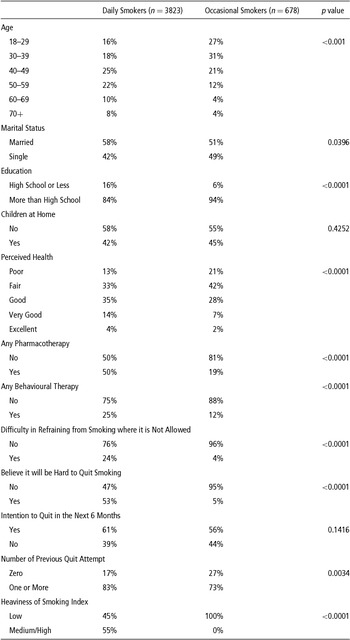
High PA was associated with older age, lower levels of education, poor perceived health, intention to quit, previous use of pharmacotherapy, behavioural therapy and previous quit attempts (Table 1). PA was associated with belief that it was hard to refrain from smoking and that it would be hard to quit.
Demographic characteristics of occasional and daily smokers in the Ontario tobacco survey (n = 678)

Among daily smokers, 12% of those reporting they were not very addicted attempted to quit, compared to 19% of those somewhat addicted and 20% of very addicted. Among occasional smokers, 13% of those not very addicted attempted to quit, compared to 29% of those somewhat addicted and 45% of those very addicted. The mean length of a quit attempt among daily smokers was 50 days for those not very addicted compared to 13 days for those somewhat addicted and only 8 days for those very addicted. For occasional smokers, among those not very addicted the mean quit attempt length was 84 days compared to 46 days for those somewhat addicted, and 32 days for those very addicted.
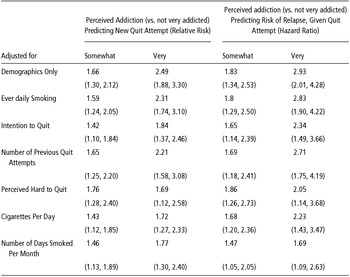
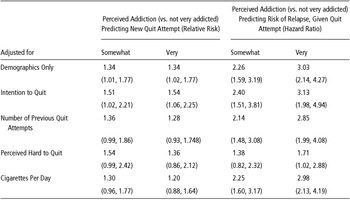
Occasional smokers, who were very addicted were more likely to make a quit attempt (RR: 2.49; 95%CI 1.88, 3.30), and the effect was independent of cigarettes smoked per day, number of days smoked per month, perceived difficulty quitting, intention to quit, number of previous quit attempts, and previous ever daily smoking (Table 2). PA also predicted quit attempts among daily smokers, but this relationship was not independent of previous quit attempts, perceived difficulty quitting or number of cigarettes smoked per day (Table 3).
Perceived addiction as a predictor (relative risk) of making a subsequent quit attempt among 678 occasional smokers (less than daily smoking in the past 30 days) and risk of relapse (hazard ratio) among those making a quit attempt (n = 308) in the Ontario tobacco survey

Estimates are hazard ratios (risk of relapse after a quit attempt) and relative risks (risk of making a quit attempt at subsequent wave). All analyses are adjusted for demographics (age, sex, region, education, children, marital status, and health status) plus additional variables as stated.
Perceived addiction as a predictor (relative risk) of making a subsequent quit attempt among 3823 daily smokers (in the past 30 days) and risk of relapse (hazard ratio) among those making a quit attempt (n = 2433) in the Ontario tobacco survey

Estimates are hazard ratios (risk of relapse after a quit attempt) and relative risks (risk of making a quit attempt at subsequent wave). All analyses are adjusted for demographics (age, sex, region, education, children, marital status, and health status) plus additional variables as stated.
Both daily and occasional smokers, who perceived themselves to be very addicted prior to a quit attempt had an increased risk of relapse (Table 2 and Table 3). PA was an independent predictor of relapse; however, among daily smokers the magnitude of the effect decreased when perceived difficulty in quitting was added to the model.
Discussion
Asking smokers about PA provides independent information to predict their likely success in quitting, particularly for occasional smokers. Despite the ability to withdraw from nicotine for at least temporary periods, there is substantial variation of risk of relapse in occasional smokers. PA can identify those who are least likely to have success. PA was strongly correlated with other single item measures of self-reported addiction, such as ability to refrain from smoking and perception of the difficulty in quitting, and was also directly proportional to cigarettes smoked per day, a consumption-based measure of dependence. Nevertheless, results demonstrated that PA continued to be a significant independent predictor of cessation after controlling for these other single item measures.
PA was a predictor of quit attempts and quit success among daily smokers as well as among nondaily smokers. This is consistent with earlier research that found that PA was associated with the likelihood of quitting smoking (Eiser et al., Reference Eiser, van der Pligt, Raw and Sutton1985). This suggests that PA, unlike cigarettes per day or time to first cigarette, can identify smokers with greater difficultly in quitting among both daily and occasional smoking using a measure that can be ascertained equivalently in both groups.
However, PA demonstrates less ability to identify discrete categories among daily smokers in likelihood of making a quit attempt and succeeding. There were no differences in quit attempt likelihood between those daily smokers who considered themselves moderate or very addicted, and no independent effect on quit attempts after controlling for other single item measures of addiction. For daily smokers, unlike nondaily smokers, controlling for perceived difficulty in quitting did reduce the magnitude of the predictive ability of PA on relapse.
In general, there were relatively higher levels of PA among occasional smokers compared to daily smokers than what might be expected according to their level of cigarette consumption. Among this representative sample, it was rare for occasional smokers to have never been daily smokers. Notably, there were few people who had both never smoked daily and described themselves as very addicted. Never daily smokers may also include young adults who have not yet progressed to daily smoking as well as those who will never progress.
The results suggest a role in experience in developing levels of PA. Smokers may start, in some cases, with an elevated perception of addiction, perhaps reflecting popular attitudes and beliefs, as youth begin reporting being addicted to cigarettes very soon after initiation (Okoli et al., Reference Okoli, Richardson, Ratner and Johnson2008; O'Loughlin et al., Reference O'Loughlin, DiFranza, Tyndale, Meshefedjian, McMillan-Davey, Clarke and Paradis2003). The perception of addiction may then be confirmed with the onset of cravings and failed attempts to quit (Borland, Partos, & Cummings, Reference Borland, Partos and Cummings2012; Herd, Borland & Hyland, Reference Herd, Borland and Hyland2009; O'Loughlin, Reference O'Loughlin, Karp, Koulis, Paradis and Difranza2009). This contrasts with many other substances of abuse, where treatment assumes that the addict is not aware of, or is in denial of, their addiction (Goldstein et al., Reference Goldstein, Craig, Bechara, Garavan, Childress and Paulus2009; Howard et al., Reference Howard, McMillen, Nower, Elze, Edmond and Bricout2002; Vos, Reference Vos1989). Engaging in a quit attempt and experiencing the ensuing outcome is therefore likely to alter the perception of the magnitude of the problem because it alters the sense of agency and autonomy. Occasional smokers with high PA were more likely to have made failed quit attempts, and used supports in quitting, reflecting an experience of difficulty quitting. Interestingly, occasional smokers with very high PA and were more likely to intend to quit smoking and to go on to make a quit attempt, suggesting that they are also more concerned about their smoking. While Schauer, Malarcher, & Berg (Reference Schauer, Malarcher and Berg2014) had also found that recent daily smokers were more likely to make quit attempts than never daily smokers or consistent occasional smokers, no significant statistical interaction was found between PA and never being a daily smoker in this report.
This study did not use multi-dimensional measures that have been developed to assess the relationship of dependence to smoking cessation among occasional smokers (such as the Nicotine Dependence Syndrome Scale (Shiffman, Waters & Hickcox, Reference Shiffman, Waters and Hickcox2004), the Cigarette Dependence Scale (Etter, Reference Etter2008), and the Wisconsin Inventory of Smoking Dependence Motives (Piper et al., Reference Piper, Federman, Piasecki, Bolt, Smith and Fiore2004)). Nevertheless, for daily smokers, multi-item measures do not consistently perform better as a predictor than consumption measures alone (Baker et al., Reference Baker, Breslau, Covey and Shiffman2012). For occasional smokers for whom neither cigarettes per day nor time to first cigarette are relevant variables, PA functions are a similarly good predictor of cessation. As a simple single item measure, PA has strong face validity and may allow the respondent to place appropriate weights on internal and external dimensions of addiction to accurately self-characterise the barriers to sustained complete abstinence.
Other limitations include that the measurement of unsuccessful quit attempts relied on self-report and short unsuccessful quit attempts may not be recalled successfully (Borland, Partos, & Cummings, Reference Borland, Partos and Cummings2012) and it is possible that quit attempts would be more recalled by those who believe that they are more addicted. No biochemical verification of abstinence was used; however, there is no reason to believe that misclassification of quit outcomes differs by PA. Nevertheless, as this study uses a large population representative cohort, with frequent and multiple follow-ups, specifically designed to study smoking dynamics at the population level, it possesses many advantages over other population-level or clinical studies.
In conclusion, PA is a strong predictor of quitting behaviour among both occasional and daily smokers independent of number of cigarettes smoked. For those smokers with high PA, further investigation into appropriate cessation assistance is warranted. Treatment that targets the cognitive labelling may be effective in overcoming the barriers to long-term abstinence. PA deserves increased consideration as an indicator of dependence in general and clinical populations of smokers.
Funding
The OTS is an initiative of the Ontario Tobacco Research Unit which receives funding from the Ontario Ministry of Health and Long-Term Care (all authors). Canadian Cancer Society (MC award #702160).
Conflict of interest
All authors have no conflicts of interest to declare.
Ethics
The OTS received Research Ethics Board approvals from the University of Toronto and University of Waterloo. The authors assert that all procedures contributing to this work comply with the ethical standards of the relevant national and institutional committees on human experimentation and with the Helsinki Declaration of 1975, as revised in 2008.