Introduction
Military personnel must frequently make time-sensitive decisions while experiencing situations that are simultaneously precarious and ambiguous. They are also increasingly tasked with using new technologies that depend on intact cognitive functioning, including attention, vigilance, memory, error recognition, and motor control (Lieberman, Bathalon, Falco, Kramer, et al., Reference Lieberman, Bathalon, Falco, Kramer, Morgan and Niro2005). Over the past decade, scientific research on impact of acute stress on cognitive function in Special Operations military forces has provided robust evidence that exposure to acute stress may result in significant alterations in perceptual, learning, and executive abilities (Lieberman, Bathalon, Falco, Morgan, et al., Reference Lieberman, Bathalon, Falco, Morgan, Niro and Tharion2005; Morgan, Doran, Steffian, Hazlett, & Southwick, Reference Morgan, Doran, Steffian, Hazlett and Southwick2006; Paulus et al., Reference Paulus, Potterat, Taylor, Van Orden, Bauman, Momen and Swain2009). Identification of factors that contribute to, or protect from, stress-induced cognitive deficits may lead to the development of countermeasures that may help reduce battlefield errors and reduce morbidity and mortality in military personnel.
Burnout, which is characterized by symptoms of physical and emotional exhaustion, cynicism, and a reduced sense of professional efficacy (Maslach, Jackson, & Leiter, Reference Maslach, Jackson and Leiter1996; Maslach, Schaufeli, & Leiter, Reference Maslach, Schaufeli and Leiter2001), may deleteriously affect psychological and physiological function (De Vente, Olff, Van Amsterdam, Kamphuis, & Emmelkamp, Reference De Vente, Olff, Van Amsterdam, Kamphuis and Emmelkamp2003), and operational performance (Morgan, Cho, Hazlett, Coric, & Morgan, Reference Morgan, Cho, Hazlett, Coric and Morgan2002). Symptoms of burnout arise from excessive and prolonged work-related stress (e.g., overloaded work schedule, lack of control, conflict of values) and lead to blunted emotions, reduced motivation, and disengagement (Maslach et al., Reference Maslach, Jackson and Leiter1996; Maslach et al., 2001). In a previous investigation of burnout and hypothalamic-adrenal-pituitary (HPA) axis functioning in active duty military personnel (Morgan et al., Reference Morgan, Cho, Hazlett, Coric and Morgan2002), we found that greater burnout symptoms were associated with lower waking cortisol, reduced diurnal variation in cortisol, and alterations in sympathetic tone.
Burnout may deleteriously affect prefrontal cortical functions such as working memory and executive functions, as high levels of stress-related catecholaminergic turnover (e.g., dopamine and norepinephrine) in the prefrontal cortex may induce reductions in the ability to concentrate, organize, and plan (Robbins & Arnsten, Reference Robbins and Arnsten2009), which may in turn negatively affect real-world military performance that depends on intact executive functions (e.g., navigational ability, decision-making, attentional set-shifting; Lieberman, Bathalon, Falco, Kramer, et al., Reference Lieberman, Bathalon, Falco, Kramer, Morgan and Niro2005; Lieberman, Bathalon, Falco, Morgan, et al., Reference Lieberman, Bathalon, Falco, Morgan, Niro and Tharion2005; Morgan, Rasmusson, Pietrzak, Coric, & Southwick, Reference Morgan, Rasmusson, Pietrzak, Coric and Southwick2009; Paulus et al., Reference Paulus, Potterat, Taylor, Van Orden, Bauman, Momen and Swain2009).
Despite research linking burnout with HPA axis dysfunction (Morgan et al., Reference Morgan, Cho, Hazlett, Coric and Morgan2002), alterations in sympathetic tone (De Vente et al., Reference De Vente, Olff, Van Amsterdam, Kamphuis and Emmelkamp2003) and decrements in cognitive performance (Lieberman, Bathalon, Falco, Kramer, et al., Reference Lieberman, Bathalon, Falco, Kramer, Morgan and Niro2005; Lieberman, Bathalon, Falco, Morgan, et al., Reference Lieberman, Bathalon, Falco, Morgan, Niro and Tharion2005), there is a notable absence of studies that examined the association between burnout and cognitive function in military personnel. Given that repeated exposure to significant stress is inherent to many of the professions in which burnout is typically observed (e.g., military and law enforcement personnel), and the link between cognitive dysfunction and battlefield error (Lieberman, Bathalon, Falco, Kramer, et al., Reference Lieberman, Bathalon, Falco, Kramer, Morgan and Niro2005; Lieberman, Bathalon, Falco, Morgan, et al., Reference Lieberman, Bathalon, Falco, Morgan, Niro and Tharion2005), an examination of burnout and its relationship to cognitive function in military personnel experiencing significant stress is warranted.
The present investigation assessed the relationship between symptoms of burnout and integrative visuospatial executive function in U.S. Military Special Operations personnel exposed to extreme stress in a naturalistic military training environment. Specifically, in our previous work, baseline trauma history, dissociation, and burnout symptoms have all been found to be independently related to reduced military performance (e.g., Morgan et al., Reference Morgan, Cho, Hazlett, Coric and Morgan2002, Reference Morgan, Hazlett, Wang, Richardson, Schnurr and Southwick2001; Morgan, Southwick, Hazlett, & Dial-Ward, Reference Morgan, Southwick, Hazlett and Dial-Ward2008). The current study sought to extend these findings to examine the role that pre-training burnout symptoms may have on integrative visuospatial executive function during Survival School. Because we are interested primarily in executive function under conditions of high stress, our main goal for this study was to examine the extent to which trauma history, dissociation, and burnout symptoms at baseline would predict executive performance during stressful field-based Survival School training. Identification of baseline variables that predict executive function during Survival School may help identify Marines who may have reduced higher-order cognitive abilities during stressful training-related situations, as well as deployment.
Based on prior research (Lieberman, Bathalon, Falco, Kramer, et al., Reference Lieberman, Bathalon, Falco, Kramer, Morgan and Niro2005; Lieberman, Bathalon, Falco, Morgan, et al., Reference Lieberman, Bathalon, Falco, Morgan, Niro and Tharion2005; Morgan et al., Reference Morgan, Cho, Hazlett, Coric and Morgan2002; Ohman, Nordin, Bergdahl, Slunga Birgander, & Stigsdotter Neely, Reference Ohman, Nordin, Bergdahl, Slunga Birgander and Stigsdotter Neely2007; Paulus et al., Reference Paulus, Potterat, Taylor, Van Orden, Bauman, Momen and Swain2009; Sandstrom, Rhodin, Lundberg, Olsson, & Nyberg, Reference Sandstrom, Rhodin, Lundberg, Olsson and Nyberg2005), we hypothesized that soldiers reporting greater pre-training burnout symptoms would exhibit reduced executive function during all phases of field-based training. Marines in the Special Operations Command have often served deployments (81.2% of the current sample) before Survival School and have completed multiple training programs before Survival School (e.g., close quarters battle training, sniper training). Thus, it is not uncommon for Marines to experience some symptoms of burnout before enrolling in Survival School. Given that the burnout questionnaire used in this study (Maslach Burnout Inventory-General Survey) provides a retrospective assessment of burnout symptoms, it directly assesses subjective perceptions about one's level of exhaustion (e.g., “I feel emotionally drained from my work”), cynicism (e.g., “I doubt the significance of my work.”), and one's ability to solve problems on the job (e.g., “I can effectively solve the problems that arise in my work”). Thus, we reasoned that greater burnout symptoms at baseline would predict reduced performance on a measure of executive function during field-based phases of Survival School.
Method
Participants
A total of 32 male, active duty personnel (mean age, 24.1 years; SD = 3.3; range, 18–32 years) enrolled in U.S. military Survival School training at the Marine Corps Special Operations Command in Camp Lejeune, North Carolina, participated in this study. Before enrollment in Survival School, all students were cleared medically and psychiatrically (i.e., psychiatric interview and psychological testing) by MARSOC medical and psychiatric teams. As per Department of Defense Governing Panel regulations, no students with clinically significant medical or psychiatric conditions are permitted to participate in Survival School training. Results of psychiatric screenings are not available to the public and, as in our prior studies of Special Operations personnel, are not part of our standard research assessments. The principal investigator of this study (C.A.M.) and the medical/psychiatric teams were able to confer so as to confirm that no students with known medical or psychiatric conditions were enrolled in this study.
Recruitment of participants was conducted by the principal investigator (C.A.M.). It was explicitly stated to the prospective participants by the Command that the investigator was a civilian and that participation in the study was voluntary; furthermore, prospective participants were informed that their decision to participate in the research project would not influence—positively or negatively—their status in the Survival School course. After explaining the study, the PI conducted a question and answer period with prospective participants. Individuals who chose to participate in the study (100%) then provided written informed consent. As per Survival School training requirements, all students provided documentation of a physical examination and of medical clearance before enrollment. The study was approved by Institutional Review Boards of VA Connecticut Healthcare System and Yale University.
Study Venue: Survival School
Over the past decade, numerous studies from our and other research teams have established that military Survival School training represents a valid, reliable venue for assessing the impact of acute stress in humans (Morgan et al., Reference Morgan, Wang, Mason, Southwick, Fox, Hazlett and Greenfield2000, Reference Morgan, Cho, Hazlett, Coric and Morgan2002, Reference Morgan, Doran, Steffian, Hazlett and Southwick2006). The stress experienced by participants enrolled in Survival School is intense and produces robust alterations of both psychological and biological processes similar to those elicited by real world threat-to-life events. This venue offers a unique opportunity to evaluate how stress affects cognitive function.
Survival school training is comprised of didactic and experiential phases. The didactic phase consists of classroom instruction, instructor role-plays, and “hands on” practice to learn specific survival skills. The experiential phase consists of putting the students out into an environment where they must demonstrate their skill sets that they learned.
During the first day of the non-stressful, didactic phase of the course, participants completed valid, reliable, self report measures of burnout (Maslach Burnout Inventory-General Survey (MBI; subscales: cynicism, exhaustion, professional efficacy; Maslach et al., Reference Maslach, Jackson and Leiter1996), propensity to dissociation (Clinician Administered Dissociation Symptom Scale [CADSS]; Bremner et al., Reference Bremner, Krystal, Putnam, Southwick, Marmar, Charney and Mazure1998), history of trauma exposure (Brief Trauma Questionnaire [BTQ]; Schnurr, Vielhauer, Weathers, & Findler, Reference Schnurr, Vielhauer, Weathers and Findler1999), and questions regarding deployment history. These instruments were administered only on the first day. These instruments were selected because they have been found to predict training-related cognitive performance in previous studies of Special Forces trainees (Morgan et al., Reference Morgan, Cho, Hazlett, Coric and Morgan2002, Reference Morgan, Southwick, Hazlett and Dial-Ward2008).
On the third classroom day, participants completed a baseline administration of Groton Maze Learning Test (GMLT), a valid, reliable, rapidly administrable (approximately 5 min for the 5 learning trials), and repeatable computerized test that assesses visuospatial executive function (Pietrzak et al., Reference Pietrzak, Maruff, Mayes, Roman, Sosa and Snyder2008; Snyder, Bednar, Cromer, & Maruff, Reference Snyder, Bednar, Cromer and Maruff2005). The GMLT was selected for this study because it is brief; assesses integrative visuospatial executive function, which is critical for optimal performance in military environments (Paulus et al., Reference Paulus, Potterat, Taylor, Van Orden, Bauman, Momen and Swain2009) and negatively affected by Survival School-related stress in Special Operations personnel (Morgan et al., Reference Morgan, Doran, Steffian, Hazlett and Southwick2006); and because it is resistant to practice effects following repeated administration (Pietrzak, Maruff, & Snyder, Reference Pietrzak, Maruff and Snyder2009a).
The GMLT, which is administered on a tablet PC, requires participants to find a 28-step pathway (with 11 turns) hidden beneath a 10 × 10 matrix of tiles. A total of 20 matched alternate forms are available, so repeated administration of this task does not generate practice effects. Participants are trained on three rules: they can move only one tile at a time; they cannot move diagonally; and, if their choice is incorrect, they must return to the last correct location. Correct moves (i.e., is the next step in the pathway) are signaled with a “check mark;” incorrect responses with a cross. Participants can only see the current location on the pathway. When the entire pathway is found, the participant repeats the same maze pathway for four additional trials. Total errors made across five learning trials serve as the outcome measure and reflect visuospatial executive function. Performance on the GMLT depends on right hippocampal, anterior cingulate, and dorsolateral prefrontal cortical function (Chen, Chuah, Sim, & Chee, Reference Chen, Chuah, Sim and Chee2010; Mathewson, Dywan, Snyder, Tays, & Segalowitz, Reference Mathewson, Dywan, Snyder, Tays and Segalowitz2008) and correlates with scores on established measures of visuospatial learning and executive function (Pietrzak et al., Reference Pietrzak, Maruff, Mayes, Roman, Sosa and Snyder2008; Pietrzak, Maruff, & Snyder, Reference Pietrzak, Maruff and Snyder2009b).
The GMLT was administered during three time points during the experiential phase of Survival School training. Each participant was tested separately in a private area without external distractions. Evaluators who administered the GMLT during this phase were the same individuals who administered the task to participants at the baseline evaluation (CAM; BAR). The order of administration was consistent across participants. The three administrations occurred during three field-based phases of Survival School:
1. Enemy Evasion: The first field-based administration occurred while students were engaged in activities associated with evading detection by “enemy” forces while moving through a national forest. During this phase, participants were “smuggled” in a boat up a river for approximately 45 min to a new point in the forest. When they exited the boat, participants were met by the research team and completed the GMLT. This administration was approximately 15 days after the baseline GMLT assessment.
2. Captivity/Interrogation: The second field-based administration of the GMLT occurred 2 days later and approximately 15 min after trainees had been exposed to interrogation stress while in the mock captivity phase of Survival School; this assessment also occurred in the mid-afternoon.
3. Escape/Release: The third and final field-based GMLT administration occurred 2 days later (i.e., 17 days post baseline) and approximately 15 min after trainees had completed the escape and rescue phase of their training. This assessment was completed after participants had been “on the run” for approximately 12 h and subsequently rescued by a U.S. helicopter. Once transported back to base, trainees entered a classroom setting and completed the GMLT.
Data Analysis
Pearson correlations were computed to examine associations among independent variables (age, education, trauma history, number of deployments, dissociation, and MBI measures of exhaustion, cynicism, and professional efficacy) and GMLT performance during the three field-based phases of Survival School. Baseline variables (e.g., MBI scores) associated with GMLT performance during field-based phases of training were inspected for normality before analysis using Shapiro-Wilk's W test. Because professional efficacy scores were non-normally/bimodally distributed (Shapiro-Wilk's W test = .885, p = .002), a median split procedure was performed to divide the sample into those with low and high professional efficacy scores. To examine the magnitudes of the associations between baseline professional efficacy scores and executive function during the three phases of field-based training, a repeated-measures analysis of covariance (ANCOVA) was conducted. Professional efficacy group (low vs. high scores), baseline GMLT scores, and demographic variables and scores on other MBI subscales that differed between low and high professional efficacy groups were entered as independent variables, and GMLT scores during the three field-based phases of Survival School were entered as dependent variables; Cohen's d values were computed to estimate magnitudes of group differences during each field-based phase of training (Cohen, Reference Cohen1988).
Results
Compared to population-based norms (Roelofs, Verbraak, Keijsers, de Bruin, & Schmidt, Reference Roelofs, Verbraak, Keijsers, de Bruin and Schmidt2005), a total 37.5% of the sample met or exceeded the cut score of ⩾4.6 on the emotional exhaustion subscale; 56.2% for the cut score of ⩾3.5 on the cynicism subscale; and 0% for the cut score of ⩽3.6 on the professional efficacy subscale.
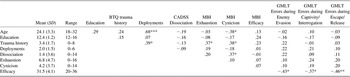
Table 1 shows mean scores and bivariate correlations for all variables. MBI-Efficacy scores correlated negatively with GMLT errors during all three of the field-based phases of training (large magnitude correlations; Cohen, Reference Cohen1988). None of the other independent variables, including MBI-Exhaustion and Cynicism scores, were related to GMLT performance.
Mean scores and correlation matrix of all measures

Note. SD = standard deviation; Trauma history = scores on Brief Trauma Questionnaire; CADSS Dissociation = scores on Clinician Administered Dissociation Symptom Scale; MBI = Maslach Burnout Inventory; GMLT = Groton Maze Learning Test. Significant correlation: *p < .05; **p < .01.
On average, the high professional efficacy group scored more than 2.5 SDs higher than the low professional efficacy group on the MBI professional efficacy subscale (34.76 ± 1.15 vs. 28.29 ± 3.42; t(30) = 7.39; p < .001; Cohen's d = 2.54). Compared to the low professional efficacy group, the high professional efficacy group had more years of education (12.9 ± .4 vs. 12.0 ± 0; t(30) = 2.21; p = .035), scored lower on the cynicism subscale of the MBI (2.8 ± .6 vs. 5.6 ± 1.0; t(30) = 2.40; p = .023; d = .84), and made fewer errors on the GMLT at baseline (42.5 ± 1.7 vs. 35.7 ± 2.8; t(30) = 2.08; p = .047; d = .68); accordingly, these variables were entered as covariates in the repeated-measures ANCOVA. None of the other variables assessed differed between these groups (all t's < 1.80, all p's > .08).
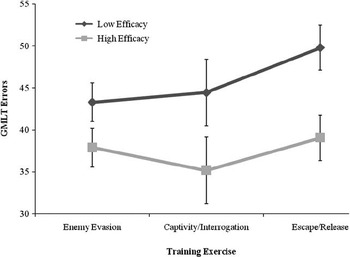
Results of the repeated-measures ANCOVA revealed the high professional efficacy group made significantly fewer errors during all three field-based phases of training (F(1,27) = 6.27; p = .019). As shown in Figure 1, the low professional efficacy group made more errors on the GMLT than the high professional efficacy group during the enemy evasion (43.29 ± 2.31 vs. 37.90 ± 2.31; Cohen's d = .58); captivity and interrogation (44.46 ± 3.97 vs. 35.16 ± 3.97; Cohen's d = .59); and escape/release (49.81 ± 2.70 vs. 39.06 ± 2.70; Cohen's d = .99) portions of the training exercise. Baseline GMLT scores were also significantly associated with GMLT performance during the field-based phases of training (F(1,27) = 21.76; p < .001), but years of education (F(1,27) = .10; p = .75), MBI Cynicism scores (F(1,27) = .51; p = .48), and the interaction of professional efficacy group x training phase (F(2,26) = 1.03; p = .37) were not significant in this analysis.
GMLT performance during each training exercise for low efficacy (n = 16) or high efficacy (n = 16) groups. (Note. Means and standard errors are adjusted for years of education, MBI cynicism scores, and baseline GMLT performance.)

Discussion
Results of the current study extend previous research (Lieberman, Bathalon, Falco, Kramer, et al., Reference Lieberman, Bathalon, Falco, Kramer, Morgan and Niro2005; Lieberman, Bathalon, Falco, Morgan, et al., Reference Lieberman, Bathalon, Falco, Morgan, Niro and Tharion2005; Morgan et al., Reference Morgan, Doran, Steffian, Hazlett and Southwick2006; Ohman et al., Reference Ohman, Nordin, Bergdahl, Slunga Birgander and Stigsdotter Neely2007; Paulus et al., Reference Paulus, Potterat, Taylor, Van Orden, Bauman, Momen and Swain2009; Sandstrom et al., Reference Sandstrom, Rhodin, Lundberg, Olsson and Nyberg2005) to show that pre-training baseline assessment of burnout symptoms, particularly perceptions of professional efficacy, may predict cognitive performance during naturalistic, intense military training. These results, which are consistent with studies linking psychological factors such as resilience to better cognitive function (Pickering, Hammermeister, Ohlson, Holliday, & Ulmer, Reference Pickering, Hammermeister, Ohlson, Holliday and Ulmer2010; Wingo, Fani, Bradley, & Ressler, Reference Wingo, Fani, Bradley and Ressler2010), suggest that greater perceptions of self-efficacy may help preserve cognitive function during highly stressful military training. Greater self-efficacy is associated with greater perceptions of purpose and control (Benight & Bandura, Reference Benight and Bandura2004), which may in turn help maintain optimal cognitive function during stressful training.
Moderate to large magnitude reductions in executive function were observed among trainees with lower professional efficacy relative to trainees with higher professional efficacy during each of the three field-based phases of training (Cohen, Reference Cohen1988), with the largest effect size (d = .99) difference observed during the final portion of the training exercise—escape/release. This magnitude of reduced executive function is comparable to that observed following an acute benzodiazepine challenge (Pietrzak, Fredrickson, Snyder, & Maruff, Reference Pietrzak, Fredrickson, Snyder and Maruff2010; Snyder et al., Reference Snyder, Werth, Giordani, Caveney, Feltner and Maruff2005). While the interaction of level of efficacy and phase of training was not statistically significant, inspection of Figure 1 suggests that the number of errors on the GMLT increased slightly as a function of training in the low professional efficacy group, while the high professional group evidenced more stable performance. This finding may suggest that, compared to trainees with higher professional efficacy, those with lower professional efficacy may have been more sensitized to the deleterious effects of training-related stress (Ursin & Eriksen, Reference Ursin and Eriksen2010), thereby resulting in their showing progressively greater magnitude reduction in executive function. Additional research using larger samples and with repeated assessment of burnout symptoms is needed to further examine how executive function changes as a function of training in Special Operations personnel with different levels of professional efficacy. Nevertheless, these findings underscore the potential utility of assessing burnout symptoms during training, as perceptions of control/self-efficacy may decline as training (or operational activity) progresses. It is reasonable to speculate that as one's perception of professional efficacy declines, one may also experience a decrement of executive function under conditions of high stress. Further research is needed to investigate this possibility.
The overall level of burnout observed in this sample was lower than that observed before training in a sample of tri-service medical and support staff (Whealin et al., Reference Whealin, Batzer, Morgan, Detwiler, Schnurr and Friedman2007). Compared to population-based norms (Roelofs et al., Reference Roelofs, Verbraak, Keijsers, de Bruin and Schmidt2005), 37.5% and 56.2% of the sample met or exceeded clinical thresholds for emotional exhaustion and cynicism, respectively, although scores on these measures were unrelated to executive function during the three field-based phases of training. None of the participants met or exceeded the clinical threshold for lack of professional efficacy. This may be attributable to the elite nature of the Marines who participate in MARSOC Survival School, who are a highly selected group of individuals that undergo extensive selection and assessment before commencing training. Accordingly, high levels of professional efficacy (i.e., perception that one is effective at their job and can complete the mission) are essential to success during all phases of training. The finding that lower, though still above clinical threshold, perceptions of professional efficacy at baseline were predictive of performance on a measure of executive function during three field-based phases of Survival School suggests that confidence and belief in one's ability to effectively solve work-related problems may help preserve integrative visuospatial executive function during subsequently experienced training-related stress. Importantly, these results suggest that the clinical cut-point for the professional efficacy subscale of the MBI may not be useful in predicting executive function during field-based phases of Survival School in Special Operations personnel, as none of the Marines scored below the clinical threshold on this subscale, while several scored above the clinical thresholds for MBI measures of emotional exhaustion and cynicism.
Results of this study have several clinical implications. First, screening prospective military personnel for symptoms of burnout (i.e., low perceived professional efficacy) before participation in stressful military training programs may help identify individuals at risk for executive dysfunction during stressful military training. Screening for burnout may also provide valuable information to clinicians who work with Marines who are actively engaged in military operations and who might be experiencing difficulties in their operational work related activities. In addition to measures of professional efficacy such as the MBI, measures of psychological resilience such as the Connor-Davidson Resilience Scale (Connor & Davidson, Reference Connor and Davidson2003) and the Response to Stressful Experiences Scale (Johnson et al., In press), which assess broader aspects of coping skills and dimensions of resilience, may be useful in elucidating specific aspects of self-efficacy that may help promote optimal cognitive functioning in military personnel. Assessment of PTSD, depression, and related symptoms may also be useful in examining the extent to which these symptoms may relate to burnout and cognitive performance during military training (Ahola et al., Reference Ahola, Honkonen, Kivimaki, Virtanen, Isometsa, Aromaa and Lönnqvist2006).
Neurobiological factors that may mediate the association between burnout and cognitive performance during stress include HPA axis dysregulation (Morgan et al., Reference Morgan, Cho, Hazlett, Coric and Morgan2002; Wingenfeld, Schulz, Damkroeger, Rose, & Driessen, Reference Wingenfeld, Schulz, Damkroeger, Rose and Driessen2009), decreased brain-derived neurotrophic factor levels (Onen Sertoz et al., Reference Onen Sertoz, Tolga Binbay, Koylu, Noyan, Yildirim and Elbi Mete2008), and high dopamine and norepinephrine turnover in the prefrontal cortex (Robbins & Arnsten, Reference Robbins and Arnsten2009). As shown in our earlier work in active duty military personnel enrolled in a combat diver qualification course (Morgan et al., Reference Morgan, Rasmusson, Pietrzak, Coric and Southwick2009), greater baseline dehydroepiandrosterone (DHEA) is related to superior stress tolerance, fewer dissociative symptoms, and superior, objectively assessed, military performance. Additional research is needed to evaluate neurobiological mediators of the association between burnout and cognitive dysfunction, as well as the extent to which training-related increases in burnout are related to neurobiological and cognitive changes, in military and other stress-exposed populations.
Methodological limitations of this study must be noted. First, we recruited a small sample for this preliminary study, so generalizability of the results to the broader population of Special Forces trainees awaits replication in a larger sample. Second, only a select number of assessments were administered at the baseline visit. Consequently, broader aspects of psychopathology (e.g., traumatic stress symptoms, depression), which may be related to burnout (Ahola et al., Reference Ahola, Honkonen, Kivimaki, Virtanen, Isometsa, Aromaa and Lönnqvist2006) and cognitive performance (Horner & Hamner, Reference Horner and Hamner2002), were not assessed. Third, burnout symptoms were only assessed during the baseline evaluation and not during the three field-based phases of Survival School training. Consequently, the effect of burnout on executive function during training may be underestimated; increased burnout symptoms as a function of training may account for the observed increase in GMLT errors as training progressed in the group with low professional efficacy scores during the baseline visit. Finally, ecologically valid measures of military performance during Survival School were not available for analysis, so the effect of baseline burnout symptoms on military performance during training could not be ascertained.
Taken together, this study represents an initial step to understanding how burnout symptoms may be related to integrative visuospatial executive function in Special Operations personnel enrolled in Survival School. Given the preliminary nature of the current study, we plan to examine more thoroughly the relation between burnout and cognitive performance in future studies by using a more comprehensive battery of psychological and cognitive measures; repeatedly assessing burnout as well as other stress-related symptoms (e.g., anxiety) during training cycles in larger samples of Special Forces personnel; and examining how burnout and related symptoms may affect ecologically valid indicators of military performance (e.g., navigational ability, decision-making under stress, marksmanship; Morgan et al., Reference Morgan, Rasmusson, Pietrzak, Coric and Southwick2009). Finally, given the potential importance of perceptions of professional efficacy in predicting executive function during military training, future studies will examine a broader constellation of constructs (e.g., coping skills, psychological resilience, social support) that may enhance professional efficacy, cognitive function, and military performance in Special Operations and other military personnel.
At present, little data exist to indicate which treatments or interventions for burnout are effective. The present data elucidate some of the specific cognitive difficulties associated with symptoms of burnout. This knowledge, coupled with extant information regarding neurohormonal alterations in burnout, may lead to the development of interventions designed to reduce the negative impact of burnout symptoms on cognitive functioning. It is reasonable to speculate that modulation of catecholamine release (Morgan, Krystal, & Southwick, Reference Morgan, Krystal and Southwick2003), as well as facilitation of cortical modulation of arousal by enhancing coping skills (i.e., stress inoculation training; Gaab et al., Reference Gaab, Blattler, Menzi, Pabst, Stoyer and Ehlert2003), might help counteract the deleterious cognitive effects of burnout symptoms. Clearly, additional research is needed to evaluate these possibilities.
Acknowledgments
The authors thank Capt. Joseph Clemmey, MAJ. Rob Sellars, Mr. Scott Kinder, SSGT. Pete Peterson, Mr. Ben Blick, Mr. Byron Sevario, and Alison Rivers. Their support and work significantly facilitated the completion of this project. Funding for this project was provided by the Clinical Neurosciences Division of the National Center for Posttraumatic Stress Disorder. The opinions reflected in this study are not to be considered policy or guidance of the U.S. Government, U.S. Marine Corps, U.S. Navy, or the Department of Defense, but reflect solely the opinions of the authors. Dr. Pietrzak receives partial salary support from CogState, Inc., a cognitive test company that provided the cognitive test used in this study. Dr. Snyder serves as a consultant to this company.