

Introduction
Diatoms are unicellular siliceous algae found throughout the world in aquatic ecosystems. Each individual taxon is characteristic of specific environmental conditions and, from their presence, distribution and abundance, are especially useful in reconstructing modern and past environmental conditions in climatically extreme environments (Spaulding & McKnight Reference Spaulding and McKnight1999) where other common palaeoecological indicators, such as pollen, are often of limited use (Hodgson et al. Reference Hodgson, Doran, Roberts and McMinn2004).
Diatoms have previously been noted in the snow in various locations across Antarctica, namely at South Pole (Kellogg & Kellogg Reference Kellogg and Kellogg1996), Siple Dome, Taylor Dome and Dome C (Burckle et al. Reference Burckle, Gayley, Ram and Petit1988). Diatoms have also been recorded in ice cores from Greenland (e.g. Crête core samples, Gayley & Ram Reference Gayley and Ram1984, Ram et al. Reference Ram, Gayley and Petit1988). The presence of diatom frustules or fragments of frustules has been attributed to aeolian sources due to the large distances from typical polar diatom habitats, such as melt lakes and the ocean (e.g. Smol & Douglas Reference Smol and Douglas1996, Roberts et al. Reference Roberts, McMinn, Johnston, Gore, Melles and Cremer2001, Cremer et al. Reference Cremer, Roberts, McMinn, Gore and Melles2003b).
Diatoms found at Dome C, Siple Dome and Taylor Dome are mostly of freshwater origin (Burckle et al. Reference Burckle, Gayley, Ram and Petit1988). Similarly, the diatoms identified in Greenland ice core samples are also freshwater in origin (Gayley & Ram Reference Gayley and Ram1984). However, both marine and freshwater diatoms have been noted in an ice core taken at the South Pole (Kellogg & Kellogg Reference Kellogg and Kellogg1996). In Greenland, peaks in diatom abundance in the Crête core were shown to coincide with peaks in dust deposition (Gayley et al. Reference Gayley, Ram and Stoermer1989). As these peaks are thought to represent a spring influx of dust particles, it was concluded that the diatoms originated from the same location as the dust. It was possible to trace the dust to a North American source, but similarities to diatoms found in Africa were noted.
There is some controversy over the presence of Pliocene aged marine diatoms found in glacial tills of the Sirius Group in the Transantarctic Mountains. Before the reworking of the sediments, the diatoms may have been deposited by aeolian sources (e.g. Kellogg & Kellogg Reference Kellogg and Kellogg1996, McKay et al. Reference McKay, Barrett, Harper and Hannah2008) or directly by sedimentation from the ocean (Webb et al. Reference Webb, Harwood, McKelvey, Mercer and Stott1984). For summaries of the major debate see Sugden et al. (Reference Sugden, Denton and Marchant1993) and Wilson (Reference Wilson1995). The origin of these diatoms is important, as it constrains the extent of the East Antarctic Ice Sheet (EAIS) during the Pliocene, which is of particular interest as the full effects of human induced climate change on the EAIS may be understood from this prior warm period.
An abundant and diverse diatom flora was found in snow samples collected during the Airlink Environmental Impact Monitoring Program (AEIMP). The AEIMP was established to monitor the environmental impact of the Wilkins Runway, established in 2007 to service regular flights to Casey Station in the Windmill Islands, East Antarctica. In this study, different diatom species were identified and their distribution and environmental preferences used to determine their spatial source. The implications of our results for palaeoclimatic reconstructions using ice core data are also discussed.
Method
Sample collection
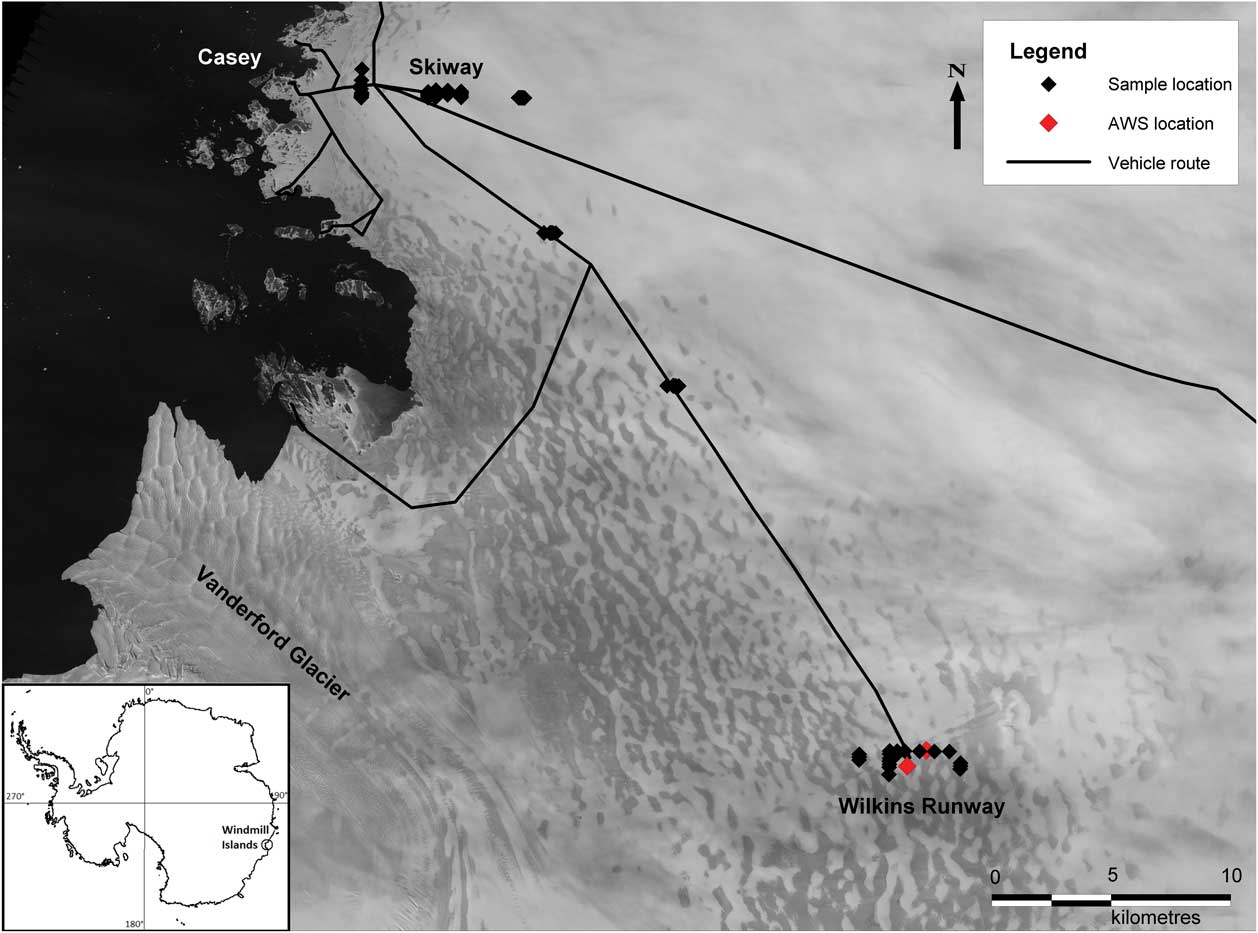
Snow samples were collected from sites in the vicinity of the Windmill Islands, Wilkes Land, Antarctica, as part of the AEIMP. These sites were concentrated around Wilkins Runway (located c. 50 km from the coast at an elevation of 755 m), Casey skiway (located c. 10 km from the coast at an elevation of 400 m) and surrounding areas. Four summer sampling campaigns from 2007–10 yielded a total number of 365 snow samples. Samples taken during the second sampling campaign correspond to an unusual weather event at the site from 7–10 February 2009. These samples offer a unique opportunity to trace the source of the event and study the impact of the event on the snow. Snow samples from other sampling campaigns are used as a comparison to show normal conditions at the site.
The Windmill Islands (66°10′–66°35′S, 110°10′–110°50′E) are located in Wilkes Land, East Antarctica (Fig. 1). During the sample month in February 2009, Casey Station had an average temperature of -1.6°C and wind speed of 8.6 m s-1. For the same month, the temperature at Wilkins Runway averaged -7.7°C with an average wind speed of 10.6 m s-1. Easterly wind (0°–180°) dominated the Wilkins site through February, occurring 80% of the time.
Map of the Windmill Islands showing the locations of Casey Station, Casey skiway, Wilkins Runway and snow sample locations.
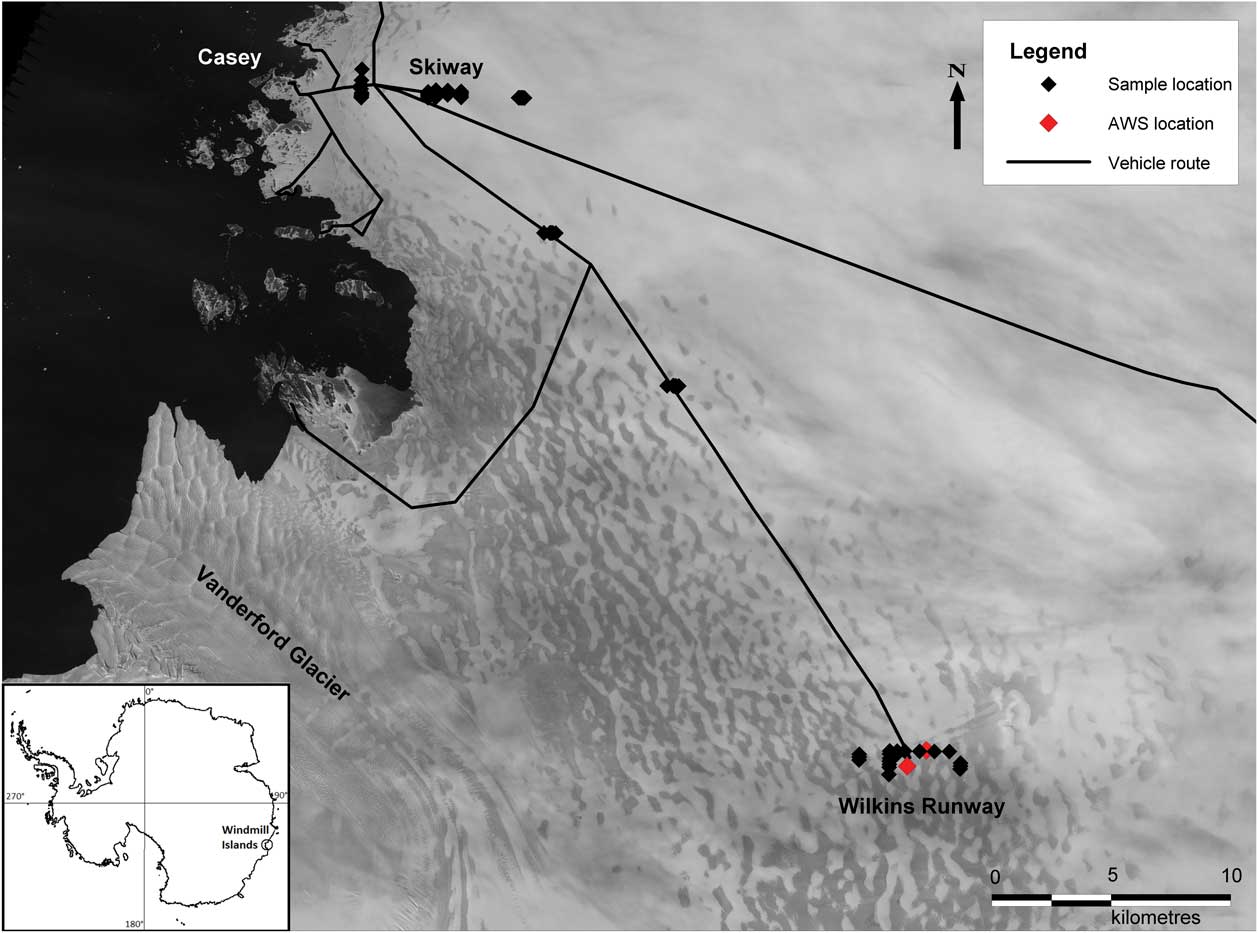
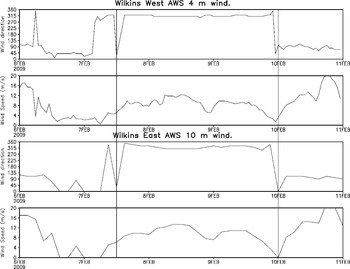
During the anomalous weather event, the wind came from a north-westerly direction at a maximum speed of around 12 m s-1 (Fig. 2) as measured by both Automatic Weather Stations (AWSs) at Wilkins (see Fig. 1 for AWS locations with respect to the runway). This was caused by a strong ridge of high pressure, which intensified as it moved over the Windmill Islands, producing a significant west to north-westerly flow throughout the troposphere. The anomalous weather event contributed 1.2 mm rainfall equivalent or c. 0.6% of the annual snow budget as measured at Casey Station. Local geography at Wilkins Runway may have contributed to more snow being deposited at the site. Sixteen snow samples were taken immediately after this event on 10 February. On the evening of 10 February, another snowfall occurred but with the wind coming from the more usual easterly direction. Fifteen samples were taken at the Wilkins Runway and along the track to Casey Station following the second snowfall (see Fig. 1). Blowing snow was recorded during and after both events.
Automatic Weather Station (AWS) recordings from 00h00 coordinated universal time (UTC) 6 February to 00h00 UTC 11 February taken from Wilkins Runway west AWS with anemometer at a height of 4 m and Wilkins Runway east AWS with anemometer at a height of 10 m. Vertical lines denote the start and end of the unusual weather event that occurred between 12h00 UTC 7 February and 00h00 UTC 10 February.

Snow samples were collected from 60 sites during the second sampling campaign of the AEIMP in February 2009 (Fig. 1). Sampling occurred along grids at the Casey skiway (7 samples), Wilkins runway (13 samples), along the track from Casey Station to Wilkins Runway (14 samples) and close to passive air samplers installed upwind and downwind of the Casey skiway and Wilkins Runway (26 samples).
All sample collection and analysis were conducted under clean room protocols to minimize the potential for contamination. Snow samples were collected carefully by scooping c. 200 ml melt equivalent snow into a ziplock polyethylene bag, rinsed with snow prior to sampling. Samples were melted overnight and pH and conductivity were measured. The remaining sample was filtered using a polyethylene syringe and 12 mm diameter 0.45 μm cellulose nitrate Millipore filters. The filters were then transferred onto an aluminium stub for scanning electron microscopy (SEM) analysis.
Sample analysis
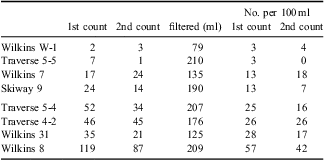
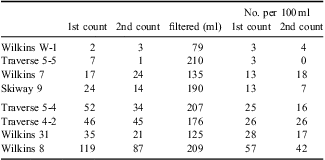
Samples were analysed using a JEOL JSM 6460LA SEM with energy dispersive spectroscopy (EDS) and low vacuum capability. Typical settings were < 25 Pa (low vacuum), 15 kV and 1 nA probe current. Low vacuum capability allows for the sample to be viewed without coating, which minimizes sample handling and potential contamination. For each sample, ten images at 200 x were taken along a N–S traverse of the filter covering an area of 3 mm2 or c. 1% of the filter area. The traverse started approximately one third of the way down the filter to allow for edge effects. Diatom frustules or fragments of frustules visible within these images were counted to compare the relative numbers of diatom fragments on each sample. To check the reproducibility of the method, eight samples were recounted on different ten image frames taken in the same consistent manner as other previously counted frames. It was found that there was a maximum variation in counts of around 40% of those previously counted (Table I). Smaller species such as Fragilariopsis cylindrus (Grunow) Krieger were not visible at 200 x magnification, so were not included in the count. Each species of diatom found on a filter was individually photographed both on and off the traverse and identified to species where possible. Taxonomy of the diatom species identified was based principally on Scott & Thomas (Reference Scott and Thomas2005) and references therein.
Number of diatom frustules and fragments of frustules counted in duplicate. The first group of samples are representative of “background” samples while the lower section is associated with the anomalous weather event.
Results
Species assemblage
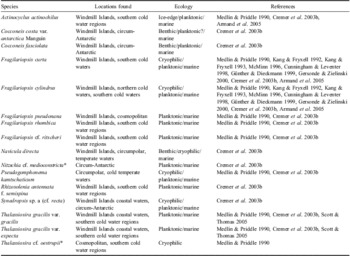
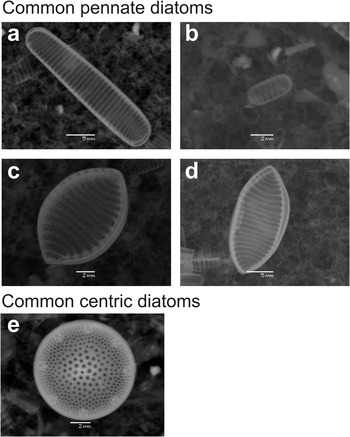
A total of 16 diatom species were found from the February 2009 sampling period (Table II). Five species account for the majority of diatoms identified: the common marine pennate taxa Fragilariopsis curta (van Heurck) Hustedt (Fig. 3a), F. cylindrus (Fig. 3b), Fragilariopsis pseudonana Hasle (Fig. 3c) and Fragilariopsis rhombica (O'Meara) Hustedt (Fig. 3d) and the common marine centric taxon Thalassiosira gracilis var. gracilis Fryxell & Hasle (Fig. 3e).
Diatom species identified in the Windmill Islands snow.

*Not associated with unusual weather event.
SEM images of common diatoms found within the Windmill Islands snow. The common pennate diatoms a.Fragilariopsis curta, b.Fragilariopsis cylindrus, c.Fragilariopsis pseudonana, d.Fragilariopsis rhombica, and the common centric diatom e.Thalassiosira gracilis var. gracilis.

Abundance
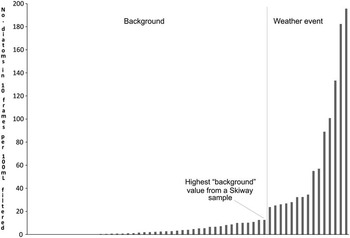
From the relative abundance of diatoms in the snow, it was clear that there were two populations of samples: the background level (44 samples) and those deposited with the weather event (15 samples) (see Fig. 4). The largest diatom count noted for a background sample taken at Casey skiway was 13 diatom fragments in ten image frames per 100 ml of melted snow, while the lowest of the weather event group being 24 diatom fragments in the area per 100 ml. Background samples were found to have an average of three diatoms in ten image frames per 100 ml with standard deviation of four, while weather event samples had an average of 69 diatoms in ten frames per 100 ml with a standard deviation of 58. Weather event samples included nine samples from Wilkins Runway and six from along the track between Wilkins Runway and Casey Station.
Graph showing the number of diatom frustules and fragments of frustules within ten image frames per 100 ml filtered. The weather event group is defined by having more than 20 diatom fragments within ten image frames per 100 ml filtered.

The second sampling trip in February 2009 was the only one to yield large numbers of diatoms, due to the prevailing conditions being present around sampling dates. Samples taken on separate sampling campaigns undertaken in January 2008 and November 2009 at the same locations as the weather event samples had no diatoms within the ten comparison frames. Samples from Casey skiway generally exhibit a “background” deposition of diatoms that we have defined previously due to its vicinity to the coast.
Not all fresh snow sampled was from the anomalous weather event, as a second snowfall occurred soon after in a flow from the more usual prevailing easterlies. Samples that have a high diatom count also have a high conductivity when compared to samples taken from identical sites in other sampling campaigns (Table III). All of the samples with a diatom count of over 20 in ten image frames per 100 ml of sample filtered are defined as being associated directly with the weather event (Fig. 4). The 31 other samples collected after the unusual weather event have an overall lower diatom count and conductivity, however, it is not possible to establish whether the snow sampled at these sites was deposited during or after the unusual weather event.
The conductivity and standard deviation for samples that are associated with the weather event compared to other samples taken from the same location during separate sampling campaigns.

*Samples contain no diatoms.
Despite the large variation in replicate counts the data defines two statistically distinct populations in agreement with the salinity data. Although the error in replicate counts may affect the definition of the boundary between the two populations, this uncertainty does not have any consequences for our interpretation of the dataset.
Individual diatom species appear in both high and low abundance in samples. The most common species are T. gracilis var. gracilis, F. curta, F. rhombica and F. pseudonana. Others occur as single cells: Actinocyclus actinochilus (Ehr.) Sim., Cocconeis fasciolata (Ehrenberg) Brown, Nitzschia cf. medioconstricta Hustedt, Rhizosolenia antennata f. semispina Sundstrøm, Thalassiosira gracilis var. expecta (Van Land.) G. Fryxell et Hasle, and Thalassiosira cf. oestrupii (Ost.) Hasle. The presence of some of these taxa (e.g. the ice-edge diatom A. actinochilus, the cryophylic Pseudogomphonema kamtschaticum (Grunow) Medlin, and the Antarctic coastal water R. antennata f. semispina) are particularly illuminating in terms of source conditions.
It is hard to draw conclusions from single diatom species, however, the common species T. gracilis (in c. 80% samples with diatoms), F. curta (in c. 97% samples with diatoms), F. rhombica and F. pseudonana (found in the majority of samples) suggest that they derive from marine open water conditions with partial sea ice coverage. All other species present were only found rarely in samples.
Discussion
All diatoms found in the snow samples from the Windmill Islands are of marine origin. This is in contrast to most diatoms reported elsewhere in snow on the Antarctic continent (Burckle et al. Reference Burckle, Gayley, Ram and Petit1988, Ram et al. Reference Ram, Gayley and Petit1988, Kellogg & Kellogg Reference Kellogg and Kellogg1996). Although, compared to other sites where diatoms have been found, this is a coastal site with maximum distance to ice-free sea being c. 50 km.
Fragilariopsis is a widespread genus of marine diatom commonly found in Antarctic aquatic ecosystems (e.g. Cremer et al. Reference Cremer, Roberts, McMinn, Gore and Melles2003b, Armand et al. Reference Armand, Crosta, Romero and Pichon2005). Both F. curta and F. cylindrus have been found in planktonic habitats in the marginal Antarctic ice-edge zone (Kang & Fryxell Reference Kang and Fryxell1992, Cunningham & Leventer Reference Cunningham and Leventer1998), in Southern Ocean open waters (Kang & Fryxell Reference Kang and Fryxell1993), as benthos attached to Antarctic sea ice (McMinn Reference McMinn1996) and above the platelet ice layer within Antarctic sea ice (Günther & Dieckmann Reference Günther and Dieckmann1999). Both F. curta and F. cylindrus are regarded as cryophilic, i.e. associated with sea ice conditions in cold open ocean waters (e.g. Gersonde & Zielinski Reference Gersonde and Zielinski2000) and meltwater-stratified surface conditions in near-coastal Antarctic regions (e.g. Cremer et al. Reference Cremer, Gore, Melles and Roberts2003a). Fragilariopsis pseudonana is known to be common in Southern Ocean waters south of Australia (Scott & Thomas Reference Scott and Thomas2005) and F. rhombica is commonly found in Antarctic waters including coastal waters near Davis Station, Terra Nova Bay and offshore Wilkes Land (Scott & Thomas Reference Scott and Thomas2005) and, like F. curta and F. cylindrus, is indicative of active sea ice production in these waters (Armand et al. Reference Armand, Crosta, Romero and Pichon2005). We also found cells that appear to be Fragilariopsis ritscheri Hustedt. This taxon is also often found in the Antarctic plankton (Medlin & Priddle Reference Medlin and Priddle1990) and has been specifically reported in Southern Ocean and coastal Antarctic waters off Wilkes Land, East Antarctica (Scott & Thomas Reference Scott and Thomas2005).
Members of the genus Thalassiosira are associated with open water conditions in Antarctica (Medlin & Priddle Reference Medlin and Priddle1990, Zielinski & Gersonde Reference Zielinski and Gersonde1997, Crosta et al. Reference Crosta, Romero, Armand and Pichon2005). Varieties of Thalassiosira gracilis (var. gracilis and var. expecta) have been reported from sub-Antarctic, sub-tropical and Antarctic sectors of the Atlantic, Indian and Pacific oceans (Scott & Thomas Reference Scott and Thomas2005). Their presence in large numbers in the snow samples provides further evidence of a marine parent water mass.
The presence of both F. curta and F. cylindrus in the snow samples reflect typical coastal marine conditions during summer that result from strong sea ice melting in the region. These conditions are typical in the vicinity of the Windmill Islands during summer. Only one species, Thalassiosira cf. oestrupii, has not been previously reported in the Windmill Islands. This particular diatom was not associated with the unusual weather event, which highlights the potential of a different transport mechanism. This suggests that the source region for the diatom assemblage reported herein is a local coastal community, and it is probable that diatoms from the coastal waters of the Windmill Islands are deposited via aeolian transportation.
The remaining, albeit in smaller numbers, species found in the snow samples are also typical of a polar marine environment. The presence of A. actinochilus, P. kamtschaticum and R. antennata f. semispina, in particular, indicate a marine source with sea ice production/depletion.
Actinocyclus actinochilus is a common Antarctic ice-edge diatom (Medlin & Priddle Reference Medlin and Priddle1990, Armand et al. Reference Armand, Crosta, Romero and Pichon2005). This distinctive diatom is seen in coastal waters near Davis and Syowa Stations, East Antarctica, the Weddell Sea and the Indian, Atlantic and Kerguelen sectors of the Antarctic (Scott & Thomas Reference Scott and Thomas2005).
Pseudogomphonema kamtschaticum is a common marine epiphytic ice associated diatom in cold temperate and polar waters (Medlin & Priddle Reference Medlin and Priddle1990). Scott & Thomas (Reference Scott and Thomas2005) reported this taxon from coastal waters near Davis Station, Renwick glacier and Prydz Bay.
Rhizosolenia is an important genus worldwide but very common in both Arctic and Antarctic pelagic communities (Medlin & Priddle Reference Medlin and Priddle1990). Armand & Zielinski (Reference Armand and Zielinski2001) suggested R. antennata f. semispina is one of the most common Rhizosoleniae in the Southern Ocean.
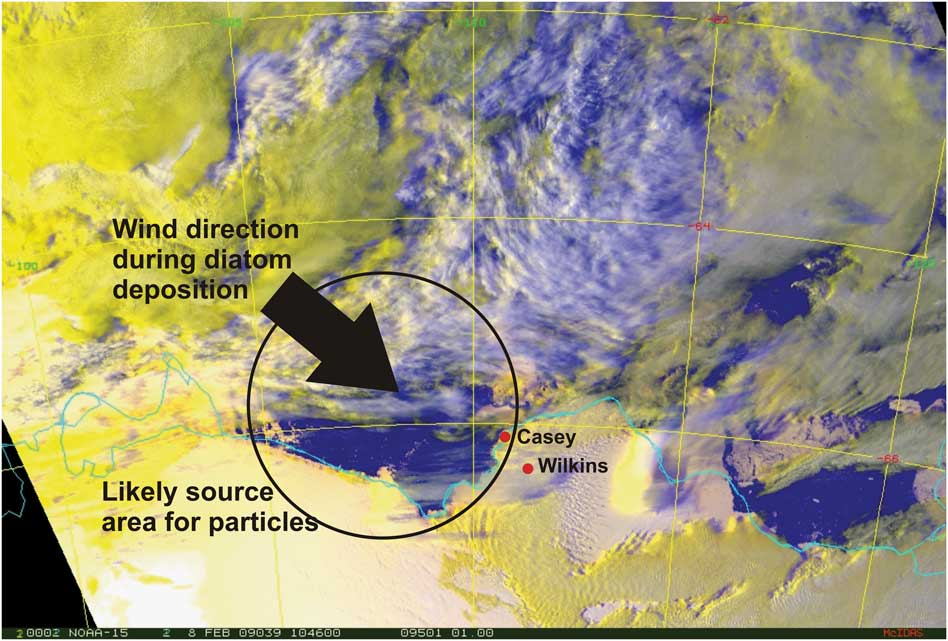
The composition of the floral assemblage collected unambiguously indicates that the parent water mass is from a coastal marine region undergoing typical Antarctic summer conditions with periods of both consolidated sea ice and open water. These conditions were noticed close to the deposition site from the NOAA-15 satellite images (Fig. 5) taken at 10h46 coordinated universal time (UTC) 8 February 2009 prior to the weather event that caused the deposition of these diatoms in the snow.
A high-resolution multi-spectral false colour image from the NOAA-15 satellite pass at 10h46 UTC on 8 February. Banner cloud caused by the strong north-westerly jet stream is seen as white (glaciated cloud) over Wilkins Runway site. Low level mixed-phase cloud (yellow) is evident over the Wilkins area. Vincennes Bay, to the west of Casey Station is relatively ice-free (dark blue). The circle shows the probable source area for the diatoms.
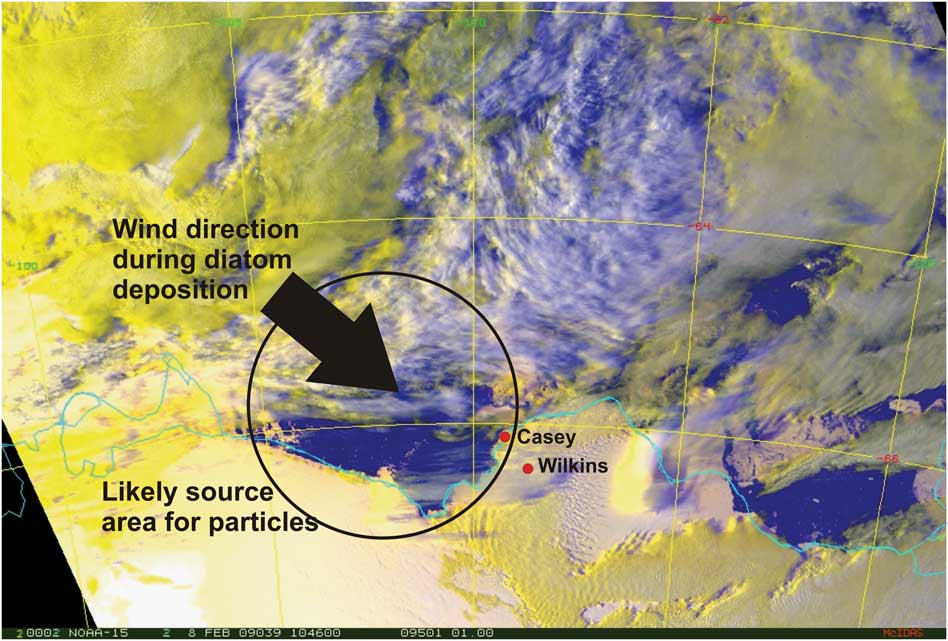
Marine diatoms can become airborne by ocean spray and by bursting air bubbles (Kellogg & Kellogg Reference Kellogg and Kellogg1996). It has also been postulated that erosion from diatomaceous deposits is another source (Kellogg & Kellogg Reference Kellogg and Kellogg1996). In this study, it is most probable that the diatoms derived from the area of ocean shown in Fig. 5. The diatom assemblage deposited, in particular the presence of Navicula directa (Wm. Smith) Ralfs, P. kamtschaticum and Synedropsis sp. a (cf. recta) Hasle, Syvertsen & Medlin, suggest that the break-up of sea ice in high winds played an important part in the source of these diatoms. In an enclosed bay, like those found in the Windmill Islands, the sea ice can accumulate in one end and continue to break. Waves breaking against the sea ice produce large amounts of sea salt aerosol, seen in the higher conductivities of samples (Table III), and also aerosolise large amounts of diatoms from the surface of the water column as well as from the sea ice.
The presence of large amounts of solely marine diatoms in the snow has implications for the interpretation of marine diatoms found in sediment and ice cores, as diatom assemblages can be indicative of source regions and environmental conditions at the time of their deposition. For example, Pliocene-aged marine diatoms have been found within glacial tillites of the Sirius Group in the Transantarctic Mountains. According to Webb et al. (Reference Webb, Harwood, McKelvey, Mercer and Stott1984) these diatoms were deposited in the Pliocene in a marine environment during a reduction of the EAIS and have since been reworked by glaciers. An aeolian source for the diatoms, however, was suggested by Burckle et al. (Reference Burckle, Gayley, Ram and Petit1988) as an alternative to the marine deposition. The implication of this alternative deposition mechanism for the diatoms is that the deposition of the Sirius Group does not require a reduction of the EAIS during this period. Our findings demonstrate that large-sale deposition of marine aeolian-derived diatoms is possible, at least within c. 50 km from the coast.
Diatoms have been found in many ice cores, including South Pole (Kellogg & Kellogg Reference Kellogg and Kellogg1996), Dome C, Siple Dome and Taylor Dome (Burckle et al. Reference Burckle, Gayley, Ram and Petit1988), but it is possible that more sites may contain diatoms that have not been previously found. Full frustules as well as identifiable fragments of frustules were found in last glacial maximum ice at Dome C (Burckle et al. Reference Burckle, Gayley, Ram and Petit1988) and at depths of 75 m in Greenland ice core at Crête (Gayley et al. Reference Gayley, Ram and Stoermer1989). From size distributions indicating a large number of particles above 10 μm noted from a firn core from Hercules Névé (Maggi & Petit Reference Maggi and Petit1998), it is plausible that diatoms may contribute to an increased particle size. Also in Talos Dome, a large amount of the sea ice mineral ikaite (CaCO3·6H2O) was noticed within cores that also would suggest another location with possible diatom assemblages (Sala et al. Reference Sala, Delmonte, Frezzotti, Proposito, Scarchilli, Maggi, Artioli, Dapiaggi, Marino, Ricci and De Giudici2008). It is probable that most cores taken from Antarctica (and Greenland) would contain assemblages of diatoms whether marine or freshwater, but have not been previously found due to incomplete sampling protocols. Theoretically diatoms could be found by a large particle size and through individual particle analysis. Past source areas could be reconstructed from diatom assemblages preserved deep within ice cores with the potential to provide information about atmospheric circulation, including anomalous events, in the past. This will allow a more complete reconstruction of Antarctic climate into the past, which will help with understanding the potential impact of human-induced climate change.
Conclusion
From the marine diatom floral assemblage found in snow samples collected in the Windmill Islands source region and environmental conditions at source can be determined. The diatoms were transported via aeolian deposition from coastal Windmill Islands waters during the summer, as we see an assemblage that is typical of both sea ice and open water conditions. This matches the conditions seen on satellite pictures taken during a wind event that deposited large numbers of diatoms at the site. This observation provides direct evidence of the mechanism for large-scale aeolian transport of marine diatoms over tens of kilometres from the coast to an ice sheet which has important implication for the use of diatoms to determine the source of particles preserved within ice cores and for the understanding of sea ice extent and open water conditions in the past.
Acknowledgements
This research was a part of the Airlink Environmental Impact Monitoring Program that was funded by the Australian Antarctic Division under project reference number 07/768. A. Budgeon would like to thank the Australian Government for the Australian Postgraduate Award scholarship that made this possible. A. Budgeon would also like to thank everyone on station who assisted with sampling. The authors would also like to acknowledge the important contributions of two anonymous reviewers for their helpful comments.
The authors would like to acknowledge the recent passing of Neil Adams. Neil was a respected and admired member of the Antarctic science community and will be sorely missed.