Implications
The chemical esterification of acid oils with glycerol (both economically interesting by-products from oil refining and biodiesel industries, respectively), generates a new type of fats with a different acylglycerol structure, that can provide valuable characteristics in animal nutrition, apart from the environmental benefits associated with their use. The results of this study indicate that re-esterified palm oils are interesting fat sources to be considered in fattening pigs.
Introduction
Palm oil is one of the few vegetable oils rich in saturated fatty acids (SFA). Thus, its use in fattening pig diets is attractive because it may be associated with a positive influence on fat firmness (Wiseman and Agunbiade, Reference Wiseman and Agunbiade1998). However, its high SFA content impairs its nutritive value (Powles et al., Reference Powles, Wiseman, Cole and Hardy1993). Besides the importance of the fat degree of saturation, the fat acylglycerol structure also plays an important role in the nutritive value of fats. Given the specificity of pancreatic lipase for the hydrolysis of fatty acids (FA) located at the sn-1,3 positions (Mattson and Beck, Reference Mattson and Beck1956), SFA are better absorbed if they are located at the sn-2 position, because they are absorbed as 2-monoacylglycerols, instead of as free SFA. Free SFA are highly hydrophobic and have a great ability to form insoluble soaps with divalent cations in the gut (Small, Reference Small1991). This fact might become more relevant with the use of acid palm oils (by-products from oil-refining industry), which are rich in free SFA.
The chemical esterification of acid palm oil with glycerol (another economically interesting by-product from biodiesel industry) results in the formation of re-esterified palm oils. These alternative fat sources show an increased proportion of SFA located at the acylglycerol sn-2 position, and a higher amount of mono- (MAG) and diacylglycerol (DAG) molecules than their corresponding native oil (Vilarrasa et al., Reference Vilarrasa, Barroeta, Tres and Esteve-Garcia2015). Therefore, it was hypothesized that the different acylglycerol structure of re-esterified palm oils may enhance SFA apparent absorption and, thus, their overall nutritive value, which might lead to an increased deposition of SFA. The aim of the present study was to investigate the potential use of re-esterified palm oils, differing in their acylglycerol structure, in comparison with their corresponding acid and native oils in fattening pig diets, studying their effects on FA apparent absorption, acylglycerol and free fatty acid (FFA) composition of feces, growth performance, carcass-fat depots and FA composition of backfat.
Material and methods
Experimental fats
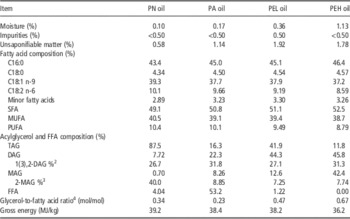
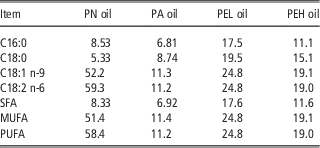
Experimental fats were supplied by SILO S.p.a. (Florence, Italy). Re-esterified palm oils were produced using, as raw materials, acid palm oil (a by-product obtained from the refining process of crude palm oil, with a high FFA content) and glycerol (a by-product obtained from the methylation process applied in biodiesel production), which were processed under high vacuum conditions (1 to 3 mmHg), for 4 to 6 h, at 190°C to 250°C, and without chemical catalysts. According to the stoichiometric proportion of FFA and glycerol, fats with the same FA profile (Table 1), but with different FA positional distribution (Table 2), and triacylglycerol (TAG), DAG and MAG proportions (Table 1) were obtained.
Chemical analyses of the experimental fatsFootnote 1

SFA=saturated fatty acids; MUFA=monounsaturated fatty acids; PUFA=polyunsaturated fatty acids; TAG=triacylglycerols; DAG=diacylglycerols; MAG=monoacylglycerols; FFA=free fatty acids.
1 Native palm oil (PN oil), acid palm oil (PA oil), re-esterified palm oil low in mono- and diacylglycerols (PEL oil), and re-esterified palm oil high in mono- and diacylglycerols (PEH oil).
2 The proportion of 1(3),2-DAG v.1,3-DAG.
3 The proportion of 2-MAG v.1(3)-MAG.
4 Estimated calculation based on the values of the acylglycerol and FFA composition.
Fatty acid positional distributionFootnote 1 within acylglycerol molecules of the experimental fatsFootnote 2 (%)

SFA=saturated fatty acids; MUFA=monounsaturated fatty acids; PUFA=polyunsaturated fatty acids.
1 Expressed as the proportion of each fatty acid located at the sn-2 position of the acylglycerol molecules, calculated as follows: sn-2%=(sn-2/Total)×a×100, where sn-2 is the FA composition at the sn-2 position, Total is the total FA composition in the original fat, and a is the ratio between the moles of FA located at the sn-2 position and the moles of total FA. a was 0.30, 0.09, 0.21 and 0.15 for PN, PA, PEL and PEH oils, respectively.
2 Native palm oil (PN oil), acid palm oil (PA oil), re-esterified palm oil low in mono- and diacylglycerols (PEL oil) and re-esterified palm oil high in mono- and diacylglycerols (PEH oil).
Oil samples were analyzed in triplicate for moisture (Method 926.12 of the Association of Official Analytical Chemists (AOAC), 2005), impurities (ISO 663:2007), unsaponifiable matter (Method 933.08 of the AOAC, 2005), acylglycerol and FFA composition (ISO 18395:2005), MAG and DAG positional isomers (Sacchi et al., Reference Sacchi, Addeo and Paolillo1997), total FA composition (Guardiola et al., Reference Guardiola, Codony, Rafecas, Boatella and López1994), sn-2 FA composition (Commission Regulation (EEC) No. 2568/91 – Annex VII), and gross energy content (IKA-Kalorimeter system C2000 basic; Staufen, Germany), as described in more detail in our previous report (Vilarrasa et al., Reference Vilarrasa, Tres, Bayés-García, Parella, Esteve-Garcia and Barroeta2014).
Animals and diets
The study was performed at the experimental farm of IRTA Mas de Bover (Constantí, Tarragona, Spain). The experimental procedure received the prior approval from the Ethical Committee of the same institution. All animal housing and husbandry conformed to the European Union Guidelines (2010/63/EU).
A total of 72 crossbred ((Landrace×Duroc)×Pietrain) boars and gilts, with an initial BW of 24.7±2.55 kg, were obtained from the swine herd of the same experimental station, blocked by initial BW (nine blocks of BW for each gender), and randomly assigned to one of the four dietary treatments. Animals were housed in adjacent individual boxes, had free access to feed and water, and were raised under controlled conditions of light and temperature.
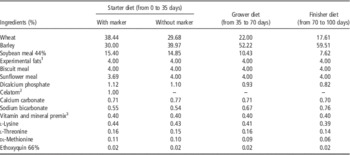
The experiment was planned to cover the BW range from ~25 to 100 kg of BW. For this purpose, the feeding program consisted of three diets (in pelleted form): a starter diet (from ~25 to 50 kg of BW; from 0 to 35 days of the experiment), a grower diet (from ~50 to 75 kg of BW; from 35 to 70 days of the experiment) and a finisher diet (from ~75 to 100 kg of BW; from 70 to 100 days of the experiment). Basal diets were formulated to meet or exceed (National Research Council, 2012) requirements and to minimize basal fat levels. One-half of the starter diet was supplemented with 1% of Celatom (Jesús Riesgo; Madrid, Spain) to increase the amount of HCl-insoluble ash as an inert digestibility marker and, thus, perform the digestibility balance. The four dietary treatments were the results of including 4% (as-fed basis) of one of the following experimental fats in the basal diets: native palm oil (PN), acid palm oil (PA), re-esterified palm oil low in MAG and DAG (PEL) or re-esterified palm oil high in MAG and DAG (PEH). The composition of experimental diets is presented in Table 3.
Ingredient composition of the experimental diets (as-fed basis)Footnote 1

1 Native palm oil (PN oil), acid palm oil (PA oil), re-esterified palm oil low in mono- and diacylglycerols (PEL oil) or re-esterified palm oil high in mono- and diacylglycerols (PEH oil).
2 Jesús Riesgo; Madrid, Spain.
3 Provides per kg of feed: vitamin A (from retinol), 5500 IU; vitamin D3 (from cholecalciferol), 1100 IU; vitamin E (from alfa-tocopherol), 7 mg; thiamine, 0.5 mg; riboflavin, 1.4 mg; pyridoxine, 1.0 mg; cobalamine, 0.008 mg; calcium pantothenate, 5.6 mg; nicotinic acid, 8 mg; menadione, 0.5 mg; Ca, 0.72 g; Mg, 57 mg; Fe (from FeSO4·7H2O), 80 mg; Cu (from CuSO4·5H2O), 10 mg; Co (from 2CoCO3·3Co(OH)2·H2O), 0.4 mg; Zn (from ZnO), 100 mg; Mn (from MnO), 40 mg; I (from Ca(I2O3)2), 0.5 mg; Se (from Na2SeO3), 0.25 mg; ethoxyquin, 2.67 mg.
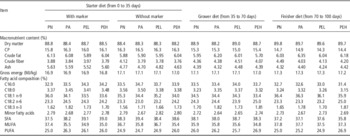
Analytical determinations of feeds were performed according to the methods of AOAC (2005): dry matter (Method 934.01), ash (Method 942.05), CP (Method 968.06), crude fat (Method 2003.05) and crude fiber (Method 962.09). Gross energy was determined as described previously for experimental fats and HCl-insoluble ash of pre-starter feeds was determined following the method of McCarthy et al. (Reference McCarthy, Aherne and Okai1974). Lipids from feeds were extracted with chloroform/methanol (2 : 1, by vol) according to the Folch et al. (Reference Folch, Lees and Sloane-Stanley1974) procedure. Nonadecanoic acid (C19:0, Sigma-Aldrich Chemical Co.; St. Louis, MO, USA) was added as an internal standard before processing. The FA content was analyzed following the method of Morrison and Smith (Reference Morrison and Smith1964). The macronutrient and the FA composition of the experimental diets are presented in Table 4.
AnalyzedFootnote 1 macronutrient content and fatty acid composition of the experimental diets (as-fed basis)Footnote 2

SFA=saturated fatty acids; MUFA=monounsaturated fatty acids; PUFA=polyunsaturated fatty acids.
1 All samples were analyzed, at least, in duplicate.
2 Diets with 4% (as-fed basis) of native palm oil (PN), acid palm oil (PA), re-esterified palm oil low in mono- and diacylglycerols (PEL), or re-esterified palm oil high in mono- and diacylglycerols (PEH).
Controls and sampling
The amount of feed and BW of the animals were recorded at the beginning and at the end of each phase (0, 35, 70 and 100 days of the experiment), which enabled the calculation of average daily feed intake, average daily gain and gain-to-feed ratio (G : F) for each period and for the overall study.
From day 6 to 9, a digestibility balance was undertaken. Feces were collected once a day by rectal stimulation and were immediately frozen at −20°C. On the last day of the balance, feces from each animal were pooled, homogenized, and a representative sample was freeze-dried, ground and kept at 5°C until further analyses. Fecal samples were analyzed by the same methods as those described for feeds (HCl-insoluble ash, gross energy and FA content) to determine the digestible energy of the diets and the apparent absorption of FA. The apparent absorption coefficient of a particular nutrient (X) was calculated as follows:
 $$\eqalignno{\%\,\,{\rm apparent}\,{\rm absorption}\,{\rm of}\,X=&\,\left\{ {{\rm 1}\!-{\rm [}(F_{X} /F_{M} )/(D_{X} /D_{M} ){\rm ]}} \right\}\cr &{\times}{\rm 1}00$$
where F X is the concentration of a particular nutrient in feces, F M is the concentration of the inert marker in feces, D X is the concentration of a particular nutrient in the diet and D M is the concentration of the inert marker in the diet. The digestible energy was calculated from the product of energy apparent absorption and its corresponding feed gross energy.
The acylglycerol and FFA composition of feces was analyzed according to ISO 18395:2005, in which TAG, DAG, MAG and FFA are separated according to their molecular size by size-exclusion HPLC. Before analysis, fat was extracted from feces with diethyl ether after acidification with HCl 1N. The acylglycerol molecules were quantified by internal normalization. Finally, these values were expressed as grams per 100 g of fat intake, based on values of fat apparent absorption.
At the end of the experimental period, three boars and three gilts of each treatment (those with BW close to the treatment average weight) were transported to the IRTA experimental abattoir (Monells, Girona, Spain). Animals were fasted (deprived of feed but not water) for ∼16 h. The following morning, they were reweighed to obtain the fasted live weight, stunned using 85% CO2 for 120 s, and killed by exsanguination. The carcasses were then scalded, mechanically dehaired before evisceration, split along the mid line and weighed. Fat and muscle thickness were measured using the Fat-O-Meat’er probe (Carometec A/S; Soeborg, Denmark) between the third- and the fourth-last ribs at 6 cm to the midline. Values obtained were used to calculate the lean meat percentage according to the Spanish official equation (Font-i-Furnols and Gispert, Reference Font-i-Furnols and Gispert2009). The liver and perirenal fat were weighed, and were expressed in absolute values and as a percentage of the live animal weight. Backfat samples (from the dorsal midline overlaying the m. longissimus dorsi) were taken, vacuum packed, and stored at −20°C until chemical analyses. The FA composition of backfat samples was analyzed following the same method as that described for feed and feces.
Statistical analysis
Normality of the data and homogeneity of the variance were verified. The experiment was designed as a randomized complete block design with nine blocks of initial BW within sexes and four dietary treatments. All data were subjected to ANOVA using the GLM procedure of SAS (version 9.2, SAS Institue Inc.; Cary, NC, USA). For carcass-fat depots and FA composition of backfat, the model only included dietary treatment as fixed effect and sex as a blocking factor. No interaction between sex and treatments was found to be significant for any of the variables studied. Differences between treatment means were tested using Tukey’s correction for multiple comparisons. Individual pig data served as the experimental unit, so there were 18 replicates per dietary treatment. For carcass-fat depots and FA composition of backfat, there were only six observations per dietary treatment. For perirenal fat and liver weights, the BW before slaughter was included as a covariate in the model. Results in tables are reported as least square means and differences were considered significant at P<0.05.
Results and discussion
Characterization of experimental fats
The chemical analyses of the experimental fats are presented in Table 1. Experimental fats showed a similar FA composition, indicating that the esterification of acid palm oil with glycerol did not substantially modify the FA composition of fat. More than 80% of the total FA was composed of palmitic (45.0±1.23%) and oleic (38.0±0.65%) acids.
Regarding the fat acylglycerol and FFA composition, PN oil, considered the positive control, was mainly composed of TAG. Acid palm oil, as a negative control, showed a high FFA content. Re-esterified oils contained 45.1±1.06% of DAG, almost no FFA, and variable amounts of TAG and MAG. Re-esterified palm oil high in MAG and DAG showed a higher amount of MAG (42.4% v. 12.6%) and a lower amount of TAG (11.8% v. 42.4%) than did PEL oil. In both re-esterified oils, 1(3)-MAG and 1,3-DAG were the major isomers.
The FA positional distribution within acylglycerol molecules (Table 2) found in PN oil was in agreement with that reported by Mattson and Volpenhein (Reference Mattson and Volpenhein1963), SFA being preferentially esterified at the sn-1,3 positions and unsaturated FA at the sn-2 position, as FA distribution in vegetable oils is genetically determined. However, the chemical esterification process does not allow a selective esterification of FA in the different glycerol positions. Therefore, compared with PN oil, re-esterified palm oils showed a certain redistribution of FA within acylglycerol molecules. Although this process did not result in a complete random distribution of FA (i.e. 33% of each FA should appear in the sn-2 position), re-esterified palm oils showed a higher percentage of SFA and, therefore, a lower percentage of MUFA and PUFA located at the sn-2 position, when compared with their corresponding PN oil. The reason for the lower proportion of sn-2 FA in PEH oil than in PEL was the higher 1(3)-MAG content of the former. In this sense, PA oil, due to its high FFA content, showed the lowest proportions of sn-2 FA.
Finally, indices of lipid quality (Table 1) showed low levels of moisture, impurities, and unsaponifiable matter for PN and PA oils, but yielded values above 2.5% for re-esterified palm oils.
Digestibility balance
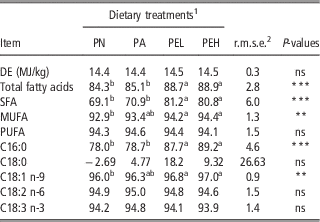
The effects of dietary fat sources on the digestible energy of the diets and the apparent absorption of individual FA are presented in Table 5. We only performed one digestibility balance at the beginning of the study. In a previous study, using the same experimental fats with weaning piglets (Vilarrasa et al., Reference Vilarrasa, Barroeta, Tres and Esteve-Garcia2015) only small differences were observed, and it was considered that this and the measurement in the current study would be representative of the digestibility of the fats under study. As expected, unsaturated FA were better absorbed than SFA, and stearic acid was less well absorbed than was palmitic acid. According to Doreau and Chilliard (Reference Doreau and Chilliard1997), as unsaturation increases, digestibility is increased, and as FA chain-length increases, digestibility is reduced. However, it must be taken into account that the apparent fecal absorption of individual FA is affected by microflora biohydrogenation of unsaturated FA in the hindgut, resulting in an underestimation of the apparent absorption of stearic acid and an overestimation of the apparent absorption of unsaturated FA of the C18-family (Duran-Montgé et al., Reference Duran-Montgé, Lizardo, Torrellardona and Esteve-Garcia2007). In any case, the total FA apparent absorption is not affected (Jørgensen et al., Reference Jørgensen, Jakobsen and Eggum1992).
Digestible energy of the diets (MJ/kg) and apparent total-tract digestibility coefficients (%) of fattening pigs according to different fat sources in diet

DE=digestible energy; SFA=saturated fatty acids; MUFA=monounsaturated fatty acids; PUFA=polyunsaturated fatty acids; ns=not significant.
a,bValues within a row with different superscripts differ significantly at P<0.05.
1 Diets with 4% (as-fed basis) of native palm oil (PN), acid palm oil (PA), re-esterified palm oil low in mono- and diacylglycerols (PEL) or re-esterified palm oil high in mono- and diacylglycerols (PEH).
2 n=18.
**P<0.01; ***P<0.001.
Contrary to what was expected, no differences in FA apparent absorption were found between PN and PA treatments (P>0.05). The same results were found by DeRouchey et al. (Reference DeRouchey, Hancock, Hines, Maloney, Lee, Cao, Dean and Park2004), who examined the effects of different levels of FFA in choice white grease in weaning piglets. In contrast, Powles et al. (Reference Powles, Wiseman, Cole and Hardy1993) reported that the FFA content of fats appeared to be one of the major determinants of the digestible energy values of fats when given to growing/finishing pigs. One possible explanation for the lack of differences between PN and PA oils could be related to the particular FA positional distribution of these fat sources. Both PN and PA oils showed a very similar proportion of SFA located at the sn-2 position of acylglycerol molecules (8.33% and 6.92% for PN and PA oils, respectively). This means that the amount of FFA as SFA after hydrolysis of PN oil by pancreatic lipase gives approximately the same amount of SFA as FFA as the PA oil. The difference of FFA was mainly relevant in the case of UFA (the proportion of UFA located at the sn-2 position of acylglycerol molecules was 52.8% and 11.3% for PN and PA oils, respectively). However, the effect of FFA on UFA absorption is lower in comparison with that of SFA (Powles et al., Reference Powles, Wiseman, Cole and Hardy1993). Thus, acid palm oils may be an economically interesting alternative to native palm oils, provided they have a moderate amount of FFA and a low percentage of moisture, impurities and unsaponifiable matter, as we have also observed in weaning piglets (Vilarrasa et al., Reference Vilarrasa, Barroeta, Tres and Esteve-Garcia2015).
Concerning the use of re-esterified palm oils, animals fed both PEL and PEH diets showed a higher total FA apparent absorption, compared with those fed their corresponding native (PN) and acid (PA) oil-enriched diets (P<0.001). These differences were mainly given by the enhanced SFA apparent absorption observed in both PEL and PEH treatments (P<0.001), although small differences were also found for the apparent absorption of monounsaturated FA (P=0.003). Nevertheless, these differences were not enough to be reflected in the feed digestible energy (P>0.05), probably because fat only accounted for 14% of feed gross energy.
The improved SFA apparent absorption observed in re-esterified palm oils may be related to their higher content of SFA located at the sn-2 position (Table 2), and also to their higher amount of MAG and DAG molecules (Table 1). The importance of the FA positional distribution within acylglycerol molecules on fat absorption has already been demonstrated by several authors (Carnielli et al., Reference Carnielli, Luijendijk, van Beek, Boerma, Degenhart and Sauer1995; Renaud et al., Reference Renaud, Ruf and Petithory1995; Lien et al., Reference Lien, Boyle, Yuhas, Tomarelli and Quinlan1997). For example, although lard and palm oil have similar levels of SFA, Renaud et al. (Reference Renaud, Ruf and Petithory1995) reported that rats fed with lard showed a higher total FA apparent absorption than did those fed with palm oil, because in lard the majority of palmitic acid is esterified at the sn-2 position, whereas in palm oil this SFA is mainly located at the sn-1,3 positions (Mattson and Lutton, Reference Mattson and Lutton1958) and, as a consequence, palmitic acid is easily absorbed as 2-MAG in lard or poorly absorbed as FFA in palm oil. In any case, it is important to note that our levels of sn-2 SFA were not as high as were those used in the studies cited above (from 33% to 84% of palmitic acid located at the sn-2 position). On the other hand, the importance of the presence of MAG and DAG molecules in dietary fats has been less studied. However, due to their amphiphilic properties, they may act as emulsifiers and might thus contribute towards improved digestion of fat. In this sense, Jones et al. (Reference Jones, Hancock, Harmon and Walker1992) observed that the addition of distilled MAG to tallow increased the digestibility of total FA and long-chain SFA in weaning pigs.
Acylglycerol and FFA composition of feces
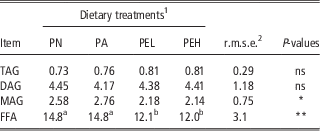
The acylglycerol and FFA composition of feces (in grams per 100 g of fat intake) is shown in Table 6. Feces contained low levels of TAG, DAG and MAG. This means that TAG and DAG were almost completely hydrolyzed along the gastrointestinal tract, and MAG were absorbed due to their hydrophilic character (2-MAG and some 1(3)-MAG) or completely hydrolyzed to glycerol and FFA (mainly 1(3)-MAG). FFA constituted the major lipid fraction in feces for all treatments, suggesting that the formation of mixed micelles may be the rate-limiting step of fat absorption in fattening pigs, as has also been observed in weaning piglets (Jones et al., Reference Jones, Hancock, Harmon and Walker1992; Vilarrasa et al., Reference Vilarrasa, Barroeta, Tres and Esteve-Garcia2015), but less severely.
Acylglycerol and FFA composition of feces (g/100 g of fat intake) according to different fat sources in diet

TAG=triacylglycerols; DAG=diacylglycerols; MAG=monoacylglycerols; FFA=free fatty acids; ns=not significant.
a,bValues within a row with different superscripts differ significantly at P<0.05.
1 Diets with 4% (as-fed basis) of native palm oil (PN), acid palm oil (PA), re-esterified palm oil low in mono- and diacylglycerols (PEL) or re-esterified palm oil high in mono- and diacylglycerols (PEH).
2 n=18.
*P<0.05; **P<0.01.
Regarding dietary treatments, differences were only observed for FFA content. Animals fed PEL and PEH excreted a lower amount of FFA than did those fed PN and PA (P>0.05). The amount of FFA excreted per 100 g of fat intake paralleled the results of SFA apparent absorption, suggesting that the emulsification of SFA is the most critical step in fat utilization, due to their strong tendency to form insoluble soaps with calcium and magnesium, at the alkaline pH of the small intestine (Renaud et al., Reference Renaud, Ruf and Petithory1995; Lien et al., Reference Lien, Boyle, Yuhas, Tomarelli and Quinlan1997).
Growth performance and carcass-fat depots
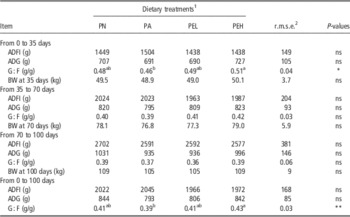
The effects of dietary fat sources on growth performance are presented in Table 7. Differences were only found for the G : F ratio in the starter period and in the overall experiment. Animals fed PEH showed a higher G : F than did those fed PA (P=0.001), and PN and PEL showed intermediate values. Thus, for the overall period, to gain 1 kg of BW, animals from the PA treatment needed to consume 10.7% more feed than did those from PEH (P<0.001), probably related to the lower coefficient of total FA apparent absorption reported in animals fed PA.
Growth performance of fattening pigs according to different fat sources in diet

ADFI=average daily feed intake; ADG=average daily gain; G : F=gain-to-feed ratio; ns=not significant.
a,bValues within a row with different superscripts differ significantly at P<0.05.
1 Diets with 4% (as-fed basis) of native palm oil (PN), acid palm oil (PA), re-esterified palm oil low in mono- and diacylglycerols (PEL) or re-esterified palm oil high in mono- and diacylglycerols (PEH).
2 n=18.
*P<0.05; **P<0.01.
In comparing our results with those of the literature, Scheeder et al. (Reference Scheeder, Gumy, Messikommer, Wenka and Lambelet2003) reported that the FA positional distribution of dietary fats did not affect growth performance in growing–finishing pigs. In relation to the fat acylglycerol composition, Murata et al. (Reference Murata, Ide and Hara1997), Taguchi et al. (Reference Taguchi, Nagao, Watanabe, Onizawa, Matsuo, Tokimitsu and Itakura2001) and Murase et al. (Reference Murase, Aoki and Tokimitsu2005) also did not find differences in the performance of rats fed DAG or TAG oil-enriched diets. In contrast, Meng et al. (Reference Meng, Zou, Shi, Duan and Mao2004) reported that the weight gain was lower in rats fed a DAG oil-rich diet, while Kamphuis et al. (Reference Kamphuis, Mela and Westerterp-Plantenga2003) observed a lesser feeling of hunger and appetite in women fed a DAG oil-enriched diet.
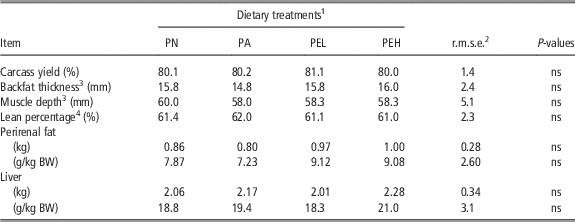
The effects of dietary fat sources on carcass yield and carcass-fat depots are presented in Table 8. Carcass yield, backfat thickness, muscle depth, carcass lean percentage and liver and perirenal fat proportions were not affected by dietary fat sources (P>0.05). Regarding the fat FA positional distribution effect, Ponnampalam et al. (Reference Ponnampalam, Lewandowski, Nesaratnam, Dunshea and Gill2011) did not find differences in body fatness (evaluated by backfat thickness) in weaning piglets fed palm oil-enriched diets with a different FA positional distribution (native palm oil, chemically modified palm oil or enzymatically modified palm oil). However, animals fed lard-enriched diets showed a greater external adipose tissue thickness than did those fed native palm oil, which has a lower sn-2 SFA content. In relation to the fat acylglycerol composition, Murase et al. (Reference Murase, Aoki, Wakisaka, Hase and Tokimitsu2002) and Meng et al. (Reference Meng, Zou, Shi, Duan and Mao2004) have reported a reduced accumulation of fat in visceral adipose and subcutaneous tissue, and a reduced fat content in the liver of animals fed 1,3-DAG-enriched diets, as compared with those fed TAG of the same FA composition. The presence of dietary 1,3-DAG has been shown to increase β-oxidation of FA in the liver (Murata et al., Reference Murata, Ide and Hara1997) and in the small intestine (Murase et al., Reference Murase, Aoki, Wakisaka, Hase and Tokimitsu2002). We might not have encountered significant differences in fat depots of animals fed re-esterified palm oils because the effect of MAG and DAG might have counteracted the effect of sn-2 SFA.
Carcass yield and carcass-fat depots of fattening pigs according to different fat sources in diet

ns=not significant.
1 Diets with 4% (as-fed basis) of native palm oil (PN), acid palm oil (PA), re-esterified palm oil low in mono- and diacylglycerols (PEL) or re-esterified palm oil high in mono- and diacylglycerols (PEH).
2 n=6.
3 Measurement made between the third and fourth last ribs at 6 cm to the carcass midline with Fat-O-Meat’er (Carometec A/S; Soeborg, Denmark).
4 Calculated from backfat thickness and muscle depth between third and fourth last ribs using the Spanish official equation (lean percentage (%)=66.91–0.895×backfat thickness+0.144×muscle depth; Font-i-Furnols and Gispert, Reference Font-i-Furnols and Gispert2009).
FA composition of backfat
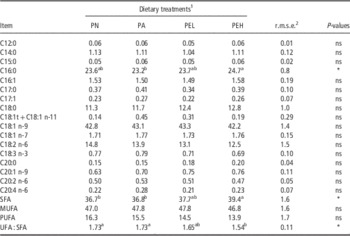
The effect of dietary fat sources on FA composition of backfat is presented in Table 9. The FA composition of backfat was a clear reflection of the FA composition of diets, as has been extensively reviewed by Madsen et al. (Reference Madsen, Jakobsen and Mortensen1992). However, although finisher diets showed a very similar FA composition, PEH animals tended to deposit more SFA than did PN and PA ones, which in turn resulted in a lower unsaturated-to-saturated FA ratio (P<0.05). This difference may be related to the higher SFA apparent absorption observed for PEH treatment, although a higher SFA content should have also been expected in animals from PEL treatment. In agreement with our results, Smink et al. (Reference Smink, Gerrits, Hovenier, Geelen, Lobee, Verstegen and Beynen2008) demonstrated that the feeding of randomized palm oil instead of native palm oil significantly raised the palmitic acid content of breast meat and abdominal fat in broiler chickens. Ponnampalam et al. (Reference Ponnampalam, Lewandowski, Nesaratnam, Dunshea and Gill2011) also observed that weaning piglets fed diets with chemically or enzymatically modified palm oil deposited more SFA in the subcutaneous adipose tissue than did those fed a diet with native palm oil. In contrast, Innis et al. (Reference Innis, Dyer, Quinlan and Diersen-Schade1996) and Scheeder et al. (Reference Scheeder, Gumy, Messikommer, Wenka and Lambelet2003) did not find differences in the FA composition of adipose tissue of pigs fed inter-esterified and native fats.
Fatty acid composition (%) of backfat according to different fat sources in diet

SFA=saturated fatty acids; MUFA=monounsaturated fatty acids; PUFA=polyunsaturated fatty acids; UFA : SFA=unsaturated-to-saturated fatty acid ratio; ns=not significant.
a,bValues within a row with different superscripts differ significantly at P<0.05.
1 Diets with 4% (as-fed basis) of native palm oil (PN), acid palm oil (PA), re-esterified palm oil low in mono- and diacylglycerols (PEL) or re-esterified palm oil high in mono- and diacylglycerols (PEH).
2 n=6.
*P<0.05.
Taken together, results of the present study indicate that feeding fattening pigs with diets supplemented with re-esterified palm oils resulted in a higher total FA apparent absorption, mainly due to the increased absorption of SFA, than did their corresponding native and acid oils. This resulted in a greater feed efficiency and an increased SFA deposition in backfat of pigs fed PEH when compared with those fed PA. Thus, we conclude that re-esterified oils are interesting fat sources to be considered in fattening. However, further studies are needed to determine whether the use of re-esterified palm oils can affect the FA positional distribution of meat and fat depots, because a higher content of SFA at the sn-2 position of TAG in meat could lead to increased SFA availability for the consumer.
Acknowledgments
This work was carried out thanks to the financial support provided by the Ministerio de Economía y Competitividad of the Spanish Government (Projects AGL2010-22008-C02 and CTQ2012-32436), a pre-doctoral research grant from the Generalitat de Catalunya (Ref. 2012FI_B 00406), and a post-doctoral research grant from the Generalitat de Catalunya and the EU through the Beatriu de Pinós Post-doctoral Program (Ref. 2011BP_B 00113). The authors are also grateful to SILO S.p.a. (Florence, Italy) for providing the experimental fats. This manuscript has been proofread by Mr Chuck Simmons, a native English-speaking University Instructor of English.