Background
With the faster rate of growth of the elderly population in developing countries compared to the global rate, in India too the proportion of elderly people is increasing at an increasing rate and is projected to reach 19 per cent in 2050 from 8 per cent in 2015. Unlike developed countries, the ageing process in developing countries is not accompanied by increases in personal income and the governments of the developing countries are slow in responding to the demographic shift (Kowal et al., Reference Kowal, Kahn, Ng, Naidoo, Abdullah, Bawah, Binka, Chuc, Debpuur, Ezeh, Gomez-Olive, Hakimi, Hirve, Hodgson, Juvekar, Kyobutungi, Menken, Minh, Mwanyangala, Razzaque, Sankoh, Streatfield, Wall, Wilopo, Byass, Chaterji and Tollman2010; Giridhar et al., Reference Giridhar, James and Kumar2017). Studies suggest that these developing countries will have even less time to adapt their institutional structures to the health and income problems of elderly people compared to developed countries like the United States of America (Smith, Reference Smith1994). This demographic shift has been a result of an advance in mortality transition, a movement from the dominance of child and adult mortality to old-age mortality, and this trend is visible in both rural and urban areas (Yadav and Arokiasamy, Reference Yadav and Arokiasamy2013). This demographic transition which the rich industrialised countries of Western Europe, North America and Japan experienced earlier, is now occurring in developing countries, being associated with a huge burden of non-communicable diseases (Beaglehole and Yach, Reference Beaglehole and Yach2003; Boutayeb, Reference Boutayeb2006; Ghosh and Arokiasamy, Reference Ghosh and Arokiasamy2009; Shradhha et al., Reference Shradhha, Prasantha and Prakash2012; Barik and Arokiasamy, Reference Barik and Arokiasamy2016). Along with the physical health morbidities, population ageing in India has led to a rise in mental health morbidities too (Chandrashekhar et al., Reference Chandrashekhar, Gududur and Reddy2014; George et al., Reference George, Deshpande, Kumar and Patil2017). In the case of India, by 2030 almost half of the disease burden will be borne by elderly people with high levels of non-communicable diseases, smoking habits and physical inactivity (Chatterji et al., Reference Chatterji, Kowal, Mathers, Naidoo, Verdes, Smith and Suzman2008; Munsur et al., Reference Munsur, Tareque and Rahman2010). The regional case studies in India and other countries also reflect that the prevalence of unhealthy lifestyles is associated with morbidity among elderly people (Simsek et al., Reference Simsek, Doganay, Budak and Ucku2014; Machón et al., Reference Machón, Vergara, Dorronsoro, Vrotsou and Larrañaga2016; Gagauz et al., Reference Gagauz, Avram and Pahomii2017; Kaur et al., Reference Kaur, Bansal, Anand, Kumar and Singh2017). Also there occurred a steady deterioration in self-perceived health status among Indian elderly people over the recent decades, even after controlling for socio-economic characteristics (Husain and Ghosh, Reference Husain and Ghosh2010). All these studies pointed towards policies to address the problems of geriatric health care.
Although in Asia and Africa, co-residence with adult children is most common, living arrangements are changing with rising education levels as families are becoming more nuclear due to migration to cities, preference for privacy, etc. (Bongaarts and Zimmer, Reference Bongaarts and Zimmer2002). Also urbanisation, modernisation and globalisation, leading to changing economic structure and the younger generation searching for new identities encompassing economic independence, led to reduced dependence on land which had been a factor in keeping the intergenerational bonding strong, weakening the joint family structure (Bhat and Dhruvarajan, Reference Bhat and Dhruvarajan2001). Also, the intergenerational spacing leading to the spread between grandparents and grandchildren is associated with lesser family bonding (Bloom and Eggleston, Reference Bloom and Eggleston2014). With erosion of the joint family system and moving towards the nuclear family system, the changes are leading to worsening of the physical and mental health of Indian elderly people and old-age homes are emerging in India (Lamb, Reference Lamb2007). Among elderly people, childlessness and widowhood have been important factors in deciding to opt for old-age homes (Munsur et al., Reference Munsur, Tareque and Rahman2010; Kalavar and Jamuna, Reference Kalavar and Jamuna2011). Although co-residence does not always ensure healthy relationships between successive generations as the elderly people often face abuse there (Munsur et al., Reference Munsur, Tareque and Rahman2010), nor does it always indicate flow of support from younger to elderly people as it also sometimes indicates child care or help in household chores by elderly people (Chan, Reference Chan1997; Irudaya, Reference Rajan Irudaya1999), empirical evidence is there that multigenerational households, the traditional form of living arrangement in India, have some potential protective health benefits for older adults (Ghosh and Husain, Reference Ghosh and Husain2010; Agarwal, Reference Agarwal2012; Samanta et al., Reference Samanta, Chen and Reeve2015).
In the face of decaying family support systems, economic security emerges as one of the most important determinants of health status as economic dependence has made elderly people more vulnerable (Alam and Karan, Reference Alam and Karan2011; Alam et al., Reference Alam, James, Giridhar, Sathyanarayana, Kumar, Raju, Syamala, Subaiya and Bansod2012; Gagauz et al., Reference Gagauz, Avram and Pahomii2017. Physical vulnerability in combination with economic vulnerability creates emotional vulnerability, which aggravates the self-perceived health status (Gupta and Sankar, Reference Gupta and Sankar2003). Irrespective of gender and place of residence, economically independent elderly people in comparison to their dependent counterparts reported better health status (Gupta and Sankar, Reference Gupta and Sankar2003; Rajan and Kumar, Reference Rajan and Kumar2003; Roy and Chaudhuri, Reference Roy and Chaudhuri2008; Alam, Reference Alam2009; Mini, Reference Mini2009; Ghosh and Husain, Reference Ghosh and Husain2010). Economic independence, by providing a sense of security, enhances the psycho-mental health conditions which gets reflected in a better self-perceived health status. Also, economically independent elderly people might have more decision-making power on spending as well (Alam et al., Reference Alam, Mazumdar and Yadav2015). Along with economic dependence, the economic position of the households which the elderly people belong to always acted as a significant influencer on the health status of elderly people. The rich enjoy a better health status compared to the poor (Huisman et al., Reference Huisman, Kunst and Mackenbach2003; Roy and Chaudhuri, Reference Roy and Chaudhuri2008; Kowal et al., Reference Kowal, Kahn, Ng, Naidoo, Abdullah, Bawah, Binka, Chuc, Debpuur, Ezeh, Gomez-Olive, Hakimi, Hirve, Hodgson, Juvekar, Kyobutungi, Menken, Minh, Mwanyangala, Razzaque, Sankoh, Streatfield, Wall, Wilopo, Byass, Chaterji and Tollman2010; Alam et al., Reference Alam, Mazumdar and Yadav2015; Gagauz et al., Reference Gagauz, Avram and Pahomii2017). Elderly people in upper expenditure quintiles are more likely to report better health compared to those in lower expenditure quintiles (Dhak, Reference Dhak2009) as elderly people in upper expenditure quintiles are better taken care of, provided with a healthier diet, less likely to face abuse and enjoy better health status compared to their counterparts in lower expenditure quintiles (Munsur et al., Reference Munsur, Tareque and Rahman2010). Across the world, economic condition appears to be a crucial factor as it influences many other determinants of health status (Husain and Ghosh, Reference Husain and Ghosh2010). At the country level too, although the effects of age have been much larger than national income on self-perceived health status, and self-perceived health status has deteriorated with age, the rate of deterioration has been much lower in the case of high-income countries compared to low-income countries. High national income moderates the influence of age on health status and thus the decline in health satisfaction with age is much stronger in poor countries than rich countries (Deaton, Reference Deaton2008). Among elderly people, the work participation rate is much higher among the poor and uneducated compared to rich and educated groups, which indicates that their workforce participation is out of economic compulsion (Alam et al., Reference Alam, James, Giridhar, Sathyanarayana, Kumar, Raju, Syamala, Subaiya and Bansod2012). Regarding the work status, the perception of bad health increased from paid workers to unpaid and not working elderly people (Dhak, Reference Dhak2009; Ghosh and Husain, Reference Ghosh and Husain2010; Tareque and Rahman, Reference Tareque and Rahman2010; Maniscalco et al., Reference Maniscalco, Miceli, Bono and Matranga2020). The influence of regular cash flow increases the likelihood of reporting better health in the case of employed elderly people compared to their unemployed counterparts by protecting from financial deprivation (Alam et al., Reference Alam, Mazumdar and Yadav2015; Smolic, Reference Smolic2017).
With this background, the purpose of this research is to investigate how the variables like state of economic independence and employment status influence the self-perceived health status of elderly people in India, and how these impacts vary across the level of expenditure quintiles of the households as with different levels of economic resources of the households, the importance of these variables on self-perceived health status may differ.
Database and methodology
In this study, we used the database of the Social Consumption: Health Survey of the 75th round of the National Sample Survey. The National Sample Survey Organization conducts nationally representative large-scale population-based surveys. The Health Survey was conducted from July 2017 to June 2018 with the purpose of collecting information on health at the household level. Apart from the basic demographic and socio-economic particulars, the dataset provides detailed information on people above 60 years of age. The information set includes self-reported health status, state of economic dependence, living arrangement, state of physical mobility, whether suffering from chronic morbidity or not, etc., which have been used in this study.
As the response variable in this model is the self-perceived health status which takes binary values, 0 in the case of poor health status and 1 in the case of good/excellent health status, the logistic regression model has been applied here. The main predictor variables in this model have been the state of economic dependence and the employment status. Regarding the state of economic dependence, the survey collects information on whether an elderly person is fully dependent, partially dependent on others or independent. Two categories have been formed for the state of economic dependence: the reference category including those partially or fully dependent on others and the second category representing those who are economically independent. The usual principal activity status codes are provided in the survey. A binary variable is formed for the employment status which takes the value of 1 when the elderly person is involved in any economic activity as self-employed/unpaid family worker/regular salaried/casual wage labour and 0 otherwise, being the reference category. As the objective of the study is to look into the impact of the state of economic independence and the employment status on self-perceived health status across different expenditure quintiles of households, logit regression has been run separately for each expenditure quintile group along with measuring the impact in aggregate for all the expenditure quintiles together.
The control variables in this model are the different demographic and socio-economic factors like place of residence in terms of rural and urban areas, gender, social category, marital status, general education, living arrangements, health-related factors like health insurance coverage, physical mobility and chronic illness. The reference categories in the case of place of residence, gender, social category, marital status are rural areas, male, other castes and currently married, respectively. Six age groups are formed for the following age brackets: 60–64, 65–69, 70–74, 75–79, 80–84, 85 and above, with 60–64 years being the reference group. Four levels of general education are created: level 1 consisting of those without literacy; level 2 for those who are literate with or without formal schooling; level 3 for those below primary to middle school; level 4 includes those with education up to secondary and higher-secondary; and level 5 representing graduates, postgraduates and above, with level 1 being the reference category. In the case of health insurance coverage, the reference category is elderly people without any insurance coverage. Living arrangement has been categorised into staying with spouse/children/spouse and children, and living alone/in old-age homes/living with relatives/non-relations, with the latter being the reference category. In case of physical mobility and chronic illness, those who are physically immobile and suffering from chronic disease are the reference categories, respectively.
Results
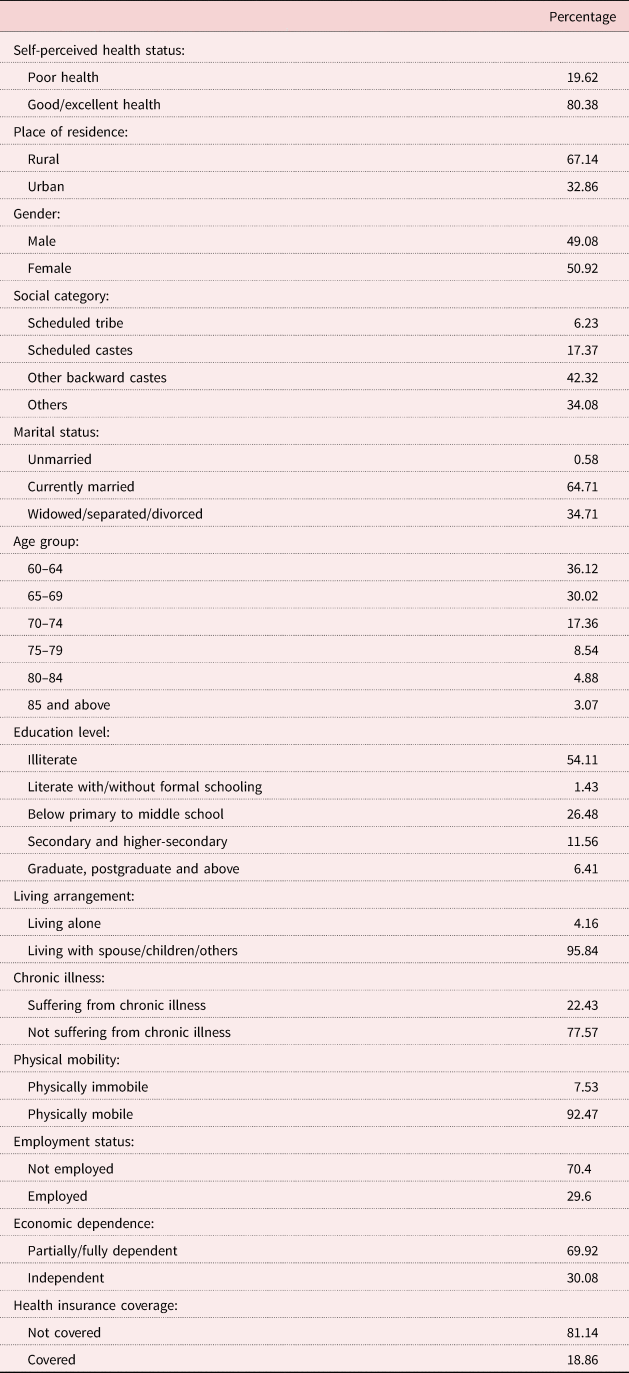
The elderly population majorly reported good/excellent health when asked about their self-perceived health status (Table 1). Predominantly the elderly population stays in rural areas. Their population is almost evenly distributed among men and women. The major social category among the elderly population had been other backward castes, followed by others, scheduled castes and scheduled tribe, respectively. The largest proportion of the elderly people is currently married followed by widowed/separated/divorced. Around 83.5 per cent of the elderly people were below 75 years of age. More than 50 per cent of the elderly people are illiterate. More than 95 per cent of the elderly people stay with spouse/children/others. Around 22 and 7 per cent of the elderly people are suffering from chronic illness and are physically immobile, respectively. A substantial proportion of the elderly people, around 70% of them, are unemployed and also around 70% of them are economically dependent on others. Most of the elderly people do not have any health insurance coverage.
Socio-economic, demographic and health-related characteristics of the population

Note: N = 42,760.
Source: Social Consumption: Health Survey, 75th round of the National Sample Survey.
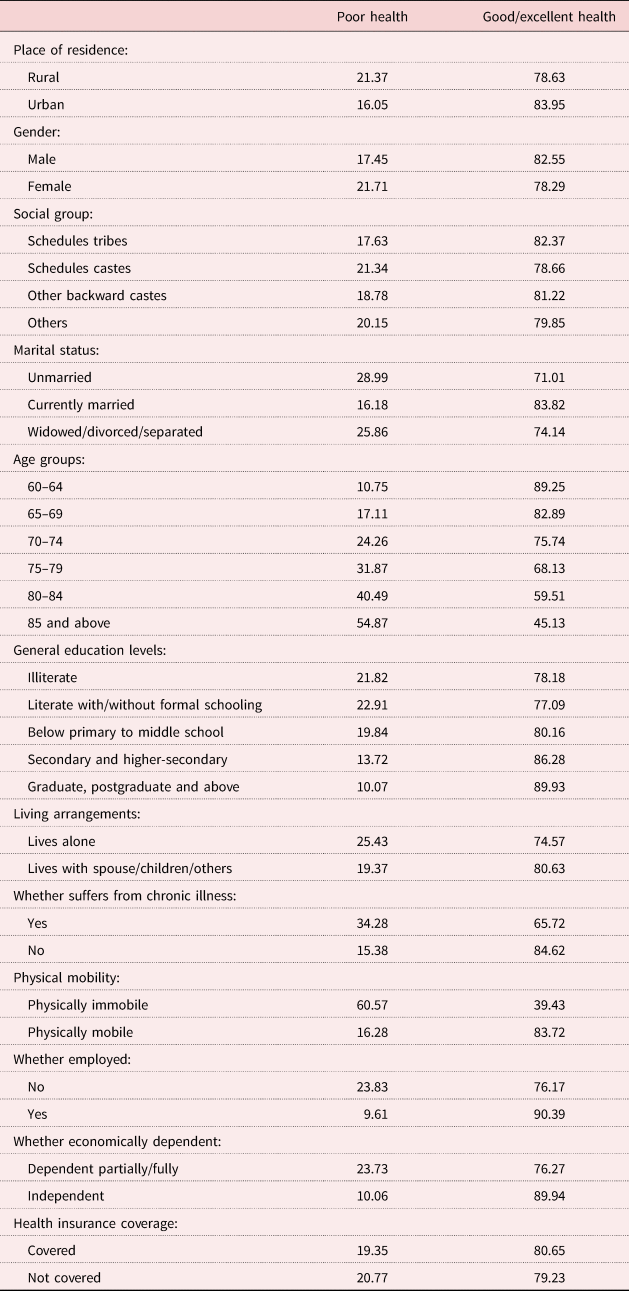
Table 2 enables us to compare the socio-economic, demographic and health-related characteristics between the elderly people reporting poor self-perceived health status and elderly people reporting excellent/good health. A higher percentage of elderly people in rural areas in comparison to urban areas reported poor health. More females tended to report poor health compared to males. More elderly people belonging to the other social category and scheduled castes reported poor health status compared to others. A higher percentage of married elderly people reported better health status compared to unmarried/divorced/widowed/separated ones. Among the elderly people, the more aged ones reported poorer health status. The elderly people tended to report better health with higher education level. Elderly people who live with spouse/children/others reported better health compared to those staying alone. Prevalence of chronic illness and physical immobility are associated with reporting poor health in much higher number of cases compared to those without any chronic illness and those with physical mobility, respectively. Those who are actively employed reported good health in more cases than others. The share of elderly people reporting good/excellent health is much higher among the economically independent compared to others. Self-reported health status does not differ much with health insurance coverage.
Socio-economic, demographic and health-related characteristics of the population by their self-perceived health status (shares mentioned in row percentages)

Note: N = 42,760.
Source: Social Consumption: Health Survey, 75th round of the National Sample Survey.
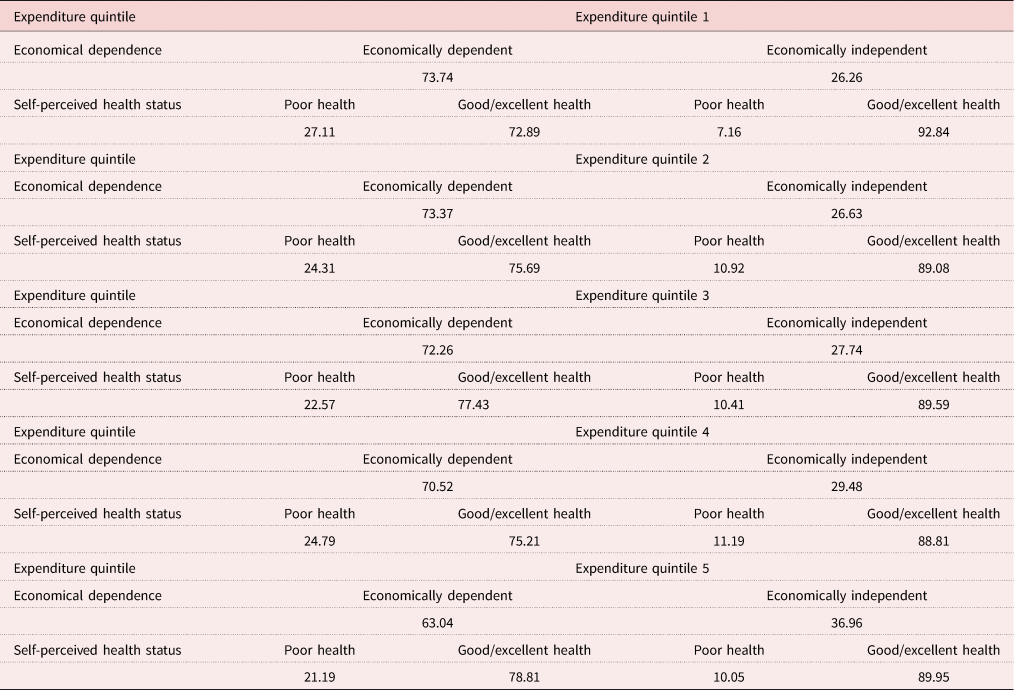
As the focus of the study is to find out the effect of economic vulnerability on the self-perceived health status of elderly people, it is worth looking at how the reporting of health status varies with state of economic dependence and employment status across the expenditure quintiles of the households to which the elderly people belong. Except the uppermost expenditure quintile where the share of economically independent elderly people stands at 37 per cent, for all other quintiles the share hovers around 26–29 per cent, as the share marginally increased moving up the expenditure quintiles. Elderly people who are economically dependent are far more likely to report poor health compared to the economically independent ones. However, the share of elderly people reporting poor health among the economically dependent ones declines to some extent when they belong to upper expenditure quintiles (Table 3).
Self-perceived health status among economically dependent and independent across different expenditure quintiles (shares mentioned in row percentages)

Note: N = 42,760.
Source: Social Consumption: Health Survey, 75th round of the National Sample Survey.
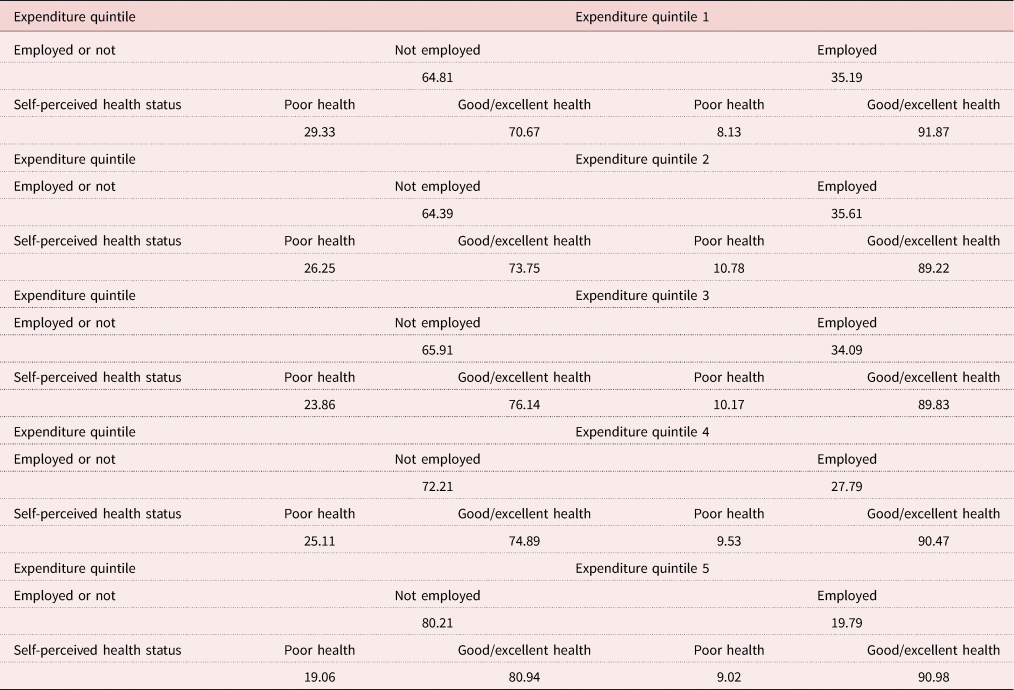
The share of elderly people who are employed declined as they belong to upper expenditure quintiles, with the shares of employed at around 35 per cent for the lowest expenditure quintile and 20 per cent for the uppermost expenditure quintile. The proportion of elderly people reporting good health is much higher among the employed compared to the unemployed in all expenditure quintiles. But the share of elderly people reporting poor health declined among the unemployed moving up the upper expenditure quintiles, with the share being at around 29 per cent for the lowest expenditure quintile and 19 per cent for the highest expenditure quintile (Table 4).
Self-perceived health status among employed and unemployed across different expenditure quintiles (shares mentioned in row percentages)

Note: N = 42,760.
Source: Social Consumption: Health Survey, 75th round of the National Sample Survey.
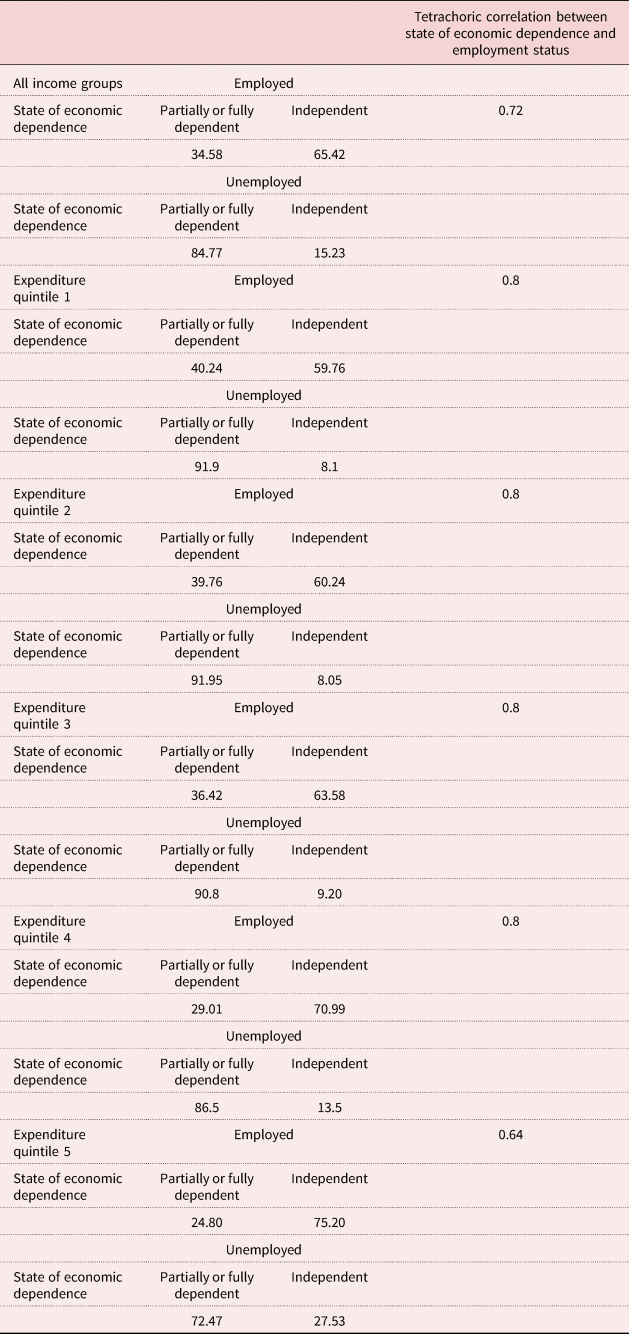
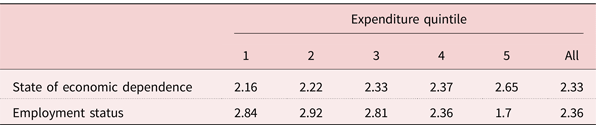
Looking into how employment status and state of economic dependence are associated with each other for all the expenditure groups together, it is found that for the employed around 35 per cent of the elderly people are partially or fully dependent economically on others. For the unemployed, around 15 per cent of the elderly people are economically independent. For the three lowest expenditure quintiles, among the unemployed the share of economically dependent elderly people is above 90 per cent. The share falls for the upper two quintiles and sharply for the uppermost expenditure quintile. For the employed, the share of economically dependent elderly people falls in the upper expenditure quintiles compared to the lower expenditure quintiles. The tetrachoric correlation between the two variables does not vary much among the expenditure groups of the households except the highest expenditure group, where it takes the lowest value (Table 5). The Variation Inflation Factor (VIF) for these variables after doing logit regression for all the expenditure quintiles indicates that although some correlation exists, it is still not enough to worry about and both the variables are included in our model to see their impact separately (see Appendix Table A1).
State of economic dependence among employed and unemployed elderly people (shares mentioned in row percentages)

Note: N = 42,760.
Source: Social Consumption: Health Survey, 75th round of the National Sample Survey.
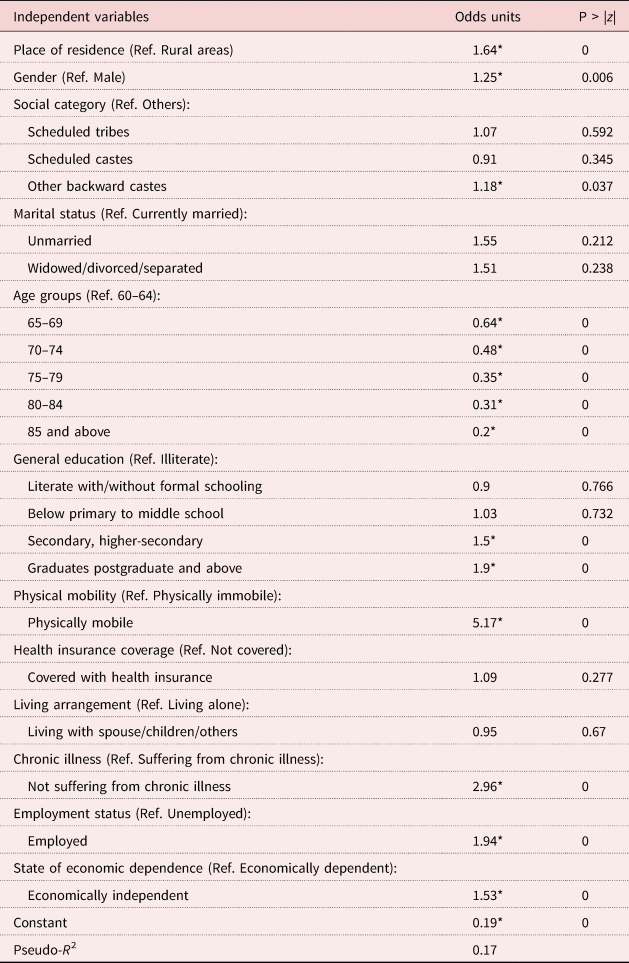
According to the logistic regression model, place of residence, gender, age, education level, physical mobility, presence of chronic illness are found to be statistically significantly associated with self-perceived health status among the control variables (Table 6). Urban residents, female, less aged and elderly people with education level above secondary are found to be more likely to report good/excellent health in comparison to rural residents, male, elder cohort among the elderly people and elderly people with education level below secondary level. Also, the elderly people who are physically immobile or suffering from chronic disease are more likely to rate their health as poor.
Odds ratios of the predictors in logit regression results for all the expenditure quintiles

Notes: N = 42,760. Ref.: reference category.
Source: Social Consumption: Health Survey, 75th round of the National Sample Survey.
P > |z| indicating the probability of two-tailed z statistic, * indicates the coefficients to be statistically significant at 5% level.
The main predictor variables in this model have been the employment status and state of economic dependence. After controlling for other social and demographic variables, regarding employment status it is found that elderly people who are employed are 1.9 times more likely to report their health as good or excellent in comparison to those who are unemployed. There exists a significant association between states of economic dependence and reporting of health status too. Being economically independent significantly increases the likelihood by 1.5 times of rating their health as good or excellent compared to the partially or fully economically dependent ones.
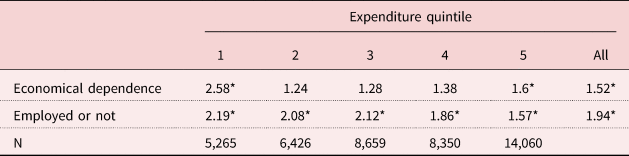
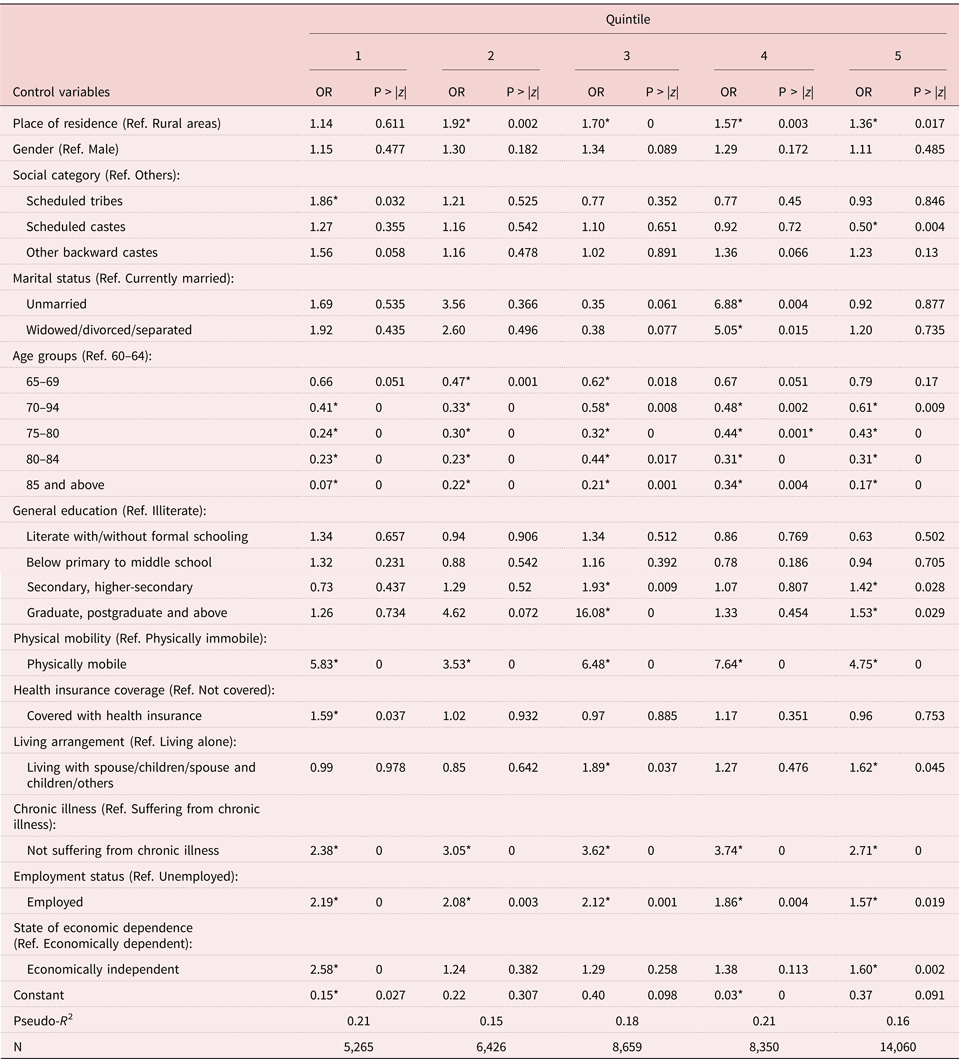
As the purpose of the study is to look into whether the association of the state of economic dependence and employment status with self-perceived health status varies with household expenditure quintile classes, logit models are run separately for each expenditure quintile (Table 7). It appears that employment status has a significant influence on self-perceived health status in all the expenditure quintiles. But the importance of being employed on reported health status declines when moving to the upper expenditure quintiles, as indicated by the odds ratios. Whereas in case of the lowest expenditure quintile, employed elderly people are 2.2 times likely to report good/excellent health compared to their unemployed counterparts, in case of the uppermost expenditure quintile, being employed increases the likelihood of reporting good/excellent health by only 1.6 times compared to unemployed ones. In the case of state of independence, the influence on self-perceived health was significant only among elderly people belonging to households in the lowest and highest expenditure quintiles. The results indicate that the status of economic independence has been much more impactful on reported health status among the elderly people in the lowest expenditure quintile in comparison to those in the upper expenditure quintile. The detailed results of the regression models for the different expenditure quintile classes are in Appendix Table A2.
Odds ratios for the main predictor variables from logit regression results for different expenditure quintiles

Source: Social Consumption: Health Survey, 75th round of the National Sample Survey.
* Indicates the coefficients to be significant at 5% level.
Discussion
Self-perceived health status has been taken as the dependent variable in the study. Although a study indicated that elderly Indians tend to report more positive perception of health than that indicated by objective measures (Cramm et al., Reference Cramm, Bornscheuer, Selivanova and Lee2015), many suggest that although there are many factors like life and work pressure, spiritual status, interpersonal relations, level of education, material welfare and presence of behavioural vices which influence self-rated health, it is still a good reflector of objective health status (Wu et al., Reference Wu, Rui, Yanfang, Ma, Wu, Yan and He2013; Gagauz et al., Reference Gagauz, Avram and Pahomii2017). Self-rated health captures illness in a more inclusive manner, even the diseases yet to be diagnosed but present in a preclinical stage, and is also thought to be a dynamic evaluation of health, not only the current state of health, and a good predictor of mortality as well (Idler and Benyamini, Reference Idler and Benyamini1997; Menec et al., Reference Menec, Chipperfield and Perry1999; Rahman and Barsky, Reference Rahman and Barsky2003).
After controlling for demographic, socio-economic and health-related factors, the logit regression results prove that state of economic independence and employment status significantly influence self-perceived health status. For all the income groups together, being economically independent increases the likelihood of reporting good/excellent health compared to their economically dependent counterparts. In the current trend of eroding joint family systems, economic security emerges as a major issue for the wellbeing of elderly people (Rajan and Kumar, Reference Rajan and Kumar2003). Often economic dependence is associated with absence of power and autonomy, and lack of decision-making power in the family. Because of being economically dependent, the cost of treatment in cases of illness is often a burden on the household and thus elderly people ignore the ailments until they become acute but till then they affect their self-perceived health status (Rajan, Reference Rajan2006).
Another measure of economic vulnerability, the status of being employed, also has a significant positive impact on the reported health status of elderly people and improves the likelihood of rating their health as good/excellent even more than the state of economic independence. This result confirmed earlier studies that being engaged in wage-earning activity increases the likelihood of reporting better health compared to their non-working counterparts (Dhak, Reference Dhak2009; Ghosh and Husain, Reference Ghosh and Husain2010; Maniscalco et al., Reference Maniscalco, Miceli, Bono and Matranga2020). Apart from ensuring regular cash flow which acts as a protective factor, engaging in economic activity also ensures a physically active state and thus lower chances of non-communicable diseases (Chatterji et al., Reference Chatterji, Kowal, Mathers, Naidoo, Verdes, Smith and Suzman2008; Tareque and Rahman, Reference Tareque and Rahman2010; Maniscalco et al., Reference Maniscalco, Miceli, Bono and Matranga2020) and also helps in keeping physical mobility by maintaining functional mobility more (Cyarto et al., Reference Cyarto, Moorhead and Brown2004; Tareque and Rahman, Reference Tareque and Rahman2010). Daily bouts of physical activity at low to moderate intensity are found to enhance both the physical and psychological health of elderly people (Rejeski and Mihalko, Reference Rejeski and Mihalko2001).
The influence of the determinants varies over the expenditure quintiles of the households. Being economically independent has been much more impactful on self-reported health status for the lowest expenditure group in comparison to the uppermost expenditure group. Similarly, employment status comes out to be significant in the case of all the expenditure quintiles but the impact strictly decreases moving up to the upper expenditure quintiles. This indicates that the self-perceived health of elderly people in poorer households due to their higher economic vulnerability is more sensitive to their own state of economic independence. In the case of medical expenditure, the intra-household resource allocation is found to be proportional to the individuals’ contribution to the family resources (Kochar, Reference Kochar1999). This might stand true in case of other consumption expenditures too. In the case of poor households with low economic resources, the intra-household distribution is expected to be more discriminatory against elderly people, affecting their quality of life. But in the case of upper expenditure quintiles, financial resources are enough to take care of every family member, including elderly members. Studies suggest that among the economically affluent section, more elderly people expect that their dependence on children, both financial and emotional, will be taken care of, compared to elderly people in poor households. In the case of India, where land is an important and secure source of economic support, a survey found that landed elderly people are more confident of receiving old-age support from their children compared to their landless counterparts (Dharmalingam, Reference Dharmalingam1994).
Conclusion
The study concludes that factors like state of economic dependence and employment status are significant influencers of self-reported health status for elderly people but both factors become less important in the case of the upper expenditure quintiles of the households compared to the lower expenditure quintiles. This is because the intra-household resource allocation is often biased against elderly people as it is related to the economic contribution of the members (Kochar, Reference Kochar1999) and this bias is going to be more acute where the economic resources are limited.
In this context, the Indira Gandhi National Old Age Pension Scheme (IGNOPS), a part of the National Social Assistance Programme, seems to be an important measure in India in alleviating poverty among elderly people below the poverty line, by providing pensions covering around one-fifth of the elderly people in 2012–2013. Along with IGNOPS, the state governments also often provide financial assistance to the beneficiary elderly individuals with variation in the amount of assistance and age-group targeting among the elderly people, but IGNOPS is the biggest scheme of such kind.
However, the trend of public expenditure on IGNOPS shows that it has been very less in percentage terms of total public expenditure, total revenue expenditure and Gross Domestic Product to date. Given the high importance of the scheme in easing the financial constraint of poor elderly people, studies suggest that the pension expenditure should be increased after adjusting for inflation, the pension expenditure should be linked to economic growth and by correcting the inclusion and exclusion errors the coverage of the scheme should be extended to all eligible elderly people (Narayana, Reference Narayana2019). To tackle the high inclusion and exclusion error and ensure effective delivery of benefits, innovative measures like the banking correspondent model as implemented in Andhra Pradesh, could be adopted across the country (Asher et al., Reference Asher, Vora and Maurya2015).
Acknowledgement
I am thankful to Mr Jay Dev Dubey (Fellow II in the National Institute of Public Finance and Policy) for his help with the data.
Appendix
Variance Inflation Factor for state of economic dependence and employment status

Odds ratios for the predictors in logit regression results for all the expenditure quintiles