


Introduction
Obesity results when energy intake levels systematically exceed energy expenditure (Dietz, Reference Dietz, Bray, Bouchard and James1998.). For children, the principal learning environment with regard to these two factors is the family. Not only is there evidence from different research traditions that eating habits aggregate within families, it has also been shown that there are potentially modifiable risk factors for the development of overweight that can be identified in the home environment of the child (for interesting reviews see Faith, Scanlon, Birch, Francis and Sherry, Reference Faith, Scanlon, Birch, Francis and Sherry2004 and Ventura and Birch, Reference Ventura and Birch2008).
Especially relevant in this context are parental feeding control strategies, i.e. restricting children's access to unhealthy food and/or pressuring children to eat healthy food (Birch and Davison, Reference Birch and Davison2001). There are many studies evidencing that parental feeding control can lead to selective food preferences in children (Fisher and Birch, Reference Fisher and Birch1999) and diminished abilities to self-regulate their energy intake (Johnson and Birch, Reference Johnson and Birch1994), indirectly contributing to the development of overweight, as has been shown by means of longitudinal research designs (Faith, Scanlon et al., Reference Faith, Scanlon, Birch, Francis and Sherry2004; Francis and Birch, Reference Francis and Birch2005). Next to parental control, parents sometimes make use of other feeding strategies, especially when their children grow older (Robinson, Kiernan, Matheson and Haydel, Reference Robinson, Kiernan, Matheson and Haydel2001). Bourcier, Bowen, Meischke and Moinpour (Reference Bourcier, Bowen, Meischke and Moinpour2003) evaluated parental feeding strategies in families with children of different ages ranging from 0 to 17 years and found that the most commonly used feeding strategies were bringing home healthy foods, making healthy food and trying to set a good example. These strategies can be labelled as parental modelling. The development of eating routines (Birch and Fisher, Reference Birch and Fisher1998; Epstein, Paluch, Gordy and Dorn, Reference Epstein, Paluch, Gordy and Dorn2000), and also the promotion of healthy eating behaviour, may indeed be strongly influenced by the social context that serves as a model for the child (Tibbs et al., Reference Tibbs, Haire-Joshu, Schechtman, Brownson, Nanney and Houston2001; Addessi, Galloway, Visalberghi and Birch, Reference Addessi, Galloway, Visalberghi and Birch2005). These results recognize parents' role in shaping their children's health behaviour and underscore the need for involving the parents in the treatment of childhood obesity. Moreover, it has been evidenced that parents can influence the course of treatment by modifying the shared environment and by supporting their children's behavioural change (Epstein, Paluch, Roemmich, and Beecher, Reference Epstein, Paluch, Roemmich and Beecher2007).
Several review papers have focused on family-based approaches in the treatment of childhood obesity. All studies (Kitzmann and Beech, Reference Kitzmann and Beech2006; McLean, Griffin, Toney and Hardeman, Reference McLean, Griffin, Toney and Hardeman2003; St. Jeor, Perumean-Chaney, Sigmant-Grant, Williams and Foreyt, Reference St. Jeor, Perumean-Chaney, Sigmant-Grant, Williams and Foreyt2002), including the most recent Cohrane review (Luttikhuis et al., Reference Luttikhuis, Baur, Jansen, Shrewsbury, O'Mally and Stolk2009), point at significant and clinically meaningful weight outcomes of family-based lifestyle-interventions compared to standard care (dietary and physical interventions focused on the child) in both short and long terms. However, there is still no clear insight into which specific components of family-based interventions are of particular significance.
A meta-analysis (Young, Northern, Lister, Drummond and O'Brien, Reference Young, Northern, Lister, Drummond and O'Brien2007) found the largest effect sizes in interventions with a higher level of parental involvement. Dalton and Kitzmann (Reference Dalton and Kitzzman2008) also plead in favour of broadening parental involvement in paediatric overweight interventions. They argue that besides parental feeding strategies, general parenting skills should also be targeted. This approach is supported by studies showing an association between general family functioning and children's weight status (Lissau and Sorensen, Reference Lissau and Sorensen1994; Mendelson, White and Schlieker, Reference Mendelson, White and Schlieker1995). Moreover, as in other paediatric conditions, a family's ability to implement treatment recommendations and to manage their child's problem is related to their general family functioning (Dalton and Kitzmann, Reference Dalton and Kitzzman2008).
The most intensive parent-focused interventions are those that target the parents exclusively and focus on parenting-skills training. Golan, Fainaru and Weizman (Reference Golan, Fainaru and Weizman1998) randomly assigned participants to an experimental (parents as the agents of change) or a conventional (children as the agents of change) intervention. Children in both groups showed a significant decrease in degree of overweight at one-year follow-up, but the change was significantly greater in the parent intervention group (−14.6% vs. −8.4%). More recently, the parents-only approach was also chosen by Golley, Magarey, Baur, Steinbeck and Daniels (Reference Golley, Magarey, Baur, Steinbeck and Daniels2007) and by Munsch et al. (Reference Munsch, Roth, Michael, Meyer, Biedert and Roth2008). The former group examined the effectiveness of parent-skills training with and without intensive lifestyle education, as part of a parent-led weight-management project of children aged 6–9 years.
All groups of children (parent skills condition; parent skills + lifestyle education condition, waitlist condition) showed a significant reduction in BMI z-scores over 12 months (respectively 10% in the parent skills + lifestyle education and 5% in both the parent skills and waitlist condition; Golley et al., Reference Golley, Magarey, Baur, Steinbeck and Daniels2007). Munsch et al. (Reference Munsch, Roth, Michael, Meyer, Biedert and Roth2008) further explored the effectiveness of the parents-only approach by comparing it to a parent-child approach. Both treatments reduced children's percentage overweight significantly (−4.5% reduction for the parent-only program versus −1.9% in the parent-child program) and equally at a 6-month follow-up and they both produced similar results in reducing psychological problems in children.
An interesting question that arises from the above studies is the underlying mechanism of change. Parent management training generally starts from the assumption that parents are the mediator of change in a child's behaviour via their parental behaviour. This assumption implies that it is to be expected that behavioural changes in parental behaviour will occur first, eventually leading to changes in children's behaviour in the long term. However, in the context of childhood obesity treatment, it is not yet clear whether specific feeding strategies (e.g. parental control and modelling), or general parenting skills, should be targeted when working with the parents. A first important step in further examining the role of parental involvement will be to assess whether involvement in treatment actually does produce expected changes in parent health behaviour and/or parenting skills. A review by Kitzmann and Beech (Reference Kitzmann and Beech2006) of 31 family-based interventions for childhood obesity reveals that six studies included training of parenting skills, but only two of these incorporated this focus in the assessment of program effectiveness. Epstein, McKenzie, Valoski, Klein and Wing (Reference Epstein, McKenzie, Valoski, Klein and Wing1994) found a significant increase in parenting knowledge; however, these levels of improvement were similar for parents in the experimental and control conditions, independently of participation in the parenting training component of the treatment. Israel, Stolmaker and Andrian (Reference Israel, Stolmaker and Andrian1985) assigned parents and children either to a weight reduction only condition or a parent training condition that received the same treatment but was preceded by a short course for the parents in general child management skills. The parent training group showed increases in parental knowledge and superior maintenance of improved weight maintenance in children, supporting the importance of addressing general parental management skills in the treatment of childhood obesity. However, it remains to determine what specific changes in parental and children's behaviour were related to the success achieved, since these studies did not evaluate whether parental management skills were acquired.
Examining changes in parenting over the course of treatment can be helpful to understand the mechanism of change. In addition, it seems important to keep a developmental perspective in mind. The majority of family-based interventions for childhood obesity target parents of children aged 6–13 years. It seems that for that specific age group positive effects are reached when parents, instead of the child, take responsibility for managing the overweight (Summerbell et al., Reference Summerbell, Ashton, Campbell, Edmunds, Kelly and Waters2003).
The present pilot study aims to evaluate a parent-led intervention for overweight children between 6 and 12 years old. In addition to lifestyle education (increasing nutritional and physical activity knowledge), it includes parent skills training applied both in the feeding domain (parental modelling and feeding strategies) and also in general family functioning (positive involvement, supervision, house rules and consistent disciplining). The outcomes are compared to two control groups: a waitlist condition (Study 1) and a reference group (Study 2). The study examines both child's weight evolution and treatment-related behavioural changes in children and parents (children's eating behaviour, familial health principles and parental functioning). As such, this is the first intervention study incorporating both a narrow and a broad focus in terms of parent skills training and the assessment of outcomes.
It was hypothesized that the intervention group would produce a significant change in weight evolution in contrast to the waitlist condition (Study 1). Furthermore, the study expects positive weight and behavioural outcomes of all children of the parent training group at a 12-month follow-up as compared to the reference group (Study 2).
Method
Subjects
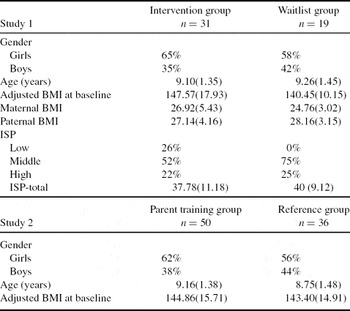
A total of 50 European (Caucasian) families with a child (19 boys and 31 girls) between 6 and 12 years old with a mean adjusted BMI (Actual BMI/Percentile 50 of BMI for age and gender x 100) of 144.86% participated in Study 1. The mean BMI z-score was 2.03 for boys (varying from 1.62 to 2.37) and 1.96 for girls (varying from 1.24 to 2.44). In Study 2, 86 families participated. They included all Study 1 families (n = 50) and an additional reference group of 36 families. The demographic and anthropometric characteristics of the participating families are described in Table 1.
Demographic and anthropometric characteristics of the 86 participating families and children: percentages or means (SD)

Notes: BMI, body mass index; ISP, index of social position.
For the Reference group no data on parental BMI and on ISP were available.
Procedure
Children and families were recruited between 2001 and 2006 through routine school health care and medical examinations in one region of Flanders. A referral folder explaining the goals and the content of the parent training project was handed out to all children aged between 6 and 12 years with a minimum adjusted BMI of 120%. A referral letter explaining the weight status of the child accompanied the referral folder. Interested parents were invited to contact the research group for an information session.
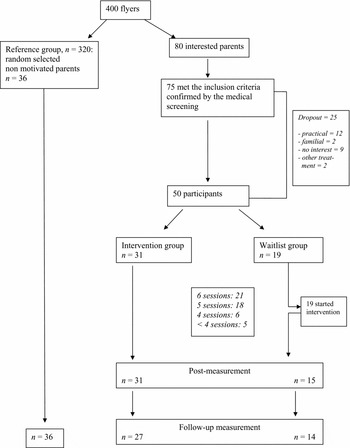
For Study 1, 80 families (approximately 20% of those to whom the referral folder was distributed) expressed an interest in participating; 75 of these met the inclusion criteria of (1) child's age between 6 and 12 years, (2) 20%-85% overweight, and (3) medical clearance from a physician (to exclude secondary overweight caused by endocrinological, chromosomal or hypothalamic diseases or by mental retardation). A total of 25 families dropped out after the medical screening and initial contact due to practical (n = 12) or familial (n = 2) constraints or no further interest (n = 9) or interference of an ongoing course of treatment (n = 2). The 50 families who remained were randomly assigned, on the basis of the date on which they contacted the research group, by an administrative co-worker to either the intervention group (n = 31) or the waitlist condition (n = 19; waited 6 months for the start of their intervention). Figure 1 summarizes participant flow through the study.
Participant flow through the study

For Study 2, all families belonging to the waitlist condition were invited to participate in a new parent training program, leading to a total of 50 families (parent training group). After the parent training, all families were invited to fill in post-measurement questionnaires. From those who did not respond to the original invitation, 36 families were randomly selected (= reference group) and their passive consent was obtained for their child's weight evolution to be monitored over a 22-month period. The protocol was approved by the Ethical Committee of the Ghent University.
Intervention program
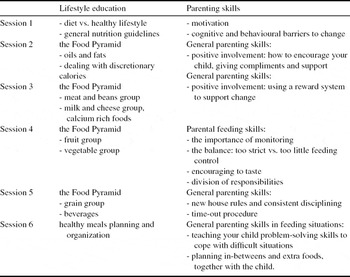
The training program used in this study involves six group meetings of 2 hours each over a 5-month period. The meetings are intended to provide the parents with information regarding an effective approach to overweight children, as a first step to preventing further weight gain. The goal is thus the achievement of weight control, not weight loss. Exclusively with the parents, ways and means of re-establishing a sense of healthy balance between energy intake and energy expenditure are explored. Sessions are conducted by a dietician and a psychologist under the supervision of a behavioural therapist. A manual of the intervention protocol (Braet, Joossens, Mels, Moens and Tanghe, Reference Braet, Joossens, Mels, Moens and Tanghe2007), describing in detail the goals and activities of each session, was available. Each family also received a comprehensive parent treatment work book. In the program the dietician educates the parents on the different food groups by providing detailed product information and child-friendly recipes. The psychologist's main goal is to help parents gain an understanding of their eating habits and lifestyles, whilst endeavouring to change behaviour and maintain the positive changes that have already been effected. Specific parental feeding strategies as well as general parental skills (based on social interactional theory; Patterson, Reid and Dishion, Reference Patterson, Reid and Dishion1992) are addressed to instruct parents on how to guide their children in accomplishing self-control and a healthier lifestyle. The inculcation of these various themes is facilitated by means of visual aids and graphics, brain storming exercises, worksheets, demonstrations and group discussions. The components of the different sessions are summarized in Table 2.
Content of the different treatment sessions

Measures
Height and weight. At admission, children were weighed (in light clothing) by a school physician on a balance-beam scale. Height (without shoes) was measured with a wall-mounted stadiometer. At post and at follow-up measurement weight and height were obtained by parental report. The adjusted BMI for all children (Actual BMI/Percentile 50 of BMI for age and gender x 100) was then calculated and overweight and obese status was identified in relation to a European body mass norm group in 0–21 year olds (Frederiks, van Buuren, Wit and Verloove-Vanhorick, Reference Frederiks, van Buuren, Wit and Verloove-Vanhorick2002). In addition, to compare the degree of overweight of the present European sample with US studies on overweight, BMI percentiles and BMI z-scores were calculated using a program provided by the Centres for Disease Control and Prevention (CDC; 2000). For parents, the BMI for adults (weight/height2) was calculated on the basis of parents' self-reported height and weight.
Measurement of children's variables. Children's eating behaviour was measured by the Dutch Eating Behaviour Questionnaire – Child version and Parent Version (original DEBQ, van Strien, Frijters, Bergers and Defares, Reference van Strien, Frijters, Bergers and Defares1986; Child version and Parent version, Braet, Soetens et al., Reference Braet, Soetens, Moens, Mels, Goossens and Van Vlierberghe2007; Braet et al., Reference Braet, Claus, Goossens, Moens, Soetens and Van Vlierberghe2008). This instrument assesses external eating (10 items), emotional eating (13 items) and restrained eating (10 items). Items are scored on a 5-point Likert scale and subscale scores are calculated by adding individual item scores. The DEBQ scales have proven psychometric value (van Strien et al., Reference van Strien, Frijters, Bergers and Defares1986). The phrasing of the Child version of the original DEBQ was slightly adapted in order to enhance the children's comprehension of the items but the content was not modified. (This version has been validated for children from 7 years and age-appropriate norms are available; Braet, Soetens et al., Reference Braet, Soetens, Moens, Mels, Goossens and Van Vlierberghe2007). The Parent version assesses the parental perspective on the child's eating behaviour. Recent research revealed satisfying internal consistency and external validity and a stable factor structure for the DEBQ Parent version (Braet, Soetens et al., Reference Braet, Soetens, Moens, Mels, Goossens and Van Vlierberghe2007) and the Child version (Braet et al., Reference Braet, Claus, Goossens, Moens, Soetens and Van Vlierberghe2008; Caccialanza et al., Reference Caccialanza, Nicholls, Cena, Maccarini, Rezzani and Antonioli2004; Ricciardelli and McCabe, Reference Ricciardelli and McCabe2001). The present study found Cronbach alphas varying from .77 to .95 for the Child version and from .84 to .97 for the Parent version.
Measurement of parental variables. The Ghent Parental Behavior Scale (GPBS, Van Leeuwen, Reference Van Leeuwen2000) is a self-rating questionnaire assessing parental skills, based on Social Learning Theory. Nine scales are distinguished: Positive parental behaviour, Monitoring, Rules, Discipline, Inconsistent discipline, Harsh punishment, Ignoring, Material rewarding, and Autonomy. Parents rate their own behaviour towards the target child (aged 8–14 years). The internal consistency of this instrument is acceptable to good, varying from .52 to .87 (Van Leeuwen and Vermulst, Reference Van Leeuwen and Vermulst2004).
A Health Principles Questionnaire was specifically developed for this study in order to assess family food and activity related habits. Parents rate eight food related questions (e.g. “How often does your child eat at a regular location, such as the kitchen table?” and three activity related questions (e.g. “How often do you engage in sports together?”) on a 7-point Likert scale (1 = never; 7 = always). Higher scores indicate a higher frequency of healthy habits. Internal consistency is acceptable, Cronbach alpha = .53.
The familial socio-economic situation was calculated using the Hollingshead Index of Social Position (ISP), which includes parents' education and occupation and results in an ISP-total score and five social position indexes (Hollingshead, Reference Hollingshead1975). In order to avoid cells with expected count less than five, we recoded the five social position indexes into three social classes (upper and upper middle into “high”, middle into “middle”, and lower middle and lower into “low”).
Missing data
Four families dropped out during the parent training programme. Consequently, data on height and weight were available for 46 out of 50 subjects (92%) at post measurement and for 41 subjects (82%) at follow-up. Questionnaires were completed by 38 out of 46 subjects (83%) of the participants. However, two DEBQ parent-version and two HPQ were withdrawn due to too many missing items and only 34 children filled in the DEBQ child version, due to age constraints.
Overview of the statistical analyses
Statistical analyses were carried out using SPSS 12.0. Potential covariates were measured at baseline (age, gender, weight status, socio-economic position and parental BMI) and differences by study group were examined through one-way analysis of variance and chi-squared.
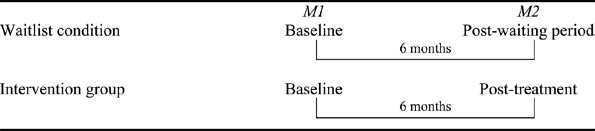
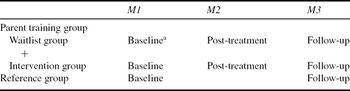
There were three measurements for the intervention group: baseline (M1), after 6 months (M2) and at one-year follow-up (M3). In study 1, there were two measurements for the waitlist condition: baseline (M1) and after the waiting period of 6 months (M2). In Study 2, there were two measurements for the reference group: baseline (M1) and follow-up (M3). Tables 3 and 4 summarize the time points of the measurements for Study 1 and Study 2 respectively.
Time point measurements of Study 1

Time point measurements of Study 2

a baseline measurement of waitlist condition = post-waiting period measurement
In Study 1, an ANOVA with repeated measures was conducted to examine the weight evolution of the children in the intervention group versus that of the children in the waitlist condition. Weight evolution was entered as a two-level within-subject factor (M1 and M2) and Group (intervention group versus waitlist condition) was entered as between-subject factor.
In Study 2, to examine the weight evolution of all children of the parent training group, an ANOVA with repeated measures was executed. Weight evolution was entered as a three-level within-subject factor (respectively M1, M2 and M3). Where appropriate, post-hoc analyses were conducted using pairwise comparisons with a Bonferroni correction in order to protect against inflation of the per family type I error rate (Howell, Reference Howell1997).
Another ANOVA with repeated measures examined the weight evolution of the children of the parent training group (intervention group + waitlist condition) versus that of the children from the reference group. Weight evolution was therefore entered as a two-level within-subject factor (M1 and M3) and Group (parent training group versus reference group) as between-subject factor. An intention to treat analysis with all participants included in the analysis according to original group allocation was conducted.
To examine training-related behavioural change in parents and children, doubly multivariate repeated measures were conducted with respectively children's eating behaviour (as measured by the DEBQ – child and parent version) and parenting skills (as measured by the GPBS) as within-subject factors. The evolution in parental health principles (as measured by the Health Principles Questionnaire) was examined by means of a paired sample t-test.
Results
Study 1
Participant characteristics at baseline are shown in Table 1. There were no significant differences in child's gender, age and adjusted BMI at baseline, in total ISP-score and in parental BMI between the families from the intervention group and the waitlist condition.
To compare the weight evolution of children in the intervention group versus the children in the waitlist group, an ANOVA with repeated measures was executed. A significant main effect of the within subjects factor Weight Evolution (F (1,47) = 6.70, p = .013) was revealed, but no significant interaction effect Time x Group was found. The decrease in adjusted BMI from baseline to the 6-month measurement was comparable in both groups (intervention group: M1 = 147.57% and M2 = 142.55%; waitlist group: M1 = 139.45% and M2 = 135.92%), but only significant in the intervention group, t(30) = 2.44, p = .021.
Study 2
There were no significant baseline differences between the intervention group and the reference group on child's gender, age and adjusted BMI.
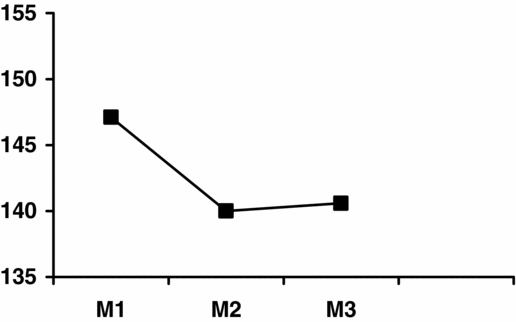
Weight evolution. To examine the weight evolution of all children of the parent training group, an ANOVA with repeated measures was conducted. A significant main effect of the within subjects factor Weight Evolution (F (2,39) = 9.16, p = .001) was revealed. The partial eta squared was .35, indicating a large effect size. The Adjusted BMI of all participants showed significant decreases over the three measurements (M1 = 147.11%, M2 = 140.00%, M3 = 140.60%). Pairwise comparisons showed significant differences between M1 and M2 (t(45) = 3.46, p = .001) and between the M1 and M3 (t(40) = 2.87, p = .006). The decrease from post to follow-up measurement was not significant. After applying the stringent Bonferroni correction (by lowering the significance level to .05/3 = .02), the results remain significant.
On a descriptive level we found that at baseline 54% of the children was overweight (120%-140% over ideal weight), 32% was obese (>140%-160% over ideal weight) and 14% was severely obese (>160% over ideal weight). At post-training, 13% of the subjects were no longer overweight, 44% were overweight, 30% were obese and 13% were still severely obese. In the overweight group as well as in the obese group 71% and 77% respectively of the children succeeded in maintaining or reducing their adjusted BMI from baseline to post measurement. In all groups there were children who managed to change their weight status over the treatment phase. In the overweight group, one quarter of the children were no longer overweight at post-training. In the obese group, one-third of the children reached an overweight status and in the severely obese group about one-third of the children lowered their weight status to obese.
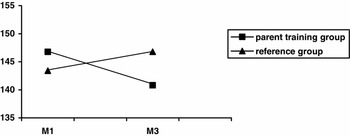
Second, to compare the weight evolution of all children of the parent training group versus the children of the reference group, an ANOVA with repeated measures was conducted. A significant interaction effect Weight Evolution x Group was found, indicating significant differences in weight evolution (F(1,75) = 10.77, p = .002). While the children of the parent training group showed a decrease in adjusted BMI from pre- to follow-up measurement (M1 = 146.77%, M3 = 140.81%), the reference group showed a slight increase in adjusted BMI over time (M1 = 143.40%, M3 = 146.78%). Figures 2 and 3 show the weight evolution of the parent training and the reference group.
Weight evolution of the parent training group (intervention group + waitlist group)

Weight evolution of the parent training group versus the reference group (pre to follow-up measurement)

On a descriptive level we found that in the reference group the percentage of overweight children remains similar from baseline to follow-up (i.e. 42%), while it seems that the heavier children become even heavier (a 3% increase of severely obese children at follow-up).
An intention to treat analysis was performed in which missing data (pre-post: n = 4; post-follow-up: n = 5) were replaced by the last available measurements. The same results were revealed.
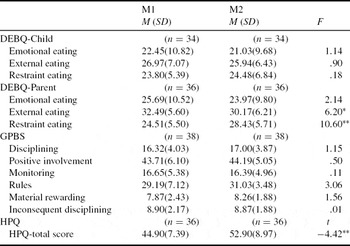
Training related behavioural change in children. Two doubly multivariate repeated measures were conducted with, respectively, the three subscales of the child-version and the parent-version of the DEBQ as within subject factors. For the child-version no significant main effect was revealed. Children report no significant changes in their eating behaviour over time. For the parent-version, a significant main effect of time was found (F(3,32) = 4.94, p = .006). The univariate tests reveal significant effects of time for dietary restraint (F(1,34) = 10.60, p = .003) and for external eating (F(1,34) = 6.20, p = .018), but not for emotional eating. Descriptives show an increase in dietary restraint in children (M1 = 24.51; M2 = 28.42) and a decrease in external eating of the children (M1 = 32.49; M2 = 30.17), as reported by the parents.
Training related behavioural change in parents. A paired sample t-test compared the total score of the Health Principle Questionnaire before and after the training and found a significant increase over time, t(31) = −4.42, p = .001 (M1 = 44.90; M2 = 52.90), indicating that parents report a significant increase in healthy eating and activity habits after the training.
A doubly multivariate repeated measure with the subscales of the GPBS as within-subject factors revealed no significant main effect of time, indicating that parents report no significant changes in general parenting skills after training; see also Table 5.
Mean scores and standard deviations on the DEBQ, GPBS and HPQ scales at pre- (M1) and post-measurement (M2)

Notes: * p< .01; ** p< .001;
DEBQ: Dutch Eating Behaviour Questionnaire; GPBS: Ghent Parental Behavioural Scale; HPQ: Health Principles Questionnaire.
MI: pre-treatment; M2: post-treatment
Discussion
The current pilot study evaluated a parent-led intervention for overweight children between 6 and 12 years in which lifestyle education and parent skills training (parental feeding strategies + general parenting skills) are included. The intervention effectiveness was assessed in three levels: (1) child's weight evolution; (2) change in children's eating behaviour; and (3) behavioural change in parents' skills. Although the effectiveness of family-based behavioural treatment for moderately obese children is well documented, few studies have evaluated interventions exclusively targeting the parents, and how they affect children's and parents' behaviour.
The key findings were that the children in the intervention group showed a significant decrease in adjusted BMI of 7% at the post-measurement and that this weight loss was maintained at the one-year follow-up measurement. These adjusted BMI changes are modest compared to the results of Golan (Golan et al., Reference Golan, Fainaru and Weizman1998; Golan and Crow, Reference Golan and Crow2004), who found a mean reduction of 14% at one-year follow-up, but in line with the other studies evaluating a parent-led intervention (Golley et al., Reference Golley, Magarey, Baur, Steinbeck and Daniels2007; Munsch et al., Reference Munsch, Roth, Michael, Meyer, Biedert and Roth2008) and our treatment rationale. However, the modest outcomes of this pilot study could also be explained by differences in baseline degree of overweight. While Golan's subjects were non-obese overweight, our group was mixed. We therefore question the effectiveness of this intervention for the more severely obese children. Descriptive analyses showed that severely obese children maintained their status post training. In the overweight group as well as in the obese group 71% and 77% respectively of the children succeeded in maintaining or reducing their adjusted BMI from baseline to post measurement. However, for the obese children a small weight change of 7% is not sufficient. In respect of their health and general well-being, more combined or more intensive treatment (combined parent and child intervention) for this latter group is warranted. The findings suggest that moderation of children's weight gain via parent groups is successful and can at least be considered as a first step in enhancing the parents' and children's self-efficacy to control their weight.
Remarkably, but in line with former studies (Golley et al., Reference Golley, Magarey, Baur, Steinbeck and Daniels2007; Israel, Stolmaker, Sharp, Silverman and Simon, Reference Israel, Stolmaker, Sharp, Silverman and Simon1984; Israel et al., Reference Israel, Stolmaker and Andrian1985), the weight evolution of children of parents in the waitlist condition stabilized and showed a decrease, albeit non-significant, in adjusted BMI of 3.5% during the pre-training waiting period. It is reasonable to assume that families who enrol for a weight management program are already motivated. Moreover, all families in the present study were contacted in advance by the school doctor regarding referral to the parent training project and took part in an information session, comparable to an advice-in-one-session (Braet, Van Winckel and Van Leeuwen, Reference Braet, Van Winckel and Van Leeuwen1997). It seems that well-motivated families have regarded this as a starting point for changing their lifestyle habits. However, this decrease was non-significant, while the intervention group showed a significant decrease in adjusted BMI of 7%, suggesting potential for intervention effectiveness. Only a few studies have tracked the natural course from childhood overweight into adulthood. Whitaker, Wright, Pepe, Seidel and Dietz (Reference Whitaker, Wright, Pepe, Seidel and Dietz1997) revealed that after 6 years of age, the probability of being obese as a young adult exceeded 50% for obese children, compared with about 10% for non-obese children. In light of this finding, it is clear that parent training intervention can succeed in reversing this natural course.
A comparison with a reference group of non-motivated families can shed more light on these deductions. A significant interaction effect revealed intervention effectiveness in favour of parent training. Furthermore, and not unexpectedly, we notice a slight increase in adjusted BMI over time for the children from the families of the reference group. It would have been interesting to study the motives underlying their refusal to start intervention, in order to examine a possible mediating effect of motivation in the explanation of differences between the treated and reference families. Braet, Jeannin, Mels, Moens and Van Winckel (Reference Braet, Jeannin, Mels, Moens and Van Winckel2010) evaluated motives and barriers to ending prematurely a weight loss program in a group of treatment-seeking obese youngsters. Since 71% of their sample never even started treatment, these findings might be generalizable to the reference group of the present study. Compared with treatment starters, the drop-out group displayed more overweight at intake, and their parents were also described by the team members as less motivated at intake. No other demographic or psychosocial markers for dropping out could be clearly distinguished. As such, the hypothesis that non-completers (compared to completers) experienced more obstacles that interfere with the treatment based on the “burden-of-treatment model” of Kazdin, Holland, Crowley and Breton (Reference Kazdin, Holland, Crowley and Breton1997) could not be confirmed. As we have no further demographic information on the reference group, it was not possible to test this hypothesis in the current study. Also, a third of eligible families dropped out before treatment started (n = 25; see participant flow). A limitation of the present study is that demographic information of this group is also lacking. It would have been interesting to put these families next to one another and compare them in more detail.
However, there could also have been another major barrier to starting treatment, that is the parent's failure to identify the child as being overweight. Recent studies have shown that parents are likely to misperceive their child's weight. The study of Luttikhuis, Stolk and Sauer (Reference Luttikhuis, Stolk and Sauer2010) assessed parental perceptions of the weight of 4- to 5-year-old children. They found that children with a normal weight were considered by their parents as normal or frequently as thinner than normal, while overweight in children was considered as normal weight, and obesity as normal or a little too heavy. The authors state that these misperceptions of parents exist because overweight in children nowadays does not seem to be considered a problem, but has become the norm. Warschburger and Kröller (Reference Warschburger and Kröller2009) compared parents' perceptions of related and unrelated children. Nearly 40% of the mothers of their sample did not recognize overweight silhouettes in general, and nearly 80% of the mothers of overweight children did not recognize the overweight of their child. The authors suggest that it is not a universal misperception but a maternal perception affected by emotional factors. Even though parents in the current study were aware of their children's weight status, this did not seem to encourage the parents of the reference group to seek treatment for their children. This may show that both the perception of the child being overweight as well as the recognition of this condition as being a problem are important mechanisms that merit further attention.
Finally, it is also possible that the reference group shares more characteristics with a community sample of obese children, which would mean that there are less psychological problems in this group compared to the group of obese youngsters that decide to seek treatment (Braet, Mervielde and Vandereycken, Reference Braet, Mervielde and Vandereycken1997). It seems important to stress that all the above mentioned explanations regarding the reference group are speculative and that it is not possible to generalize from the reference group to obese children and their families in the general community.
A second aim of this study was to evaluate behavioural change outcomes. While children did not report any changes, parents observed a significant decrease in external eating and a significant increase in restraint eating. A similar evolution in children's eating behaviour was found in a long-term follow-up study of a cognitive behavioural treatment program for obese children (Braet and Van Winckel, Reference Braet and Van Winckel2000). Braet and Wydhooge (Reference Braet and Wydhooge2000) suggest that for obese children, moderate restraint attitudes can be regarded as a necessary reflection of a healthy weight control attitude. There are no other studies that used the DEBQ in the assessment of the effectiveness of training solely involving the parents. Several possible explanations may account for the differences in parent and child reports. Parents might have been very attentive to children's eating behaviour, especially during the course of the sessions, while not all children were aware of their parents' attendance in the project. Perhaps parents were more or less biased by positive attitudes towards the training and by growing confidence experienced through the group sessions. Finally, the short evaluation interval might also account for the contrasting findings. Eating habits were probably in the process of change, but children might not have perceived new eating habits as established, thus showing the necessity for continuing parental guidance. In any case, studies examining parent-child concordances on the prevalence of eating styles in children have stressed the importance of obtaining information from both parties since both can give additional information (Braet, Soetens et al., Reference Braet, Soetens, Moens, Mels, Goossens and Van Vlierberghe2007).
Parents further showed training related positive changes in healthy eating and activity habits. They report that after training more attention is given to healthy eating principles (e.g. eating in one place, choosing healthy snacks, eating slowly) and more time is spent on physical activity (e.g. engaging in familial physical activity). It is reasonable to assume that this greater attention to healthy principles requires some adaptations in parental feeding strategies. On the other hand, reports on general parenting skills indicated no change during the course of training. It seems that parents have focused all their attention on eating related issues and applied their skills solely in weight and health related situations but did not generalize to other parenting situations. This is in line with Costanzo and Woody (Reference Costanzo and Woody1985), who introduced the concept of domain-specific parenting, according to which parents apply different skills specifically tailored to particular problem areas for parent and child. It is likely that these results additionally indicate that time and practice is needed to integrate the newly acquired behaviour into daily life. A long-term evaluation of changes in children's eating behaviour and parenting skills would have been interesting.
There were a number of shortcomings in the present study. Although families were randomly allocated to the intervention or waitlist groups, we started with a small, though non-significant, difference in baseline adjusted BMI between the two groups. Combined with the apparent motivation of the waitlist group, this could have contributed to the unanticipated reduction in adjusted BMI for this group (Golley et al., Reference Golley, Magarey, Baur, Steinbeck and Daniels2007). Second, follow-up of the training related behavioural changes in children and parents would have been a means of revealing the residual benefits of enhanced parenting skills and their effect on environmental lifestyle changes.
Much attention was given to treatment integrity, i.e. to ensuring that treatment was carried out as intended. All therapists involved were experienced in the treatment of childhood obesity; they were trained in the techniques included in the treatment, a detailed treatment protocol was available for both programs, and supervision via videotaped sessions was organized on a regular basis. However, we did not conduct manipulation checks, which can be considered a limitation. It would have been more appropriate to include measurements of treatment related changes during the course of the sessions. This would have been useful to better understand the process of treatment, both in terms of the evaluation of particular treatment techniques and of possible barriers to treatment. In addition, next to evolutions in familial health principles, it would have been interesting to include an evaluation of parental feeding strategies over the course of treatment. This would have provided more insight in how the parents managed to install more healthy principles in their families.
Finally, we did not differentiate the outcomes between families who were well positioned to benefit from the program and those who experienced multiple stressors associated with socio economic disadvantage, as suggested in the review by Kitzmann and Beech (Reference Kitzmann and Beech2006). Future research should focus on familial predictors of successful weight stabilization in respect of the improvement of family based interventions for childhood obesity, taking into account variability in the larger social context of the family.
Conclusions
The intervention group as well as the waitlist group showed a decrease in adjusted BMI over a 6 month period, although the decrease was only significant for the intervention group. All children in the parent training group showed a significant adjusted BMI decrease of 7% at post-measurement and at one-year follow-up measurement. It is appropriate to consider this format of childhood obesity intervention as a protection against further weight gain and associated chronic disease in childhood. The next step will be to conduct a clinical trial in which families are randomly allocated to a parent training condition versus an active child oriented treatment program.
Acknowledgements
This research was supported by the Johnson and Johnson Fund for Health and Well-being of the King Baudouin Foundation (Belgium). During the preparation of this manuscript, the first author was supported by a post-doctoral research grant by the National Fund for Scientific Research-Flanders (Belgium).



Comments
No Comments have been published for this article.