Introduction
Rapid aging of the population will take place across most developed countries in the twenty-first century. In Hong Kong, the population aged 60 years and over comprised 18.3% of the total population in 2010, a proportion that is estimated to increase to 33.8% by 2039 (Hong Kong Government, 2010). With the aging population will come an aging workforce (Kanfer and Ackerman, Reference Kanfer and Ackerman2004). Older workers differ from their younger counterparts in terms of their needs, expectations, and challenges (Kanfer and Acherman, Reference Kanfer and Ackerman2004). Thus, there has been a growth of research to examine the issues affecting older workers. These studies often focus on problems that older workers are likely to encounter in the workplace, such as age stereotypes and discrimination (McCann and Giles, Reference McCann, Giles and Nelson2002) as well as higher risks and injuries in the workplace (Sterns et al., Reference Sterns, Barrett, Alexander, Birren and Schaie1985). In addition, there are some studies which aim to delineate common misconceptions or “myths” of older workers, such as lower job performance and job motivation (Warr, Reference Warr and Chmiel2001). With the growth of positive psychology (Seligman and Csikszentmihalyi, Reference Seligman and Csikszentmihalyi2000) and its application on gerontology (e.g. Ranzijn, Reference Ranzijn2002), the research direction has been refocused from what is wrong with older workers to the human potentials and strengths that allow older workers to thrive and prosper, such as successful aging in the workplace (Robson et al., Reference Robson, Hansson, Abalos and Booth2006).
Research on successful aging of Chinese workers from diverse perspectives is scarce, although there is a general consensus that it is a highly desirable process and is associated with good quality of life and life satisfaction. In the present study, we investigated whether age-related work stressors, such as perceived discrimination against older workers and work-family conflict, would hinder older employees from achieving successful aging in the workplace. We also investigated whether perceived support from organizations as well as from friends and family could promote the successful aging process. Finally, we examined whether these resources would moderate the association between stressors and successful aging in the workplace.
Successful aging in the workplace
Robson et al. (Reference Robson, Hansson, Abalos and Booth2006) suggested that successful aging should be defined as a multi-faceted construct in terms of adjustment and performance in a specific domain (e.g. the work domain) rather than evaluating successful aging from a general perspective. For example, Remondet and Hansson (Reference Remondet and Hansson1991) reported that among older workers, job stress and job satisfaction were related to perceived controls that are specific to problems at work. However, it was not related to the global measure of perceived control. Thus, evaluating successful aging in a specific context (e.g. work) can provide useful information of older individuals’ adjustment and performance within a particular life domain.
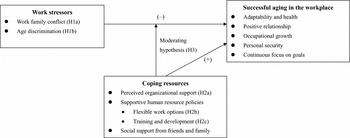
In this study, we adopted the model of successful aging in the workplace proposed by Robson et al. (Reference Robson, Hansson, Abalos and Booth2006). Similar to earlier models of successful aging (e.g. Rowe and Kahn, Reference Rowe and Kahn1997; Chou and Chi, Reference Chou and Chi2002), this theoretical framework adopts a multi-dimensional approach (Figure 1). It consists of five dimensions: adaptability and health (i.e. health conditions and a worker's ability to adapt or cope with changes in his or her job), positive relationships (the social / interpersonal relations with colleagues in the organization), occupational growth (the perception that there is still room for further advancement in one's career), personal security (the perception of whether the work environment and nature of the job may jeopardize an employee's health and well-being), and continued focus and achievement of personal goals (the of career goals).
Theoretical model H = hypothesis

Work stressors: work-family conflict and perceived discrimination
A work stressor commonly encountered by older workers is work-family conflict. This refers to the pressure from work and family when the roles are mutually incompatible. According to Super (Reference Super1980), an individual's goals and vocational behaviors are affected by social roles and relationships beyond the work environment. As people get older, the non-work (e.g. family) roles may become more important to the individual (Super, Reference Super1980). In the Chinese context, we anticipate that older workers’ aging process in the workplace is strongly influenced by their experience of work-family conflicts because of the unique role of family in Chinese philosophy.
Although Hong Kong is strongly influenced by Western culture, particularly by British traditions, the family is still considered to be the fundamental unit of Chinese society. Based on the Confucian philosophy, the family takes precedence over its individual members and the most important function of family members is the maintenance and preservation of the household. Therefore, when there is a clash between work and family roles, individual family members are expected to place the family's interests above those of the individual. Due to the demographic changes occurring in modern society, including postponed marriage and increased life expectancy, many older workers have to attend to the needs of both their young children and older parents. Failure to handle these familial roles may create high levels of tension, especially among Chinese older workers, which prohibits them from performing their regular work duties because their career or position at work may not be the most central role in older workers’ lives, and non-work roles may be of greater importance to them.
Due to the conflict between work and family domains, the strain that the older workers experience is believed to adversely affect not only their work performance and satisfaction but also successful aging in the workplace. For example, the strain resulting from work-family conflict may stop older employees focusing on their job tasks and hinder further occupational growth. Furthermore, these conflicts may create barriers for older workers who wish to practice skills that are important to job performance or search for opportunities to excel in their job which would consequently lower their adaptability. To the best of our knowledge, the impact of work-family conflicts on different dimensions of successful aging in the workplace has not been empirically studied. Our first hypothesis is therefore that when older employees experience work-family conflict, they will be less likely to report successful aging in the workplace.
Hypothesis 1a. Work-family conflict is negatively related to successful aging in the workplace.
Research also suggests that older workers are often subjected to age stereotypes and discrimination in organizations (e.g. Chiu et al., Reference Chiu, Chan, Snape and Redman2001; Posthuma and Campion, Reference Posthuma and Campion2009). For example, Posthuma and Campion (Reference Posthuma and Campion2009) noted that common negative age stereotypes about older workers were low productivity, resistance to change, low ability to learn, and being more costly. When older workers perceive that they are being evaluated unfavorably and treated unfairly, they may feel distressed and the negative bias may lower their motivation to perform well in the workplace. Such negative treatment has been shown to be associate with lowered self-efficacy, decreased performance, and cardiovascular stress among older employees (Levy et al., Reference Levy, Ashman and Dior1999).
In Chinese traditional philosophy, people are generally expected to show respect for the elderly in society. For instance, there is a traditional cultural saying that “older people are a family”. Thus, traditional Chinese values should help in preserving psychological well-being and fostering optimal aging of older workers by honoring them in their workplaces. Paradoxically, empirical research shows that negative stereotype about aging are also found in Chinese cultures (Chiu et al., Reference Chiu, Chan, Snape and Redman2001). The decreasing participation and importance of older workers in the Hong Kong labor force in recent decades has been attributed by Chiu and Ngan (Reference Chiu and Ngan1999) not only to negative stereotypes toward older people but also to the traditional Chinese values that place an expectation on older people to cease work and be taken care of by their offspring. Thus, older workers and their families may suffer from the stigma of being unfilial, regardless of their physical, psychosocial, and financial needs, while their employers may “legitimize” their unfair treatment to older adults or even exclusion of them from work force.
Based on the above research, older Chinese workers are vulnerable to age discrimination in the workplace but the impact of such discrimination on their successful aging has hardly been studied. We hypothesize a negative relationship between perceived age discrimination and successful aging in this study. For example, when older workers perceive that they are being treated unfavorably, it is likely that they will report a lower quality of interpersonal relationship with their colleagues. Furthermore, when older employees feel discriminated against, they are more likely to be demotivated which would in turn affect their desire to excel in their work role and to set future goal for occupational development.
Hypothesis 1b. Perceived age discrimination towards older workers is negatively related to successful aging in the workplace.
Coping resources: organizational support and social support from significant others
The positive role of coping resources – such as social support – on successful aging (e.g. Seeman et al., Reference Seeman, Lusignolo, Albert and Berkman2001) is well documented. Research shows that social support is related to better physiological functioning of older people (e.g. Seeman and McEwen, Reference Seeman and McEwen1996), protecting them against the risks for cognitive decline (e.g. Seeman et al., Reference Seeman, McEwen, Singer, Albert and Rowe1997). Social support can thus set the stage for older workers to function well across different domains, such as the work setting. For example, good physical health and cognitive functioning enables older workers to perceive that they are still eligible to continue their pursuit of career growth and to set goals for themselves in the workplace.
More importantly, social support has been observed to attenuate the potentially adverse effect of work-related stressors (Carlson and Perrewe, Reference Carlson and Perrewe1999) although the mechanisms underlying the relationship are less conclusive than expected (Cohen and McKay, Reference Cohen, McKay, Baum, Taylor and Singer1984). According to Cohen and McKay (Reference Cohen, McKay, Baum, Taylor and Singer1984), one of the proposed reasons for the inconclusive research findings is the multidimensionality of social support. Therefore, in this study, we examine two sources of social support for older workers: the work organization and friends and family. Under organizational support, there are two forms of support, including perceived organizational support (e.g. older workers’ socioemotional needs) and supportive human resources policies (tangible support system, such as training and development tailored for older workers as well as flexible work options). Social support from family and friends refers to the provision of socioemotional support. We sought to investigate whether such resources have both direct and moderating effects on the successful aging of Chinese people in the workplace.
Perceived organizational support refers to employees’ general evaluation of how much their organization values their membership and is concerned about their well-being. Positive valuation by the organization provides an indication that increased effort will be noted and rewarded (Eisenberger et al., Reference Eisenberger, Huntington, Hutchison and Sowa1986). Drawing from the conservation of resources theory, Hobfoll (Reference Hobfoll1989) suggested that individuals are motivated to conserve and build on their work resources to offset the strain derived from work stressors. Social support was an important resource to promote a positive sense of self in stressful circumstance. Thus, we hypothesize that perceived organizational support is an important resource that older workers can utilize to achieve successful aging in the workplace even when facing stress. For example, a supporting organization can help older workers to adapt to the workplace through better understanding their needs. A supportive organization will also consider the goals and values of the older workers, and provide sufficient care regarding the physical and psychological health of their employees. Therefore, we hypothesize that perceived organizational support promotes the successful aging of older employees.
Hypothesis 2a: Perceived organizational support is positively related to successful aging in the workplace.
As well as intangible support, the organization can express its support by various human resource policies, for example by widening the availability of flexible job options (Walker, Reference Walker2005) and providing training and development for older workers (Kubeck et al., Reference Kubeck, Delp, Haslett and McDaniel1996).
Flexible job options refer to flexible work schedule and arrangement, such as flextime or job sharing. The availability of job flexibility is crucial for older workers because it enables them to cope with their needs and facilitate better adjustment. For example, flextime allows older workers to adjust their work schedule to fit their own pace or to engage in activities that foster occupational growth. Provision of phased retirement options can allow older employees to set realistic goals in the workplace. Autonomy in the work setting enhances their opportunity to age successfully in the workplace.
Hypothesis 2b: Flexible work option is positively related to successful aging in the workplace.
Similarly, the provision of training and development programs tailored to help older workers is expected to have a direct and positive impact on successful aging in the workplace. According to the theory of Super (Reference Super1980), older workers will have entered into the stage of maintenance in which an important objective is to update job skills and knowledge. Training programs are thus important for older workers because they equip them with essential skills and knowledge to carry on their daily work (Kubeck et al. Reference Kubeck, Delp, Haslett and McDaniel1996). In addition, training programs for older workers may also enable them to learn new skills and expertise which may further reveal their potential and promote their occupational growth. Finally, training and development programs could enhance a sense of control of efficacy in their roles which can foster continuous occupational growth and heighten their sense of security in the workplace.
Hypothesis 2c: Training and development is positively related to successful aging in the workplace.
The role of social support from families and friends is also important in Chinese society. As discussed, Confucian culture places high value on the family and older people tend to rely heavily on their family members. However, due to Westernization and modernization, family ties in modern Chinese society are getting weaker. Older Chinese people are therefore also turning to friends and neighbors to find support (Ng et al., Reference Ng, Phillips and Lee2002), and it is believed that the role of friends as providers of social support is increasingly significant. We hypothesize that social support from family and friends is important for older workers to achieve successful aging in the workplace.
Hypothesis 2d: Social support from friends and family is positively related to successful aging in the workplace.
Coping resources as moderators
Viswesvaran et al. (Reference Viswesvaran, Sanchez and Fisher1999) found that support from others influences employees’ well-being in two ways: social support directly mitigates the negative outcomes (e.g. distress) and also moderates the stressor-strain association. Therefore, apart from the direct effect, we further hypothesize that both organizational and social support would buffer the negative impact derived from the social stressors. In particular, the positive correlation between stressor and strain is stronger among those individuals with lower levels of support than those with higher levels. In this study, we argued that social support should interact with work stressors which consequently affect the pursuit of successful aging in the workplace among older workers. For example, when facing age discrimination in the workplace, older workers who have more social support from friends and family or from their work organization should be better able to handle a work-related stressor; consequently, they should have a better chance of aging successfully in the workplace.
Finally, recent research (Zacher and Frese, Reference Zacher and Frese2011) has shown that age interacts with both job characteristics and individual resources in influencing successful aging at work. In particular, when working in less complex jobs, older workers who adopted more selection, optimization, and compensation (SOC) strategies tended to report more successful aging than their younger counterparts. However, in more complex jobs, younger workers who adopted more SOC strategies reported better aging than their older counterparts. In other words, age could also function as a potential factor which affects the moderation effect. Therefore, in this study we also explored the three-way interactions between age and different coping resources on successful aging in the workplace.
Hypothesis 3a: Coping resources will weaken the relationship between work stressors and successful aging in the workplace.
Methods
Participants and procedures
We recruited our participants in a large public hospital in Hong Kong. The hospital informed their employees of this survey using internal memos. Research assistants were sent to the hospital to collect data from employees who had agreed to participate in this project. All participants were eligible to participate if they were currently full-time employed Hong Kong Chinese aged 40 years or more during the study period. According to Robson et al. (Reference Robson, Hansson, Abalos and Booth2006), the term “older worker” refers to workers from the age of 40 or 45 to those aged over 75 depending on the purpose and field of study; the age of 40 or 45 is usually adopted in vocational behavior research. The use of 40 years or above as the criterion is widely adopted in older worker research including previous studies on workplace successful aging (Robson et al., Reference Robson, Hansson, Abalos and Booth2006). We adopted the chronological age instead of other approaches because chronological age is often related to other definitions, such as organizational age. For subsequent statistical analyses, participants were divided into two groups: (i) participants aged 40–54 years, and (ii) participants aged over 55.
A questionnaire package comprising the study objectives, the use to which the information would be put, and psychological measures was distributed to target participants. Participation in the research project was voluntary and participants took about 10 minutes to complete the questionnaire. Informed consent was obtained from each participant and confidentiality was assured. In order to enhance the response rate, a supermarket coupon (US$ 6.4) was granted to participants after they had completed and returned the questionnaire. A total of 260 questionnaires were distributed and 242 valid questionnaires were gathered, giving a response rate of 93%. Participants ranged in age from 40 to 64 years with a mean age of 51.1 years (SD = 4.45); 117 (48.3%) were men and 125 (51.7%) were women; and 179 (74%) were engaged in non-managerial/clerical positions while 63 (26%) were engaged in managerial/professional posts. The average working week was 45.65 hours (SD = 9.63 hours).
Measures
Questionnaire items were originally written in English. A professional translator was employed to translate the questionnaire items into Chinese. Back translation was conducted by an individual with no prior knowledge of the scales. Investigators compared the items and discussed whether there were significant discrepancies between the original version and the newly translated version.
Successful aging in the workplace
Successful aging in the workplace was measured by the Successful Aging in the Workplace Scale developed by Robson et al. (Reference Robson, Hansson, Abalos and Booth2006). The scale consists of five subscales: adaptability and health (18 items, α = 0.88), positive relationships (seven items, α = 0.83), occupational growth (eight items, α = 0.84), personal security (seven items, α = 0.82), and continued focus and achievement of personal goals (three items, α = 0.78). Sample items included “I accept suggestions for improving my performance”, “I am satisfied with my coworkers”, and “my career is still growing”. All dimensions were found to correlate with subjective successful aging among older workers in the USA (Robson et al., Reference Robson, Hansson, Abalos and Booth2006). Participants rated their feelings and attitudes toward their work on a 5-point Likert scale, ranging from 1, “strongly disagree,” to 5, “strongly agree.” Higher scores indicated higher levels of the five dimensions of successful aging in the workplace.
Perceived age discrimination
We used the Perceived Age Discrimination Scale by Redman and Snape (Reference Redman and Snape2006) to measure whether the older employees perceived that they were being treated unfairly due to their age. The scale consists of four items, sample items included “my age prevents me getting jobs for which I think I am qualified” and “the people I work with treat me less favorably because of my age”. Participants responded on a 7-point Likert scale, ranging from 1 “strongly disagree” to 7 “strongly agree”. This four-item scale had a Cronbach's α value of 0.69 in the present study. High scores represented higher perceived age discrimination.
Work-family conflict
We used the 10-item work-family conflict scale developed by Netemeyer et al. (Reference Netemeyer, Boles and McMurrian1996) to measure participants’ perception of work-to-family and family-to-work interferences. Sample items are “The demands of my work interfere with my home and family life”, and “The demands of my family or spouse/partner interfere with work-related activities”. Participants responded on a 7-point scale, ranging from 1 “strongly disagree” to 7 “strongly agree”. These scales showed satisfactory internal consistency, with Cronbach's α of 0.90 and 0.89 for work-to-family conflict and family-to-work conflict, respectively. High scores on the two subscales represented high levels of respective direction of work-family conflict.
Perceived organizational support
Perceived organizational support was measured by the Perceived Organizational Support Scale developed by Eisenberger et al. (Reference Eisenberger, Huntington, Hutchison and Sowa1986). The scale consists of ten items, and sample items include “the organization takes pride in my accomplishment at work” and “the organization really cares about my well-being”. The scale was found to be correlated with human resource practices, such as training opportunities and work options (Armstrong-Stassen and Ursel, Reference Armstrong-Stassen and Ursel2009). Participants rated perceived organizational support on a 5-point scale, ranging from 1 “strongly disagree” to 5 “strongly agree”. The internal consistency of the perceived organizational support scale was satisfactory, and its Cronbach's α coefficient was 0.70. Higher scores indicated higher perceived organizational support to the older employees.
Human resources policies
Flexible work options were measured by the 4-item scale of Armstrong-Stassen and Ursel (Reference Armstrong-Stassen and Ursel2009). Sample items included “providing flexible work schedules” and “providing a reduced working week (part-time employment)”. We modified the four-item training and development practice scale developed by Armstrong-Stassen and Ursel (Reference Armstrong-Stassen and Ursel2009) to assess participants’ perception of training practices. Because our focus was not solely on managerial and professional employees, we amended the original items in order to fit the present research. Sample items are “targeting older employees for training so they can learn new skills and expertise” and “adjusting training methods to accommodate the needs of older employees”. In both measures, participants rated their work flexibility and training and development practice on a 3-point Likert scale, ranging from 1 “not at all engaged in doing this” to 3 “highly engaged in doing this”. The scale showed satisfactory internal consistency with a Cronbach's α of 0.74 and 0.80 for flexible work options and training and development, respectively. Higher scores indicated more flexible work options and training and development practices for older employees.
Perceived social support from family and friends
We measured the perceived social support using the 3-item Social Support Scale of Redman and Snape (Reference Redman and Snape2006). Sample items include “I can talk over work problems with members of my family” and “my friends outside work provide me with encouragement when things go wrong in my job”. Participants rated their feelings and attitudes toward their work on a 5-point Likert scale, ranging from 1, “strongly disagree,” to 5, “strongly agree.” The scale showed satisfactory internal consistency with a Cronbach's α of 0.78. Higher scores indicated higher levels of perceived social support from family and friends.
Demographic characteristics
Participants were asked to indicate their gender, age, and job level.
Assessment of common method variance
All data in the present study were collected via questionnaire survey. Therefore, common method variance might have affected the strength of observed relationships (Podsakoff et al., Reference Podsakoff, MacKenzie, Lee and Podsakoff2003). In order to address the issue of common method variance, a Harman's one-factor test was conducted in the form of a confirmatory factor analysis in which all the questionnaire items were loaded on one factor. The logic underlying this approach is that if method variance is largely responsible for the covariation among the measures, a confirmatory factor analysis should indicate that a single (method) factor fits the data. Results showed that a one-factor model did not fit well in the sample (χ2 = 462.1, df = 54, p < 0.01). In comparing this one-factor model with a three-factor model (social support, work stressors, successful aging in the workplace), results showed that the χ2 of the three-factor model was significantly smaller than the one-factor model and thus indicated that the three-factor model fitted the empirical data better (χ2 = 205.1, df = 51, p < 0.01). Based on the confirmatory factor analysis results, it appears that the common method variance was not seriously confounding our results in this study.
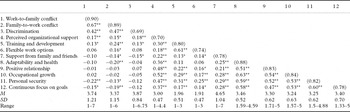
Correlation table (N = 242)

* p < 0.05, ** p < 0.01, α coefficient on the diagonal
Results
We first conducted correlation analyses on the major variables in this study. In terms of work stressors, family-to-work conflict was negatively related to three dimensions of successful aging in the workplace: adaptability and health (r = −0.20, p < 0.01), personality security (r = −0.13, p < 0.05), and continuous focus on goals (r = −0.19, p < 0.01). Work-to-family conflict was also significantly related to personal security (r = −0.22, p < 0.01) and continuous focus on goals (r = −0.15, p < 0.05). Discrimination against older workers, however, was not found to be significantly related to any dimensions of successful aging in the workplace. Based on these results, Hypothesis 1a was partially supported but Hypothesis 1b was not.
For coping resources, we found that perceived organizational support was also positively correlated with all facets of successful aging in the workplace (r ranged from 0.36 to 0.52, all p < 0.01). Thus, Hypothesis 2a was supported. In terms of human resource policies, we found that training and development practice was positively related to positive relationship (r = 0.22, p < 0.01), occupational growth (r = 0.29, p < 0.01), personal security (r = 0.31, p < 0.01), and continuous focus on goals (r = 0.17, p < 0.01). Flexible work options were also positively correlated with positive relationships (r = 0.16, p < 0.05), occupational growth (r = 0.17, p < 0.01), personal security (r = 0.25, p < 0.01), and continuous focus on goals (r = 0.14, p < 0.05). Therefore, both Hypothesis 2b and Hypothesis 2c were supported.
Finally, social support from friends and family was positively correlated with all successful aging in the workplace dimensions (r ranged from 0.21 to 0.29, all p < 0.01). Thus, Hypothesis 2d was also supported.
Hierarchical regression analysis
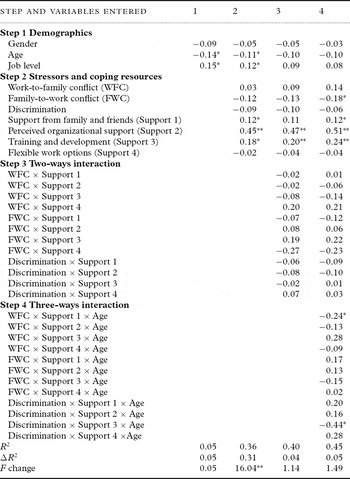
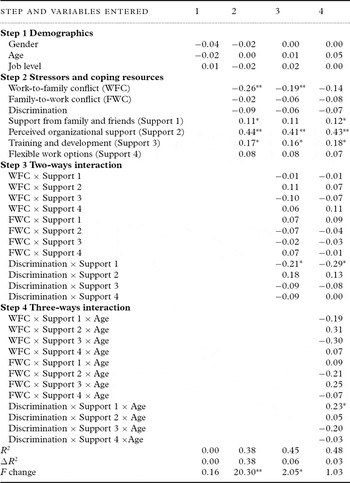
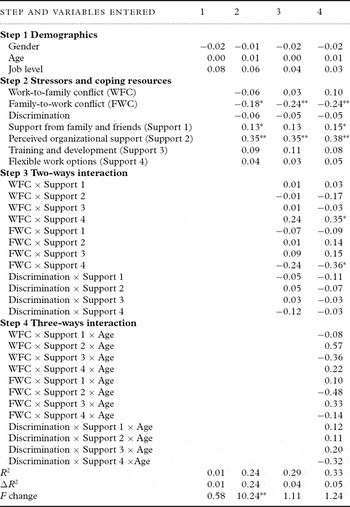
We conducted a series of moderated regression analyses to examine the direct and interacting effects of work stressors and coping resources on successful aging in the workplace. In particular, the moderating hypothesis of coping resources (i.e. Hypothesis 3) would be tested. In order to delineate clearly how stressors and coping resources were associated with successful aging in the workplace, we first entered the demographic information (gender, age, and work level) in Step 1 in each regression analysis to control their effects. In Step 2, work stressors (work-to-family conflict, family-to-work conflict, discrimination) and coping resources (perceived organizational support, training and development, flexible work options, and social support from family and friends) were entered. In Step 3, all two-way interaction terms of work stressors and coping resources were entered. In the final block (Step 4), all the three-way interaction terms (age × work stressors × coping resources) were entered. Following the recommendation of Fraizer et al. (Reference Fraizer, Tix and Barron2004), all main effects of predictors and interaction terms were centered before entering the regression analyses. Because lower-order interactions cannot be interpreted in the presence of higher-order interactions (Aiken and West, Reference Aiken and West1991), only the results of the final model are discussed below. Detailed results of the hierarchical regression analyses are presented in Tables 2–6, with each dimension of successful aging in the workplace presented in a separate table. A significant R 2 increment attributable to the last multiplicative terms (three-way interaction) reveals a moderated relationship. If a statistically significant interaction effect was found, post-hoc analyses were conducted to further reveal the associations.
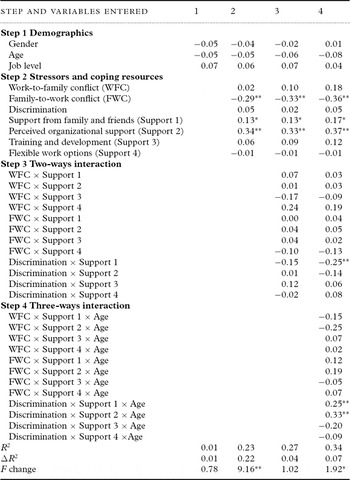
Moderated regression analysis on adaptability and health (N = 242)

Note: Displayed coefficients are standardized beta. *p < 0.05, **p < 0.01
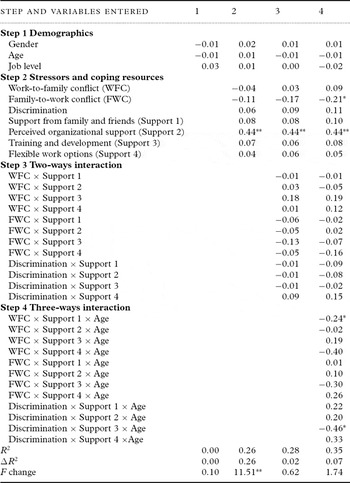
Moderated regression analysis on positive relationship (N = 242)

Note: Displayed coefficients are standardized beta. *p < 0.05, **p < 0.01
Moderated regression analysis on occupational growth (N = 242)

Note: Displayed coefficients are standardized beta. *p < .05, **p < .01
Moderated regression analysis on personal security (N = 242)

Note: Displayed coefficients are standardized beta. *p < .05, **p < .01
Moderated regression analysis on continuous focus on goals (N = 242)

Note: Displayed coefficients are standardized beta. *p < 0.05, **p < 0.01
With adaptability and health as the criterion variable, 34% of its total variance was explained by the set of variables (df = 24, 207, F = 1.49, p > 0.05). In examining the unique contribution of individual correlates, family-to-work conflict (β = −0.36, p < 0.01), perceived organizational support (β = 0.37, p < 0.01), and support from friends and family (β = 0.17, p < 0.05) were significant correlates in the regression model. The inclusion of the three-way interaction variables provided significant R 2 increments and the two three-way interaction terms (discrimination × support from family and friends × age and discrimination × perceived organizational support and age) were significant. Post-hoc analyses showed that support from friends and family and perceived organizational support moderated the association between discrimination and adaptability and health. However, this moderation operates only among workers aged 55 and over. Here, greater support from friends and family / perceived organizational support mitigate the adverse effects of discrimination on adaptability and health. No interaction effect was found among workers aged under 55.
For positive relationships, 35% of the total variance was explained by the set of variables (df = 24, 207, F = 1.19, p > 0.05). Family-to-work conflict (β = −0.21, p < 0.05) and perceived organizational support (β = 0.44, p < 0.01) were significant correlates in the final model. The entry of the three-way interaction terms did not add a significant amount of incremental variance to the prediction of positive relationship.
In occupational growth, 45% of total variance was explained by the variables (df = 24, 207, F = 1.32, p > 0.05). Family-to-work conflict (β = −0.18, p < 0.05), perceived organizational support (β = 0.51, p < 0.01) as well as training and development practice (β = 0.24, p < 0.01) were significant correlates. The entry of the three-way interaction terms did not add a significant amount of incremental variance to the prediction of occupational growth.
Regarding personal security, 48% of its variance was accounted by the final set of variables (df = 24, 207, F = 1.54, p > 0.05). In examining the unique contribution, social support from friends and family (β = 0.12, p < 0.05) and perceived organizational support (β = 0.43, p < 0.01) were significant correlates. Although the entry of the three-way interaction terms did not add a significant amount of incremental variance to the prediction of personal security, two-way interaction showed that discrimination interacted with social support from friends and family in relations to personal security. Post-hoc analysis showed that familial support was more important when employees perceived low discrimination in the workplace. However, in the case of high discrimination, employees with higher social support from families and friends still reported higher personal security than their counterparts with low level of support, even though the difference was not significant.
Finally, 33% of the variance in continuous focus on goals was explained by the final set of variables (df = 24, 207, F = 1.18, p > 0.05). Several correlates were found to contribute uniquely to the regression model, including family-to-work conflict (β = −0.24, p < 0.05), social support from friends and family (β = 0.15, p < 0.05) and perceived organizational support (β = 0.38, p < 0.01). The entry of the three-way interaction terms did not add a significant amount of incremental variance to the prediction of continuous focus on goals. Based on these results, Hypothesis 3a was only partially supported.
Discussion
Successful aging is one of the research agendas that adopt the positive psychology perspective to understand the aging process. Since the construction of successful aging varies across different cultures, understanding successful aging in a specific cultural context is therefore important. Compared to the literature of successful aging in Western cultures, only a handful of similar studies have been carried out in Chinese society (e.g. Chou and Chi, Reference Chou and Chi2002). These studies have provided important insights for understanding correlates of successful aging in the Chinese society. However, they did not discuss successful aging in a specific domain (e.g. the work setting) and in various dimensions. Our study thus supplements earlier studies by delineating correlates that facilitate or hinder successful aging in the workplace in a Chinese work context.
Among the work stressors assessed, family-work conflict was the most significant and consistent factor influencing successful aging for Chinese workers. It was negatively related to all successful aging in the workplace dimensions except personal security while work-family conflict and perceived discrimination did not significantly explain the variances of the dependent variables. To a certain extent, our findings suggest that family obligations might make it difficult to comply with work responsibilities which would adversely affect the aging process in the workplace. Drawing on the conservation of resources model (Hobfoll, Reference Hobfoll1989), the strain resulting from the conflict between the two domains drains away valuable resources and energy of lder workers, which may consequently affect employees’ adaptability and setting goals in the workplace as well as the ability to handle all the job demands in their work.
Although there was no bivariate relation between age discrimination and successful aging in the workplace, moderated regression results suggest that age discrimination might relate to the successful aging process in a more subtle way. In particular, we found that older workers aged over 55, who also perceived that they did not have many coping resources (e.g. perceived organizational support and social support from friends and family) tended to be more vulnerable to age discrimination, especially on adaptability and health. Therefore, the effect of age discrimination should be considered in conjunction with the availability of coping resources, especially for older workers.
In terms of coping resources, we found that perceived organizational support was the most salient and consistent factor for successful aging in the workplace. The present findings suggest that the importance of organizational support for older workers is quite culture-invariant because its importance has also been reported in the West (e.g. Armstrong-Stassen and Ursel, Reference Armstrong-Stassen and Ursel2009). Based on organizational support theory (Eisenberger et al., Reference Eisenberger, Huntington, Hutchison and Sowa1986), when older employees perceive that the organization supports them, the perceived care and approval from the organization helps to foster a sense of successful aging in the workplace by fulfilling their socioemotional needs, such as facilitating their occupational growth and fulfilling their interpersonal needs.
Tangible organizational support, such as training and development practices, was also significantly related to occupational growth and personal security reported by Chinese older workers. With more opportunities to obtain training, older workers can optimize their efforts as well as reveal their potential, and thus can sustain future occupational growth. In addition, training can maintain or even enhance older workers’ employability, such as the ability to obtain a job and to remain employed, within or outside one's current organization (Kubeck et al., Reference Kubeck, Delp, Haslett and McDaniel1996). Thus, training can enhance their sense of job security. While training is important for older workers, organizations should consider the unique learning skills or the interests of older adults. For example, older workers prefer more directly job-related and practical skills, rather than theoretical or basic skills (Kubeck et al., Reference Kubeck, Delp, Haslett and McDaniel1996). Furthermore, older workers tend to learn better with concrete rather than abstract materials. Therefore, when designing training materials for older workers, organizations should use more job-related examples in order to facilitate better training transfer among the older learners.
Apart from the perceived organizational support, we found that social support from family and friends was important for older workers’ adjustment and growth in their workplace. Previous research suggests that interpersonal connectedness and social support (e.g. social visitation) are particularly important in collectivistic rather than individualistic cultures (Litwin, Reference Litwin2005). Among our Chinese participants, regression results showed that social support was significantly related to four dimensions of successful aging in the workplace (the only exception was positive relationship). With a strong social support network, we believe that older workers are more likely to achieve and flourish in the workplace. For example, social support from family and friends can help to offset negative impacts when older workers encounter setbacks in the workplace. With more positive self-evaluation, older employees would be able to advance in their jobs and remain competitive. As highlighted by other management professionals (Super, Reference Super1980; Robson et al., Reference Robson, Hansson, Abalos and Booth2006), the present findings support the view that factors of life domains other than work also significantly influence one's performance and adjustment in the workplace.
In this study, perceived organizational support and social support from friends and family were particularly important for old-older workers when they perceived high levels of age discrimination in the workplace. Therefore, we suggest that management should be more sensitive to the old-older employees’ needs and provide useful resources and assistance to facilitate maximum inclusion of older workers in the labor force. For example, employers can regularly acknowledge the contribution from the older workers via different channels, such as certificate of merits or long service awards. They can also provide support to help the older employees set and achieve occupational goals and aim to create a supportive organizational culture which prohibits age discrimination in the workplace. Similarly, friends and family should provide more support to these old-older workers when they perceive age discrimination in the workplace.
Apart from the associations between stressor and resources on successful aging in the workplace, we also noted that perceived organizational support and training and development were positively related to work-family conflicts and family-work conflicts. One possible explanation was that older employees who receive support from the organization may develop a felt obligation to care about the organization's welfare and to help the organization reach its objectives (Eisenberger et al., Reference Eisenberger, Huntington, Hutchison and Sowa1986). Consequently, they would invest more time and effort in their work roles which would inevitably influence the family role. Furthermore, even though training may be positively related to successful aging in the workplace, it could create psychological strain for older workers if the program does not match their needs and learning styles. These strains may then spill over to the family domain. We did not test these hypotheses directly and thus more research is needed to examine these counter-intuitive findings and see if special clinical attention should be given to older Chinese workers in this aspect.
This study has several limitations and our results should be interpreted with caution. First, we surveyed participants at a single time point, and thus no conclusion about cause and effect can be made. A longitudinal design should be employed to examine the temporary association between different predictors (e.g. organizational support, social support, training opportunities) and successful aging in the workplace. Second, we relied solely on self-reports of participants. Thus, results in the present study might be affected by the common method variance. Future studies should consider the use of data from others (e.g. supervisors, co-workers) as external validation. Finally, we only explored the associations between various stressors and resources and successful aging in the workplace. However, several job variables, such as job control, expertise level, education level, and job complexity were not systematically considered. These variables might potentially play important roles in affecting the successful aging experience of older workers (e.g. Zacher and Frese, Reference Zacher and Frese2011). As discussed, the selection of variables in the present study was directly relevant to older employees’ career trajectories (e.g. discrimination towards older workers). Furthermore, these resources and stressors could change through better work design and organizational policies which thus provide practical insights for human resources and organization administrators. However, we believe that in future studies, these control/moderating variables should be assessed in future research in order to gain a more comprehensive picture of factors relating to successful aging in the workplace.
To conclude, the older workforce will continue to grow, which makes it vital to understand the factors which allow these older individuals to continue to thrive and develop. In this study, we examined various factors that promote or hinder the successful aging process of older workers in the workplace and we found that work-family conflicts and support from the work organization were crucial. In addition, we found that support from the work organization and from friends and family was useful in buffering the negative impact of work stressors, such as age discrimination. These findings should provide insights for organizations into their human resources planning and the development of strong support network for their older workers.
Conflict of interest
None.
Description of authors' roles
Dr. Francis Cheung designed the study, supervised the data collection, conducted the data analysis, and prepared the paper. Dr. Anise M. S. Wu helped formulate the research question and contributed to the writing of this paper.