


1 Introduction and motivation
Belief revision (BR) is the process of changing beliefs to take into account a new piece of information, observation, or evidence. The AGM paradigm (Alchourrón et al., Reference Alchourrón, Gärdenfors and Makinson1985) has been widely accepted as a standard framework for BR; usually, Individual Belief Revision (IBR) in a single-agent environment is achieved satisfying or adapting AGM postulates.
Single-agent systems have evolved into multi-agent systems (MAS), where multiple interacting agents can collaborate, negotiate, discuss, etc., in order to achieve their goals. In many multi-agent domains and applications, each agent has its own initial beliefs as well as beliefs acquired from other informant agents. Hence, an agent can receive information from other agents which is contradictory with its own current beliefs. Therefore, IBR needs to be extended to multi-agent environments.
This paper focuses on multi-source belief revision (MSBR); that is, BR performed by a single agent that can obtain new beliefs from multiple informants. Therefore, one of the contributions of our approach is the definition of an epistemic model for MSBR that considers both beliefs and meta-information representing the credibility of the belief's source. We investigate how the belief base of an agent can be rationally modified when the agent receives information from other agents that can have different degrees of credibility. Thus, our main contribution is the definition based on the AGM model of four different belief change operators which use the credibility of informant agents in order to decide prevailing information. These operators are defined through constructive models and representation theorems that provide a complete axiomatic characterization for the proposed formalism.
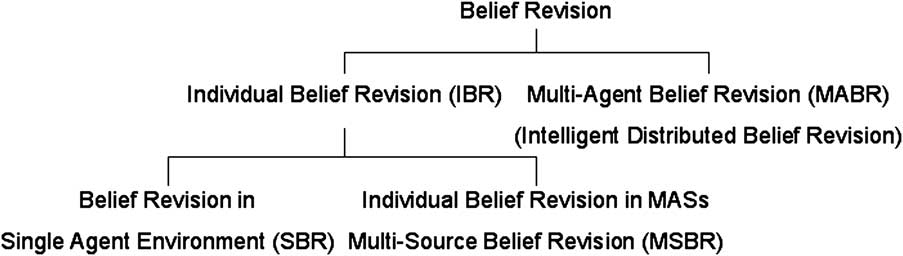
An analysis of BR in MAS was developed in Liu & Williams (Reference Liu and Williams1999) where the hierarchy of Figure 1 was introduced. There, the distinction of Multi-Agent Belief Revision (MABR), MSBR and Single-agent Belief Revision (SBR) is clearly explained. In contrast to MSBR, MABR investigates the overall BR behavior of agent teams or a society in which, in order to pursue the mutual goal, the agents involved need to communicate, cooperate, coordinate, and negotiate with one another. A MABR system is a MAS whose mutual goal involves BR. Different formalisms have been presented to deal with MABR (Malheiro et al., Reference Malheiro, Jennings and Oliveira1994; Kfir-Dahav & Tennenholz, Reference Kfir-Dahav and Tennenholz1996; Liu & Williams, Reference Liu and Williams1999, Reference Liu and Williams2001). Nevertheless, in MSBR, an IBR process is carried out in a multi-agent environment where the new information may come from multiple sources that may be in conflict. The main focus of our work is this kind of BR, also studied by Dragoni et al. (Reference Dragoni, Giorgini and Puliti1994).
Belief Revision Hierarchy.
Consider, for instance, the following (simplified) scenario. An agent A has three informants A 1, A 2 and A 3 where, for A, A 3 is the most credible and the other two are equally credible. Agent A wants to use a resource S, but it believes that S is not available. Then A 1 informs A that S is available and hence, A revises its beliefs to take into account this new piece of information. If then A 3 informs A that S is not available, since A 3 is more credible than A 2, then A should change its belief about S. Observe that new information could be rejected if the new belief is informed by a less credible agent.
In the literature, there are several studied prioritized methods ( e.g. partial meet revision (Alchourrón et al., Reference Alchourrón, Gärdenfors and Makinson1985) and kernel revision (Hansson, Reference Hansson1999)). In these methods, the new information has priority over the beliefs in the base of the receiver agent. However, as is mentioned in Fermé and Hansson (Reference Fermé and Hansson1999) and Falappa et al. (Reference Falappa, Kern-Isberner and Simari2002), in some scenarios a prioritized method can be unrealistic. Thus, some models of BR have been developed allowing for two options: either the new information is fully accepted or completely rejected (Hansson, Reference Hansson1997; Makinson, Reference Makinson1997; Hansson et al., Reference Hansson, Fermé, Cantwell and Falappa2001; Konieczny et al., Reference Konieczny, Grespan and Pérez2010). For instance, if information comes from different sources, and these sources are not equally credible, a non-prioritized method can be more adequate. In contrast, if an agent always acquires information from the same source, then a prioritized method can be used.
In this paper, based on kernel revision, we develop a complete change model for MSBR where both non-prioritized and prioritized BR are defined. First, we propose a formalism for knowledge representation in a MAS; and then, based on this formalism we define different change operators for MSBR, either to add beliefs (expansion), to withdraw beliefs (contraction), or to maintain consistency (revision). We will introduce a credibility order among agents and, based on this order, a comparison criterion among beliefs is defined. In the revision process, if inconsistency arises, the credibility order is used to decide which information prevails. The contraction operator is based on kernel contraction (Hansson, Reference Hansson1994) and also uses the credibility order to decide which information prevails. We show that the proposed non-prioritized revision operator satisfies the minimal change principle, and incoming information can be rejected when the agent has more credible beliefs that contradict the new information. In the literature, there are other approaches that also attach information to agents’ beliefs that represents its credibility: Benferhat et al. (Reference Benferhat, Dubois and Prade1993), Dragoni et al. (Reference Dragoni, Giorgini and Puliti1994), Cantwell (Reference Cantwell1998), and Benferhat et al. (Reference Benferhat, Dubois, Prade and Williams2002). However, our approach differs from them as we will explain in detail below.
Some preliminary works related to this paper have been reported in two workshop papers (Tamargo et al., Reference Tamargo, García, Falappa and Simari2008, Reference Tamargo, García, Falappa and Simari2009). However, here, we extend both in several ways. We will define different operators which describe a complete change model based on informants: expansion, contraction, prioritized revision, and non-prioritized revision. These operators are based on an epistemic model in which a rational way to weigh beliefs is developed. These operators can be seen as skills added to the agents which improve the collective reasoning of a MAS. For these operators we give both constructive definitions and an axiomatic characterization of them by representation theorems. We also formally justify minimal change and consistency principles. Thus, a complete change model where both prioritized and non-prioritized BR are defined. The rest of this paper is structured as follows. Next, Section 2 introduces the epistemic model for MSBR. Section 3 develops the concept of plausibility used to decide which beliefs will be preserved or erased in change operators. Section 4 defines change operators based on informants: expansion, two kinds of contractions, and two kinds of revisions. Section 5 presents forwarding information among agents. Finally, in Section 6 conclusions are given and related works are commented. All proofs can be found the Section 7.
2 Epistemic model for Multi-Source Belief Revision
In this section, we introduce an epistemic model for MSBR which is based on informants. Then, in the following sections, we will define change operators based on agents interactions to add beliefs (expansion), to withdraw beliefs (contraction), and to revise beliefs. Note that the AGM model (Alchourrón et al., Reference Alchourrón, Gärdenfors and Makinson1985) represents epistemic states by means of belief sets, that is, sets of sentences closed under logical consequence. Other models use belief bases; that is, arbitrary sets of sentences (Fuhrmann, Reference Fuhrmann1991; Hansson, Reference Hansson1992). Our epistemic model is based on an adapted version of belief bases which have additional information.
We adopt a propositional language  with a complete set of boolean connectives, namely
 . Also, we assume the existence of an operator
 that satisfies inclusion (
 ), iteration (
 ), monotonicity (if
 then
 ), and compactness (if
 , then
 for some finite subset
 ) and includes the classical consequence operator. In general, we will write
 as
 .
When interacting, agents will incorporate the received information into their knowledge base in form of information objects. An information object will associate a sentence with an agent. For the identification of the individual agents we introduce a finite set of agent identifiers that is denoted as  .
Definition 1 (Information object)An information object is a tuple  , where
 is a sentence of a propositional language
 and
 .
Information objects are used to represent an agent's belief base. Observe that the agent identifier of an information object I can be used for representing the agent from which the information is received, or the agent that has generated the information. In Section 5, we will describe different criteria for forwarding information that will determine which agent identifier will be used.
Definition 2 (Belief base)Let  be a set of agent identifiers. A belief base of an agent
 is a set
 containing information objects
 received from other agents
 and proper beliefs
 .
Example 1Consider the set of agent identifiers  and the belief base of the agent A 1,


 . Observe that
 has two information objects with the sentence α; however, each one has a different agent identifier.
The set  will represent all the belief bases. Next, two auxiliary functions are introduced in order to obtain the set of sentences or the set of agents that belong to a belief base
 .
Definition 3 (Sentence function)The sentence function Sen ( ) is a function such that for a given belief base
 ,
 .
In our proposal, each agent  will have a consistent belief base K A. A belief base K A is consistent if
 is consistent.
Definition 4 (Agent identifier function)The agent identifier function Ag ( ) is a function such that for every base
 ,
 .
Example 2Consider  of Example 1. Then,
•
 .
•
.
 .
 .
The agent identifier of an information object can be used to evaluate the truthfulness of the received information. In our approach, an assessment function will be used for representing the credibility each agent assigns to other agents. For defining this assessment, we assume a set of credibility labels  (common to all agents) with an order
 such that for all c 1, c 2,
 : if
 and
 then
 ;
 or
 ;
 does not hold; and if
 , then
 does not hold. That is, following (Hein, 2010), we assume an irreflexive total order (also known strict total order).
Definition 5 (Assessment)Let  be a set of agent identifiers and
 a set of credibility labels. An assessment
 for the agent A iis a function
 assigning a credibility value from
 to each agent
 .
The set of credibility labels is the same for all agents; however, each agent will have its own assessment and different agents may have different assessments. Thus, the assessment of an agent can be replaced in a modular way without changing its belief base and without affecting other agents assessments.
Example 3Consider the set of agent identifiers  and the set of credibility labels
 , where
 . The agents of
 can have the following assessments:
- , , and .
- , , and .
- , , and .
- , , and .

 ,
 ,
 and
 .

 ,
 ,
 and
 .

 ,
 ,
 and
 .

 ,
 ,
 and
 .
Observe that for agent A 2 all agents have the same credibility, for agent A 3 all agents have different credibility, and agents A 3 and A 4 have the same assessment.
Thus, based on its own assessment, each agent can have a credibility order over the set  .
Definition 6 (Credibility order among agents)A credibility order among agents for an agent A i, denoted by ‘ ’, is a total order over
 where
 means that according to A i,
 is at least as credible than A 1, and holds if
 or
 . The strict relation
 , denoting that A 2 is strictly more credible than A 1, is defined as
 and
 . Moreover,
 means that A 1 is as credible as A 2, and it holds when
 and
 .
Since ‘ ’, is a total order over
 then for all
 it holds:
• Reflexive:
.• Totality or Completeness:
or .• Transitivity: if
and , then .• Antisymmetry: if
and , then .
 .
 or
 .
 and
 , then
 .
 and
 , then
 .
Example 4Consider the set of agent identifiers  and the set of credibility labels
 , where
 . Suppose that according to the assessment of A 1,
 ,
 ,
 and
 . Then, the credibility order, according to A 1, is:
 and
 . Hence,
 .
The information received by an agent can be contradictory with its current beliefs. For instance, consider again the belief base  of Example 1, where
 (observe that there are several derivations for β). Suppose now that the agent A 1 receives the information object I=(
 ). It is clear that adding (
 ) to
 will produce an inconsistent belief base. Therefore, the agent has to decide whether it rejects (
 ) or withdraws β. In our approach, the credibility order ‘
 ’ will be used to decide which information prevails. If the new incoming information prevails, then the agent has to withdraw β. To do that, an adapted version of Kernel contractions will be introduced where all the minimal subsets of
 that entail β will be considered.
Kernel contractions were introduced in (Hansson, 1994) and they are based on a selection among the sentences that are relevant to derive the sentence to be retracted. Note that kernel contractions are a generalization of safe contractions proposed in (Alchourrón and Makinson, 1985). In order to perform a contraction, kernel contractions use incision functions which cut into the minimal subsets that entail the information to be given up. Therefore, we will adapt the definition of α-kernel to our epistemic model which will be used below to define a comparison criterion among sentences (called plausibility) and to define incision functions.
Definition 7 ( -kernel)Let
 and
 . Then H is an α-kernel of K if and only if
1
.2
.3 if
, then .
 .
 .
 , then
 .
Note that an α-kernel is a minimal set of tuples from K that entails α. The set of α-kernel of K is denoted  and is called kernel set (Hansson, 1994).
Example 5Consider  of Example 1.
 where

Observe that a belief base can contain the same sentence in two (or more) information objects with different agent identifiers. For instance, in Example 1  . As it will be explained in detail below, when an agent A i receives an information object
 consistent with its current belief base (i.e.,
 ), then
 is added to
 (expansion). Note that it may be the case that
 ; however,
 is also added to
 because the credibility of the associated agent can increase the plausibility of α. From the information objects point of view, there is no redundancy due to the fact that each information object represents a different informant.
Thus, in a belief base the same sentence can be in several information objects (with different agent identifiers). Therefore, if the assessment of the agent is changed and the credibility of a particular agent is increased, then all the sentences associated to this agent automatically have more credibility. Nevertheless, it will be useful that given a belief base K, a compacted belief base K′ can be obtained; that is, a base where there are no tuples with the same sentence and the more credible associated agent remains. In order to make more efficient the construction of changes, we propose that kernel sets can be computed over compacted belief bases.
Next, a function that given a belief base returns a compacted one is introduced (Definition 10). This function needs to know which is the most credible associated agent with respect to a given sentence, and this is returned by the top agent function.
Definition 8 (Top agent function)The top agent function,  , is a function such that for a given belief base
 and a given sentence
 ,
 and for all
 .
We assume that there is a function (see Definition 9) that based on a given policyFootnote 1 returns a single-agent identifier from a set of agent identifiers to which the assessment assigns the same label. For instance, the policy could be based on a lexicographical ordering among agent identifiers -A 1 is lesser than A 2.
Definition 9 (Selection function)The selection function of an agent A i,  , is a function such that for a given set of agent identifiers with equal credibility with respect to the assessment of A i, it returns a single-agent identifier based on a given policy.
Definition 10 (Compact belief base function)The compact belief base function (  ) is a function such that for a given belief base
 :

In order to simplify the notation we use  instead of
 .
Example 6Consider again the agent A 1 of Example 1, where

 , and consider the credibility order among agents according to A 1from Example 4,
 . Then,
•  and
 .
•  .
•  where the policy adopted is based on a lexicographical ordering among agent identifiers.
• The compact belief base is:

•  where

It is important to note that from the Definitions 3, 7, 8 and 10, the following proposition is straightforwardly deduced.
Proposition 1Let  , it holds that:
 ,
 , and
 .
Consider  and
 such that β is in m tuples of
 (
 ). Then
 . If
 and
 , then
 will have at least
 differing only in the agent identifier of the tuple in which β is in. Nevertheless, since
 has only one tuple containing β, then
 . In the following section, we will prove that it is equivalent to compute the plausibility of a sentence either with
 or with
 .
3 Sentences plausibility
As stated above, when an agent A i receives an information object that is inconsistent with its knowledge base (e.g. it receives ( ) and it holds that
 ), then the credibility order among agents
 will be used to decide which sentence prevails. Note that a sentence can have more than one derivation from a given knowledge base. Therefore, a comparison order among sentences (called Plausibility) will be defined. That is, if α and β are sentences, the notation
 will represent the following: for the agent A i, β is at least as plausible as α relative to its assessment
 and its belief base
 . The plausibility of a sentence will be used to define revision and contraction operators.
The concept of plausibility is related to epistemic entrenchment (Gärdenfors and Makinson, 1988) although the epistemic entrenchment orders are structured in a very specific way, and we apply it on belief bases instead of belief sets. According to (Gärdenfors, 1992), ‘…some sentences in a belief system have a higher degree of epistemic entrenchment than others... The guiding idea for the construction is that when a belief set  is revised or contracted, the sentences in
 that are given up are those having the lowest degrees of epistemic entrenchment’.
The following function characterizes all the sentences that can be entailed from a belief base.
Definition 11 (Belief function)The belief function,  , is a function such that for a given belief base
 ,
 and
 .
Similar to Proposition 1, note that from the Definitions 8, 10 and 11, the following proposition is straightforwardly deduced.
Proposition 2Let  , it holds that
 .
In order to calculate the plausibility of a sentence β, all its proofs have to be analyzed. Since we adopt a cautious approach, from each β-kernel we will consider those tuples that have the agent identifiers that are less credible. Two auxiliary functions are introduced below:
Definition 12 (Least credible sources function)The least credible sources function,  , is a function such that for a given belief base
 and for all
 .
Definition 13 (Most credible sources function)The most credible sources function,  , is a function such that for a given belief base
 ,
 and for all
 .
Example 7Consider the set of agent identifiers  and the credibility order of agent A 1:
 . Let
 be the belief base of A 1. Then,
•
.•
.
 .
 .
Next, based on the agent comparison criterion  of each agent, we will define a comparison criterion among sentences of
 . First, we introduce the function
 that given a sentence
 , it returns an agent identifier that represents the plausibility of α with respect to the assessment of agent A i. Then, based on the function
 , in Definition 15, a comparison criterion
 among sentences of
 is introduced.
Definition 14 (Plausibility function)The plausibility function,  , is a function such that for a given belief base
 and a sentence
 :

Observe that the function  can return more than one agent identifier, therefore
 uses the selection function
 of Definition 9 that returns only one identifier. Note also that it may be the case in which
 and
 . For instance, consider Example 7, there
 and
 .
Definition 15 (Plausibility criterion)Let  be the belief base of agent A i and let
 , then
 if and only if it holds that
 .
Thus, the notation  will represent: ‘for the agent A i, β is at least as plausible as α’. The strict relation
 , representing ‘β is more plausible than α’, is defined as ‘
 and
 ’. Moreover,
 means that α is as plausible as β, and it holds when
 and
 . From the previous definition we can observe that the plausibility of the sentences inherits the properties of the credibility order among agents (`
 ’ is a total order on
 ). Furthermore, note that the relation ‘
 ’ is only defined with respect to a given
 (different belief bases may be associated with different orderings of plausibility).
Example 8Consider a set  . Suppose that agent A 2 has the following belief base
 and according to A 2 the credibility order is
 . Furthermore, suppose that agent A 3 has the following belief base
 and the same credibility order than A 2,
 . Then, for both agents, β is more plausible than α (i.e.
 and
 ). However, for A 2,
 is more plausible than β (
 ) whereas for A 3, β is more plausible than
 (
 ). In this example A 2 and A 3 have the same assessment and
 but their beliefs have different associated agents. It is clear that two agents with the same belief base but different credibility orders produce different orderings of plausibility. For instance, consider that
 and
 then
 but
 .
The following example shows how the plausibility of a sentence can be calculated from a kernel set obtained from a compacted belief base.
Example 9Consider again Example 1, where the belief base of A 1 is 
 , and consider the credibility order among agents according to A 1 from Example 4,
 . Then, suppose that agent A 1 needs to calculate the plausibility of β. In order to do so, A 1 will do the following steps.
• Step 1. Find the minimal subsets that derive β from the compacted belief base  (
 ). From Example 6 we can see that:
 .
• Step 2. Apply ‘ ’ to each β-kernel
 :


• Step 3. Apply ‘  ’ to the union of all the sets found in step 2.
 .
• Step 4. Find from the tuples of the previous item, the set containing the agent identifiers:
 .
• Step 5. Find from the set of agent identifiers of the previous item, a single-agent identifier based on a given policy. For instance, if the policy is the lexicographical ordering among agent identifiers, then  .
Therefore,  .
Proposition 3 shows that given a belief base  , the plausibility of a sentence can be obtained from either
 or
 . However, applying the computation to
 requires computing more kernels than with
 .
Proposition 3Let  and let
 , then the plausibility of α in the belief base
 is equal to the plausibility of α in the compacted belief base
 . That is,
 .
Proof: See Appendix in Section 7.
Since the belief base of an agent may contain the same sentence in several different tuples, it could be natural to preserve only ‘the most plausible derivation’ of each sentence. However, in the following example it is shown that this criterion may be problematic.
Example 10Consider  where
 . Let

 be the belief base of A 2. Suppose that A 2 incorporates
 to
 . In this scenario there are two derivations for α, and
 . Note that the plausibility of α was increased and it is unnatural to withdraw sentences from
 in order to preserve just one derivation of α.
As we have shown in the previous example, it is very restrictive to have each sentence supported by only one derivation. For this reason, belief bases may be non-compacted. Thus, the plausibility of a sentence will be determined only by the plausibility function. Another reason for this decision is that we achieve a more dynamic framework since the evaluation of the credibility of the agent identifiers is separated by use of the assessment function.
It is important to note that the assessment function may change in time realizing dynamic assessments. Hence, the credibility order among agents can be changed without changing the knowledge base.
4 Change operators based on informants
In this section, we will define a change theory for MAS focusing on MSBR. The most widely studied model for BR is AGM model (Alchourrón et al., 1985) which distinguishes three change operators: expansions, contractions and revisions. The AGM model represents epistemic states by means of belief sets, that is, sets of sentences closed under logical consequence. Nevertheless, as introduced above, our epistemic model uses belief bases; that is, arbitrary sets of sentences. Next, in Section 4.1 we will define an expansion operator based on our epistemic model. Then in Section 4.2, we will introduce two contraction operators. In Section 4.3, we will define a prioritized revision operator and finally, in Section 4.4 we will propose a non-prioritized revision operator.
4.1 Expansion operator based on informants
In this subsection we will define an expansion operator for our epistemic model. This is the most simple operator to characterize from the logical point of view because it consists only in the addition of new information objects.
Definition 16 (Expansion using plausibility)Let  the belief base of an agent A i and
 an information object. The operator ‘+’, called expansion using plausibility, is defined as follows:

In contrast to the expansion proposed in (Hansson, 1999), here we consider information objects instead of single sentences. Therefore, if  , then this operation could increase the plausibility of α. This operation, as Hansson’s expansion, does not guarantee a consistent epistemic state.
Let  two belief bases and let A i,
 ,
 . The expansion operator will be represented by ‘+’. We propose the following postulates for expansion using plausibility operator.
(EP-1) Success:  .
The first postulate establishes that the expansion should be successful; that is, the result of expanding a belief base  by an information object
 should be a new belief base that contains
 .
(EP-2) Inclusion:  .
Obtaining information is a very expensive process, thus avoiding the unnecessary loss of information is wished in any change operator. Since  follows from adding an information object to
 without withdrawing any belief, it is natural to think that
 does not contain beliefs that do not belong to
 .
(EP-3) Vacuity: If  then
 .
A particular case of expansion occurs when a belief base  is expanded by an information object
 which is in
 . In this case, expanding
 by
 does not generate any change in
 .
(EP-4) Monotonicity: If  then
 .
Suppose that there are two belief bases and one of these is contained in the other. If both belief bases are expanded by the same belief then the inclusion relation between them should be preserved.
(EP-5) Dynamic Plausibility: If  then
 .
Suppose a belief base  is expanded by an information object
 where
 . In this case, the result of expanding
 by
 should not decrease the plausibility of α. Thus, this operation could increase the plausibility of α.
The postulates EP-1 … EP-5 characterize axiomatically our expansion operator. For all belief base K and all information object  is the smallest belief base which satisfies EP-1 … EP-5. Note that, EP-1 … EP-4 are defined in a similar way to those that define the expansion in AGM (Alchourron et al., 1985), whereas the new postulate EP-5 considers the case that our belief base contains a belief with different associated agents.
4.2 Contraction operator based on informants
The contraction is a change operation which withdraws beliefs without adding anything. In practice, this situation occurs when an agent believes in α and perceives that  is true. In this case, before adding
 it should be withdrawn α. Even thought this operation gives rise to an adding of a new belief, can be discomposed in two operations: a contraction with respect to α, and a subsequent expansion with respect to
 . Below we introduce two contraction operators that are based on kernel contraction and adapted to our epistemic model.
4.2.1 Construction
In the belief base of an agent, several derivations for one sentence can exist. For instance, consider again the belief base  of Example 9. Suppose now agent A 1 needs to withdraw β from its belief base. Since there are several derivations of β, then it has to ‘cut’ all of them. The credibility order will be used to decide which information prevails. For doing that, all the minimal subsets of
 that entail β are obtained.
Kernel contractions are based on a selection among the sentences that are relevant to derive the sentence to be retracted. In order to perform a contraction, kernel contractions use incision functions which cut into the minimal subsets that entail the information to be given up. We will adapt this notion to our epistemic model. An incision function only selects information objects that can be relevant for α and at least one element from each α-kernel.
Definition 17 (Incision function)An incision function  for
 is a function such that for all α:
1
, and2 if
, then .
 , and
 , then
 .
In the definition of an incision function in Hansson’s work it is not specified how the function selects the sentences that will be discarded of each α-kernel. In our approach, this will be solved with the sentences plausibility that we have defined above. Thus, the incision function will select the least credible information objects of each α-kernel.
Definition 18 (Bottom incision function) is a bottom incision function for
 if
 is an incision function such that,
 and for all
 it holds that
 Footnote 2.
Example 11Consider a set  where the credibility order according to A 2 is
 . Suppose that the agent A 2 has the following belief base


 . Then,
 where:

Then, the bottom incision function is:

Now that we have given the necessary background, two contraction operators will be defined. One of these operators (Definition 19) takes into consideration the whole belief base, and the other (Definition 20) considers its associated compacted belief base when an agent wants to apply the contraction operator.
Definition 19 (Contraction using plausibility)Let  ,
 and let
 be a bottom incision function for
 . The operator ‘
 ’, called contraction using plausibility, is defined as follows:

Note that when an agent wishes to contract its belief base for a sentence, it applies the contraction operator over the sentence and not over an information object. Furthermore, note that, it makes sense to have a version of contraction where the object to be contracted is a determined tuple (and not a sentence); however, we consider that it is not nessesary for the aim of this article.
Example 12Consider the set  where the credibility order according to A 1 is
 . Suppose that the agent A 1 has the following belief base


 . Then, suppose A 1 wants to contract by β using ‘
 ’.
• Step 1. Find the minimal subsets that derive β from  .
 where

• Step 2. Apply the bottom incision function ‘ ’ to
 to find the set containing the least credible information objects from each β-kernel.

• Step 3.  .
 .
Note that, in Example 12 there are kernels that differ only in the associated agent identifier. This occurs when a base has the same sentence in several information objects. Since the incision function selects the least credible information objects of each α-kernel, then as more information object containing the same belief are in  , more information objects will be selected by the bottom incision function. As a consequence, in some cases, this operator withdraws several information objects. In contrast, if the agent considers a compacted belief base when it applies the contraction operator, there will be less information objects selected by the incision function.
Definition 20 (Optimal contraction using plausibility)Let  ,
 and let
 be a bottom incision function for
 . The operator ‘
 ’, called optimal contraction using plausibility, is defined as follows:

where:  .
Example 13Consider  and ‘
 ’ of Example 12. Then, suppose A 1 wants to contract by β using ‘
 ’.
• Step 1. Find the minimal subsets that derive β from a compacted belief base  .

Note that, the policy used by the selection function (Definition 9), when we apply the compact belief base function (Definition 10), is based on a lexicographical ordering among agent identifiers.
 where

• Step 2. Apply the bottom incision function ‘  ’ to
 .
 .
• Step 3. 

 .
Note that, since the belief base may be non-compacted, in step 3 of Example 13, all those tuples whose beliefs were selected by the bottom incision function without regarding the respective associated agents are discarded from  . Besides, observe that in the last two examples the contracted belief bases have the same beliefs (see Proposition 4). However, in the latest example, the belief base contains more information objects than in the previous one (see Proposition 5). Then, this operator does not lose the associated agents of the belief remaining after the contraction. Consequently, this type of contraction is more conservative.
Proposition 4Let  ,
 , ‘
 ’ be a contraction using plausibility operator and ‘
 ’ an optimal contraction using plausibility operator, then

Proof: See Appendix in Section 7.
Proposition 5Let  ,
 , ‘
 ’ be a contraction using plausibility operator and ‘
 ’ an optimal contraction using plausibility operator, then

Proof: See Appendix in Section 7.
4.2.2 Properties
Next we will give the rationality postulates for optimal contraction using plausibility operator, adapting some of the postulates given in (Hansson, 1999), considering the following principle.
Minimal change. As much old knowledge as possible should be retained in the revised/ contracted knowledge. That is, we should give up beliefs only when forced to do so, and then we should discard as few of them as possible.
Let A i, A j,  and let
 be a belief base. The contraction operator will be represented by ‘−’. We propose the following postulates for contraction.
(CP-1) Success: if  , then
 .
The first postulate establishes that the contraction should be successful; that is, the result of contracting a belief base  by a sentence α (that is not a tautology) should be a new belief base that does not imply α.
(CP-2) Inclusion:  .
Since  follows from withdrawing some beliefs from
 without adding any belief, it is natural to think that
 does not contain beliefs that do not belong to
 .
(CP-3) Uniformity: If for all  ,
 if and only if
 then
 .
This property establishes that if two sentences α and β are implied by exactly the same subsets of  , then the contraction of
 by α should be equal to the contraction of
 by β.
Next, we propose a new postulate which is an adapted version of the postulate of core-retainment defined in (Hansson, 1994): ‘The beliefs that we give up in order to contract  by α should all be such that they contributed to the fact that
 , but not
 , implies α. More precisely, for β to be deleted in the process of forming
 from
 , there should be some order in which the elements of
 can be removed, such that the removal of β is the crucial step by which α stops to be logically implied.’ In our contraction operator, this order is based on the credibility order among agents.
(CP-4) Minimal Plausibility Change: If  and
 then there is
 where
 but there exists
 such that:
•
,•
or , and• for all
such that it holds that .
 ,
 or
 , and
 such that
 it holds that
 .
The intuition behind (CP-4) is that, if β is removed,  is preserved and both are used in a derivation of α, then β is removed because is less credible than
 . In order to remove β from
 , we should withdraw from
 all the information objects containing β.
Theorem 1Let  and let ‘
 ’ be a contraction operator. ‘
 ’ is an optimal contraction using plausibility for
 if and only if it satisfies CP-1,…, CP-4, that is, it satisfies success, inclusion, uniformity and minimal plausibility change.
Proof: See Appendix in Section 7.
Note that, from CP-4 it is straightforwardly possible verify the following remark.
Remark 1The optimal contraction using plausibility operator follows the principle of minimal change.
4.3 Prioritized revision using plausibility
In many multi-agent domains and applications, each agent has usually its own initial beliefs as well as knowledge acquired from other agents. In this Section and in Section 4.4, we develop two different ways in which the belief base of an agent can be rationally modified when the agent receives information from other agents that can have different degree of credibility. In the literature, there are several studied prioritized methods (e.g. partial meet revision (Alchourrón et al., 1985) and kernel revision (Hansson, 1999)). In these methods, the new information has priority over the beliefs in the base of the receiver agent. Our approach is based on kernel revision and the epistemic model defined above. Thus, we focus on MSBR, where agents maintain the consistency of their belief bases.
4.3.1 Construction
The revision operator is the most complex change operator. This type of change guarantees a consistent epistemic state. When a belief base  is revised by an information object
 we will have two tasks:
• to maintain the consistency of
. If α is inconsistent with , that is , a deeper analysis is required because it is necessary to erase some information objects from .• to add
to . This is the most simple task to characterize from the logical point of view because it consists only in the addition of new information object. As showed above, if then this operation could increase the plausibility of α.
 . If α is inconsistent with
 , that is
 , a deeper analysis is required because it is necessary to erase some information objects from
 .
 to
 . This is the most simple task to characterize from the logical point of view because it consists only in the addition of new information object. As showed above, if
 then this operation could increase the plausibility of α.
The first task can be accomplished contracting by  . The second task can be accomplished expanding by
 . If a belief base does not imply
 , then
 can be added without loss of consistency. This composition is based on the Levi identity (Gärdenfors, 1981; Alchourrón et al., 1985), which proposes that a revision can be constructed out of two sub-operations: a contraction by
 and an expansion by
 .
Definition 21 (Prioritized revision using plausibility)Let  , let
 be an information object and let
 a bottom incision function for
 . Let
 be the optimal contraction using plausibility operator and + the expansion using plausibility operator. The operator ‘
 ’, called prioritized revision using plausibility, is defined as follows:

Example 14Consider the set  where the credibility order according to A 1 is
 . Suppose that the agent A 1 has the following belief base

 . Then, suppose A 1 wants to revise by
 using ‘
 ’. Since
 then it is necessary to contract
 by β and then expand
 by
 . Thus,

 .
4.3.2 Properties
Next we will give the rationality postulates for prioritized revision using plausibility operator. We must introduce the following principle, similar to the principle proposed in (Dalal, 1988).
Maintenance of consistency. If a belief base K and a belief α are both consistent, then K revised by α is consistent.
Let A i, A j, A k, A p,  and let
 be a belief base. The prioritized revision operator will be represented by ‘
 ’.
(RP-1) Success:  .
Since the revision operator defined here is considered prioritized; that is, the new information has priority, the first postulate we give establishes that the revision should be successful. That is, the result of revising a belief base  by an information object
 should be a new belief base that contains
 .
(RP-2) Inclusion:  .
A particular case in the revision process occurs when a belief base  is revised by
 and
 . In this case, before adding
 ,
 should be withdrawn from
 . Hence, if
 then the revision of
 by
 is contained in the expansion of
 by
 . In contrast, if
 (i.e., α is consistent with
 ) then the revision operation is equivalent to an expansion operation.
(RP-3) Consistency: if α is consistent then  is consistent.
The main aim of the revision operator is to hold consistency in the belief base revised. However, there exist special cases in which this is not possible. If a belief base is revised by an information object containing a contradictory sentence, then the resultant belief base is inconsistent. Hence, the revision operator should preserve the consistency in the belief base if and only if an information object containing a contradictory sentence is not being added to the belief base.
(RP-4) Uniformity: If for all  ,
 if and only if
 then
 .
This postulate determines that if two beliefs α and β are inconsistent with the same sub-bases of  then
 revised by information objects containing those beliefs should preserve the same information objects from
 .
(RP-5) Minimal Plausibility Change: If  and
 then there is
 where
 but there exists
 such that:
•
,•
or , and• for all
such that it holds that .
 ,
 or
 , and
 such that
 it holds that
 .
The intuition behind this postulate is similar to that of the minimal plausibility change postulate (CP-4) for contractions introduced above.
Theorem 2Let  and let ‘
 ’ be a revision operator. ‘
 ’ is a prioritized revision using plausibility for
 if and only if it satisfies RP-1, …, RP-5, that is, it satisfies success, inclusion, consistency, uniformity and minimal plausibility change.
Proof: See Appendix in Section 7.
Note that, from RP-3 and RP-5, it is straightforwardly possible verify the following remark.
Remark 2The prioritized revision using plausibility operator follows the principles of minimal change and maintenance of consistency.
Proposition 6If ‘+’ satisfies EP-1,…,EP-5 and ‘  ’ satisfies CP-1,…,CP-4 then ‘
 ’ satisfies RP-1,…,RP-5.
Proof: See Appendix in Section 7.
4.4 Non prioritized revision using plausibility
A prioritized revision operator is characterized by success postulate from which we may infer that  . That is, the incoming information has priority over the beliefs in the base of the receiver agent. However, as is mentioned in Fermé and Hansson (1999), this is an unrealistic feature, since actual epistemic agents, when confronted with information that contradicts previous beliefs, often reject it. Several models of BR have been developed that allow for two options: either the new information is completely accepted or it is completely rejected (Hansson, 1997; Makinson, 1997). Below, a non-prioritized revision operator for our proposed epistemic model is introduced.
When an agent always acquires information from the same source, then a prioritized method can be used. Nevertheless, if information comes from different sources, and this sources are not equally credible, a non-prioritized method can be more adequate. This occurs in many multi-agent domains and applications. Thus, we focus on a non-prioritized BR operator that is based on the credibility ordering among agents. We propose a method for analyzing the information received; if inconsistency arises, the credibility order is used to decide which information prevails. Thus, we show that, with this new revision operator, incoming information cannot be accepted when the receiver agent has more credible beliefs that contradict the new information.
4.4.1 Construction
When a belief base  is revised by an information object
 using a non-prioritized revision operator there are two cases:
• α is consistent with
. In this case, the operator is equivalent to the prioritized version.• α is inconsistent with
, that is . First, it is necessary to determine whether the sentence will be accepted; and then if the input is accepted, then the operator is equivalent to the prioritized version.
 . In this case, the operator is equivalent to the prioritized version.
 , that is
 . First, it is necessary to determine whether the sentence will be accepted; and then if the input is accepted, then the operator is equivalent to the prioritized version.
According to this, two options arise: completely accept all the input, or completely reject all the input. In the literature there are other operators which may partially accept the new information, for instance, Revision by a Set of Sentences defined on belief bases (Falappa et al., 2002) and Selective Revision defined on belief sets (Farmé and Hansson, 1999).
Definition 22 (Non-prioritized revision using plausibility)Let  be a belief base in
 ,
 be an information object, and
 a bottom incision function for
 . Let
 be the prioritized revision using plausibility operator and + be the expansion using plausibility operator. The operator ‘
 ’, called non-prioritized revision using plausibility, is defined as follows:

Note that, if the incoming information is as credible as the beliefs which are possibly withdrawn, this operator prioritizes the input. That is, if an agent receives information from the same informant, it is natural that the more recent information will be accepted.
Example 15Consider  and ‘
 ’ of Example 14. Then, suppose A 1 wants to revise by (
 ) using ‘
 ’. Since
 then

 .
It is important to note that if the input of Example 14 is  rather than
 , then the revision will not have effect because
 . Thus, this operator will never discard more plausible sentences than the input.
4.4.2 Properties: success postulate must be weakened
An operator defined following the Definition 22, in general, satisfies the same postulates that satisfies the prioritized version. However, we must introduce the following principle.
Non-prioritization principle. If a belief base is revised by an information object  , then α will not be necessarily accepted in the revised belief base. A sentence α will be accepted in the revised belief base only when its informant A j is sufficiently plausible or credible.
Let A i, A j and  , let
 be a belief base and let ‘
 ’ be a prioritized revision operator on
 . The non-prioritized revision operator will be represented by ‘
 ’. In the general case, the non-prioritized revision operator will be equal to a prioritized revision operator. However, in some particular cases, ‘
 ’ does not satisfies success and, therefore, we need weaker versions of this postulate.
(NRP-1) Weak Success: if  then
 .
This postulate establishes that α is accepted in the revised belief base if  is not derived in the original belief base.
(NRP-2) Relative Success:  or
 .
This postulate, inspired in (Hansson et al., 2001), says that all or nothing is accepted. That is, α is accepted in the revised belief base or nothing changes.
Both weak success and relative success do not capture the intuitions behind the non-prioritization principle. Therefore, we propose the following postulate, called Conditional Success.
(NRP-3) Conditional Success: If  and
 then
 if and only if
 .
This postulate establishes that α is accepted in the revised belief base when its informant is sufficiently plausible.
Following Definition 22 it is possible to show that let  , ‘
 ’ is a non-prioritized revision using plausibility for
 if and only if it satisfies uniformity, consistency, conditional success, inclusion and minimal plausibility change. Hence, we can straightforwardly note that the non-prioritized revision using plausibility operator follows the principles of minimal change, maintenance of consistency and non-prioritization.
4.5 Application example
Consider the following scenario. An agent A 1 wants to travel to a village in a mountain and knows from the Tourist Information Office (A t) that if it rains ( ), then the road to the village is not open (
 ). Hence,
 . Agent A 1 also knows that it can obtain information from other sources: an agent A c coming down from the village, an agent A g at the gas station, an agent A r at some restaurant, or the weather report on the radio (A w). The credibility order of A 1 is
 and A 1 uses the non-prioritized operator
 introduced above to revise its beliefs.
Then, the agent A 1 obtains from A g the information object  and revises its belief base:
 . Observe that I 1 is added to its belief base, and now
 (i.e. with this new information A 1 believes that the road is not open). Later, A 1 obtains from A r the information object
 . Since
 and
 , then I 2 is rejected and its belief base does not change. Agent A 1 then obtains
 from the weather report and revises
 by I 3. Since I 3 is not contradictory with
 , I 3 is added:

 . Observe that the plausibility of
 and
 are both increased.
Finally, A 1 obtains  (the road is open) from an agent A c that is coming down from the village. Since this new information is contradictory with A 1 beliefs (because
 ) then the kernel set for
 is obtained:
 . Then,
 is selected to withdraw it, and hence,
 . Observe that now
 . That is, since the information that the road is open is more credible than the most plausible derivation for
 (the road is not open), then the revision operator contracts
 using the incision function which selects
 . Then I 4 is added to the agent belief base in a consistent way. Thus, A 1 finally believes that the road is open. Note that the sentences selected by the incision function in the revision are less credible than o.
5 Forwarding Information
In the previous sections we have introduced a formalism for MSBR. Using that formalism, agents can acquire information objects from multiple sources and incorporate them into their proper beliefs. Both prioritized and non-prioritized revision operators were introduced using the credibility order of each agent in order to decide which information prevails. Nevertheless, nothing was said about how an agent can forward information that is obtained from others. In the following, we assume that all agents use the epistemic model introduced above, have their own credibility order, and incorporate information objects through some of the revision operators defined above.
Although the contribution of this paper is focused on the formalism presented above, in this section we briefly comment different strategies for forwarding information to other agents. In particular, we study how to rationally choose meta-information to be sent as a label in the information objects. The choice of the agent identifier to be sent with the piece of information is crucial as it influences the decision of the receiver about whether to accept the transmitted information. Thus, it is in the interest of the sending agent, and in fact in the interest of the whole coalition of agents, to choose this meta-information carefully.
As stated above, when an agent sends information to another agent, it sends information objects. Consider the set of agent identifiers  where
 . Suppose that the belief base of the agent A 1 is
 . If A 1 wants to send α to A 2, it should send a tuple
 (
 ), and it is clear that there are several choices for the identifier ‘
 ’ of I.
In Krümpelmann et al. (2009), we describe different criteria for forwarding information that determine which agent identifier is considered by the receiver at the moment of reasoning. That is to say, we analyze different alternatives which determine which agent identifier is sent in the information object. Some of those are: ‘Sender identifier criterion’ which, as in Dragoni et al. (1994), suggests sending the proper sender (A 1) in the information object; ‘Source identifier criterion’ that proposes sending one of the identifiers stored with α in the sender’s base (e.g. A 2, A 4) that can be one of them arbitrarily or the more credible of them as is suggested by the ‘Combined criterion’. In Krümpelmann et al. (2009) is shown that there are some examples in which these simple criteria can select an unappropriated identifier.
In this section, we show a more elaborated criterion that takes the plausibility of sentences obtained from agents credibility into consideration. This criterion calculates the plausibility of a sentence α based on all its proofs before being forwarded. This calculation should return an agent identifier which will be used as the agent identifier of α. Thus, a forwarding criterion can be implemented by sending an information object  where A i is the agent identifier obtained using the plausibility function defined above; that is, A i =
 where A 1 is the forwarder. For instance, if the agentA 1 of application example of Section 4.5 wants to send the sentence
 , it will send the information object
 .
Example 16Let us consider Example 9 again. If the agent A 1 wishes to send β to agent A 4 then, according to the plausibility based criterion, A 1 will send the information object  to A 4. That is, A 1 sends, based on its belief base
 and its credibility order ‘
 ’,
 to A 4.
An important decision we made is to forward an agent identifier with a sentence rather than a credibility label in order to give additional information to the beliefs. One reason for this decision is that we achieve a more dynamic framework since the evaluation of the credibility of the agent identifiers is separated by use of the assessment function. Note that the assessment function may change in time realizing dynamic assessments. Hence, the credibility order among agents can be changed without changing the knowledge base or the operator. That is, if the credibility order among agents changes, then the plausibility of all sentences will also change without having to modify the belief base of the agent. Another reason for this decision is that since each agent has its own assessment (as stated in Section 2), it is more suitable to send agent identifiers and then the receiver agent can evaluate the received belief based on the credibility it has according to its own assessment. This means that the sending agent expresses that it considers the information it transmits as credible as it considers the agent identifier in the information object. Now it is up to the receiver to assess how credible it considers each agent from its perspective using its own assessment function. We believe that this represents an advanced way of communication in MAS.
5 Conclusions and Related Works
In this work, we have proposed a general framework to deal with the knowledge dynamics of a MAS. We have introduced an epistemic model and a set of operators to change the belief base of each agent: expansion, contraction, prioritized revision and non-prioritized revision. We have defined a set of postulates for every operator, we have proved representation theorems for the more important changes (contractions and revisions), and we have shown some interesting principles for each of them. We have shown how these operators can be used for MSBR system weighing beliefs following a credibility order among agents, giving illustrative examples, and showing that these operators may improve the collective reasoning of a MAS.
In the literature, different formalisms have been presented to deal with MABR (Malheiro et al., 1994; Kfir-Dahav and Tennenholz, 1996; Liu and Williams, 1999, 2001) where the overall BR of agent teams is investigated. In contrast to these, we focused on MSBR which is one of the essential components of MABR. Here, the agents maintain the consistency of their belief bases. Two other approaches that cope with MSBR are Dragoni et al. (1994) and Cantwell (1998). The epistemic model in these works is similar to the one we defined in Section 2; however, our theory change is different to theirs. That is, like us, both consider that the reliability of the source affects the credibility of incoming information, and this reliability is used for making decisions. Nevertheless, these two approaches differ from ours in several issues as is detailed below.
In Dragoni et al. (1994, 1997), it is considered that agents detect and store in tables the nogoods, which are the minimally inconsistent subsets of their knowledge bases. A good is a subset of the knowledge base such that: it is not inconsistent (it is not a superset of a nogood), and if augmented with whatever else assumption in knowledge base, it becomes inconsistent. In contrast to our approach, they do not remove beliefs to avoid a contradiction, but quite more generally, they choose which is the new preferred good among them in knowledge base. In our model, we obtain the kernel sets to cut some sentences, thus we break the contradictions if it is necessary.
Like us, they propose to store additional information with each sentence. However, their tuples contain five elements: <Identifier, Sentence, Origin Set (OS), Source, Credibility>, where OS records the assumption nodes upon which it really ultimately depends (as derived by the theorem prover). In contrast to them, in our model a tuple only store a sentence and an associated agent, but a tuple does not store the credibility. That is, in our model, the plausibility of a sentence is not explicitly stored with it, as it is in Dragoni et al. (1994). Thus, when the plausibility of some sentence is needed, the plausibility function should be applied. As is shown in Example 17, given a sentence α, its plausibility depends on its proofs (α- ). Therefore, if one of the sentences of these proof changes, then the plausibility of α may change. Hence, if the credibility order is replaced, then the sentence plausibility may change without changing the belief base.
Example 17Consider a set  where the credibility order is

 and
 . By Definition 14,
 . Now, suppose that A 1 receives from A 2 the belief α. Now
 and A 1 has two derivations for β, hence
 . Observe that plausibility of β is increased.
The communication policy in Dragoni et al. (1994) is that agents do not communicate the sources of the assumptions, but they present themselves as completely responsible for the knowledge they are passing on; receiving agents consider the sending ones as the sources of all the assumptions they are receiving from them. In Section 5, we showed a more elaborated criterion which proposes to calculate the plausibility of a sentence based on all its proofs before being forwarded. An important decision we made was to forward an agent identifier with a sentence rather than a credibility label in order to give additional information to the beliefs. One reason for this decision is that since each agent has its own assessment, it is more suitable to send agent identifiers so in this way, the receiver agent can evaluate the belief received based on the credibility it has according to its own assessment. Another reason is that we achieve a more dynamic framework since the evaluation of the credibility of the agent identifiers is separated by use of the assessment function.
In Cantwell (1998), a scenario (set of incoming information) presented by a source is treated as a whole and not sentence by sentence, and therefore, it can be inconsistent. A relation of trustworthiness is introduced over sets of sources and not between single sources. Besides, if two sources give the same piece of information α, and a single agent gives  , then α will be preferred, that is, the decision is based on majority. In his approach, the order in which the evidence is considered does not seem to be important. However, in our work, the order in which beliefs are considered is important: If an agent receives α and then receives
 and both have the same plausibility, then
 will be rejected.
Our work has some link with the idea of epistemic entrenchment (Gärdenfors and Makinson,1988; Rott, 1992). Here the sentence plausibility is used in a similar way to epistemic entrenchment to modify knowledge. However, there are some differences between them. For instance, in our work the order among sentences is based on the informants, whereas in Gärdenfors and Makinson (1988) the order among sentences is implicitly defined over belief states represented by belief sets.
When we count on a MAS that has only one agent, the new operator is very drastic. In this scenario there is no order among agents. The same happens when all the agents of a MAS have equal credibility. In these cases the bottom incision function does not have enough information to select sentences and it will erase all sentences in the α-kernels. This behavior is similar to full meet revision on belief bases (Hansson, 1999). Nevertheless, when a MAS has several agents with different credibility and it is necessary to represent knowledge dynamics of the agents, plausibility seems to be a good criteria.
In Benferhat et al. (1993), several methods to deal with inconsistency are investigated by defining notions of consequence capable of inferring non-trivial conclusions from an inconsistent knowledge base. It is clear that the methods proposed here and in Benferhat et al. (1993) follow different attitudes when facing inconsistent knowledge. In (Benferhat et al., 1993) inconsistency-tolerant consequence relations in layered knowledge bases are proposed, whereas here a revision operator is defined.
It is important to note that the revision operator proposed here is similar to the revision operator proposed in Benferhat et al. (2002). However, these operators are built in a different way. In Benferhat et al. (2002), the epistemic state is represented by a possibility distribution which is a mapping from the set of classical interpretations or worlds to the [0,1] interval. This distribution represents the degree of compatibility of the interpretations with the available information and the revision is done over the possibility distribution. This revision modifies the ranking of interpretations so as to give priority to the input information. The input must be incorporated in the epistemic state; in other words, it takes priority over information in the epistemic state. They discuss the revision with respect to uncertain information; the input is of the form  , which means that the classical formula
 should be believed to a degree of certainty of exactly a.
Both approaches differ in some interesting ways. A first difference occurs in the way they handle the epistemic state. In Benferhat et al. (2002), the authors use belief sets, whereas we use belief bases. The use of belief bases makes the representation of the agent’s cognitive state more natural and computationally tractable. That is, following Hansson (1999, page 24), we consider that agents’ beliefs could be represented by a limited number of sentences that correspond to the explicit beliefs of the agent. Another important difference, related to the intention of using the operator in a MAS environment, is the additional information added to each belief. Here, to decide whether to reject or accept a new belief, a comparison criterion among beliefs is defined. This criterion (called plausibility) is based on the credibility order among agents. We have assumed that this order is fixed; however, this order can be changed without affecting the definition of the operator. This characteristic is one of the motivations for using agent identifiers instead of representing the plausibility of a sentence as in Benferhat et al. (2002). Moreover, here a total order among agents is necessary, but this assumption can be relaxed considering a partial order among agents.
As future work, we will try to extend the applications of the proposed framework in environments in which the credibility of agents changes, and therefore, the plausibility of beliefs (and the results of changes) can be dynamically modified. That is, since the revision process is based on the credibility order among agents, it is possible to define an operator to revise the credibility order. This will allow to represent changes over the credibility order.
Acknowledgment
We would like to thank the anonymous referee for their valuable comments on an earlier version of this paper. We are also grateful to Martín Moguillansky for his useful comments on previous drafts of this work. This work was partially supported by UNS (PGI 24/ZN18) and CONICET (PIP 112-200801-02798).
Appendix A
Proposition 3. Let  and let
 , then the plausibility of α in the belief base
 is equal to the plausibility of α in the compacted belief base
 . That is,
 .
Proof
Let  . If
 then is trivially proved. If
 then there exists some sentence β in
 such that β occurs in m tuples in
 (
 ). Consider
 (
 ) for some
 then
 will have
 (
 ) such that they will differ only in the tuple containing β. Suppose that
 for all
 (
 ,
 and
 ). Next, we will prove that
 will contain the only relevant tuples to compute the plausibility of α. There are three cases:
• If
, then we have that . By Definition 10, for all . Moreover differ only in the tuple in that is β. Therefore, ((),(),…,()) = (). In case that , note that the selection function follows the same policy either in compact belief base function as plausibility function. Hence, the selection function returns the same agent identifier in both cases.• If
and , then will return the same tuple in all the cases. Then differ only in the tuple containing β.• If
(suppose that ) and for some , then since , . Note that, if then by the previous case . Hence, . In case that , note that the selection function follows the same policy either in compact belief base function as plausibility function. Hence, the selection function returns the same agent identifier in both cases.
 , then we have that
 . By Definition 10,
 for all
 . Moreover
 differ only in the tuple in that is β. Therefore,
 ((
 ),(
 ),…,(
 )) = (
 )
 . In case that
 , note that the selection function follows the same policy either in compact belief base function as plausibility function. Hence, the selection function returns the same agent identifier in both cases.
 and
 , then
 will return the same tuple in all the cases. Then
 differ only in the tuple containing β.
 (suppose that
 ) and
 for some
 , then since
 ,
 . Note that, if
 then by the previous case
 . Hence,
 . In case that
 , note that the selection function follows the same policy either in compact belief base function as plausibility function. Hence, the selection function returns the same agent identifier in both cases.
Therefore, from the  -kernels (
 ) only
 will contain the relevant tuples to calculate the plausibility of α. Then,
 is equal to:

Proposition 4. Let  ,
 , ‘
 ’ be a contraction using plausibility operator and ‘
 ’ an optimal contraction using plausibility operator, then

Proof
( ) Let
 . We should prove that
 . Then, by Definition 3 there exists an information object
 . It follows from Definition 19 that
 . Thus
 and
 . Since by Proposition 1
 then, by Definition 18,
 and
 . Hence, by Definition 3,
 and, by Definition 20,
 .
( ) Let
 . We should prove that
 . Then, by Definition 3, there exists an information object
 . It follows from Definition 20 that
 where
 . Thus
 and
 . Then there exists
 such that
 with
 . In case that
 then, by Definition 18,
 . Since
 , it follows from Definition 18 that there exists
 such that
 . Since
 (and, by Proposition 1,
 ) then for all
 such that
 ,
 . Thus
 . Then

 . Hence, by Definition 19,
 .
Proposition 5. Let  ,
 , ‘
 ’ be a contraction using plausibility operator and ‘
 ’ an optimal contraction using plausibility operator, then

Proof Let  , we should prove that
 . It follows from Definition 19 that
 . Thus
 and
 . Since by Proposition 1
 , then by Definition 18
 . Thus
 . Hence, by Definition 3,
 . Then, by Definition 20,
 .
Next, we give a lemma used in the representation theorem of contraction operator (Theorem 1). Note that this Lemma is an adapted version of a property defined in Hansson (1999).
Lemma 1. if and only if for all subsets
 of
 :
 if and only if
 .
Proof We will use reductio by absurdum.
( ) Suppose that there is some subset
 of
 such that
 and
 . By compactness, there is some subset
 of
 such that
 . Then, there is some element
 of
 such that
 . Since
 and
 , we have
 , so that
 . Then
 and
 contrary to
 .
( ) Suppose that
 . We may assume that there is some
 such that
 . There are two cases:
–
: then we have and , showing that the conditions of the lemma are not satisfied.–
: then it follows from that there is some such that and . It follows from that . We than have and , showing that the conditions of the lemma are not satisfied.
 : then we have
 and
 , showing that the conditions of the lemma are not satisfied.
 : then it follows from
 that there is some
 such that
 and
 . It follows from
 that
 . We than have
 and
 , showing that the conditions of the lemma are not satisfied.
Theorem 1. Let  and let ‘
 ’ be a contraction operator. ‘
 ’ is an optimal contraction using plausibility for
 if and only if it satisfies CP-1,…, CP-4, that is, it satisfies success, inclusion, uniformity and minimal plausibility change.
Proof
 Postulates to Construction. We need to show that if an operator (−) satisfies the enumerated postulates, then it is possible to build an operator in the way specified in the theorem (
 ). Let ‘
 ’ be a function such that, for every base
 (
 ) and for every consistent belief α, it holds that:
[Hypothesis]  .
We must show:
– Part A.
1. ‘
’ is a well defined function.2.
.3. If
, , then .4. If
then and for all it holds that .
 ’ is a well defined function.
 .
 ,
 , then
 .
 then
 and for all
 it holds that
 .
– Part B. ‘ ’ is equal to ‘–’, that is,
 .
Part A.
1. ‘ ’ is a well defined function.
Let α and β two sentences such that  . We need to show that
 . It follows from
 , by Lemma 1, for all subset
 of
 ,
 if and only if
 . Since
 and
 then, for all subset
 of
 ,
 if and only if
 . Thus, by uniformity,
 . Therefore, by the definition of
 adopted in the hypothesis,
 .
2.  .
Let  . By the definition of
 adopted in the hypothesis

 . Thus,
 and
 . It follows by minimal plausibility change that there is some
 such that
 and
 . By compactness, there is some finite subset
 of
 such that
 . Since
 we have
 . It follows from
 and
 that there is some α-kernel that contains
 . Hence,
 .
3. If  ,
 , then
 .
Let  , we need to show that
 . We should prove that, there exists
 such that
 . By success,
 . Since
 then
 and
 ; that is, there is some
 such that
 and
 . Since
 it follows that
 ; that is, by the definition of
 adopted in the hypothesis
 . Therefore,
 .
4. If  then
 and for all
 it holds that
 .
Suppose that  . Then, by the definition of
 adopted in the hypothesis,
 . Thus,
 and
 . It follows by minimal plausibility change that there is some
 such that
 , but
 and for all
 such that
 it holds that
 . By compactness, there is some finite subset
 of
 such that
 . Since
 we have
 . It follows from
 and
 that there is some α-kernel
 that contains
 . Then, for all
 ,
 . Since
 , it follows that
 .
Part B. ‘ ’ is equal to ‘–’, that is,
 .
Let ‘ ’ a contraction operator defined as
 where:
 and
 defined as in the hypothesis.
( ) Let
 . It follows by inclusion that
 and
 . Thus, it follows from
 and
 that
 . Since
 , then
 . Thus, by the definition of
 adopted in the hypothesis,
 . We have two cases:
–
. Then .–
. Then, if it holds that . By reductio ad absurdum, suppose that . Then by the definition of adopted in the hypothesis. Then which is absurd due to we supposed that and . Therefore, and .
 . Then
 .
 . Then, if
 it holds that
 . By reductio ad absurdum, suppose that
 . Then
 by the definition of
 adopted in the hypothesis. Then
 which is absurd due to we supposed that
 and
 . Therefore,
 and
 .
Hence, it follows from definition that  .
( ) Let
 . By definition
 where
 and
 . Then,
 and
 . Therefore,
 . Thus, by the definition of
 adopted in the hypothesis,
 . Hence,
 and it must be the case in which
 .
 Construction to Postulates. Let
 be an optimal contraction using plausibility for
 . We need to show that it satisfies the four conditions of the theorem.
(CP-1) Success: if  , then
 .
Proof. Suppose to the contrary that  and
 . By compactness, there is a finite subset
 of
 such that
 . There is then an α-kernel
 such that
 . Since
 ,
 is also an α-kernel of
 . We then have
 and
 . However, it follows from
 that
 . By clause (2) of Definition 17, there is some
 such that
 . By Definition 20,
 , contrary to
 with
 .
(CP-2) Inclusion:  .
Proof. Straightforward by definition.
(CP-3) Uniformity: If for all  ,
 if and only if
 then

 .
Proof. Suppose that for all subset  of
 ,
 if and only if
 . By Lemma 1,
 . Since ‘
 ’ is a well defined function then
 . Therefore, by Definition 20
 .
(CP-4) Minimal Plausibility Change: If  and
 then there is
 where
 but there exists
 such that:
•
,•
or , and• for all
such that it holds that .
 ,
 or
 , and
 such that
 it holds that
 .
Proof. Suppose  and
 . Then, by Definition 20,
 where
 . Then
 . By Definition 18 of bottom incision function,
 , so that there is some information object
 such that
 . It follows from Definition 7 that
 . Thus,
 or
 . Let
 such that
 . We have two cases:
–
. Then, since is minimal, but , and for all , . Therefore, by Definition 18, .–
and . Then there exists such that and, by Definition 18, . Therefore, .
 . Then, since
 is minimal,
 but
 , and for all
 ,
 . Therefore, by Definition 18,
 .
 and
 . Then there exists
 such that
 and, by Definition 18,
 . Therefore,
 .
Theorem 2. Let  and let ‘
 ’ be a revision operator. ‘
 ’ is a prioritized revision using plausibility for
 if and only if it satisfies RP-1,…, RP-5, that is, it satisfies success, inclusion, consistency, uniformity and minimal plausibility change.
Proof
 Postulates to Construction. We need to show that if an operator (
 ) satisfies the enumerated postulates, then it is possible to build an operator in the way specified in the theorem (
 ). Let ‘
 ’ be a function such that, for every base
 (
 ) and for every consistent belief α, it holds that:
[Hypothesis]  .
We must show:
– Part A.
1. ‘
’ is a well defined function.2.
.3. If
, , then .4. If
then and for all it holds that .
 ’ is a well defined function.
 .
 ,
 , then
 .
 then
 and for all
 it holds that
 .
– Part B. ‘ ’ is equal to ‘
 ’, that is,
 .
Part A.
1. ‘ ’ is a well defined function.
Let  and
 two sentences such that
 . We need to show that
 . It follows from
 , by Lemma 1, for all subset
 of
 ,
 if and only if
 . That is, for all subset
 of
 ,
 if and only if
 . Then, for all subset
 of
 ,
 if and only if
 . Since,
 (I) and
 , then for all subset
 of
 ,
 if and only if
 . Thus, by uniformity,
 . Then,
 (II). Therefore, by definition of
 adopted in the hypothesis, (I) and (II), then
 .
2.  .
Let  . By the definition of
 adopted in the hypothesis
 . Thus,
 and
 . It follows by minimal plausibility change that there is some
 such that
 and
 . By compactness, there is some finite subset
 of
 such that
 . Since
 we have
 . It follows from
 and
 that there is some
 -kernel that contains
 . Hence
 .
3. If  ,
 , then
 .
Let  , we need to show that
 . We should prove that, there exists
 such that
 . Suppose that α is consistent. Since we have assumed that
 is consistent, by consistency,
 is consistent. Since
 and
 is inconsistent with α then
 by success. This means that there is some
 and
 . Since
 it follows that
 ; that is, by the definition of
 adopted in the hypothesis
 . Therefore,
 .
4. If  then
 and for all
 it holds that
 .
Suppose that  . Then, by the definition of
 adopted in the hypothesis
 . Thus,
 and
 . It follows by minimal plausibility change that there is some
 such that
 , but
 and for all
 such that
 it holds that
 . By compactness, there is some finite subset
 of
 such that
 . Since
 we have
 . It follows from
 and
 that there is some
 -kernel
 that contains
 . Then, for all
 ,
 . Since
 , it follows that
 .
Part B. ‘ ’ is equal to ‘
 ’, that is,
 .
Let ‘ ’ a revision operator defined as
 where:
 and
 defined as in the hypothesis.
( ) Let
 . It follows by inclusion that
 and
 . If
 then
 by definition. Suppose that
 . Since
 then
 . Thus, it follows from
 and
 that
 . Since
 then
 . Therefore, by the definition of
 adopted in the hypothesis,
 . We have two cases:
–
. Then .–
. Then, if it holds that . By reductio ad absurdum, suppose that then by the definition of adopted in the hypothesis. Then which is absurd due to we supposed that and . Therefore . Thus .
 . Then
 .
 . Then, if
 it holds that
 . By reductio ad absurdum, suppose that
 then
 by the definition of
 adopted in the hypothesis. Then
 which is absurd due to we supposed that
 and
 . Therefore
 . Thus
 .
Therefore, it follows from definition that  .
( ) Let
 . It follows from definition that
 and
 . Then
 or
 . We have two cases:
•
. Then, by success, .•
and . Then, by definition, . By the definition of adopted in the hypothesis, then . From then . Since then . Therefore, it must be the case in which .
 . Then, by success,
 .
 and
 . Then, by definition,
 . By the definition of
 adopted in the hypothesis, then
 . From
 then
 . Since
 then
 . Therefore, it must be the case in which
 .
 Construction to Postulates. Let
 be an prioritized revision using plausibility for
 . We need to show that it satisfies the five conditions of the theorem.
(RP-1) Success:  .
Proof. Straightforward by definition.
(RP-2) Inclusion:  .
Proof. Straightforward by definition.
(RP-3) Consistency: if α is consistent then  is consistent.
Proof. Straightforward by definition.
(RP-4) Uniformity: If for all  ,
 if and only if
 then
 .
Proof. Suppose that for all subset  of
 ,
 if and only if
 . Then, it follows that
 if and only if
 ; that is,
 if and only if
 . Hence, by Lemma 1,
 . Since ‘
 ’ is a well defined function then
 . Therefore, by Definition 20,
 . Then, by Definition 21,
 .
(RP-5) Minimal Plausibility Change: If  and
 then there is
 where
 but there exists
 such that:
•
,•
or , and• for all
such that it holds that .
 ,
 or
 , and
 such that
 it holds that
 .
Proof. Suppose  and
 . Then, by Definition 21,

 . Thus, by Definition 20,

 . Then
 . By Definition 18 of bottom incision function,
 , so that there is some information object
 such that
 . It follows from Definition 7 that
 . Thus,
 or
 . Let
 such that
 . We have two cases:
–
. Then, since is minimal, but , and for all , . Hence, by Definition 18, .–
and . Then, there exists such that and, by Definition 18, . Therefore, .
 . Then, since
 is minimal,
 but
 , and for all
 ,
 . Hence, by Definition 18,
 .
 and
 . Then, there exists
 such that
 and, by Definition 18,
 . Therefore,
 .
Proposition 6. If ‘+’ satisfies EP-1,…,EP-5 and ‘ ’ satisfies CP-1,…,CP-4 then ‘
 ’ satisfies RP-1,…,RP-5.
Proof
Let ‘ ’ be a prioritized revision using plausibility for
 , defined as

 . We need to show that it satisfies RP-1,…,RP-5 from the postulates of expansion using plausibility and from the postulates of optimal contraction using plausibility.
(RP-1) Success:  .
Proof. Straightforward by Definition 21 and EP-1.
(RP-2) Inclusion:  .
Proof. It follows from CP-2 that  . Then,

 . Thus, by Definition 16
 . Hence, by Definition 21,
 .
(RP-3) Consistency: if α is consistent then  is consistent.
Proof. By Definition 21,  . From EP-1 and CP-1 it follows that
 is consistent.
(RP-4) Uniformity: If for all  ,
 if and only if
 then
 .
Proof. Suppose that for all subset  of
 ,
 if and only if
 . Then, it follows that
 if and only if
 ; that is,
 if and only if
 . Thus, it follows from CP-3 that
 . Hence, by Definition 21,
 .
(RP-5) Minimal Plausibility Change: If  and
 then there is
 where
 but there exists
 such that:
•
,•
or , and• for all
such that it holds that .
 ,
 or
 , and
 such that
 it holds that
 .
Proof. Suppose  and
 . Then, by Definition 21,
 . Thus, it follows by CP-4 that all conditions of the postulate are satisfied.
 on
 , it is possible to define a relation
 on every



