


In a recent study, Stephen Rose, Sandra Tuppen and Loukia Drosopoulou present a series of case studies that reveal the potential of Big Data to facilitate the study of currents in music history.Footnote 1 The authors argue that ‘quantitative analysis can allow musicologists to detect long-term trends, for instance involving the formation of musical markets and musical taste across centuries’; they also point out that ‘such long-term trends may illuminate the interplay between music and broader social, economic or political changes’.Footnote 2 In a section entitled ‘The rise and fall of music publishing, 1500–1700’, they illustrate their discussion with various graphs and tables that trace the publication of all music printed during this period by year and by decade, and that provide the total output of music prints from the ten principal European centres of music printing in the 1570s and the 1690s.Footnote 3 As they demonstrate, music publishing reached a peak during the first two decades of the seventeenth century, after which the 1620s saw a slight drop, and the 1630s and 1640s witnessed a steep decline. Recovery did not follow this decline, however; the number of prints remained relatively stable during the latter half of the century.Footnote 4
Such a study complements the work done on German music printers and publishers by numerous scholars over the years,Footnote 5 as well as several more recent studies of the German music trade,Footnote 6 and of the printing privileges granted to composers and publishers.Footnote 7 Such analyses of ‘big data’ on music publishing can identify important trends in the music market, and studies of other aspects of the music trade can help to document the preparation and production of music in material form. But all such studies can only tell the story of the circulation of printed music from the producer's perspective; by their very nature they cannot shed any light on how these volumes fared with consumers in the marketplace.Footnote 8 Thus they leave a host of fundamental questions unanswered. Just who formed the customer base for music prints? Which composers, genres and styles did these customers prefer? How readily did they embrace new genres? How much interest did they display in international styles, or in music by foreign composers? How affordable were such books to customers from different social strata? How did their prices compare to those for basic necessities? How long did titles typically remain available for purchase? How wide a geographic distribution did music prints typically enjoy? And finally, which composers enjoyed the most success in the marketplace?
In order to explore these and other questions bound up with the reception history of music made available in print, we must move beyond the sorts of production-oriented studies mentioned above, valuable as they are, and turn instead to sources related more directly to the consumption of printed music.Footnote 9 A considerable number of such sources survive today, chiefly in the form of music inventories and account books from seventeenth-century Lutheran courts, churches, Latin schools and volunteer choirs.Footnote 10 The inventories record the music, and occasionally the instruments, owned by Lutheran institutions, while the account books document the costs related to the purchase and binding of music prints. Many of these financial records, however, also supply the names and professions of the community members who donated volumes of music to these institutions, and thus reveal the identities of some of the consumers of printed sacred music from this era. The sources considered here stem from nearly all of the German-speaking areas in which Lutherans were active, including parts of modern-day Poland and Russia, but the majority come from Saxony and Thuringia, and predominantly from Latin schools and the churches with which their choirs were associated. As these documents derive almost solely from institutions, however, they do not shed light on the individual market, which may have been quite robust.Footnote 11 And they also do not reveal just which compositions worshippers heard in church on a weekly basis; such details would appear in performance calendars, few of which exist.
While the overall complexion of the print collections documented in these inventories varies considerably, the sets of prints owned by courts generally do not differentiate themselves in any particular manner from those of schools and churches.Footnote 12 Some inventories include titles published throughout the century, while others report volumes that appeared during a narrower period of years.Footnote 13 The music of German Lutheran composers dominates most collections, but music by both Italians and northern Catholics appears in a significant number of collections; a few also include music of Reformed composers. This diversity helps to account for the fact that one cannot identify a core set of prints owned by virtually every institution, as an analysis by Daniela Garbe has revealed.Footnote 14 Still, as the present discussion makes clear, the music of a central group of composers did form part of most collections.
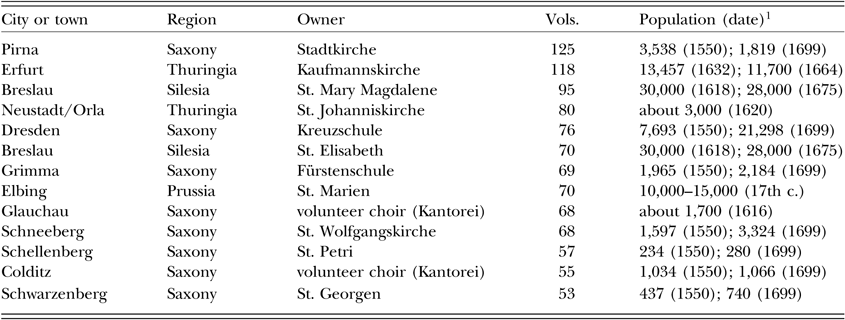
These collections also vary greatly in size. On one end of the spectrum lie large sets of prints such as that owned by St. Anna in Augsburg, which included over two hundred volumes, while on the other end lie very modest collections such as that of St. Walpurgis in Apfelstädt, a small village in Thuringia, which numbered just eighteen volumes in 1712.Footnote 15 But as Table 1 reveals, population size in itself was not determinative of whether the local church-music programme could thrive; many of the more sizeable known collections stemmed from institutions in towns with small to moderate populations. And it was not unusual to find concentrations of wealth in very small towns; Schwarzenberg, with fewer than one thousand inhabitants, was the official seat (Amtssitz) one of the most population-rich administrative districts (Ämter) in electoral Saxony,Footnote 16 and the music programme in the local church clearly benefitted from the prosperity of its citizens.
Examples of collection size with population data

1 Sources: Colditz, Dresden, Glauchau, Grimma, Pirna, Schellenberg, Schneeberg, Schwarzenberg: Keller, ‘Kursachsen am Ende des 17. Jahrhunderts’, pp. 159–60; Breslau (St. Mary Magdalene and St. Elisabeth), Elbing: E. Keyser (ed.), Deutsches Städtebuch: Handbuch städtischer Geschichte, vol. 1: Nordostdeutschland (Stuttgart and Berlin, 1939), pp. 712, 43; Erfurt, Glauchau, Neustadt/Orla: E. Keyser (ed.), Deutsches Städtebuch: Handbuch städtischer Geschichte, vol. 2: Mitteldeutschland (Stuttgart and Berlin, 1941), pp. 480, 88, 341.
The wealth of detail preserved in these sources offers us the opportunity to probe for answers to some of the broad questions outlined above, at least as they pertain to printed sacred music in Lutheran use during the seventeenth century.Footnote 17 In order to facilitate an examination of these questions, this study foregrounds four broad topics related to musical taste, all of which emerge from a study of these documents. First, evidence drawn principally from institutional account books is used to explore the economics of collection development, and also to suggest which musical genres found favour with Lutheran consumers at various points in the century. Then the inventories themselves are interrogated, first for what they might reveal about Lutheran interest in music by Catholic composers, and then for what they might suggest about the degree of market success enjoyed by various Lutheran composers during this century.Footnote 18 All four topics shed light on the purchasing patterns of seventeenth-century Lutherans, and thus significantly enhance our understanding of their musical preferences.
THE ECONOMICS OF COLLECTION DEVELOPMENT
Both account books as well as some inventories reveal that schools and volunteer choirs acquired music prints both through institutional purchases and outside donations, and that both mechanisms were essential to the development of the collection. These sources also generally document the avenue by which a print entered a collection, in that they record the date of purchase or donation, the name(s) and profession(s) of the donor(s), and the purchase price and/or binding cost.Footnote 19 With respect to music purchased by the cantor himself, or by church or city officials, the account books also reveal the various funding sources available for such acquisitions. In 1620, for example, all four volumes of the Promptuarium musicum (1611–17) edited by Schadaeus and Vincentius were purchased for the choir of the Stuttgart Stiftskirche with a combination of funds from the city's mayor and the school's music fund (‘Music Casse’).Footnote 20 In the 1640s and 1650s, the Ratschule in Zwickau (Saxony) purchased music by several composers with funds from an unidentified source, perhaps also the ‘Music Casse’.Footnote 21 The sources also reveal that members of the church council (Kirchenjuraten) might also provide funds for the purchase of music; in 1650 and 1654, the council members of the Johanniskirche in Lüneburg authorised the cantor to purchase a total of twenty-two volumes of music for the school.Footnote 22 Music acquisitions were also made possible by financial bequests and endowments. Funds bequeathed to the school in Waldenburg by Hugo von Schönburg-Glauchau-Waldenburg (1555–1605) enabled the purchase of numerous music prints as well as instruments from 1626 to the early 1640s,Footnote 23 and in the years 1660–2, the Lyceum in Saalfeld (Thuringia) purchased multiple prints with funds bequeathed to the school by one of the town's mayors.Footnote 24 After 1672, the school in Heilsbronn purchased a large group of later seventeenth-century prints with funds received from the local sovereign; the acquisition included both sacred vocal and instrumental music by a wide range of German and Italian composers.Footnote 25
Volunteer choirs also received funding for music purchases from a number of sources. The financial records of such groups in Saxony, for example, document music purchases made by the school cantor and officers of the ensembles in the 1640s and 1650s, using funds from the church coffers and money collected from members of the ensemble.Footnote 26 The local government also often supported these volunteer organisations with revenues collected through the state tax on alcoholic drinks (the Trank- or Biersteuer); in 1655, the choir in Düben used such funds to purchase unidentified ‘musical parts’ to replace those that had been ‘torn up and carried off’ by soldiers.Footnote 27 Volunteer choirs also supplemented their music collections with purchases made with funds from endowments, the terms of which often stipulated the performance of polyphonic music on particular occasions. In Geyer, a member of the volunteer choir bequeathed a small sum to the ensemble under the proviso that it sing figural music at the Hospitalkirche on four feast days.Footnote 28 But the officers of volunteer choirs also identified other means of building the ensemble's music collection. Some established policies allowing members to contribute music in lieu of paying dues,Footnote 29 some collected ‘Chorpfennige’ during church services to add funds to their coffers,Footnote 30 and some occasionally charged members an extra fee to help defray the costs of music. In 1655, the collection of such fees allowed the volunteer choir of Mügeln to purchase the fifth volume of Hammerschmidt's Musicalische Andachten.Footnote 31 Volunteer choirs might also petition the city council for permission to do ‘Umsingen’ (street singing) around the parish at Christmas, New Year, and on the feast of St Gregory, during which they would receive monetary contributions from citizens.Footnote 32
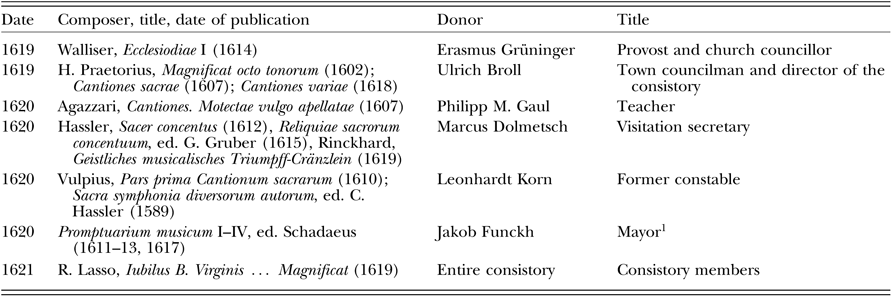
While a number of music prints were purchased with funds identified for that purpose, many others were donated by individual patrons; this group included those with close ties to the school or volunteer choir as well as those who simply heard the ensembles perform on Sundays and feast days. Records of such donations reveal just how extensive was the network was of local residents who supported music in the local church, and the number of professions represented in the pool of donors, the majority of whom stemmed from the propertied and educated classes. Particularly generous were officials of church, city and state government, teachers and other professionals, and members of the business community, as seen in the donations to the Stiftskirche in Stuttgart between 1619 and 1621 (see Table 2).Footnote 33
Donations of music to the Stiftskirche in Stuttgart, 1619–1621

1 Funckh paid 10 fl towards the purchase price, while the remaining 7 fl and 24 gr were drawn from the Musik Casse; see Bopp, ‘Beiträge zur Geschichte der Stuttgarter Stiftsmusik’, p. 215.
Such acts of community patronage were common in other regions as well. From the 1630s to the 1660s, St. Katharine's School in Zwickau received the anonymously edited Nordhausen anthologies as well as many volumes of sacred concertos and motets by Schütz, Schein, Scheidt, Viadana, Finetti, Pfendner, Samuel Michael, Dilliger, Hammerschmidt, Zeutschner and Fabricius; some these volumes were donated by various local officers of the electoral court in Dresden, and others by a notary public, a local doctor of law and philosophy, a theology student, and the ‘four masters of the praiseworthy guild of clothmakers’. But the local cantor and organist also appear among the donors, as do a number of individuals whose titles are not recorded.Footnote 34 The volunteer choirs in Saxony benefitted similarly from such largess, and received music donations from members of the ensemble itself, as well as from pastors, cantors, organists, school masters and other ‘friends of music’. The latter group included a wide range of individuals, among them townspeople, theology students, millers, tax collectors, members of the city council, officials of the state government and local noblemen.Footnote 35 Many of these men were probably alumni of the Latin school choir themselves; altogether they contributed an appreciable number of prints to the music collections of these ensembles.
Still other volumes in these collections were donated by the composers themselves, who regularly dedicated prints to members of the nobility, as well as to city councils and choirs, but also sent gratis copies to city and town councils, choirs and individuals. Schütz, for example, sent out at least twelve copies of his 1619 Psalmen Davids; recipients included the city councils in Nuremberg, Zeitz, Colditz, Braunschweig, Chemnitz, Dresden, Frankfurt am Main, Halle, Leipzig and Weißenfels, and the cathedrals of Magdeburg and Naumburg.Footnote 36 A decade later, he also dispatched his 1629 Symphoniae sacrae, published in Venice, to the Nuremberg city council,Footnote 37 and in 1647 and 1650, he sent copies of his Symphoniae sacrae II and III to a notary public and an organist in Zwickau; both men then donated the prints to the school.Footnote 38 Schütz also sent copies of his 1650 collection to the Peterskirche in Görlitz and to the Dreieinigkeitskirche in Regensburg, presumably for use at the Gymnasium poeticum.Footnote 39 Other composers, among them Schein,Footnote 40 ScheidtFootnote 41 and Hammerschmidt,Footnote 42 made similar donations. Most of these records also indicate that the composers received a small honorarium from the dedicatee or recipient of the volume. Records from Nuremberg, however, reveal that a local musician might be asked to evaluate the donated music in order to help the city council determine the amount of the honorarium; in 1626, organist Johann Staden evaluated Schein's Opella nova II, and in 1634, he examined Scheidt's Geistliche Concerten II.Footnote 43 Sometimes, however, the desired compensation did not materialise; Scheidt also sent music to the town of Bitterfeld, but received nothing in return; he then wrote several letters requesting payment, but to no avail.Footnote 44
In addition to documenting the dates of acquisition of many prints, some of the inventories and financial ledgers of these institutions also record the amount paid for each volume. Prices appear in the records of a number of institutions in Württemberg,Footnote 45 Braunschweig-Lüneburg,Footnote 46 Franconia, Saxony and Thuringia. In the case of the latter two regions, which used the same system of currency, some of the prices that churches, schools and volunteer choirs paid for music can be documented for a period of nearly fifty years. Analysis of this data reveals that the cost of music prints in middle Germany remained remarkably stable during this period; as Table 3 reveals, a set of twenty to thirty sacred compositions often sold for 1 fl and 3 or 6 gr.Footnote 47
Prices of music prints purchased between 1626 and 1673

Sources: Chemnitz (church or Latin school): H.-H. Schmidt, ‘Zum Musikleben der Stadt Chemnitz im 17. Jahrhundert: Über Musikalien aus dem Nachlaßverzeichnis des Atlas Crusius und anderen Quellen’, in I. Crusius (ed.), Atlas Crusius—Bürgermeister in schwerer Zeit. Die Stadt Chemnitz nach dem Dreißigjährigen Krieg, Aus dem Stadtarchiv Chemnitz, 7 (Chemnitz, 2004), 67–111, at p. 97 (price converted from Reichsthaler); Colditz, Glauchau, Grimma (volunteer choirs): Rautenstrauch, Luther und die Pflege der kirchlichen Musik, 265–8, 298; Erfurt (church): Brück, ‘Das Chorbuch der Kaufmannskirche’, 184–5 (no dates given; prices given in Reichsthaler and converted above); Pirna (volunteer choir): W. Nagel, ‘Die Kantoreigesellschaft zu Pirna’, Monatshefte für Musikgeschichte, 28 (1896), pp. 148–66, at 158–60 (Nagel provides the prices in Thaler and Groschen; these have been converted to Floren here; the cantor who drew up the list dated it ‘1654’, and indicated that the prints were purchased from 1630 on); Saalfeld (Latin school): Rumpf, Kirchenmusikpflege in Sachsen, p. 154 (all purchased between 1660 and 1662); Waldenburg (church): Ephoralarchiv Glauchau, W I a V 1a (Loc. 241), fols. 11–12. Only the date of the first edition is given in the table.
1 See Zirnbauer, Der Notenbestand der reichsstädtisch Nürnbergischen Ratsmusik, p. 33: Zirnbauer quotes documents from the city council that give the Leipzig cost of Schein's print (which he had donated to the council) as 1 Reichsthaler, which converts to the price in Gulden given above.
Local booksellers probably based their prices on the amount of paper contained in the print, just as ‘bookdealers and publishers [at the Frankfurt and Leipzig trade fairs] swapped stock on the basis of the quantity of paper’.Footnote 48 This system would explain the considerably higher price paid for the collections of Bodenschatz (1618 or 1621), Schütz (1619) and Hammerschmidt (1663). In 1626, the church in Waldenburg acquired Schütz's 1619 Psalmen Davids, and paid 4 fl 12 gr for the thirteen partbooks, which contain about 850 folio-sized pages.Footnote 49 The page count and price of this part set help to clarify the ledger entry documenting the church's 1628 purchase of the ‘Florilegium Musicum Erhardi Bodenschatz’; while the cantor did not record the precise title in the inventory, the amount (6 fl 18 gr) suggests that the church purchased just one volume at this time; the nine partbooks (including basso continuo) of the 1618 print alone include 115 motets and a total of over 1,500 quarto-sized pages, and the 1621 volume comprises 150 pieces and over 1,900 pages.Footnote 50 Decades later, the volunteer choir in Colditz purchased Hammerschmidt's 1663 Missae for 3 fl 6 gr; the price again reflects the amount of paper (nearly 1,100 quarto-sized pages) contained in the thirteen partbooks of this set. On the other hand, the prices paid by the Latin school in Saalfeld (Thuringia) for prints of Capricornus and others in the early 1660s would seem at first glance to reflect anomalies, but examination of some of the collections reveals that they contain about a third as many pages as the prints of Hammerschmidt.
But how did the prices of music prints relate to costs associated with other material goods in seventeenth-century Saxony? Some perspective on this question can be gained by examining the salaries of a few civic and court musicians in relation to commodity prices from this period. Unlike court musicians, a cantor's income derived from a number of sources, and thus today one can only estimate the actual amount of compensation. Evidence suggests, however, that a cantor of a medium to large Saxon city could expect to realise a total income of 100 to 200 fl per year. A portion of this was awarded annually by the city or town council, and supplemented by funds from other sources, such as the tax on alcoholic drinks (Tranksteuer) and various endowments; together these monies formed the cantor's base salary. We know the base salaries of some Saxon cantors:
Leipzig 1616 (Schein): 100 fl Footnote 51
Dresden 1615 (Neander): 76 fl Footnote 52
Freiberg 1638 (Demantius): 82 fl Footnote 53
Delitzsch 1633 (Schultze): 86 fl Footnote 54
Glashütte 1617 (Kleppisch): 61 fl Footnote 55
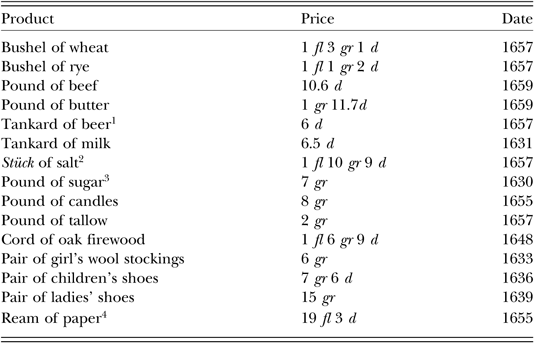
On top of this base salary, a cantor typically received free housing as well as payments-in-kind, or Naturalien, including firewood, bushels of grain and other commodities; he could also expect to receive fees, or Accidentien, for musical duties performed at weddings and funerals, although the fees for figural performances had to be shared with the young singers. Finally, a cantor might further supplement his earnings by taking on private students. Cantors who served in smaller communities, however, probably received lower base salaries, and could only expect fees to provide a modest addition to that amount, given the smaller populations in those locales. And many court musicians faced similar financial circumstances; records from the Dresden court for 1646 and 1651, for example, report that Heinrich Schütz received a salary of 400 fl as Kapellmeister, while the alto Christoph Bernhard and one of the court instrumentalists, Zacharias Hertel, each received 200 fl per annum, and the court organist Johann Klemm received 180 fl per year.Footnote 56 Thus the typical price of 1 fl 6 gr (or 1.285 fl) for a set of partbooks represented 0.3% (.003) of Schütz's salary, 0.6% of that of Bernhard and Hertel, and 0.8% of that of Klemm.Footnote 57 As Table 4 reveals, musicians would have found that many music prints cost as much as a bushel of wheat or a cord of oak firewood. Thus even without the burden of housing costs, many cantors may well have been forced to regard music prints as a relatively expensive luxury.Footnote 58 And like their colleagues in the public sector, many court musicians would also have had to weigh purchases of music carefully, as the cost might well have stretched their budgets to the breaking point, given the larger percentage of their salaries consumed by living expenses. All of this helps to explain the domination of the donor lists by those members of society in possession of discretionary income, given that for many others, the purchase of a set of printed partbooks likely represented a significant financial outlay.
Food and commodity prices in Saxony (Leipzig), 1630–1657

Source: Elsas, Umriss einer Geschichte der Preise und Löhne, vol. 2A, pp. 257–385 and vol. 2IB, p. 36; all prices are given in denarii, and here have been converted to fl, gr and d. Elsas culled prices from the purchase records of the St. Johannis-Hospital in Leipzig for the years 1564–1700, and gives the average prices for 1580 (average of 1578–82), 1621 (average of 1619–21, 1623–4) and 1657 (average of 1655–9). The amounts for 1621 were not used here, however, as they reflect the high inflation in the early 1620s and are thus anomalous. Elsas also gives some prices from particular years in his discussions of various commodities (vol. 2A, pp. 257–385); some of those prices are reported here. He also explains the measurements and quantities used in vol. 2A, pp. 29–38.
1 According to Elsas, a barrel (Faß) contained 420 tankards (Kannen); see Umriss einer Geschichte der Preise und Löhne, vol. 2A, p. 31.
2 One Stück seems to have equalled a bushel (Scheffel); see ibid., pp. 37–8.
3 One pound was the equivalent of 467 grams; see ibid., p. 33.
4 One ream (Ries) of paper contained twenty quires (Buch), each of which contained twenty-four bifolios (Bögen); see M. Kirsch, ‘“fein holl. wapenpapier Zur Capelle”: Papierversorgung und Handschriftenproduktion am Gottorfer Hof’, Schütz-Jahrbuch, 37 (2015), pp. 63–76, at p. 65. Elsas gives the number of bifolios in a quire as twenty-five; see Umriss einer Geschichte der Preise und Löhne, vol. 2A, p. 38. See also Rose, ‘Music Printing in Leipzig’, p. 342.
THE STAYING POWER OF THE MOTET
The inventories and account books considered here clearly document both the entry of the small-scale sacred concerto into the Lutheran repertoire already in the second decade of the century, as well as the rapid growth in popularity experienced by the genre beginning in the 1620s. But they also reveal that the rise of the sacred concerto did not signal the demise of the motet; many dated records of acquisition (both purchases and donations) and binding demonstrate that the earlier genre, particularly in its polychoral manifestation, continued to enjoy cultivation in a number of regions well into the latter half of the century.Footnote 59 In the 1630s and 1640s, the volunteer choir in Grimma purchased sacred concertos of Schein and Hammerschmidt, but also replaced worn copies of Vulpius's 1602 Pars prima cantionum sacrarum and purchased the second volume of that set, which had appeared in 1603; the group also had other (unidentified) motets of Vulpius bound in 1640, and paid for the repair of the Cantus II partbook from one of the volumes of Bodenschatz's Florilegium portense (1618–21) in 1641.Footnote 60 The Katharinenkirche in Zwickau received Schütz's 1619 Psalmen Davids through a donation in 1634, and was given Scheidt's 1620 Cantiones sacrae in 1637,Footnote 61 while the Frankenberg volunteer choir acquired Bodenschatz's 1618 volume thirty years after its first appearance.Footnote 62 Schütz's Psalmen Davids of 1619 came even later into the collections of the volunteer choirs in Oschatz, Schellenberg and Glauchau, which acquired the volume in 1643, 1648 and 1654 respectively.Footnote 63 In Helmstedt the partbooks for Hammerschmidt's Fest- Buß- und Danck-Lieder of 1658–9 and his Kirchen- und Tafelmusik of 1662 were bound together with various prints of Hieronymus Praetorius published between 1599 and 1622, suggesting the continued use of the latter into at least the early 1660s.Footnote 64 In 1672, the cantor of the Fürstenschule in Grimma arranged for the binding of recent prints of Havemann (1659) and Pfleger (1659), but also of the Magnificats of Demantius (1602) and Vulpius (1603).Footnote 65 That same year, the Peterskirche in Görlitz procured a replacement copy of the same collection of Demantius after a fire had rendered the original set unusable.Footnote 66 Even as late as 1687, the Buchholz volunteer choir received Vulpius's Ander Theil deutscher Sonntägliche Evangelische Sprüche (Jena 1614; repr. 1617, 1622) as a gift from a donor.Footnote 67 This continued interest in earlier repertoire can also be seen in the book-fair catalogues; both volumes of Bodenschatz's Florilegium Portense (1618 and 1621) were available for purchase at the fairs in the years immediately following their publication, but also again in 1662; the first volume then appeared again in a catalogue for 1692.Footnote 68 Clearly music prints remained in stock in bookshops for many years; a 1617 inventory list of the Leipzig bookseller Johann Rosa reveals that at that time he still retained copies of Friedrich Lindner's anthologies printed in 1590 and 1591, Demantius's Magnificats of 1602, works of Michael Praetorius published between 1608 and 1612, and Latin and German motets of Melchior Franck that appeared between 1601 and 1608.Footnote 69
Signs of continued interest in this older repertoire also appear in manuscript anthologies and performance records. The Zellerfeld organ tablature, copied in north Germany between 1635 and 1645, includes Schütz's 1619 setting of Ps. 136, ‘Danket dem Herren’ (SWV 32),Footnote 70 while three intabulations from the same print, SWV 22, 24 and 37, appear in a tablature from 1676 with the parts reduced; that anthology also includes works by Clemens, Lasso, Andrea and Giovanni Gabrieli, Hassler and Schein.Footnote 71 And works for double choir by Schein, Lohr, Hammerschmidt, Ahle and others dominate a manuscript anthology of sacred vocal works from Frankenberg (Saxony) copied between 1678 and 1685.Footnote 72 In 1646, the performance records for the dedication of the new castle church in Gotha (Thuringia) reveal that the festive services included polychoral works of Schütz (including several from his 1619 Psalmen Davids), Schein and Hieronymus Praetorius; the services also featured sacred concertos for five and six voices with capella by Tobias Michael as well as works of Vulpius and Joachim a Burck (1546–1610).Footnote 73 The 1650 dedication service for a church in Schneeberg (Saxony) featured music of Michael Praetorius, Schein, Crüger and Schütz; works by the latter included a setting of ‘Jauchzet dem Herren’ for three choirs, probably one of the settings from the Psalmen Davids (SWV 36a or SWV 47).Footnote 74 And the Dresden court musical ensemble continued to perform polychoral psalms of Schütz, both those drawn from the 1619 Psalmen Davids as well as new compositions, into the late 1670s.Footnote 75 Such evidence of the regular presence of polychoral music in the performed repertoire may help to explain the decisions of some composers to issue new prints of works in this retrospective style around mid-century; examples include the fourth volume of Hammerschmidt's Musicalische Andachten, published in 1646, and Schütz's Symphoniae sacrae part III of 1650; the latter includes the famous Saul, Saul, was verfolgst du mich, itself composed at least twenty years earlier.Footnote 76
CROSS-CONFESSIONALITY IN LUTHERAN MUSIC COLLECTIONS
Studies of the cultivation of music across the confessional divide during this era have long noted the high esteem in which music from Italy was held by many German Lutheran performers, composers, theorists and anthologists, and the inventories under consideration here simply serve as further testimony of the allure this music held for northern musicians.Footnote 77 But they also reveal that the cross-confessional interests of Lutherans also extended to the music of many northern Catholics, among them German, Austrian, Bohemian and Flemish composers. The numerous titles by these composers that appear in the inventories emanated from presses in cities all over central Europe, including Antwerp, Augsburg, Munich, Würzburg, Dillingen, Cologne, Frankfurt am Main, Innsbruck, Salzburg, Vienna, Konstanz, Lucerne, Prague, Bamberg, Ravensburg, Passau, Kempten, Nuremberg, Regensburg, Ingolstadt, Klosterbruck (Bavaria) and St. Gallen. While most of these cities are represented by five or fewer titles in the inventories, Frankfurt am Main is represented by twenty-seven (twenty-two of them issued by Stein) and Innsbruck by twenty-four; in addition, Munich is represented by fourteen titles, Antwerp by eleven, Würzburg by nine and Dillingen by eight.Footnote 78
Altogether the music of more than sixty-five northern Catholics appears in these Lutheran collections, and about fifty of the institutions represented here owned music by one or more of these composers. While motets and sacred concertos by these composers slightly dominate the selections, Lutherans also purchased Catholic mass settings and music for Vespers. Measured solely by the number of his imprints that appear in the inventories – fourteen – Stadlmayr appears to have enjoyed the most popularity among Lutherans, but one also encounters quite a few titles by Aichinger, Arnold, Bonhomme, Erbach, Pfendner, Reiner, Gletle and Ruschardus. And while most volumes of music by northern Catholics were held by only one or two of the institutions represented in the sources, some titles of Arnold, Bonhomme, Gletle and Pfendner appear in as many as seven different collections representing a broad geographic area.Footnote 79 As might be expected, the number of titles by northern Catholics reported in the inventories pales in comparison with those of many Lutheran composers, but both the number of Catholics represented and the number of collections in which their music appears speak to an ongoing Lutheran interest in the musical output of those with whom they did not see eye to eye confessionally.Footnote 80
The other large body of music that comprises this cross-confessional repertoire, of course, was that composed in Italy, which travelled to German lands along a number of paths. Between c. 1590 and c. 1660, various German anthologists placed a considerable amount of Italian music on the market, and the inventories document the popularity of these volumes among Lutheran consumers. Georg Gruber's 1615 anthology of works by Giovanni Gabrieli and Hans Leo Hassler,Footnote 81 for example, was owned by Lutheran schools and churches in Saxony, Thuringia, Hesse, Bavaria, Franconia, Braunschweig-Lüneburg, Schleswig-Holstein and Silesia, and Ambrosius Profe's anthologies of the 1640s enjoyed distribution over an equally broad area.Footnote 82 But quite a few churches and schools in German Lutheran areas also managed to procure Italian imprints, particularly titles published in Venice between 1600 and 1640. Venetian editions of Viadana's 100 concertos, for example, appear in the collections of at least two Latin schools in Saxony and Thuringia.Footnote 83 In addition, the music library of the Latin school in Heilsbronn (Franconia) included ten volumes of psalms, motets and sacred concertos published in Venice before 1630,Footnote 84 and that of St Mary Magdalene in Breslau featured volumes of music by Bianciardi, Porta, Ratti, Merula, Rovetta and others published there between 1608 and 1639.Footnote 85 A number of other institutions also managed to amass considerable collections of Italian music in the early decades of the century.Footnote 86 After c. 1640, however, the number of such purchases seems to have declined markedly, probably due both to the war's disruption of supply chains and the dire financial straits into which some schools and churches fell as the conflict raged on.Footnote 87 But Lutheran interest in Italian repertoire did not diminish with the lack of access to prints, as the content of many manuscript collections assembled between c. 1650 and 1720 attests.
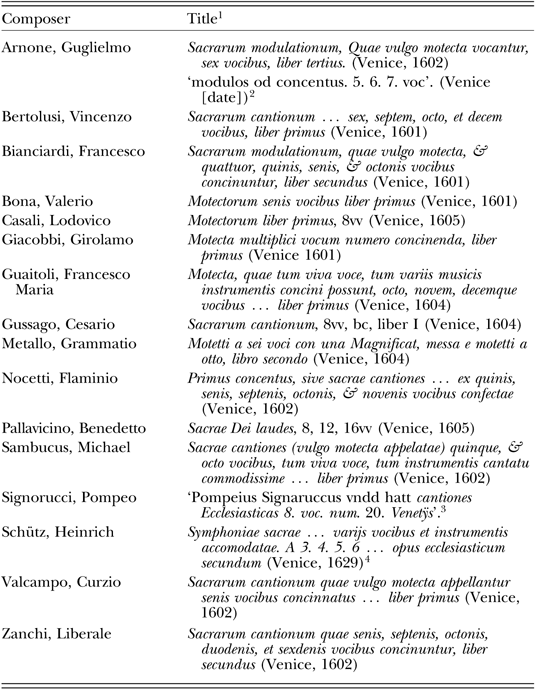
Not surprisingly, most of the institutions known to have acquired Venetian publications were located in larger towns and cities with more significant financial resources and a larger pool of well-heeled potential donors. But we also find that some smaller municipalities owned surprising numbers of such volumes. A recently discovered inventory from the Marienstiftskirche in Lich, a small town near Marburg (Hesse), reveals that the church owned sixty-four volumes of sacred vocal music published between 1600 and 1631, including sixteen titles that appeared in Venice between 1601 and 1605, and one, Schütz's Symphoniae sacrae prima pars, that appeared there in 1629 (see Table 5).Footnote 88
Venetian sacred music in the inventory of the Marienstiftskirche in Lich

1 Titles have been modernised.
2 At present unidentifiable.
3 Probably a lost print.
4 ‘Henrici Sagittarÿ Sÿmphoniae Sacrae à. 3. 4. 5. 6. voc. Venetÿs’.
The avenues through which Germans acquired music from Venice and other Italian cities, however, are still only partially understood. Until 1610, some Venetian imprints were available at the Frankfurt and Leipzig book fairs, where book dealers could procure them for sale in their shops.Footnote 89 After that, however, German dealers must have imported volumes directly from Italy.Footnote 90 A few of those who traded in Italian music prints are known today; both Kaspar Flurschütz and Georg Willer operated in Augsburg, while Caspar Förster (senior) owned a book shop in Danzig, and Paul Parstorffer sold books in Munich. Three of these dealers are known to have published catalogues; those of Flurschütz appeared between 1613 and 1628, while that of Willer dates from 1622, and that of Parstorffer, which does not survive, from 1653.Footnote 91 It seems, however, that these dealers served a clientele that extended far beyond the limits of their respective cities of residence. A copy of Flurschütz's 1615 catalogue bears the initials and annotations of Michael Praetorius, who presumably used it to order music from Augsburg.Footnote 92 Schein also seems to have owned a copy of one of the Augsburg dealer's catalogues, for in 1620 the Leipzig city council reimbursed him for ‘some foreign canzonas and other musical items that he ordered from Venice via Augsburg’.Footnote 93 And in Stuttgart, the court Kapellmeister sent musicians to Augsburg and Nuremberg to purchase music, including motets of Riccio, for which they were reimbursed.Footnote 94 The means by which the church in Lich acquired its collection of Venetian prints, however, cannot easily be explained; the vast majority of the titles appear neither in the book-fair catalogues, nor in those of Flurschütz and Willer.Footnote 95 However, Elisabeth Giselbrecht has pointed out that Nicolaus Stein, a publisher in Frankfurt who specialised in reprints of Italian music, also served as a book dealer; given Lich's general proximity to Frankfurt, this Italian repertoire may have been purchased through him.Footnote 96 Alternatively, the volumes may have been purchased from yet another dealer, or by a wealthy donor who travelled to Italy. Overall, the inventories reveal a continuing demand for Italian music prints on the part of Lutherans that extended into the 1640s, which in turn suggests that more booksellers were involved in the importation of music from Venice and other Italian cities, and for a longer period, than can currently be documented.
Lutherans also availed themselves of some of the Italian music published in Frankfurt during the first three decades of the century by Catholics such as Stein.Footnote 97 In fact, the inventories suggest that some Lutherans first encountered the new sacred concerto through the works of Viadana rather than through those of Schein or a German Catholic, such as Gregor Aichinger or Urban Loth.Footnote 98 Of the many titles that flowed from the Frankfurt presses, particularly that of Stein, the most popular by far among Lutherans was Stein's omnibus edition of Viadana's sacred concertos, Opera omnia concertuum ecclesiasticorum, which he first issued in 1613 and reprinted in 1620; his successor Emmel reprinted the volume again in 1626. The 1613 edition and its reprints feature 148 concertos by Viadana – all one hundred from the seminal collection of 1602, and forty-eight additional works drawn from the second and third volumes of 1607 and 1609.Footnote 99 Either the 1613 edition or one of the reprints can be traced to the collections of eighteen Lutheran institutions; in fact, the Lutheran demand may have helped to spur the reprints of the volume.Footnote 100 Stein's editions of Viadana's concertos appear in the inventories as often as do the Italian anthologies of Profe, a Lutheran, published two decades later. Curiously, however, none of Stein's other Italian reprints achieved as much popularity among Lutherans, which may suggest that Viadana enjoyed particular name recognition in Germany. Among Stein's other reissues of Italian music, the next most popular among Lutherans was the Tripartitus S. S. concentuum fasciculus of 1621, with music of Finetti, Lappi and Belli; this volume, however, appears in only six inventories.Footnote 101 In addition, a few Lutheran institutions also owned one or two of Stein's editions of music by Agazzari, Pacelli, Tresti, Finetti, Lappi and Belli.Footnote 102
Overall, however, Lutheran interest in printed collections of Italian music seems to have diminished after c. 1650, due perhaps to a growing recognition that the music, increasingly florid in nature, now surpassed the abilities of many young German singers.Footnote 103 Although the daughters of Pierre Phalèse (Jr) issued many reprints of Italian music in Antwerp after c. 1638, as well as first editions of music by various northern Catholic composers, very few copies can be associated with Lutheran collections.Footnote 104 Of the inventories surveyed here, only that of St Mary's in Lübeck included later prints of Phalèse, and only one of these, the Missarum … liber secundus (1651) of Giovanni Battista Chinelli, represents music by an Italian.Footnote 105 But copies of motets that appear in some of the Phalèse reprints, such as those of Francesco Della Porta, appear in a number of Lutheran manuscript collections; this in turn suggests that some Lutheran musicians acquired volumes from Antwerp for their own private collections.Footnote 106 Another publisher from the Low Countries, Jan van Geertsom of Rotterdam, issued anthologies of Italian music in the 1650s and 1660s, but none of these volumes has surfaced in Lutheran collections.Footnote 107 At least two Lutheran institutions, however, the Ansbach court and the Stadtkirche in Pirna, owned Musica Romana, a German anthology of Roman music by Carissimi, Graziani and Foggia published in Bamberg in 1665.Footnote 108 Curiously, however, the collection of Carissimi's motets published in 1670 in Konstanz, Arion Romanus, does not form part of any of these inventories; its absence is notable, given the Roman master's great popularity among Lutherans, as evidenced by the presence of his works in a great many of their manuscript collections from the latter half of the century.
LUTHERAN COMPOSERS IN THE MARKETPLACE
Perhaps the greatest value of these inventories resides in their potential to suggest which composers, musical styles and genres resonated most strongly with the tastes of seventeenth-century Lutheran music consumers.Footnote 109 Yet we must proceed with caution when examining such questions, for the very nature of these sources limits our ability to draw any more than preliminary conclusions from the data derived from them. First, inventories are known to survive from only a small percentage of the hundreds of Lutheran institutions that existed in the seventeenth century.Footnote 110 Thus today we can trace only a small number of the total copies once in circulation, due both to the limited number of surviving inventories and to the fact that virtually all known copies of prints are associated with institutions. In addition, the majority of inventories stem from Saxony and Thuringia; far fewer have surfaced from other predominantly Lutheran areas,Footnote 111 making it difficult to determine the extent to which the available data can be regarded as representative of the entire German Lutheran market. Also problematic is the fact that we can never ascertain whether or to what extent an inventory or extant collection is complete. Additionally, the fact that some inventories only report holdings published during a certain period of years, rather than across the entire century, complicates assessments of market share and distribution,Footnote 112 as does the knowledge that some prints were acquired ten or more years after publication. Although account books that document these late acquisitions do survive for some institutions, similar records are lacking for many others, which further complicates the analysis of market share, and also renders it difficult to gauge the Thirty Years War's overall impact on sales of music.Footnote 113 But the laments of contemporary musicians on the war's deleterious effects suggest that sales of music, at least of larger-scale works, probably slowed considerably during the worst periods of the extended conflict.Footnote 114 And finally, the paucity of documentation on the size of print runs renders it difficult if not impossible to compare the availability and market share of music by different composers with confidence.Footnote 115
Despite all of these qualifiers, however, the number of inventories that report extensive holdings remains large enough to allow us to form some initial impressions about the state and nature of the Lutheran market for sacred music during the seventeenth century. The following discussion presents a decade-by-decade look at this market, and identifies the composers and titles that Lutherans purchased with the most frequency, as revealed in a collation of 167 inventories.Footnote 116 Many of the results of this collation, which runs to over seventy pages in the original, are presented in summary form in Appendix 1, ‘Known Copies of Selected Music Prints, by Decade’, while the sources of the inventories, together with the size and date-range of each collection, appear in Appendix 2, ‘Bibliography of Sources, by Region’. The discussion below draws upon the data presented in Appendix 1, where the regional distribution for a number of titles is also given; these statistics, incomplete though they be, demonstrate just how widely disseminated were many of these music books in Lutheran areas of Germany. This in turn suggests that the basic distribution system, through which booksellers bought and traded books at the Leipzig and Frankfurt fairs for sale in their own shops, or for transfer to another dealer, had evolved into a reasonably well-oiled machine by this time.Footnote 117 Finally, the table also includes the number of ‘possible copies’ of some prints, those for which the inventory does not clearly indicate whether the institution owned all or part of a multi-volume series.Footnote 118
In the opening decade of the seventeenth century, motets for four to twelve voices without continuo dominate the repertoire, and four composers – Melchior Vulpius, Hieronymus and Michael Praetorius, and Hans Leo Hassler – dominate the market for such works. Of these, Vulpius's two volumes of Latin Cantiones sacrae of 1602–3 represent the most frequently encountered titles. But the first five instalments of Michael Praetorius's chorale-based Musae Sioniae series also appear in a number of school and church collections;Footnote 119 these volumes also mark the beginning of a turn towards German-texted repertoire more generally.Footnote 120 Equally well received were the Latin Cantiones sacrae and Magnificat octo vocum of the Hamburg composer Hieronymus Praetorius; with the reprints of both volumes through 1623, the number of known copies of each totals more than thirty. And Hassler's 1601 Sacri concentus appears in nearly as many inventories as some of the titles of the other three composers. Volumes of motets by Christoph Demantius, Friedrich Weissensee and Adam Gumpelzhaimer also appear frequently, as do the anthologies of Italian and German music edited by Caspar Hassler and Erhard Bodenschatz. All of these prints enjoyed wide regional distribution, and were owned by Latin schools both large and small. By contrast, the numerous motet collections issued by Coburg (Thuringia) Kapellmeister Melchior Franck during this decade seem to have fared less well in the marketplace,Footnote 121 although they did reach schools and churches over a comparatively wide region.
In the following decade, the new sacred concerto began to exert a presence in the market, but those purchasing music for institutions seem to have continued to focus primarily on new collections of motets for a variety of vocal combinations. By far the best-represented print during these years is Bodenschatz's 1618 Florilegium Portense, an anthology of motets for four to eight voices and continuo that appears in more than twice as many inventories as do any of the volumes issued by the four most successful composers of the previous decade.Footnote 122 Sales of Bodenschatz's two volumes (1618 and 1621) also considerably surpassed those of the four similar anthologies edited by Abraham Schadaeus and Caspar Vincentius, which appeared in Strasbourg between 1611 and 1617. Instead, Bodenschatz's main competitor for market share seems to have been Schütz, with his Psalmen Davids of 1619. As many as forty-five copies of this volume can be accounted for; thirty-three of these were probably purchased, while another twelve were sent by the composer to city councils and cathedrals. Schütz himself served as the publisher of this volume, but this decision seems not to have negatively impacted either the sales or the dissemination of the print.Footnote 123 Following Schütz in popularity, however, seems to have been a far less familiar figure, the Coburg cantor Heinrich Hartmann; his two volumes of Confortativae sacrae (1613, 1617), German-texted motets for five to eight voices without continuo, met with considerable market success, and the first volume saw a reprint in 1618. Hartmann also enjoyed quite widespread regional distribution, and may have sold more copies in Thuringia than either Bodenschatz or Schütz; his volume also did well against the two volumes of German Gospel settings of Vulpius.Footnote 124 But the fifth most successful print from this decade, Johann Hermann Schein's 1618 Opella nova, represented a harbinger of things to come; most of the twenty-eight known copies (including at least eight of the 1627 reprint) appear in church and school inventories from a broad geographic area. In the preface to this self-published collection of chorale-based sacred concertos, Schein famously referenced the ‘opera omnia’ edition of Viadana's concertos,Footnote 125 and thus must have owned the compendium published by Stein in 1613. Eighteen copies of Stein's Viadana edition (including those of the two reprints) can be traced to Lutheran collections,Footnote 126 but these found their way to only half as many regions as those of Schein's concertos. Still, these two collections together introduced the new sacred concerto to many Lutheran listeners.Footnote 127 In addition, Walliser, Demantius, Gruber (ed.) and Michael Praetorius also published popular collections during this decade; Praetorius's Polyhymnia caduceatrix of 1619, however, seems to have been far outpaced by Schütz's Psalmen Davids of the same year.
The Lutheran demand for motets of all sorts remained strong in the third decade of the century, and was met by volumes from a variety of composers; Bodenschatz's second Florilegium volume of 1621, however, seems to have outperformed them all. The success of a number of titles representing newer genres, however, points to a general diversification of the repertoire at this time. Three volumes that were self-published, Schein's 1623 sacred madrigals (Israelsbrünnlein), as well as sacred concertos of Daniel Selich (Opus novum, 1623; repr. 1624, 1625) and Schein (Opella nova II, 1626), all seem to have enjoyed considerable market success and regional appeal; Selich's collection reached institutions in at least ten different German-speaking areas, while copies of Schein's volume are found in at least nine.Footnote 128 Lutherans also continued to purchase Frankfurt reprints of Viadana's concertos during this decade (editions of 1620 and 1626), and a few also acquired the three massive anthologies of sacred concertos edited by Johann Donfrid, Promptuarii musici (1622–7).Footnote 129 Johann Crüger's Magnificats for two to six voices and continuo (1626) and Lohr's German motets for seven and eight voices (1629) also enjoyed reasonably good sales. But fewer copies can be documented of Schütz's Resurrection History (1623) and his Cantiones sacrae (1625), or of Franck's Rosetulum musicum (1627), a collection of homophonic chorale settings. At the end of the decade, while in Venice, Schütz published his Symphoniae sacrae prima pars, a set of Latin-texted sacred concertos, but seems to have left most of the copies in Italy;Footnote 130 exemplars can only be traced to Breslau, Heilsbronn, Lich, Nuremberg, Wolfenbüttel and possibly Darmstadt, and most of these may have been donated by the composer.Footnote 131 Curiously, however, the title did appear in the Frankfurt and Leipzig book-fair catalogues for the autumn of 1629 and the spring of 1630.Footnote 132
In the 1630s and 1640s, years in which the war ravaged parts of Saxony, the number of prints on the market began to decline steadily.Footnote 133 Of those composers still offering music for publication, Schütz, Scheidt and Tobias Michael enjoyed reasonable success during the 1630s, but they could not compete with the newcomer who came thundering onto the musical scene at the end of that decade. Andreas Hammerschmidt (1611–75) issued his first collection of sacred concertos, Musicalische Andacht I, in 1638, and scored an immediate success; the volume was reprinted in Freiberg the following year, and then again in 1651 and 1659. Three years later, Hammerschmidt issued his second volume of Musicalische Andachten, which stands as one of the most popular collections of the century. This set of sacred madrigals also saw three further editions; altogether the inventories report as many as sixty copies of this title, forty-three of which appear in more extensive inventories. The third volume of Hammerschmidt's Andachten series (1642; repr. 1652), a set of few-voiced sacred concertos with ‘symphonias’ for obbligato instruments, appears in as many as forty inventories, while the fourth volume of 1646 (repr. 1654, 1669), a collection of larger-scale German motets, is found in as many as fifty-seven. In 1645, Hammerschmidt also published two volumes of dialogues, the first of which, with three reprints, seems to have enjoyed slightly more popularity than the second, which was reissued only once.Footnote 134 It seems that only with his 1649 collection of Latin motets did the Zittau organist somewhat misjudge his market. Unlike many of his contemporaries, Hammerschmidt rarely felt the need to rely on self-publication.Footnote 135 Most of his titles were published and printed either by Georg Beuther in the wealthy Saxony mining town of Freiberg,Footnote 136 or by Christian Berg in Dresden, and consistently reached a very broad market; copies of these prints (as well as later titles) are found in institutions in many regions of Germany as well as in Scandinavia and eastern Europe.Footnote 137
Schütz, Rosenmüller and Profe also issued volumes of music (predominantly sacred concertos) during the 1640s, but Hammerschmidt seems to have outsold all three by a considerable margin.Footnote 138 Rosenmüller's first volume of Kernsprüche of 1648, however, seems to have been more enthusiastically received than Schütz's Symphoniae sacrae II, which appeared the previous year.Footnote 139 Interestingly, Rosenmüller undertook the publication of his collection himself, while that of Schütz was published by a colleague and a student; in fact, Rosenmüller served as one of the agents for Schütz's print.Footnote 140 But Schütz's set of Spruchmotetten from 1648, Geistliche Chormusic, seems to have met with a rather tepid response; the volume appears in only twelve inventories, whereas Hammerschmidt's motet collection of 1646 is found in as many as fifty-seven. Schütz's 1648 collection even seems to have been outsold by the multi-genre Kronen Krönlein of Stephan Otto, cantor at the court in Weesenstein (Saxony).Footnote 141 With respect to output, only the publishing activity of the editor Ambrosius Profe compares to that of Hammerschmidt during this decade; Profe, however, focused on sacred concertos by Italian composers. While these volumes do appear in Lutheran inventories from many German-speaking areas, they found homes in considerably fewer institutional collections than the prints of Hammerschmidt.
The numerous reprints of Hammerschmidt's collections testify to the great demand for his music, but also complicate an evaluation of his reception in particular decades, and render head-to-head comparisons with single-issue prints of other composers more difficult, as few of the inventories report the dates of the editions owned by the institution. But Hammerschmidt's collections from the 1650s and 1660s saw no reprints, and the inventory totals for these volumes are as high as or higher than those for earlier titles that were reissued; this suggests that the majority of known copies of titles first issued in the 1630s and 1640s represent those of the first edition. But even when known reprints and later acquisitions are omitted from Hammerschmidt's totals, his Musicalische Andachten series still seems to have enjoyed considerably more popularity than the contributions of his main competitors from the late 1630s through the early 1650s.Footnote 142 Comparative statistics for the circulation of music by Hammerschmidt, Schütz, Profe, and Rosenmüller, 1638–53, are as follows:Footnote 143
Hammerschmidt, Musicalische Andachten I (1638): 32 (28/4*)
Schütz, Kleine geistliche Konzerte II (1639): 20 (19/1*)
Hammerschmidt, Musicalische Andachten II (1641): 49; 38/9* + 2 possible (1/1*)
Profe (ed.), Geistliche Concerten und Harmonien I (1641): 19 (18/1*)
Profe (ed.), Geistliche Concerten und Harmonien II (1641): 20 (19/1*)
Hammerschmidt, Musicalische Andachten III (1642): 38; 29/6* + 3 possible (1/2*)
Profe (ed.), Geistliche Concerten und Harmonien III (1642): 19 (18/1*)
Hammerschmidt, Musicalische Andachten IV (1646): 52; 38/8* + 6 possible (4/2*)
Profe (ed.), Geistliche Concerten und Harmonien IV (1646): 18 (17/1*)
Hammerschmidt, Musicalische Andachten V (1653): 46; 36/9* + 1 possible
Rosenmüller, Kernsprüche II (1652–53): 27 (22 + 5 possible)
Hammerschmidt continued to dominate the market of available prints throughout the 1650s with new offerings of sacred madrigals, dialogic concertos (the Gespräche), and settings of seventeenth-century devotional hymns; each appears in inventories across the vast majority of regions where German Lutherans were active. But his Musicalische Gespräche I (1655), with as many as sixty-two known copies, stands as the most frequently encountered title in these inventories. In addition, fully nine volumes of his earlier sacred concertos, dialogues and motets saw reprints during the decade. A number of other composers issued sacred concertos at this time, among them Schütz, Rosenmüller, Capricornus, Ahle, Briegel, Seidel, Sartorius and Havemann (ed.), but with the exception of Rosenmüller's second volume of Kernsprüche (1652–3), none of these titles appears in even half as many inventories as those of the Zittau organist. But many of these other volumes nevertheless reached a broad regional market; the 1658 Fest- und Danck-Andachten of Christian Sartorius, for example, could be found in collections in Saxony, Thuringia, Franconia, Silesia and Braunschweig-Lüneburg.
Hammerschmidt's frenetic pace finally slowed in the 1660s, at which point his grip on the market seems to have begun to loosen. But while he issued only two new sacred collections during this decade, the 1662 Kirchen- und Tafelmusik and the 1663 Missae, both did very well; the totals for the self-published volume of 1662 in particular compare favourably to those of his earlier publications. Following Hammerschmidt in popularity during this decade, however, seems to have been Tobias Zeutschner with his 1661 Musicalische Kirchen- und Haus-Freude, a set of sacred concertos with arias for three to six voices and instruments; it also enjoyed dissemination over a very broad area. Wolfgang Carl Briegel, who had entered the market in the 1650s, continued to publish music during this decade, but only the first part of his Evangelisches Gespräch of 1660 seems to have enjoyed a level of success at all comparable to that of Hammerschmidt and Zeutschner. Some of the music of Capricornus, a composer of considerably more depth and sophistication, also seems to have been quite well received at this time; two of the three titles that appeared in 1660 could be found in the collections of schools and courts in a number of regions. A number of other composers also issued sacred concertos during this decade, but all apparently sold considerably fewer copies than those mentioned above. Ahle also self-published several collections of strophic arias for choir in the 1660s, but despite his detailed guidelines for their performance in church as well as in the home, most potential buyers seem to have regarded this repertoire best suited to domestic use.Footnote 144
In the final three decades of the century, the number of prints of sacred music declined even further; relatively few composers now attempted to see their works into print. Hammerschmidt's final offering, the VI-Stimmige Fest- und Zeit-Andachten of 1671, stands as the most popular collection of the 1670s, although the total number of known copies does not approach that of most of his earlier publications. This single-issue print remained popular, however; records in Mügeln (Saxony) indicate that a copy was purchased in 1685.Footnote 145 Only Briegel seems to have enjoyed a comparable level of success during this decade, and then only with his Musicalische Trost-Quelle of 1679. By comparison, less than half as many copies of Dedekind's sacred concertos and his setting of Ps. 119 can be documented. And the masses of two Lutheran composers, Capricornus and Theile, may have been outsold by those issued by the Catholic editor Rudolf Dreher, whose Sacrae sirenes (Kempten, 1671) appears in five Lutheran inventories from institutions in Bavaria, Franconia, Saxony, Schleswig-Holstein and Württemberg.
In the following decade, the apparent best-sellers were two volumes of sacred concertos and motets for the liturgical year by Johann Caspar Horn, a physician who, after studying law, was active in Leipzig as a musician and amateur composer, particularly of instrumental music. The two parts of the Geistliche Harmonien, Horn's only sacred publications, seem to have outsold all of the prints that Briegel, by this time a well-established and prolific composer of sacred music, issued between 1679 and 1686. Horn's success is somewhat difficult to explain; it may reside at least part in the name recognition that he had developed with his instrumental music, particularly the six volumes of his Parergon musicum (Leipzig, 1663–76), but it may also reflect the fact that so little sacred music was now offered in print. A few other composers issued sacred concertos during this decade, among them Kress, Speer and Schmetzer, but their works, much more sophisticated and musically challenging than those of Briegel and Horn, seem to have appealed only to a more select market of courts and larger Latin schools. After this point, however, the record becomes very thin; only a few inventories include prints from the 1690s, and the highest number of known copies that these record is six – all in Thuringia – of Nicolaus Niedt's Musicalische Sonn- und Festtagslust (Sondershausen, 1698).
Despite their limitations, the data gleaned from these sources nonetheless serve to elucidate a number of aspects of the market for sacred music at this time. First, they point to a remarkably extensive and effective distribution network, one that reached the entire German-speaking area in which Lutherans were active, and stretched beyond that into ScandinaviaFootnote 146 and eastern Europe.Footnote 147 The broad regional distribution of many prints in turn suggests that composers and publishers could realistically aim – and may even have expected – to sell music throughout the German-speaking territories and beyond, and thus that they did not necessarily confine their efforts to sales in the immediate region.Footnote 148 And although the evidence is inconclusive, it does suggest that many self-publishing composers managed to gain access to the same network of distribution used by commercial publishers, and thus that a composer's decision to self-publish did not in itself negatively impact sales of a volume of music. Similarly, at least for those composers active in the central territories of Saxony, Thuringia, Franconia and Hesse, the place (city) of publication generally seems to have been of less consequence than access to the network of book dealers. At the same time, the presence of prints from these central regions in all inventories, including those from the north and north-east, and the general absence from inventories of music printed in the latter regions after c. 1625, suggests that the distribution system may have worked more efficiently for those composers and publishers who were more centrally located, particularly during and after the war. Finally, both the inventories and the ancillary documents (purchase records and the like) strongly suggest that the Lutheran repertoire in the decades after c. 1620 was not dominated by one particular musical style or genre. While they enthusiastically embraced the new sacred concerto, Lutherans continued to cultivate both small- and large-scale works in a variety of genres, and retained some music in their performed repertoire for many decades.
Still, the statistics presented in this study do raise a number of questions, particularly with respect to perceived market success (or the lack thereof). One might be tempted, for example, to equate the apparently poor showings in these inventories of many composers as evidence of their failure to capture the imaginations of many consumers of sacred music. But in some cases, evidence drawn from other sources suggests that such a judgement would be premature. Such is the case with Coburg Kapellmeister Melchior Franck (c. 1579–1639). A prolific composer, Franck issued at least thirty volumes of music between 1601 and 1636, among them collections of Latin motets as well as German Magnificats, Spruchmotetten, sacred concertos and settings of German poetry. The style of much of this repertoire suggests that Franck conceived it for church use, but the dependence upon homophony in some of the German collections (such as the Suspiria musica of 1612) may have caused potential customers to regard these as Hausmusik, even though Franck did not identify them as such. Most of Franck's titles appeared under a publisher's name, and quite a few of his collections were issued in Nuremberg, an important centre in the music trade; in addition, nearly all of his sacred music was advertised in the Frankfurt and Leipzig book-fair catalogues.Footnote 149 Yet the data examined here would suggest that his music sold rather poorly, even though it reached regions far distant from his place of residence; copies of his Rosetulum musicum (1628), for example, can be documented in Prussia and Pomerania.Footnote 150 How then, to square this information with the esteem in which Franck was held by some of his contemporaries? In 1628, he dedicated his Suspirium Germaniae Publicum to the Nuremberg city council, and the latter subsequently asked two local organist-composers, Johann Staden and Valentin Dretzel, to assess the work, presumably to help the councillors decide upon an amount for the honorarium. Staden and Dretzel, however, responded that since Franck was ‘an old, famous master who has published many various works of music over twenty-four years and who is known in all of Germany’, his work required no special evaluation.Footnote 151 These laudatory comments suggest that Franck's music had reached a much wider public than can be determined solely by assessing the holdings reported in these inventories, and serves as a reminder that such evidence often requires a careful and nuanced interpretation.
But with respect to Hammerschmidt, these sources raise no such lingering questions concerning reception, for this ‘German Orpheus’ seems to have enjoyed a consumer response that bordered on the phenomenal.Footnote 152 Not only do the inventories strongly suggest that he dominated the market for new sacred music for at least thirty years, but various acquisition records indicate that his music remained a repertory staple in towns large and small, as well as in some courts, into at least the 1690s. The Johanniskantorei in Lüneburg, for example, purchased eight volumes of his music in 1673,Footnote 153 the Pädagogium in Gießen (Hesse) acquired his Musicalische Andachten IV in the same year, obtained another instalment of that series in 1674, and acquired his masses in 1675,Footnote 154 and the volunteer choir in Udestedt (Thuringia) acquired manuscript copies of both volumes of Gespräche (1655–6) in 1679.Footnote 155 At the Langenburg court (Württemberg), a composite volume containing Hammerschmidt's Fest-, Buß-, und Dancklieder (1658–9), as well as sacred concertos by Capricornus and Löwe von Eisenach, was still in use in 1682.Footnote 156 And even during the final decade of the century, schools and churches continued to acquire his music: the school in Neustadt/Aisch (Franconia) obtained a volume of the Gespräche in 1690,Footnote 157 the cantor at the Nicolaikirche in Rostock (Mecklenburg-Vorpommern) purchased one of these same volumes, as well as the composer's 1662 Kirchen- und Tafelmusik, in 1691–2,Footnote 158 the volunteer choir in Schlettau (Saxony) had his 1658 Fest-, Buß- und Dancklieder copied and bound in 1693,Footnote 159 and the Frankenberg (Saxony) volunteer choir received his Kirchen- und Tafelmusik in 1696, nearly thirty-five years after its first appearance.Footnote 160 Such late-century acquisitions and performance indications strongly suggest that Hammerschmidt's music continued to enjoy currency at a time when its style contrasted markedly with that of such moderns as Buxtehude and Krieger.Footnote 161 His remarkable sixty-year run as Lutheranism's most popular and ubiquitous composer most likely also explains why writers in the early eighteenth century still invoked his name, often somewhat disparagingly, as the purveyor of an older style familiar to all.Footnote 162
In order fully to understand why Hammerschmidt's works enjoyed such a strong and prolonged reception among Lutheran musicians, one must also take into account the system for the preparation and performance of church music that had developed in their communities. During this era, the cantor of the Latin school bore the responsibility for preparing students ages thirteen to nineteen or so, as well as a choir of adult male volunteers, to sing figural works in church every week, or at least every few weeks. To accomplish this task he was typically allotted an hour at noon on four schooldays to teach the rudiments of music and to rehearse that week's repertoire with all of the singers from the school; he probably also rehearsed the entire ensemble – including the volunteers, civic instrumentalists (Stadtpfeifer) and church organist – on Saturday afternoons, either before or after Vespers. The musical demands on these musicians could be considerable, as revealed in a church order from the small Saxon town of Bischofswerda, home to fewer than 1,700 dwellers in the seventeenth century.Footnote 163 The document stipulates that for the many Sundays and feast days on which figural music was performed, the cantor was expected to prepare a total of six such works: settings of the Kyrie and Gloria, motets to follow the Epistle and Gospel, a sacred concerto to follow the sermon, and a motet for performance during the distribution of Communion. The three-day feasts of Christmas, Easter and Pentecost required that the cantor prepare such figural music for morning and afternoon services on the first two days of the feast, if not all three. Beyond this, the choir also supported the congregation in the singing of chorales, and probably also sang short polyphonic responses in the dialogues with the celebrant at the Epistle and Gospel.Footnote 164 One can well imagine that when faced with such a high-pressure situation, many cantors, particularly those in smaller communities, found it necessary to opt for at least some repertoire that presented fewer technical challenges, but that was nonetheless melodious, well-constructed and readily mastered – qualities easily associated with Hammerschmidt's music.
But neither Hammerschmidt's overall popularity nor the abiding presence of his works in the repertoires of many choirs squares with modern perceptions of his music. Unlike Schütz, and to a lesser extent Rosenmüller and Capricornus, he is generally not regarded as one of the major figures of the mid-seventeenth century; his works have received scant attention from scholars, comparatively few have been recorded, and, until recently, most were not available in modern editions.Footnote 165 Today most scholars would probably concede that despite its charms, his music does not reward detailed study. Taken as a whole, his musical output betrays a harmonic and stylistic conservatism,Footnote 166 exhibits a certain stylistic sameness from genre to genre, and suffers from an over-reliance upon repetition. One misses in it the power and profundity of Schütz, the stylistic suavity of Rosenmüller and the interpretative depth of Capricornus. But at the same time, many of his individual compositions reveal his ability to marry brief, substantive textual phrases to attractive musical motifs that readily impress themselves on the memory, and to weave these into affective and moving compositions capable of eliciting deep emotional reactions from listeners. Such was the experience of the north German pastor Hector Mithobius, who reported that performances of Hammerschmidt during the liturgy frequently brought members of his congregation to tears.Footnote 167 Such musical and affective qualities won the composer a large and loyal following among contemporary Lutherans, who found they could rely on him for accessible, aesthetically satisfying compositions that met their musical and spiritual needs. At a time when fewer and fewer composers issued new works of sacred music in print, and much of the repertoire that circulated in manuscript remained technically beyond the reach of many performers, Hammerschmidt's myriad offerings proved essential to the health of music programmes in many Lutheran communities, as well as to the health of the souls of those served by those programmes.
As the survey of these sources reveals, local support networks played a crucial role in placing substantial collections of music at the disposal of musicians associated with Lutheran institutions in the seventeenth century. The various patrons who donated volumes of music represent some of the very consumers who helped to create and sustain the market for sacred music at this time, and their purchases shed light on the collective nature of Lutheran musical taste during this period.Footnote 168 Admittedly, the picture these sources present is incomplete; a larger and more geographically balanced group of inventories, as well as knowledge of the size of print runs and a better understanding of the workings of the distribution system would doubtless clarify many issues. Information from a larger number of inventories might, for example, allow us to detect instances in which purchasing patterns suggest that composers and publishers responded directly to consumer taste. Additional data on the distribution system might also reveal whether the system worked most efficiently when delivering music books from the centre of the catchment area to the periphery, or whether composers who published in cities further to the north and east also enjoyed market access to the central area. In addition, more granular analyses of individual music collections that took into account such factors as the size of the local population and its breakdown by social class, and the number of students in the Latin school and the nature of the local economy would afford a better understanding of the purchasing decisions made in particular communities, and a larger set of court inventories would allow a comparison of purchasing patterns in private and civic institutions. In the final analysis, then, these records raise far more questions than they answer, but they do provide a fascinating glimpse into the workings of the system that helped to create the soundscape of seventeenth-century Lutheranism.
APPENDIX 1 Known Copies of Selected Music Prints, by Decade
Organisation: publications are grouped by decade; the composer with the most frequently encountered title appears first, followed by statistics for some of his other imprints from the same decade; other composers follow in descending order. The total number of copies is followed in parentheses by the breakdown based on size of collection (fifteen or more titles / fourteen or fewer titles), and copies in small collections are denoted by asterisks; possible copies are also reported. The regional distribution (including possible copies) is also given for selected titles.
1600–1609
- M. Vulpius
Pars prima cantionum sacrarum (Jena, 1602; repr. 1610): 35 (31/1* + 3 possible copies); regional distribution: Saxony: 13; Thuringia: 8; Saxony-Anhalt: 2; Silesia: 2; Brandenburg: 2; Hesse: 2; Schleswig-Holstein: 1; Prussia: 1; Franconia: 1; Braunschweig-Lüneburg: 2; Württemberg: 1
Pars secunda selectissimarum cantionum sacrarum (Jena, 1603; repr. 1610–11): 30 (26/1* + 3 possible copies); Canticum beatissimae Virginis Mariae (Jena, 1605): 16 (14/2*)
- M. Praetorius
Musae Sioniae I (Regensburg, 1605): 24 (21/3*); regional distribution: Saxony: 8; Thuringia: 4; Franconia: 3; Silesia: 2; Bavaria: 1; Brandenburg: 1; Saxony-Anhalt: 1; Mecklenburg-Vorpommern 1; Schleswig-Holstein 1; Prussia: 1; Hesse: 1
Musae Sioniae II (Jena, 1607): 22 (19/3*); III (Helmstedt, 1607): 25 (21/4*); IV (Helmstedt, 1607): 26 (22/4*); V (Wolfenbüttel, 1607): 23 (20/3*); VI (Wolfenbüttel, 1609): 13 (11/2*); VII (Wolfenbüttel, 1609): 13 (11/2*)
Musarum Sioniarum: motectae et psalmi latini (Nuremberg, 1607): 17 (16/1*)
- H. Praetorius
Cantiones sacrae (Hamburg, 1599; repr. 1607): 23 (21/2*); regional distribution: Saxony: 5; Hesse: 3; Thuringia: 3; Saxony-Anhalt: 2; Silesia: 2; Württemberg: 2; Schleswig-Holstein: 1; Braunschweig-Lüneburg: 1; Franconia: 1; Mecklenburg-Vorpommern: 1; Brandenburg: 1; Bavaria: 1
Magnificat octo vocum (Hamburg, 1602): 24 (23/1*)
- H. L. Hassler
Sacri concentus (Augsburg, 1601; enl. Nuremberg, 1612): 20
- C. Demantius
Trias precum vespertinarum (Nuremberg, 1602): 14 (13/1*); regional distribution: Saxony: 7, Silesia: 2, Hesse: 1, Thuringia: 1, Saxony-Anhalt: 1, Bavaria: 1, Mecklenburg-Vorpommern: 1
- F. Weissensee
Opus melicum (Magdeburg, 1602): 14 (13/1*); regional distribution: Saxony: 4; Thuringia: 3; Braunschweig-Lüneburg: 2; Brandenburg: 2; Silesia: 2; Saxony-Anhalt: 1
- C. Hassler, ed.
Sacrae symphoniae (Nuremberg, 1598; repr. 1601): 14
- E. Bodenschatz, ed.
Florilegium selectissimarum cantionum (Leipzig, 1603): 13 (11/2*)
- A. Gumpelzhaimer
Sacrorum concentuum octonis vocibus (Augsburg, 1601): 12 (11/1*)
- M. Franck
Geistliche Gesang unnd Melodeyen (Coburg, 1608): 8; regional distribution: Thuringia: 3; Saxony: 2; Silesia: 1; Hesse: 1; Saxony-Anhalt: 1
Sacrorum Melodiarum I, 4–8 vv (Augsburg, 1601): 6 (5 + 1 possible); regional distribution: Franconia: 2; Bavaria: 1; Hesse: 1; Schleswig-Holstein: 1; Saxony: 1
Melodiarum sacrarum IV, 5–12 vv (Coburg, 1606–7): 6
Sacrae melodiae II, 4–8 vv (Nuremberg, 1604): 3 (2 + 1 possible)
Tomus tertius melodiarum sacrarum (Coburg, 1604): 2 (1 + 1 possible)
- P. Dulichius
Prima pars centuriae octonum et septenum vocum harmonias sacras (Stettin, 1607): 6
- M. Altenburg
Das 53. Capitel des geistreichen Propheten Esaiae (Erfurt, 1608): 3
1610–1619
- E. Bodenschatz, ed.
Florilegium portense (Leipzig, 1618): 47 (42/5*): 37 (35/2*) definite, 10 (7/3*) possible; regional distribution: Saxony: 30; Hesse: 4; Silesia: 3; Braunschweig-Lüneburg: 2; Thuringia: 2; Schleswig-Holstein 2; Brandenburg: 1; Pomerania: 1; Prussia: 1; Württemberg: 1
- H. Schütz
Psalmen Davids (Dresden, 1619): 45 (30/3* purchased, 8/4* donated by Schütz); regional distribution: Saxony: 22; Thuringia: 8; Braunschweig-Lüneburg: 4; Franconia: 2; Brandenburg: 2; Silesia: 2; Hesse: 2; Saxony-Anhalt: 1; Pomerania: 1; Württemberg: 1
- H. Hartmann
Confortativae sacrae I (Erfurt, 1613; repr. 1618), II (Erfurt, 1617): both 24 (19/1* + 4 possible); regional distribution: Saxony: 11; Thuringia: 7; Franconia: 3; Silesia: 1; Württemberg: 1; Braunschweig-Lüneburg: 1
- M. Vulpius
Deutsche Sonntägliche Evangelische Sprüche I (Jena, 1612; repr. 1615, 1619): 23 (20/2* + 1 possible; includes 10 c. of 1615 and 1619 reprints); II (Jena, 1614; repr. 1617, 1622): 22 (19/2* + 1 possible)
- J. H. Schein
Opella nova I (Leipzig, 1618; repr. 1627): 28 (25/3*; includes 8 c. of 1627 reprint); regional distribution: Saxony: 14; Thuringia: 5; Franconia: 3; Brandenburg: 1; Silesia: 1; Schleswig-Holstein: 1; Hesse: 1; Braunschweig-Lüneburg: 1; Württemberg: 1
Cymbalum Sionium (Leipzig, 1615): 15
- C. T. Walliser
Ecclesiodiae (Strasbourg, 1614): 20 (17/2* + 1 possible); regional distribution: Saxony: 4; Franconia: 4; Thuringia: 3; Hesse: 3; Bavaria: 2; Württemberg: 2; Silesia: 1; Prussia: 1
- A. Schadaeus, ed.
Promptuarium musicum I (Strasbourg, 1611): 19; regional distribution: Saxony: 4; Thuringia: 4; Silesia: 3; Brandenburg: 2; Braunschweig-Lüneburg: 2; Franconia: 2; Schleswig-Holstein: 1; Württemberg: 1; II (Strasbourg, 1612): 16; III (Strasbourg, 1613): 16; IV (ed. Vincentius; Strasbourg, 1617): 16; as many as 10 additional possible copies of each volume
- L. Viadana
Opera omnia sacrarum concertuum (Frankfurt, 1613; repr. 1620, 1626): 18; regional distribution: Saxony: 12; Franconia: 2; Hesse: 2; Bavaria: 1; Schleswig-Holstein: 1
- M. Praetorius
Polyhymnia caduceatrix (Wolfenbüttel, 1619): 17
Musae Sioniae VIII (Wolfenbüttel, 1610): 13 (11/2*);IX (Wolfenbüttel, 1610): 16 (13/3*); Missodia Sionia (Wolfenbüttel, 1611): 13 (12/1*); Hymnodia Sionia (Wolfenbüttel, 1611): 14 (13/1*); Megalynodia Sionia (Wolfenbüttel, 1611): 16 (15/1*); Eulogodia Sionia (Wolfenbüttel, 1611): 10 (9/1*)
- G. Gruber, ed.
Reliquiae sacrorum concentuum (Nuremberg, 1615): 16 (14/2*)
- C. Demantius
Triades Sioniae (Freiberg 1619): 16
Corona harmonica (Leipzig, 1610): 14 (13/1*)
- J. P. Sweelinck
Sechs-stimmige Psalmen (Berlin, 1616): 8; Vier-Stimmige Psalmen (Berlin, 1618): 2
- A. Hakenberger
Sacri modulorum (Stettin, 1615): 6 (5/1*)
- J. Staden
Harmoniae sacrae (Nuremberg, 1616): 6 (5/1*); regional distribution: Württemberg: 2; Braunschweig-Lüneburg: 1; Hesse: 1; Franconia: 1; Thuringia: 1
- T. Elsbeth
Erster Theil sontäglicher Evangelien (Liegnitz, 1616): 4
- D. Friderici
Sertum Musicale Primum (Rostock, 1614; repr. 1617, 1623, 1629): 3; regional distribution: Brandenburg: 1; Schleswig-Holstein: 1; Saxony: 1; Sertum Musicale Alterum (Rostock, 1619; repr. 1625, 1637): 2
1620–1629
- E. Bodenschatz, ed.
Florilegii musici Portensis (Leipzig, 1621): 44 (39/5*); 31 (29/2*) definite, 13 (10/3*) possible
- D. Selich
Opus novum (Wolfenbüttel, 1623; repr. 1624; repr. Hamburg, 1625): 27 (26/1*); regional distribution: Saxony: 9; Franconia: 4; Brandenburg: 2; Thuringia: 2; Hesse: 2; Braunschweig-Lüneburg: 2; Württemberg: 2; Silesia: 1; Bavaria: 1; Prussia: 1; Saxony-Anhalt: 1
- J. H. Schein
Israelsbrünnlein (Leipzig, 1623): 26 (24/2*); regional distribution: Saxony: 14; Thuringia: 5; Brandenburg: 2; Silesia: 2; Württemberg: 2; Franconia: 1
Opella nova II (Leipzig, 1626): 19 (17/2*)
- S. Scheidt
Cantiones sacrae (Hamburg, 1620): 21
- J. Crüger
Meditationum Musicarum Paradisus (German Magnificats; Berlin, 1626): 17 (16/1*)
- M. Lohr
Newe teutzsche Kirchen Gesänge (Freiberg, 1629): 15 (11/2* + 2 possible); regional distribution: Saxony: 13; Thuringia: 1; Franconia: 1
- C. T. Walliser
Ecclesiodiae novae (Strasbourg, 1625): 13 (12 + 1 possible)
- J. Altenburg
Newer Kirchen und Hauß Gesänge I (Erfurt, 1620): 12 (11/1*); II (Erfurt, 1620): 11 (10/1*)
- H. Schütz
Auferstehungshistorie (Dresden, 1623): 11
Cantiones sacrae (Freiberg, 1625): 11 (10/1*); regional distribution: Saxony: 7; Hesse: 1; Franconia: 1; Württemberg: 1; Silesia: 1
- M. Franck
Rosetulum Musicum (Coburg, 1627–8): 9; regional distribution: Thuringia: 3; Saxony: 2; Franconia: 1; Hesse: 1; Prussia: 1; Pomerania: 1
Laudes Dei vespertinae, 4 pts. (all Coburg, 1622): I: 5 (3 + 2 possible); II: 6 (4 + 2 possible), III: 6 (4 + 2 possible), IV: 6 (3 + 3 possible)
Gemmulae evangeliorum musicae (Coburg, 1623; repr. Erfurt, 1653): 6 (5/1*)
- V. Dretzel
Sertulum musicale (Nuremberg, 1620): 8 (7/1*)
- H. Grimm
Missae aliquot V. et VI. voc: (Magdeburg, 1628): 8
- T. Fritsch
Novum et insigne opus musicum (Breslau, 1620): 8 (6/2*)
- J. Staden
Kirchen-Music I (Nuremberg, 1625): 8; regional distribution: Hesse: 2; Saxony: 2; Franconia: 2; Bavaria: 1; Württemberg: 1; Kirchen-Music II (Nuremberg, 1626): 7 (6/1*)
Harmoniae novae sacrarum cantionum (Nuremberg, 1628): 5
- A. Rauch
Thymiaterium musicale (Nuremberg, 1625): 6
- J. Donfrid, ed.
Promptuarii musici I (Strasbourg, 1622): 4; II (Strasbourg, 1623): 3; III (Strasbourg, 1627): 4
- J. Friderici
Viridarium musicum sacrum (Rostock, 1625): 4
- J. Dilliger
Musica votiva (Coburg, 1629): 4
1630–1639
- A. Hammerschmidt
Musicalischer Andacht I (Freiberg, 1638; repr. 1639, 1651, 1659): 34 (28/6*); regional distribution: Saxony: 21; Braunschweig-Lüneburg: 3; Thuringia: 3; Hesse: 2; Brandenburg: 2; Silesia: 1; Franconia: 1; Württemberg: 1
- T. Michael
Musicalischer Seelenlust II (Leipzig, 1637): 21 (16/1* + 4 possible)
Musicalischer Seelenlust I (Leipzig, 1634): 19 (14/1* + 4 possible)
- H. Schütz
Kleine geistliche Konzerte II (Dresden, 1639): 20 (19/1*)
Kleine geistliche Konzerte I (Leipzig, 1636): 18 (15/2* + 1 possible); regional distribution: Saxony: 8; Thuringia; 3; Franconia: 3; Brandenburg: 1; Prussia: 1; Hesse: 1; Braunschweig-Lüneburg: 1
- S. Scheidt
Geistliche Concerten II (Halle, 1634): 19 (18/1*); III (Erfurt, 1635): 19 (17/2*); Neue Geistliche Concerten … Prima pars (Halle, 1631): 12
- M. Lohr
Ander Theil Newer teutscher und lateinischer Kirchen Gesänge und Concerten (Dresden, 1637): 18 (12/4* + 2 possible); regional distribution: Saxony: 17; Thuringia: 1
- J. Vintz
Missae ad praecipuos dies festos accommodatae (Erfurt, 1630): 12 (11 + 1 possible)
- S. Michael
Psalmodia regia (Leipzig, 1632): 10 (8 + 2 possible)
- M. Franck
Dulces mundani exilij deliciae (Nuremberg, 1631): 7
- J. Dilliger
Musica concertativa (Coburg, 1632): 6 (4/2*)
- Anonymous, ed.
Fasciculus Primus Geistlicher wolklingender Concerten (Nordhausen, 1638): 5; Fasciculus Secundus Geistlicher wolklingender Concerten (Nordhausen, 1637)Footnote 1: 7; regional distribution: Saxony: 2; Thuringia: 2; Braunschweig-Lüneburg: 1 Brandenburg: 1; Hesse: 1
- C. Movius
Hymnodia sacra d. i. Newe Geistliche Concerten (Rostock, 1639): 5
- J. Staden
Harmoniae variatae sacrarum Cantionum (Nuremberg, 1632): 3
1640–1649
- A. Hammerschmidt
Musicalische Andachten II (Freiberg, 1641; repr. 1643, 1650, 1659): 60 (43/14* + 3 possible); regional distribution: Saxony: 25; Thuringia: 13; Hesse: 4; Brandenburg: 3; Braunschweig-Lüneburg: 3; Württemberg: 3; Silesia: 2; Bavaria: 2; Mecklenburg-Vorpommern: 2; Franconia: 2; Saxony-Anhalt: 1
Musicalische Andachten III (Freiberg, 1642; repr. 1652): 40 (30/7* + 3 possible)
Musicalische Andachten IV (Freiberg, 1646; repr. 1654, 1669): 57 (39/12* + 6 possible)
Dialogi oder Gespräch I (Dresden, 1645; repr. 1652, 1654, 1669): 38 (29/5* + 4 possible)
Geistliche Dialogen II (Dresden, 1645; repr. 1658): 32 (22/6* + 4 possible)
Motettae, unius et duarum vocum (Dresden, 1649): 5 (4/1*)
- J. Rosenmüller
Kernsprüche I (Leipzig, 1648): 29 (22/2* + 5 possible); regional distribution: Saxony: 12; Thuringia: 6; Braunschweig-Lüneburg: 3; Silesia: 2; Franconia: 2; Bavaria: 1; Brandenburg: 1; Prussia: 1; Württemberg: 1
- H. Schütz
Symphoniae sacrae II (Dresden, 1647): 23 (22/1*); regional distribution: Saxony: 9; Thuringia: 4; Braunschweig-Lüneburg: 3; Franconia: 3; Württemberg: 2; Bavaria: 1; Silesia: 1
Geistliche Chormusik (Dresden, 1648): 12 (11/1*)
- A. Profe, ed.
Geistliche Concerten und Harmonien I (publ. Breslau, pr. Leipzig, 1641): 19 (18/1*); regional distribution: Saxony: 5; Thuringia: 3; Braunschweig-Lüneburg: 3; Brandenburg: 2; Franconia: 2; Bavaria: 1; Silesia: 1; Hesse: 1; Württemberg: 1
Geistliche Concerten und Harmonien II (publ. Breslau, pr. Leipzig, 1641): 20 (19/1*)
Geistliche Concerten und Harmonien III (publ. Breslau, pr. Leipzig, 1642): 19 (18/1*)
Geistliche Concerten und Harmonien IV (publ. Breslau, pr. Leipzig, 1646): 18 (17/1*)
Corollarium Geistlicher Collectaneorum (publ./pr. Leipzig, 1649): 14
- S. Otto
Kronen Krönlein (Freiberg, 1648): 18 (17/1*)
- J. Vierdanck
Geistliche Concerten I (Greifswald, 1641; repr. Rostock, 1656): 15 (12/1* + 2 possible); II (Greifswald, 1643; repr. Rostock, 1656): 10 (7/1* + 2 possible); regional distribution (vols. 1/2): Saxony: 6/4; Braunschweig-Lüneburg: 2/1; Thuringia: 2/2; Bavaria: 1/1; Brandenburg: 1/0; Hesse: 1/0; Schleswig-Holstein: 1/1; Saxony-Anhalt: 1/0; Württemberg: 0/1
- J. Crüger
Geistliche Kirchen-Melodien (Berlin, 1649): 11 (10 + 1 possible)
- C. Movius
Triumphus musicus spiritualis (Rostock, 1640): 9; regional distribution: Braunschweig-Lüneburg: 2; Bavaria: 1; Prussia: 1; Pomerania: 1; Schleswig-Holstein: 1; Franconia: 1; Württemberg: 1; Saxony: 1
- J. R. Ahle
Erster Theil Geistlicher Dialogen (Erfurt, 1648): 7 (5/2*)
- A. Rauch
Currus triumphalis musici (Vienna, 1646): 5
1650–1659
- A. Hammerschmidt
Musicalische Andachten V (Leipzig, 1653): 46 (36/9* + 1 possible)
Musicalische Gespräche über die Evangelia I (Dresden, 1655): 62; (39/12* + 11 possible); regional distribution: Saxony: 28; Thuringia: 8; Braunschweig-Lüneburg: 5; Franconia: 5; Hesse: 4; Mecklenburg-Vorpommern: 3; Brandenburg: 2; Prussia: 2; Württemberg: 2; Bavaria: 1; Silesia: 1; Schleswig-Holstein: 1
Geistliche Gespräche über die Evangelia II (Dresden, 1656): 52 (33/8* + 11 possible)
Fest- Buß- und Danck-Lieder (publ. Dresden, pr. Zittau, 1658–59): 42 (32/10*)
- J. Rosenmüller
Kernsprüche II (Leipzig, 1652–53): 27 (22 + 5 possible); regional distribution: Saxony: 15; Thuringia: 3; Braunschweig-Lüneburg: 3; Franconia: 2; Bavaria: 1; Brandenburg: 1; Hesse: 1; Württemberg: 1
- S. Capricornus
Geistliche Harmonien I (Stuttgart, 1659): 20 (18/1* + 1 possible); regional distribution: Saxony: 7; Thuringia: 3; Braunschweig-Lüneburg: 3; Franconia: 3; Württemberg: 3; Hesse: 1
Opus musicum (Nuremberg, 1655): 10 (8/2*)
Geistliche Concerten I (Stuttgart, 1658): 7
- H. Schütz
Symphoniae sacrae III (Dresden, 1650): 18 (17/1*); regional distribution: Saxony: 9; Thuringia: 3; Braunschweig-Lüneburg: 3; Bavaria: 2; Schleswig-Holstein: 1
- J. R. Ahle
Neu-gepflanzter Thüringischer Lustgarten I (Mühlhausen, 1657): 16 (15/1*); regional distribution: Thuringia: 6; Saxony: 5; Braunschweig-Lüneburg: 2; Brandenburg: 1; Silesia: 1; Prussia: 1
Neu-gepflanzter Thüringischer Lustgarten II (Mühlhausen, 1658): 14 (13/1*)
- W. C. Briegel
Geistlicher Musicalischer Rosengarten (Gotha, 1658): 16 (15/1*)
- J. Havemann, ed.
Jesu Hilf/Erster Theil Geistlicher Concerten (Berlin, 1659): 14; regional distribution: Saxony: 6; Thuringia: 4; Prussia: 1; Hesse: 1; Franconia: 1; Braunschweig-Lüneburg: 1
- S. Seidel
Geistliche Seelenparadis (Freiberg, 1658): 13 (7/6*); regional distribution: Saxony: 11; Braunschweig-Lüneburg: 1; Franconia: 1
Suspiria musicalia (Freiberg, 1650): 8 (7/1*); Corona gloriae (Freiberg, 1657): 7 (4/3*)
- C. Sartorius
Fest- und Danck-Andachten (Nuremberg, 1658): 12; regional distribution: Saxony: 6; Braunschweig-Lüneburg: 2; Thuringia: 2; Franconia: 1; Silesia: 1
- T. Zeutschner
Decas prima, oder Musical. Fleißes Erster Theil (Breslau, 1652): 8 (7/1*); regional distribution: Saxony: 3; Braunschweig-Lüneburg: 2; Franconia: 1; Silesia: 1; Thuringia: 1
- S. Ranisius
Sprüche, Lieder und Psalmen (Dresden, 1652–3): 7
- W. Brückner
Zweyfaches Zehen ordentlicher Sonn- und Fest-Täglicher Evangelien (Erfurt, 1656): 5
- J. J. Weiland
Deuterotokos, hoc est, sacratissimarum odarum (Bremen, 1656): 4
1660–1669
- A. Hammerschmidt
Kirchen- und Tafelmusik (Zittau, 1662): 44 (38/6*)
Missae (Dresden, 1663): 30 (27/3*)
- T. Zeutschner
Musicalische Kirchen- und Haus- Freude (Leipzig, 1661): 33 (29/4*); regional distribution: Saxony: 16; Franconia: 4; Braunschweig-Lüneburg: 3; Württemberg: 3; Thuringia: 2; Bavaria: 1; Prussia: 1; Schleswig-Holstein: 1; Hesse: 1; Pomerania: 1
- W. C. Briegel
Evangelisches Gespräch I (publ. Frankfurt, pr. Mühlhausen, 1660): 25 (22/3*); regional distribution: Saxony: 8; Thuringia: 5; Franconia: 4; Braunschweig-Lüneburg: 2; Silesia: 2; Hesse: 2; Bavaria: 1; Franconia: 1
Evangelisches Gespräch II (publ. Frankfurt, pr. Mühlhausen, 1660): 14
Evangelischer Blumengarten I (Gotha, 1666): 17 (12/1* + 4 possible); II (Gotha 1666): 16 (11/1* + 4 possible); III (Gotha 1666): 14 (9/1* + 4 possible); IV (Gotha 1668): 13 (8/2* + 3 possible)
- S. Capricornus
Jubilus Bernhardi (Nuremberg, 1660): 17 (16/1*); regional distribution: Franconia: 5; Württemberg: 4; Saxony: 4; Bavaria: 1; Schleswig-Holstein: 1; Braunschweig-Lüneburg: 1; Saxony-Anhalt: 1
Geistliche Harmonien II (Stuttgart, 1660): 15 (13/1* + 1 possible)
Zwey Lieder von dem Leyden und Tode Jesu (Nuremberg, 1660): 8 (7/1*)
Geistliche Harmonien III (Stuttgart, 1664): 10 (8/1* + 1 possible)
Geistliche Concerten II (Stuttgart, 1665): 6
Theatrum musicum (Würzburg, 1669): 3; Continuatio Theatri musici (Würzburg, 1669): 3
Scelta musicale (Frankfurt/Main, 1669): 1
Opus aureum missarum (Frankfurt/Main, 1670: 1
- J. Nicolai
Geistliche Harmonien I (Frankfurt/Main, 1669): 14 (13/1*); regional distribution: Franconia: 3; Hesse: 3; Saxony: 3; Württemberg: 2; Bavaria: 1; Mecklenburg-Vorpommern: 1; Silesia: 1
- W. Fabricius
Arien, Dialogen und Concerten (Leipzig, 1662): 14
- C. Bernhard
Geistliche Harmonien I (Dresden, 1665): 14 (12/2*)
- J. R. Ahle
Neue geistliche Chorstücke (Mühlhausen, 1663–64): 10 (7/3*); regional distribution: Saxony: 4; Thuringia: 3; Braunschweig-Lüneburg: 3
Neu-gepflantzter Thüringischer Lust-Gartens Nebengang (Mühlhausen, 1663): 8
Neu-gepflantzter Thüringischer Lust-Garten III (Mühlhausen, 1665): 5
Neu verfassete Chor-Music. XII geistl. Motetten (Mühlhausen, 1668): 9
- C. Peter
Precationis thuribulum continens Litanias sive missas (Guben, 1669): 10 (9/1*)
- J. G. Reuschel
Decas missarum sacra (Freiberg, 1667): 10 (8/2*)
- J. J. Löwe v. Eisenach
Neue geistliche Concerten (Wolfenbüttel, 1660): 7
- A. Pfleger
Psalmi, Dialogi et Motettae (Hamburg, 1661): 6 (5/1*)
- J. M. Rubert
Musicalische Seelen-Erquickung (Stralsund, 1664); 6 (5/1*); regional distribution: Saxony: 2; Braunschweig-Lüneburg: 1; Franconia: 1; Württemberg: 1; Thuringia: 1
1670–1679
- A. Hammerschmidt
VI-Stimmige Fest- und Zeit-Andachten (Dresden, 1671): 34 (26/8*)
- W. C. Briegel
Musicalische Trost-Quelle (Darmstadt, 1679): 22 (16/5* + 1 possible); regional distribution: Saxony: 7; Thuringia: 5; Franconia: 3; Prussia: 2; Silesia: 2; Hesse: 2; Württemberg: 1
Kriegsmanns evangelisches Hosianna (Frankfurt/Main, 1677): 14 (12 + 2 possible)
Geistliche Gespräche und Psalmen (Gotha, 1674): 7 (5/2*)
- C. C. Dedekind
Musicalischer Jahrgang und Vespergesang (Dresden 1672–4): 9 (8/1*)
Königs Davids göldnes Kleinod (Dresden, 1674): 9
Sonderbahre Seelen-Freude (Dresden, 1672): 3 (2/1*)
- G. Schmetzer
Motettae sive Cantiones sacrae (Augsburg, 1671): 1
- J. Theile
Pars prima missarum (Frankfurt/Main, 1673): 1
1680–1689
- J. C. Horn
Geistliche Harmonien, über die … Evangelia, I (Dresden, 1680): 31 (19/7* + 5 possible); regional distribution: Saxony: 18; Thuringia: 4; Franconia: 4; Braunschweig-Lüneburg: 2; Bavaria: 1; Silesia: 1; Württemberg: 1
Geistliche Harmonien, über die … Evangelia, II (Dresden, 1681): 31 (20/6* + 5 possible)
- W. C. Briegel
Musicalischer Lebens-Brunn (Darmstadt, 1680): 19 (17/1* + 1 possible)
Rehefelds evangelischer Palmenzweig (Frankfurt/Main, 1684): 16 (13/2* + 1 possible)
Braunens … Cithara Davidico-Evangelica (Giessen, 1685): 10 (8/2*)
Evangelischer Gespräch III (Darmstadt, 1681): 4 (3 + 1 possible)
- J. A. Kress
Der süsse Nahme Jesu oder Teutscher Jubilus Bernhardi (Stuttgart, 1681): 6
Musicalische Seelen-Belustigung (Stuttgart, 1681): 3
- D. Speer
Philomela angelica cantionum sacrarum (Venice, 1688): 3
- G. Schmetzer
Sacri concentus latini et partim latino-germanici (Augsburg, 1689): 3
1690–1699
- N. Niedt
Musicalische Sonn- und Festtagslust (Sondershausen, 1698): 6 (3/3*)
- G. C. Wecker
XVIII. Geistliche Concerten (Nuremberg, 1695): 4
- W. C. Briegel
Concentus Apostolico-Musicus (Giessen, 1697): 4 (3/1*)
Des Königs und Propheten Davids sieben Busspsalmen (Gotha, 1692): 2
- C. Prentz
Alauda sacra sive Psalmi per annum consueti (Regensburg, 1693): 2
- G. Hungar
Neue Musicalische Kirchen-Lust (Gotha, 1690): 1*
- L. Sailer
Cantiones sacrae (Basel, 1696): 1
APPENDIX 2 Bibliography of Sources, by Region
The bibliography includes the town and institution name, when known, as well as the number of prints of sacred music published between 1598 and 1700 owned by the institution, with the date range of these titles. Many of these collections include(d) numerous earlier sixteenth-century prints, as well as secular and instrumental music, and music in manuscript; some also include(d) volumes of sacred Lieder, hymnals, and liturgical books; all of these have been omitted here. Many of these totals are somewhat approximate, as we cannot always determine whether the institution owned one or several volumes of multipartite publications. Towns and cities are assigned to regions based on seventeenth-century boundaries; thus Coburg, which is now in Bavaria, falls under Thuringia.
Key: asterisks indicate collections with fourteen or fewer items; bold type identifies collections that survive (at least in part); italics indicate unpublished inventories. Large gaps in the date range are indicated as [date], [date–date], while ‘[church]’ indicates that the church name cannot be determined.
Abbreviations:
- D-Dl
Online catalogue of the Sächsische Landesbibliothek – Staats- und Universitätsbibliothek Dresden (SLUB), https://www.slub-dresden.de
- Ev.
Evangelische
- Fürstenau
M. Fürstenau, ‘Mittheilungen über die Musikaliensammlungen des Königreichs Sachsen’, Mittheilungen des Königlich Sächsischen Vereins für Erforschung und Erhaltung vaterländischer Geschichts- und Kunst-Denkmale, 23 (1873), pp. 41–58
- Gerigk
H. Gerigk, ‘Musikgeschichte der Stadt Elbing, Teil I: Bis zum Ausgang der polnischen Zeit’, Elbinger Jahrbuch, 8 (1929), pp. 94–8
- Gymn.
Gymnasium
- Israël
C. Israël, Die Musikalischen Schätze der Gymnasialbibliothek und der Peterskirche zu Frankfurt a. M. (Frankfurt am Main, 1872)
- Jung
H. R. Jung, Thematischer Katalog der Musikaliensammlung Großfahner/Eschenbergen in Thüringen (Kassel, 2001)
- K.
Kirche (ex.: Johannisk.)
- Leichtentritt
H. Leichtentritt (ed.), Andreas Hammerschmidt, Ausgewählte Werke, Denkmäler deutscher Tonkunst, 40 (Leipzig, 1910), pp. xiii–xxi
- Möller
E. Möller, ‘Schütziana in Chemnitz, Freiberg und Schneeberg’, Schütz-Jahrbuch, 13 (1991), pp. 56–90
- Müller
H. Müller, ‘Aus schlesischen Visitationsprotokollen’, Sämmelbände der Internationalen Musikgesellschaft, 5 (1903–4), pp. 25–9
- Pallas
Karl Pallas, Die Registraturen der Kirchenvisitationen im ehemals sächsischen Kurkreise, Abt. 2, Teil 5, Die Ephorien Liebenwerda und Elsterwerda (Halle, 1914)
- Rauschning
H. Rauschning, Geschichte der Musik und Musikpflege in Danzig: Von den Anfängen bis zur Auflösung der Kirchenkapellen (Danzig, 1931)
- Rautenstrauch
J. Rautenstrauch, Luther und die Pflege der Kirchlichen Musik in Sachsen (14.–19. Jahrhundert) (Leipzig, 1907), pp. 304–28
- RISM
Répertoire International des Sources Musicales, https://opac.rism.info
- Rollberg
F. Rollberg, ‘Adjuvantenchöre in Westthüringen: Ein Beitrag zur Geschichte des ländlichen Musikwesens’, Beiträge zur Thüringischen Kirchengeschichte, 3/1 (1933/1934), pp. 70–111
- Schramm
W. Schramm, ‘Beiträge zur Musikgeschichte der Stadt Glashütte’, Archiv für Musikforschung, 3 (1938), pp. 29–64
- Serauky
W. Serauky, Musikgeschichte der Stadt Halle: Von Samuel Scheidt bis in die Zeit Georg Friedrich Händels und Johann Sebastian Bachs, II/1 (Hildesheim, 1971)
- Steinhäuser
K. Steinhäuser, Die Musik an den Hessen-Darmstädtischen Lateinschulen im 16. und 17. Jahrhundert und ihre Beziehungen zum kirchlichen und bürgerlichen Leben (Düsseldorf, 1936)
- Voss
S. Voss, Die Musikaliensammlung im Pfarrarchiv Udestedt. Untersuchungen zur Musikgeschichte Thüringens im 17. und 18. Jahrhundert (Schneverdingen, 2006)
- Werner 1911
A. Werner, Städtische und fürstliche Musikpflege in Weissenfels bis zum Ende des 18. Jahrhunderts (Leipzig, 1911), p. 47
Bavaria
- Augsburg: St Anna (208; 1598–1697)
L. Gerheuser, ‘Jacob Scheiffelhut und seine Instrumentalmusik’, Zeitschrift des historischen Vereins für Schwaben und Neuburg, 49 (1933), pp. 78–84; R. Schaal, Das Inventar der Kantorei St. Anna in Augsburg: Ein Beitrag zur protestantischen Musikpflege im 16. und beginnenden 17. Jahrhundert (Kassel, 1965); J. Bernstein, ‘Buyers and Collections of Music Publications: Two Sixteenth-Century Music Libraries Recovered’, in J. A. Owens and A. M. Cummings (eds.), Music in Renaissance Cities and Courts: Studies in Honor of Lewis Lockwood (Warren, Mich., 1997), pp. 21–2; R. Charteris, ‘A Rediscovered Collection of Music Purchased for St. Anna, Augsburg, in June 1618’, Music & Letters, 78 (1997), pp. 487–501; Charteris, ‘An Early Seventeenth-Century Collection of Sacred Vocal Music and its Augsburg Connections’, Music Library Association Notes, 58 (2002), pp. 511–35
- Bayreuth: Alumneum* (3; 1615–60)
K. Hartmann, ‘Musikpflege in Alt-Bayreuth’, Archiv für Geschichte und Altertumskunde von Oberfranken, 33 (1936), p. 46
- Kempten: St Mang* (1; 1604)
RISM
- Regensburg: Gymn. Poeticum (22; 1602–50)
RISM; A. Watty, ‘Neue Quellen zum Werk und zur Biographie von Schütz sowie zur Aufführungspraxis und Rezeption seiner Werke’, Beiträge zur musikalischen Quellenforschung, Protokollbände wissenschaftlicher Kolloquien, No. 2 (1991), pp. 40–51
Brandenburg
- Berlin: St Nikolai (22; 1599–1641)
J. Hoffmeister, Der Kantor zu St. Nikolai (Berlin, 1964), Pl. 12 (follows p. 72); also RISM
- Brand./Havel: St Gotthard (29; 1602–59)
Stadtarchiv Brandenburg (Havel), Sign. 10.03.02–17
- Brand./Havel: St Katharinen (70; 1602–71)
J. F. Täglichsbeck, Die musikalischen Schätze der St. Katharinenkirche zu Brandenburg a. d. Havel (Brandenburg, 1857), pp. 39–50
Braunschweig-Lüneburg
- Braunschweig: St Martini* (7; 1605–23)
H. Lorenzen, Der Cantor Heinrich Grimm (1593–1637): Sein Leben und seine Werke mit Beiträgen zur Musikgeschichte Magdeburgs und Braunschweigs (Ph.D. Diss., University of Hamburg, 1940), pp. 37–8
- Celle: [Latin school]* (12; 1610–80)
G. Linnemann, Celler Musikgeschichte bis zum Beginn des 19. Jahrhunderts (Celle, 1935), pp. 140–1
- Goslar: Marktkirche* (6; 1602–16, 1655–9)
RISM
- Helmstedt: St Stephani (69; 1599–1681)
D. Garbe, Das Musikalienrepertoire von St. Stephani zu Helmstedt: Ein Bestand an Drucken und Handschriften des 17. Jahrhunderts, 2 vols. (Wiesbaden: Harrassowitz, 1998), i, pp. 9–12
- Jever: Marien-Gymn.* (2; 1623–46)
RISM
- Lüneburg: Johanneum (88; 1599–1687)
H. Walter, Musikgeschichte der Stadt Lüneburg vom Ende des 16. bis zum Anfang des 18. Jahrhunderts (Tutzing, 1969), pp. 282–90; W. Junghans, ‘Johann Sebastian Bach als Schüler der Partikularschule zu St. Michaelis in Lüneburg oder Lüneburg eine Pflegstätte kirchlicher Musik’, in Programm des Johanneums zu Lüneburg. Ostern 1870 (Lüneburg, 1870), pp. 29–33
- Lüneburg: Michaelisschule (77; 1599–1684)
M. Seiffert, ‘Die Chorbibliothek der St. Michaelisschule in Lüneburg zu Seb. Bach's Zeit’, Sammelbände der Internationalen Musikgesellschaft, 9 (1907–8), pp. 593–621
Franconia
- Ansbach: Br.-Ansbach court (38; 1636–75)
R. Schaal, Die Musikhandschriften des Ansbacher Inventars von 1686 (Wilhelmshaven: Heinrichhofen, 1966), pp. 78–9
- Bad Windsheim: St Kilian*(11; 1603–26)
RISM
- Heilsbronn: Fürstenschule (92; 1599–1688)
Staatsarchiv Nürnberg, KIVA. Heilsbronn, Tome Nr. 128/3956/. – Chorus Musicus-Inventar um 1660
- Nuremberg: Ratsmusik (60; 1598–1667)
H. Zirnbauer, Der Notenbestand der Reichsstädtischen Nürnbergischen Ratsmusik: Eine bibliographische Rekonstruktion (Nuremberg, 1959)
- Rothenburg/Tauber: Jacobsk. (79; 1598–1696)
E. Schmidt, Die Geschichte des evangelischen Gesangbuches der ehemaligen freien Reichsstadt Rothenburg ob der Tauber (Rothenburg ob der Tauber, 1928), pp. 270–6; G. Reichert, Erasmus Widmann (1572–1634): Leben, Wirken und Werke eines württembergisch-fränkischen Musikers (Stuttgart, 1951), pp. 52–3, 58, 60
- Schweinfurt: St Johannis (112; 1603–97)
P. Wollny, ‘Materialien zur Schweinfurter Musikpflege im 17. Jahrhundert: Von 1592 bis zum Tod Georg Christoph Bachs (1642–1697)’, Schütz-Jahrbuch, 19 (1997), pp. 113–63
- Weissenburg: St Andreas (25; 1620, 1648–97)
F. Krummacher and T. Wohnhaas, ‘Inventare zur Figuralmusik des 17. und 18. Jahrhunderts aus Weissenburg/Mfr.’, Musik in Bayern, 17 (1978), pp. 27–56
- Wertheim: [church]* (1; 1660)
RISM
Hesse
- Alsfeld: St Walpurgis (16; 1600–74)
Steinhäuser, pp. 43–4, 80–1
- Butzbach: court* (7; 1603–7)
Ph. A. F. Walther, ‘Landgraf Philipp von Hessen, genannt “der Dritte” oder auch “von Butzbach”’, Archiv für Hessische Geschichte und Alterthumskunde, 11 (1867), pp. 269–403, at pp. 337–41
- Darmstadt: court (36; 1601–92)
W. Nagel, ‘Zur Geschichte der Musik am Hofe von Darmstadt’, Monatshefte für Musik-Geschichte, 32 (1900), pp. 13–15, 36; F. W. Roth, ‘Zur Bibliographie der Musikdrucke des XV. bis XVII. Jahrhunderts in der Darmstädter Hofbibliothek’, Monatshefte für Musik-Geschichte, 20 (1888), pp. 118–25, 134–41, 154–61
- Frankfurt/Main: Petersk. (35; 1598–1697)
Israël
- Frankfurt/Main: Barfüßerk. (142; 1598–1692)
Israël; E. Giselbrecht, ‘Crossing Boundaries: The Printed Dissemination of Italian Sacred Music in German-Speaking Areas (1580–1620)’ (Ph.D. diss., University of Cambridge, 2010), pp. 296–300
- Friedberg: Stadtkirche (22; 1621–97)
RISM
- Gießen: Pädagogium (24; 1603–81)
Steinhäuser, pp. 82–3
- Lich: Marienstiftskirche (65; 1599–1631)
Archiv der Marienstiftskirche Lich, Nr. 423
- Michelstadt: Stadtkirche* (2; 1684–5)
RISM
- Schotten: Liebfrauenkirche (24; 1604–84)
P. Albrecht, ‘Geschichte der Kirchenmusik in Schotten mit ihrer Notenbestände und dem im 17. und 18. Jahrhundert bestehenden Collegium musicum Schottense’, in J. Schlichte (ed.), Thematischer Katalog der kirchlichen Musikhandschriften in der Liebfrauen-kirche zu Schotten (Tutzing, 1985), pp. 9–41
Mecklenburg-Vorpommern
- Barth: St Marien* (7; 1599–1656)
RISM
- Greifswald: Marienkirche* (3–6; 1607–12, 1665–9)
T. Pyl, Nachträge zur Geschichte der Greifswalder Kirchen, vol. 2 (Greifswald, 1899), p. 76; Pyl, Die Entwicklung der kirchlichen und weltlichen Musik in Greifswalds Vergangenheit = Pommersche Jahrbücher, 5 (1904), pp. 54–74
- Greifswald: Jakobikirche* (9–12; 1611–17, 1641–58)
T. Pyl, Nachträge zur Geschichte der Greifswalder Kirchen, vol. 1 (Greifswald, 1898), p. 54; Pyl, Nachträge zur Geschichte der Greifswalder Kirchen, vol. 2 (Greifswald, 1899), p. 98
- Güstrow: court*(4; 1607–61)
A. Waczkat, ‘Die Güstrower Herzoglichen Musikaliensammlung des 16. und 17. Jahrhunderts’, in K. Heller, H. Möller and A. Waczkat (eds.), Musik in Mecklenburg: Beiträge eines Kolloquiums zur mecklenburgischen Musikgeschichte (Hildesheim, 2000), pp. 193–200
- Rostock: Nikolaikirche* (3; c. 1647–62)
E. Praetorius, ‘Mitteilungen aus norddeutschen Archiven über Kantoren, Organisten, Orgelbauer und Stadtmusiker älterer Zeit bis ungefähr 1800’, Sammelbände der Internationalen Musikgesellschaft, 7 (1905–6), pp. 204–52
- Schwerin: Schloßkirche* (9; 1605–10)
RISM
Pomerania
- Stettin: Ratslyceum (26; 1607–61)
W. Freytag, Musikgeschichte der Stadt Stettin im 18. Jahrhundert (Greifswald, 1936), pp. 138–9
Prussia
- Danzig: St Bartholomai* (8; 1626–46)
Rauschning, p. 190
- Danzig: St Johannes* (5; 1646–79)
Rauschning, pp. 241–2
- Elbing: St Marien (70; 1601–95)
Gerigk, pp. 94–8
- Elbing: Heilige Drei Könige* (2; 1646–55)
Gerigk, p. 54
Saxony
- (OL: Oberlausitz; NL: Niederlausitz) Altenberg: Kantorei* (8; 1618, 1639–58)
Rautenstrauch
- Bautzen (OL): St Petri* (11; 1602–37)
H. Biehle, Musikgeschichte von Bautzen bis zum Anfang des 19. Jahrhunderts (Leipzig, 1924), pp. 62–3
- Borna: [church]* (2; 1661–71)
Rautenstrauch
- Buchholz: Kantorei* (9; 1614, 1641–81)
Rautenstrauch
- Chemnitz: St Jacobi (34; 1602–65)
Rautenstrauch; H.-H. Schmidt, ‘Zum Musikleben der Stadt Chemnitz im 17. Jahrhundert: Über Musikalien aus dem Nachlaßverzeichnis des Atlas Crusius und anderen Quellen’, in I. Crusius (ed.), Atlas Crusius – Bürgermeister in schwerer Zeit: Die Stadt Chemnitz nach dem Dreißigjährigen Krieg (Chemnitz, 2004), pp. 67–111
- Colditz: Kantorei (44; 1602–81)
RISM
- Delitzsch: St. Petri Pauli (32; 1602–48)
A. Werner, ‘Zur Musikgeschichte von Delitzsch’, Archiv für Musikwissenschaft, 1 (1918–19), pp. 538–42
- Dippoldiswalde: St Marien und Laurentius* (8; 1613–81)
RISM
- Dresden: Kreuzschule (76; 1601–80)
K. Held, ‘Das Kreuzkantorat zu Dresden: Nach archivalischen Quellen bearbeitet’, Vierteljahrsschrift für Musikwissenschaft, 10 (1894), pp. 402–10
- Dresden: Dreikönigskirche* (3; 1617, 1652–4)
Fürstenau, p. 54
- Elsterberg: Stadtkirche* (11; 1605–58)
H. R. Jung, Geschichte des Musiklebens der Stadt Greiz, 1. Teil: Von den Anfängen bis zum Stadtbrand 1802 (Greiz, 1963), pp. 66–7
- Finsterwalde: Kantorei (17; 1611–80)
Rautenstrauch
- Frankenberg: Kantorei (24; 1618–81)
Rautenstrauch and 1647–1724 inventory of Evangelische Lutherische Kirchengemeinde in Frankenberg (no shelf number)
- Freiberg: Gymn. Albertinum (19; 1623–59)
Möller, pp. 56–90
- Freyburg/Unstrut: St. Marien (15; 1603–95)
W. Braun, ‘Die alten Musikbibliotheken der Stadt Freyburg (Unstrut)’, Die Musikforschung, 15 (1962), pp. 123–45
- Gauernitz-Constappel: Nikolaik.* (7; 1605–11)
RISM
- Gelenau: Pfarrkirche* (6; 1639–1700)
R. Eitner, ‘Verzeichniss öffentlicher Bibliotheken Deutschlands, in denen Musikwerke aufbewahrt werden’, Monatshefte für Musikgeschichte, 5/12 (1873), pp. 191–4
- Geringswalde: Kantorei* (2; 1646, 1667)
Rautenstrauch
- Geyer: Kantorei* (4; 1614–37)
Rautenstrauch
- Glashütte: St Wolfgang (28; 1609–85)
Schramm, pp. 58–61
- Glauchau: Kantorei (68; 1600–90)
Rautenstrauch; Serauky, pp. 341–2
- Görlitz (OL): Peterskirche (30; 1602–55)
M. Gondolatsch, ‘Ein alter Musikalienkatalog der Peterskirche in Görlitz’, Zeitschrift für Musikwissenschaft, 11 (1928–9), pp. 507–10; 16 (1934), pp. 39–41
- Grimma: Fürstenschule (69; 1601–80)
N. M. Petersen, Verzeichniss der in der Bibliothek der Königl. Landesschule zu Grimma vorhandenen Musikalien aus dem 16. und 17. Jahrhundert (Grimma, 1861)
- Grimma: Kantorei (41; 1602–71)
Rautenstrauch
- Großröhrsdorf: Kantorei* (7; 1645–81)
Rautenstrauch
- Halle: Ulrichskirche* (14; 1604–32)
Serauky, pp. 137–8
- Halle: Moritzkirche (48; 1602–74)
Serauky, pp. 149–50
- Halle: Marktkirche* (11; 1642–64)
RISM; Serauky, p. 292
- Hartha: Kantorei* (2; 1658–62)
RISM
- Kamenz: St Marien (31; 1598–1704)
[Unknown], ‘Die Rathsbibliothek zu Kamenz’, Serapeum, 14 (1853), pp. 382–3
- Klingenthal: [church]* (1; 1667)
Rautenstrauch
- Leipzig: Thomaskirche (36; 1601–1700)
A. Schering, ‘Die alte Chorbibliothek der Thomasschule in Leipzig’, Archiv für Musikwissenschaft, 1 (1918–19), pp. 275–88; A. Glöckner, Die ältere Notenbibliothek der Thomasschule in Leipzig: Verzeichnis eines weitgehend verschollenen Bestands (Hildesheim, 2011)
- Leisnig: Kantorei (59; 1599–1690)
Rautenstrauch
- Löbau (OL): St. Nikolai (37; 1599–1690)
D-Dl; Fürstenau, p. 57
- Lößnitz: Kantorei* (3; 1601–22)
Rautenstrauch
- Lommatzsch: Kantorei (23; 1613–95)
Rautenstrauch
- Luckau (NL): Nikolaikirche (37; 1602–81)
RISM; K. Paulke, ‘Musikpflege in Luckau: Neue Beiträge zur Musikgeschichte der Niederlausitz’, Niederlausitzer Mitteilungen: Jahrbuch der Niederlausitzer Gesellschaft, 14 (1918–19), pp. 73–150; E. Krüger, ‘“… dem lieben Gott in der Kirche dienen”: Kirchenmusik in Luckau/Niederlausitz im ausgehenden 17. Jahrhundert’, in W. Alexander, J. Stange-Elbe, and A. Waczkat (eds.), Miscellaneorum de musica concentus: Karl Heller zum 65. Geburtstag am 10. Dezember 2000 (Rostock, 2000), pp. 25–47
- Mügeln: St Johannis (38; 1607–74)
E. Möller, ‘Zum Repertoire der Mügelner Kantorei im 17. Jahrhundert: Die Inventarien der (Alt-) Bestände von 1657 und 1845/46’, in M. Heinemann and P. Wollny (eds.), Musik zwischen Leipzig und Dresden: Zur Geschichte der Kantoreigesellschaft Mügeln 1571–1996 (Oschersleben, 1996), pp. 43–50; H. Eichhorn, ‘In modo mixto: Drucke des 17. Jahrhunderts im Kantoreiarchiv St. Johannis Mügeln’, ibid., pp. 85–98
- Naumburg: St Wenzel (56; 1599–1662)
RISM; A. Werner, ‘Die alte Musikbibliothek und die Instrumentensammlung an St. Wenzel in Naumburg a. d. S’, Archiv für Musikwissenschaft, 8 (1926–7), pp. 390–415
- Oberfrankenhain: St Mauritius* (1; 1671)
RISM
- Ortrand: [church]* (7; c. 1618–48)
Pallas, p. 536
- Oschatz: Kantorei (26; 1610–53)
Rautenstrauch
- Pegau: Kantorei* (7; 1608–21)
Rautenstrauch
- Pirna: Stadtkirche (125; 1599–1681)
D-Dl; Rautenstrauch; O. Kade, ‘Die Musikalien der Stadtkirche zu Pirna’, Serapeum, 18 (1857), pp. 312–28; W. Nagel, ‘Die Kantoreigesellschaft zu Pirna’, Monatshefte für Musikgeschichte, 28 (1896), pp. 148–66
- Plauen: Johanniskirche* (1; 1650)
Schramm, p. 49
- Pretzschendorf: [church]* (9; 1663–81)
RISM
- Querfurt: St Lamperti (26; 1602–69)
M. Maul, ‘Ein Noteninventar aus Querfurt als Quelle für das Repertoire an lateinischer Kirchenmusik in Halle um 1695’, Händel-Jahrbuch, 51 (2005), pp. 281–316
- Reinhardsgrimma: [church]* (1; 1658)
Schramm, p. 50
- Reinsdorf: [church]* (2; 1657–8)
Schramm, pp. 49–50
- Rötha: Kantorei* (2; 1680–1)
RISM
- Schellenberg: St Petri (57; 1601–92)
D-Dl
- Schlettau: Kantorei (2; 1658–97)*
Rautenstrauch
- Schneeberg: St Wolfgangsk. (68; 1607–80)
Rautenstrauch; Möller, pp. 84–8
- Schulpforta: Fürstenschule (21; 1603–c. 1670)
Werner 1911; Leichtentritt; A. Werner, ‘Musik und Musiker in der Landesschule Pforta’, Sammelbände der Internationalen Musikgesellschaft, 8 (1906–7), pp. 535–50
- Schwarzenberg: St Georgen (53; 1603–85)
D-Dl
- Staucha: Kantorei (15–20; 1613–62)
Rautenstrauch
- Strehla: Kantorei* (3; 1639–50)
Rautenstrauch
- Waldenburg: St Bartolomäus (49; 1599–1662, 1689)
Rautenstrauch; RISM; Ephoralarchiv Glauchau, W I a V 1a (Loc. 241), fols. 10r–16r
- Waldheim: St Nikolai (19; 1602–85)
RISM
- Weißenfels: [church]* (6; 1619–50)
RISM
- Wilsdruff: [church]* (1; 1658)
Schramm, p. 50
- Wittenberg: Stadtkirche* (8; 1617–71)
RISM
- Zeitz: Nikolaikirche* (3; 1659–63)
RISM
- Zeitz: [church]* (3; 1619, 1659–63)
RISM
- Zittau: Johanniskirche* (13; 1650–71)
RISM; Fürstenau, p. 57
- Zöblitz: [church]* (1; 1657)
Schramm, p. 49
- Zwickau: Katharinenk. (42; 1618–62)
E. Möller, ‘Neue Schütz-Funde in der Ratsschulbibliothek und im Stadtarchiv Zwickau’, Schütz-Jahrbuch, 6 (1984), pp. 5–22
- Zwickau: Marienkirche (23; 1598–1684)
RISM; R. Vollhardt, R. Bibliographie der Musik-Werke in der Ratsschulbibliothek zu Zwickau (Leipzig, 1896)
Saxony-Anhalt
- Halberstadt: St Martini (?)* (8; 1607–13)
RISM
- Quedlinburg: [church]* (2; 1648–51)
RISM
- Salzwedel: Katharinenk. (28; 1599–1634)
RISM
- Stendal: Marienkirche (30; 1598–1645)
RISM; G. Knoche, ‘Der Organist Adam Ileborgh von Stendal: Beitrag zur Erforschung seiner Lebensumstände’, Franziskanische Studien, 28 (1941), pp. 53–62
Schleswig-Holstein
- Flensburg: Gymnasium* (4; 1618–50)
H. P. Detlefsen, Musikgeschichte der Stadt Flensburg bis zum Jahre 1850 (Kassel, 1961), pp. 208–9
- Hamburg: Selle inventory (43; 1601–46)
J. Neubacher, Die Musikbibliothek des Hamburger Kantors und Musikdirektors Thomas Selle (1599–1663): Rekonstruktion des ursprünglichen und Beschreibung des erhaltenen, überwiegend in der Staats- und Universitäts-bibliothek Hamburg Carl von Ossietzky aufbewahrten Bestandes (Neuhausen, 1997)
- Kiel: Stadtschule/St. Nikolai* (5; 1605–55)
E. Pomsel, ‘Die Kantoren der Kieler Stadtschule von 1550 bis 1780’, Mitteilungen der Gesellschaft für Kieler Stadtgeschichte (1961), 1/2, p. 152
- Lübeck: St Petri*(8; 1615–43)
J. Hennings, and W. Stahl, Musikgeschichte Lübecks, vol. 2: Die Kirchenmusik (Kassel, 1952), pp. 194–6
- Lübeck: St Marien (42; 1606–72)
K. J. Snyder, Dieterich Buxtehude: Organist in Lübeck, 2nd edn (Rochester, NY, 2007), pp. 492–4
Silesia
- Breslau: St Elisabeth
D-B, Mus. ms. theor. kat. 166
- Breslau: St Maria Magdalena (95; 1599–1668)
D-B, Mus. ms. theor. kat. 163 (70; 1599–1684)
- Breslau: St Bernhardin* (3; 1620–52)
B. Wiermann, ‘Die Musikaliensammlungen und Musikpflege im Umkreis der St. Elizabethkirch Breslau: Kirchliches und bürgerliches Musikleben im Kontrast’, Schütz-Jahrbuch, 30 (2008), pp. 93–109
- Breslau: St Christophori* (3; 1599–1627)
B. Wiermann, Die Entwicklung vokal-instrumentalen Komponierens im protestantischen Deutschland bis zur mitte des 17. Jahrnunderts (Göttingen, 2005), p. 347 n. 44
- Greiffenberg: [church] (28; 1601–21)
F. Hamann, ‘Evangelische Kirchenmusikpflege in Greiffenberg’, Zeitschrift für Musikwissenschaft, 14 (1931–2), pp. 465–71
- Grottkau: [church] (11; 1602–28)
Müller, pp. 225–9
- Liegnitz: Ritterakademie (31; 1599–1648)
S. Dehn, ‘Katalog der in der Kgl. Ritterakademie zu Liegnitz befindlichen gedruckten und handschriftlichen Musikalien nebst den hymnologischen und musikalisch-theoretischen Werken’, Monatshefte für Musik-Geschichte, 1 (1869), pp. 25–39, 50–6, 70–6; A. Kolbuszewska, Katalog zbiorów muzycznych Legnickiej Biblioteki Księcia Jerzego Rudolfa ‘Bibliotheca Rudolphina’ (Legnica, 1992); A. Kolbuszewska, Bibliotheca Rudolphina: Druki i rękopisy muzyczńe z Legnickiej Biblioteki Księcia Jerzego Rudolfa. Katalog wystawy (Legnica, 1983)
- Neustadt (Silesia): [church] (21; c. 1602–25)
Müller
- Sorau: [city churches] (23; 1605–85)
G. Tischer and K. Burchard, Musikalienkatalog der Hauptkirche zu Sorau N./L. (Langensalza, 1902)
Thuringia
- Apfelstädt: St Walpurgis (18; 1602–1700)
H. R. Jung, Thematischer Katalog der Musikaliensammlung Großfahner/Eschenbergen in Thüringen (Kassel, 2001), pp. 21–2
- Arnstadt: Oberkirche* (4; 1624, 1652–9)
RISM
- Coburg: Moritzkirche (58; 1599–1633, 1661)
RISM
- Eichelborn: St Marien* (3; 1641–71)
RISM
- Eichfeld: Dorfkirche* (3; 1641–8)
RISM
- Eischleben: St Matthias* (2; 1655–6)
RISM
- Eisenach: Stadtkirche (32; 1611–84)
RISM; D-Dl; W. Braun, ‘Theodor Schuchardt und die Eisenacher Musikkultur im 17. Jahrhundert’, Archiv für Musikwissenschaft, 15 (1958), pp. 291–306
- Erfurt: Kaufmannskirche (118; 1598–1680)
H. Brück, ‘Das Chorbuch der Kaufmannskirche, der Hauskirche der Erfurter Bach-Familien: Adjuvantenmusik der Barockzeit’, Bach-Jahrbuch, 86 (2000), pp. 177–86
- Erfurt: Michaeliskirche* (4; 1619, 1649–59)
Leichtentritt; Werner 1911
- Goldbach: Johanniskirche (40; 1606–98)
RISM: H. R. Jung, ‘Zur Pflege der Figuralmusik in Goldbach bei Gotha im 17. und 18. Jahrhundert’, in R. Szeskus and J. Asmus (eds.), Johann Sebastian Bachs Traditionsraum (Leipzig, 1986), pp. 111–49
- Gotha: court (24; 1623–65)
Thüringisches Staatsarchiv Gotha, Kammer Immediate, Nr. 1281, fol. 8r (drawn up in 1662, revised in 1671)
- Großbrembach: Bonifatiusk.* (5; 1652–81)
RISM
- Groß Lupnitz: St Petri Pauli* (11; 1622–98)
Rollberg
- Großfahner/Eschenbergen: [church] and St Margaretha* (11; 1639–74)
Jung, pp. 17–47
- Großmonra: St Peter u. Paul* (8; 1646–98)
RISM
- Kleinbrembach: [church]* (3; 1650–9)
D-Dl
- Mühlhausen: Divi Blasii (50; 1599–1679)
RISM; W. Baumgarten, ‘Weshalb sind so viele Kompositionen alter Mühlhäuser Meister in Mühlhausen nicht mehr vorhanden?’, Mühlhauser Geschichtsblatter, 29 (1928–9), pp. 302–6
- Neudietendorf: [church]* (1; 1648)
RISM
- Neudietendorf: Ev. Brüdergemeine* (3; 1646–52)
RISM
- Neustadt/Orla: St Johannisk. (80; 1602–84)
U. Omonsky, Untersuchungen zur Musiksammelhandschrift Signatur N. 22 aus dem Pfarrarchiv Neustadt (Orla): Ein Beitrag zur Musikgeschichte Thüringens der 1. Hälfte des 17. Jahrhunderts (Bad Köstritz, 1993)
- Niederroßla: [church]* (3; 1602–5)
RISM
- Niedertrebra: Pfarrkirche* (3; 1658–74)
RISM
- Nordhausen: [Latin school]
Stadtarchiv Nordhausen, Best. 1.2.II Za 5 XIII, pp. 746–50; RISM (51; 1602–70)
- Pferdsdorf: Kantorei* (1; 1685)
Rollberg, pp. 94–5
- Rothenstein: St Wenzel* (1; 1680)
RISM
- Rudolstadt: court (38; 1604–81)
Werner 1911; P. H. Erlebach, Harmonische Freude musikalischer Freude, Erster und Anderer Theil, ed. O. Kinkeldey, Denkmäler deutscher Tonkunst, 1st ser., 46–7 (Leipzig, 1914)
- Saalfeld: Lyceum (87; 1601–64)
D. Rumpf, Kirchenmusik in Sachsen nach der Reformation bis 1837: Beiträge zur Musikpflege der evangelischen Lateinschule in Saalfeld nach der Reformation bis zur Gründung der Realschule (Hamburg, 2007), pp. 154, 273–89
- Schloßvippach: Kantorei* (5?; c. 1640–98)
Voss, p. 28
- Sülzenbrücken: Kantorei* (7; 1662–90)
Jung, p. 22
- Udestedt: Kantorei (45; 1598–1698)
Voss
- Weimar: court (30; 1611–56)
E. Möller, ‘Die Weimarer Noteninventare von 1662 und ihre Bedeutung als Schütz-Quellen’, Schütz-Jahrbuch, 10 (1988), pp. 62–85
- Weißensee: [church]* (2; 1658–63)
Leichtentritt
Württemberg
- Lahr: Gymnasium* (12; 1617–84)
RISM
- Langenburg: court (61; 1598–1692)
A. Traub, ‘Ein Musikalien-Inventar des 17. Jahrhunderts aus Langenburg’, Musik in Baden-Württemberg: Jahrbuch, 1 (1994), pp. 143–77
- Schwäbisch Hall: [church]* (4; 1660–84)
RISM
- Stuttgart: court (B. Froberger) (49; 1604–34)
H. Siedentopf, Johann Jacob Froberger, Leben und Werk (Stuttgart, 1977), pp. 26–30
- Stuttgart: Stiftskirche (1) (49; 1598–1681)
Sittard, J., Zur Geschichte der Musik und des Theaters am Württembergischen Hof, Erster Band. 1458–1733 (Stuttgart, 1890; repr. Hildesheim and New York, 1970), pp. 339–40
- Stuttgart: Stiftskirche (2): Kirchner collection (39; 1639–89)
A. Bopp, ‘Beiträge zur Geschichte der Stuttgarter Stiftsmusik’, Württembergische Jahrbücher für Statistik und Landeskunde 1910, pp. 211–50, at pp. 238–43