Introduction
Applications of flexible antennas have been increasing in recent wireless communication technology, therefore, these antennas are required for communication applications in portable devices, gadgets, smart clothes, microwave imaging, real-time health monitoring, biomedical, sports, and short-distance communication from one device to another [Reference Zhao, Mao, Zhao, Yang and Lian1]. The compact and wearable antenna is preferred to establish connectivity in portable devices to enhance life efficiency and real-time monitoring as well as internet connectivity between devices and sensors. Textile substrate antennas are a strong choice due to low cost, flexibility, and easy inclusion in wearable devices as well as fabrication in the garment. The wireless system requires a multi-input and multi-output (MIMO) antenna with recently introduced 5G communication and increased demand for data rate and channel capacity, while the antenna also will further increase the channel capacity of the system if it is circularly polarized [Reference Dicandia, Genovesi and Monorchio2]. Although designing a MIMO antenna for wearable gadgets is a challenging problem in itself but it is very important for wearable devices to have a compact antenna with minimum distance between antenna elements in the limited space, this increases the mutual coupling, which affects the antenna performance [Reference Kumar3].
In the literature, many single-element [Reference Bhattacharjee, Midya, Chaudhuri and Mitra4–Reference Arif, Zubair, Ali, Khan and Mehmood6] and two-element antenna [Reference Biswas and Chakraborty7–Reference Roy, Ghosh, Pattanayak and Chakarborty12] designs are studied for wearable and biomedical applications with textile or flexible material. In [Reference Bhattacharjee, Midya, Chaudhuri and Mitra4], a dual-band, s-shaped single element textile antenna with co-axial feed based on two open stubs in the ground is used for ISM band and on-body communication. In [Reference Ashyap, Abidin, Dahlan, Majid, Waddah, Kamarudin, Oguntala, Abd-Alhameed and Noras5], E-shaped etched on the rectangular radiator with the partial ground using textile material for ISM and medical communication is presented. In [Reference Arif, Zubair, Ali, Khan and Mehmood6], flexible and single element, fractal microstrip antenna with the defected ground and a meandering line is designed for ISM bands and on-body applications, where size miniaturization and bandwidth enhancement is achieved. The MIMO antenna fulfills the requirement of present communications but the demand of compact size is a complex approach as antenna edge to edge distance affects the correlation and isolation which in-turn affects the MIMO antenna performance. Many complex decoupling technologies are discussed in the literature to diminish the surface current moving from one port to another port and improve the isolation. A two-element antenna with the rectangular-shaped radiator is accomplished on jeans material with partial ground [Reference Biswas and Chakraborty7], where I-shaped decoupling structure diminished the surface current and reduced the mutual coupling between antenna elements. In [Reference Biswas and Chakraborty8], a switch-based reconfigurable MIMO antenna with the partial defected ground is used which can be applicable on wideband frequencies and wearable applications. In [Reference Singh, Kanaujia, Kumar, Srivastava and Kumar9], the two-element textile antenna is designed for medical and wearable communication, where T-shaped with three rings decoupling structure enhanced the isolation between antenna elements. In [Reference Dey, Pattanayak, Mitra and Arif10], a two-element antenna based on the dual-ring shaped radiator for UWB wearable application is used where isolation between elements is improved with two symmetric inverted U-shaped decoupling structures in the ground. In [Reference Gupta, Kansal and Chawla11], open-stub is etched in the rectangular radiator to achieve the ISM band, where the unconnected ground is used in a two-element flexible antenna and an inverted U-shaped parasitic stub is used to diminish the mutual coupling. In [Reference Roy, Ghosh, Pattanayak and Chakarborty12], the dual-polarized two-element textile antenna is used with a meander-line decoupling structure for wearable applications. In [Reference Haerinia and Noghanian13], a single element planer antenna is designed for dual-band wearable applications. In [Reference Ahmed, Tahir, Shamim and Cheema14], CPW-fed monopole antenna is designed with circular ground and Kapton substrate for multiband wireless communication applications. In the above discussion, it is revealed that to reduce the mutual coupling in the textiles or wearable MIMO antenna, where port isolation is increased by increasing the distance between the two elements as well as by unconnected ground, thereby increasing the size of the antenna.
However, in wearable applications, it is considered more effective to minimize the effective area of the antenna, so that the antenna can be easily embedded in the working space and reduce its space by incorporating battery and sensors in the devices. Antenna elements are placed orthogonally and in a different plane to keep the compact size, less complexity in MIMO antenna with high isolation (|S 21|), which can be easily accomplished in any device. In portable and wearable applications the direction of EM waves is not fixed as devices can change the physical position with time in this case, the polarization diversity improves the performance of the MIMO antenna and receives the EM waves from different directions. MIMO antenna also fulfills the present and future wearable and portable application where more than one sensor is used therefore multiple signals can be transmitted and received at the same time. Circular polarized (CP) MIMO antennas improve the MIMO antenna performance and improve the channel capacity in a multipath environment over the linear polarized (LP) antenna [Reference Dicandia, Genovesi and Monorchio2]. This two-element antenna is designed for wearable and biomedical application at 5G communication, where the novelty and major technical contributions are discussed below:
(1) The two-element antenna is designed on low-cost and flexible textile jeans material.
(2) The two-element antenna is designed for 5G communication, wearable technology and biomedical applications for 3.3 to 4.3 GHz.
(3) Both two elements radiate LHCP/RHCP waves in the entire operating band whereas it helps to improve the channel capacity of the system when compared to LP antenna [Reference Dicandia, Genovesi and Monorchio2].
(4) The antenna step-feed is placed orthogonal and it provides the diversity performance as well as receives and radiates the EM waves from different directions.
(5) Open-stubs and diagonal strips play an important role to obtain the CP waves and improve the isolation (|S 21|) between antenna elements, which is more than 24 dB.
(6) The two-element antenna is analyzed on a human female breast model, which provides the SAR values for the detection of malignant tissues.
In this paper, a two-element textile diversity/MIMO antenna is designed with step-feed, open-stubs, and diagonal stub in the ground for isolation enrichment, where 3.3 to 4.3 GHz operating bandwidth (|S 11|) is achieved with isolation (|S 21|) more than 24 dB and left-hand circular polarization (LHCP) and right-hand circular polarization (RHCP) in the entire operating band. The proposed two-port CP diversity antenna is designed to be part of the wearable application, covering the frequency band of 5G communication with high port isolation (|S 21|) on flexible material, diversity performance, low envelope correlation coefficient (ECC) with circular polarization in the entire operating band.
Design of two-element antenna
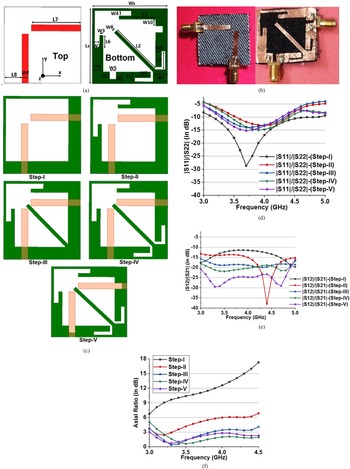
The proposed two-element, textile, CP antenna and its fabricated prototype are represented in Figs 1(a) and 1(b).
Textile two-element antenna (a) prototype design (b) hardware (c) design steps (d) |S 11|/|S 22| of design steps (e) |S 12|/|S 21| of design steps (f) axial ratio (dB) in different steps.

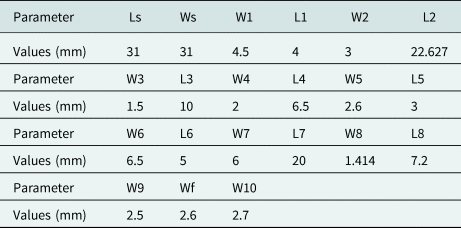
The copper tape of 0.057 mm thickness is used as a conducting element whereas jeans material (loss tangent (tan δ) = 0.025) with permittivity (ɛr) of 1.7 and thickness (t) of 1 mm is used as a substrate. The width (Ws) and length (Ls) of the substrate are 31 × 31 mm2. The dimensions of the circularly polarized textile antenna are depicted in Table 1. The proposed antenna evolution is discussed in five steps, which are illustrated in Fig. 1(c). In step-1, two orthogonally placed microstrip step-feed is accomplished with the defected ground. The impedance bandwidth (|S 11|) and isolation (|S 21|) are achieved from 3.2 to 4.8 GHz and 11 to 15 dB respectively, as depicted in Figs 1(d) and 1(e). In step-2, width W1 is increased with symmetrically open stub on both sides in the ground, which perturbs the surface current in the ground and supports circular polarization. The axial ratio in Fig. 1(f) reveals that the width (W1) and open stub in the ground shift the axial ratio in the operating band close to 3 dB whereas it is less than 3 dB at 3.2 GHz. The impedance bandwidth (|S 11|) varies from 3.6 to 4.4 GHz in this step with isolation (|S 21|) more than 13.5 dB. In step-3, a diagonal stub is accomplished in the ground to diminish the surface current between ports, which improves more than 5 dB isolation (|S 21|) along with axial ratio as illustrated in Fig. 1(f). The impedance bandwidth (|S 11|) of the antenna is achieved from 3.3 to 4.3 GHz with isolation (|S 21|) more than 18.5 dB. In step-4, two symmetric L-shaped open-stubs are incorporated between the ports to further enhance the isolation (|S 21|) and axial ratio. The impedance bandwidth (|S 11|) is obtained from 3.4 to 4.4 GHz with 18.4 to 21.9 dB isolation. In step-5, impedance matching is enhanced with a rectangular slot introduced in the ground behind the step feed, which improves the impedance bandwidth (|S 11|) and isolation (|S 21|) of the two-element antenna. The impedance bandwidth (|S 11|) of the antenna varies from 3.3 to 4.3 GHz with more than 24 dB isolation and the less than 3 dB axial ratio is achieved in the entire operating band.
Dimensions of different geometrical parameters

Analysis of circular polarization and surface current of two-element antenna
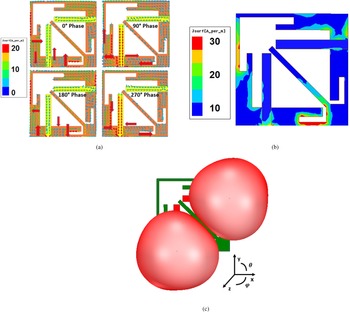
In this section, axial ratio, surface current and radiation characteristics are analyzed to understand the antenna performance. It is clear from the previous section that the defected ground with open-stubs as well as the position of feed perturbs the surface current, which enhances the isolation (|S 21|) and axial ratio (dB) for achieving the CP band. The obtained 3 dB axial ratio covers the entire operating band. The vector analysis of surface current is investigated at 0°, 90°, 270° and 360° phase in 3.8 GHz as depicted in Fig. 2(a). It is revealed that the direction of the current vectors in the ground is clockwise as well as anti-clockwise which validates LHCP and RHCP in the antenna. The surface current at 3.8 GHz in port-1 is excited and is represented in Fig. 2(b), where the open-stubs mitigate the surface current moving from one port to another in a clockwise and anti-clockwise direction, which improves the isolation (|S 21|), and reduce the mutual coupling of the antenna. The 3D radiation pattern at 3.8 GHz is illustrated in Fig. 2(c), the figure reveals the diversity performance of the two-port antenna and its ability to transmit and receive the EM waves from different directions.
Textile two-element diversity antenna (a) CP behaviors analysis form surface current (b) surface current when port-1 is excited (c) 3D radiation pattern.

Simulated and experiment results
The CP and two-element antenna is measured on Anritsu MS2025B VNA to verify the simulation results obtained from HFSS 13.
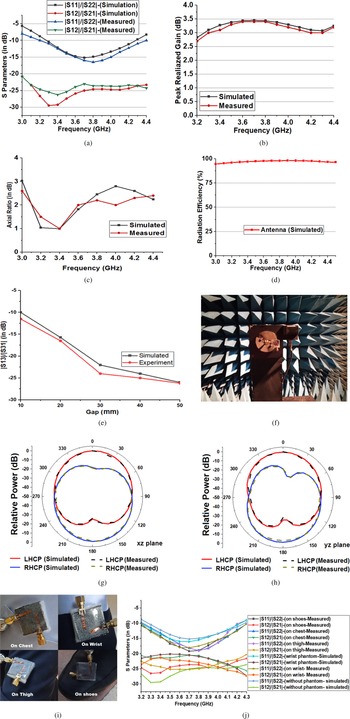
The 10 dB impedance bandwidth (|S 11|) varies from 3.3 to 4.3 GHz while the isolation (|S 21|) is more than 24 dB as depicted in Fig. 3(a), where the measured results are close to simulated results that validate the results. A minor deviation is found between simulated and measured results due to some irregularities in soldering and fabrication. The realized gain (dB) of the antenna varies from 3 to 3.45 dB and less than 0.5 dB gain variation is achieved in all operating bandwidths as illustrated in Fig. 3(b). The axial ratio (3 dB) is illustrated in Fig. 3(c), which reveals that less than 3 dB measurement and simulated results are achieved. The measured and simulated E and H components (radiation pattern) of an antenna are 90 degrees out of phase at 0°, 90°, 180° and 270° degree which validates the circular polarization behavior of the antenna. The radiation efficiency (%) is achieved more than 90 in the entire operating band. In this paper, equation (1) is used to calculate the transmission efficiency [Reference Haerinia and Noghanian13] of the proposed CP antenna where the Tx antenna or Rx antenna is analyzed with a variation of 10 mm over a distance of 10 to 50 mm at 3.8 GHz. The analysis of transmission coefficient (|S 31|) in dB at different distances is shown in Fig. 3(e). The Antenna-1 is the Tx antenna and Antenna-3 is the Rx antenna because the Antenna-1 and antenna-2 are accomplished in transmitter antenna where in Ref [Reference Haerinia and Noghanian13] paper, Antenna-1 is the transmitter and antenna-2 is the Rx antenna. The fractional variation of transmission efficiency from 10to 50 mm is 2.94% while for 20 to 50 mm is 11.3%, which makes it appear that the antenna can work effectively with minimum variation in transmission efficiency.

Textile two-element diversity antenna (a) simulated and measured s-parameters (b) realized gain (dB) (c) axial ratio (dB) (d) radiation efficiency (%)(e) Transmission coefficient (S 21) at 3.7 GHz with Rx antenna distance varies from 10 to 50 mm (f) Measurement set-up (g) and (h) normalized radiation pattern at 3.8 GHz (i) Measurement of antenna on the human body (j) |S 11| and |S 12| analysis of antenna on the human body (Simulated and measured).

In design, both antenna elements are the same, therefore measurement is done in Ant-1 and another element is terminated with a matched load of 50 Ω in an anechoic chamber where the distance from reference antenna to under test antenna is 3 meter as depicted in Fig. 3(f), ridge type horn antenna used as a reference antenna with more than 11 dB gain at operating bandwidth. The LHCP and RHCP normalized radiation patterns at 3.8 GHz in the xz and yz planes are illustrated in Figs 3(g) and 3(h), where a stable radiation pattern is observed.
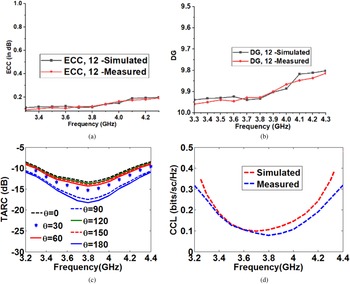
The two-port antenna is analyzed on the chest, wrist, thigh and shoes at 20 mm distance from the antenna where foam padding is used to separate the antenna from the human body which does not affect the s-parameter as depicted in Fig. 3(i). The simulation analysis is conducted on the human wrist phantom model. The electrical characteristics of the human wrist phantom model is taken from Ref [15] and the thickness of skin, fat, and muscle are used 2, 5, and 10 mm with 50 mm × 50 mm dimensions. The distance of the phantom model from an antenna is 20 mm to remove the coupling effect as well as a minimum effect on the isolation of the antenna. The measured and simulated results of |S 11| and |S 12| parameters are illustrated in Fig. 3(j), where small variation is found in impedance bandwidth (|S 11|) and isolation is higher than 20 dB in all on-body measurements. The antenna elements are orthogonally placed in the design; therefore, the antenna provides the pattern diversity, which can be observed from the radiation patterns. The diversity performance of the antenna is also determined from the MIMO parameters, therefore ECC and diversity gain (DG) are analyzed with radiation pattern from equations (2) to (3) [Reference Jha, Kumar, De and Jain16] whereas total active reflection coefficient (TARC) and channel capacity loss (CCL) are extracted from the simulated and measured s-parameter and computed from equations (4) to (5) [Reference Kumar3].


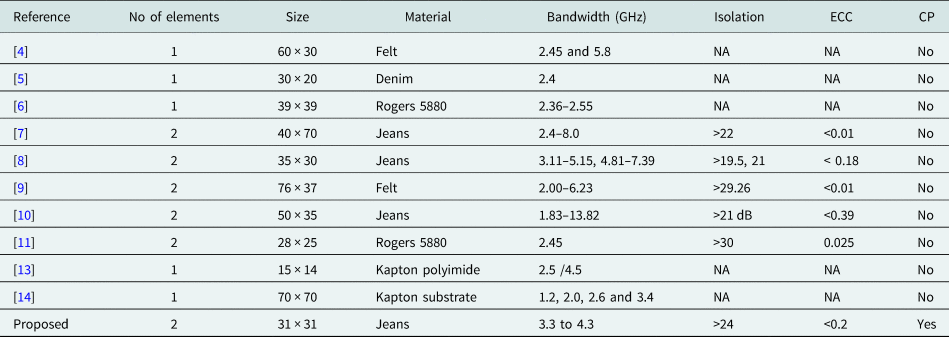
The ECC represents a correlation of the radiation pattern of antenna elements and its practical accepted value should be less than 0.5 where DG should be higher for practical applications. The extracted simulated and measured ECC and DG is < 0.2 and close to 10 dB respectively, therefore good diversity performance of the two-port textile antenna is achieved as depicted in Figs 4(a) and 4(b). The TARC and CCL of MIMO antenna parameters are extracted from equations (3) and (4), where the correlation matrix at receiving end is represented by ψ R. The results reveal that the minimum variation is observed in the measured value of the TARC at different phase angles whereas measured and simulated CCL is less than 0.35 bits/sec/Hz in the entire operating band (Figs 4(c) and 4(d)). The CCL is less than the accepted value of 0.4 bits/sec/Hz [Reference Kumar3]. Table 2 represents the comparative analysis with recently published textile or flexible single element and two-element antenna. The analysis reveals that the proposed antenna is compact, low cost and flexible with low ECC. The diversity performance and CP is achieved in the entire operating band, however, it can be a good candidate for the 5G, wearable and biomedical applications.
Textile two-element diversity antenna (a) ECC (b) DG (c) TARC (d) CCL.

Comparison analysis of proposed antenna with existing antenna

Simulated analysis of breast cancer detection
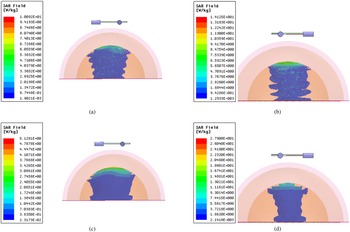
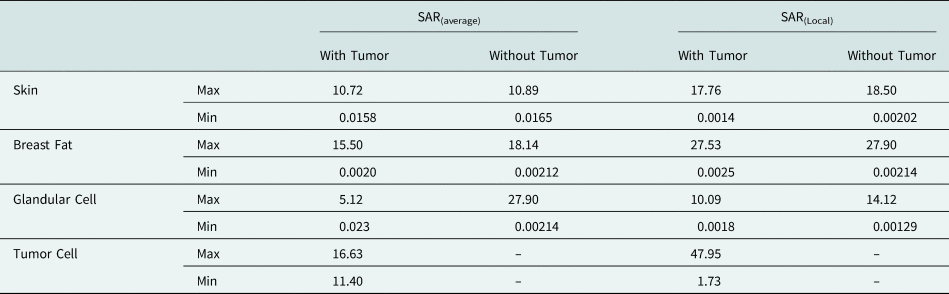
In this section, simulation analysis is investigated on the human female breast model and standard parameters of skin, fat, glandular tissue, as well as a tumor cell, are used [15]. The proposed antenna is placed in the broadside direction at a 5 mm distance from the model for maximum power penetration. The differences in the local and average SAR values are detected in the female breast model at 1W incident power on 1 g tissues with an 8 mm tumor radius. The average and local (maximum and minimum) SAR (W/Kg) of the skin, fat, glandular, and tumor cell are depicted in Table 3. The analysis focuses on two major outcomes, according to the first finding, where the difference between the local and average of SAR are achieved with and without the tumor tissue, which can be analyzed in the practical situation with the tumor-affected breast and normal breast. In the second finding, there is a significant difference in the SAR of the tumor tissue and surrounding glandular tissue, so that the tumor tissue can be easily detected from the breast. The local and average SAR with and without tumor is illustrated in Fig. 5. The analysis reveals that the proposed two-port antenna can be used in biomedical cancer detection applications.
Analysis of female breast model at 1W power on glandular tissue (a) local SAR with tumor (b) local SAR without tumor (c) average SAR with tumor (d) average SAR without tumor.

SAR(average) and SAR(Local)Values of Tissue types at 3.8 GHz

Conclusion
The two-element circularly polarized textile antenna is presented for 5G, wearable, and biomedical applications. The isolation (|S 21|) between radiators is enhanced by open slots and diagonal stubs in the ground whereas defected ground perturbs the surface current and is responsible for full band CP. The polarization diversity of orthogonally placed radiators is investigated where ECC and DG are under acceptable limits. The antenna operating bandwidth (|S 11|) covers the 5G n47, n77, and n78 bands where its application can be found for wearable and cancer detection. The two-port MIMO antenna can be modified further in the eight-port and sixteen-port MIMO antenna for future work with compact size.
Conflict of interest
The author(s) declare none.
 Anubhav Kumar received B. Tech and M.Tech from Uttar Pradesh Technical University (Now Dr. APJ AKTU), Lucknow, India, in electronics and communication engineering (ECE). He has more than 10 years of teaching experience. He is currently pursuing Ph.D from Shobhit Institute of Engineering and Technology, (Deemed to be University), Meerut, Uttar Pradesh, India. He has published many SCIE/ESCI and Scopus indexed research papers in international journals. His research interests include microstrip antenna, metamaterial, FSS, MIMO antenna, wearable, EBG antenna and image processing.
 Professor Asok De was born in November 1955 at Kolkata. He did his B.Tech, M.Tech from Jadavpur University, Kolkata and Ph.D from Indian Institute of Technology, Kharagpur. He served as faculty at the University of Delhi, the University of Kolkata from 1984 to 1997. He joined as a professor of electronics and communication engineering at Delhi College of Engineering (At present Delhi Technological University) in the year 1997. He was the founder principal of Ambedkar Institute of Advanced Communication Technology and Research (2005–2012). He served National Institute of Technology Patna as Director from 2012 to 2017. He also served National Institute of Technology Durgapur as Director (Additional Charge) from 2015 to 2017. Professor De has published more than 200 research papers in international journals and international conferences. He supervised 16 Ph.D scholars. At present, he is an emeritus professor at Delhi Technological University.
 Dr. R.K. Jain is a professor & associate dean of the School of Engineering & Technology at Shobhit Institute of Engineering and Technology (Deemed to-be University), Meerut, where he has been teaching and doing research with the collaboration of BHU, Varanasi and BARC, Mumbai. Prof. R.K. Jain obtained his Ph.D. degree from the number one rated university of India, the Banaras Hindu University in 1990. He holds an all-through good academic record. After a brief period of SRA at GNDU, Amritsar, he got an opportunity of postdoctoral fellowship under TRIL program, Trieste in Rome from November, 1997 to July 2001. He worked on cosmic radiation and calculated the radiation doses at different altitudes using passive detectors at ANPA (National Agency for Environmental Protection), Rome. He also worked as postdoctoral fellow at Seoul National University, Seoul, S. Korea from August, 2001 to April, 2002 and was involved in “Dark Matter Search” project. He has also got postdoctoral fellowship at the Department of Physics, North Carolina State University, Raleigh, USA from May, 2002 to June, 2003 and worked on low intensity and low-energy proton beams for the development of low-energy proton detectors (needed to detect protons emitted in neutron beta decay). He has been awarded Confederation of Education Excellence (CEE) Teacher's Award 2014 in recognition of outstanding contribution “No. of National/International/Journals Published”. The function was held on 6 September 2014 at Crowne Plaza, Rohini, New Delhi. He has nearly 23 years teaching experience and 30 years of research after Ph.D.