

Introduction
Harpullia Roxb. (Sapindaceae) is a characteristic genus of Papuasian lowland and premontane environments, often achieving floristic dominance over localised areas. In the alluvial forests of Papua New Guinea’s southern limestone, Harpullia is represented by extensive populations of H. ramiflora Radlk. and H. rhachiptera Radlk. (pers. obs.). Recent surveys of these habitats have revealed the existence of an undescribed congener, typically occurring in mixed populations with its more common associates. The new species, Harpullia mabberleyana W.N.Takeuchi, is the first member of the genus to be discovered in New Guinea since 1940. Its formal description is presented in this paper, together with previously unreported observations for Harpullia rhachiptera and Lepisanthes mixta Leenh.
Although Harpullia mabberleyana has several features inconsistent with the existing generic taxonomy, assignment to the given genus is clearly supported by a number of salient characteristics: the stellate indument (non-stinging), inflated capsules with two rounded lobes (not winged, crested, or marginate), epicarp smooth to wrinkled (lacking spines, scales, or excrescences), seeds with an inconspicuous hilum (< 1/10 the seed length), and the presence of a basal sarcotestal disc (c.4 mm diameter). These characters are collectively found only in certain species of Harpullia. Irrespective of its unusual qualities, the new plant has a character profile indicative of the assigned genus.
Sapindaceae
Harpullia mabberleyana W.N.Takeuchi, sp. nov.Fig. 1.
Species haec inter speciebus congeneribus singularis foliis simplicibus usque ad 29 × 8 cm statim distinguitur. – Type: Papua New Guinea, Southern Highlands Province, Strickland drainage, Tualapa, premontane forest, 05°17.260′S, 142°29.995′E, 1140 m, 17 vii 2008, W. Takeuchi & D. Ama 24181 (holo LAE; iso A).
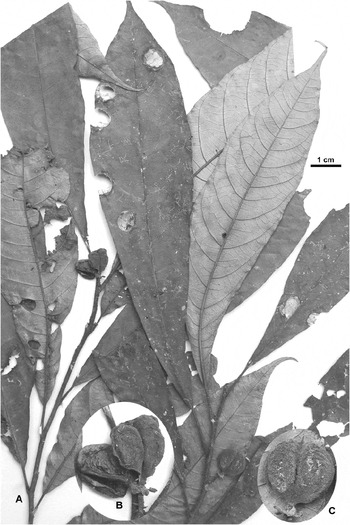
Harpullia mabberleyana W.N.Takeuchi. Type collection. A, fruiting stems; B, inset, open capsule, 18 × 13 mm; C, inset, closed capsule, 20 × 18 mm (all from W. Takeuchi & D. Ama 24181).

Understorey subshrubs 50–75 cm tall, monocaulous. Stems terete, 2–3.5 mm diameter at the higher nodes, striate, dull brown or black, lenticels absent; hairs stellately tufted, 2–7(–11)-armed from the base (or simple), 0.3–0.8 mm long, setiform, subulate, hyaline, patent, persisting, ± obscuring surfaces, not septate; internodes (1–)1.4–3.1 cm long. Leaves spirally inserted, lax, obliquely ascending; petioles 10–22(–36) × 1–2(–3) mm, cylindrical, slightly swollen at the base, not articulate, indument as for stems; leaf-blades oblanceolate or elliptic, 18–29 × 4–8 cm, papery-chartaceous, fuliginous or brown, eglandular, domatia absent; adaxial surfaces tomentulose on midribs; abaxial surfaces granulose, indument stelliform (or simple), hair tufts 2–8(–12)-armed, 0.1–0.3(–0.6) mm long, setiform, ± dense but with underlying surfaces clearly visible to the naked eye; lamina base attenuate, obliquely (or symmetrically) reducing to the petiole; margin entire; apex cuspidate (to 3 × 0.5 cm), curved; venation camptodromous (or brochidodromous), secondaries (12–)16–21 per side, (3–)9–28 mm apart, at the lamina centre with divergence angles of 50–70(–85)°, gradually or abruptly arcuate, seldom closing by looping nerves, partial intersecondaries present or not; midribs strongly raised on both sides, other nervation prominulous, reticulum conspicuous, densely areolate. Inflorescence not seen. Infructescence axillary from attached or fallen leaves, solitary, simple, 26–29 mm long (inclusive of capsule), axes with indument as on the stem, longitudinally wrinkled; peduncle cylindrical, 4–6.5 × 1–1.3 mm, articulated at the pedicel; peduncle bracts subulate, 1–2 × 0.3–0.4 mm, divergent or antrorse, persisting; pedicel 3.5–4 × 0.8–1.3 mm, terete, ebracteate; calyx free or nearly so, sepals 5, narrowly deltate, 3.5–4 × 1.3–2 mm, equal, persisting, adaxially papillate-pubescent, abaxially stelliform-hairy. Fruits solitary, subglobose-obovoid, 18–20 × 13–18 mm inclusive of the 2.5–3 × 1.5–1.7 mm stipe, loculicidal; valves 2, papyraceous, 0.2 mm thick, exterior surfaces subdensely set with compact-globuliform hair-tufts, interior surfaces glabrous, rugose; style residue subulate, c.3 mm long, straight, densely hairy on the lower half, upper half glabrous, marked by twisted stigmatic lines; seed 1 per locule, ellipsoid-oblongoid, c.6 × 4 mm, subapically inserted, pendent; hilum miniscule, < 1/10 the seed length; aril sarcotestal, forming a basal disc c.4 mm across.
Field notes. Leaves papery, bifacially dull green; capsules orange-red; seeds black, sarcotesta orange-yellow.
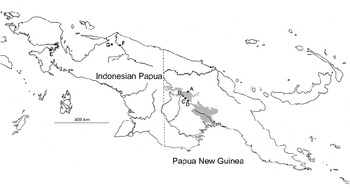
Distribution. Known only from the type locality in the Strickland basin of southern Papua New Guinea (Fig. 2).
Island of New Guinea. Collection localities. Harpullia mabberleyana W.N.Takeuchi: A, Tualapa, type locality. Harpullia rhachiptera Radlk.: B, Juha North; C, Juha South; D, Baia River. Early collections from the Strickland-Fly basin cannot be mapped due to inadequate data. Overlay (shaded area) shows distribution of the southern karst formations. Lepisanthes mixta Leenh.: E, Babo on McCluer Bay (Aet 679); F, Albatros Biv. (W.M. Docters van Leeuwen 11326, type); G, Sungai Noau (W. Takeuchi & J. Mogea 21558).

Habitat. Premontane forest on limestone, 1140 m.
Phenology. Fruiting in July.
Etymology. Named after David J. Mabberley (K), a major contributor to our knowledge of tropical floras.
Notes
1 The new species is characterised by extreme simplification of structural form. It is consistently of monoaxial habit, with the smallest (< 1 m) stature in the genus. The simple (not unifoliolate) leaves are unprecedented in a group otherwise entirely composed of pinnately-leaved plants. Among the previously described species of Harpullia, single fruits are present only as an exceptional character state. But with Harpullia mabberleyana, solitary capsules are the usual condition. The diagnostic characters are collectively among the most distinctive in the Sapindaceae.
2 Harpullia mabberleyana has fruits with a persisting calyx and a short style, characters indicative of membership in subgen. Harpullia. However, the presence of a basal sarcotestal disc (c.4 mm wide) and straight styles (vs. hooked or curved) are defining features of subgen. Otonychium (Leenhouts & Vente, Reference Leenhouts and Vente1982, Reference Leenhouts, Vente, Adema, Leenhouts and Welzen1994). The fruiting facies is an anomalous combination of character states, uniting qualities previously regarded as diagnostic for separate subgenera. The character sets embodied by the new Harpullia will require redefinition of existing subgeneric separations or their abandonment.
3 Couplet 1 in the existing key (Leenhouts & Vente, Reference Leenhouts and Vente1982: 5, 1994: 599) assumes the presence of compound leaves in a specimen being identified, thus excluding Harpullia mabberleyana from entry into the key. The following change is suggested to that couplet in order to accommodate the new species:
1. Monocaulous subshrubs; leaves simple; fruits solitary Harpullia mabberleyana
1. Shrubs or trees, branching (or monocaulous); leaves always paripinnate; fruits usually disposed in compound (thyrsoid) arrangements, rarely solitary To the existing couplet 1
4 In the Flora Malesiana generic key for Sapindaceae, the addition of a third lead to couplet 6 is necessitated by the new species (Welzen, Reference Welzen, Adema, Leenhouts and Welzen1994: 441):
6c. Fruit not winged. Leaves simple Harpullia mabberleyana
The short key (Welzen, Reference Welzen, Adema, Leenhouts and Welzen1994: 440) needs no adjustment.
5 With the addition made here, there are now 27 species in the genus. New Guinea and its satellite islands are currently represented by 20 species.
Harpullia rhachiptera Radlk., Sitzungsber. Math.-Phys. Cl. Königl. Bayer. Akad. Wiss. München 20: 278 (1890). – Type: SE New Guinea, Strickland River, viii 1885, W. Bäuerlen 191 (holo M; iso MEL). Fig. 3.
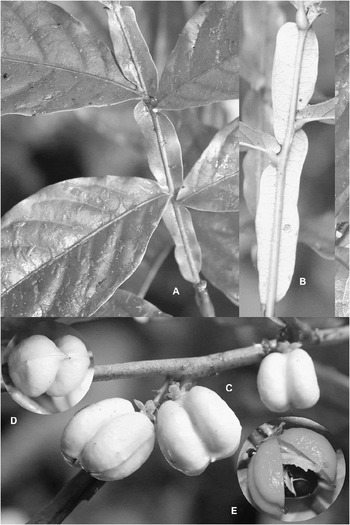
Harpullia rhachiptera Radlk. A, upper leaf surface; B, lower leaf surface; C, fruiting branchlet; D, immature (greenish-yellow) fruit, oblique apical view; E, mature (red) fruit with seed and arillode (A–D from W. Takeuchi et al. 23605; E from W. Takeuchi et al. 22879).

Additional specimens examined. Papua New Guinea. Western Province, Baia River, lowland hill forest, 06°01.143′S, 142°33.042′E, 300 m, 13 ii 2008, W. Takeuchi et al. 22879 (A, LAE); Juha South, mossy montane forest, 05°53.994′S, 142°26.234′E, 910 m, 21 ii 2008, W. Takeuchi et al. 23229 (A, LAE); Juha North, perhumid hill forest, 05°48.647′S, 142°18.702′E, 265 m, 31 iii 2008, W. Takeuchi et al. 23605 (A, LAE).
Harpullia mabberleyana often occurs in mixed populations with H. rhachiptera. The latter species is historically known from only five specimens (Leenhouts & Vente, Reference Leenhouts and Vente1982, Reference Leenhouts, Vente, Adema, Leenhouts and Welzen1994), but the number of extant collections is a misleading indication of presumed rarity. Recent observations and collections of Harpullia rhachiptera from Tualapa, Juha North, Juha South, and Baia River (Southern Highlands Province and Western Province; Takeuchi, Reference Takeuchi and Crome2009) provide evidence of high frequency on the southern limestone. The distinctive species is undoubtedly more widespread and common than suggested by specimen counts in world herbaria.
Lepisanthes mixta Leenh., Blumea 17: 83 (1969). – Type: Indonesia, New Guinea, Mamberamo, Albatros Biv. (c.02°19′S, 138°02′E), 60 m, xi 1926, W.M. Docters van Leeuwen 11326 (holo K; iso L). Fig. 4.
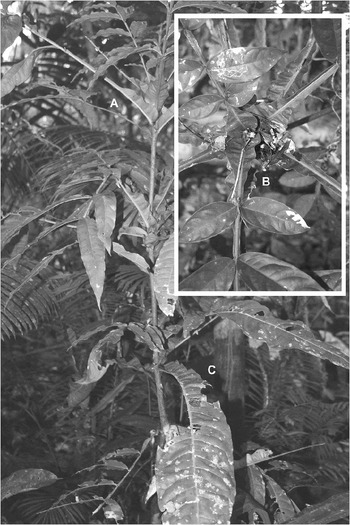
Lepisanthes mixta Leenh. Single-stemmed, 3 m shrub in the Mamberamo alluvial forest at Sungai Noau. A, imparipinnate leaves; B, apical view of the leaves in ‘A’, showing the expanded petiole base; C, simple leaf (all from W. Takeuchi & J. Mogea 21558).

Additional specimen examined. Indonesia. Papua Province, Mamberamo River, Sungai Noau (E of Gessa River), selectively logged alluvial forest, 02°04′58.1″S, 137°27′24.5″E, 65 m, 4 v 2007, W. Takeuchi & J. Mogea 21558 (BO).
Lepisanthes mixta was previously known from just two specimens (Leenhouts, Reference Leenhouts, Adema, Leenhouts and Welzen1994). Based on recent observations from Sungai Noau and Baitanisa (Conservation International 2007 Mamberamo Expedition) the species is an unbranched shrub of dark understoreys, occurring primarily in periodically flooded habitats. The latest gathering has only very immature flowers, but there is little doubt of its identity (compare Fig. 4 with Leenhouts, Reference Leenhouts1969: 84).
The historical specimens known to Leenhouts (Reference Leenhouts1969, Reference Leenhouts, Adema, Leenhouts and Welzen1994) have pinnate-alate leaves with abruptly expanded bases, features clearly shown in Fig. 4. However, in the newly documented populations, there are also simple leaves at the lower nodes (Fig. 4C), which because of their position on the stem, were possibly overlooked by earlier collectors. Leaf dimorphism of this kind is rarely encountered in Malesian Sapindaceae, and was previously known in New Guinea only for Rhysotoechia etmanii W.N.Takeuchi.
Acknowledgements
The Porgera II Expedition was sponsored by the Conservation International Rapid Assessment Program (CI-RAP) and by the Porgera Joint Venture. The 2007 Mamberamo Expedition was sponsored by the Research Center for Biology, Indonesian Institute of Sciences (Puslit Biologi-LIPI), and by the CI-RAP. My participation on these surveys was also supported by the National Science Foundation (grant DEB 0315930), the Arnold Arboretum, and the Harvard University Herbaria.