Rheumatic heart disease is the most common global cause of acquired cardiovascular mortality and disability for those between 15 and 48 years of age.Reference Watkins and Roth1 In 2015, there were an estimated 33 million prevalent rheumatic heart disease cases with 320,000 deaths.Reference Watkins and Roth1 The geographical distribution of rheumatic heart disease is uneven, with the highest burdens in the world’s most disadvantaged and vulnerable populations.Reference Carapetis, Steer, Mulholland and Weber2
Recent mortality data from the United States have revealed that rheumatic heart disease is not as “eliminated” from this context as previously thought. Between 1980 and 2014, rheumatic heart disease accounted for an estimated 350,000 deaths in the United States alone Reference Roth and Johnson3 and there were geographic pockets in the United States where estimated age-standardised rheumatic heart disease mortality rates are flat or increasing. Reference Roth and Johnson3 Similar to what is seen globally, rheumatic heart disease also affects the most vulnerable United States populations, with higher death rates in areas with lower socioeconomic status and disparities in other health outcomes. Reference Roth and Johnson3
This study sought to assess two aspects of ongoing rheumatic fever disease burden in the United States. First, we estimate the national incidence of rheumatic fever and examine incidence trends over a decade, with the hypothesis that national rheumatic fever incidence is decreasing. Then, we describe the demographic and clinical features of United States patients admitted to the hospital with rheumatic fever, including the cost of rheumatic fever hospitalisations.
Materials and methods
Data source
Data were obtained from the Healthcare Cost and Utilization Project sponsored by the Agency for Healthcare Research and Quality, 2000–2012 Kids’ Inpatient Database. 4 The Kid’s Inpatient Database is the largest all-payer paediatric inpatient database yielding information from a random sampling of paediatric hospital discharges in the United States. Kid’s Inpatient Database is comprised of a sample of all hospitals reporting to the State Inpatient Databases. Psychiatric hospitals, short-term rehabilitation facilities, alcohol and drug treatment facilities, and long-term non-acute facilities are excluded. Systematic random sampling is used to select 80% of paediatric cases from each frame hospital. States reporting in the Kid’s Inpatient Database have increased from 27 in the year 2000 to 44 in 2012. No United States territories contribute data. The number of hospitals reporting paediatric discharges has also increased from 2784 to 4179 over the same time period. The sample is weighted to be nationally representative of paediatric discharges. The Kid’s Inpatient Database reports clinical data (based on the International Classification of Diseases, Ninth Revision, Clinical Modification (ICD-9)) as well as demographic, hospital, expected payer type, and total charge data for paediatric discharges. Total charge data reported varied by state, but generally excluded professional fees and non-covered charges.
For this study, data were collected across five Kid’s Inpatient Database -reporting periods (2000, 2003, 2006, 2009, and 2012). United States Census data were used to determine the number of person-years at risk in each study period in order to produce national incidence estimates, both intercensal estimates for years 2000–2010 and projected estimates for 2012. Reference Steer, Kado and Jenney9
Data analysis
Rheumatic fever cases were selected using ICD-9 diagnosis codes (390, 391.0–2, 391.8–9, 392.0, and 392.9). Cases were excluded based on age ≤2 years (rheumatic fever highly unlikely) or >20 years (not included in Kid’s Inpatient Database). The number of rheumatic fever cases in the total United States population during each study period was estimated using the discharge weights provided by Kid’s Inpatient Database. All hospitalisations (2–20 years) in the Kid’s Inpatient Database, regardless of diagnosis, were tabulated to provide a comparison group for the rheumatic fever admissions. Raw unweighted case data across the entire sample were compiled using SAS (SAS Version 9.2, Cary, North Carolina, United States of America) to define demographics and patterns of rheumatic fever presentation. Sub-classifications of rheumatic fever were defined by primary and secondary diagnostic codes and included: (1) rheumatic fever (primary arthritis) without carditis, (2) rheumatic fever (primary arthritis) with carditis, (3) chorea without carditis, and (4) chorea with carditis. Demographic characteristics of study included age, gender, race/ethnicity (white, black, Hispanic, Asian/Pacific Islander, American Indian, or other), expected primary payer type (Medicare, Medicaid, private insurance including health maintenance organisation, self-pay, no charge, or other). Hospital characteristics in this study included region of presentation (Midwest, Northeast, South, and West), length of stay, seasonal variation as measured by month of admission, and total hospital charges. Charges reported varied by state. Charges were adjusted to 2012 United States dollars. Variables with ≥1% of data missing include 18.3% for race and 2.5% for cost. When applicable, chi square analysis was used to determine significant differences among groups.
Results
National incidence and trends
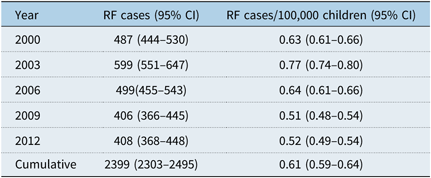
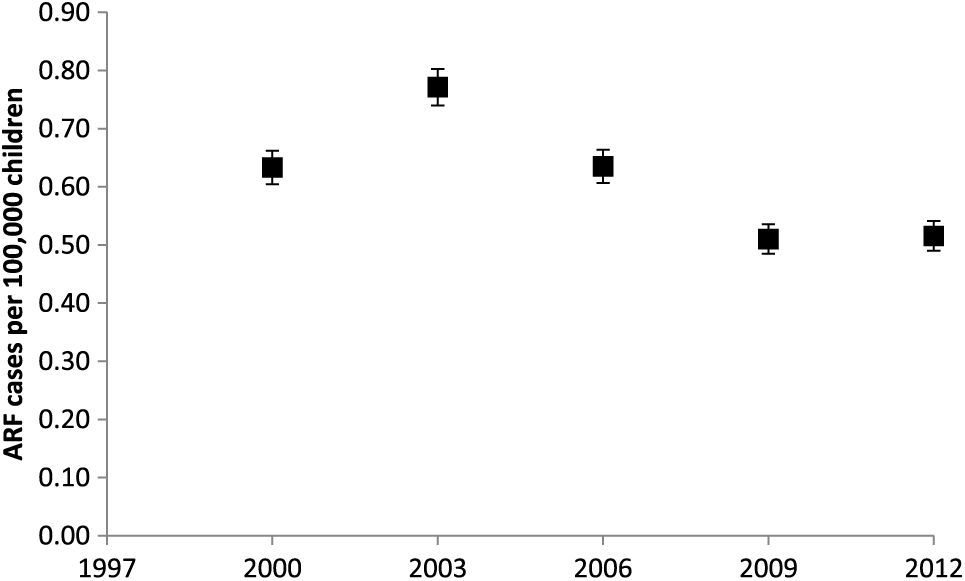
During the five reporting periods between 2000 and 2012, estimates of rheumatic fever hospitalisation ranged from 410 to 600 admissions per year, resulting in an average national incidence rate of 0.61 per 100,000 children. Both the number of cases and the national incidence rate peaked in 2003 and then declined through 2012, though this decline was not significant (p = 0.19) (Table 1, Fig 1).
Nationally weighted RF incidence by enrollment period

CI = confidence interval; RF = rheumatic fever.
Yearly incidence based on Kid’s Inpatient Database weighted discharges from 2000 to 2012

Demographics, clinical features, cost
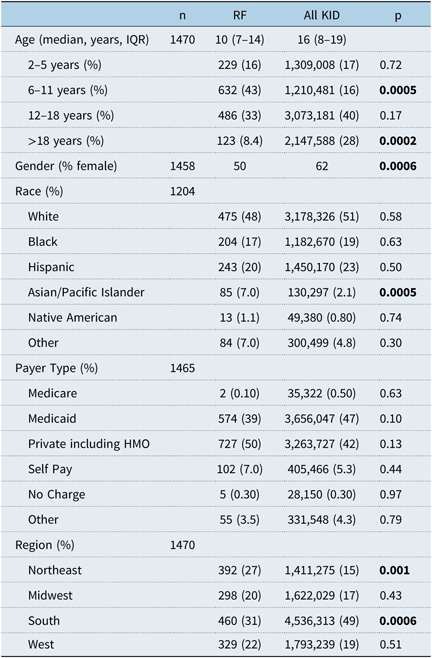
Unweighted demographic data for rheumatic fever hospitalisations are reported in Table 2. The median age of children hospitalised with rheumatic fever was 10 years old (interquartile range: 7–14). Rheumatic fever admissions were equal between sexes (50% female) which was significantly different than overall hospitalisations, where females were more likely to be admitted (62% for all hospitalisations, p < 0.001) The majority of children identified as white (48%), followed by Hispanic (20%), and black (17%). Around half of the children were insured by private insurance and 40% by Medicaid.
Demographic data of total cases of RF between 2000 and 2012

IQR = interquartile range; KID = Kid’s Inpatient Database; RF = rheumatic fever.
Bold values denote a significance (p-level) difference in the categorical percentage of children with RF as compared to the categorical percentage of children in the general pediatric admission pool of the KID database. Compared to general pediatric admissions, a higher percentage of children with RF were in the 6-11 year old age range, of Asian-Pacific race, and from the Northeastern Region of the United States and a lower percentage of children with RF were in the >18 age range, female, and from the Southern United States.
Compared to the overall proportion of Kid’s Inpatient Database admissions between 2000 and 2012, rheumatic fever admissions were significantly more common in younger children (p < 0.001, Table 2, supplementary Figure 3). Asian/Pacific Islanders as a group were significantly over-represented among those admitted with rheumatic fever as compared to all-cause admission (7.1 versus 2.1%, p < 0.001, supplementary Figure 4).
The highest number of rheumatic fever hospitalisations came from the South (31% of all rheumatic fever admissions nationally), but at a lower percentage than all paediatric hospitalisations (43% in the South, p < 0.001, Table 2). In contrast, a higher percentage of rheumatic fever admissions as compared to general paediatric admissions were seen in the Northeast region (27 versus 15%, p = 0.001, Table 2, supplementary Figure 5).
Overall, no seasonal variation, as measured by admission month, was observed.
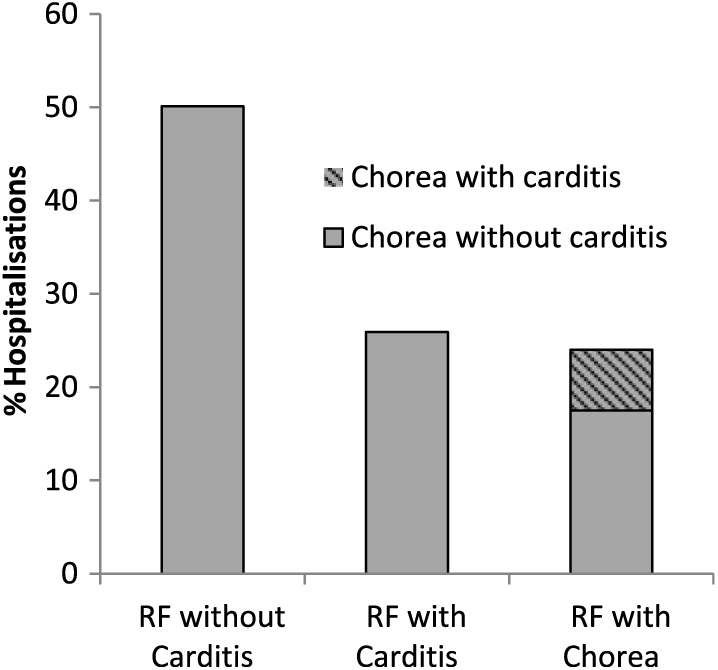
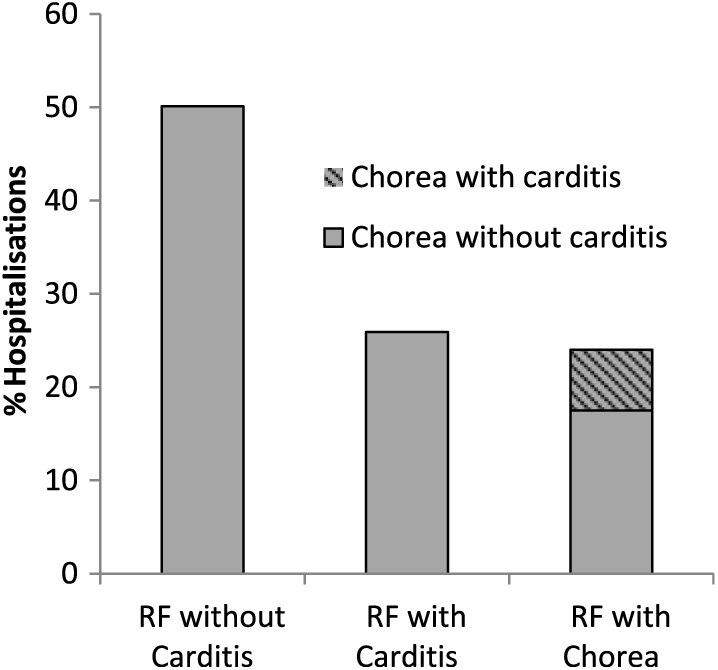
Of all rheumatic fever hospitalisations, 50% presented with primary arthritis without carditis, 26% presented with arthritis and carditis, and 24% presented with chorea, 6.5% of these present with both chorea and carditis (Fig 2). The case fatality ratio for rheumatic fever in the United States was 0.4%.
Overall distribution of clinical features of rheumatic fever hospitalisations from 2000 to 2012
Children hospitalised with rheumatic fever had a median length stay of 3 days (range: 0–70 days; interquartile range: 2–5). Medicaid and Private insurance were the most common payer types, accounting for 90% of the paediatric admissions in the Kid’s Inpatient Database, as well as rheumatic fever admissions. There was no significant difference in the distribution of payer types in those admitted with rheumatic fever as compared to the overall Kid’s Inpatient Database from 2000 to 2012 (Table 2). Over the five reporting periods, the median total charge per paediatric hospitalisation for rheumatic fever was $16,000 (range: $940–$1,100,000; interquartile range: $8,900–$31,000), accounting for $51,000,000 in total charges accrued from pooled rheumatic fever hospitalisations.
Discussion
Rheumatic fever is not reportable in the United States, making estimation of national incidence challenging. Here, we utilise the Kid’s Inpatient Database (2000–2012) which captures inpatient diagnostic codes to look for patterns in incidence and trends. These data demonstrate that rheumatic fever affects at least 0.61 per 100,000 children annually in the United States. Our data also reveal potential higher risk populations, including younger children, children residing in the Northeast, and children with Asian/Pacific Islander descent.
As in previous United States studies, Reference Miyake, Gauvreau, Tani, Sundel and Newburger5 children were more likely to have an inpatient rheumatic fever hospitalisation if they were of primary school age (6–11 years). Consistent with international data, Reference Sika-Paotonu, Beaton, Raghu, Steer, Carapetis, Ferretti, Stevens and Fischetti6 but in contrast to an earlier United States report, Reference Miyake, Gauvreau, Tani, Sundel and Newburger5 we found no significant difference between the proportion of males and females with rheumatic fever hospitalisation, Additionally, we did not find any seasonal variation in rheumatic fever cases, though the month of March has previously been reported to have a higher proportion of rheumatic fever hospitalisations in the United States. Reference Miyake, Gauvreau, Tani, Sundel and Newburger5
While there is need to interpret cautiously given low numbers (<15%), children who identified as Asian/Pacific Islanders showed higher proportion of rheumatic fever hospitalisations compared to overall Kid’s Inpatient Database hospitalisations. This may be important and certainly points to the need for better characterisation of risk within indigenous populations within the United States. The globally, indigenous populations living within high-income countries have increased risk of rheumatic fever/rheumatic heart disease (Australia, 4 New Zealand, Reference Miyake, Gauvreau, Tani, Sundel and Newburger5 and Canada Reference Gordon, Kirlew and Schreiber7 ). The Kid’s Inpatient Database does not cover United States territories, but recent data from American Samoa found high levels of rheumatic fever (110–150 cases per 100,000) among its paediatric population. More data are needed to understand the importance of rheumatic fever and rheumatic heart disease in these higher risk groups.
While the highest proportion of rheumatic fever in the United States comes from the Northeast, as previously reported, Reference Miyake, Gauvreau, Tani, Sundel and Newburger5 the greatest number of children hospitalised with rheumatic fever (460 of 1470 over this study period) reside in the South. A recent study examining rheumatic heart disease mortality suggests that this may be a longstanding trend as areas in the South have experienced a slower rate in decline of rheumatic heart disease mortality from 1980 to 2014, mirroring the healthcare and outcomes disparity for all cardiovascular disease in this region. Reference Roth, Johnson and Abajobir8 The same study also identified several specific counties in Louisiana where rheumatic heart disease mortality is increasing. Reference Roth, Johnson and Abajobir8
The clinical presentation of rheumatic fever in the United States may be milder than that reported around the globe. In this cohort, similar to other reported United States cohorts, only 32% of children newly diagnosed with rheumatic fever had evidence of rheumatic carditis. This is contrasted to data from Fiji, where 79% showed evidence of carditis, and 51% were hospitalised with admission diagnosis of cardiac failure. Reference Steer, Kado and Jenney9 This picture of more advanced disease and higher case fatality ratio (9.7% in Fiji versus 0.4% in our cohort) may represent later presentation in low-resource settings, more children presenting with recurrent rheumatic fever rather than the primary attack, or differences in host susceptibility or streptococcal strains. Further work is needed to understand variability in rheumatic fever among international populations.
This study was limited by the reporting characteristics of the Kid’s Inpatient Database. The Kid’s Inpatient Database only reports ICD-9 codes associated with paediatric discharges. As such, the Kid’s Inpatient Database misses cases of rheumatic fever diagnosed and managed in the ambulatory and emergency room settings, which may be significant. On the other hand, it is unlikely that we are missing a significant fraction of deaths, as most rheumatic fever deaths can be assumed to occur in hospital and would be captured. Additionally, though the Kid’s Inpatient Database is designed to be nationally representative, there may be some marginalised populations (such as those in the American territories) that may not be representative of overall trends seen.
Our study demonstrates that rheumatic fever remains a relevant health concern in the United States and has not been “eradicated” as is commonly claimed. Consistent with international studies, rheumatic fever incidence varies across different geographic regions and population groups. Further investigation of high-risk populations in the United States is needed. Further studies are needed to study rheumatic fever outcomes over time in the United States as well as to quantify the outpatient burden of disease.
Supplementary material
To view supplementary material for this article, please visit https://doi.org/10.1017/S1047951119002270
Acknowledgements
This project supported by the Children’s National Medical Center Global Health Initiative. Thank you to the HCUP Data Partners that contribute to HCUP (www.hcup-us.ahrq.gov/hcupdatapartners.jsp).
Financial support
This research received no specific grant from any funding agency, commercial or not-for-profit sectors.
Conflicts of interest
None.
Ethical standards
The authors assert that all procedures contributing to this work comply with the ethical standards of the US Office of Human Research Protections, in compliance with the Helsinki Declaration of 1975, as revised in 2008, and has been approved by the Children’s National Medical Center Institutional Review Board.