Implications
Certain saturated fatty acids (SFA) are thought to increase the risk of cardiovascular diseases and insulin resistance in humans. The present study examined the potential of lowering milk SFA concentrations through altering the diet of dairy cows under two scenarios relevant to commercial milk production. Results demonstrated the feasibility of decreasing SFA and increasing unsaturated fatty acid (FA) in milk, but these were also accompanied by increases in trans FA concentrations. Overall, it was possible to alter milk FA composition consistent with the potential to lower the disease risk of consumers, without adverse effects on animal performance.
Introduction
Ruminant milk fat is relatively rich in saturated fatty acids (SFA) and contains low proportions of polyunsaturated fatty acids (PUFA). Clinical and biomedical studies have demonstrated that when consumed in excess, SFA, 12:0, 14:0 and 16:0, in particular, increase cardiovascular disease risk, with evidence to suggest an involvement in the development of insulin resistance and dyslipidaemia in humans (WHO, 2003). Milk from ruminants also contains several bioactive lipids including 4:0, several odd- and branched-chain fatty acids (OBCFA), cis-9 18:1 and cis-9, trans-11-conjugated linoleic acid (CLA) with a potential to maintain human health and prevent the onset and development of chronic diseases (Shingfield et al., Reference Shingfield, Chilliard, Toivonen, Kairenius and Givens2008b). In most developed countries, milk and dairy products are the principle source of 12:0, 14:0 and cis-9, trans-11 CLA in the human diet, and contribute to 16:0 consumption (Shingfield et al., Reference Shingfield, Bonnet and Scollan2013). Developing systems for the production of milk containing lower medium-chain SFA and higher OBCFA, cis-9 18:1, cis-9, trans-11 CLA and PUFA concentrations may offer benefits to long-term human health without requiring changes in consumer eating habits.
Fat supplements are often used to increase the energy content of diets fed to lactating cows. Owing to cost and attempts to avoid adverse effects on nutrient digestion in the rumen, palm-based supplements enriched in 16:0 are often fed. Supplements of plant oils or oilseeds rich in 18-carbon unsaturated fatty acids (FA) lower SFA and increase unsaturated FA in bovine milk, with lipid rich in 18:2n-6 being particularly effective for increasing cis-9, trans-11 CLA concentrations (Palmquist et al., Reference Palmquist, Lock, Shingfield and Bauman2005; Chilliard et al., Reference Chilliard, Glasser, Ferlay, Bernard, Rouel and Doreau2007). However, the magnitude of milk FA composition responses varies according to several factors including the amount and FA profile of lipid supplements and composition of the basal diet (Chilliard et al., Reference Chilliard, Glasser, Ferlay, Bernard, Rouel and Doreau2007; Glasser et al., Reference Glasser, Ferlay and Chilliard2008a). Furthermore, changes in milk fat composition to increased unsaturated FA supply do not occur in isolation, but may be accompanied by alterations in milk fat secretion. Replacing forages with concentrate ingredients in diets containing plant oils often results in a decrease in milk fat content and secretion (Bauman and Griinari, Reference Bauman and Griinari2003; Shingfield and Griinari, Reference Shingfield and Griinari2007).
Dietary supplements of plant oils and oilseeds typically increase trans FA (TFA) concentrations in bovine milk (Chilliard et al., Reference Chilliard, Glasser, Ferlay, Bernard, Rouel and Doreau2007; Shingfield et al., Reference Shingfield, Bonnet and Scollan2013). Although the evidence on ruminant-derived TFA on cardiovascular disease risk is inconsistent (Shingfield et al., Reference Shingfield, Chilliard, Toivonen, Kairenius and Givens2008b; Brouwer et al., Reference Brouwer, Wanders and Katan2010), relatively few studies (Roy et al., Reference Roy, Ferlay, Shingfield and Chilliard2006; Rego et al., Reference Rego, Alves, Antunes, Rosa, Alfaia, Prates, Cabrita, Fonseca and Bessa2009; Halmemies-Beauchet-Filleau et al., Reference Halmemies-Beauchet-Filleau, Kokkonen, Lampi, Toivonen, Shingfield and Vanhatalo2011) have characterized changes in milk FA composition to plant oils enriched in 18:2n-6 in sufficient detail to allow definitive conclusions on the impact of the distribution of individual TFA isomers to be drawn.
The present study examined the effects of replacing prilled palm fat (PALM) with sunflower oil (SFO) enriched in 18:2n-6 in high-concentrate diets (Experiment 1), and increases in the forage : concentrate (F : C) ratio of diets containing SFO (Experiment 2) under conditions relevant to commercial milk production on animal performance, nutrient digestion and milk fat composition, with specific emphasis on TFA and CLA isomer concentrations. To meet these objectives, the amount of supplemental fat was restricted to 30 g/kg diet DM, whereas differences in the F : C ratio of experimental diets were limited from 39 : 61 to 48 : 52 to resemble the type of diet composition changes that could be expected on-farm.
Material and methods
Experimental design, animals and management
Two experiments were conducted at the University of Tehran Dairy Research Farm (Karaj, Iran). All experimental procedures were in accordance with the guidelines for the use and care of experimental animals and approved by the University of Tehran Animal Ethics Committee. Twenty-four multiparous Holstein cows averaging (mean±s.e.) 618±9.19 kg live weight, 3.2±0.22 parity and 90±6.04 days in lactation producing 35.8±0.88 kg milk/day were used in Experiment 1. Experiment 2 followed Experiment 1 after a 14-day washout, using 19 of the 24 cows recruited to the first experiment and five additional cows averaging 619±15.1 kg live weight, 3.0±0.24 parity and 107±6.22 days in lactation producing 35.5±0.89 kg milk/day. During the transition between experiments, cows were offered a standard total mixed ration (TMR) that comprised lucerne hay and maize silage (5:4 wt/wt on a dry matter (DM) basis), concentrates (F : C ratio 39 : 61; DM basis) and 18 g/kg diet DM of PALM. Both experiments were conducted according to a completely randomized block design. Within each block, cows were randomly assigned to one of the three treatments. Each experiment comprised 3-day covariate, 4-day adaptation and 21-day interval for experimental measurements and sampling. Cows were housed in individual tie-stalls with continuous access to fresh water and milked three times daily at 0100, 1000 and 1700 h.
Experimental diets
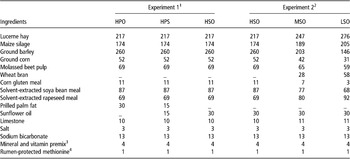
For Experiment 1, treatments comprised TMR containing a mixture of lucerne hay and maize silage (5 : 4 wt/wt; DM basis), concentrates (F : C ratio 39 : 61; DM basis) and 30 g/kg DM of fat prills prepared from fractionated refined palm oil (RumiFat R100, Ecolex, Selangor, Malaysia), refined SFO (Oila-Golrang Pakhsh Co., Tehran, Iran) or a mixture (1 : 1 wt/wt on a fresh weight basis) of PALM and SFO (treatments HPO, HSO and HPS, respectively; Table 1). In the 2nd experiment, treatments comprised TMR based on lucerne hay and maize silage, concentrate ingredients and 30 g/kg DM of SFO with a F : C ratio (on a DM basis) of 39 : 61 (HSO), 44 : 56 (MSO) or 48 : 52 (LSO). The relative proportions of lucerne hay and maize silage in the forage component of each TMR in Experiment 2 were adjusted in accordance with differences in the F : C ratio to ensure that treatments contained the same amount of 18:2n-6 (Table 1). All diets were formulated using the Cornell–Penn–Miner system (CPM-Dairy, version 3.0.7) to meet or exceed the metabolizable energy and protein requirements of cows in mid-lactation producing 40 kg milk/day. Daily rations in both experiments were offered as equal meals at 0800 and 1600 h in amounts to ensure ad libitum intakes. Ration mixes were adjusted weekly for changes in component DM content.
Formulation of experimental diets (g/kg DM)

1 Treatments consisted of high-concentrate diets containing 30 g/kg DM of supplemental fat in the form of prilled palm fat (HPO), sunflower oil (HSO) or an equal mixture of both fat supplements (HPS).
2 Treatments consisted of diets containing 30 g/kg dry matter (DM) of sunflower oil with forage-to-concentrate ratio (on a DM basis) of 39 : 61 (HSO), 44 : 56 (MSO) or 48 : 52 (LSO).
3 Declared as containing (g/kg DM) Ca (180), P (70), Mg (30), Na (50), Fe (4), Cu (3), Zn (3), Mn (5), I (0.1), Co (0.1), Se (0.02), antioxidant (0.4); (IU/g), retinyl acetate (400), cholecalciferol (100) and dl-α-tocopheryl acetate (0.2).
4 Rumen-protected methionine (Methioplus; Soda Feed Ingredients, Monaco, France).
Measurements and sampling
Intakes of individual cows were recorded daily. Samples of fresh TMR and refused feeds were collected three times weekly. Once collected, feed samples were dried in a forced-air oven at 60°C for 48 h, milled through a 1 mm screen (Retsch mill; Retsch Co., Haan, Germany) and composited until submitted for chemical analysis. Daily milk yields were recorded throughout both experiments. Milk samples were collected at each milking for all cows on alternate days throughout each experiment, preserved with potassium dichromate (Merck KGaA, Darmstadt, Germany) until analysed for fat, CP, lactose and urea by infrared analysis (MilkoScan 4000; Foss, Hillerød, Denmark). Unpreserved samples of milk were also collected at each milking on days 15, 17 and 19 of each experiment, stored at –20°C, thawed at 38°C, composited according to yield and analysed for FA composition. Spot faecal samples were taken on day 18 of each experiment at 4 h intervals over a 24 h interval, starting at 0830 h and stored at −20°C until submitted for chemical analysis. Apparent whole-tract digestibility was estimated using acid-insoluble ash as an internal marker (Van Keulen and Young, Reference Van Keulen and Young1977).
Chemical analysis
The DM content of feeds and faeces was determined by oven drying at 105°C for 24 h. Ash was determined by combustion at 550°C for 6 h. Concentrations of acid-insoluble ash were determined following sequential acid hydrolysis (Van Keulen and Young, Reference Van Keulen and Young1977). Nitrogen (N) was determined by the Kjeldahl method (Kjeltec 1030 Autoanalyzer; Foss Tecator AB, Höganäs, Sweden) and ether extract (EE) using an automated Soxtec System (Soxtec 1043, Foss). NDF was determined using heat-stable α-amylase and sodium sulfite in an Ankom200 Fiber Analyzer (Ankom Technology Corp., Fairport, NY, USA) and reported on an ash-free basis. Starch was determined using an amyloglucosidase-based assay (Salo and Salmi, Reference Salo and Salmi1968). Concentration of indigestible NDF in samples of TMR and faeces was determined in duplicate following 288-h in situ ruminal incubations using 12 µm pore size polyester bags (Saatifil PES 12/6; Saatitech S.p.A., Veniano, Como, Italy) in two non-lactating cows offered grass silage and 1 kg/day of a commercial compound feed (Solid 220; Lantmännen Lantbruk AB, Stockholm, Sweden).
Lipid analysis
Fatty-acid methyl esters (FAME) in dried ground samples of TMR and samples of PALM and SFO lipid supplements were prepared in a one-step extraction–transesterification procedure using 2% (vol/vol) methanolic sulphuric acid as a catalyst and tritridecanoin (T-135; Nu-Check Prep Inc., Elysian, MN, USA) as an internal standard (Halmemies-Beauchet-Filleau et al., Reference Halmemies-Beauchet-Filleau, Kokkonen, Lampi, Toivonen, Shingfield and Vanhatalo2011). Lipid in 1 ml of milk was extracted in duplicate using a mixture of ammonia, ethanol, diethylether and hexane (0.2 : 1 : 2.5 : 2.5, vol/vol, respectively) and transesterified to FAME using methanolic sodium methoxide (Halmemies-Beauchet-Filleau et al., Reference Halmemies-Beauchet-Filleau, Kokkonen, Lampi, Toivonen, Shingfield and Vanhatalo2011). The FAME prepared from feeds and milk fat were quantified using a gas chromatograph (model 6890; Hewlett-Packard, Wilmington, DE, USA) equipped with a flame-ionization detector and 100-m fused silica capillary column (CP-SIL; Chromopack 7489, Middelburg, the Netherlands). Total FAME profile in a 2-μl sample at a split ratio of 1 : 50 was determined using a temperature gradient programme and hydrogen as a carrier gas (Halmemies-Beauchet-Filleau et al., Reference Halmemies-Beauchet-Filleau, Kokkonen, Lampi, Toivonen, Shingfield and Vanhatalo2011). Isomers of 18:1 were further resolved in a separate analysis under isothermal conditions at 170°C (Halmemies-Beauchet-Filleau et al., Reference Halmemies-Beauchet-Filleau, Kokkonen, Lampi, Toivonen, Shingfield and Vanhatalo2011). Peaks were identified by comparison of retention times with authentic FAME standards (Halmemies-Beauchet-Filleau et al., Reference Halmemies-Beauchet-Filleau, Kokkonen, Lampi, Toivonen, Shingfield and Vanhatalo2011). Methyl esters not contained in commercially available standards were identified by GC-MS analysis of 4,4-dimethyloxazoline (DMOX) derivatives prepared from FAME. Preparation of DMOX derivatives, parameters used for GC-MS analysis and interpretation mass spectra were in accordance with earlier reports (Halmemies-Beauchet-Filleau et al., Reference Halmemies-Beauchet-Filleau, Kokkonen, Lampi, Toivonen, Shingfield and Vanhatalo2011). The distribution of CLA isomers in milk fat was determined by HPLC (model 1090; Hewlett-Packard) using four silver-impregnated silica columns (Chrom-Spher 5 Lipids, 250×4.6 mm, 5 μm particle size; Varian Ltd., Walton-on-280, Thames, UK) coupled in series and 0.1% (vol/vol) acetonitrile in heptane as the mobile phase (Halmemies-Beauchet-Filleau et al., Reference Halmemies-Beauchet-Filleau, Kokkonen, Lampi, Toivonen, Shingfield and Vanhatalo2011). Milk FA composition was expressed as a weight percentage of total FA using theoretical relative response factors to account for the carbon deficiency in the flame-ionization detector response for FAME containing 4- to 10-carbon atoms (Halmemies-Beauchet-Filleau et al., Reference Halmemies-Beauchet-Filleau, Kokkonen, Lampi, Toivonen, Shingfield and Vanhatalo2011). Concentrations of CLA isomers were calculated on the basis of proportionate peak area responses determined by HPLC and the sum of trans-7, cis-9 CLA, trans-8, cis-10 CLA and cis-9, trans-11 CLA weight percentage determined by GC analysis.
Statistical analysis
Intake, milk yield and milk composition data during the covariate period and the last week of each experiment were averaged before analysis by ANOVA for a completely randomized block design, using a mixed model that included the fixed effects of treatment, block and covariate, and cow within treatment and block as a random effect (Statistical Analysis Systems software package version 9.1; SAS Institute, Cary, NC, USA). The effect of block was removed from the model when non-significant (P>0.10). Nutrient digestibility and milk FA composition data were analysed using the same model without covariate. Sums of squares for treatment effects were further separated using orthogonal contrasts into a single degree of freedom comparisons to test for the significance of linear and quadratic components of the response to replacing PALM with SFO or increases in dietary F : C ratio. Least square means are reported and treatment effects were declared significant at P<0.05, with P-values between 0.05 and 0.10 considered a trend towards significance.
Associations between milk fat yield and the concentration of specific FA in milk fat based on 48 observations, 24 made during the last week of experiments 1 and 2, respectively, were explored by partial least square regression (PLSR) using the Unscrambler X (version 10.0.1®; Camo, Oslo, Norway). The relationship between the response variables (Y-variables; milk fat content and yield as g/kg and g/day, respectively) and explanatory variables (X-variables; milk FA composition as g/100 g of FA) was examined by two-block bilinear modelling:
 $$X=x{\plus}T_{A} P_{A} \prime{\plus}E_{A} \,{\rm and}\,Y=y{\plus}T_{A} Q_{A} \prime{\plus}F_{A} $$
where a set of X-variables collected in the X matrix were decomposed into a Y-relevant score matrix for A factors, T A , which were used to model both X and Y in terms of the loading matrices, P A ′ and Q A ′, and their residuals, E A and F A . Variables in the PLSR analysis were standardised to a mean of zero and an initial standard deviation of one. The optimal number of factors in the model was defined by the minimum root mean square error in the calibration and cross-validated model. Only variables at P<0.05 were retained in the model, as estimated by jackknifing, and the model was verified by a full cross-validation (Martens and Martens, Reference Martens and Martens2000).
Results
Nutrient intake, digestibility, milk yield and milk composition
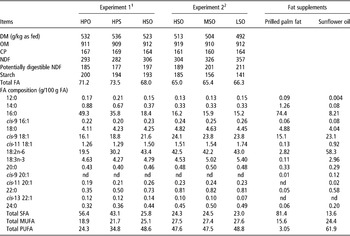
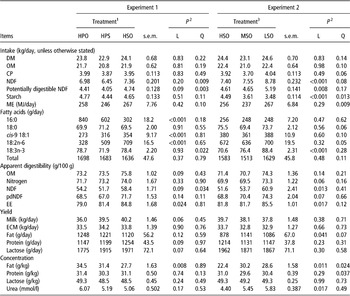
The PALM supplement predominated in 16:0 and cis-9 18:1, whereas SFO was rich in 18:2n-6 and relatively abundant in cis-9 18:1 and 16:0 (Table 2). Substituting PALM with SFO (Experiment 1) progressively increased cis-9 18:1, 18:2n-6, monounsaturated FA (MUFA) and PUFA, and decreased 16:0 and SFA in the diet (Table 2). Incremental replacement of PALM with SFO had no effect (P>0.10) on DM, organic matter (OM), CP, starch, metabolizable energy (ME) or total FA ingestion, but increased (P<0.05) NDF and pdNDF intake in a quadratic manner (Table 3). By design, incremental replacement of PALM with SFO progressively decreased (P<0.01) 16:0 and increased (P<0.01) cis-9 18:1 and 18:2n-6 intake (Table 3). Substitution of SFO for PALM linearly increased (P<0.05) apparent total-tract EE digestibility, NDF digestibility in a quadratic manner (P<0.05), and tended (P=0.09) to increase OM digestion, but had no effect (P>0.10) on total-tract N or pdNDF digestibility (Table 3). Replacing PALM with SFO tended (P<0.09) to increase the yields of milk, protein and lactose, linearly decreased (P<0.01) milk fat content, but had no effect (P>0.10) on milk urea concentration or milk fat secretion (Table 3).
Chemical composition of experimental diets and fat supplements (g/kg DM, unless otherwise stated)

DM=dry matter; OM=organic matter; FA=fatty acids; MUFA=monounsaturated FA; nd=not detected; PUFA=polyunsaturated FA; SFA=saturated FA.
1 Treatments consisted of high-concentrate diets containing 30 g/kg DM of supplemental fat in the form of prilled palm fat (HPO), sunflower oil (HSO) or an equal mixture of both fat supplements (HPS).
2 Treatments consisted of diets containing 30 g/kg DM of sunflower oil with forage-to-concentrate ratio (on a DM basis) of 39 : 61 (HSO), 44 : 56 (MSO) or 48 : 52 (LSO).
Effect of incremental replacement of prilled palm fat with sunflower oil in high-concentrate diets (Experiment 1), or increases in the forage-to-concentrate ratio of diets containing sunflower oil (Experiment 2) on intake, apparent total-tract nutrient digestibility, milk production and composition in lactating cows

DM=dry matter; OM=organic matter; ME=metabolizable energy; EE=ether extract; ECM=Energy corrected milk.
1 Treatments consisted of high-concentrate diets containing 30 g/kg DM of supplemental fat in the form of prilled palm fat (HPO), sunflower oil (HSO) or an equal mixture of both fat supplements (HPS).
2 Significance of linear (L) and quadratic (Q) components of the response to replacing prilled palm fat with sunflower oil in high-concentrate diets (Experiment 1) or increases in the forage-to-concentrate ratio of diets containing sunflower oil (Experiment 2).
3 Treatments consisted of diets containing 30 g/kg DM of sunflower oil with forage-to-concentrate ratio (on a DM basis) of 39 : 61 (HSO), 44 : 56 (MSO) or 48 : 52 (LSO).
Increases in the F : C ratio (Experiment 2) resulted in higher dietary NDF and potential digestible NDF (pdNDF) and lower starch concentrations (Table 2). Higher proportions of forage in the diet linearly increased (P<0.01) NDF and pdNDF intake, linearly decreased (P<0.01) starch ingestion, increased (P<0.01) ME intake in a quadratic manner, but had no effect (P>0.10) on DM, OM or total FA consumption (Table 3). Replacing concentrate ingredients with forages linearly increased (P<0.01) 18:3n-3 intake, tended to increase (P=0.05) 18:2n-6 ingestion in a quadratic manner, but had no influence (P>0.10) on the consumption of 16:0 or cis-9 18:1 (Table 3). Increases in dietary F : C ratio had no effect (P>0.10) on apparent total-tract OM digestibility, but linearly increased (P<0.05) NDF and EE digestibility and tended (P<0.07) to increase N and pdNDF digestion (Table 3). Increases in the F : C ratio had no effect (P>0.10) on milk yield or milk protein and lactose output, but linearly increased (P<0.05) milk fat secretion and milk urea concentration and lowered (P<0.05) milk protein content in a quadratic manner (Table 3).
Milk FA composition
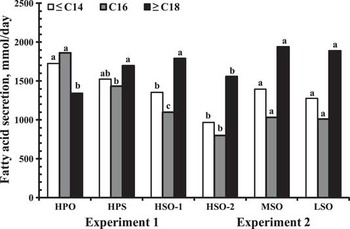
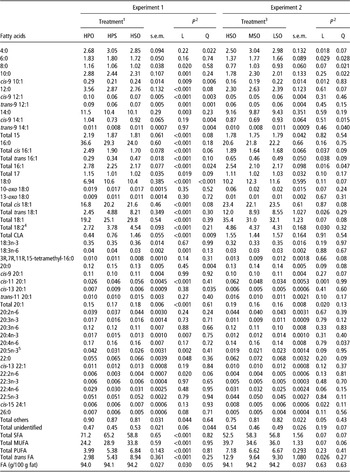
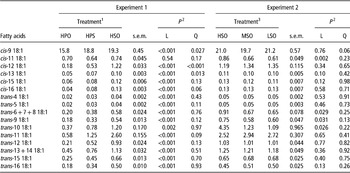
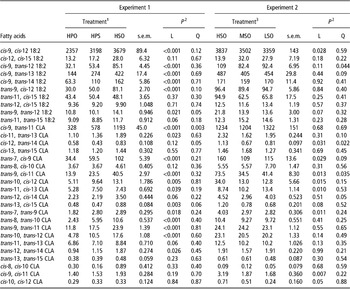
Incremental replacement of PALM with SFO linearly decreased (P<0.01) total milk fat SFA and linearly increased (P<0.01) total MUFA, CLA, 18:2 and TFA concentrations (Table 4). Substitution of PALM for SFO increased (P<0.05) 4:0 in a quadratic manner, linearly decreased (P<0.05) 8:0 to 16:0 and linearly increased (P<0.01) 18:0, but had no effect (P>0.10) on 6:0 or 18:3n-3 concentrations (Table 4). Overall, replacing PALM with SFO linearly decreased (P<0.01) the secretion of 4- to 16-carbon FA and linearly increased (P<0.01) the output of ⩾18-carbon FA in milk (Figure 1). Replacing PALM with SFO linearly decreased (P<0.01) milk fat cis-9 16:1 and cis-13 16:1 and linearly increased (P<0.01) cis-16:1 (Δ10 and 12) and trans-16:1 (Δ6 to 11 and 13) concentrations (Supplementary Table S1). Furthermore, SFO linearly increased (P<0.01) the relative abundance of cis-18:1 (Δ9, 12 to 16) and trans-18:1 (Δ4 to 16) in milk fat (Table 5). Substitution of PALM with SFO linearly increased (P<0.05) several PUFA, including Δ9,12 18:2, cis-9, trans-13 18:2, cis-9, trans-14 18:2, cis-9, trans-11 CLA, cis-11, trans-13 CLA, and several minor trans, cis (7,9; 9,11; 10,12; 11,13 and 13,15) and trans, trans (7,9; 8,10; 9,11; 10,12 and 12,14) CLA isomers (Table 6). Replacing PALM with SFO also altered the relative abundance of OBCFA in milk, changes characterized as linear decreases (P<0.05) in 13:0 anteiso, 15:0, cis-9 15:1, 17:0, cis-6+7 17:1, cis-9 17:1, 11-cyclohexyl 11:0, cis-10 19:1 and 23:0, and linear or quadratic increases (P<0.05) in 14:0 iso and trans-9 15:1 concentrations (Supplementary Table S2).
Milk fatty-acid secretion (mmol/day) in cows fed high-concentrate diets containing 30 g/kg (on a dry matter basis) of supplemental fat as prilled palm fat (HPO), sunflower oil (HSO-1) or an equal mixture of both fat supplements (HPS; Experiment 1), or fed diets containing 30 g/kg sunflower oil with forage-to-concentrate ratio (on a dry matter basis) of 39 : 61 (HSO-2), 44 : 56 (MSO) or 48 : 52 (LSO; Experiment 2). Values represent least square means for eight animals during the last week of each experiment. Fatty acids are categorized according to metabolic origin: ⩽C14 synthesized de novo, ⩾C18 extracted and incorporated into milk fat from circulating plasma lipids and C16 derived from both sources. a–cDifferent letters within columns indicate differences between treatments within experiment (P<0.05).

Effect of incremental replacement of prilled palm fat with sunflower oil in high-concentrate diets (Experiment 1), or increases in the forage-to-concentrate ratio of diets containing sunflower oil (Experiment 2) on milk fatty acid composition (g/100 g fatty acids) in lactating cows

CLA=conjugated linoleic acid; FA=fatty acids; MUFA=monounsaturated FA; PUFA=polyunsaturated FA; SFA=saturated FA.
1 Treatments consisted of high-concentrate diets containing 30 g/kg dry matter (DM) of supplemental fat in the form of prilled palm fat (HPO), sunflower oil (HSO) or an equal mixture of both fat supplements (HPS).
2 Significance of linear (L) and quadratic (Q) components of the response to replacing prilled palm fat with sunflower oil in high-concentrate diets (Experiment 1) or increases in the forage-to-concentrate ratio of diets containing sunflower oil (Experiment 2).
3 Treatments consisted of diets containing 30 g/kg DM of sunflower oil with forage-to-concentrate ratio (on a DM basis) of 39 : 61 (HSO), 44 : 56 (MSO) or 48 : 52 (LSO).
4 Sum of 18:2 FA excluding isomers of CLA.
5 Co-elutes with 24:0.
Effect of incremental replacement of prilled palm fat with sunflower oil in high-concentrate diets (Experiment 1), or increases in the forage-to-concentrate ratio of diets containing sunflower oil (Experiment 2) on milk 18:1 composition (g/100 g fatty acids) in lactating cows

1 Treatments consisted of high-concentrate diets containing 30 g/kg dry matter (DM) of supplemental fat in the form of prilled palm fat (HPO), sunflower oil (HSO) or an equal mixture of both fat supplements (HPS).
2 Significance of linear (L) and quadratic (Q) components of the response to replacing prilled palm fat with sunflower oil in high-concentrate diets (Experiment 1) or increases in the forage-to-concentrate ratio of diets containing sunflower oil (Experiment 2).
3 Treatments consisted of diets containing 30 g/kg DM of sunflower oil with forage-to-concentrate ratio (on a DM basis) of 39 : 61 (HSO), 44 : 56 (MSO) or 48 : 52 (LSO).
Effect of incremental replacement of prilled palm fat with sunflower oil in high-concentrate diets (Experiment 1), or increases in the forage-to-concentrate ratio of diets containing sunflower oil (Experiment 2) on milk 18:2 composition (mg/100 g fatty acids) in lactating cows

CLA=conjugated linoleic acid.
1 Treatments consisted of high-concentrate diets containing 30 g/kg dry matter (DM) of supplemental fat in the form of prilled palm fat (HPO), sunflower oil (HSO) or an equal mixture of both fat supplements (HPS).
2 Significance of linear (L) and quadratic (Q) components of the response to replacing prilled palm fat with sunflower oil in high-concentrate diets (Experiment 1) or increases in the forage-to-concentrate ratio of diets containing sunflower oil (Experiment 2).
3 Treatments consisted of diets containing 30 g/kg DM of sunflower oil with forage-to-concentrate ratio (on a DM basis) of 39 : 61 (HSO), 44 : 56 (MSO) or 48 : 52 (LSO).
Increases in the F : C ratio of diets containing SFO tended (P<0.07) to increase total SFA and decrease total MUFA, but had no effect (P>0.10) on PUFA concentrations (Table 4). Higher proportions of forage increased (P<0.05) 4:0 to 10:0 in a linear or quadratic manner, tended (P=0.07) to enrich 12:0 and 18:0 in a quadratic manner and linearly lowered (P<0.05) TFA, in the absence of changes (P>0.10) in 14:0 to 16:0 or 18:3n-3 concentrations (Table 4). Higher dietary F : C ratios tended (P<0.08) to linearly increase the secretion of ⩽14-, total 16-carbon and ⩾18-carbon FA in milk (Figure 1). Increases in the F : C ratio linearly decreased (P<0.05) cis-9 16:1, trans-16:1 (Δ6 to 8 and 10), cis-11 18:1 and trans-6 to -10 18:1, decreased (P<0.05) cis-11 16:1 in a quadratic manner, and tended (P=0.06) to increase cis-9 18:1 concentration in a quadratic manner (Table 5 and Supplementary Table S1). Higher F : C ratios linearly lowered (P<0.05) milk 18:2n-6, trans-7, cis-9 CLA, trans-7, trans-9 CLA, cis-9, cis-11 CLA, trans-9, cis-11 CLA and trans-10, cis-12 CLA, decreased (P<0.05) cis-9, trans-12 18:2 and cis-12, trans-14 CLA in a quadratic manner and linearly increased (P=0.01) trans-11, cis-13 CLA concentration (Table 6). Furthermore, higher proportions of dietary forage linearly increased (P<0.01) 14:0 iso, 15:0 iso and 29:0 and linearly decreased (P<0.05) cis-8 17:1, cis-9 17:1 and 18:0 iso concentrations (Supplementary Table S2).
The correlation-loading plot derived from PLSR analysis for the first two factors is presented in Supplementary Figure S1. The outer and inner ellipses in loading plot represent proportionately 1.0 and 0.50 of the explained variance of Y, respectively. The first two factors accounted for 0.61 of total variance of response variables. Across both experiments, 65 different FAs were found to be related (P<0.05) with milk fat content and yield. Factor 1 discriminated milk fat content and yield, short- and medium-chain SFA (positive loadings) from 16- and 18-carbon unsaturated FA (negative loadings). Factor 2 discriminated 4:0 and 6:0 (north-east quadrant) from 8:0, 10:0 and 16:0 (south-east quadrant), and trans-16:1 (Δ6+7, 10, 11 and 13), cis-13 18:1, trans-18:1 (Δ5, 6+7+8, 9 and 13+14), 18:2n-6, cis-9, trans-12 18:2, cis-9, trans-13 18:2, cis-9, trans-14 18:2, trans-7, cis-9 CLA, trans-10, trans-12 CLA and trans-11, trans-13 CLA (north-west quadrant) from 10-oxo 18:0, trans-8 16:1, cis-11 18:1, trans-10 18:1, trans-9, trans-12 18:2, trans-9, cis-11 CLA, trans-10, cis-12 CLA and trans-13, cis-15 CLA (south-west quadrant). The score plot describes the distribution of all 48 analysed milk samples on the basis of FA composition for cows fed different diets in both experiments along both factors (Supplementary Figure S2). When combined, the correlation loading and score plots provide an additional and complementary interpretation of the two factors in terms of variables and sample distribution in relation to milk fat in the input data. Scores of cows on HPO and HPS treatments showed a high positive correlation with factor 1, whereas three of the eight cows on the HSO treatment experiencing milk fat depression (MFD) in Experiment 2 had a high negative correlation with factor 1.
Discussion
Dietary supplements of plant oils and oilseeds influence the FA composition of bovine milk fat, but there is considerable variation depending on fat source and composition of the basal diet (Chilliard et al., Reference Chilliard, Glasser, Ferlay, Bernard, Rouel and Doreau2007; Glasser et al., Reference Glasser, Ferlay and Chilliard2008a; Shingfield et al., Reference Shingfield, Bonnet and Scollan2013). In the present study, the potential to alter milk fat composition under two scenarios relevant to commercial milk production was examined.
Milk FA composition
Replacing PALM with SFO in high-concentrate diets altered milk fat composition that, to a large extent, reflected differences in the relative intake of 16- and 18-carbon FA. A mean decrease in the relative proportion of 16:0 in milk fat of 0.42 percentage units per g/kg substitution of PALM with SFO in the diet is marginally higher than values of between 0.19 and 0.35 following isolipid replacement of palm-based supplements (40 to 50 g/kg DM) with sunflower seeds (Mohammed et al., Reference Mohammed, McGinn and Beauchemin2011), milled rapeseeds (Kliem et al., Reference Kliem, Shingfield, Humphries and Givens2011), and either maize or safflower oil (He and Armentano, Reference He and Armentano2011). Changes in milk 16:0 concentration were also accompanied by lowered milk fat content and secretion of short- and medium-chain (8:0 to 14:0) SFA synthesized de novo that can, to a large extent, be attributed to a higher availability of 18-carbon FA inhibiting the activity of acetyl-CoA carboxylase in the mammary glands (Shingfield et al., Reference Shingfield, Bernard, Leroux and Chilliard2010). Replacing PALM with SFO in the diet also increased milk 4:0 concentrations that represent a typical response to dietary plant oil supplements (Shingfield et al., Reference Shingfield, Bonnet and Scollan2013), whereas discrimination of 4:0 from longer-chain SFA in the PLSR analysis is consistent with the four-carbon FA being incorporated into milk fat triacylglycerol via two pathways independent of the inhibitable acetyl-CoA carboxylase pathway (Chilliard et al., Reference Chilliard, Glasser, Ferlay, Bernard, Rouel and Doreau2007).
Replacing PALM with SFO progressively increased milk fat cis-9 18:1 concentrations that reflects a higher ruminal escape of cis-9 18:1 and increased availability of 18:0 for desaturation in the mammary glands. On most diets, the extent of biohydrogenation (BH) of cis-9 18:1, 18:2n-6 and 18:3n-3 varies between 58% and 87%, 70% and 95%, and 85% and 100%, respectively (Glasser et al., Reference Glasser, Schmidely, Sauvant and Doreau2008b; Shingfield et al., Reference Shingfield, Bernard, Leroux and Chilliard2010). Both an increase in milk 18:0 concentrations, along with the decrease in cis-9 18:1/18:0 concentration ratio, suggest that synthesis in the mammary glands was the principle mechanism contributing to higher milk cis-9 18:1 concentrations when SFO replaced PALM in the diet. Although 18:0 is the preferred substrate for stearoyl-CoA desaturase in the ruminant mammary glands (Palmquist et al., Reference Palmquist, Lock, Shingfield and Bauman2005), ca. 2% to 3% of 16:0 extracted from the blood is desaturated to cis-9 16:1 (Mosley and McGuire, Reference Mosley and McGuire2007). A decrease in the availability of 16:0 in the mammary glands when SFO replaced PALM in the diet also offers an explanation for the concomitant decrease in milk cis-9 16:1 content.
Substitution of SFO for PALM increased the abundance of numerous TFAs in milk that can be attributed, in the most part, to the formation and accumulation of intermediates during incomplete BH of unsaturated 16- and 18-carbon FA in the rumen (Chilliard et al., Reference Chilliard, Glasser, Ferlay, Bernard, Rouel and Doreau2007; Shingfield et al., Reference Shingfield, Bernard, Leroux and Chilliard2010). Earlier studies have also demonstrated that replacing palm-based supplements with milled rapeseeds (Kliem et al., Reference Kliem, Shingfield, Humphries and Givens2011), sunflower seeds (Mohammed et al., Reference Mohammed, McGinn and Beauchemin2011), or maize and safflower oil (He and Armentano, Reference He and Armentano2011) increase milk TFA content. However, the relative abundance and distribution of TFA isomers is dependent on both the FA composition of fat supplements and the basal diet (Chilliard et al., Reference Chilliard, Glasser, Ferlay, Bernard, Rouel and Doreau2007; Shingfield et al., Reference Shingfield, Bonnet and Scollan2013). Direct comparisons indicate that plant oils or oilseeds rich in 18:2n-6 can be expected to increase milk fat concentrations of specific trans-18:1 (Δ8 to 12) and 8,10; 9,11 and 10,12 geometric isomers of CLA (Roy et al., Reference Roy, Ferlay, Shingfield and Chilliard2006; Rego et al., Reference Rego, Alves, Antunes, Rosa, Alfaia, Prates, Cabrita, Fonseca and Bessa2009; Halmemies-Beauchet-Filleau et al., Reference Halmemies-Beauchet-Filleau, Kokkonen, Lampi, Toivonen, Shingfield and Vanhatalo2011).
Replacing PALM with SFO increased milk cis-9, trans-11 CLA concentrations with enrichment on HSO treatment being within the range (0.54 to 1.83 g/100 g FA) reported for cows fed high-concentrate-based diets supplemented with ca. 50 g/kg DM of plant oils rich in 18:2n-6 (Chilliard et al., Reference Chilliard, Glasser, Ferlay, Bernard, Rouel and Doreau2007; Shingfield et al., Reference Shingfield, Bonnet and Scollan2013). Although most cis-9, trans-11 CLA secreted in milk is synthesized endogenously from trans-11 18:1 in the mammary glands (Palmquist et al., Reference Palmquist, Lock, Shingfield and Bauman2005), dietary SFO supplements may also increase, in a dose-dependent manner, the amount of cis-9, trans-11 CLA leaving the rumen in lactating cows (Shingfield et al., Reference Shingfield, Ahvenjärvi, Toivonen, Vanhatalo, Huhtanen and Griinari2008a). Inclusion of SFO in the diet at the expense of PALM also enriched milk trans-7, cis-9 CLA, cis-9, trans-12 18:2, cis-9, trans-13 18:2 and cis-9, trans-14 18:2 concentrations that can be explained by increases in the supply of 18:1 intermediates formed during ruminal BH of unsaturated FA in SFO available for desaturation in the mammary glands (Palmquist et al., Reference Palmquist, Lock, Shingfield and Bauman2005; Shingfield et al., Reference Shingfield, Chilliard, Toivonen, Kairenius and Givens2008b).
Replacing forages with concentrates typically increases the ratio of NDF to starch in the diet and the substitution of 18:3n-3 for cis-9 18:1 and 18:2n-6. Both the composition and amount of concentrates in the diet influences the extent of lipolysis and BH in the rumen (Palmquist et al., Reference Palmquist, Lock, Shingfield and Bauman2005). At least part of the influence of higher concentrate supplementation on ruminal lipid metabolism is thought to be mediated via decreases in rumen pH (Fuentes et al., Reference Fuentes, Calsamiglia, Cardozo and Vlaeminck2009) and alterations in microbial communities (Weimer et al., Reference Weimer, Stevenson and Mertens2010). In the present investigation, increases in the F : C ratio of diets containing SFO resulted in higher milk fat 4:0 to 12:0 concentrations, without altering milk 14:0 and 16:0 content. Relatively minor increases in milk 4:0 to 14:0 concentrations and marginal decreases in 16:0 are in line with the findings from earlier studies examining the influence of forage proportions of diets containing plant oils (Chilliard et al., Reference Chilliard, Glasser, Ferlay, Bernard, Rouel and Doreau2007; Glasser et al., Reference Glasser, Ferlay and Chilliard2008a; Shingfield et al., Reference Shingfield, Bonnet and Scollan2013).
Changes in dietary F : C ratio also influence the complete BH of 18-carbon unsaturated FAs to 18:0 in the rumen leading to changes in the relative abundance of specific trans 18:1 and trans 18:2 isomers leaving the rumen and incorporated into milk fat (Bauman and Griinari, Reference Bauman and Griinari2003; Shingfield and Griinari, Reference Shingfield and Griinari2007). Furthermore, the effects of changes in F : C ratio on milk 18:1 composition also differ, depending on the presence or absence of plant oils in the basal diet (Chilliard et al., Reference Chilliard, Glasser, Ferlay, Bernard, Rouel and Doreau2007; Shingfield et al., Reference Shingfield, Bonnet and Scollan2013). In the present study, increases in the F : C ratio of diets containing SFO lowered the relative abundance of trans-6 to -10 18:1 and increased milk fat 18:0 content. High-concentrate diets containing high amounts of PUFA typically promote trans-10, cis-12 CLA and trans-10 18:1 formation in the rumen (Bauman and Griinari, Reference Bauman and Griinari2003; Shingfield and Griinari, Reference Shingfield and Griinari2007). Across both experiments, a close association existed between milk fat trans-10 18:1 and trans-10, cis-12 CLA concentrations (Supplementary Figure S1), consistent with trans-10 18:1 originating, at least partly, from the reduction of trans-10, cis-12 CLA, an intermediate formed during the initial isomerization of 18:2n-6 in the rumen (Bauman and Griinari, Reference Bauman and Griinari2003).
Supplementing high-forage diets with plant oils can be expected to increase milk fat cis-9, trans-11 CLA concentrations (Palmquist et al., Reference Palmquist, Lock, Shingfield and Bauman2005; Chilliard et al., Reference Chilliard, Glasser, Ferlay, Bernard, Rouel and Doreau2007). However, increases in F : C ratio had no influence on cis-9, trans-11 CLA or trans-11 18:1 enrichment in milk from diets containing SFO. Previous studies suggest that alterations in F : C ratio may have a larger influence on milk cis-9, trans-11 CLA concentration when higher amounts of plant oil supplements are fed or when differences in the proportion of forage in the diet are more extreme (Shingfield et al., Reference Shingfield, Bonnet and Scollan2013).
Animal performance
Replacing PALM with SFO did not influence DM intake, but tended to increase milk yield. Evaluation of published reports indicate that lipid supplements rich in 18:2n-6 generally lower the DM intake and result in numerically higher yields of milk and milk constituents (Rabiee et al., Reference Rabiee, Breinhild, Scott, Golder, Block and Lean2012). At least part of the increase in milk yield to SFO in the present investigation was associated with improvements in fibre and fat digestibility. In ruminants, the apparent digestibility and availability of 16-carbon FA is ca. 7 percentage units lower compared with 18-carbon FA (Schmidely et al., Reference Schmidely, Glasser, Doreau and Sauvant2008), whereas the absorption of unsaturated FA is generally higher compared with SFA in the small intestine (Glasser et al., Reference Glasser, Schmidely, Sauvant and Doreau2008b).
Milk fat
Replacing PALM with SFO lowered milk fat content, but had no substantial influence on milk fat secretion, consistent with the findings of a recent meta-analysis (Rabiee et al., Reference Rabiee, Breinhild, Scott, Golder, Block and Lean2012). For diets containing SFO, increases in the F : C ratio resulted in higher milk fat synthesis, in the absence of substantial differences in the intake of total or individual FA, other than a decrease in the ratio of n-6/n-3 PUFA. Increases in the amount of concentrates in diets containing unsaturated FA is known to influence ruminal BH and promote the formation of specific BH intermediates, including trans-10 18:1 and trans-10, cis-12 CLA (Bauman and Griinari, Reference Bauman and Griinari2003). However, on the basis of the relationship between milk fat yield and milk trans-10, cis-12 CLA concentrations derived from several post-ruminal infusion studies (Shingfield and Griinari, Reference Shingfield and Griinari2007), increases in the amount of trans-10, cis-12 CLA at the mammary glands could only account for up to 25% of the difference in milk fat yield between the LSO and HSO treatment.
It is possible that alterations in ruminal lipid metabolism during diet-induced MFD and associated changes in the relative abundance of FA available for milk fat synthesis may also have a direct or indirect effect on the regulation of mammary lipogenesis (Shingfield et al., Reference Shingfield, Bernard, Leroux and Chilliard2010). Examination of changes in milk FA composition and milk fat yield indicated that milk from cows experiencing MFD contained higher concentrations of trans-10, cis-12 CLA, trans-10 18:1, trans-9, cis-11 CLA, trans-9, trans-12 18:2, trans-8 16:1, 10-oxo 18:0, cis-11 18:1 and trans-13, cis-15 CLA (Supplementary Figures S1 and S2). Over a wide range of situations, increases in milk trans-10 18:1 concentration is a consistent feature of diet-induced MFD (Bauman and Griinari, Reference Bauman and Griinari2003; Shingfield and Griinari, Reference Shingfield and Griinari2007). However, reports on the physiological effects of trans-10 18:1 in the lactating cow are equivocal. Abomasal infusion of 42.6 g trans-10 18:1/day was shown to have no influence on milk fat secretion (Lock et al., Reference Lock, Tyburczy, Dwyer, Harvatine, Destaillats, Mouloungui, Candy and Bauman2007), whereas post-ruminal infusions of a mixture of 18:1 FAME providing 92.1 g trans-10 18:1/day resulted in ca. 20% decrease in milk fat output (Shingfield et al., Reference Shingfield, Sæbø, Sæbø, Toivonen and Griinari2009). Across both experiments in the present study, a close association existed between milk fat trans-10 18:1 and trans-10, cis-12 CLA concentration, highlighting the challenges in establishing a direct cause and effect. Limited evidence also indicate that trans-9, cis-11 CLA inhibits milk fat synthesis in lactating cows (Perfield et al., Reference Perfield, Lock, Griinari, Sæbø, Delmonte, Dwyer and Bauman2007). Over a range of diets causing MFD, a close inverse relationship has been reported between milk trans-9, cis-11 CLA concentration and milk fat secretion (Roy et al., Reference Roy, Ferlay, Shingfield and Chilliard2006; Shingfield et al., Reference Shingfield, Reynolds, Hervas, Griinari, Grandison and Beever2006; Perfield et al., Reference Perfield, Lock, Griinari, Sæbø, Delmonte, Dwyer and Bauman2007). Even though increases in milk trans-6+7+8 18:1 and trans-7, cis-9 CLA concentrations have been observed during diet-induced MFD (Kadegowda et al., Reference Kadegowda, Piperova and Erdman2008), no causal mechanism has been established. Across experiments in the present investigation, no association was identified between milk fat secretion and trans-6+7 16:1, trans-6+7+8 18:1 or trans-7, cis-9 CLA concentrations, whereas trans-8 16:1 was located close to trans-10, cis-12 CLA in the loading plot and opposite to milk fat content and yield (Supplementary Figure S1).
Acknowledgements
The authors gratefully acknowledge the assistance of Minna Aalto, Piia Kairenius, Laura Vento and Anne Honkanen (MTT Agrifood Research, Finland) during lipid analysis. The PhD research of Mina Vazirigohar is partly supported by the University of Tehran, MTT Agrifood Research Finland and Swedish University of Agricultural Science.