Introduction
The increase in human life span and the decrease in birth rates have culminated in the aging of modern societies (Laidlaw et al., Reference Laidlaw, Thompson, Dick-Siskin and Gallagher-Thompson2003). Portugal has one of the largest aging rates in Europe and, according to Instituto Nacional de Estatística (INE), 18.7% to 28.6% of the population is aged 65 years or older (INE, 2016). Whereas it is possible to remain physically and mentally healthy even at a prolonged age, it is also undeniable that functional incapacities, chronic diseases, and overall stress factors may result in impoverished quality of life and higher risk of psychopathology. During the aging process, one normatively experiences the decline in or loss of physical and psychological resources, and adjusting to these life stressors can be challenging. Older adults may respond to such undesired changes in a self-critical way, by blaming themselves and being overwhelmed with negative affect, regret, and rumination (Baltes and Smith, Reference Baltes and Smith2003; Casey, Reference Casey2012; Laidlaw et al., Reference Laidlaw, Thompson, Dick-Siskin and Gallagher-Thompson2003). Therefore, it is of crucial importance to study constructs that may contribute to a kinder, more accepting, and more adaptative attitude toward the effects of aging. One such construct may be self-compassion (SC).
SC originates from the Asian Buddhist philosophy, preconizing an adaptive relationship with the self during times of difficulty or failure, by being kind and understanding instead of judgmental and self-critical. SC entails recognizing that personal mistakes are inherent to the human condition, rather than a sign of one’s inadequacy. This fosters the capacity to be mindfully aware of painful sentiments and cognitions, without avoiding, suppressing, or overidentifying the self with them (Neff, Reference Neff2003a; Reference Neff2003b). Neff (Reference Neff2003b) conceptualizes SC as three interrelated components. Self-kindness represents the capacity to be soothing and gentle toward oneself while experiencing complicated challenges and promotes the motivation for personal growth and improvement. Mindfulness represents the capacity to be aware of one’s feelings, thoughts, and experiences in a given moment, which promotes the acknowledging of negative circumstances in an adaptative manner. Finally, common humanity represents the capacity to have a holistic and broader view of one’s flaws and shortcomings, understanding that negative experiences are shared by others.
Research in the field of SC has significantly increased within the past two decades. SC has been associated with several positive psychological outcomes (e.g., life satisfaction, well-being, positive affect) and has been suggested as a protection factor in face of psychological distress and mental health disorders and symptoms (Neff, Reference Neff2011; Neff et al., Reference Neff, Kirkpatrick and Rude2007a; Reference Neff, Rude and Kirkpatrick2007b; MacBeth and Gumley, Reference Macbeth and Gumley2012; Zessin et al., Reference Zessin, Dickhäuser and Garbade2015). Although most of this research has been conducted with younger populations, recent studies also suggest that SC may be of great importance for older adults and may help develop or improve psychological interventions to promote successful aging. In their systematic review and meta-analysis, Brown et al. (Reference Brown, Huffman and Bryant2019) have concluded that, in the geriatric population, SC was associated with lowered depressive and anxious symptoms, and with heightened levels of hedonic and eudaemonic well-being. SC was also considered particularly important for the well-being of older adults who experienced more health problems, emerging as a moderator of this relationship. The authors, therefore, considered SC to be a promising resilience factor for this population, able to foster the aging process in a more adaptative manner. This work was essential to demonstrate the relevance of SC for older adults, but their search process was limited by not including qualitative studies, conference abstracts, nor materials published in a language other than English.
The present study, therefore, aimed to extend the currently existing knowledge. Its purposes were to clarify the extent and breadth of research related to SC in the geriatric population and to identify potential gaps in this field. We elaborated the following research question: What is currently known about the role of SC in the psychological (mal)adjustment of older adults? The scoping review is a method of knowledge and evidence synthesis that allows for an initial overview of a research field, by making use of broad search terms without imposing quality filters. It is a useful methodology to summarize and disseminate research findings, to identify research gaps, and to make recommendations for future research. Additionally, it may be particularly useful to review the literature in areas with emerging evidence (Arksey and O’Malley, Reference Arksey and O’Malley2005; Grant and Booth, Reference Grant and Booth2009; Levac et al., Reference Levac, Colquhoun and O’Brien2010; Peters et al., Reference Peters, Godfrey, Khalil, Mcinerney, Parker and Soares2015). Given the relatively recent nature of research regarding SC in the geriatric population, we considered that the scoping review is a well-suited methodology able to answer our research question and to complement the results of Brown et al. (Reference Brown, Huffman and Bryant2019), by providing broader conclusions.
To this purpose, the present study reviewed any study designs, in any setting, where SC and any indicators of psychological (mal)adjustment (e.g., depressive symptoms, life satisfaction) were assessed in participants aged 60 years or older or with a mean age of 65 years or older.
Methods
Eligibility criteria
The present review included studies where the sample’s age was ≥60 years or its mean age was ≥65 years. Studies with samples of mixed age were excluded, except for studies where the geriatric sample was examined independently (Homan, Reference Homan2016a; Greene et al., Reference Greene, Britton and Shepherd2016). SC must be an outcome analyzed in the study and assessed with a validated instrument. Studies where compassion was the outcome were excluded. Any study design and methodology, as well as any setting, were considered acceptable. Finally, published and unpublished materials (e.g., dissertations), written in Portuguese, English, or Spanish, were considered acceptable.
Information sources
The present scoping review was conducted according to the recommendations of Preferred Reporting Items for Systematic reviews and Meta-Analyses extension for Scoping Reviews (PRISMA-ScR; Tricco et al., Reference Herriot, Wrosch and Gouin2018). The PRISMA-ScR checklist is available in Table S1, as supplementary material. The lead researcher performed the search between June 2019 and September 2019, using the EBSCO host Research and PubMed databases. Additionally, the same researcher manually scanned the reference lists of relevant studies. No date limitations were applied. The EBSCO host Research databases, Academic Search Ultimate, Fonte Académica, Psyc ARTICLES, Psychology and Behavioral Sciences Collection, and Psyc INFO were searched using the following combination of Boolean operators: “self-compassion or self compassion” AND “older adults or elderly or seniors or geriatrics.” In the PubMed databases, the combination of Boolean operators used was “self compassion” AND “older adults”.
Selection of sources of evidence
During the search, the lead researcher screened the titles and abstracts for eligibility. All materials of potential relevance were retrieved in full text. These were posteriorly read by the same researcher who further applied the eligibility criteria until achieving the final selection of studies to be included in the scoping review.
Data charting process
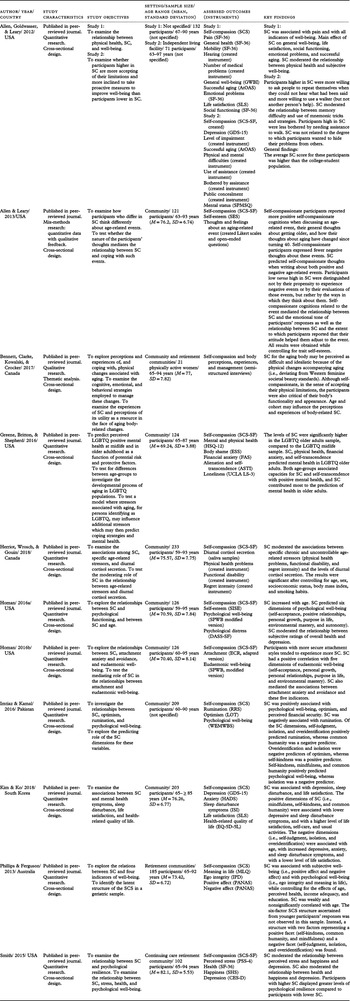
The lead researcher charted the data from each study and inserted it in a table elaborated a priori by the same researcher. This table was further reviewed by the two co-researchers. This table was created according to the recommendations of PRISMA-ScR (Tricco et al., Reference Tricco2018), with the objective of capturing all relevant information about all key study characteristics that would answer the present review’s research question. The lead researcher abstracted data on (1) characteristics of participants (sample size, age range and mean age, country, setting); (2) study objectives; (3) outcomes and instruments; and (4) study design and methodology. For mixed-age studies and studies where multiple outcomes were assessed, only the results referring to the geriatric samples and to the SC-related outcomes, respectively, were charted. The summary of the charted data is presented in Table 1.
Summary of reviewed studies about the role of self-compassion in the psychological (mal)adjustment of older adults

SC = Self-compassion; SCS = Self-Compassion Scale; SF-36 = Short Form (36) Health Survey; GWBI = General Well-Being Index; AtOAS = Attitude toward Own Aging Scale; SLS = Satisfaction with Life Scale; SCS-SF = Self-Compassion Scale – Short Form; GDS-15 = Geriatric Depression Scale – 15 items; SPMSQ = Short Portable Mental Status Questionnaire; SES = Self-esteem Scale; HSQ-12 = Health Status Questionnaire-12; ESS = Experience of Shame Scale; FAS = Financial Anxiety Scale; ASTI = Adult Self-Transcendence Inventory; UCLA LS-3 = UCLA Loneliness Scale Version 3; LGBTQ = lesbian, gay, bisexual, transgender, and queer or questioning; SISE = Single-Item Self-Esteem Scale; SPWB = Scales of Psychological Well-Being; DASS-SF = Depression Anxiety and Stress Scale – Short Form; ECR = Experiences in Close Relationships Scale; RRS = Ruminative Responses Scale; LOT = Life Orientation Test; WEMWBS = Warwick-Edinburgh Mental Well-Being Scale; HADS = Hospital Anxiety and Depression Scale; ISI = Insomnia Severity Index; EQ-5D-5L = EuroQoL-5 Dimensions; MLQ = Meaning in Life Questionnaire; IPD = Inventory of Psychosocial Development; PANAS = Positive and Negative Affect Scale; PSS-4 = Perceived Stress Scale – 4 items; SHS = Subjective Happiness Scale; CES-D = Center for Epidemiologic Studies Depression Scale.
Critical appraisal of individual sources of evidence
According to the PRISMA-ScR methodology (Tricco et al., Reference Tricco2018), this step is described as optional, given the scoping review’s objective of providing an overview of the existing evidence, regardless of methodological quality. Given this recommendation, corroborated by similar methodological frameworks suggested by Arksey and O’Malley (Reference Arksey and O’Malley2005) and Peters et al. (Reference Peters, Godfrey, Khalil, Mcinerney, Parker and Soares2015), and given the paucity of research with older adults which we have already mentioned, we opted for not conducting a quality appraisal of the included studies, in order to make our review as broad as possible.
Results
Selection of sources of evidence
The search in the EBSCO host Research and PubMed databases provided, respectively, 72 and 123 results. Together with 2 studies identified from scanning reference lists, the initial total was 197 results. After review of the titles and abstracts, 56 results (EBSCO host Research) and 122 results (PubMed) were discarded, based on duplicated results, nonrelevant results, and the application of the selection criteria. The full text of 19 results was examined, with further exclusion of 8 results. Reasons for exclusion were one or more of the following: study objectives that were not pertinent to answering the present review’s research question, assessed outcomes did not include SC, mean age value did not meet the inclusion criteria or was not specified. A final total of 11 published studies were included in the scoping review (no unpublished materials were eligible). Figure 1 provides an overview of the PRISMA-ScR strategy (Tricco et al., Reference Tricco2018) used during this process.
Modified PRISMA flow diagram of study screening and selection.

Characteristics of sources of evidence
The reviewed studies dated between 2012 and 2018. All studies were published in peer-reviewed journals and had a cross-sectional design. Six studies were conducted in the USA (Allen et al., Reference Allen, Goldwasser and Leary2012; Allen and Leary, Reference Allen and Leary2013; Greene et al., Reference Greene, Britton and Shepherd2016; Homan, Reference Homan2016a; Reference Homan2016b; Smith, Reference Smith2015), two in Canada (Bennett et al., Reference Bennett, Clarke, Kowalski and Crocker2017; Herriot et al., Reference Herriot, Wrosch and Gouin2018), one in Pakistan (Imtiaz and Kamal, Reference Imtiaz and Kamal2016), one in South Korea (Kim and Ko, Reference Kim and Ko2018), and one in Australia (Phillips and Ferguson, Reference Phillips and Ferguson2013). Nine studies had a quantitative methodology (Allen et al., Reference Allen, Goldwasser and Leary2012; Greene et al., Reference Greene, Britton and Shepherd2016; Herriot et al., Reference Herriot, Wrosch and Gouin2018; Homan, Reference Homan2016a; Reference Homan2016b; Imtiaz and Kamal, Reference Imtiaz and Kamal2016; Kim and Ko, Reference Kim and Ko2018; Phillips and Ferguson, Reference Phillips and Ferguson2013; Smith, Reference Smith2015), one had a qualitative methodology (Bennett et al., Reference Bennett, Clarke, Kowalski and Crocker2017), and one had a mixed methodology (Allen and Leary, Reference Allen and Leary2013).
The main objectives of the studies were to examine relations between SC and other variables (Allen et al., Reference Allen, Goldwasser and Leary2012; Greene et al., Reference Greene, Britton and Shepherd2016; Herriot et al., Reference Herriot, Wrosch and Gouin2018; Homan, Reference Homan2016a; Reference Homan2016b; Imtiaz and Kamal, Reference Imtiaz and Kamal2016; Kim and Ko, Reference Kim and Ko2018; Phillips and Ferguson, Reference Phillips and Ferguson2013; Smith, Reference Smith2015), to test the role of SC as a moderator (Allen et al., Reference Allen, Goldwasser and Leary2012; Herriot et al., Reference Herriot, Wrosch and Gouin2018; Reference Homan2016a; Smith, Reference Smith2015) or mediator (Allen and Leary, Reference Allen and Leary2013; Homan, Reference Homan2016b), to explore the nature of cognitions associated with SC (Allen and Leary, Reference Allen and Leary2013), to explore experiences and perceptions of SC in the context of body image (Bennett et al., Reference Bennett, Clarke, Kowalski and Crocker2017), and to examine the factorial structure of the Self-Compassion Scale in the geriatric population (Phillips and Ferguson, Reference Phillips and Ferguson2013).
No studies recruited clinical samples. Eight studies recruited participants from the general community (Allen and Leary, Reference Allen and Leary2013; Bennett et al., Reference Bennett, Clarke, Kowalski and Crocker2017; Greene et al., Reference Greene, Britton and Shepherd2016; Herriot et al., Reference Herriot, Wrosch and Gouin2018; Homan, Reference Homan2016a; Reference Homan2016b; Imtiaz and Kamal, Reference Imtiaz and Kamal2016; Kim and Ko, Reference Kim and Ko2018), two studies recruited from retirement communities (Bennett et al., Reference Bennett, Clarke, Kowalski and Crocker2017; Phillips and Ferguson, Reference Phillips and Ferguson2013), one study recruited from a continuing care retirement community (Smith, Reference Smith2015), one study recruited from an independent living facility (Allen et al., Reference Allen, Goldwasser and Leary2012, study 2), and one study did not specify the origin of the recruited sample (Allen et al., Reference Allen, Goldwasser and Leary2012, study 1). The sample size of the studies varied between 21 and 233 participants, the age range varied between 59 and 97 years, and the mean age varied between 69.24 and 82.1 years.
SC was assessed with the Self-Compassion Scale in four studies (Allen et al., Reference Allen, Goldwasser and Leary2012, study 1; Imtiaz and Kamal, Reference Imtiaz and Kamal2016; Kim and Ko, Reference Kim and Ko2018; Phillips and Ferguson, Reference Phillips and Ferguson2013), with the shortened version of this scale in six studies (Allen and Leary, Reference Allen and Leary2013; Greene et al., Reference Greene, Britton and Shepherd2016; Herriot et al., Reference Herriot, Wrosch and Gouin2018; Homan, Reference Homan2016a, Reference Homan2016b; Smith, Reference Smith2015), and with a semi-structured interview in one study (Bennett et al., Reference Bennett, Clarke, Kowalski and Crocker2017). In their study 2, Allen et al. (Reference Allen, Goldwasser and Leary2012) created their own short form of the Self-Compassion Scale, given that, at the time of their research, no abbreviated version was available.
Other psychological outcomes assessed in the studies included general well-being, successful aging, emotional problems, social functioning, mental status (Allen et al., Reference Allen, Goldwasser and Leary2012), psychological well-being (Homan, Reference Homan2016a; Reference Homan2016b; Imtiaz and Kamal, Reference Imtiaz and Kamal2016; Phillips and Ferguson, Reference Phillips and Ferguson2013), subjective well-being (Phillips and Ferguson, Reference Phillips and Ferguson2013), life satisfaction (Allen et al., Reference Allen, Goldwasser and Leary2012; Kim and Ko, Reference Kim and Ko2018), depression (Kim and Ko, Reference Kim and Ko2018; Allen et al., Reference Allen, Goldwasser and Leary2012; Smith, Reference Smith2015), self-esteem (Allen and Leary, Reference Allen and Leary2013; Homan, Reference Homan2016a), body shame, financial anxiety, alienation and self-transcendence, loneliness (Greene et al., Reference Greene, Britton and Shepherd2016), psychological distress (Homan, Reference Homan2016a), attachment (Homan, Reference Homan2016b), rumination, optimism (Imtiaz and Kamal, Reference Imtiaz and Kamal2016), anxiety, health-related quality of life (Kim and Ko, Reference Kim and Ko2018), perceived stress, happiness (Smith, Reference Smith2015), body image-related indicators (Bennett et al., Reference Bennett, Clarke, Kowalski and Crocker2017), and assorted mental health indicators (e.g., mental difficulties, regret intensity; Allen et al., Reference Allen, Goldwasser and Leary2012; Allen and Leary, Reference Allen and Leary2013; Greene et al., Reference Greene, Britton and Shepherd2016; Herriot et al., Reference Herriot, Wrosch and Gouin2018).
Physical outcomes assessed in the studies included pain (Allen et al., Reference Allen, Goldwasser and Leary2012), general health (Allen et al., Reference Allen, Goldwasser and Leary2012; Smith, Reference Smith2015), diurnal cortisol secretion (Herriot et al., Reference Herriot, Wrosch and Gouin2018), sleep disturbance (Kim and Ko, Reference Kim and Ko2018), and assorted physical health indicators (e.g., number of medical problems, functional disability; Allen et al., Reference Allen, Goldwasser and Leary2012; Greene et al., Reference Greene, Britton and Shepherd2016; Herriot et al., Reference Herriot, Wrosch and Gouin2018).
Synthesis of results
Results of individual sources of evidence are presented in Table 1.
In the studies with quantitative or mixed methodology, SC was positively correlated with, and was a predictor of, beneficial mental health outcomes in nine studies (Allen et al., Reference Allen, Goldwasser and Leary2012; Allen and Leary, Reference Allen and Leary2013; Greene et al., Reference Greene, Britton and Shepherd2016; Homan, Reference Homan2016a; Reference Homan2016b; Imtiaz and Kamal, Reference Imtiaz and Kamal2016; Kim and Ko, Reference Kim and Ko2018; Phillips and Ferguson, Reference Phillips and Ferguson2013; Smith, Reference Smith2015). SC was also negatively correlated with, and was a predictor of, psychopathology-related symptoms in six studies (Allen et al., Reference Allen, Goldwasser and Leary2012; Herriot et al., Reference Herriot, Wrosch and Gouin2018; Homan, Reference Homan2016a; Imtiaz and Kamal, Reference Imtiaz and Kamal2016; Kim and Ko, Reference Kim and Ko2018; Smith, Reference Smith2015). SC was further associated with indicators of physical health in five studies (Allen et al., Reference Allen, Goldwasser and Leary2012; Herriot et al., Reference Herriot, Wrosch and Gouin2018; Homan, Reference Homan2016a; Kim and Ko, Reference Kim and Ko2018; Smith, Reference Smith2015). The moderator role of SC was tested in four studies (Allen et al., Reference Allen, Goldwasser and Leary2012; Herriot et al., Reference Herriot, Wrosch and Gouin2018; Homan, Reference Homan2016a; Smith, Reference Smith2015), regarding the relationship between physical health-related outcomes (e.g., functional disability) and mental health-related outcomes (e.g., subjective well-being). The mediator role of SC was tested in one study (Homan, Reference Homan2016b), regarding the relationship between diverse mental health-related constructs. Additionally, the mediator role of self-compassionate cognitions was tested in one study (Allen and Leary, Reference Allen and Leary2013).
Still regarding the quantitative studies, these beneficial results reported for SC were found for older adults in western (Allen et al., Reference Allen, Goldwasser and Leary2012; Allen and Leary, Reference Allen and Leary2013; Greene et al., Reference Greene, Britton and Shepherd2016; Herriot et al., Reference Herriot, Wrosch and Gouin2018; Homan, Reference Homan2016; Homan, Reference Homan2016b; Phillips and Ferguson, Reference Phillips and Ferguson2013; Smith, Reference Smith2015) and eastern societies (Imtiaz and Kamal, Reference Imtiaz and Kamal2016; Kim and Ko, Reference Kim and Ko2018). Likewise, and based on Funnell (Reference Funnell2010)’s terminology, beneficial results were reported for “young-old” participants (i.e., mean age of less than 75 years; Greene et al., Reference Greene, Britton and Shepherd2016; Homan, Reference Homan2016a; Homan, Reference Homan2016b; Phillips and Ferguson, Reference Phillips and Ferguson2013) and for “old-old” participants (i.e., mean age of 75 years or older; Allen and Leary, Reference Allen and Leary2013; Herriot et al., Reference Herriot, Wrosch and Gouin2018; Kim and Ko, Reference Kim and Ko2018; Smith, Reference Smith2015). All these studies recruited nonclinical samples and assessed SC with a self-report instrument.
In the studies with qualitative or mixed methodology, mixed results were found about the role of SC. One study (Allen and Leary, Reference Allen and Leary2013) interpreted SC and self-compassionate cognitions as having a beneficial impact on the emotional tone of age-related thoughts and on the appraisal of, and coping with, negative age-related events. On the other hand, one study (Bennett et al., Reference Bennett, Clarke, Kowalski and Crocker2017) interpreted SC as being potentially difficult to foster and idealistic. In this case, SC was explored solely regarding age-related body image perceptions. Results of both studies were reported for “old-old” participants in a western society. Both recruited nonclinical samples, the mixed methodology study (Allen and Leary, Reference Allen and Leary2013) assessed SC with a self-report instrument, and the qualitative methodology study (Bennett et al., Reference Bennett, Clarke, Kowalski and Crocker2017) assessed SC with a semi-structured interview.
Discussion
Summary of evidence
Within the past two decades, the role of SC as a protection factor in the face of psychopathology symptoms has been increasingly researched. Whereas the majority of this literature has focused on younger populations, SC has also been suggested as an important resource to cope with the challenges inherent to the aging process.
The systematic review and meta-analysis conducted by Brown et al. (Reference Brown, Huffman and Bryant2019) was the first to address this possibility, by synthesizing the currently available knowledge. They reported, for older adults, meta-analytic results for the association between SC and reduced symptoms of depression and anxiety as well as the association between SC and higher levels of both hedonic and eudaemonic well-being. Additionally, they found evidence that SC may reduce the emotional burden of health issues in these individuals. Finally, preliminary findings were reported in regard to the relation between SC and social well-being.
The present scoping review was conducted to complement and expand the work of Brown et al. (Reference Brown, Huffman and Bryant2019) and to further ascertain the role of SC in the psychological (mal)adjustment of older adults. Both works included six overlapping studies (Allen et al., Reference Allen, Goldwasser and Leary2012; Allen and Leary, Reference Allen and Leary2013; Greene et al., Reference Greene, Britton and Shepherd2016; Homan, Reference Homan2016a; Phillips and Ferguson, Reference Phillips and Ferguson2013; Smith, Reference Smith2015). On the other hand, our inclusion criteria were broader and we did not perform a quality appraisal of the included studies, which allowed us to review five studies not addressed by the previous article (Bennett et al., Reference Bennett, Clarke, Kowalski and Crocker2017; Herriot et al., Reference Herriot, Wrosch and Gouin2018; Homan, Reference Homan2016b; Imtiaz and Kamal, Reference Imtiaz and Kamal2016; Kim and Ko, Reference Kim and Ko2018). Additionally, our scoping review contributes to the literature by having included one qualitative study (Bennett et al., Reference Bennett, Clarke, Kowalski and Crocker2017). This methodology allowed those participants the opportunity to talk more in-depth about their experience of SC, rather than responding to preestablished closed questions only, and inclusively highlighted potential difficulties in being compassionate toward oneself (a further discussion of this topic is presented below). Our review also contributes by having searched and reviewed unpublished materials and materials written in Spanish and Portuguese (although none were ultimately included, based on our selection criteria). Finally, our work provides the synthesis of data regarding constructs that may be highly relevant to the process of healthy aging: rumination, optimism, attachment anxiety and avoidance, sleep disturbance symptoms, life satisfaction, health-related quality of life, regret intensity, functional disability, diurnal cortisol secretion, and perceptions, experiences, and management of body image.
The present scoping review included 11 studies, between 2012 and 2018, that investigated the relationship of SC with several constructs associated with psychological (mal)adjustment in the geriatric population as well as constructs related to physical health, and that tested the role of SC as a potential protection factor for this population. The reduced number of eligible studies, and of studies identified through the search process, demonstrates the paucity of research in this area. Nonetheless, some conclusions can be drawn at this point.
Of the 11 reviewed studies, 10 had a quantitative or mixed methodology and, in all of these, SC was (a) positively associated with, and a predictor of, beneficial mental health constructs (e.g., life satisfaction, psychological well-being), and/or (b) negatively associated with, and a predictor of, mental disorder symptoms (e.g., depression). Additionally, SC was associated with physical health constructs (e.g., pain, sleep disturbances, diurnal cortisol secretion). In some studies, SC further emerged as a protection factor regarding the mental health of older adults, in face of life stressors normatively associated with the aging process (e.g., decline or loss of general health or physical skills). Therefore, SC seems to be a valuable resource for the psychological adjustment of these individuals, as has been demonstrated for younger populations (e.g., MacBeth and Gumley, Reference Macbeth and Gumley2012). It is noteworthy that, based on these findings, SC may benefit not only the mental health of older adults but their biological functioning as well. The present review replicates the results found by Brown et al. (Reference Brown, Huffman and Bryant2019) regarding mental health-related constructs (i.e., depression, anxiety, hedonic well-being, eudaemonic well-being) and physical health and add to this body of evidence by extending these results to other constructs (e.g., life satisfaction, attachment anxiety and avoidance, sleep disturbance symptoms).
Allen et al. (Reference Allen, Goldwasser and Leary2012) suggested that SC is associated with more acceptance toward one’s physical limitations and with the motivation for self-care, whereas Smith (Reference Smith2015) ascertained that self-compassionate participants showed greater levels of psychological resilience. Thus, SC may contribute to a kinder and more accepting attitude toward the effects of aging. Self-compassionate older adults are aware that such changes are part of the human nature, rather than personal failures, and this can foster positive interpersonal relationships, personal growth-related activities, and the cherishing of a purpose in life (Neff, Reference Neff2003b). The findings of the present review suggest that SC may be particularly relevant for those who experience more negative life circumstances, which was also highlighted by Brown et al. (Reference Brown, Huffman and Bryant2019). This conclusion was particularly emphasized in the work of Allen et al. (Reference Allen, Goldwasser and Leary2012).
The extent to which our results can be generalized is somewhat limited. Most of the included studies recruited participants from the general community and no studies included clinical samples. Despite including participants from eastern societies (Imtiaz and Kamal, Reference Imtiaz and Kamal2016; Kim and Ko, Reference Kim and Ko2018), all samples were relatively homogenous and comprised mostly of White, well-functioning, financially stable older adults. As was mentioned, SC may be of increased importance for those who face more challenging life conditions. Nonetheless, our scoping review contributes to further extend the results of Brown et al. (Reference Brown, Huffman and Bryant2019) who have extracted and analyzed data mainly from developed, western societies (i.e., USA, Canada, and Europe). On the other hand, the study of Greene and colleagues (2016) is a first indicator of the beneficial role of SC for lesbian, gay, bisexual, transgender, and queer or questioning (LGBTQ) older adults, and more research is needed that takes into account the specificities of minority groups.
Additionally, the positive impact of SC was demonstrated even with “old-old” participants, suggesting that the benefits of fostering a self-compassionate mind and attitude do not decrease with age. Nonetheless, through a qualitative methodology and by the use of semi-structured interviews, Bennett and colleagues (2017) alerted for the possibility of SC being interpreted as difficult and idealistic, at least in the context of the body image of physically active older women, and emphasized that such perceptions were mostly expressed by the oldest participants, which suggest that body-related SC may be influenced by age and cohort. Further research is needed to clarify whether such perceptions may also apply to general SC, for example, by conducting more qualitative studies that allow a deeper understanding of what SC means to these individuals, along with its perceived utility. Additionally, it might prove useful to explore whether beliefs similar to the ones expressed by those participants are an indicator of fear of SC (Gilbert and Procter, Reference Gilbert and Procter2006), which is a construct not yet studied in the geriatric population.
The relationship between SC and age also requires attention. Whereas Neff (Reference Neff2011) suggested that SC may increase in older adulthood, particularly upon achieving the stage of ego integrity, the studies included in the present review showed mixed results: Allen and colleagues (2012) found that SC was higher in their geriatric sample compared to college students. Using a multigenerational sample, Homan (Reference Homan2016a) also reported an increase in SC with age, and Greene and colleagues (2016) found that LGBTQ participants aged 65 years and older were more self-compassionate than midlife participants. However, the results of Phillips and Ferguson (Reference Phillips and Ferguson2013) showed a weak and nonsignificant correlation between SC and age. We suggest that these mixed results may be due to the heterogeneity of older adult samples, given the idiosyncrasies of the aging process in itself, even among well-functioning community residents. Future research with longitudinal designs would be useful to clarify these mixed findings.
Finally, with the exception of Bennett and colleagues (Reference Bennett, Clarke, Kowalski and Crocker2017), all studies assessed SC with a self-report measure, namely, the Self-Compassion Scale (Neff, Reference Neff2003a). Most studies preferred the shortened version of this instrument, with the intention of reducing the assessment burden for the participants. However, a recent study by Bratt and Fagerström (Reference Bratt and Fagerström2020) reported psychometric problems when using the scale’s short form in a sample of adults of age 66–102 years. Acceptable internal consistency was found only for the “young-old” participants, which suggests that adjustments may be necessary to improve the fit of the abbreviated scale for the “old-old” cohorts. Additionally, confirmatory factorial analyses indicated that the six-factor solution, obtained with younger populations, did not have an acceptable fit for this sample of older adults. Instead, a two-factor model, comprising a compassionate or uncompassionate relation with the self, showed better adjustment. Such model was corroborated by Phillips and Ferguson (Reference Phillips and Ferguson2013), regarding the standard form of the scale. Therefore, the conclusions of the studies where the abbreviated scale was used should be interpreted with caution, and more research is needed to clarify the reliability of this version with this population. These findings add to the conclusions provided by Brown et al. (Reference Brown, Huffman and Bryant2019) who had already alerted for the heterogeneity issues caused by the use of several, and diverse, measures across different studies.
As a final note, we would like to emphasize the cross-sectional design of all the studies reviewed, which inherently limits the conclusions that can be drawn. We, therefore, argue that future research with longitudinal designs will be essential to clarify the results obtained so far. All the beneficial outcomes associated with SC, as well as its promising role as a protection factor regarding the mental health of older adults, must be replicated with more robust methodologies, in order to improve the reliability of current knowledge. Additionally, we argue that more intervention studies with the geriatric population will be of great value, provided they include an assessment of SC with validated instruments and an intervention rationale explicitly based on the promotion of SC. In this regard, we further argue that such intervention studies will benefit from not only assessing SC as an outcome but, as well, considering SC as a mechanism of change in said interventions. We furthermore suggest that qualitative studies will provide a more in-depth understanding of the role of SC in this population and would allow older adults to more openly express their representations and appraisal of this construct.
Limitations
The present scoping review presents three main limitations. First, despite aiming to be as broad as possible, it included a small number of studies and only published papers written in English were ultimately selected. Six studies were excluded due to not meeting the selection criteria, and these studies could have contributed in answering the present review’s research question. However, we made this decision based on the paucity of SC-related research focused only on the geriatric population, and with the intention to provide more specific conclusions.
Second, all the studies included in this review had a cross-sectional design and, therefore, cannot provide inferences about causality. It is plausible to assume that increased levels of SC lead to the reported positive outcomes, but it is also possible that higher levels of indicators such as psychological well-being or life satisfaction, in turn, foster one’s capacity to be self-compassionate. Likewise, it is possible that third, unknown variables have an impact on these relationships. Therefore, whereas the conclusions provided by these studies are optimistic, their interpretation warrants caution. Future studies with longitudinal design, as already discussed, will be essential to clarify the results and conclusions achieved so far.
Finally, the screening and review of all studies included were conducted by the lead researcher only, due to limitations associated with the broader research project in which this scoping review is included.
Conclusions
Notwithstanding the limitations identified, SC seems to be a valuable resource for the psychological adjustment of older adults and can be a protective factor in coping with the challenges associated with aging. Research shows that SC is a malleable trait that can be promoted through psychological interventions (e.g., Gilbert, Reference Gilbert2010), and some evidence of the efficacy and utility of these interventions were already found for older adults (e.g., Perez-Blasco et al., Reference Perez-Blasco, Sales, Meléndez and Mayordomo2016). Therefore, the implementation and/or optimization of such protocols is of great clinical and societal value. Future research should invest in further assessing the efficacy of SC-based interventions for older adults as well as to begin exploring mechanisms of therapeutic change and continue to examine the relations of SC with indicators of psychological and physical (mal)adjustment in this population. Studies with longitudinal design, with clinical samples, and with samples of more diverse backgrounds could help improving the presently available knowledge.
Conflict of interest
None.
Funding source(s)
This research did not receive any specific grant from funding agencies in the public, commercial, or not-for-profit sectors. The authors are willing to allow the journal to review their data if requested.
Supplementary material
To view supplementary material for this article, please visit https://doi.org/10.1017/S1041610220001222