





Introduction
Radiotherapy (RT) is prescribed to approximately 60% of people with head and neck cancer (HNC) and requires precise targeting of the treatment field while sparing surrounding healthy tissue. Reference Chow1,Reference Mody, Rosko and Yom2 Immobilisation involves the use of a customised thermoplastic mask (Figure 1), worn during CT simulation and throughout daily treatment sessions spanning up to 6–8 weeks. Reference Beyzadeoglu, Sager and Dincoglan3 The fitting and daily use of a mask can be challenging for patients: studies report that 16–29% of people experience mask-related anxiety or fear, which may lead to treatment delays, refusal or premature cessation of RT. Reference Nixon, Cartmill and Turner4–Reference Oultram, Findlay and Clover6 Qualitative and mixed-methods work has identified several contributors to this anxiety, including the sensation of confinement and restricted movement, loss of control and the inability to speak or move freely during the procedure, pre-existing claustrophobic tendencies and the influence of prior experience and expectation. Reference Keast, Sundaresan and Burns7,Reference Pelland, Lagadec-Gaulin and Bahig8 Female sex and higher baseline distress have also been associated with greater mask anxiety. Reference Nixon, Brown and Pigott9 The clinical consequences are tangible: in a regional cohort of 101 people with HNC, 10% required a sedative medication and 5% required a break from the mask during simulation, Reference Forbes, Clover and Oultram10 and in severe cases have required systematic desensitisation before treatment can proceed. Reference Carmack, Agosta, Ann-Yi and Bruera11 Because mask anxiety is frequently under-recognised, radiation therapists correctly identify only a minority of anxious patients Reference Oultram, Findlay and Clover6,Reference Burns, Campbell and French12 systematic screening at the point of simulation is needed to identify those who would benefit from additional support before immobilisation becomes a barrier to treatment.
Patient in a customised thermoplastic mask positioned for radiotherapy.

Systematic screening requires an instrument that is psychometrically sound yet brief enough for routine use. Validated patient-reported outcome measures (PROMs) such as the State-Trait Anxiety Inventory (STAI), Distress Thermometer and Hospital Anxiety and Depression Scale (HADS) have been widely adopted to assess anxiety in people with HNC. Reference Goldsworthy, Latour and Palmer13–Reference Shunmugasundaram, Rutherford and Butow15 However, their validity in measuring mask-specific anxiety is limited. Modified tools (e.g., adapted distress thermometers) have yielded inconsistent findings, and no standardised instrument capturing mask anxiety has been validated. Reference Nixon, Cartmill and Turner4 The HADS and Distress Thermometer were also designed to capture generalised distress over the preceding week rather than acute anxiety at a defined moment, and the full 20-item STAI, although the reference standard for state anxiety, is impractical in a pre-simulation waiting room. The six-item short form of the STAI state scale (STAI Y-6) was derived by Marteau and Bekker specifically to retain the properties of the parent instrument while taking under two minutes to complete and correlates highly (r > 0.90) with the full 20-item version. Reference Marteau and Bekker16 Subsequent work has supported its reliability and factor structure in clinical samples and has recommended it explicitly for use in fast-paced medical environments, Reference Abed, Hall and Moser17–Reference Chell, Waller and Masser19 while pro-rating the raw score to the 20-item equivalent allows published STAI thresholds to be applied. Reference Kvaal, Ulstein, Nordhus and Engedal20 These properties make the STAI Y-6 a plausible candidate for point-of-care screening immediately before mask fabrication, although its performance in this specific context has not previously been reported.
Screening is only clinically useful if it can be linked to an intervention. Current responses to mask anxiety, anxiolytic medication, open-face mask designs and staff reassurance, are largely pharmacological, resource-intensive or applied reactively once distress has already occurred. Because mask anxiety appears to be driven substantially by anticipatory fear of an unfamiliar, confining and uncontrollable procedure, Reference Keast, Sundaresan and Burns7,Reference Pelland, Lagadec-Gaulin and Bahig8 interventions that allow patients to rehearse the procedure in advance are conceptually well matched to the problem. Virtual reality (VR)-based preparation offers one such approach. A systematic review of seven interventional studies including 376 adults found that VR-based educational sessions improved treatment knowledge and were generally associated with reduced anxiety relative to standard care, although the anxiety findings were less consistent across studies. Reference Grilo, Almeida and Rodrigues21 A VR simulation of the linear accelerator environment has also been shown to improve patient knowledge and self-efficacy prior to treatment. Reference Wang, Casto, Luh and Wang22 However, no published VR intervention has specifically targeted mask-related anxiety in HNC; uptake of VR in routine RT remains low, and it is unclear whether people with HNC who face the additional burden of mask immobilisation would be receptive to it. Establishing both the prevalence of anxiety at mask fabrication and patient receptivity to VR is therefore a necessary first step in designing a future interventional study.
This study aimed to (1) describe the prevalence of state anxiety among people with HNC at the time of first mask fabrication using the STAI Y-6, (2) evaluate the practicality of administering the STAI Y-6 in a pre-treatment clinical workflow and (3) explore patient interest in VR-based preparation as a potential anxiety-management strategy.
Methods
Study design and setting
A single-centre, cross-sectional study was conducted from January to November 2020 in the RT department of a tertiary cancer centre across two campuses. Reporting follows the Strengthening the Reporting of Observational Studies in Epidemiology (STROBE) checklist. Reference von Elm, Altman and Egger23 Ethics approval and the ethical conduct of the study are detailed in the Ethical Standards section.
Participants
Consecutive adults (aged ≥18 years) with a confirmed diagnosis of HNC who were referred for their first course of RT requiring a thermoplastic mask were eligible. Participants were required to have sufficient English proficiency for self-report measures. People who had previously undergone RT requiring a thermoplastic mask were excluded. Participation was voluntary; verbal informed consent was obtained by the treating radiation oncologist or radiation therapist immediately prior to the CT simulation appointment and could be withdrawn at any time without consequence.
Data collection
All participants completed a 10-item questionnaire in the waiting room immediately before their CT simulation and mask fabrication. The questionnaire comprised the six-item short-form State-Trait Anxiety Inventory (STAI Y-6), which captures state anxiety ‘right now, at this moment’ The STAI Y-6 was selected in preference to longer instruments because it captures acute state anxiety at a defined moment rather than distress over the preceding week, requires less than two minutes to complete and retains acceptable psychometric properties relative to the full 20-item scale. Reference Marteau and Bekker16–Reference Chell, Waller and Masser19 Each item is scored on a four-point ordinal scale (1 = not at all, 4 = very much so). Three items assessing the absence of anxiety (calm, relaxed, content) are reverse-scored before summation. Raw scores are pro-rated to the 20-item equivalent, yielding a range of 20–80; this conversion allows comparison with published STAI thresholds. Reference Marteau and Bekker16–Reference Kvaal, Ulstein, Nordhus and Engedal20
Four additional questions developed by the study team were appended: two relating to anxiety (Q7, anxiety about having the mask made; Q8, anxiety about the treatment itself), each scored on a four-point ordinal scale (not at all, somewhat, moderately, very much), and two concerning VR as a preparatory tool (Q9, whether the participant would like a guided session of their CT and treatment procedure using VR; Q10, whether they felt such a session might lower their anxiety), each answered yes/no/not sure. The VR items were informed by published findings suggesting potential effectiveness. Reference Wang, Casto, Luh and Wang22 Questionnaire content was developed by a multidisciplinary team comprising two radiation therapists, a head and neck radiation oncologist and a quantitative psychologist. These four items have not undergone formal psychometric validation.
Demographic and clinical data (age, sex, current smoking status, current alcohol consumption, history of psychological disorder, tumour stage, treatment prescription, treatment intent and CT simulation duration) were extracted from the electronic medical record. Radical-intent treatment was defined as a prescribed dose of ≥50 Gy delivered in 20–35 fractions, consistent with departmental protocols for definitive and adjuvant HNC radiotherapy; all other prescriptions were classified as palliative. Data were de-identified and questionnaire responses were collected via Qualtrics survey software.
Outcome measures
The primary outcomes were (1) the prevalence of state anxiety, defined as the proportion of participants with a pro-rated STAI Y-6 score ≥41, the established threshold for clinically meaningful state anxiety, Reference Kvaal, Ulstein, Nordhus and Engedal20,Reference Leentjens, Dujardin and Marsh24–Reference Julian26 and (2) the practicality of administration, indicated by the recruitment rate, the questionnaire completion rate and the time taken to complete the questionnaire, recorded automatically by the survey software. A secondary threshold of ≥55 was also applied, consistent with recommendations for identifying severe situational anxiety, particularly in older adults. Reference Kvaal, Ulstein, Nordhus and Engedal20,Reference Julian26,Reference Knight, Waal-Manning and Spears27 Secondary outcomes were the distribution of responses to the four study-specific supplementary items: self-reported anxiety about mask fabrication (Q7), general treatment anxiety (Q8) and interest in (Q9) and perceived benefit of (Q10) a guided VR session and the association of each with STAI Y-6 caseness. These items were exploratory and are reported descriptively alongside the corresponding tests of association.
Statistical analysis
All analyses were performed using IBM SPSS Statistics (v.24.0; IBM Corp., Armonk, NY). Continuous variables are presented as means and standard deviations (SD) where approximately symmetric or medians and interquartile ranges (IQR) where skewed; categorical variables as counts and percentages. The 95% confidence interval (CI) for the proportion meeting the ≥41 threshold was calculated using the Wilson score method; these intervals are presented to convey the precision with which the sample estimates the underlying population prevalence, not as a test of any hypothesis.
Responses to the four supplementary questions were cross-tabulated by anxiety group (below vs. at or above the ≥41 threshold). Given small expected cell counts, Pearson’s chi-squared test p-values were computed using two-sided Monte Carlo simulation with 10,000 replicates (α = 0.05). Reference Hope28 A priori sample size calculation was not performed, as the study was designed to estimate prevalence rather than to test a hypothesis; with 39 participants, the 95% CI around a prevalence of approximately 44% has a half-width of about ±15 percentage points. Post hoc power calculated from observed effects is uninformative and was therefore not undertaken. Reference Button, Ioannidis and Mokrysz29 Furthermore, given the small sample size (N = 39), no inferential testing of associations between anxiety and demographic or clinical variables was undertaken; subgroup analyses would be underpowered and risk Type I and II error. Reference Button, Ioannidis and Mokrysz29 Characteristics are tabulated descriptively for the full sample (Table 1) and stratified by anxiety group (Table 2).
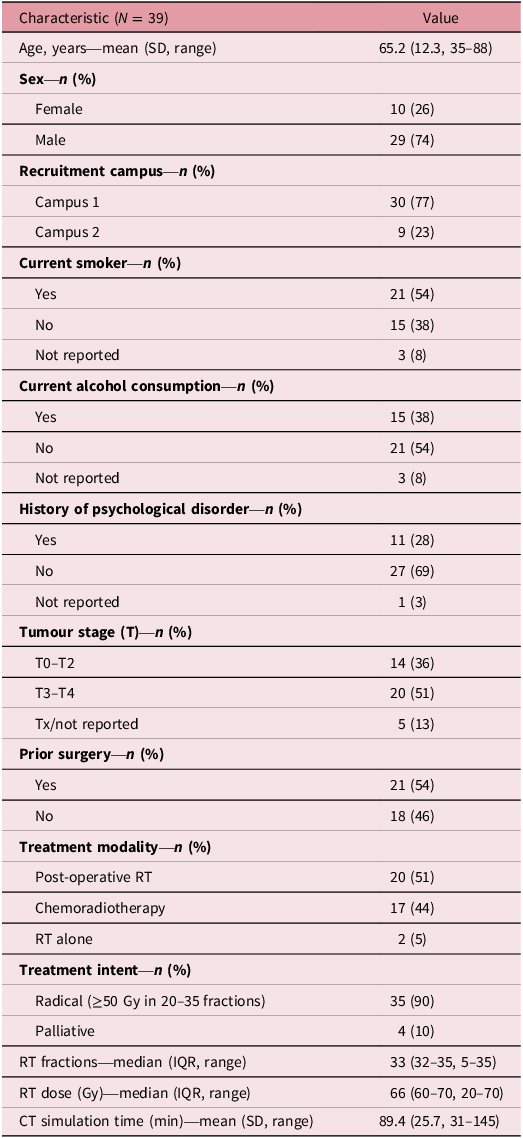
Demographic and clinical characteristics of participants (N = 39). IQR = interquartile range; RT = radiotherapy; SD = standard deviation

Table 1. Long description
A table with 11 rows and 2 columns. The columns are labeled ‘Characteristic (N = 39)’ and ‘Value’. The table presents various demographic and clinical characteristics of 39 participants. Row 1: Age, years—mean (SD, range), 65.2 (12.3, 35–88). Row 2: Sex—n (%), Female, 10 (26). Row 3: Sex—n (%), Male, 29 (74). Row 4: Recruitment campus—n (%), Campus 1, 30 (77). Row 5: Recruitment campus—n (%), Campus 2, 9 (23). Row 6: Current smoker—n (%), Yes, 21 (54). Row 7: Current smoker—n (%), No, 15 (38). Row 8: Current smoker—n (%), Not reported, 3 (8). Row 9: Current alcohol consumption—n (%), Yes, 15 (38). Row 10: Current alcohol consumption—n (%), No, 21 (54). Row 11: Current alcohol consumption—n (%), Not reported, 3 (8).
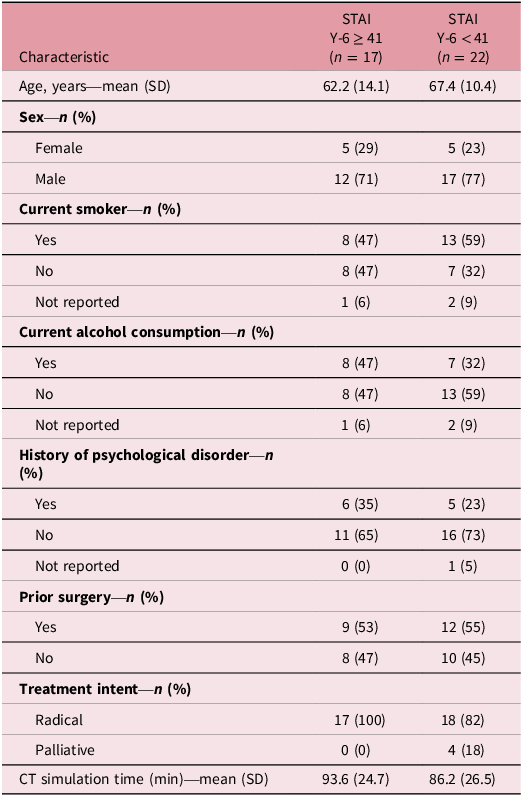
Demographic and clinical characteristics by STAI Y-6 anxiety group (≥41 threshold). Percentages rounded to whole numbers. No between-group inferential testing was performed given the small sample size

Table 2. Long description
A table with 10 rows and 10 columns comparing demographic and clinical characteristics by anxiety group. The table includes characteristics such as age, sex, current smoker status, current alcohol consumption, history of psychological disorder, prior surgery, treatment intent, and CT simulation time. The columns are divided into two groups: STAI Y-6 >= 41 and STAI Y-6 < 41. Row 1: Age, years—mean (SD), STAI Y-6 >= 41: 62.2 (14.1), STAI Y-6 < 41: 67.4 (10.4). Row 2: Sex—n (%), Female, STAI Y-6 >= 41: 5 (29), STAI Y-6 < 41: 5 (23). Row 2: Sex—n (%), Male, STAI Y-6 >= 41: 12 (71), STAI Y-6 < 41: 17 (77). Row 3: Current smoker—n (%), Yes, STAI Y-6 >= 41: 8 (47), STAI Y-6 < 41: 13 (59). Row 3: Current smoker—n (%), No, STAI Y-6 >= 41: 8 (47), STAI Y-6 < 41: 7 (32). Row 3: Current smoker—n (%), Not reported, STAI Y-6 >= 41: 1 (6), STAI Y-6 < 41: 2 (9). Row 4: Current alcohol consumption—n (%), Yes, STAI Y-6 >= 41: 8 (47), STAI Y-6 < 41: 7 (32). Row 4: Current alcohol consumption—n (%), No, STAI Y-6 >= 41: 8 (47), STAI Y-6 < 41: 13 (59). Row 4: Current alcohol consumption—n (%), Not reported, STAI Y-6 >= 41: 1 (6), STAI Y-6 < 41: 2 (9). Row 5: History of psychological disorder—n (%), Yes, STAI Y-6 >= 41: 6 (35), STAI Y-6 < 41: 5 (23). Row 5: History of psychological disorder—n (%), No, STAI Y-6 >= 41: 11 (65), STAI Y-6 < 41: 16 (73). Row 5: History of psychological disorder—n (%), Not reported, STAI Y-6 >= 41: 0 (0), STAI Y-6 < 41: 1 (5). Row 6: Prior surgery—n (%), Yes, STAI Y-6 >= 41: 9 (53), STAI Y-6 < 41: 12 (55). Row 6: Prior surgery—n (%), No, STAI Y-6 >= 41: 8 (47), STAI Y-6 < 41: 10 (45). Row 7: Treatment intent—n (%), Radical, STAI Y-6 >= 41: 17 (100), STAI Y-6 < 41: 18 (82). Row 7: Treatment intent—n (%), Palliative, STAI Y-6 >= 41: 0 (0), STAI Y-6 < 41: 4 (18). Row 8: CT simulation time (min)—mean (SD), STAI Y-6 >= 41: 93.6 (24.7), STAI Y-6 < 41: 86.2 (26.5).
Results
Recruitment and questionnaire completion
Between January and November 2020, 42 eligible HNC patients were screened across the two campuses. Of these, 39 provided informed consent, yielding a recruitment rate of 93%. Three declined participation (7%). All 39 enrolled participants completed every item of the 10-item questionnaire, giving a completion rate of 100%. The median time taken to complete the questionnaire, recorded automatically by the survey software, was 3.6 minutes (IQR 1.7–6.3; range 0.6–23.4), and 26 participants (67%) completed it within five minutes. No participant reported adverse effects or distress from completing the questionnaire.
Participant characteristics
Participant characteristics are presented in Table 1. The mean age was 65.2 years (SD 12.3, range 35–88). Most participants were male (n = 29, 74%). Over half reported current smoking (n = 21, 54%), 15 (38%) reported current alcohol consumption and 11 (28%) had a history of psychological disorder. Most (n = 21, 54%) had undergone surgery prior to RT. The median number of RT fractions was 33 (IQR 32–35, range 5–35) at a median total dose of 66 Gy (IQR 60–70, range 20–70). Thirty-five participants (90%) received radical-intent treatment.
Prevalence of state anxiety
The mean pro-rated STAI Y-6 score for the full sample was 43.3 (SD 14.1, median 40.0, IQR 35.0–50.0, range 20–77). Seventeen participants (44%, 95% CI 29–59%) scored at or above the ≥41 threshold for clinically meaningful state anxiety. Demographic and clinical characteristics by anxiety group are presented in Table 2.
At the higher threshold of ≥55, indicating severe situational anxiety, eight participants (21%, 95% CI 11–36%) met the criterion. Participants meeting this threshold tended to be slightly younger (mean age 61.1 years, SD 8.7) than those below it (mean age 66.2 years, SD 13.0), suggesting severe anxiety in this cohort was not concentrated among older adults.
Supplementary questions
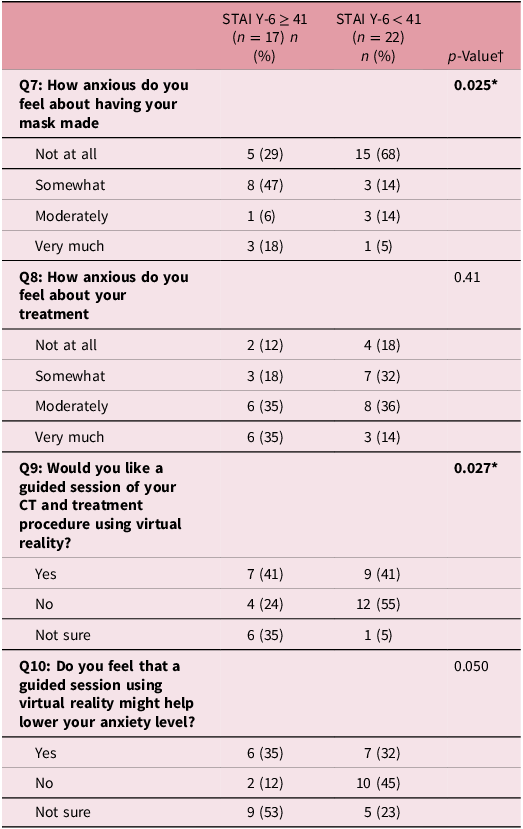
Table 3 presents responses to the four supplementary questions by anxiety group (≥41 threshold), with p-values computed by Monte Carlo-simulated chi-squared tests (10,000 replicates). An association was observed between STAI Y-6 caseness and self-reported mask anxiety (Q7; p = 0.025): among the 17 participants scoring ≥41, 12 (71%) reported at least some degree of mask-specific anxiety, compared with 7 (32%) of the 22 below the threshold. Given the small sample and the number of cells with low expected counts, this association is best regarded as exploratory rather than confirmatory. No association was found with general treatment anxiety (Q8; p = 0.41).
Responses to supplementary questions by STAI Y-6 anxiety group (≥41 threshold). Percentages rounded to whole numbers. VR = virtual reality

Table 3. Long description
A table comparing responses to supplementary questions by STAI Y-6 anxiety group with a threshold of 41. The table has 4 rows and 5 columns. Column headers are Q7, Q8, Q9, Q10, and p-Value. Row labels include different questions and their responses. Row 1: Q7: How anxious do you feel about having your mask made. Not at all: STAI Y-6 >= 41 (17): 5 (29%), STAI Y-6 < 41 (22): 15 (68%). Somewhat: STAI Y-6 >= 41 (17): 8 (47%), STAI Y-6 < 41 (22): 3 (14%). Moderately: STAI Y-6 >= 41 (17): 1 (6%), STAI Y-6 < 41 (22): 3 (14%). Very much: STAI Y-6 >= 41 (17): 3 (18%), STAI Y-6 < 41 (22): 1 (5%). p-Value: 0.025*. Row 2: Q8: How anxious do you feel about your treatment. Not at all: STAI Y-6 >= 41 (17): 2 (12%), STAI Y-6 < 41 (22): 4 (18%). Somewhat: STAI Y-6 >= 41 (17): 3 (18%), STAI Y-6 < 41 (22): 7 (32%). Moderately: STAI Y-6 >= 41 (17): 6 (35%), STAI Y-6 < 41 (22): 8 (36%). Very much: STAI Y-6 >= 41 (17): 6 (35%), STAI Y-6 < 41 (22): 3 (14%). p-Value: 0.41. Row 3: Q9: Would you like a guided session of your CT and treatment procedure using virtual reality? Yes: STAI Y-6 >= 41 (17): 7 (41%), STAI Y-6 < 41 (22): 9 (41%). No: STAI Y-6 >= 41 (17): 4 (24%), STAI Y-6 < 41 (22): 12 (55%). Not sure: STAI Y-6 >= 41 (17): 6 (35%), STAI Y-6 < 41 (22): 1 (5%). p-Value: 0.027*. Row 4: Q10: Do you feel that a guided session using virtual reality might help lower your anxiety level? Yes: STAI Y-6 >= 41 (17): 6 (35%), STAI Y-6 < 41 (22): 7 (32%). No: STAI Y-6 >= 41 (17): 2 (12%), STAI Y-6 < 41 (22): 10 (45%). Not sure: STAI Y-6 >= 41 (17): 9 (53%), STAI Y-6 < 41 (22): 5 (23%). p-Value: 0.050.
†Pearson’s Chi-squared test with p-values computed by Monte Carlo simulation (10,000 replicates).
*p < 0.05; given the small sample and the exploratory nature of these comparisons, p-values are presented as descriptive indicators rather than confirmatory tests.
Interest in a guided VR session (Q9) was associated with the anxiety group (p = 0.027). Overall, 16 of 39 participants (41%) indicated they would like a VR session, 16 (41%) declined and 7 (18%) were unsure. The association was driven by a marked difference in uncertainty: 6 of 17 (35%) in the elevated-anxiety group were ‘not sure’ compared with only 1 of 22 (5%) below the threshold. A similar pattern emerged for Q10 (whether VR might lower anxiety; p = 0.050), with 9 of 17 (53%) in the elevated-anxiety group unsure, compared with 5 of 22 (23%) below the threshold. Overall, the majority of the sample either did not believe or were unsure whether a guided VR session would help relieve their anxiety (67% combined). As with Q7, these comparisons involve small cell counts and are reported as exploratory.
Discussion
This study found that 44% (95% CI 29–59%) of people with HNC reported clinically meaningful state anxiety (≥41 on the STAI Y-6) immediately before their first thermoplastic mask fabrication and that the STAI Y-6 could be administered within a busy pre-treatment workflow. A recruitment rate of 93%, a questionnaire completion rate of 100% and a median completion time of under four minutes indicate that people with HNC are both willing and able to engage with brief anxiety screening at this point in the pathway and that the instrument adds little to appointment time. These indicators establish acceptability and feasibility of administration rather than clinical utility: they do not demonstrate that screening changes management, nor that services would have the capacity to respond to a positive result. Establishing that link is a necessary next step and requires a study in which screening is embedded within a defined care pathway.
Our prevalence estimate sits toward the upper end of published figures. In a cross-sectional study by Nixon et al. (2018), 26% of 77 people with HNC reported moderate-to-severe anxiety during mask fabrication when screened with a modified distress thermometer. Reference Nixon, Cartmill and Turner4 A subsequent prospective study by Nixon et al. (2019) using the full 20-item STAI (Form Y-1) identified 36% with moderate-to-severe anxiety at simulation. Reference Nixon, Brown and Pigott9 More recently, Burns et al. (2022) found that 43% met the threshold for clinically significant anxiety using the STAI Y-1 ≥40 across a multi-centre cohort. Reference Burns, Campbell and French12 Because instruments (full STAI Y-1 vs. pro-rated STAI Y-6) and thresholds differ, direct numerical comparisons should be interpreted with caution; nonetheless, the consistency of elevated rates underscores the need for routine screening.
The timing of our assessment immediately before the first mask application likely captures a period of heightened anticipatory distress. Notably, the comparison study that measured anxiety during rather than before mask fabrication reported a somewhat lower rate, Reference Nixon, Brown and Pigott9 raising the possibility that anticipatory ‘fear of the unknown’ peaks before the procedure begins and attenuates once patients experience the mask and find it tolerable; Burns et al. similarly described a declining anxiety trajectory across the treatment course. Reference Burns, Campbell and French12 If anxiety is indeed highest in the anticipatory window, this strengthens the rationale for preparation delivered before the simulation appointment (VR rehearsal, video walkthroughs or structured verbal preparation) rather than reactive management once distress has already occurred. Because anxiety was measured at only a single time point, we cannot determine whether the level we observed represents a transient peak or a sustained elevation. Future studies should incorporate repeated assessments from referral through simulation to treatment completion.
The association between STAI Y-6 caseness and mask-specific anxiety (Q7; p = 0.025) may suggest that the STAI Y-6 captures anxiety that is at least partly linked to the mask experience, rather than solely to generalised treatment-related distress. This interpretation is supported by the absence of an association with broader treatment anxiety (Q8; p = 0.41). However, with 39 participants and several cells containing fewer than five observations, the comparison is underpowered, and the finding should be regarded as hypothesis-generating rather than established; replication in a larger sample is required before the STAI Y-6 could be relied upon as a proxy for mask-specific anxiety.
The association with interest in VR (Q9; p = 0.027) also warrants careful interpretation. Across the full sample, 41% expressed interest in a guided VR session, 41% declined and 18% were unsure. The proportion expressing interest was virtually identical (41%) across anxiety groups; the difference between groups was driven by uncertainty. Among those with elevated anxiety, 35% responded ‘not sure’ compared with only 5% below the threshold, while those below the threshold were more likely to decline outright (55% vs. 24%). This suggests that people with higher anxiety may be open to novel preparatory tools but lack sufficient information or confidence to commit. Targeted education about VR-based preparation could help bridge this gap, although with only one ‘not sure’ response in the lower-anxiety group, this pattern requires confirmation in a larger sample.
These VR-related questions were included specifically to gauge patient receptivity ahead of a planned (and subsequently completed) interventional study. The existing evidence base provides a rationale: Wang et al. (2022) demonstrated that a VR simulation of the linear accelerator environment improved patient knowledge and self-efficacy prior to RT, Reference Wang, Casto, Luh and Wang22 while a systematic review of seven interventional studies involving 376 adults found that VR-based educational sessions consistently improved treatment knowledge, with more variable but generally favourable effects on anxiety. Reference Grilo, Almeida and Rodrigues21 However, none of these studies focused specifically on mask-related anxiety in HNC. Our finding that 41% of participants expressed interest in VR, with a further 18% uncertain, suggests sufficient receptivity to justify a feasibility trial of VR-based mask familiarisation in this population.
Persistently elevated anxiety has been associated with malnutrition and cachexia, Reference Gosak, Gradišar, Rotovnik Kozjek and Strojan30 greater psychiatric contribution to opioid prescribing after diagnosis, Reference Henry, Alias and Frenkiel31 and disrupted treatment sessions, Reference Clover, Oultram, Adams, Cross, Findlay and Ponman32 all of which can jeopardise loco-regional control. Beyond VR, a 2024 scoping review of publicly available patient education materials for immobilisation masks found that many resources were limited in scope and that materials produced by cancer foundations and organisations were the most likely to discuss coping strategies for mask anxiety. Reference Wood, Holman and Nguyen33 A 2025 randomised controlled trial reported that a personalised open-face mask combined with styrofoam fixation improved patient comfort relative to a conventional perforated head, neck and shoulder mask without compromising set-up accuracy, although the accompanying reduction in anxiety was a non-significant trend only. Reference Yang, Li and Li34
Given the small sample size, we deliberately omitted formal inferential testing of associations between anxiety scores and demographic or clinical variables. Descriptively, some patterns are nonetheless worth noting. Participants meeting the ≥41 threshold were on average five years younger than those below it (62.2 vs. 67.4 years), were slightly more likely to be female (29% vs. 23%) and more often reported a history of psychological disorder (35% vs. 23%); all 17 were receiving radical-intent treatment, whereas all four participants treated with palliative intent scored below the threshold. The direction of these differences is broadly consistent with the wider literature, in which female sex and pre-existing psychological morbidity have been associated with higher anxiety and mask anxiety in HNC, Reference Pelland, Lagadec-Gaulin and Bahig8,Reference Nixon, Brown and Pigott9 although reported relationships with age have been less consistent. With only 39 participants, however, subdividing the sample across multiple strata would render any tests underpowered and inflate the risk of spurious findings, and none of these differences should be read as evidence of an effect. Larger, multi-centre cohorts are required before demographic or clinical factors can be examined robustly; a recent 512-patient study has begun this work by deriving a brief mask anxiety screening measure from multivariable predictors. Reference Pelland, Lagadec-Gaulin and Bahig8
Limitations
This study has several limitations. First, the small convenience sample from a single centre (two campuses) limits statistical power and generalisability and means that the supplementary question associations should be considered exploratory findings requiring replication; with 39 participants, the 95% CI around the prevalence estimate spans approximately 30 percentage points and a sample of roughly 150 would be required to estimate prevalence to within ±8 percentage points. Second, anxiety was assessed at only one pre-treatment time point. Third, although the STAI Y-6 is a validated measure of state anxiety, it was not designed to capture mask-specific anxiety; the supplementary items added for this purpose have not been formally validated. Fourth, potential selection and response biases were not fully explored. Fifth, recruitment took place between January and November 2020, during the first year of the COVID-19 pandemic. Anxiety and distress were elevated among cancer patients receiving radiotherapy during this period, Reference Nardone, Reginelli and Vinciguerra35 and mask-related distress specifically has been reported to be higher in people with HNC during the pandemic than before it, Reference Hay, McLoone and Campbell36 so our prevalence estimate may be higher than would be observed under normal conditions. Practice has also evolved since 2020, with wider availability of open-face mask designs, more established psycho-oncology screening pathways and a greater range of digital preparation resources; the level of unmet need described here may therefore have changed.
Conclusions
Nearly half of the people with HNC in this sample reported clinically meaningful state anxiety at the point of first thermoplastic mask fabrication, and the six-item STAI Y-6 proved quick and acceptable to administer within a routine simulation workflow, achieving 93% recruitment and 100% completion. The observed association between higher STAI Y-6 scores and self-reported mask anxiety supports the instrument’s use as a screening trigger at simulation. Future studies should address three specific areas. First, a stable prevalence estimate is needed: a single-centre estimate of this size is imprecise; larger multi-site sampling would additionally establish whether prevalence varies with case mix, immobilisation technique and local preparation practice. Second, the trajectory of anxiety from referral through simulation to treatment completion is not established, and repeated measurement is needed to determine when the burden is greatest and therefore when support should be delivered. Third, receptivity to preparatory tools such as VR is heterogeneous; a substantial minority in this study were uncertain rather than opposed, so trials should test whether targeted information and rehearsal convert uncertainty into engagement and should identify which patients benefit most. Addressing these questions would move the field from documenting that anxiety exists at mask fabrication towards delivering support that demonstrably reduces it.
Acknowledgements
The authors thank the radiation therapists and clinical staff at the participating centre for their assistance with participant recruitment and the patients who generously contributed their time to this study.
Author contributions
Daniel Sapkaroski is the primary author of this article. Daniel Sapkaroski was responsible for (a) the conception/design and the initial analysis and interpretation of the research, (b) drafting the article and (c) providing final approval of the version to be published.
Nigel Anderson, Karla Gough and Lachlan McDowowell have (a) completed a secondary review and analysis of the published literature and data, assisting with interpretation of the literature reported, (b) provided a critical review of the manuscript and (c) provided final approval of the version to be published.
Financial support
This research received no specific grant from any funding agency, commercial or not-for-profit sectors.
Competing interests
The authors declare none.
Ethical standards
The authors assert that all procedures contributing to this work comply with the ethical standards of the relevant national guidelines on human experimentation (National Health and Medical Research Council National Statement on Ethical Conduct in Human Research) and with the Helsinki Declaration of 1975, as revised in 2008 and approved by the institutional Human Research Ethics Committee (HREC reference number redacted for blinded review). Verbal informed consent was obtained from all participants.


 Open access

