A critical developmental task during adolescence is to gain mastery over academic endeavors. In the formal school setting, adolescents are expected to demonstrate adequate ability and motivation to master academic materials and perform well in evaluative assessments. However, adolescents increasingly find schoolwork less engaging and perceive themselves as academically less competent (Benner, Reference Benner2011; Caprara et al., Reference Caprara, Fida, Vecchione, Del Bove, Vecchio, Barbaranelli and Bandura2008; Wigfield et al., Reference Wigfield, Eccles, Fredricks, Simpkins, Roeser, Schiefele, Lerner, Lamb and Garcia Coll2015) and less motivated (Gnambs & Hanfstingl, Reference Gnambs and Hanfstingl2016; Ramos et al., Reference Ramos, De Fraine and Verschueren2021; Wang & Pomerantz, Reference Wang and Pomerantz2009) as they transition into the higher grade levels. At the same time, adolescents are also at heightened risk for emotional distress such as depression and anxiety (Hale et al., Reference Hale, Raaijmakers, Muris, van Hoof and Meeus2009; Twenge et al., Reference Twenge, Joiner, Rogers and Martin2018). Adolescents who fail to perform academically or ensure sustained motivation for learning may subsequently experience elevated psychological symptoms (Huang, Reference Huang2015). Conversely, the onset of internalizing symptoms may impede adolescents’ motivation for academic endeavors over time (Roeser et al., Reference Roeser, Eccles and Sameroff1998). Although the longitudinal interplay between academic achievement (e.g., grades) and internalizing symptoms among adolescents has been investigated in previous research (Hishinuma et al., Reference Hishinuma, Chang, McArdle and Hamagami2012; Weidman et al., Reference Weidman, Augustine, Murayama and Elliot2015; Zhang et al., Reference Zhang, Zhang, Chen, Ji and Deater-Deckard2019), little is known about the longitudinal associations between personal qualities associated with competence-building (e.g., academic self-efficacy, interest, perseverance) and depression. The present research examines the bidirectional influences between academic competence-building and depression symptoms over time in a sample of early adolescents.
Two developmental mechanisms have been proposed for delineating the longitudinal associations between academic competence and psychological symptoms among children and adolescents (Masten et al., Reference Masten, Roisman, Long, Burt, Obradović, Riley, Boelcke-Stennes and Tellegen2005; Moilanen et al., Reference Moilanen, Shaw and Maxwell2010). The first mechanism is represented by the academic incompetence hypothesis, which postulates that prior failures in academic endeavors lead to the development of psychological symptoms. Gaining and exhibiting competence in learning is a developmentally critical task for children and adolescents. Failures in this domain have undesirable consequences (e.g., low self-esteem, negative evaluations from parents and teachers), potentially leading to the onset of emotional problems (Cole et al., Reference Cole, Martin and Powers1997; Herman et al., Reference Herman, Lambert, Reinke and Ialongo2008; Yang et al., Reference Yang, Tian, Huebner and Zhu2019). Conversely, the adjustment erosion hypothesis, which describes the second mechanism, suggests that precipitating psychological symptoms may result in reduced academic functioning. Internalizing symptoms, especially depression, may interfere with academic activities via cognitive and motivational impairments such as concentration difficulties and the ineffective deployment of learning strategies (e.g., Brackney & Karabenick, Reference Brackney and Karabenick1995; Chen & Li, Reference Chen and Li2000; Roeser et al., Reference Roeser, van der Wolf and Strobel2001; Vaillancourt et al., Reference Vaillancourt, Duku, Becker, Schmidt, Nicol, Muir and MacMillan2011).Footnote 1 However, anxiety’s relation to academic motivation and achievement has shown mixed findings, with some studies indicating positive (instead of negative) associations (e.g., Elmelid et al., Reference Elmelid, Stickley, Lindblad, Schwab-Stone, Henrich and Ruchkin2015). Such mixed findings suggest slight anxiety levels might have a facilitative effect on academic endeavors, especially among Asian students (e.g., anxious students work harder to compensate for the threat of academic failure; see Tao & Hong, Reference Tao and Hong2014). Given this, the current study limited its focus to depression symptoms rather than the broader internalizing symptom construct.
Longitudinal studies have examined the viability of the two hypotheses using predominantly cross-lagged panel models (CLPMs). Academic competence has been defined in different ways. Some researchers define it as academic achievement (i.e., obtained grades), whereas others have described it as a form of self-perception inferred from academic performance and feedback (Cole, Reference Cole1990, Reference Cole1991). In studies where academic competence is operationalized as grades achieved, some have found significant support for cross-lagged associations from academic achievement to internalizing symptoms but not the opposite effect (e.g., Burt & Roisman, Reference Burt and Roisman2010; Weeks et al., Reference Weeks, Ploubidis, Cairney, Wild, Naicker and Colman2016; van Lier et al., Reference van Lier, Vitaro, Barker, Brendgen, Tremblay and Boivin2012). However, the contrary pattern where depression negatively impacted subsequent academic achievement but not the other way round has also been documented (Hishinuma et al., Reference Hishinuma, Chang, McArdle and Hamagami2012). Some studies found evidence of bidirectional effects between academic achievement and depression (Liu et al., Reference Liu, Bullock, Coplan, Chen, Li and Zhou2018; Pekrun et al., Reference Pekrun, Lichtenfeld, Marsh, Murayama and Goetz2017; Weidman et al., Reference Weidman, Augustine, Murayama and Elliot2015; Zhang et al., Reference Zhang, Zhang, Chen, Ji and Deater-Deckard2019), whereas others found no cross-lagged associations (Defoe et al., Reference Defoe, Farrington and Loeber2013; Vaillancourt et al., Reference Vaillancourt, Brittain, McDougall and Duku2013).
Studies that have used perceptions of academic competence found some support for the cross-lagged associations from academic competence to internalizing problems but not for associations in the opposite direction (Masten et al., Reference Masten, Roisman, Long, Burt, Obradović, Riley, Boelcke-Stennes and Tellegen2005; Moilanen et al., Reference Moilanen, Shaw and Maxwell2010). Verboom et al. (Reference Verboom, Sijtsema, Verhulst, Penninx and Ormel2014) showed bidirectional effects between academic competence and depression symptoms for adolescent girls but not boys. Overall, regardless of how academic competence is operationalized (i.e., as grades or perceptions), the weight of the evidence suggests that the academic incompetence hypothesis garnered more empirical support than the adjustment erosion hypothesis.
Academic competence-building
The preceding paragraphs reviewed the literature where academic competence is conceptualized as achieved grades or perceptions from academic feedback. We propose that personal qualities leading to academic competence (as outcomes) are also essential and constitute a logical extension in this research domain. Such personal qualities, which include beliefs, attitudes, and self-regulatory behavior, are broadly defined as motivational mechanisms that facilitate competence-building or the development of skills and knowledge, predicting high performance independent of cognitive ability. For our current purposes, we refer to these mechanisms as competence-building qualities.
In this research, we focused on the following competence-building qualities: academic self-control (Tsukayama et al., Reference Tsukayama, Duckworth and Kim2013), grit (Duckworth & Quinn, Reference Duckworth and Quinn2009), mastery orientation (Midgley et al., Reference Midgley, Maehr, Hruda, Anderman, Anderman, Freeman and Urdan2000), autonomous motivation (Ryan & Connell, Reference Ryan and Connell1989), academic self-efficacy (Midgley et al., Reference Midgley, Maehr, Hruda, Anderman, Anderman, Freeman and Urdan2000), expectancy (Wigfield & Eccles, Reference Wigfield and Eccles2000), and intellectual interest (von Stumm et al., Reference von Stumm, Hell and Chamorro-Premuzic2011). These qualities are well-established exemplars critical to adolescents’ academic performance and achievement (Duckworth & Yeager, Reference Duckworth and Yeager2015; Eccles & Wigfield, Reference Eccles and Wigfield2002; Farrington et al., Reference Farrington, Roderick, Allensworth, Nagaoka, Keyes, Johnson and Beechum2012; Richardson et al., Reference Richardson, Abraham and Bond2012; Robbins et al., Reference Robbins, Lauver, Le, Davis, Langley and Carlstrom2004). In addition, these constructs were selected because they were linked to competence-building and can be construed as varied pathways for orienting adolescents toward a common core of competence-building (e.g., Elliot & Dweck, Reference Elliot, Dweck, Elliot and Dweck2005; Ryan & Deci, Reference Ryan and Deci2000). For example, academic self-control and self-efficacy facilitate practice behavior and engagement in challenging tasks (e.g., Galla et al., Reference Galla, Plummer, White, Meketon, D’Mello and Duckworth2014; Honicke & Broadbent, Reference Honicke and Broadbent2016) critical in building one’s academic competence. Importantly, recent research suggests that these constructs could share an overarching dimension that reflects a single core orientation towards competence-building (Tucker-Drob et al., Reference Tucker-Drob, Briley, Engelhardt, Mann and Harden2016). Table S1 presents brief definitions of these qualities (see online supplementary material; OSM).
Among adolescents, internalizing symptoms are associated with deficits in competence-building such as academic motivation (e.g., Elmelid et al., Reference Elmelid, Stickley, Lindblad, Schwab-Stone, Henrich and Ruchkin2015), mastery goal orientation (Duchesne & Ratelle, Reference Duchesne and Ratelle2010; Duchesne et al., Reference Duchesne, Ratelle and Feng2014), grit (Datu et al., Reference Datu, Yuen and Chen2018), intrinsic motivation and locus of control (Gilman & Anderman, Reference Gilman and Anderman2006). However, little is known about the longitudinal associations between competence-building and depression as, to our knowledge, no CLPM study has been conducted. The lack of research using CLPM on this topic is surprising because the longitudinal link between academic achievement and depression symptoms could be mediated by deficits in competence-building, as suggested by the adjustment erosion hypothesis. That is, deficits in academic-related motivation and self-regulatory behavior may be mechanisms by which depression symptoms lead to impaired academic performance (Brackney & Karabenick, Reference Brackney and Karabenick1995; Chen & Li, Reference Chen and Li2000). Conversely, competence-building deficits (e.g., maladaptive academic beliefs and task-related behaviors) can lead to mental health symptoms over time (cf. academic incompetence hypothesis; Roeser et al., Reference Roeser, Eccles and Sameroff1998; Rudolph et al., Reference Rudolph, Lambert, Clark and Kurlakowsky2001). It is therefore critical to examine whether these two developmental mechanisms mutually affect each other or whether the academic incompetence hypothesis is more plausible.
The present study
Unlike most CLPM studies that investigated the bidirectional longitudinal associations between academic achievement (i.e., grades or self-perceptions) and internalizing symptoms, the present work focused on academic competence-building qualities and depression symptoms among early adolescents (age 11–13 years). The focus on academic competence-building rather than achievement was the novel feature of this study. As many competence-building qualities were being postulated in the literature, we examined a wide array of established qualities to ensure a comprehensive representation. Specifically, we focused on (a) academic self-control, (b) grit, (c) mastery orientation, (d) autonomous motivation, (e) academic self-efficacy, (f) expectancy, and (g) intellectual interest.Footnote 2 Consistent with recent structural analyses (Tucker-Drob et al., Reference Tucker-Drob, Briley, Engelhardt, Mann and Harden2016), we combined these qualities to represent a higher-order dimension of academic competence-building.
The present study aimed to clarify the bidirectional influences between academic competence-building and depression by using the random intercept cross-lagged panel model (RI-CLPM; Hamaker et al., Reference Hamaker, Kuiper and Grasman2015) in addition to the traditional CLPM. A limitation of the CLPM is that between- and within-individual variances are confounded, making interpretations of the cross-lagged associations ambiguous (Keijsers, Reference Keijsers2016). RI-CLPM disaggregates the two sources of variance by estimating the between-individual effects via the random intercepts, thus making the autoregressive stability and cross-lagged paths strictly within-individual (see more details in the Analytic Plan section).
Based on the previous CLPM studies, we predicted that the academic competence-building hypothesis would yield more support than the adjustment erosion hypothesis. Moreover, we hypothesized that these effects would be evident at the within-person level (but see Zhang et al. (Reference Zhang, Zhang, Chen, Ji and Deater-Deckard2019), who found no within-individual cross-lagged effects between grades and depression symptoms). We tested the interplay between within-individual competence-building and depression on three measurement occasions over one academic year. We reasoned that state-based within-person dynamics might be more readily observed with repeated measurements within a year rather than across several years.
We further considered how within-person fluctuations in academic competence-building and depression over the academic year predicted grades and teacher-rated psychological adjustment (i.e., internalizing, externalizing, and attention problems) at the end of the year, using an extension to the RI-CLPM (Mulder & Hamaker, Reference Mulder and Hamaker2020). Specifically, we hypothesized that end-of-year grades would be predicted by the within-individual deviations in academic competence-building (positively) and depression (negatively), consistent with prior findings (e.g., Chen & Li, Reference Chen and Li2000; Roeser et al., Reference Roeser, van der Wolf and Strobel2001). Additionally, we expected that within-individual deviations in competence-building would negatively predict internalizing and externalizing symptoms at the end of the school year, whereas within-individual deviations in depression would yield positive associations (Weeks et al., Reference Weeks, Ploubidis, Cairney, Wild, Naicker and Colman2016; Zhang et al., Reference Zhang, Zhang, Chen, Ji and Deater-Deckard2019). As adolescents with attention and hyperactivity problems tend to show academic motivational deficits (Smith et al., Reference Smith, Langberg, Cusick, Green and Becker2020), we also predicted that the within-individual deviations in competence-building would be negatively associated with the attention problems. We included these outcome variables (assessed from sources other than the adolescents) as an additional strategy for validating the relations between competence-building and adjustment.
The present research built upon past work by focusing on a broad spectrum of academic competence-building qualities (beyond grades and self-perceptions) and using RI-CLPM to differentiate between and within-individual effects in the longitudinal associations. We tested our hypotheses in Singapore, where academic achievement is highly valued. Singaporean students rank consistently at the top of international academic competitions such as the Programme for International Student Assessment (OECD, 2018). They often face high academic expectations from parents and teachers (Ang et al., Reference Ang, Klassen, Chong, Huan, Wong, Yeo and Krawchuk2009). The pervasive pressure to strive academically among Singaporean students provided an appropriate sociocultural context to examine the longitudinal transactions between academic competence-building qualities and depression.
Method
Participants and procedure
Students from four primary and five secondary schools (N = 990) in Singapore were invited to participate in the study, of which 745 agreed. Three students did not participate, and one had difficulty understanding the study materials. The final sample comprised 741 adolescents (416 boys, 325 girls) with an average age of 11.6 years (SD = 1.12, range = 10–14). The ethnic composition was 58.3% Chinese, 21.1% Malay, 8.6% Indian, and 12.0% others. The adolescents came from diverse family and socioeconomic backgrounds. Demographic variables were reported by one of the adolescents’ parents, as part of obtaining informed consent for their children to participate in the study. We asked the reporting parent about their education. For approximately half of them, their highest educational attainment was vocational/secondary level or lower; the remaining half of the sample had at least a post-secondary diploma/degree. In terms of monthly household income, 12.1% of the adolescents came from families with an income of less than 2,000 Singapore dollars (approximately US$1,400), 73.5% from families earning between 2,000 and 15,000 Singapore dollars, and 11.2% from households earning 15,000 Singapore dollars (about US$11,000) or more, 3.2% of households did not provide income information. Earning $2,000 or less in monthly household income constitutes the bottom tenth percentile of households in Singapore, whereas earning $15,000 or more represents the top twentieth percentile. An overall socioeconomic status (SES) index was computed using household income, parents' education attainment, and housing type.
The adolescents were recruited via their schools and completed online questionnaires in classroom settings three times over the school year. The questionnaires were administered at the start of the school year in January/February (Time 1; T1), in April/May (Time 2; T2), and in October/November (Time 3; T3). The adolescents were reimbursed with gift vouchers for their participation. For the participating adolescents, demographic information about their households was obtained from their parents (N = 733). Form teachers, who were responsible for the administrative aspects of a class, were most familiar with the adolescents within their classes. Twenty-six teachers (18 female) were invited to provide ratings on the adolescents’ psychological adjustment, which included internalizing, externalizing, and attention problems during T3.Footnote 3 Teacher reports were available for 736 adolescents. We recruited teachers because they would be the better informants on externalizing and attention problems compared to the adolescents reporting on their own behaviors (Smith, Reference Smith2007). The end-of-year grades of the adolescents (standardized within schools) were obtained from school records. Data for this research came from a larger project that included measures not relevant to the current study. Portions of data from this project have been reported elsewhere (Poh et al., Reference Poh, Zhuang, Ong and Hong2021).
Measures
Academic competence-building
Seven measures of academic competence-building were included in this study. Unless otherwise stated, the participants responded to the items using a 5-point Likert-type scale (1 = not at all true; 5 = very true). All scale scores were obtained by averaging across items.
Academic self-control
Academic self-control was measured using the academic domain of the Domain-Specific Impulsivity Scale for Children (Tsukayama et al., Reference Tsukayama, Duckworth and Kim2013). For this study, we used the version adapted by Park et al. (Reference Park, Yu, Metz, Tsukayama, Crum and Duckworth2018). The scale consists of five items measuring self-control in the academic domain (e.g., “I did my homework right away, instead of waiting until the last minute”).
Grit
Grit was measured using the Grit Scale for Children (Duckworth & Quinn, Reference Duckworth and Quinn2009). In the current research, only the perseverance of effort subscale was used. This subscale consists of five items that tap the tendency to sustain effort over the long term (e.g., “I keep working hard even when I feel like quitting”).
Mastery orientation
Mastery orientation was assessed using the five-item Mastery Goal Orientation (Revised) scale from the Patterns of Adaptive Learning Scales (Midgley et al., Reference Midgley, Maehr, Hruda, Anderman, Anderman, Freeman and Urdan2000). This scale taps students’ motivation to improve their understanding and mastery of class work (e.g., “One of my goals in class is to learn as much as I can”).
Autonomous motivation
Autonomous motivation was assessed using an adapted version of the Academic Self-Regulation Questionnaire (Ryan & Connell, Reference Ryan and Connell1989). Students are asked two questions about why they do various school-related behavior (e.g., “Why do I try to do well in school?”). Each question is followed by eight statements tapping the four types of motivation (i.e., intrinsic, identified, introjected, and external).
Each statement is rated on a 4-point Likert scale ranging from 1 (not at all true) to 4 (very true). Based on the recommendation by Vansteenkiste et al. (Reference Vansteenkiste, Zhou, Lens and Soenens2005), an overall index for autonomous motivation was derived by combining the scores for intrinsic (e.g., “Because I enjoy doing my school work well”) and identified motivation (e.g., “Because it’s important to me to try to do well in school”).
Academic self-efficacy
Students completed the three-item Academic Efficacy scale from the Patterns of Adaptive Learning Scales (Midgley et al., Reference Midgley, Maehr, Hruda, Anderman, Anderman, Freeman and Urdan2000). The scale taps into students’ beliefs about their competence in class work (e.g., “I’m certain I can figure out how to do the most difficult class work”).
Expectancy
Expectancy beliefs were assessed using the three-item Expectancy for Success subscale in the Motivated Strategies for Learning Questionnaire (Pintrich et al., Reference Pintrich, Smith, García and McKeachie1991). This scale taps students’ beliefs about the likelihood of achieving successful academic outcomes (e.g., “Considering the difficulty of my subjects, I think I will do well in my exams”).
Intellectual interest
Students responded to the four-item Intrinsic Goal Orientation subscale of the Motivated Strategies for Learning Questionnaire (Pintrich et al., Reference Pintrich, Smith, García and McKeachie1991). The scale taps students’ desire to engage in intellectually challenging tasks (e.g., “I prefer work that is challenging so that I can learn new things”).
Depression symptoms
Depression was measured using the major depressive disorder (MDD) subscale of the 25-item Revised Child Anxiety and Depression Scale – Short Version (RCADS-SV; Ebesutani et al., Reference Ebesutani, Reise, Chorpita, Ale, Regan, Young, Higa-McMillan and Weisz2012). Adolescents responded to items (e.g., “I feel sad or empty”) on a 4-point Likert-type scale (0 = Never; 3 = Always), indicating their experiences over the past month. Responses on the 10-item subscale were averaged to obtain the overall depression score.
Psychological adjustment
The Brief Problem Monitor (BPM, Achenbach et al., Reference Achenbach, McConaughy, Ivanova and Rescorla2011) is an 18-item informant report used to monitor children’s behavioral and emotional difficulties and was developed as a shortened version of the Child Behavior Checklist (Achenbach & Rescorla, Reference Achenbach and Rescorla2001). The BPM consists of three 6-item subscales, Internalizing Difficulties (e.g., “Unhappy, sad, or depressed”; α = .75), Externalizing Difficulties (e.g., “Disobedient at school”; α = .83), and Attention Problems (e.g., “Can’t concentrate, can’t pay attention for long”; α = .89). In the present study, form class teachers rated adolescents on all items using a three-point scale (0 = Not true, 1 = Somewhat True, 2 = Very true). Items were averaged to derive the respective subscale scores.
Analytic plan
As our focus was on the aggregated higher-order variable of academic competence-building, we first determined its measurement model via confirmatory factor analysis, followed by ascertaining its longitudinal measurement invariance across the three waves. If measurement invariance was obtained, the constituent variables were then aggregated to form the higher-order variable.
The RI-CLPM and traditional CLPM were estimated using Lavaan (Rosseel, Reference Rosseel2012) with R version 4.0.1. Following the procedure outlined in Hamaker et al. (Reference Hamaker, Kuiper and Grasman2015), we specified the RI-CLPM for academic competence-building and depression symptoms. A random intercept latent factor was created by specifying loadings onto the observed competence-building at T1–T3, each loading constrained to 1. Using the exact specification, a second random intercept factor was made for depression symptoms. These two random intercepts captured the stable between-individual differences in the two variables across time and allowed them to correlate in RI-CLPM. We regressed each observed variable (i.e., competence-building and depression symptoms at T1, T2, and T3) on its own latent factor, constraining each loading to 1. Using these latent factors that captured within-individual sources of variance, we specified the stability paths, cross-lagged paths, T1 correlations, and within-wave associations at T2 and T3. The stability (or autoregressive) paths represent the within-individual carry-over effects from one time point to the next. A significant and positive stability path implies that a person elevated on a variable (relative to their expected score) at a prior time point is likely to have elevated scores on the same variable (relative to their expected score) at a subsequent time point. The cross-lagged paths reflect the within-individual influence of one variable (e.g., competence-building) on a second variable (e.g., depression) on the next occasion. A significant and positive cross-lagged path indicates that a person elevated on a variable (relative to their expected score) at a prior time point is likely to have elevated scores on a different variable (relative to their expected score) at a subsequent time point.
The CLPM was obtained by constraining the variances of the random intercepts and their covariance to zero in the RI-CLPM. This re-parameterization of the RI-CLPM would result in estimates that correspond to the traditional CLPM and allow for nested model comparisons. The RI-CLPM was expected to fit better with the data and thus be preferred over the CLPM. We also expected gender would not moderate the within-individual cross-lagged and autoregressive effects and the between-individual random intercepts correlation. We tested this possibility by comparing models where parameters were freely estimated versus constrained across gender. Based on the obtained parameter estimates, we also conducted Monte Carlo simulations to estimate the power of the RI-CLPM.
We then extended the RI-CLPM by including time-invariant outcome variables (Mulder & Hamaker, Reference Mulder and Hamaker2020). Specifically, the adolescents’ year-end grades and psychological adjustment at T3 were included as correlated outcome variables in a single model. The random intercepts could predict these outcome variables, reflecting the associations between these outcomes and the stable between-individual differences component of the RI-CLPM variables. In such models, we extended the RI-CLPM by regressing the outcome variables on the random intercepts of academic competence-building and depression symptoms as well as on gender and SES (as covariates). Alternatively, the outcome variables could be predicted by the within-individual deviations component of the RI-CLPM variables. We specified regression paths predicting the outcomes from the within-individual deviations at each time point (i.e., T1, T2, and T3, respectively). Three paths were specified for one RI-CLPM variable (e.g., competence-building), and three paths were specified for the other variable (e.g., depression symptoms).
In all structural equation models, we accounted for the nested data structure (i.e., students nested within classes and schools) using lavaan.survey package in R (Oberski, Reference Oberski2014) where standard errors were adjusted accordingly. Model evaluation was based on the following fit indices: the Tucker-Lewis index (TLI), the comparative fit index (CFI), the standardized root mean square residual (SRMR), and the root mean square error of approximation (RMSEA). Values of TLI and CFI greater than .95 and SRMR less than .08 would reflect excellent model fit (Hu & Bentler, Reference Hu and Bentler1999). RMSEA should be less than .06, with its 90% confidence interval not exceeding .10 for good model fit, though RMSEA values between .06 and .08 indicate acceptable fit (Hu & Bentler, Reference Hu and Bentler1999). We reported the robust version of the fit indices. The data, analysis scripts, and other supplementary information are available on Open Science Framework (https://osf.io/dngq6/).
Results
Preliminary analyses
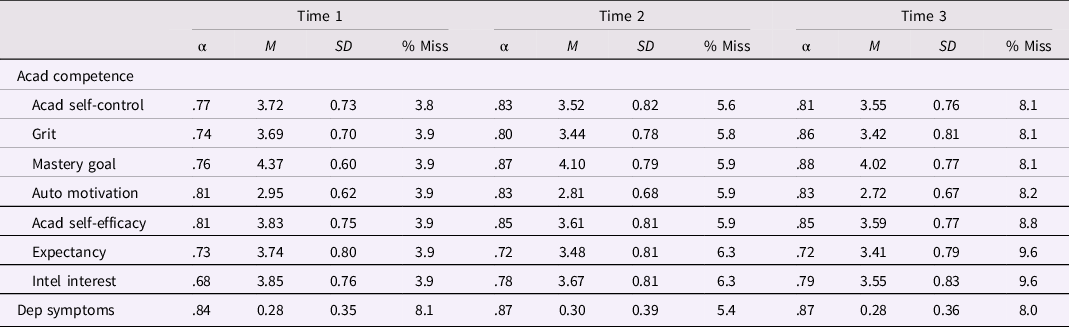
Table 1 presents the study variables’ descriptive statistics and coefficient alphas across the three time points. All variables had coefficient alphas greater than .70, except for intellectual curiosity at T1 (α = .68). The extent of missing data ranged between 3.8% and 9.6%, and they were not missing completely at random (Little’s MCAR test χ2(336) = 445.63, p < .001). To deal with missing data, we performed multiple imputation with the Markov Chain Monte Carlo method with 100 iterations to generate 50 imputed data sets (Graham, Reference Graham2009). Recent research (Mustillo & Kwon, Reference Mustillo and Kwon2015) suggested that using multiple imputation on data that were not missing at random yielded acceptable results with low bias, especially when the amount of missing values was low (e.g., not more than 30%). In addition, using auxiliary variables in data with small proportions of missing values (e.g., 10%) does not optimize model efficiency (Madley-Dowd et al., Reference Madley-Dowd, Hughes, Tilling and Heron2019). Our entire findings reflected data pooled across the imputed data sets.
Descriptive statistics of longitudinal study variables

Note. Acad competence = Academic competence-building; Acad self-control = Academic self-control; Auto motivation = Autonomous motivation; Acad self-efficacy = Academic self-efficacy; Intel interest = Intellectual interest; Dep symptoms = Depression symptoms; % Miss = Percentage of missing data.
Confirmatory factor analyses were conducted to ascertain the factorial structure of academic competence-building and depression symptoms, respectively. All models were evaluated using the weighted least square mean and variance estimation with robust standard errors to accommodate ordinal and non-normal distributions (e.g., depression symptom scores). Table S2 presents the fit indices of the measurement models at the three time points. The seven academic-related variables defined the latent factor of competence-building, and this one-factor model yielded an excellent fit to the data. For depression symptoms, the RCADS MDD items were specified to load onto a single latent factor, which provided an excellent model fit. In addition, the models evaluating longitudinal measurement invariance (i.e., configural, metric, scalar, strict invariance) indicated excellent fit. Model comparisons indicated that the imposition of the increasingly stringent invariance criteria did not significantly worsen model fit (see Table S3). All models achieved strict longitudinal measurement invariance, suggesting that the measurement models of academic competence-building and depression symptoms do not change across the measurement occasions. Strong factor loadings for the respective constructs were observed; averaged loading (across variables and time points) was .71 (SD = .05) for competence-building, and .59 (SD = .06) for depression symptoms (see Table S4). This allowed for meaningful longitudinal evaluation of these constructs.
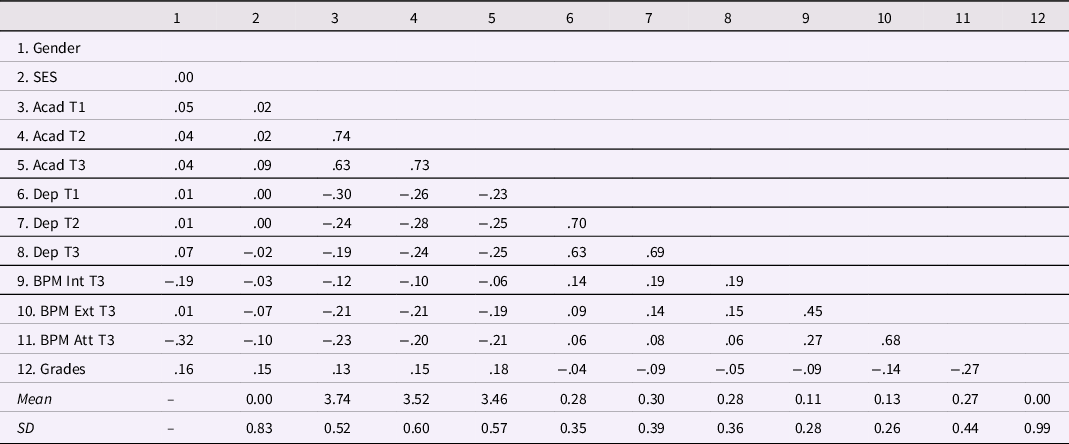
Having established longitudinal measurement invariance, we computed the higher-order variable of academic competence-building by averaging its constituent variables (after accounting for response differences). The depression symptom scores were obtained by averaging the RCADS MDD items. The correlations among these aggregated variables (after missing data imputation) are presented in Table 2. Competence-building and depression symptoms showed strong temporal stability (rs between .63 and .74). Academic competence-building correlated negatively with depression, with small to moderate effect sizes.
Descriptive statistics and correlations among aggregated variables after imputation (N = 741)

Note. Correlation coefficients with magnitude greater than .07 or .10 are significant at p < .05 or .01, respectively. Acad = academic competence-building; Dep = depression symptoms; BPM = Brief Problem Monitor; BPM Int = Internalizing; BPM Ext = Externalizing; BPM Att = Attention problems. Theoretical ranges of variables are as follows: Acad = 1–5; Dep = 0–3; BPM subscales = 0–2.
RI-CLPM and CLPM
The ICCs of the repeated measures indicated that approximately 65% of the variance in those measures could be attributed to between-individual differences (i.e., 64% for academic competence-building, 67% for depression symptoms). Within-individual fluctuations could explain approximately 35% of the variance in those measures over time. These results suggested that RI-CLPM would be an appropriate analytic strategy. Maximum likelihood estimation with robust standard errors was used in all models.
In the RI-CLPM and CLPM models, gender and SES were specified as covariates to both competence-building and depression (at each time point) to account for their influences. The RI-CLPM yielded an excellent fit to the data, χ2(6) = 4.505, p = .609, TLI = 1.012, CFI = 1.000; RMSEA = .000 (90% CI = .000–.037), SRMR = .014. The corresponding CLPM yielded a satisfactory model fit, χ2(9) = 82.632, p < .001, TLI = .898, CFI = .967; RMSEA = .104 (90% CI = .075–.135), SRMR = .028. While the CFI and SRMR values indicated excellent model fit, TLI and RMSEA values reflected poor fit. Comparing the models using the Satorra-Bentler scaled chi-square difference test suggested that the RI-CLPM should be preferred, Δχ2(3) = 35.213, p < .001. Our subsequent analyses were henceforth based on the RI-CLPM. Information about the CLPM are presented in the OSM.
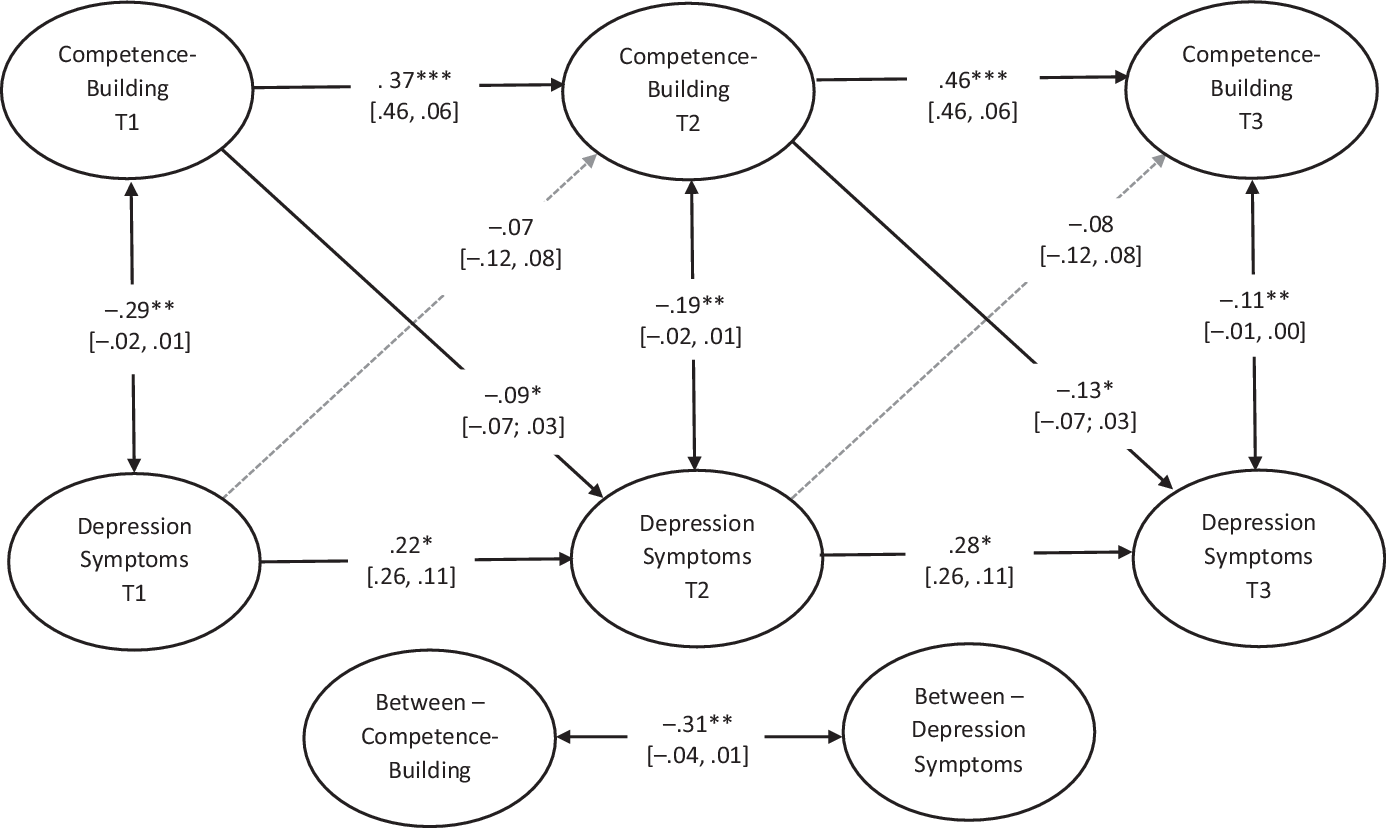
We further constrained the within-individual autoregressive and cross-lagged paths in the RI-CLPM to be equal across time points (i.e., T1–T2, T2–T3). This RI-CLPM yielded an excellent fit to the data, χ2(10) = 14.220, p = .163, TLI = 1.003, CFI = 1.000; RMSEA = .000 (90% CI = .000–.031), SRMR = .023. The chi-square difference test indicated that the more parsimonious model should be preferred, Δχ2(4) = 5.820, p = .213. As seen in Figure 1, the between-individual random intercepts of the two variables were negatively and significantly correlated, indicating that adolescents with higher competence-building experienced less severe depression symptoms across the three measurement waves. At the within-individual level, significant within-time associations between competence-building and depression symptoms were observed, though they seemed to reduce in magnitude across the time points. This finding implied that adolescents whose deviations from their expected competence-building score tended to correlate negatively with deviations from their expected depression symptoms at T1. At the subsequent time points, within-individual increases in competence-building were associated with within-individual decreases in depression symptoms. Within-individual stability effects over time were also observed for competence-building and depression symptoms.
RI-CLPM for academic competence-building and depression symptoms. Standardized estimates (unstandardized estimates and standard errors in brackets) are presented. Solid lines denote significant parameters; dashed lines denote nonsignificant parameters. Gender and SES were specified as covariates but they are not shown here for presentation clarity. *p < .05. **p < .01. ***p < .001.

More critically, beyond the stability effects, we found significant negative cross-lagged paths from competence at one measurement wave to depression symptoms at the subsequent wave (β = −.09 from T1 to T2; β = −.13 from T2 to T3; ps < .05). This indicated that adolescents who reported higher scores on their competence-building than they typically would were more likely to report less severe depression symptoms than they usually would on the subsequent measurement occasion. Conversely, the cross-lagged paths from depression symptoms to competence-building were nonsignificant, suggesting that deviations in depression symptoms did not predict deviations in competence-building at a subsequent time point. Gender did not moderate the critical parameters of the RI-CLPM (i.e., the correlation between the random intercepts, autoregressive and cross-lagged path coefficients). A nested model comparison where these parameters were freely estimated or fixed across gender yielded a nonsignificant χ2(5) = 4.898, p = .428.
Based on the parameter estimates obtained from the RI-CLPM, we conducted a power analysis to determine if we had an adequate sample size to detect the small within-individual cross-lagged associations. Monte Carlo simulations (Muthén & Muthén, Reference Muthén and Muthén2002) indicated that the significant cross-lagged associations had about 35% power. More details are provided in the OSM Appendix.
Predicting grades and adjustment
Table 3 presents the predictions of year-end grades and psychological adjustment (i.e., teacher-reported BPM) from the extended RI-CLPMs. In these analyses, the outcome variables were adjusted for the influence of gender and SES. First, the outcome variables were regressed onto the random intercepts, extending the academic competence-building and depression symptoms RI-CLPM. Model fit was excellent, χ2(46) = 145.156, p < .001, TLI = .959, CFI = .972; RMSEA = .049 (90% CI = .034–.063), SRMR = .049. The competence-building random intercept predicted grades positively, but the depression symptoms random intercept did not. The regression of T3 BPM symptom scores suggested that competence-building random intercept predicted all three BPM symptom scores negatively. In contrast, the depression symptoms random intercept did not predict any of the BPM symptoms.
Prediction of year-end grades and psychological adjustment

Note. Unstandardized path coefficients and standard error (in parentheses) are presented. Acad = academic competence-building; Dep = depression symptoms; RI = Random intercepts; within-ind deviations = within-individual deviations; BPM = Brief Problem Monitor. The random intercepts analyses were conducted separately from the within-individual deviations analyses. The paths predicting the outcome from the within-individual deviations were constrained to equal for the same variable. The outcomes were controlled for gender and SES. See text for more information.
* p < .01.
** p < .001.
Next, we specified paths between (a) the outcome variable and the competence-building within-individual deviations at each time point, and (b) the outcome variable and the depression symptoms within-individual deviations at each time point. The three paths associated with competence-building were constrained to be equal, as were the three paths associated with depression symptoms, as indicated by model comparisons using the Satorra-Bentler scaled chi-square difference tests (χ2(6) = 10.35, p = .111). The model fitted the data well, χ2(32) = 114.000, p < .001, TLI = .952, CFI = .977; RMSEA = .054 (90% CI = .040–.069), SRMR = .052. The competence-building within-individual deviations predicted grades positively and BPM externalizing and attention problems negatively. In contrast, the depression symptoms within-individual deviations predicted BPM internalizing, externalizing, and attention problems.
Stable between-person differences in competence-building (i.e., as reflected in the RI) were predictive of academic achievement and fewer psychological symptoms at T3. More importantly, the within-person deviations in competence-building predicted the same outcomes (except for internalizing symptoms), suggesting that adolescents’ academic competence-building increases from their typical levels were associated with better grades and fewer maladjustment problems. Stable between-person differences in depression symptoms did not predict any of the T3 outcomes. Within-person deviations in depression symptoms predicted T3 adjustment problems, suggesting that adolescents’ increased severity in depression symptoms from their typical levels were associated with higher T3 BPM symptoms at the between-person level.
Discussion
Consistent with our expectations, the present data supported the academic incompetence hypothesis more than the adjustment erosion hypothesis. These findings were derived from the RI-CLPM that allowed for disaggregation of between- and within-person sources of variance. At the between-person level, academic competence-building exhibited moderate negative associations with depression symptoms. At the within-person level, adolescents who were higher on their competence-building than they usually would on one occasion were less likely to experience depression symptoms than they typically would on the subsequent occasion. To further ascertain the validity of the within-person changes in depression symptoms, we found these within-person variations to be associated with teacher-reported adolescent psychological symptoms at the end of the school year. Critically, adolescents’ competence-building increase from their typical levels prospectively predicted better end-of-year grades and fewer teacher-reported symptoms.
Theoretical implications
Our study constitutes one of the first to show within-person cross-lagged effects from academic competence-building to depression symptoms using RI-CLPM. Adolescents with low expectations and efficacy about their academic endeavors and who have trouble regulating their study-related behavior are prone to subsequent depressive symptoms. Our results were generally in line with the related body of research on academic achievement and depression using CLPM. Academic achievement tended to predict subsequent changes in depression than vice versa (e.g., Burt & Roisman, Reference Burt and Roisman2010; Masten et al., Reference Masten, Roisman, Long, Burt, Obradović, Riley, Boelcke-Stennes and Tellegen2005; Moilanen et al., Reference Moilanen, Shaw and Maxwell2010; Weeks et al., Reference Weeks, Ploubidis, Cairney, Wild, Naicker and Colman2016; van Lier et al., Reference van Lier, Vitaro, Barker, Brendgen, Tremblay and Boivin2012). However, our findings were in contrast to the only other RI-CLPM study thus far (Zhang et al., Reference Zhang, Zhang, Chen, Ji and Deater-Deckard2019), where the authors found no within-individual associations between grades and depression symptoms over 5 years. The non-convergence in results could be due to differences in sample characteristics, measurement schedule, and the focus on academic competence-building (as a process) versus achievement (as an outcome).
The longitudinal association between academic achievement (defined as grades and self-perceptions) and depression symptoms could be mediated by deficits in academic competence-building qualities (Roeser et al., Reference Roeser, Eccles and Sameroff1998). Although research has examined such links between academic achievement and depression, the cross-lagged associations between competence-building and depression have not been systematically evaluated. Our current findings point to a potential mechanism by which achievement contributes to the elevation of depression – deficits in academic competence-building. Furthermore, this longitudinal association between academic competence-building and depression symptoms operates at the within-individual level. This result provides strong support that adolescents who show deficits in competence-building more than their typical levels experience a subsequent worsening of depression symptoms from their normal levels. Such deficits probably stall the adolescents’ sense of ownership and progress in building their academic competence, likely reducing their self-worth and exacerbating their symptoms. These deficits may be more pronounced under a pervasive norm of high expectations for academic achievement (Ang et al., Reference Ang, Klassen, Chong, Huan, Wong, Yeo and Krawchuk2009), where less motivated adolescents may face criticisms from parents and teachers about their lack of academic progress. In an 18-year longitudinal study using latent change score analysis, within-individual increases in goal persistence were associated with future reduced emotional disorders (including depression), but not the opposite effect (Zainal & Newman, Reference Zainal and Newman2019). Together, that study and ours highlight how within-individual increases in motivation can mitigate the occurrence and aggravation of depression over the short and long term. This is also generally in support of behavioral activation theories for treating depression (Dimidjian et al., Reference Dimidjian, Barrera, Martell, Muñoz and Lewinsohn2011).
Consistent with our predictions, the current research also found that within-person fluctuations in academic competence-building over the academic year positively predicted end-of-year grades and negatively predicted teacher-rated externalizing/attention problems (at the between-persons level). Within-person increases in depression symptoms did not predict grades (contrary to expectations), but they predicted teacher-rated internalizing, externalizing, and attention problems. These findings provided preliminary evidence that decreases in the adolescents’ typical academic competence-building are associated with lower grades. This result is consistent with the extant literature where individual differences in academic motivation are predictive of achievement indicators such as grades (Eccles & Wigfield, Reference Eccles and Wigfield2002; Richardson et al., Reference Richardson, Abraham and Bond2012). Other than grades, decreases in within-person competence-building over the year predicted externalizing/attention problems, consistent with prior work (e.g., Almroth et al., Reference Almroth, László, Kosidou and Galanti2018; Aunola et al., Reference Aunola, Stattin and Nurmi2000; Rocchino et al., Reference Rocchino, Dever, Telesford and Fletcher2017). Our unique contribution here is to demonstrate that, at the within-individual level, changes from the typical levels of competence-building can predict individual differences in obtained grades and adjustment problems. Our data provide further support to the academic incompetence hypothesis. The significant relationship between within-person deviations in depression and teacher-rated internalizing symptoms implies convergent validity from different sources.
Practical implications
Although support for the academic incompetence hypothesis in the literature is evident, it remains unclear how practical solutions might be derived to help adolescents. How should educators and counselors help students improve their grades or self-perceptions of competence to reduce depression? As our data suggest, an intervention target would be competence-building processes such as academic-related beliefs and regulatory behavior. Such beliefs, expectancies, and self-regulatory behavior are deemed malleable, even when targeted in brief “wise” social-psychological interventions (Walton & Wilson, Reference Walton and Wilson2018; Yeager & Walton, Reference Yeager and Walton2011). These empirically supported interventions have effectively set key motivational processes into motion that reinforce sustained learning and improve academic achievement (e.g., Harackiewicz et al., Reference Harackiewicz, Rozek, Hulleman and Hyde2012; Paunesku et al., Reference Paunesku, Walton, Romero, Smith, Yeager and Dweck2015; Walton & Cohen, Reference Walton and Cohen2011). Given their brief nature and low-cost investment, such self-administered interventions are easily scalable and potentially significantly impact improving adolescents’ learning motivation. As adolescents face increasing academic challenges during transitions into the higher grade levels (Benner, Reference Benner2011; Gnambs & Hanfstingl, Reference Gnambs and Hanfstingl2016), maintaining their academic motivation may minimize the worsening of depression symptoms over time. Such an approach is also consistent with behavioral activation intervention programs that are potentially scalable in school settings (Chu et al., Reference Chu, Crocco, Esseling, Areizaga, Lindner and Skriner2016).
Limitations and conclusion
Several study limitations should be noted. First, we used a relatively short-term longitudinal design (i.e., over 1 year) to capture the within-individual developmental dynamics between academic competence-building and depression. Thus, it is unknown whether these dynamics would occur similarly over a more extended measurement schedule (e.g., annual assessments). Second, because this sample consisted of Singaporean students, the generalizability of the current findings needs to be assessed in other cultures. We speculate that our results would have more validity in cultures that strongly value adolescents’ academic achievements (e.g., East Asian countries), compared to cultures with less normative expectations on adolescents’ accomplishments. Furthermore, as the current study focused on early adolescents, it is unclear if the similar within-individual dynamics between competence-building and depression could be found in children or older adolescents. Further work must establish the generalizability of the current findings to other cultural and age groups.
A third limitation is that the possibility of other variables such as adverse familial circumstances accounting for the observed associations between competence-building and depression cannot be confidently ruled out. Fourth, based on our post hoc power analysis, our sample size is underpowered to some extent to detect the cross-lagged effects in the RI-CLPM. As in other recent simulation studies for RI-CLPM, the recommended sample size for a 3-wave RI-CLPM is 1,500 and above (see Appendix in OSM). Although the power associated with the significant within-person cross-lagged paths in our RI-CLPM for competence-building and depression symptoms was on average about .35, we believe these effects are substantive and warrant our attention. As these within-individual effects were independent of between-individual effects, their effect sizes are expected to be small. Future research should recruit large sample sizes to ensure adequate power to detect the within-person cross-lagged associations.
The present findings are important because they first clarify within-person developmental dynamics between academic competence-building and depression symptoms in adolescents as they navigate their studies throughout an academic year. Key study strengths include using a comprehensive collection of competence-building qualities, 3-wave RI-CLPM analyses, and multiple sources of information. Findings generally support the academic incompetence hypothesis, bolstering the idea that prior deficiencies in academic competence-building can lead to subsequent worsening of depression symptoms. An important implication for educators and parents is the need to support adolescents in their academic endeavors by instilling positive beliefs and behavior that facilitate their motivation for learning, which may diminish threats to their psychological well-being.
Supplementary material
The supplementary material for this article can be found at https://doi.org/10.1017/S0954579422000694
Funding statement
This research was funded by a Ministry of Education Academic Research Fund (FY2017-FRC1-009) awarded to RH.
Conflicts of interest
None.