Corruption is endemic in the developing world and widely considered to have pernicious effects on political and economic governance (for example, Mauro Reference Mauro1995; Rose-Ackerman Reference Rose-Ackerman1999). Countries that aspire to achieve a better quality of government often make fighting corruption one of their highest priorities (Klitgaard Reference Klitgaard1988; Svensson Reference Svensson2005). In places as diverse as Nigeria, Singapore, India and China, political leaders have taken forceful measures to punish official venality with the promise of building cleaner and better government. Anticorruption has also been a centerpiece of the institutional reform programs advocated by international donors and development agencies since the mid-1990s (United Nations 1998; World Bank 1997). Prior empirical research has shown that anticorruption measures, if sincerely and effectively executed, can indeed curb predatory behavior by government officials (Avis, Ferraz and Finan Reference Avis, Ferraz and Finan2018; Bobonis, Cámara Fuertes and Schwabe Reference Bobonis, Cámara Fuertes and Schwabe2016; Chen and Kung Reference Chen and Kung2018). However, corruption is rarely merely an isolated phenomenon independent of other institutions and practices. By changing one part of an interconnected politico-economic equilibrium, anticorruption may also have important repercussions in other parts of the political system. How these repercussions affect the quality of government is not yet well understood.
This article studies the unintended effects of anticorruption on a key aspect of government quality – political selection. It is widely recognized that achieving good governance requires a government that can recruit and retain candidates who are both competent and represent the interests of the broader society (Besley Reference Besley2005; Dahl [1961] Reference Dahl2005; Dal Bó and Finan Reference Dal Bó and Finan2018; Fearon Reference Fearon, Przeworski, Stokes and Manin1999). For many scholars and practitioners, fighting corruption can help improve political selection. By removing rent-seeking opportunities associated with government offices, anticorruption drives away candidates who are motivated purely by pecuniary returns and encourages the entry of individuals with better morals and stronger public service motivations (Ferraz and Finan Reference Ferraz and Finan2008; Perry and Wise Reference Perry and Wise1990). An implicit assumption in this view, however, is that the formal benefits offered by government jobs are already sufficiently competitive to attract and retain talent. In this article, we argue that this is not always the case in many parts of the developing world, where governments lack the necessary fiscal resources to pay public servants market-competitive salaries, and mobility between the public and private sectors is limited. In those settings, corruption often serves as an important source of complementary income to attract talent into the civil service (Bayley Reference Bayley1966; Besley and McLaren Reference Besley and McLaren1993), and its elimination may unintentionally weaken both the capability and representativeness of candidates entering the government.
Specifically, we argue that anticorruption enforcement can produce two potentially negative effects on political selection. The first is a deterrence effect: by lowering the expected returns from government service, anticorruption measures undercut the attractiveness of public sector jobs, especially in the eyes of high-ability candidates, who typically have many alternative employment options; this can lead to a decline in the quality of candidates recruited into the government. Secondly, since individuals from different socioeconomic backgrounds often assign different degrees of importance to short-term income, anticorruption can also produce a compositional effect: compared to those from affluent families, candidates from lower class backgrounds may have stronger incentives to switch to higher-paying jobs outside of government because they face greater financial constraints; this means that those who enter public service during a phase of intense anticorruption may have more elitist backgrounds and be less representative of the general population.
To substantiate these claims, we study how anticorruption enforcement affects the characteristics of incoming entry-level civil servants in China. The ability to draw a large number of capable individuals into government has long been viewed as a core strength of the Chinese Communist Party (CCP) (Bell Reference Bell2015; Yao Reference Yao2018). However, this ability is also inherently puzzling given that government officials’ salaries are only on par with those of average urban workers (Chan and Ma Reference Chan and Ma2011). We argue that the presence of various rent-seeking opportunities within the government is an important reason why the regime can attract talent without paying a high nominal wage, and estimate how curtailing such opportunities may affect the type of individuals recruited into the civil service.
Our empirical design combines a nationwide survey of civil servants with a province-level panel dataset on anticorruption enforcement. We match each survey respondent to the level of enforcement in the province-year spell in which he/she graduated from college, and exploit the cross-cohort variation in exposure to anticorruption enforcement for estimation. To overcome the endogeneity problem associated with anticorruption enforcement, we adopt an instrumental variables approach, leveraging two plausibly exogenous sources of variation in enforcement created by Xi Jinping's recent anticorruption campaign. The first is a sharp, unexpected rise in the overall intensity of enforcement after late 2013, when the campaign was launched in full force. The second is the regional variation in enforcement intensity determined by each province's political connections to Xi.
The results from the instrumental variables analysis provide support for both of the theorized effects. Consistent with the deterrence effect, we find that, on average, civil servants who graduated in (or were recruited from) province-year spells with a high level of enforcement report significantly fewer activities and achievements during college than those who graduated in low-enforcement spells. Consistent with the compositional effect, we find that the share of civil servants recruited from poor, rural families declines precipitously during high-enforcement province-year spells. We also observe a corresponding increase in the share of new recruits who are children of government officials or come from economically affluent families. These findings are robust to a range of additional tests, including altering the sample time span, using different measures of the dependent and independent variables, and applying various post-stratification weighting adjustments for sample representativeness. We also conduct additional analyses using several other surveys and administrative datasets to substantiate the theoretical mechanisms and to address important alternative explanations. Lastly, we provide some evidence that the compositional change among new civil service recruits is also accompanied by a change in their policy preferences: those who join the service during more intense enforcement spells tend to be less supportive of redistributive policies, suggesting that the selection effect of anticorruption may have long-term policy ramifications.
This article contributes to several strands of literature. By examining the unintended consequences of anticorruption on political selection, our study is directly related to the literature on the effects of anticorruption. Many researchers have argued that anticorruption measures, if implemented sincerely and effectively, can curb rent-seeking behaviors (Avis, Ferraz and Finan Reference Avis, Ferraz and Finan2018; Chen and Kung Reference Chen and Kung2018), reduce administrative waste (Olken Reference Olken2007) and improve the overall quality of governance (Reinikka and Svensson Reference Reinikka and Svensson2005; Teachout Reference Teachout2008). On anticorruption's effect on selection more specifically, several recent studies suggest that anticorruption measures, such as mandatory financial disclosure laws, can discourage the entry of potentially corrupt candidates (Ferraz and Finan Reference Ferraz and Finan2008; Fisman, Schulz and Vig Reference Fisman, Schulz and Vig2017; Szakonyi Reference Szakonyi2018). Most of the discussion about the negative effects of anticorruption, however, focuses on extraneous causes, such as weak enforcement or political manipulation (Gordon Reference Gordon2009; Ramalho Reference Ramalho2003; Shleifer and Vishny Reference Shleifer and Vishny1993). While not denying that there are important positive benefits of tighter enforcement of anticorruption, our study provides an important qualification to the relatively optimistic received wisdom: when formal civil service compensation is universally low and the attractiveness of government jobs depends heavily on rent-seeking opportunities, eliminating such opportunities may unintentionally undermine government quality through poorer selection.Footnote 1
This article also speaks to a large body of work on the determinants of political selection. Researchers have studied how monetary rewards affect the quality of candidates for government jobs (Dal Bó, Finan and Rossi Reference Dal Bó, Finan and Rossi2013; Ferraz and Finan Reference Ferraz and Finan2009; Keane and Merlo Reference Keane and Merlo2010; Kotakorpi and Poutvaara Reference Kotakorpi and Poutvaara2011; Krueger Reference Krueger1988). We complement this line of research by studying the selection effects of a reduction in non-wage benefits due to anticorruption enforcement. Another important line of research has studied the selection functions of political institutions, such as competitive elections (Fowler Reference Fowler2016; Galasso and Nannicini Reference Galasso and Nannicini2011), term limits (Alt, Bueno de Mesquita and Rose Reference Alt, Bueno de Mesquita and Rose2011; Fearon Reference Fearon, Przeworski, Stokes and Manin1999) and gender quotas (Baltrunaite et al. Reference Baltrunaite2014). This literature, however, has focused mainly on formal and nominally ‘good’ institutions; it has paid relatively little attention to informal institutions that have negative/ambiguous normative standings but are nonetheless very common in developing societies (Helmke and Levitsky Reference Helmke and Levitsky2004). Only recently have a small number of studies begun to document the potentially positive roles that informal institutions, such as corruption and patron–client relations, can play in supporting the functioning of governments in non-Western societies (Jia, Kudamatsu and Seim Reference Jia, Kudamatsu and Seim2015; Jiang Reference Jiang2018; Weaver Reference Weaver2018). Our study contributes new evidence to this nascent literature by showing what may happen to political selection when these informal institutions are disrupted or removed.
Moreover, our study sheds new light on our understanding of China's recent anticorruption campaign. There has been an ongoing debate among researchers and China observers about the nature and consequences of the campaign. While critics regard the campaign as short term, opportunistic and selectively enforced by the incumbent to eliminate political rivals (Pei Reference Pei2018), others suggest that its underlying motives need to be taken more seriously (Manion Reference Manion2016) and provide evidence that the campaign has indeed helped reduce corruption in certain areas (Chen and Kung Reference Chen and Kung2018; Lu and Lorentzen Reference Lu and Lorentzen2016; Shu and Cai Reference Shu and Cai2017). Our analysis of the changes in government recruitment patterns lends greater support to the second view – that is, China's anticorruption campaign has generally succeeded in lowering popular expectations about the availability of rent-seeking opportunities within the government. This change in belief may be an important step toward building a culture of clean government in the long run (Manion Reference Manion2004). However, to the extent that corruption has been an integral part of how the system works, effective anticorruption may have actually weakened the bureaucracy, at least in the short run, by making it both less capable and less representative of the broader society.
Corruption, Anticorruption and Political Selection in The Developing World
The quality of government is determined to a large extent by those who run it (Key Reference Key1956). A key prerequisite for achieving good governance is therefore to recruit competent individuals to make and implement government policies. Previous studies have identified several ways in which governments can attract talent.Footnote 2 One approach is simply to pay them a higher salary. Raising the formal salaries of public servants has been shown to improve the quality of candidates for government jobs (for example, Dal Bó, Finan and Rossi Reference Dal Bó, Finan and Rossi2013; Ferraz and Finan Reference Ferraz and Finan2009; Kotakorpi and Poutvaara Reference Kotakorpi and Poutvaara2011). In systems that have a ‘revolving door’ arrangement, talent may also be drawn into public service with the expectation of post-tenure rewards in the private sector (Blanes i Vidal, Draca and Fons-Rosen Reference Blanes i Vidal, Draca and Fons-Rosen2012; Eggers and Hainmueller Reference Eggers and Hainmueller2009). For these arrangements to work, however, there has to be either a state that has access to a stable, robust revenue base, or a strong and vibrant private sector that is willing and able to provide employment to retired government officials. Both conditions can be difficult to satisfy in most developing countries, where government fiscal capacity is typically weak and the linkage between the private and public sectors is underdeveloped (Evans Reference Evans1995; Migdal Reference Migdal1988).
We argue that when these two options are not available, another common strategy for governments to attract talent is by providing informal opportunities for corruption (Bayley Reference Bayley1966; Leys Reference Leys1965).Footnote 3 Instead of paying public servants for the full value of their service, governments can reduce their nominal wage but allow them to earn additional informal income by exploiting the public power attached to their offices (Besley and McLaren Reference Besley and McLaren1993). This type of arrangement was common in pre-modern regimes, when royal tax collectors were implicitly or even explicitly allowed to keep a portion of the tax revenue for themselves (Grindle Reference Grindle2012; Guardado Reference Guardado2018). Many developing countries still tolerate such practices. According to Gorodnichenko and Peter (Reference Gorodnichenko and Peter2007), for example, public sector employees in Ukraine are paid about one-quarter to one-third less than their private sector counterparts, but manage to enjoy an essentially identical level of consumption due to the presence of unreported informal income. Similarly, in India, Indonesia and the Philippines, civil servants’ formal salaries usually cover only a fraction of what is needed to maintain a decent standard of living, and officials rely heavily on various types of rent-seeking activities to make up the difference (Palmier Reference Palmier1985; Quah Reference Quah2011). In those systems, corruption is not only an isolated immoral action taken by a small group of greedy individuals, but a crucial source of supplementary income for a large number of government employees.
Recognizing the integral role of corruption in public servants' compensation has important implications for thinking about the effects of anticorruption enforcement in many developing countries. When most individuals enter the government with the expectation of receiving additional income through some form of rent seeking, denying such opportunities can induce profound changes in the candidate pool for government jobs. Specifically, we argue that anticorruption enforcement can have two important selection effects. The first relatively straightforward one is a negative effect on candidates’ overall competence. This effect follows directly from the negative impact of anticorruption on government officials' expected income. When the risk of losing one's office increases while the return declines (relative to that in other sectors), fewer individuals will be willing to pursue a public service career. In particular, those with higher abilities may be more reluctant to enter the government compared to their less capable counterparts because it is easier for them to find safe and good-paying jobs in the private sector. Both the reduction in the overall size of the applicant pool and the scaring away of higher-ability individuals imply a loss of human capital for the government. Consistent with this, recent studies have shown, in various country settings, that a reduction in formal compensation to public servants can result in lower skill levels among politicians and civil servants by disproportionately discouraging high-skilled individuals from taking up government jobs (Keane and Merlo Reference Keane and Merlo2010; Olowu Reference Olowu2010). Extending this line of reasoning to informal, corruption-based benefits, our first hypothesis is as follows.
Hypothesis 1 (Deterrence Effect): As a de facto negative income shock to government jobs, anticorruption enforcement will cause a loss of talent in the government by reducing the size of the candidate pool and discouraging the entry of high-ability individuals. This means that, all else being equal, the capabilities of recruits will decrease during a period of heightened anticorruption.
In addition to the deterrence effect, we argue that anticorruption also has a second, more subtle impact on the composition of government officials. This is because individuals from different backgrounds often vary in their expectations about what they can get from a political/bureaucratic career (Avis et al. Reference Avis2017). Studies have shown that, in making private sector career decisions, candidates from affluent families tend to pay greater attention to the prospects of long-term career development, whereas those from poor families usually care more about short-term earnings (Erola, Jalonen and Lehti Reference Erola, Jalonen and Lehti2016; Zellweger, Sieger and Halter Reference Zellweger, Sieger and Halter2011).Footnote 4 The same contrast is also likely to hold for public sector employment. In China, for example, long-term rewards from civil service jobs include political promotions, knowledge about the operation of the government and personal contacts with key decision makers. In order to be able to enjoy these rewards, however, one must stay in the government for a long enough period of time while living off a modest nominal wage. When anticorruption enforcement removes the informal benefits, individuals with poorer economic conditions will find it harder to make ends meet in the short run. As a result, they will be more likely to stay away from government jobs than their affluent counterparts, who can afford to be more patient due to income support from other sources (for example, families).Footnote 5 This leads to our second hypothesis.
Hypothesis 2 (Compositional Effect): The negative income shock produced by anticorruption enforcement differentially reduces the appeal of a career in government for individuals from different socioeconomic backgrounds. In particular, a period of intense enforcement is more likely to discourage those from poorer, lower-class families from applying for government jobs, which will lead to an increase in the share of the more affluent class among those who enter the government.
Rent-seeking Opportunities and Civil Service Recruitment in China
For much of China's history, the bureaucracy has been the quintessential institution for governance. It has not only provided capable administrative support for the ruler but has also served as an important channel of upward mobility for ordinary families (Ho Reference Ho1964). This continues to be the case today under the CCP. Many observers attribute the party's resilience and impressive economic performance to its ability to attract the best and brightest into the party-state (Bell Reference Bell2015; Yao Reference Yao2018). Civil service positions are among the most highly sought-after jobs in China. Each year, millions of individuals, mostly fresh college graduates, go through a highly competitive selection process to join the civil service, with a success rate of less than 2 per cent (Burns Reference Burns2010).
On the surface, the popularity of civil service positions may appear puzzling given the modest pay associated with these jobs. Despite several rounds of wage adjustments over the past two decades, average civil servant salaries remain at the level of an average urban worker, even though the selection of the former is far more competitive (Wu Reference Wu2014).Footnote 6 Opportunities for post-government employment in the private sector, while growing in recent years, are still rather limited relative to the vast size of the bureaucracy.Footnote 7
We argue that instead of a high nominal salary or the prospect of a lucrative post-government career, a much more important (financial) appeal of civil service jobs lies in the presence of substantial informal benefits from a wide range of rent-seeking activities. These activities include not only more ‘conventional’ types of corruption such as bribe taking (Liu Reference Liu1983; Manion Reference Manion2004), but also many other activities that would be considered illegal or unethical in a more professionalized system, such as diverting budgetary funds to pay staff bonuses, abusing position-based consumption for private purchases, and using government vehicles or equipment for private purposes (Chan and Ma Reference Chan and Ma2011; Chen Reference Chen2009). When dealing with non-government sectors, officials can also leverage their power and elevated status to receive various preferential treatments, including discounts for property purchases (Fang, Gu and Zhou Reference Fang, Gu and Zhou2019), higher priority in medical services, and guaranteed admission of their children to high-quality primary and secondary schools.Footnote 8 The risk of engaging in these more mundane forms of rent-seeking activities is generally low,Footnote 9 and sometimes such behavior is even implicitly encouraged by higher-level authorities as a way to incentivize subordinate bureaucrats.Footnote 10
Although it is difficult to ascertain the exact share of informal benefits in civil servants' compensation, anecdotal evidence suggests that it is substantial: when civil servants choose to quit their jobs and join the private sector, they usually do so only when the move can increase their nominal salary by multiple times.Footnote 11 The size of the informal benefits has also fluctuated significantly over time. When these benefits decrease, the government typically has a difficult time recruiting and retaining talented individuals. During the early 1990s, for example, the post-1989 corruption crackdown, coupled with a flourishing market sector, led to a relative decline in civil service income. This propelled millions of cadres and officials to leave the government and start their own businesses (Cooke Reference Cooke2004). Likewise, Xi's recent anticorruption campaign has considerably reduced the expected return from government employment. The prosecution of hundreds of high-ranking officials and many more lower-ranking bureaucrats with corruption charges significantly has increased the likelihood of punishment for rent-seeking behavior. The campaign has also imposed a number of draconian regulations that drastically reduced the scale and scope of the informal rents that government employees had previously enjoyed. For example, officials may lose their jobs for attending extravagant banquets, accepting expensive gifts from businesspersons, or enjoying pay and benefit levels above what their grades formally permit (Yuen Reference Yuen2014). In many localities, civil servants also lose their informal privileges in healthcare, housing and their children's education. Although these changes were generally welcomed by the public and the press as a way to curb official venality, the argument presented in the previous section suggests that the disappearance of informal rents might have had adverse impacts on civil service recruitment. Some anecdotal evidence suggests that this may indeed be the case,Footnote 12 but systematic evidence remains scant. We seek to address this gap by introducing a research design that exploits exogenous variations created by this campaign to estimate the effect of anticorruption enforcement on civil service selection.
Research Design
Overview
To test our hypotheses on how anticorruption enforcement affects political selection, an ideal design would be to study within a sample of potential civil service applicants how exposure to information about anticorruption enforcement differentially affects their decisions about whether to join the civil service. Implementing such a design, however, would be practically challenging because (1) there is usually no well-defined population of ‘potential applicants’ for government jobs and, even if there were, (2) tracking individuals’ career decisions in such a population over time would incur formidable logistic and financial costs. In light of these challenges, this study uses an alternative design that focuses on those who join the civil service. We analyze and compare the characteristics of civil servants who enter the government during periods with varying degrees of anticorruption enforcement. Although we do not directly observe those who chose not to apply for government jobs, with some reasonable assumptions,Footnote 13 we can use individuals who entered the government during a period of relatively low enforcement as the reference point to infer how recruitment patterns changed after enforcement became more intense.Footnote 14
Our empirical design combines a nationwide survey of government officials with province-level panel data on anticorruption enforcement. We measure each respondent's exposure to anticorruption enforcement by focusing on the intensity of enforcement in his/her college province during the year of graduation (which is often also his/her first year of work). The estimation leverages variations across both college cohorts and provinces of graduation. To address endogeneity concerns, we use two features of Xi's anticorruption campaign to create instruments that capture the plausibly exogenous temporal and regional variations in enforcement intensity. The remainder of this section walks through the design in greater detail.
Data
The first empirical challenge associated with studying the dynamics of political selection is obtaining a representative sample of government officials. Conventional social surveys do not cover government officials very well due to their small share of the Chinese population and the general difficulty of accessing government buildings. Establishing an appropriate sampling frame for government officials can also be difficult because there is little publicly available information about the regional breakdown of their number and demographic attributes. In this study, we circumvent these problems by instead surveying government officials who are pursuing part-time Masters of Public Administration (MPA) degrees. Having a graduate degree is a key formal prerequisite for promotion in the Chinese government; as a result, most government officials will enroll in a graduate program at some point in their careers. MPA degrees are one of the most popular choices for low- and mid-level civil servants because the tuition is relatively low and the content of the curriculum is tailored to public sector employees.Footnote 15 When there are major changes in the type of civil servants recruited, we expect such changes to also be reflected in the characteristics of the civil servants enrolled in MPA programs.Footnote 16
It is important to acknowledge, however, that although MPA programs provide a useful avenue for accessing government officials, conducting a fully randomized sampling of all MPA programs in China is not possible at this time due to various logistical and political constraints.Footnote 17 Instead, our sampling procedure strives for a balance between geographic representativeness and practical feasibility. We first divided China (excluding the ethnic minority regions) into six key geographic regions (Northeast, North, Northwest, Southwest, South-Pearl Delta, South-Yangtze Delta) and then selected one or two programs in each region to field our survey. The choice of specific programs depended on both the availability of our personal contacts in that region and the characteristics of the programs. In general, we preferred larger programs that take in students from multiple provinces; however, we also selected several smaller programs to ensure that there was some variation in program quality.
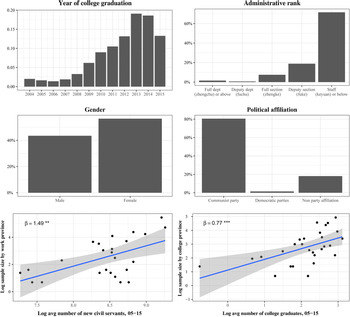
In September 2018, we first fielded a pilot survey in a southern school (n = 302) and then expanded it to eight other schools (n = 910) over the next six months. Details about the survey implementation can be found in Appendix B.Footnote 18 Among all MPA students who responded to our survey, 791 (65 per cent) were incumbent civil servants.Footnote 19 Figure 1 presents the distribution of key demographic characteristics in this sample. Respondents in our sample were quite young: most of them (75 per cent) had graduated from college between 2011 and 2015 and still held an entry-level job (staff member, or keyuan, ~73 per cent). There were more women than men in our sample (57 per cent v. 43 per cent), which is consistent with the fact that the majority of newly recruited entry-level civil servants are now female.Footnote 20 Moreover, about 81 per cent of the respondents are CCP members, a figure that is in line with the general impression that government employees are overwhelmingly party members.
Demographic distribution of survey respondents

How representative is our sample of entry-level civil servants in China? The two bottom panels of Figure 1 compare our sample to two pieces of aggregate information – the number of newly recruited civil servants and the number of new college graduates, respectively, both of which are collected from provincial yearbooks. If our sample captures important demographic trends among entry-level civil servants, we expect that (1) there will be more respondents working in provinces that have recruited a larger number of civil servants in the recent past and (2) there will be more respondents who obtained college degrees in provinces that have produced more college graduates. Consistent with these expectations, we see that both sets of relationships hold and are statistically significant at the 95 per cent level or above. For a 1 per cent increase in the size of the new recruitment/graduate cohort in a province, the size of the corresponding cohort in our sample increases by about 1.4 and 0.7 per cent, respectively. This strong proportionality gives us confidence in the representativeness of our sample. Later, we evaluate the generalizability of our findings in greater detail using various subsample analyses and post-stratification adjustments (see Section 5.3 and Appendix F).
Measurement
Civil servants’ ability and background
We embedded in our survey a range of questions that measure respondents' abilities and personal backgrounds. For ability, we focused on respondents' experience in college. We compiled a list of activities common in Chinese universities and asked our respondents whether they had taken part in any of them during college.Footnote 21 This list included academic-related activities such as receiving prestigious scholarships, participating in overseas exchanges and conducting undergraduate research, as well as extra-curricular experiences such as running student-led organizations and participating in sports competitions or artistic performances. Since all MPA students admitted to the same program typically have similar course grades and standardized test scores, they cannot be differentiated solely based on academic performance. Instead, the breadth and depth of their overall activities during college would be a better indicator of personal capability. We thus create two variables. The first, Activities in College, simply sums the number of activities to which a respondent answered ‘yes’. The second, Achievements in College, narrows it down to the more challenging activities, including significant leadership roles in student organizations and competitive awards based on individual merits.Footnote 22 According to research on the labor market outcomes of Chinese college students, activities and accomplishments in college are strongly correlated with job market success in both the public and private sectors (for example, Li and Zhang Reference Li and Zhang2008; Liu Reference Liu2019).Footnote 23 Based on the first hypothesis on the deterrence effect of anticorruption enforcement, we expect civil servants recruited during the anticorruption campaign to have fewer activities and achievements in college than those recruited before the campaign started.
Respondents' socioeconomic background is measured in two ways. First, we asked respondents about the occupations of their parents. Since most of our respondents are junior civil servants with limited personal savings, their social status is determined largely by that of their parents, and studies have shown that occupation is a powerful predictor of social status in China (Walder Reference Walder2003). Government officials are widely regarded as one of the most privileged occupations, followed by other urban occupations, such as state sector employees, white-collar professionals and business owners; farmers typically lie at the bottom of the social hierarchy (Goodman Reference Goodman2014). We create two variables, Farmer Parents and Official Parents, to capture the occupations at the two extremes. Both variables take a value of 1 if either of a respondent's parents is a farmer/official, and 0 otherwise.Footnote 24 We expect that, compared to those with parents who hold other occupations, individuals with farmer parents are more likely to be discouraged from entering government due to heightened anticorruption enforcement because they face tighter short-term financial constraints. By contrast, those whose parents are government officials should be less discouraged, both because their families are relatively affluent and because they usually have better access to networks/tacit knowledge that can help mitigate the risk of investigation.Footnote 25 This implies that there will be an increase in the share of individuals with parents who are government officials (and a decrease in the share of those with parents who are farmers) among civil servants who were recruited during the anticorruption campaign.
We also designed two questions to directly measure respondents' economic conditions based on their life experiences. One question asked how often respondents had experienced economic hardships when growing up (1 = never; 4 = very frequent). The other question asked whether respondents had participated in work-study schemes, which is a common income-assistance program provided by colleges to students from poor families. In Appendix A.2, we show that the occupation and experience-based measures are closely correlated: respondents with parents who are officials are less likely to have experienced economic difficulties or to have participated in work-study schemes than average respondents, whereas farmers' children report both types of experiences at much higher rates than the sample average.
Anticorruption enforcement
We obtain data on the intensity of anticorruption enforcement from two sources. The main source is the China Political Elite Database (CPED), a comprehensive biographical database covering over 4,000 Chinese officials in leading city, provincial and central positions since 2000 (Jiang Reference Jiang2018). We use the CPED to calculate the total number of politicians investigated in each province-year spell. Since the database only covers the leading officials at each level (for example, party chiefs, government heads and standing committee members), this measure essentially captures major corruption cases involving senior political figures. As a robustness check, we also construct a second measure for the total number of disciplinary investigations using data from the provincial disciplinary agencies' annual reports (available in the provincial yearbooks). The two measures are highly correlated (ρ = 0.43, p < 0.001).
Identification Strategy: Exploiting Variations in Anticorruption Exposure Across Regions and College Cohorts
We match our survey with province-level enforcement data based on each respondent's year and province of college graduation. The key explanatory variable is the intensity of anticorruption enforcement to which a respondent was exposed in the province where he/she studied in the year of their college graduation. For college students in China, the year of graduation (which is also the year most of them begin their first job) is a critical juncture in their career development. It is usually a period of intense job hunting and weighing up various options. Employment contracts are typically signed right before the graduation ceremony in July or sometime during the summer vacation. During this period, students are likely to be highly attentive to any information that may provide clues about the viability of their chosen careers. Since the majority of our respondents work in the provinces in which they went to college (~70 per cent), we expect that they will be attentive to the scope and intensity of anticorruption enforcement in their college provinces when deciding whether to become a government bureaucrat.Footnote 26 In one of the robustness checks (Table 4), we also try matching enforcement data to each respondent's year and province of his/her first government job, and we obtain substantively similar findings.
Given the structure of our data, a naïve way to estimate the effect of anticorruption would be to simply regress respondents' characteristics on anticorruption intensity. However, this approach can raise important endogeneity concerns. Since anticorruption enforcement is obviously not randomly assigned, it may be correlated with unobservable regional factors that can influence college graduates’ career choices. The biases caused by these unobservables can be either positive or negative. For instance, if anticorruption specifically targets more corrupt provinces, where government jobs are very appealing to capable individuals, the deterrence effect caused by enforcement may be difficult to detect because it is offset by a higher level of pre-existing human capital stock within the government. Alternatively, if anticorruption is more frequent in more developed provinces, where many capable graduates are hired by the private sector and the rural population is relatively small, we may observe a spurious negative relationship between enforcement intensity and the measures of civil servants' ability and social status, even in the absence of actual causality.
To circumvent this problem, we use an instrumental variables (IV) approach that leverages variation in enforcement arising from the recent anticorruption campaign. This campaign, which led to the downfall of tens of thousands of officials at various levels, produced two types of plausibly exogenous variations that are important to our causal identification. The first type of variation is intertemporal: while prior to 2013 the overall level of enforcement was quite low and stable, the campaign subsequently introduced a sudden and dramatic increase in enforcement intensity. According to the CPED data, a total of 127 senior city and provincial officials were investigated within the first two years of the campaign (2014 and 2015), more than the total from the previous decade (124 for the period between 2004 and 2013).Footnote 27
Secondly, the intensity of enforcement during the campaign was unevenly distributed across provinces. Enforcement levels tend to be lower in the four provinces in which Xi has either served as a senior provincial leader or has strong family connections (that is, Zhejiang, Fujian, Shanghai and Shaanxi).Footnote 28 For the purpose of identification, the most important assumption here is that both types of variations are caused by factors that are unrelated to regional-level confounders that may affect college students' career choices. Our substantive understanding of the campaign suggests that there are good reasons to believe that this is indeed the case: Xi's ability to launch the anticorruption campaign was aided by a number of contingent events that occurred within the top leadership, and the timing and intensity of the campaign could not have been foreseen by anyone at that time.Footnote 29 Moreover, the fact that some provinces developed strong ties with Xi was mainly due to birthplace connections or rotation decisions made by previous leaders many years before his ascent to power.Footnote 30 Both sets of variations are therefore likely to be orthogonal to contemporary provincial conditions. We provide some evidence to support this claim in the following subsection. Later in the article, we also conduct IV analysis using only the variations caused by the post-2013 increase in enforcement, which we believe is the more exogenous type of the two, and all our results still hold (see Table 4).
Specification
The main estimation framework is a two-stage least-squares model with fixed effects. The first-stage model estimates each respondent's (predicted) exposure to anticorruption enforcement given his/her college province and year of graduation.
 $$\eqalign{{\rm Anticorruption\ enforcemen}{\rm t}_{ipt} & = \gamma {\rm \;After\ 201} 3_t \times {\rm Xi\ provinc}{\rm e}_p \cr & \quad + \theta {\rm \;After\ 201} 3_t + \phi _p + \tau _t + {\rm \epsilon }_{ipt}} $$
where i, p and t index the respondent, college province and graduation year, respectively. In light of the previous discussion, we create two instruments. The first, After 2013, is a binary indicator that captures the campaign's intertemporal variation in enforcement. It takes a value of 1 if the respondent graduated from college after 2013, and 0 otherwise. The second instrument is an interaction between After 2013 and another binary indicator, Xi Province, which takes a value of 1 if a respondent graduated in one of the four provinces where Xi had worked or had native ties. This interaction essentially captures the differential change in the enforcement level between Xi and non-Xi provinces after the campaign was launched. In more extensive models, we also include a linear measure of the year of college graduation τt and college province fixed effects φp, which absorb all time-invariant heterogeneity across provinces, including the main effect of Xi province.
We use the first-stage model to generate a predicted value of Anticorruption Enforcement, which we employ as our main explanatory in the second-stage regression, which takes the following form:
 $$y_{ipt} = \delta \overline {{\rm \;Anticorruption\ enforcement}} _{ipt} + \phi _p + \tau _t + \zeta _{ipt}.$$
Here, y ipt is a measure of respondent i's ability or social status. δ is the main coefficient of interest, which tells us how much the characteristics of an average civil servant will change given a one-unit increase in anticorruption enforcement. Since our treatment varies at the province level, we cluster our standard errors by the respondents' college province to account for the possibility that individuals graduating in the same province may have correlated error terms.Footnote 31 Later, we also add to the model fixed effects for MPA programs and several individual- and province-level covariates as controls.
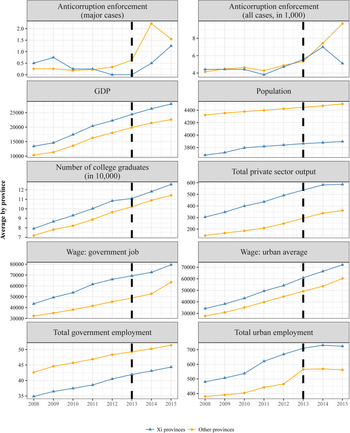
For the IV estimation to be valid, two key assumptions must hold. The first assumption, often known as the relevance condition, requires the relationship between the instrument and the endogenous variable to be sufficiently strong. To verify this, we plot the yearly variation in anticorruption intensity (separately for Xi and non-Xi provinces) in the two top panels of Figure 2. The top left panel uses the number of investigations for prefectural and provincial leaders from the CPED and the top right panel uses the total number of investigations collected from the provincial yearbooks. In both panels, we see that (1) there was a sharp increase in enforcement intensity after 2013 and (2) the enforcement gap between Xi and non-Xi provinces became notably larger when the campaign was underway. These patterns strongly support the relevance of our instruments. As a more systematic test, we present in Appendix Table A.5 the numerical results from our first-stage regressions. The F statistics from the joint significance test of the two instruments are consistently over 30, which is substantially higher than the conventional threshold of 10.
IV validity
Note: this figure visualizes the respective trends in key province-level characteristics for Xi and non-Xi provinces before and after the anticorruption campaign. Numerical results from the regression-based tests can be found in Table A.6.

In addition to the relevance condition, a valid IV must also satisfy the exclusion restriction, which means that the instruments should not be correlated with the outcome other than through the endogenous variable. While this assumption cannot be directly tested, our prior discussion about the nature of the anticorruption campaign suggests that the exclusion restriction is likely to hold. In the middle and bottom panels of Figure 2, we provide additional visual tests of this assumption by plotting the temporal trends of several key province-level variables (for example, GDP, population, number of new college graduates, number of new civil service recruits, wage levels, etc.). We can see that unlike anticorruption enforcement, there is no obvious discontinuity in national trends for these variables after 2013. Although there are pre-existing differences between Xi and non-Xi provinces in some of the variables, these differences remain largely the same after 2013. These patterns provide reassuring evidence of the validity of our instruments. Appendix D.3 provides several additional tests on the exclusion restriction (Davidson and MacKinnon Reference Davidson and MacKinnon2010), which showed similar results (Table A.8).
Baseline Results
Deterrence Effect
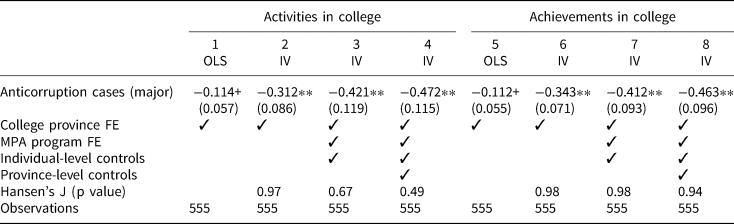
Table 1 presents evidence of the deterrence effect. Columns 1–4 use Activities in College as the dependent variable. We begin with a parsimonious ordinary least squares (OLS) model that only controls for college province fixed effects, and report in Column 2 the second stage of an IV model using the same specification. Column 3 adds to the IV model fixed effects for respondents' MPA schools and individual-level controls for age, gender, ethnicity and a linear measure of year of college graduation. Column 4 further controls for province-level socioeconomic characteristics such as GDP per capita, population, the respective size of government expenditures and the share of private sector output in the provincial economy. Both the OLS and IV results consistently suggest that anticorruption enforcement has a negative and statistically significant effect on the overall ability of entry-level civil servants. Focusing on Column 4, the coefficient estimate suggests that for one additional senior official investigated in a given province-year spell (~72 per cent of a standard deviation), individuals recruited into the civil service from that spell report 0.47 fewer (~28 per cent of a standard deviation) activities in college on average. Since the average number of college activities reported in our civil servant sample is about 2.1 (out of 10), this decline amounts to a 22 per cent drop from the baseline, which is quite substantial.
Deterrence effects

Note: this table presents the effect of anticorruption enforcement on officials' ability. The dependent variables are the number of activities or achievements in college. Individual-level controls include gender, ethnic minority, age, and college graduation year. Province-level controls include GDP per capita, total population, fiscal expenditure and share of the private sector. Standard errors are clustered at the province of college graduation. +p < 0.1, ∗p < 0.05, ∗∗p < 0.01 (two-tailed test)
In Columns 5–8, we change our dependent variable to the more restrictive Achievements in College and repeat the analysis. The results are quite similar: one additional major-case investigation in a province-year spell causes a 0.34 to 0.46-unit decline in the number of achievements reported by civil servant respondents recruited during that spell, which amounts to a 19–25 per cent drop from the sample average of 1.8 achievements.
Since our estimation relies on more than one instrument, it is possible to conduct an overidentification test to assess the validity of our instruments. At the bottom of each model, we report the p-value from Hansen's J test of over-identification (Hansen Reference Hansen1982), which assesses how much influence our instruments have on the outcomes in addition to affecting the value of anticorruption enforcement. All the p-values are generally quite large, which suggests that we cannot reject the null hypothesis that the instruments have no additional impact. This gives us greater confidence in the validity of our instruments.
Compositional Effect
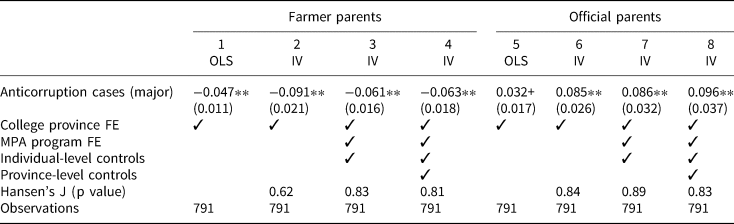
Next, we turn to our second hypothesis about the compositional effects. Table 2 presents the OLS and IV regressions on the effect of anticorruption enforcement on the occupations of the respondents' parents. Columns 1–4 focus on parents who are farmers and Columns 5–8 focus on parents who are government officials. The specifications are identical to those used in Table 1. The results suggest that the intensification of anticorruption enforcement leads to a clear and strong compositional change among entry-level civil servants. According to the first four columns, one additional high-level investigation in a province-year spell reduces the likelihood of having at least one parent who is a farmer by about 5 to 9 percentage points among the civil servants recruited in that spell; the magnitudes of these estimates are equivalent to about 26–51 per cent of the sample average (18 per cent). By contrast, Columns 5 to 8 suggest that more individuals whose parents are government officials are recruited into the civil service in times of heightened anticorruption enforcement. For one extra major case investigation, the share of children of government officials among newly recruited civil servants increases by about 3.2 to 9.6 percentage points, or 8 to 25 per cent of the sample average.
Compositional effects

Note: this table presents the effect of anticorruption enforcement on the socioeconomic status of incoming officials. The dependent variables are the occupations of the respondents' parents. Individual-level controls include gender, ethnic minority, age and college graduation year. Province-level controls include GDP per capita, total population, fiscal expenditure and share of the private sector. Standard errors are clustered at the provinces of college graduation. +p < 0.1, ∗p < 0.05, ∗∗p < 0.01 (two-tailed test)
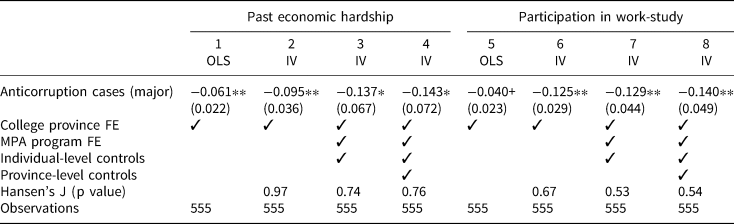
One potential concern about our findings is that the distinction between farmer and official parents may not fully reflect the differences in socioeconomic status among the respondents. To address this issue, we also estimate regressions using the two experience-based measures of economic conditions and present the results in Table 3. The first four columns suggest that civil servants recruited from province-year spells in which the enforcement level was high are less likely to have encountered economic hardships in the past. The last four columns show that there is a similar negative effect for participation in work-study programs. Consistent with the findings on the change in the parents' occupations, these patterns suggest a clear elitist shift in the composition of the civil service following heightened enforcement.
Using alternative measures of economic conditions

Note: this table presents the effect of anticorruption enforcement on incoming officials' socioeconomic status using experience-based measures of past economic conditions. Individual-level controls include gender, ethnic minority, age, and college graduation year. Province-level controls include GDP per capita, total population, fiscal expenditure and share of the private sector. Standard errors are clustered at the provinces of college graduation. +p < 0.1, ∗p < 0.05, ∗∗p < 0.01 (two-tailed test).
Robustness and External Validity
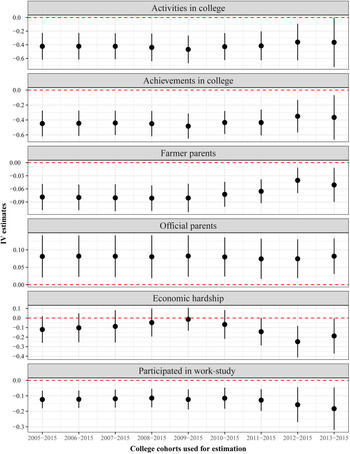
We conduct several additional tests to evaluate the robustness of our results. First, since our sample encompasses more than a decade of graduating cohorts (2004–2015), one concern is that our findings may be driven by different patterns of MPA enrollment across these cohorts. Civil servants who waited many years after college graduation to enroll in an MPA program may differ systematically from those who chose to attend graduate school soon after college.Footnote 32 To address this concern, we re-estimate the IV regressions on samples with shorter time spans. The results are visualized in Figure 3. Each circle on the figure represents an estimate from a separate IV regression, and the vertical bars indicate the confidence intervals. From left to right, the time span of the sample changes from eleven years (2005–2015) to three years (2013–2015). Reassuringly, we see that even when focusing on the most restrictive three-year sample, all the coefficient estimates are still statistically significant at the 10 per cent level or above. This helps mitigate the concern that systematic, cohort-based differences are driving our results.
IV results from samples with different time spans
Note: this figure shows the estimation results using different sample time spans. Each circle represents a separate regression and the vertical bars indicate 90 per cent confidence intervals. The x-axis indicates the cohort years used for estimation.

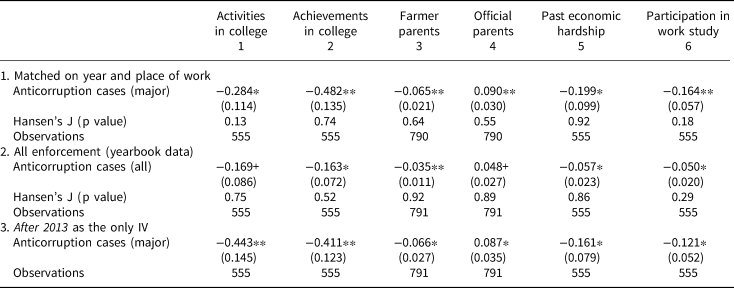
We also evaluate whether our results are sensitive to different sample construction methods or variable and specification choices. To begin with, we replicate our baseline regressions using an alternative way of matching the survey with the enforcement data. Instead of matching based on college graduation, we use the year and province of the first government job. As shown in the top panel of Table 4, all our results remain substantively the same. To ensure that the results are not driven by our measurement of anticorruption enforcement, we also use data on the total number of disciplinary investigations from the provincial yearbooks to construct an alternative independent variable and re-estimate all our models. This again does not change our findings (see the middle panel of Table 4). Moreover, one may be concerned that the different enforcement levels that Xi and non-Xi provinces experienced during the campaign were not entirely exogenous. In the bottom panel of the same table, we re-estimate our IV models using After 2013 as the sole instrument. All the results continue to hold, and the magnitudes of the estimates are quite similar to those in the two-instrument specification. Additional robustness results can be found in Appendix E.
Robustness checks

Note: this table represents several robustness checks of the baseline findings. All models include the following variables: year of graduation, college province fixed effects, MPA fixed effects, age, gender and ethnicity. Standard errors clustered at college province are reported in parentheses. +p < 0.1, ∗p < 0.05, ∗∗p < 0.01 (two-tailed test)
Since our survey is not based on a probability sample, another important concern is the generalizability of our findings. We address this in two ways. First, we conduct a number of subsample analyses, splitting the main sample by school characteristics, such as academic ranking and location, as well as respondent characteristics, such as gender and level/place of work (see Figure A.6 for details). We find that the basic patterns of the coefficients are remarkably consistent across the different subsamples, although the levels of statistical significance sometimes vary due to changes in the sample size. Secondly, we apply several post-stratification adjustments to improve the representativeness of our sample. In Appendix F.2, we report the results of using four different sets of post-stratification weights. Reassuringly, the weighted estimates are largely consistent with the original (unweighted) ones. The results from these tests give us greater confidence in the external validity of our findings.
Mechanisms and Alternative Explanations
We also carry out a number of further analyses to verify the posited mechanisms and to address several alternative explanations. The key findings of these additional analyses are summarized here and reported in detail in Appendix Section G.
(1) Consistent with the assumption that anticorruption enforcement lowers the perceived return from government jobs, we analyze multiple years of national survey data (the Chinese General Social Survey 2005, 2006, 2013 and 2015) and find that the public became less likely to identify government cadres as the greatest beneficiaries of the economic reforms when anticorruption enforcement was high (Columns 1 and 2 of Table A.13).
(2) Consistent with the argument about the deterrence effect, we find that (a) anticorruption enforcement decreases the number of applicants for civil service jobs (Columns 3 and 4 of Table A.13) and (b) high-ability individuals are less committed to a government career than less capable individuals (Table A.14).
(3) Consistent with the argument about the compositional effect, we find that when making career decisions, individuals from lower class backgrounds tend to face greater parental pressures to choose jobs that promise high monetary rewards (Table A.15).
(4) To further address the possibility that the results may be driven by unobserved shocks to enrollment in college or MPA programs (as opposed to entry to the government), we estimate placebo regressions on the subsample of MPA students who are not in the civil service.Footnote 33 We find that anticorruption enforcement did little to change the characteristics of non-civil servant MPAs, suggesting that the selection effects that we observe are highly specific to those working in the government (Table A.16). We also find that enforcement has little effect on a number of other career and demographic factors that are common parameters in MPA admission decisions, such as age, gender, political affiliation, and levels and sectors of work (Figure A.9).
(5) We also conduct several additional tests to address the possibility that the results are driven by other (non-anticorruption-related) political or policy changes that occurred under the Xi administration. For example, it could be that Xi's assumption of power resulted in direct, qualitative changes in the government's recruitment preferences. To address this possibility, we collect and analyze province-level data on both the number and required qualifications for civil service jobs posted between 2011 and 2016. We find no significant change in recruitment criteria after Xi took power (Figure A.10). Secondly, because Xi's administration has also promulgated a number of new policies that have placed heavy implementation burdens on civil servants at the grassroots level, the deterrence effect may be the result of an increased workload rather than diminished monetary returns. To evaluate this possibility, we reran all the models on a sample that excludes respondents working in grassroots-level agencies. All of our results remain substantively unchanged (Table A.17). We also collected and carefully reviewed the timing of a number of other signature policies of the Xi administration. We were unable to find any other concurrent policy initiative of a scale comparable to the anticorruption campaign during the treatment period (that is, 2014 and 2015). Most of Xi's other major policies were implemented much later, after he had consolidated his power through anticorruption (see Figure A.11).
Implications For Future Policy
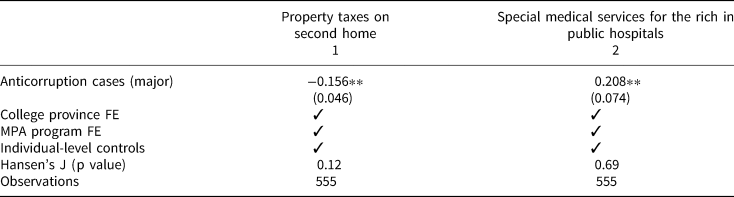
Finally, we investigate what the changing selection patterns may mean for future policy making. Although it is still too early to gauge the full policy impact, we provide some suggestive evidence based on the revealed policy preferences of the new recruits. Our survey asked about respondents' policy preferences on two issues: property taxes for multiple-home owners and special medical services for the rich in public hospitals, both of which are salient and controversial issues in China today. Typically, more affluent individuals tend to oppose property taxes and support special medical services.Footnote 34 We use the responses to these questions as the dependent variables in IV regressions. Table 5 shows that, consistent with the previous finding on parental occupation and socioeconomic status, civil servants recruited during high-enforcement spells show policy preferences that are more aligned with the preferences of the privileged: they are less supportive of property taxes and more supportive of commercialized medical services. Assuming that these preferences persist over time, we would expect to see more elitist, and less egalitarian, policies in the future when these new recruits rise to positions of power.
Effect of anticorruption on policy preferences of newly recruited civil servants

Note: this table presents the results of the effect of anticorruption enforcement on the policy preferences of newly recruited civil servants in two areas: property taxes and commercialized medical services. Responses are normalized by cohort averages. Individual-level controls include gender, ethnic minority, age and year of graduation. Standard errors are clustered at the provinces of college graduation. +p < 0.1, ∗p < 0.05, ∗∗p < 0.01 (two-tailed test)
Concluding Remarks
The study's central finding is that when rent-seeking constitutes an informal, yet crucial, part of officials' de facto income, efforts to build a cleaner government may have unintended negative effects on both the quality and representativeness of the government bureaucracy.Footnote 35 Exploiting cohort-based variations in exposure to anticorruption enforcement, we estimate how anticorruption alters the characteristics of entry-level civil servants. We show that in provinces and years in which enforcement intensity is high, individuals entering the civil service tend to have fewer achievements in college and are less likely to come from rural or low-class families. These findings are robust to a range of additional tests, including using highly restrictive bandwidths and alternative measures for both the dependent and independent variables. We provide aggregate- and individual-level evidence on the mechanism that gives rise to these selection effects and offer suggestive evidence that the change in the class composition of the civil service may have long-term policy ramifications.
Our study has important implications for understanding the challenges faced by developing countries in eliminating persistent corruption. During the past several decades, many countries have adopted forceful measures to fight corruption, but most of these measures have failed to bring about a permanent improvement in the quality of government (Brown and Cloke Reference Brown and Cloke2004). While existing explanations of this failure tend to focus on those countries' weak enforcement capacity and/or the political leaders' ulterior motives, our study suggests a different possibility: fully eliminating rent seeking while retaining the current quality of talent may require a level of civil service compensation that few governments in the developing world can afford. To the extent that China is already ahead of many other developing countries in terms of formal civil service pay, the fact that we still observe these sharp changes in recruitment patterns suggests that the selection impacts of anticorruption enforcement are likely to be even stronger elsewhere. This explanation is also consistent with the empirical observation that where anticorruption enforcement did improve government quality (for example, Singapore, Hong Kong and nineteenth-century Sweden), strong enforcement measures were often implemented in tandem with significant civil service pay increases (Persson, Rothstein and Teorell Reference Persson, Rothstein and Teorell2012; Quah Reference Quah2011; Scott Reference Scott1989).
That being said, the negative selection effects of anticorruption enforcement that we observe must not be interpreted to suggest that governments should not implement anticorruption measures, or that such measures cannot improve the welfare of society. For one thing, tolerating corruption can sometimes lead to greater societal welfare losses than the cost of selection. Moreover, from a general equilibrium perspective, having fewer talented individuals wanting to join the government is not necessarily undesirable if it means that more talent will be entering the private sector, which is typically more efficient and productive. Instead, our point is that when rent seeking is not an isolated act by immoral individuals but the centerpiece of an interconnected political-economic ecosystem, successfully battling it requires doing much more than merely rounding up a few corrupt officials. Building cleaner and better institutions is a systematic project that involves coordinated policy interventions on multiple fronts.
Supplementary material
Data replication sets available in Harvard Dataverse at: https://doi.org/10.7910/DVN/SFYMSY and online appendices are available at https://doi.org/10.1017/S0007123420000393.
Acknowledgements
Authors are listed in alphabetical order. Previous versions of this article were presented at the Virtual Workshop on Authoritarian Regimes, the 3rd Empirical Political Science Research Workshop in Hong Kong, the PKU–Fudan State Governance Forum, the SJTU–SIPA Workshop on Chinese Politics and Society, and the Transition and Governance Workshop at Sun Yat-Sen University. For valuable feedback, we thank Xun Cao, Shuo Chen, Ting Chen, Wilfred Chow, Charles Crabtree, Donglin Han, Jean Hong, Yue Hou, Chengyuan Ji, Holger Kern, Pierre Landry, Dov Levin, Tao Li, Melanie Manion, Lawrence Reardon, Min Tang, Erik Wang, Matthew Winters, Vivian Zhan, Lu Zheng, Yang Zhong, and Jiangnan Zhu. Our survey benefited tremendously from the generous assistance from the following individuals: Huirong Chen, Yang Dong, Rongrong Li, Liming Suo, Kai Tian, Lin Ye and Hualiang Zheng. All errors are our own.
Financial support
Jiang acknowledges financial support from the Faculty of Social Sciences at the Chinese University of Hong Kong and the Research Grant Council of Hong Kong (ECS-24612618). Shao acknowledges support from China Postdoctoral Science Fund (2018M631011).