Introduction
Most definitions of successful aging include the absence of cognitive or physical morbidity. Rowe and Kahn (Reference Rowe and Kahn1998), for example, cited minimizing disease and disability, maintaining mental and physical functioning and continued engagement with life as the key components. Unsurprisingly, this is best predicted by younger age (Depp and Jeste, Reference Depp and Jeste2006). Many people, however, report subjective well-being despite impaired physical and mental health, and could therefore be considered to be aging successfully. This has been referred to as the “disability paradox” (Albrecht and Devlieger, Reference Albrecht and Devlieger1999). In one study, many people reported good quality of life despite poor physical health; this group tended to experience a lower subjective burden of disease and to have more socio-psychological resources to help them to cope effectively (Bowling and Iliffe, Reference Bowling and Iliffe2006; Bowling et al., Reference Bowling, Seetai, Morris and Ebrahim2007). Older people's rating of high quality of life was best predicted by a model incorporating a broad range of measures of general health, mental health, physical, social and psychological functioning, income and social capital (Bowling et al., Reference Bowling, Seetai, Morris and Ebrahim2007).
These studies did not consider the effect of cognitive impairment. It is often assumed that quality of life in people with cognitive decline will be decreased by the biological factors that influence the decline itself. We hypothesize, however, that the influence of cognitive decline on quality of life is modulated by the same emotional and social factors as in people without cognitive impairment. We have reported previously that poor mental health is one of the most consistent predictors of worse quality of life in people with dementia (Livingston et al., Reference Livingston, Cooper, Woods, Milne and Katona2008). In our cohort of people with Alzheimer's disease, successful aging was predicted by better mental health and higher self-rating of the quality of relationships with friends, family and closest confidant (Livingston et al., Reference Livingston, Cooper, Woods, Milne and Katona2008). While better overall health and fewer cognitive impairments were also predictors, these effects were no longer significant after taking account of mental health and social relationships. There is therefore a body of evidence that dementia per se is unrelated to quality of life, once the effects of mental and physical health are taken into account. In this study we tested this hypothesis for the first time in a representative sample including people with and without dementia and using a validated measure of quality of life. Earlier studies used a single-item measure of quality of life (Bowling et al., Reference Bowling, Seetai, Morris and Ebrahim2007; Livingston et al., Reference Livingston, Cooper, Woods, Milne and Katona2008). We also considered the effects of cognitive dysfunction (which has not necessarily impacted on functioning) in relation to physical and mental health on quality of life in older people together for the first time.
We analyzed health-related quality of life in older people interviewed for the 2000 British Psychiatric Morbidity Survey (PMS), in which quality of life was associated with cognitive impairment (Evans et al., Reference Evans, Singleton, Meltzer, Stewart and Prince2003). We investigated the relative contributions of mental health and social support to quality of life in older people generally and to the link between cognitive impairment and quality of life. Our first hypothesis was that the relationship between cognitive impairment and poorer health-related quality of life would be mediated by a greater prevalence of affective symptoms and reduced social support in people with cognitive impairment. Baltes and Baltes (Reference Baltes, Baltes, Baltes and Baltes1990) suggested that any model of successful aging should consider the degree to which people are able to optimize and compensate for the problems of aging. As these adaptive mechanisms may be particularly impaired in those with executive functioning deficits, we then tested our hypothesis with a measure of executive functioning instead of overall cognitive impairment.
Methods
Procedures
The second British National Survey of Psychiatric Morbidity involved computer-assisted interviews carried out with a national probability sample in the year 2000. Throughout Britain, 15,804 delivery points were randomly drawn from postal sectors of the Small Area Postcode Address File, stratifying for socioeconomic grouping. Using the Kish (Reference Kish1956) grid method, 12,792 adults aged 16–74 were selected from 14,285 eligible households. Sixty-nine percent (8,580) of those approached agreed to take part. In this report, we have included participants aged 60 and over (n = 2007). See Evans et al. (Reference Evans, Singleton, Meltzer, Stewart and Prince2003) for further details of the study.
Measures
Standardized questions provided information about age, gender, marital status (married or cohabiting, or not), ethnic origin (White British or other), tenure (whether living in accommodation they owned or rented) and education (whether or not they had obtained any formal qualifications, including national school leaving exams such as “O Levels” or equivalent).
Participants also completed a number of measures.
The 12-item short form health survey (SF-12)
This is an acceptable and valid measure of health-related quality of life for use in large community-based studies, including those of older people (Pettit et al., Reference Pettit, Livingston, Manela, Kitchen, Katona and Bowling2001; Dorr et al., Reference Dorr2006). It yields two scores, a Mental Component Score (MCS) and a Physical Component Score (PCS) each of which has been scaled to have a mean of 50 and a standard deviation of 10 in the adult U.S. population (Ware et al., Reference Ware, Kosinski and Keller1996). Higher scores indicate better physical and mental health-related quality of life.
Cognitive measures
The Telephone Interview for Cognitive status (TIC-m) screens for cognitive impairment (Plassman et al., Reference Plassman, Welsh, Helms, Brandt, Page and Breitner1995). It tests orientation, concentration, immediate and delayed memory, naming, calculation, comprehension and reasoning. We used a cut-off point of 20/21 to define suspected dementia cases. This has been found to be equivalent to an MMSE score of below 25 (de Jager et al., Reference de Jager, Budge and Clarke2003). Concurrent validity (de Jager et al., Reference de Jager, Budge and Clarke2003) and internal consistency (Galen Buckwalter et al., Reference Galen Buckwalter, Crooks and Petitti2002) are good.
The Animal Naming Test is a measure indicating verbal fluency from the Consortium to Establish a Registry for Alzheimer's Disease (Diehl et al., Reference Diehl2005). Participants were asked to name as many animals as they could in one minute. This tests executive functioning, and is also influenced by intelligence (Abrahams et al., Reference Abrahams, Leigh, Harvey, Vythelingum, Grise and Goldstein2000; Ho et al., Reference Ho, Sahakian, Robbins, Barker, Rosser and Hodges2002).
Participants also completed the National Adult Reading Test (NART) (Nelson and Willison, Reference Nelson and Willison1991). This test is a widely used and validated brief measure of crystallized (premorbid) intelligence for English speakers.
Mental health measures
The Revised Clinical Interview Schedule (CIS-R) was also completed. The reliability and validity of the CIS-R has been reported (Lewis et al., Reference Lewis, Pelosi, Araya and Dunn1992; Jordanova et al., Reference Jordanova, Wickramesinghe, Gerada and Prince2004). The instrument produces a total score, indicative of the level of affective symptoms.
Social resources
Social network size
In our previous study (Livingston et al., Reference Livingston, Cooper, Woods, Milne and Katona2008) we included a measure summed from three items of the Quality of Life – Alzheimer's Disease Scale that asked respondents about the quality of their relationships with family, friends and their closest confidant. In this survey, most of the respondents scored the maximum on the measure of social support (reported in Brugha et al., Reference Brugha2003). Owing to this ceiling effect, we used social network size as a proxy of available social support. This was assessed by asking the respondent how many people (aged over 16) they felt close to. They were asked about the adults they lived with; relatives they did not live with; and close or good friends they did not live with. We used the total number of people reported as a measure of their primary social group size (Brugha et al., Reference Brugha2003).
Physical health
The number of longstanding physical illnesses reported by participants was recorded.
ADL score
This was computed from the sum of responses to seven questions regarding whether the participants experienced difficulties in the following areas: personal care, transport, medical care, household activities, practical activities, dealing with paperwork and managing money. This instrument was developed from the activities of daily living (ADL) measure used in the 1993 PMS, described in more detail by Bebbington et al. (Reference Bebbington2000). Possible scores ranged from 0 (no difficulties) to 7 (difficulties in all areas listed).
Data analysis
All analyses were performed using data weighted to take account of the complex survey design and of non-response in order to ensure that the results were representative of the British Household population. We used the relevant “survey” commands in STATA release 8.2 (StatCorp, 2003), which allow for the use of clustered data modified by probability weights and provide robust estimates of variance.
We compared the mean PCS and MCS scores to norms reported in the general U.S. population (see earlier). We described the variables studied using weighted means and proportions, and determined which of these were significantly associated with MCS and PCS scores. As the survey commands in STATA do not allow correlations, we used the “svyregression” command to determine the relation of MCS and PCS scores to continuous variables, entering the variable studied as the only independent factor in a regression with MCS or PCS as the dependent variable, and reported t values and their significance level. We used the correlation coefficient from these equations to test for collinearity of continuous variables; this method is sufficient for a point estimate of effect, although p values are not reliable.
To explore our hypotheses, we used generally accepted criteria (Baron and Kenny, Reference Baron and Kenny1986) to define mediation. In this situation, mediation would require that MCS and PCS were associated with cognition (TIC-m score) and with the putative mediators (number of affective symptoms and social support); and secondly that the standardized β for the relationships of MCS/PCS to cognition was reduced by adding the mediator to a model with MCS/PCS as the dependent variable. If the relationship between cognition and MCS/PCS was no longer significant after adding the mediator, full mediation would have occurred; if it was reduced but still significant, this would indicate partial mediation. We conducted linear regressions, with (1) MCS and (2) PCS scores as dependent variables, entering as independent variables those factors that approached significance (p < 0.1) in univariate relationships with these scores. We initially added sociodemographic variables with each of our cognitive measures of effect (dementia score and animal naming test score), then the NART score as a measure of crystallized intelligence, followed by the putative mediators. In the final model, we also entered the number of longstanding illnesses and ADL score, as these have also previously been associated with quality of life, to examine which sociodemographic, cognitive and morbidity characteristics were the strongest predictors of quality of life.
Results
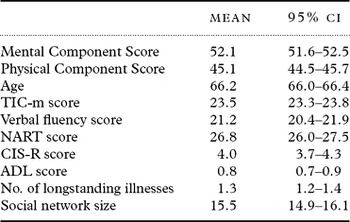
Of the 2007 participants, 1136 (53.0%) participants were female, 1938 (97.6%) were White British, 1196 (72.5%) were married, 908 (47.3%) had some kind of qualification and 1494 (78.9%) lived in a property they owned. Some 402 (20.0%) participants were scored as suspected dementia cases. The distribution of continuous variables is listed in Table 1. Some 72.7% of people without suspected dementia and 63.5% of people with suspected dementia scored above the accepted population mean (50) for MCS, indicating better mental health-related quality of life; 51.0% of people without suspected dementia and 35.3% with suspected dementia scored above the mean for PCS.
Means and 95% confidence intervals (CI) for variables studied

Univariate analyses
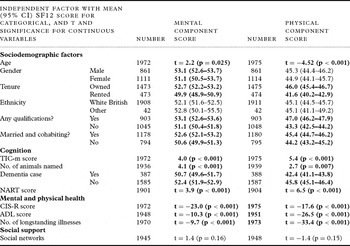
On univariate analysis, higher SF-12 MCS and PCS scores were both significantly associated with being male, married, owning one's own property and having qualifications. They were also associated with higher crystallized intelligence (NART score), global cognition (TIC-m), and our measure of executive functioning, and with fewer affective symptoms, longstanding illnesses and ADL limitations (Table 2). TIC-m score correlated inversely with CIS-R score (t = −3.7, p < 0.001). Neither MCS nor PCS score was associated with social support on univariate analysis. Our hypothesis that social support would mediate the relationship between cognition and quality of life was therefore not supported and we did not explore this further. The continuous variables were not excessively correlated (all r ≤ 0.65), so none was omitted from multivariate analyses due to potential collinearity. The highest correlations were between PCS and ADL scores (r = 0.65), and between MCS and CIS-R scores (r = 0.63).
Univariate relationship between SF12 Mental Component Score and Physical Component Score

Note: Bold denotes significant results.
Mental health-related quality of life
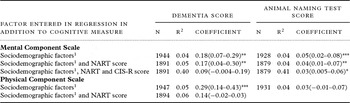
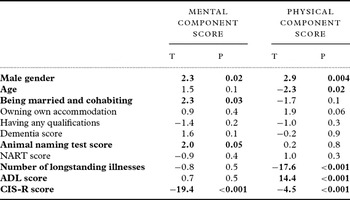
The regression coefficient for the relationship of dementia score to MCS score was significantly reduced by controlling for affective symptoms, supporting our hypothesis that affective symptoms fully mediated the relationship between cognition and mental health-related quality of life. Executive functioning was a strong predictor of MCS score, but this was not greatly attenuated by controlling for sociodemographic characteristics or affective symptoms. This suggested that our second hypothesis – i.e. affective symptoms would mediate this relationship – was not supported. In stepwise linear regression with MCS as the dependent variable, we found that the number of affective symptoms explained most of the variance (Table 3). In the final model (R2 = 0.41), only male gender, being married, better executive functioning and having fewer symptoms of mental illness predicted greater mental health-related quality of life (Table 4). When we analyzed cases of suspected dementia in place of cognitive score, the predictors of a higher score remained the same: male gender (t = 2.2, p = 0.026), being married (t = 2.3, p = 0.024), better executive functioning (t = 2.2, p = 0.027) and fewer mental health problems (−19.4, p < 0.001).
Relationship of SF-12 scale scores with (1) dementia score and (2) verbal fluency score on adjusting for sociodemographic characteristics, premorbid cognition and mental health problems

1Age, gender, tenure (whether owned or rented accommodation), whether any qualifications or not, whether married and cohabiting or not; *p < 0.05; **p < 0.01; ***p < 0.001.
Final model for regression analyses

Note: Bold denotes significant results.
ADL = activities of daily living; CIS-R = Revised Clinical Interview Schedule.
Physical health-related quality of life
The relationship of dementia and executive functioning scores to physical health-related quality of life was no longer significant after controlling for sociodemographic characteristics and pre-existing cognition (measured using the NART). On linear regression with PCS as the dependent variable (R2 = 0.56), the significant predictors were: male gender, younger age, fewer symptoms of mental illness, having fewer longstanding illnesses, and ADL score (Table 4). Having fewer longstanding illnesses and ADL score were the strongest predictors. When we substituted being a suspected dementia case for cognitive score, the predictors were unchanged: male gender (t = 2.9, p = 0.004), younger age (t = −2.3, p = 0.024), more symptoms of mental illness (t = −4.5, p < 0.001), having fewer longstanding illnesses (t = −17.5, p < 0.001) and ADL score (t = −14.4, p < 0.001). Being a suspected dementia case was not a predictor at conventional levels of significance (t = 0.07, p = 0.95).
Discussion
We confirmed our hypothesis that the relationship between overall cognition and mental health-related quality of life was mediated by the number of affective symptoms. This is the first study to investigate this hypothesis in a representative sample of all those in the older general population, and using a validated measure of quality of life. Contrary to our original hypothesis, however, social network size did not mediate the relationship of cognitive function with health-related quality of life. Executive functioning was a significant predictor of mental health-related quality of life after potential mediators and confounders were considered. Physical health-related quality of life was not associated with cognition and executive functioning after controlling for sociodemographic characteristics and crystallized intelligence.
Quality of life was no longer predicted by overall cognitive function nor being a suspected dementia case after controlling for sociodemographic factors, previous qualifications and crystallized intelligence, physical and mental health and ADL functioning. While the final model predicting mental health-related quality of life also included greater executive functioning, male gender and being married, the predominant contribution was from affective disturbance. The number of longstanding illnesses and ADL score explained most of the variance in our final model predicting physical health-related quality of life; this also included male gender, younger age, and affective symptoms.
It is unsurprising that MCS was predicted by affective symptoms, and PCS by ADL score and the number of longstanding illnesses, as HR-QoL would be expected to relate to actual health problems. Importantly, however, cognitive impairment did not predict quality of life once these were taken into account. These results support earlier findings in people with Alzheimer's disease that the relationship between cognitive deficit and poor quality of life is explained by the higher levels of physical illness and affective symptoms experienced by people with cognitive impairment (Livingston et al., Reference Livingston, Cooper, Woods, Milne and Katona2008). This indicates that active management of mental and physical morbidity may have a major effect in improving quality of life, both in older people with dementia and in those without. There is now a compelling need for further research to explore barriers to health promotion and mental health treatment for people with cognitive impairment, to try to prevent this excess disability.
The mean quality of life of our participants was higher than the normal mean values reported in the U.S. adult population (Ware et al., Reference Ware, Kosinski and Keller1996) as would be expected from the positive association we found between better quality of life and older age. Strikingly, even among people scoring as suspected dementia cases, nearly two-thirds reported mental health-related quality of life above the accepted general population mean, while under half this number rated themselves as highly in physical health-related quality of life. This contradicts previous assertions that successful aging requires relative cognitive health (Rowe and Kahn, Reference Rowe and Kahn1998). People with dementia will be functionally impaired, as a consequence both of the dementia and, often, of other physical comorbidity. Our results suggest that they are aware of this, and that it does affect their physical quality of life. However, only a minority of people with suspected dementia reported low mental health-related quality of life. It would seem therefore that they may be less troubled by, or less aware of, cognitive and mental impairment. By contrast, executive functioning deficits did predict worse mental health-related quality of life after controlling for higher sociodemographic conditions and crystallized intelligence. This relationship has not been reported before, and could be explained with reference to the model of successful aging proposed by Baltes and Baltes (Reference Baltes, Baltes, Baltes and Baltes1990): people may devise strategies to compensate for mild cognitive impairments and optimize their mental and physical health, but executive functioning deficits interfere with these compensatory mechanisms.
In a previous study, successful aging in people with Alzheimer's disease was associated with the quality of their social relationships (Livingston et al., Reference Livingston, Cooper, Woods, Milne and Katona2008). In the current study, social network sizes were not associated with quality of life. This difference may relate to our use of social network size as a proxy for social support in this study; these measures are related but not the same (Wenger, Reference Wenger2004); network size is probably a less sensitive measure of actual support received. The difference could also be due in part to the reduced power to detect this relationship in the present study, given that few participants reported having a small social network size. In those that did, this may have represented choice rather than isolation in this population in which most of the suspected dementia cases in this study had only mild impairment.
The survey only included people aged between 60 and 75 living in private households. Previous research has indicated that people living in care homes report worse quality of life (Hoe et al., Reference Hoe, Katona, Orrell and Livingston2007) and that while the “third age” may be a time of successful aging, this is less true of the “fourth age” (the oldest old) (Baltes and Smith, Reference Baltes and Smith2003); our results are unlikely to be applicable to these groups. The cross-sectional design of this survey is also a limitation: while it seems plausible that mental and physical disability and executive functioning predicted quality of life rather than the converse, we cannot be sure about the direction of causality. Similarly, we hypothesized that affective symptoms were on the causal pathway between cognition and quality of life, but it is also possible that they were only a confounder of this relationship. These results are, however in line with previous findings from a longitudinal study (Livingston et al., Reference Livingston, Cooper, Woods, Milne and Katona2008).
Most of the questions in the SF-12 measure health-related quality of life, and we cannot comment on other contributors to quality of life such as mastery, sense of coherence and internal locus of control. While we used a conventional cut-point for defining a suspected dementia case, the high prevalence in the sample suggests low specificity; we therefore analyzed TIC-m score as a continuous variable. It was not possible to investigate the relationship between the potential range of impairments and quality of life across the range of cognitive impairment severity.
Most older people, including those with cognitive morbidity, rate their mental health-related quality of life highly and thus could be seen to be aging successfully. The lower mental and physical health-related quality of life reported by people with cognitive impairment was accounted for by physical illness and affective symptoms. Active management of mental health and physical impairment may improve the quality of life of those with cognitive impairment who are not aging successfully.
Conflict of interest
None.
Description of authors’ roles
CC and GL designed the study and analyzed the data; CC prepared the first draft; all authors revised the content critically for important intellectual content and approved the final version.