Introduction
Psychotic disorders have a prevalence of 3% presenting a major global burden to society (Collins et al. Reference Collins, Patel, Joestl, March, Insel, Daar, Bordin, Costello, Durkin and Fairburn2011). Over 60% of patients with schizophrenia are functionally impaired with no regular employment at 10-year follow-up (Wiersma et al. Reference Wiersma, Wanderling, Dragomirecka, Ganev, Harrison, An Der Heiden, Nienhuis and Walsh2000; Harrison et al. Reference Harrison, Hopper, Craig, Laska, Siegel, Wanderling, Dube, Ganev, Giel and Der Heiden2001; Harrow et al. Reference Harrow, Grossman, Jobe and Herbener2005; Bottlender et al. Reference Bottlender, Strauß and Möller2010). The first 3–5 years of the illness has been argued as being critical in determining long-term outcomes (Birchwood & Fiorillo, Reference Birchwood and Fiorillo2000; Crumlish et al. Reference Crumlish, Whitty, Clarke, Browne, Kamali, Gervin, McTigue, Kinsella, Waddington and Larkin2009). This view has underpinned the development of specific early intervention (EI) services for first-episode psychosis worldwide to improve the long-term outcomes of patients with psychosis (Bertolote & McGorry, Reference Bertolote and McGorry2005). Hong Kong had a population of 7 million by mid-2011. The public healthcare system provides a universal coverage operated by the Hospital Authority (HA). An EI service, the Early Assessment Service for Young People with Psychosis (EASY; Chen, Reference Chen, Ehmann, MacEvan and Honer2004) program, was implemented in 2001 as a territory-wide service within the public healthcare system by the HA. With specialized multidisciplinary teams, the EASY program provided a 2-year case management service to patients aged 15–25 years with first-episode psychosis (Tang et al. Reference Tang, Wong, Hui, Lam, Chiu, Chan, Chung, Tso, Chan and Yip2010).
Internationally, short-term outcome studies have consistently demonstrated that patients receiving an EI service generally achieved better outcome in symptom control and functioning compared to the standard intervention (Malla et al. Reference Malla, Norman, McLean, Scholten and Townsend2003; Craig et al. Reference Craig, Garety, Power, Rahaman, Colbert, Fornells-Ambrojo and Dunn2004; Petersen et al. Reference Petersen, Nordentoft, Jeppesen, OHLENSCHLAeGER, Thorup, Christensen, Krarup, Dahlstrom, Haastrup and Jorgensen2005; Agius et al. Reference Agius, Shah, Ramkisson, Murphy and Zaman2007; Addington & Addington, Reference Addington and Addington2008; Melle et al. Reference Melle, Larsen, Haahr, Friis, Johannesen, Opjordsmoen, Rund, Simonsen, Vaglum and McGlashan2008; McCrone et al. Reference McCrone, Craig, Power and Garety2010; Wong et al. Reference Wong, Chan, Lam, Hui, Hung, Tay, Lee and Chen2011). A meta-analysis (Harvey et al. Reference Harvey, Lepage and Malla2007) and a recent review (Nordentoft et al. Reference Nordentoft, Rasmussen, Melau, Hjorthoj and Thorup2014) confirmed the short-term clinical and functional benefits of the EI model for recent-onset psychosis. However, most of these EI programs are operated on a subset of population which limits the generalizability of the results. The development of a population-based EI service with significant media coverage focusing on psychoeducation does not easily accommodate randomized controlled studies. Under these circumstances a historical control design may be an optimal approach to estimate the real-life impact of the EI service. A few historical control studies on EI services have reported beneficial short-term outcomes on reducing negative symptoms and suicidal behaviors (McGorry et al. Reference McGorry, Edwards, Mihalopoulos, Harrigan and Jackson1996; Larsen et al. Reference Larsen, Melle, Friis, Joa, Johannessen, Opjordsmoen, Simonsen, Vaglum and McGlashan2007). A historical control study comparing the 3-year outcomes of patients who received the EI service (EASY) in Hong Kong with those who received standard care suggested that patients receiving EI had fewer hospitalizations and better functional outcomes (Chen et al. Reference Chen, Tang, Hui, Chiu, Lam, Law, Yew, Wong, Chung and Tso2011).
Most EI programs offer services for no more than 3 years. The question has therefore been raised about the sustainability of these initial beneficial effects (Bosanac et al. Reference Bosanac, Patton and Castle2010; Singh, Reference Singh2010). Studies on the longer-term effects of the EI service are limited and results are generally inconsistent. Both Danish OPUS (Bertelsen et al. Reference Bertelsen, Jeppesen, Petersen, Thorup, Ohlenschlaeger, le Quach, Christensen, Krarup, Jorgensen and Nordentoft2008) and British LEO (Gafoor et al. Reference Gafoor, Nitsch, McCrone, Craig, Garety, Power and McGuire2010) trials suggested the initial beneficial effects of the EI service in clinical and functional outcomes compared to standard care did not last for 5 years, although the OPUS study suggested patients receiving EI had fewer days of hospitalization and less time living in supported housing at 5-year follow-up. Without a control group, a study on the 5-year outcomes of an EI program in Ontario, Canada (PEPP), suggested the clinical and functional benefit achieved at 2 years remained at 5 years (Norman et al. Reference Norman, Manchanda, Malla, Windell, Harricharan and Northcott2011). Studies analyzing outcomes of patients receiving EI beyond 5 years are even more limited. The TIPS study looking at the effect of early detection on 10-year outcome of psychosis suggested patients of early-detection groups recovered better functionally at 10-year follow-up compared to usual-detection patients but there was no significant difference in psychotic symptoms between these groups (Hegelstad et al. Reference Hegelstad, Larsen, Auestad, Evensen, Haahr, Joa, Johannesen, Langeveld, Melle, Opjordsmoen, Rossberg, Rund, Simonsen, Sundet, Vaglum, Friis and McGlashan2012). A small sample, 8-year follow-up, cost-effectiveness study of the EI service in Australia (EPPIC) using an historical control design found patients receiving EI achieved better symptomatic remission (Mihalopoulos et al. Reference Mihalopoulos, Harris, Henry, Harrigan and McGorry2009). In fact a recent Cochrane review of early intervention in psychosis concluded on the effect of specialized EI service but questioned the sustainability of such effect (Marshall & Rathbone, Reference Marshall and Rathbone2011).
These limited and inconsistent findings have raised doubt about the persistence of the effects of the EI service and identified the need for more studies to explore the longer term effects of the EI service (Bertelsen et al. Reference Bertelsen, Jeppesen, Petersen, Thorup, Ohlenschlaeger, le Quach, Christensen, Krarup, Jorgensen and Nordentoft2008; Singh, Reference Singh2010). This would be essential to inform the health service policy worldwide. The current study proposes to investigate the 10-year outcomes of a cohort of patients who received the EI service in Hong Kong, compared with a matched historical cohort of patients who were treated prior to the introduction of the program. We assessed whether the short-term benefits of an EI service including the reduction of hospitalizations and the improvement of functioning could be maintained over a 10-year period.
Method
Study design and sample identification
An historical control design was adopted for this study as the territory-wide implementation of the EASY service precluded the possibility of using study methods with a concurrent control group. To minimize the potential cohort effects, samples were chosen with close temporal proximity of a 1-year difference.
Consecutive patients who received EI from the EASY program in the whole territory between 1 July 2001 and 30 June 2002 (first year of the program), and with diagnosis of schizophrenia-spectrum disorder were identified from the centralized hospital database (Clinical Management System; CMS). This is a central electronic health record system in Hong Kong capturing all clinical activities and information of patients within the public health sector. Information includes clinical diagnosis, clinical service usage, investigation results and medication prescriptions. Patients with co-morbid organic brain conditions, drug-induced psychosis or learning disabilities, and who had more than 1 month of prior psychiatric treatment before presentation were excluded. The patients identified were matched individually based on gender, age of presentation and diagnosis with those who received standard care (SC) first presenting to the public psychiatric service between 1 July 2000 and 30 June 2001. The same inclusion and exclusion criteria applied to the SC group. With this approach, 148 matched pairs were subsequently identified.
Interventions
The EASY program (EI)
In 2001, there were four intervention teams covering the whole territory of Hong Kong. Each team consisted of two psychiatrists, three keyworkers and 0.25 clinical psychologists and served a population of around 1.5 million. It is an assertive, phase-specific intervention provided by keyworkers based on a specifically developed protocol, the Psychological Intervention Program in Early Psychosis (PIPE) with specific focus on initial engagment, psychoeducation, psychological adjustment of the illness and management of co-morbidity tailored to the stages and needs of patients (Wong et al. Reference Wong, Hui, Chiu, Lam, Chung, Tso, Chan, Yip, Hung and Chen2008; Tang et al. Reference Tang, Wong, Hui, Lam, Chiu, Chan, Chung, Tso, Chan and Yip2010). Psychoeducation groups for patients and caregivers were provided. The caseload for each keyworker was approximately 80 patients (Tang et al. Reference Tang, Wong, Hui, Lam, Chiu, Chan, Chung, Tso, Chan and Yip2010). The EASY service also established close collaboration with local non-governmental organizations to provide vocational training and facilitate psychosocial rehabilitation. Following 2 years of the EASY service, patients would be in a transitional phase with gradual withdrawal of keyworkers to facilitate smooth transition to the general public psychiatric service in the third year. The pace of transfer would be individually determined.
Standard care (SC)
SC consisted of mainly publicly funded outpatient clinic consultation and inpatient care. The general psychiatric outpatient service was characterized by high service volume with infrequent and brief clinician consultation sessions (5–6 min per consultation) (Hui et al. Reference Hui, Wong, Lam, Chow and Chen2008). Support and intervention from generic community psychiatric nurses, clinical psychologists and social workers were offered depending on the needs of individuals. About 6% of the discharged in-patients were followed up by a community support service (Tang et al. Reference Tang, Wong, Hui, Lam, Chiu, Chan, Chung, Tso, Chan and Yip2010).
Assessments
All identified patients were contacted after they reached 10 years after entering the specified service. The date of service entrance was defined as the first documented clinical consultation. Interviews were conducted at the outpatient or inpatient units for those who were still engaging with the public mental health service; and in the community for others. Informed consent was obtained from all patients. Approval of the study was obtained from the institutional review board and ethics committees of all seven research sites in Hong Kong. The authors assert that all procedures contributing to this work comply with the ethical standards of the relevant national and institutional committees on human experimentation and with the Helsinki Declaration of 1975, as revised in 2008.
Semi-structured interviews were conducted by two experienced researchers. Symptoms were assessed using the Positive and Negative Syndrome Scale for schizophrenia (PANSS; Kay et al. Reference Kay, Flszbein and Opfer1987), the Scale for the Assessment of Negative Symptoms (SANS; Andreasen, Reference Andreasen, Carpenter, Kane, Lasser, Marder and Weinberger1983) and the Calgary Depression Scale for Schizophrenia (CDSS; Addington et al. Reference Addington, Addington, Maticka-Tyndale and Joyce1992). Information about social and occupational functioning was assessed with the Social and Occupational Functioning Assessment Scale (SOFAS; APA & APA Task Force on DSM-IV, Reference Andreasen2000), the Role Functioning Scale (RFS; Goodman et al. Reference Goodman, Sewell, Cooley and Leavitt1993) and the Strauss and Carpenter Scale (SCS; Strauss & Carpenter, Reference Strauss and Carpenter1972). Demographic information including living condition, marital status, education level, employment status and duration of employment were documented.
Longitudinal data over a 10-year period was retrieved from medical records as well as the HA CMS. Standardized data entry forms were used to systematically extract information at 3-month intervals. Information collected included: (1) number and duration of hospitalizations; (2) number of suicide attempts; (3) mortality and cause of death (4) employment status and duration; (5) symptomatic levels based on the Clinical Global Impressions Severity Scale (CGI-S) positive and negative (Haro et al. Reference Haro, Kamath, Ochoa, Novick, Rele, Fargas, Rodriguez, Rele, Orta and Kharbeng2003); (6) number of relapses, with relapse being operationally defined as a change of CGI scores, from 1 to 3 or from 4–6 to 5–7, followed with hospitalization or adjustment of antipsychotic medication (Haro et al. Reference Haro, Novick, Bertsch, Karagianis, Dossenbach and Jones2011); (7) type of medication and daily dosage. Chlorpromazine equivalent daily dose (CPZe) was also calculated (Gardner et al. Reference Gardner, Murphy, O'Donnell, Centorrino and Baldessarini2010). Longitudinal diagnosis was determined based on the Structural Clinical Interview for DSM-IV Axis I disorder (SCID-I; First, Reference First1997) criteria using all available clinic information including face-to-face interviews and medical records.
Validity and inter-rater reliability
Two-weekly consensus meetings were conducted among clinicians and researchers during the data collection period for quality assurance. An experienced clinician and two researchers completed medical record reviews of 12 patients using the actual data collection form. CGI-S positive and CGI-S negative were selected for test of validity (between clinician and researchers) using the intra-class correlation coefficient (ICC) test. The validity test results (CGI-S positive: ICC = 0.89; CGI-S negative: ICC = 0.77) suggested that the ratings of researchers were comparable to the ratings of clinicians. The inter-rater reliability of the researchers was also assessed for PANSS, SANS and SOFAS on 10 patients. Results (PANSS: ICC = 0.88; SANS: ICC = 0.85; SOFAS: ICC = 0.97) represented a satisfactory level of concordance between researchers.
Outcome measures
Based on previous studies, the primary outcome measures of the current study included the number of hospitalizations, duration of hospitalization and social and occupational functioning (SOFAS, RFS, employment status). Secondary outcomes included symptomatology at 10 years (PANSS, SANS, CDSS), suicidal behaviors, mortality and number of relapses over 10 years. Separate analyses on the longitudinal outcomes on hospitalization and employment during the first 3 years and subsequent 7 years were performed to evaluate the sustainability of the effects of the EI service.
Power calculation
The expected mean difference and standard deviation of the ‘number of bed days’ were 80 and 220, respectively, based on a previous local 3-year outcome study (Chen et al. Reference Chen, Tang, Hui, Chiu, Lam, Law, Yew, Wong, Chung and Tso2011). To detect a significant difference using t test (two-tailed) and a threshold of p < 0.05 with 80% power, 95 patients for each cohort were needed.
Statistical analysis
Cross-sectional comparisons at baseline and 10-year follow-up between EI and SC groups were conducted using independent-sample t tests, Mann–Whitney U test and χ 2 tests depending on the nature and distribution of variables. Bonferroni correction was applied to control for multiple testing. Generalized linear model (GLM) analysis was used to investigate the effect of cohorts on the number and duration of hospitalizations, employment status, number of suicide attempts and relapse over 10 years. This regression analysis serves as a unified methodological framework for both parametric variables and non-normally distributed observations during a given period of time. Poisson distribution was used for the analysis of the number of hospitalizations, suicide attempts and relapses. A linear model was used for duration of hospitalizations and months of employment with log transformation applied. Covariates included duration of antipsychotics, duration of untreated psychosis (DUP), gender, age and years of education. In order to control the potential cohort effect of the two groups because of the historical control design, time (in months) of first contact with the mental health service was used as a covariate. Results were presented in terms of odd ratios (ORs) and 95% confidence intervals (CIs) and p values. Statistical analyses were performed with the Statistical Package for the Social Sciences v. 20.0 (SPSS Inc., USA).
Generalized estimating equation (GEE) was employed to analyze the longitudinal trend of hospitalizations and employment status in the two groups. An unstructured covariance matrix was assumed for the correlation among repeated measures. The intervention group (EI v. SC), time (in years) and group × time interaction were included as predictor variables. Covariates included gender, age, years of education, DUP, duration of antipsychotics, age at first presentation and the time of first contact with the specified service. GEE analysis was also performed separately for the first 3 years and subsequent 7 years. A logistic model was used for the analysis of employment status (full and partial employment combined v. unemployment) while a Poisson regression model was employed for the number of hospitalizations. GEE analysis was performed using R 3.02 package ‘gee’ (R Foundation, Austria).
Results
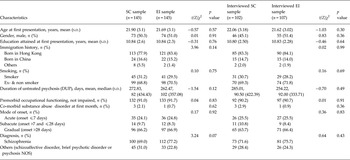
The successful interview rates for SC and EI groups were 70.3% (N = 104), and 74.3% (N = 110), respectively (see online Supplementary Fig. S1). After the longitudinal diagnostic review, six patients were excluded as they had non-schizophrenia-spectrum disorder (two patients had substance-induced psychosis, three patients had affective psychosis and one patient had delusional disorder). As a result, each group consisted of 145 patients and were all included in the longitudinal analysis. For cross-sectional interview, 102 patients from SC and 107 from the EI group were included in the final analysis. The baseline demographics and clinical characteristics of the two groups did not differ significantly (Table 1).
Baseline demographics of standard care (SC) and early intervention (EI) groups, both the complete sample and the interviewed sample

s.d., Standard deviation; NOS, not otherwise specified.
DUP refers to days between first onset of positive symptoms to presentation to the mental health service.
Premorbid occupational functioning, not impaired was defined as having open employment (part time or full time) or as a full-time student.
Diagnosis: Longitudinal diagnosis was determined based on Structural Clinical Interview for DSM-IV Axis I disorder (SCID-I; First, Reference First1997).
There was no significant group difference in the duration of conventional (Z = −0.99, p = 0.32) or atypical (Z = −0.57, p = 0.57) antipsychotic medication used over 10 years. The average daily dose of antipsychotic medication did not differ significantly between groups at year 10 (Z = −0.21, p = 0.83; mean CPZe dose of SC = 636.71, mean CPZe dose of EI = 560.99).
Primary outcome measures
Hospitalizations
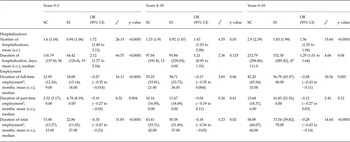
Over a 10-year period, more SC (98.6%) than EI (71%) patients had been hospitalized (χ 2 = 42.87, df = 1, p < 0.0001). Excluding the admission for the first episode, more SC (55%) than EI (45%) patients had been hospitalized (χ 2 = 4.119, df = 1, p = 0.042). The EI patients had significantly fewer hospitalizations compared to the SC patients (p < 0.0001) (Table 2) after controlling for the variables stated. Evaluating the outcomes in the first 3 years and last 7 years of the 10-year period separately, EI patients had significantly fewer number of hospitalizations compared to the SC patients over both periods and shorter duration of hospitalization during the first 3 years (Table 2).
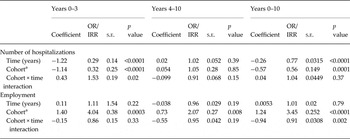
GEE was performed to analyze the longitudinal trajectories of hospitalizations in the two study groups (Table 3). The cohort term was significant over 10 years, indicating a significant difference in the number of hospitalizations between groups, with SC having increased number of hospitalizations [β = −0.57, incidence rate ratio (IRR) for EI group = 0.56, p = 0.0001]. The time effect was also significant (β = −0.26, IRR = 0.77, p < 0.0001), indicating decreasing number of hospitalizations over time. However, no significant time × cohort interaction was observed.
Considering the first 3 years only, the number of hospitalization again significantly reduced with time, and the EI cohort had significantly fewer hospitalizations (p < 0.0001). The time × cohort interaction term was also significant and positive, indicating that the number of hospitalizations of the EI group approached that of the SC group over time. When the analysis was restricted to years 4–10, the time, cohort and interactions were all non-significant.
Social and occupational function
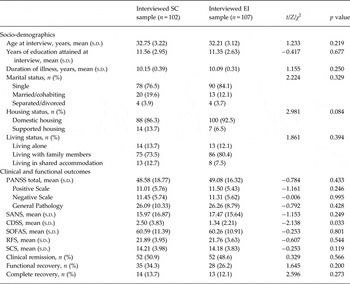
At 10-year follow up, significantly more EI patients (N = 51, 47.8%) were engaged in full-time open employment than SC patients (N = 35, 34.3%) (χ 2 = 6.71, p = 0.04). Analysis with GLM found that the group effect was significant in relation to current occupation status (effect = −0.78, s.e. = 0.32, 95% CI −1.384 to −0.018, p = 0.01). However, there was no difference between groups on SOFAS, RFS, SCS and functional recovery, which was defined based on criteria developed by Strauss et al. (Reference Strauss, Harrow, Grossman and Rosen2010) (SCS items scored ⩾2 and SOFAS total score ⩾61) (Table 4).
Months of employment were analyzed using the last-observation-carried-forward principle to manage missing data due to disengagement. After controlling for the stated covariates, EI patients had significantly more months of total employment (full time and part time) over 10 years (p < 0.0001), years 0–3 (p < 0.0001) and years 4–10 (p < 0.02). They had significantly more months of full-time employment over 10 years (p = 0.001) and years 0–3 (p < 0.0001) and more months of part-time employment for years 0–3 than the SC group (p = 0.004) (Table 2).
Longitudinal comparison of SC (n = 145) and EI (n = 145) patients on hospitalizations and employment using generalized linear model

a All duration of employment were measured in months. Duration of total employment includes both full-time and part-time employment.
SC, Standard Care; EI, Early Intervention; s.d., Standard deviation.
To compare the longitudinal trajectories of total employment in the two groups, GEE was employed (Table 3). The cohort term was significant, showing a higher probability of employment in the EI group (p < 0.0001, OR 3.45). The time × cohort interaction was significant with negative coefficient (β = −0.094, OR 0.91 for every year increase within the EI group), suggesting the employment status of the SC group approached that of the EI group over time.
Generalized estimating equation analysis on longitudinal hospitalizations and employment comparing Early Intervention (EI) and Standard Care (SC) groups

OR, Odds ratios; IRR, incidence rate ratio; s.e., standard error.
a SC, standard care, coded 0; EI, early intervention, coded 1.
OR/IRR obtained by exponentiating the coefficient estimate.
Employment includes both full-time and part-time employment, measured in months.
When the analysis was limited to the first 3 years, the cohort term was significant but the interaction term was not. When only the last 7 years was taken into account, similar results were obtained. The EI cohort achieved better employment with non-significant interaction with time, showing that the group effect did not differ significantly with time.
Secondary outcomes
Symptomatology at 10 years
At the 10-year follow-up, EI patients had significantly fewer depressive symptoms (Table 4). Covariate with medication duration, gender and DUP, the effect of group was still significant (F 1,201 = 5.78, p = 0.02) with small effect (η 2 = 0.03). However, it did not survive Bonferroni correction for multiple testing. There was no difference found on positive and negative psychotic symptoms between groups. Symptomatic remission was defined operationally (Andreasen et al. 2005). Complete recovery was defined as achieving both symptomatic remission and functional recovery. There were no significant differences between groups on symptomatic remission and complete recovery (Table 4).
Socio-demographic, clinical and functional outcomes of standard care (SC) and early intervention (EI) patients at 10 years

PANSS, Positive and Negative Syndrome scale for Schizophrenia; SANS, Scale for the Assessment of Negative Symptoms; CDSS, Calgary Depression Scale for Schizophrenia; SOFAS, Social and Occupational Functioning Assessment Scale; RFS, Role Functioning Scale; SCS, Strauss and Carpenter Scale; s.d., Standard deviation.
Clinical remission: PANSS items P1, P2, P3, N1, N4, N6, G3, G5, G9 scored ⩽3 at 10-year follow up; CGI positive and CGI negative ⩽3 for 6 months before the assessment (Andreasen et al. 2005).
Functional recovery: SCS items scored ⩾2 and SOFAS total score ⩾61 (Strauss et al. Reference Strauss, Harrow, Grossman and Rosen2010).
Complete recovery: achieving both symptomatic remission and functional recovery.
Mortality and suicidal behavior
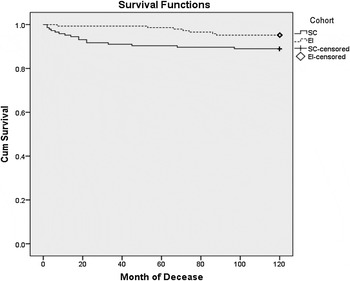
Sixteen SC patients (10.8%) and seven EI patients (4.7%) died during the 10-year period. The cause of death for 15 SC patients (10.3%) and six EI patients (4.1%) was confirmed as suicide based on clinical records and the rest were considered to be unnatural deaths. Survival analysis Mantel-Cox Log Rank tests showed that the group difference was significant in their time to death (χ 2 (1) = 4.35, p = 0.037) with SC patients dying earlier than EI patients (Fig. 1). The effect of group was still significant after controlling for the effect of gender using Cox regression analysis with a hazard ratio of EI being 0.37 (95% CI 0.145–0.642, p = 0.042).
Kaplan–Meier survival analysis with Mantel-Cox Log Rank test of mortality comparing Early Intervention (EI) and Standard Care (SC) groups. Mantel-Cox Log Rank test: (χ 2 (1) = 4.35, p = 0.037) with SC patients dying earlier than EI patients.

Using GLM analysis with Poisson distribution, group effect was significant on the total number of suicide attempts over 10 years (χ 2 = 11.47, df = 1, p = 0.001) with the EI group having fewer suicide attempts over 10 years (OR 2.97, 95% CI 1.582–5.575) after controlling for the effect of age, gender, duration of antipsychotic use and DUP.
Relapse
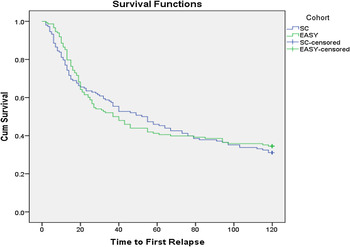
No difference was found in numbers of relapse over 10 years between groups with GLM (EI = 1.88, SC = 1.76; χ2 = 0.016, df = 1, p = 0.898). Survival analysis Kaplan–Meier test showed no significant difference (χ 2 (1) = 0.15, p = 0.69) in the time of first relapse between groups over 10 years (Fig. 2). However, more SC patients had relapse resulting in hospitalization than EI patients over the 10-year period (SC = 1.38, EI = 1.01; χ2 = 14.86, df = 1, OR 1.55, 95% CI 1.24–1.94, p < 0.0001).
Kaplan–Meier survival analysis of time to first relapse comparing Early Intervention (EI) and Standard Care (SC) groups.

Discussion
In summary, patients receiving the low-resource EI service in Hong Kong, had reduced number and shorter duration of hospitalizations, longer periods of employment, fewer suicide attempts and reduced suicide rate over 10 years compared to SC patients. At 10 years, EI patients had fewer depressive symptoms compared to SC patients although this did not survive correction for multiple testing. No difference was found between groups in psychotic symptoms, symptomatic remission and functional recovery. The longitudinal clinical and functional information collected in the current study facilitated a detailed exploration of the sustainability of the short-term effects of EI. Results suggest that the admission rate of EI patients caught up with that of SC patients but patients in the EI group still had fewer hospitalizations over the last 7 years. Regarding employment, the initial benefit of EI over the first 3 years continued although the SC group gradually approached that of EI group over 10 years.
A reduction in the number of admissions and duration of hospitalization are some of the most consistent findings of the short-term effects of the EI service and was replicated in our study. Results of GLM on the total number of hospitalizations suggest that this initial effect was still present during the last 7 years with smaller OR than that of the first 3 years. However, the longitudinal analysis with GEE found there was no effect of cohort, time and interaction over the last 7 years. In fact, the number of admissions of the EI group approached that of SC group. Moreover, the effect on the duration of hospitalization also disappeared in the last 7 years. These results suggested that some initial benefit of the EI service on hospitalization still remained after the end of the service but the effect was diluted over time. These may explain the negative findings on the number of hospitalizations after the withdrawal of the EI service in 5-year follow-up studies of LEO (Gafoor et al. Reference Gafoor, Nitsch, McCrone, Craig, Garety, Power and McGuire2010) and OPUS (Bertelsen et al. Reference Bertelsen, Jeppesen, Petersen, Thorup, Ohlenschlaeger, le Quach, Christensen, Krarup, Jorgensen and Nordentoft2008). The current study also found that more SC patients had relapse requiring hospitalization than EI patients, indicating that one of the main effects of the EI service may be allowing EI patients to better manage relapse.
There was no difference between groups in functional recovery assessed by semi-structured tools. They were higher than the recently reported functional recovery rate in patients with first-episode psychosis at 10 years, although the rate of complete recovery was similar (Austin et al. Reference Austin, Mors, Secher, Hjorthoj, Albert, Bertelsen, Jensen, Jeppesen, Petersen, Randers, Thorup and Nordentoft2013). However, when focusing mainly on employment status, a key indicator of vocational functioning, the study found a significant beneficial effect of the EI service over the 10-year period and the initial beneficial effects were sustained during the last 7 years. At 10-year follow-up, significantly more EI patients were engaged in full-time open employment than SC patients. The relatively high full-time employment rate may be explained by the relatively low unemployment rate in Hong Kong during the 2-year study period (4.3% for 2010, 3.4% for 2011, based on the Census and Statistical Department of Hong Kong). The potential calendar effect introduced by the historical design of the study was controlled for during the analysis. The smaller OR during the last 7 years suggested a dilution of effect of the EI service over time.
The current study demonstrates that the EI service had a positive effect in delaying mortality due to suicide. This was not found in other intermediate follow-up studies probably because of shorter duration of follow-up. Although the effect of early detection on mortality in the TIPS study was not specified, the mortality rate was reported (Hegelstad et al. Reference Hegelstad, Larsen, Auestad, Evensen, Haahr, Joa, Johannesen, Langeveld, Melle, Opjordsmoen, Rossberg, Rund, Simonsen, Sundet, Vaglum, Friis and McGlashan2012). In the usual-detection group (11.4%), it was similar to that in the SC group. However, in the early-detection group of TIPS (8.5%), it was almost double that of the EI group of our study. This suggested that the EI program with phase-specific case management may have a specific effect on suicide rate. One of the key elements of EI service is to improve coping skills of patients in managing their illness and stress levels. The enhancement of these skills may contribute to better management of their illness in the long-term. This can be reflected in the results that EI patients had lower number of suicide attempts over 10 years. There was also a trend reduction of depressive symptoms in the EI group compared to the SC group at 10-year follow-up.
The cultural context of the study may have also influenced the understanding of the results of the study. Hong Kong has a majority Han Chinese population with a relatively low ethnic minority and low prevalence of cannabis use (Abdullah et al. Reference Abdullah, Fielding and Hedley2002). These allow the study sample to be relatively homogenous with fewer confounding factors contributing to the outcomes. With the majority Chinese, Hong Kong is heavily influenced by the traditional Chinese culture that comprises close family ties (Lam et al. Reference Lam, Pearson, Ng, Chiu, Law and Chen2011). The current study found that more than 70% of patients in their 30s are still living with their family and the majority is single. It is possible that after the withdrawal of the EI service, family will be the main support of patients. The targeted psychoeducation and caregivers support provided by the EI service may have empowered the family to provide continuous support to patients which is likely to have a positive influence on outcomes.
One of the main limitations of the study is the potential cohort effect introduced by an historical control design. It was minimized by sample selection with 1 year difference, and was controlled statistically by adding time of first contact with the specified service as covariate. Another major disadvantage of historical control and the retrospective nature of the study over a randomized control study is that it did not allow for baseline matching of symptom severity and other indicators of illness complexity. Therefore it was difficult to ensure the comparability of the two sample groups despite all possible clinical information collected being matched between the groups in the current study. The design has also made it impossible to blind the interviewers from the patient group as most controls would have been interviewed before the EI group. The quality of the longitudinal data may be limited by the quality of clinical documentation. Of the eligible patients, 18.9% of SC and 20.9% of EI refused to participate in the study or were unable to be contacted. This resulted in a loss of valuable information.
Despite these limitations, this is the first study in Asia and one of the few in the world comparing 10-year outcomes of EI with SC. The results provide evidence about the sustainability of some of the short-term effects of the EI service, mainly the reduction of hospitalizations and improvement of vocational functioning. The overall long-term effect of the EI service provides evidence for the continual development of EI programs. The dilution of the initial short-term effect of the EI service suggests the need to evaluate its optimal duration.
Supplementary material
For supplementary material accompanying this paper visit http://dx.doi.org/10.1017/S0033291714002220.
Acknowledgements
This work was supported by Health and Health Services Research Fund, Food and Health Bureau, The Government of the Hong Kong Special Administrative Region (SMH-28). The authors thank all the psychiatric units in Hong Kong for logistic support and the patients who participated in the study.
Declaration of Interest
None.