

Introduction
In poultry diets, animal fats and vegetable oils are mostly included in diets because of their high energy concentration to support growth performance (Blanch et al., Reference BLANCH, BARROETA, BAUCELLS, SERRANO and PUCHAL1996). Enzymatic hydrolysis of lipids (oils and fats) produces fatty acids (FA) which are water insoluble. FA passes through the liquid phase of the small intestine and, after aggregating to form micelles, are absorbed as hydrophobic components. This process is naturally mediated by endogenous emulsifiers, such as bile salts. The assimilation of dietary fats in young birds is poor because they have a limited capacity to produce and secrete bile salts and lipase until their gastrointestinal tract matures at 10-14 days of age (Noy and Sklan, Reference NOY and SKLAN1998). This immaturity leads to an inability to form mixed micelles in the intestinal lumen of the birds which reduces fat digestion and absorption of nutrients (Leeson and Atteh, Reference LEESON and ATTEH1995). Studies have indicated that age has an effect on ME values and growth performance. This has led to considerable interest in the potential of exogenous emulsifier preparations in order to improve the utilisation of fats in young birds (Azman and Ciftci, Reference AZMAN and CIFTCI2004; Ashraf, Reference ASHRAF2007; Roy et al., Reference ROY, HALDAR, MONDAL and GHOSH2010).
Energy is a major cost component factor in diets of high performance animals, such as broilers. Emulsifiers can be used to improve fat digestibility and energy efficiency. As a result, lower energy diets can be formulated for birds whilst maintaining the same performance, leading to lower feed cost and more economical and sustainable production. Emulsifiers facilitate the formation of emulsion droplets, which lowers the surface tension (Ashraf, Reference ASHRAF2007), stimulates the formation of micelles, causes high levels of monoglycerides in the intestine and facilitates the nutrient transport through the membrane (Melegy et al., Reference MELEGY, KHALED, EL-BANA and ABDELLATIF2010). The use of emulsifiers in poultry diets have increased feed efficiency, lipids absorption, growth performance and modified the lipids present in the blood (Udomprasert and Rukkwamsuk, Reference UDOMPRASERT and RUKKWAMSUK2006). However, other researchers reported that the supplementation of emulsifiers in diet elevated digestibility of nutrients, but has less effect on carcass traits and growth performance (Xing et al., Reference XING, HEUGTEN, LI, TOUCHETTE, COALSON, ODGAARD and ODLE2004; Jones et al., Reference JONES, HANCOCK, HARMON and WALKER1992).
Low cost emulsifying agents or detergents which transform a hydrophobic surface into a hydrophilic environment have been used to increase fat digestibility in young chicken (Al-Marzooqi and Leeson, Reference AL-MARZOOQI and LEESON1999). Soy lecithin is a known emulsifier which promotes incorporation of fatty acids into micelles and improves fat digestibility in chicken (Polin, Reference POLIN1980). Polyoxyethylene glycol mono- and dioleates are synthetic emulsifiers and have been used on other animals, such as pigs, although in vivo emulsification tests indicated that synthetic emulsifiers were not as effective as bile salts (Frobish et al., Reference FROBISH, HAYS, SPEER and EWAN1969). However, the demand of using exogenous emulsifiers in broiler diets must be looked into the use of nutrient dense diets containing supplied fat that is almost usual to take advantage of the full growth potential in fast growing broiler strains.
The main purpose of this review is to highlight the importance and uses of emulsifiers in the broiler industry, for assisting greater awareness for researchers, scientists, veterinary professionals, poultry producers/owners as well as examining applications in the poultry industry.
Digestibility problems in young chicks
Commercial poultry feeds are commonly supplemented with fats and oils to provide higher energy density. However, it must be considered that fat absorption increases with bird age, as young broilers have a physiological limitation to absorb that nutrient (Jeason and Kellog, Reference JEASON and KELLOG1992; Nir et al., Reference NIR, NITSAN and MAHAGUA1993; Lima et al., Reference LIMA, PIZAURO, MACARI and MALHEIROS2003). The inability of young birds to absorb fat efficiently has been attributed to its poor emulsification ability and poor lipase activity; however, these biological processes improve with the age and adapt to cope with higher unsaturated fatty acids (Meng et al., Reference MENG, SLOMINSKI and GUENTER2004).
However, the addition of high levels of saturated fat to broiler rations may result in excessive visceral and carcass fat, inadequate vitamin A and E and poorer meat quality (Chae et al., Reference CHAE, LOHAKARE and CHOI2006; Zulkifli et al., Reference ZULKIFLI, HTIN, ALIMON and LOH BEJO2007). Differences in the digestibility of various fats affects animal performance, especially in non-ruminants, and the composition of dietary lipids is an important factor for the digestibility of the fat and therefore the extent to which it can be used as a source of metabolisable energy in chickens (Wiseman, Reference WISEMAN1984). It has been established that the addition of fat containing a high proportion of unsaturated fatty acids and/or phospholipids to one with a preponderance of saturation will enhance the absorption and subsequent dietary energy value of the latter (Renner and Hill, Reference RENNER and HILL1961; Sibbald, Reference SIBBALD1978; Sibbald and Kramer, Reference SIBBALD and KRAMER1980; Leeson and Atteh, Reference LEESON and ATTEH1995; Smits et al., Reference SMITS, MOUGHAN and BEYNEN2000). Phospholipids are known to have surface active properties. They are important in the emulsification of lipids and may influence the absorption of fatty acids in the small intestine (Jenkins et al., Reference JENKINS, GIMENEZ and CROSS1989).
What are emulsifying agents?
An emulsifying agent is a substance that stabilises an emulsion and prevents the coalescence of the globules of the dispersed phase. An emulsion is a mixture of two products such as oil and water that do not mix together i.e. that are immiscible. Adding an emulsifying agent (emulsifiers or emulgents) to the mixture causes the oil to be broken down into smaller pieces that can then be dispersed throughout the water. The emulsifier's action is made possible by reducing the tension between the two phases and creating a constant interfacial film.
In the formulation of a stable emulsion, selecting suitable agents is important as different types have variable effects. Soluble substances in both fat and water allow fat to be equally dispersed in water as an emulsion. These substances have both a hydrophilic and lipophilic component in their chemical structure. The emulsifiers are absorbed into the oil-water interface to provide a defensive barrier around the dispersed droplets. They stabilise the emulsion by reducing the interfacial tension of the system. Some emulsifying agents increase constancy by imparting a charge on the droplet surface, thus lowering the physical contact between the droplets and reducing the potential for coalescence. Some commonly used emulsifying agents include sodium dioctyl sulphosuccinate, sodium laurylsulphate, tragacanth and other polymers known as the Spans and Tweens.
Fats are insoluble in water and cannot be solubilised in the gastrointestinal tract, and have to be emulsified before lipolytic enzymes can digest them. Emulsification depends on the characteristics of the fat such as chain length, position of fatty acids on the triglycerides and fat saturation (Gu and Li, Reference GU and LI2003). Emulsifiers help to improve the utilisation of lipids, particularly animal fats, and play a role in performing the insufficiencies of naturally low bile production and recirculation in young birds.
Commercial agents which are usually used in the feed industry can be categorised as two groups (natural and synthetic emulsifiers). Natural ones are those produced in the animal body such bile and phospholids, and those from food materials such as soy lecithin (Soares and Lopez-Bote, Reference SOARES and LOPEZ-BOTE2002) Synthetic emulsifiers that are modified emulsifiers such as lysolecithin or lysophosphatidylcholine (Zhang et al., Reference ZHANG, HAITAO, ZHAO, GUOAND and BARRI2011).
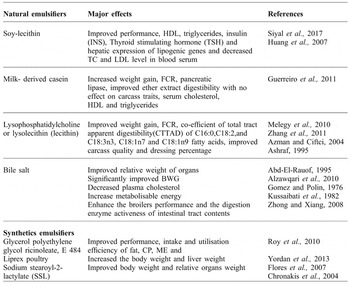
Bile salts are natural emulsifiers, and monoglycerides formed after hydrolysis of fat act as emulsifiers. However, the capacity of these natural emulsifiers can be a constraint for fat digestion. Young birds have inadequate portions of bile salt production so fat digestibility is poor in the early stage of life, and the characteristics of dietary fat can limit digestibility. High amounts of free fatty acids cause poor monoglyceride formation and consequently have a poor emulsifying capacity. Long chain unsaturated fatty acids and monoglycerides form micelles rapidly, whereas saturated fatty acids have low ability to form micelles because of their weak polarity. A list of emulsifiers that are usable in poultry industry is presented in Table 1 .
Available emulsifiers used in poultry industry.

Hydrophilic-lipophilic balance
The combination of hydrophilic and lipophilic characteristics in one molecule gives it the distinctive property that the emulsifier can dissolve in fat as well as in water, and can aid in mixing the two fractions. The key indicator for selecting an emulsifier is hydrophilic-lipophilic balance (HLB), ranging from 0 to 20 which reveals the degree of fat or water solubility. Lower HLB indicates a more lipophilic or fat-soluble emulsifier. On the other hand, higher HLB indicates a more water soluble or hydrophilic emulsifier.
Ideally, the emulsifier should be soluble in the continuous phase as the Bancroft rule states (1912). For the soluble condition known as the ‘fat-rich environment’ mixed in a small amount of water, an emulsifier with a lower HLB is advised, and vice versa. Because of birds consume water 1.5-2 times more than feed; the diet should contain a small amount of fat and the water amount should exceed fat in digestive tract. In this situation, a high HLB is more appropriate.
Use of emulsifiers in animal diet
Use of exogenous emulsifier can be made necessary due to supplementing high levels of vegetable or animal fat for improving growth potential. Fat utilisation in young birds is poorly developed and a marked improvement of the apparent metabolisable energy (AME) value of fats has been reported in birds that are 1.5 to 3.5 weeks of age (Wisman and Salvador, Reference WISMAN and SALVADOR1989). Natural emulsifiers like soy lecithin cause absorption of fatty acids into micelles and improve fat digestion in chicks (Polin, Reference POLIN1980). Lecithin structure contains choline which is effective in preventing perosis in birds (Schaible, Reference SCHAIBLE1970).
Synthetic emulsifiers like polyoxyethylene glycol mono and dioleates gave good results in utilisation of fat (Frobish et al., Reference FROBISH, HAYS, SPEER and EWAN1969). An emulsifier in the diet is helpful to increases the total enzymatic surface needed for digestion of fats (Jones et al., Reference JONES, HANCOCK, HARMON and WALKER1992; Roy et al., Reference ROY, HALDAR, MONDAL and GHOSH2010).
There are several emulsifiers that have been used in animal/poultry diets and gave good results i.e. soy-lecithin, a by-product from the processing of soybean oil, which not only makes available more energy to broilers, but also serves as an emulsifier to enhance digestion of fat. Jin et al. (Reference JIN, KIM, HAN, JING and WON1998) reported that adding lecithin to tallow improved the digestibility of gross energy, dry matter, ether extract and crude protein in piglets. Lecithin has been considered for using in animal diets, such as sheep (Jenkins and Fotouhi, Reference JENKINS and FOTOUHI1990), lambs (Lough et al., Reference LOUGH, SOLOMON, RUMSEY, ELSASSER, SLYTER, KAHL and LYNCH1991), horses (Holland et al., Reference HOLLAND, RONFELD, RICH and KLINE1998), swine (Overland et al., Reference OVERLAND, MROZ and SUNDSTOL1994; Soares and Lopez-Bote, Reference SOARES and LOPEZ-BOTE2002), fish and crustacean larviculture (Coutteau et al., Reference COUTTEAU, GEM-DEN, CAMARA, BERGOT and SORGELOOS1997), but has limited data in poultry. Among emulsifying agents, casein has become an important feed additive. The main source of casein is skimmed milk powder and soluble caseinates, which are heterogeneous protein aggregates, and are the most important components included in the emulsification of beta-casein, and proline residues (Araujo, Reference ARAUJO1999). Supplementation of bile salts in poultry diets increased fat digestion but this may not be economically viable (Al-Marzooqi and Leeson, Reference AL-MARZOOQI and LEESON1999). Synthetic emulsifiers like polyoxyethylene glycol mono and dioleates have been used in pig diets but not in poultry as yet, although the in vivo emulsification of fat by the synthetic emulsifiers was not as efficient as that obtained with bile salts (Frobish et al., Reference FROBISH, HAYS, SPEER and EWAN1969).
Major effects of emulsifier substances
Supplementation with emulsifiers in poultry feed has been determined to increase utilisation efficiency of dietary fat and improve live body weight and FCR in broiler chickens (Siyal et al., Reference SIYAL, EZZAT ABD EL-HACK, ALAGAWANY, WANG, WAN, HE, WANG, ZHANG, ZHONG, WANG and DHAMA2017; Dierick and Decuypere, Reference DIERICK and DECUYPERE2004; Jones et al., Reference JONES, HANCOCK, HARMON and WALKER1992). Supplying an emulsifier in broiler diet is more important during the early age (Sell et al., Reference SELL, KROGDAHL and HANYU1986) because lipase activity in chickens reaches at its peak usually during 40-56 days of age (Krogdahl and Sell, Reference KROGDAHL and SELL1989). In addition, synthesis of bile salts remains at a low level in early birds (Serafin and Nesheim, 1970; Smallwood et al., Reference SMALLWOOD, LESTER, BROWN, PIASECKI and JACKSON1970; Reference SMALLWOOD, LESTER, PLASECKI, KLEIN, GRECO and JACKSON1972), and bile salts added to diets caused better fat absorption (Polin, Reference POLIN1980) and improved performance in young chickens (Frobish et al., Reference FROBISH, HAYS, SPEER and EWAN1969; Jones et al., Reference JONES, HANCOCK, HARMON and WALKER1992; Overland et al., Reference OVERLAND, MROZ and SUNDSTOL1994; Jin et al., Reference JIN, KIM, HAN, JING and WON1998; Dierick and Decuypere, Reference DIERICK and DECUYPERE2004; Dersjant and Peisker, 2005). Birds supplemented with 0.5% soy-lecithin and 1.5% soy-oil increased performance, while chickens fed with 2% lecithin revealed poor performance (Huang et al., Reference HUANG, YANG and WANG2007).
Exogenous emulsifiers used in broiler diet revealed that these synthetic products caused no increase in morbidity and mortality (Guerreiro Neto et al., Reference GUERREIRO NETO, PEZZATO, SARTORI, MORI, CRUZ, FASCINA, PINHEIRO, MADEIRA and GONÇALVEZ2011) and do not affect feed intake (Ashraf, Reference ASHRAF2007; Roy et al., Reference ROY, HALDAR, MONDAL and GHOSH2010; Guerreiro Neto et al., Reference GUERREIRO NETO, PEZZATO, SARTORI, MORI, CRUZ, FASCINA, PINHEIRO, MADEIRA and GONÇALVEZ2011; Yao et al., Reference YAO, WANG, DING, FU, LIU, ZHU, LIU, LI, KANG, YIN, WU and HOU2012). Lysophosphatidyl choline acted as an emulsifier on broiler chicken performance, but did depend on the type of oil (Zhang et al., Reference ZHANG, HAITAO, ZHAO, GUOAND and BARRI2011). Emulsifiers are more effective in birds supplemented with soybean oil (rich in polyunsaturated fatty acids), in comparison with palm oil (saturated fat) (Guerreiro Neto et al., Reference GUERREIRO NETO, PEZZATO, SARTORI, MORI, CRUZ, FASCINA, PINHEIRO, MADEIRA and GONÇALVEZ2011). Various researchers reported beneficial results on digestibility, BW, FCR, weight gain and abdominal fat in broiler chicks, respectively caused by with exogenous emulsifiers (Udomprasert and Rukkwamsuk, Reference UDOMPRASERT and RUKKWAMSUK2006; Roy et al., Reference ROY, HALDAR, MONDAL and GHOSH2010). However other reports on broiler chicken trials showed that exogenous emulsifier has no significant effect on productive indicators and lipid profile, however it improved ME and palm oil (Yordan et al., Reference YORDAN, JOHANNA, ROMAN, JAVIER, LIU and CESAR2013).
Effects on serum parameters
Concentrations of lipoproteins and plasma lipids are representative of metabolic regulation and the basal adjustment of fatty acid transfer between the adipose tissue and the liver (Amal et al., Reference AMAL, MICHEL, SOLANG and MARYLINE2002). Studies have determined that lecithin, a phosphatidylcholine containing phospholipid, has hypocholesterolemic properties (Thomas et al., Reference THOMAS, CRAIG and ROBERT1998). Huang et al. (Reference HUANG, YANG and WANG2007) reported birds fed a diet supplemented with soy-lecithin resulted in a lower serum concentration of total cholesterol (TC) and LDL- C (Jones et al., Reference JONES, HANCOCK, HARMON and WALKER1992; Thomas et al., Reference THOMAS, CRAIG and ROBERT1998), whereas serum concentrations of HDL-C and triglyceride (TG) were elevated. In a further study, soybean emulsifier products significantly reduced total and LDL-cholesterol and TG levels (Ristic et al., Reference RISTIC, RISTIC and TEPSIC2003) whereas HDL cholesterol was significantly elevated and phospholipid fatty acid content was optimised after 24 weeks feeding.
Plasma metabolic hormones like insulin, glucagon and T3 are valuable factors which indicated the level of hepatic lipogenesis of birds (Hillgartner et al., Reference HILLGARTNER, SALATI and GOODRIDGE1995). It has been observed that circulating levels of thyroid stimulating hormone (TSH) increased when 2% crude soybean lecithin was supplemented in broiler diets, but no significant differences were observed on serum free fatty acids (FFA) and T4, although T3 concentration declined compared with other groups (Huang et al., Reference HUANG, YANG and WANG2007).
Conclusions
Exogenous nutritional emulsifiers can be helpful in digestion of fatty acids. Clearly, the positive effect of adding such emulsifiers is indicated in poorly digestible fats than highly digestible fats. This positive effect is more noteworthy when high levels of fats are included in diets. However, with higher level of digestible fats, positive effects have still been observed. The efficacy of emulsifiers depends upon the type of oil used in the broiler diets. The function of nutritional emulsifier is to enhance the digestibility of long chain fatty acids, especially saturated fatty acids (SFA) C16 and C18. Hence emulsifiers could have an important role in economic aspects in poultry industry since they increase efficiency in digestion of both animal and vegetable fats. Metabolisable energy of the diet is a key factor and emulsifiers have showed positive results on performance, fat digestibility, immune response and blood metabolic hormones while used in a high ME diet.
The selection of an emulsifier and type of oil is an important step for obtaining good performance results. The HLB should be used as part of the selection process, as it indicates fat and water solubility on a range from zero to 20. Lower HLB products are more fat soluble, while higher HLBs are more water soluble. When feeding poultry, a higher number would be desirable because the content of the gut is more watery. However, no one has focused on the economy of oil and emulsifiers used in poultry rations. Most of the research has been conducted on soya bean oil, although palm oil is more economical and shows better performance. From the available literature, it is clear that attention must be paid to the type of oil used in feed and applying cheaper emulsifiers in order to formulate more economical diets as well as to explore the efficacy of emulsifiers in the broiler diets.
In addition, that no one has focused on the humidity and temperature; because both have a great impact on performance of broilers and the utilisation of concentrated energy forms such as fat and more attention is needed on the efficacy of emulsifiers when ambient temperature and humidity is high. Most studies have been conducted in broilers and other poultry species should be investigated to give expected outcomes from fat and emulsifier use. No one has paid interest to the blends of emulsifying agents, because there are both natural and synthetic sources of emulsifier, and this would be useful to understand to allow optimal emulsification recommendations. Not only this, but most of the studies are conducted on natural emulsifiers therefore some importance must be given to synthetic or exogenous emulsifying agents. Studies have focused on in vivo studies therefore; in future in vitro studies are need to be conducted on natural as well as synthetic emulsifiers.