Implications
In steer production systems, castration and weaning are the main stressors experienced by calves. In this study, the effect of weaning conducted concurrently or consecutively with castration by the Burdizzo method on the stress response and performance was evaluated. Calves that were castrated and weaned concurrently did not show an enhanced response to the management procedures. Compared with Burdizzo castration, weaning was found to be the greater stressor for the animals. This highlights that applying both treatments at the same time does not markedly increase the stress response compared with performing these procedures at intervals of a few weeks.
Introduction
In steer production systems, castration is, apart from weaning, the major management procedure causing distress in calves, which can lead to reduced feed intake, growth rates and even weight loss during the first weeks after the procedures are conducted (Arthington et al., Reference Arthington, Eicher, Kunkle and Martin2003; Ting et al., Reference Ting, Earley, Veissier, Gupta and Crowe2005; Warnock et al., Reference Warnock, Thrift, Irsik, Herson, Yelich, Maddock, Lamb and Arthington2012).
Weaning is commonly practised by abrupt separation characterized by physical separation of mother and young and includes the immediate milk withdrawal for the calves. Calves respond to weaning with increased vocalizations, agitation, walking activity and reduced feed intake and rumination (Veissier and Le Neindre, Reference Veissier and Le Neindre1989; Haley et al., Reference Haley, Bailey and Stookey2005) resulting in a suppressed immune system and enhanced disease susceptibility (Lefcourt and Elsasser, Reference Lefcourt and Elsasser1995).
An alternative weaning strategy is two-stage weaning with the calves being prevented from suckling the dam by fitting an anti-suckling device (nose-flap) before they are separated from the dam (Haley et al., Reference Haley, Bailey and Stookey2005; Boland et al., Reference Boland, Scaglia, Swecker and Burke2008). Studies in lambs emphasized the suitability of this method to reduce weaning stress (Schichowski et al., Reference Schichowski, Moors and Gauly2008). As another alternative, fence-line weaning allows the calf to have a certain level of social contact to the dam for several days while being prevented from suckling (Stookey et al., Reference Stookey, Schwartzkopf-Genswein, Waltz and Watts1997; Price et al., Reference Price, Harris, Borgwardt, Sween and Connor2003). However, these methods have drawbacks, and are for several reasons not widely used under practical conditions to reduce weaning stress in beef calves.
Castration of the male calves causes a degree of pain and stress, whereas the animal’s response to it is probably dependent on several factors such as the age, method of castration, and use of anaesthetics and analgesics (Ting et al., Reference Ting, Earley, Hughes and Crowe2003; Coetzee et al., Reference Coetzee, Lubbers, Toerber, Gehring, Thomson, White and Apley2008; Currah et al., Reference Currah, Hendrick and Stookey2009). The most commonly used physical castration methods can be divided into methods in which the testicles are removed surgically or the blood supply is eliminated (Stafford and Mellor, Reference Stafford and Mellor2005). Cutting off the blood supply with elastic rubber rings is labour extensive and a safe method, though the animal well-being is impacted (Booker et al., Reference Booker, Abutarbush, Schunicht, Pollock, Perrett, Wildman, Hannon, Pittman, Jones, Jim and Morley2007; Stafford, Reference Stafford2007). Therefore, this procedure is forbidden in some countries like Germany. Alternatively, it can be done by using a Burdizzo clamp, which application causes the crushing of the spermatic cords and associated blood vessels within the scrotum, leaving the scrotum intact without any wound. Castration by the Burdizzo method is frequently used in various countries (Stafford et al., Reference Stafford, Mellor and McMeekan2000; Boesch et al., Reference Boesch, Seiner and Stauffacher2006; Coetzee et al., Reference Coetzee, Nutsch, Barbur and Bradburn2010). During the first days after castration, a swelling of the scrotum is reported independent of the age of the calves at castration (Molony et al., Reference Molony, Kent and Robertson1995; Ting et al., Reference Ting, Earley, Veissier, Gupta and Crowe2005; Pang et al., Reference Pang, Earley, Gath and Crowe2008).
For the assessment of the stress caused by either weaning or castration, vocalization is a useful indicator measuring the response of the calves to distress, signalling the physiological and emotional state, motivations and intentions of the calling animal (Watts and Stookey, Reference Watts and Stookey2000). Furthermore, changes in the behaviour of the calves can be observed following weaning (Veissier and Le Neindre, Reference Veissier and Le Neindre1989; Haley et al., Reference Haley, Bailey and Stookey2005) and castration (Molony et al., Reference Molony, Kent and Robertson1995) such as in increased agitation, walking activity and reduced feed intake and rumination.
Changes in different blood traits can also be observed following stressful situations. These changes are expressed as an increase in leucocyte numbers and a decreased proportion of lymphocytes following weaning (Hickey et al., Reference Hickey, Drennan and Early2003; Lynch et al., Reference Lynch, Earley, McGee and Doyle2010). After castration increased numbers of leucocytes are commonly found (Ting et al., Reference Ting, Earley, Hughes and Crowe2003). Arthington et al. (Reference Arthington, Eicher, Kunkle and Martin2003) reported that acute-phase proteins, which are inflammatory mediators, increased after weaning and transportation.
The easiest way to reduce weaning stress is to minimize other management processes undertaken at the same time as weaning. However, studies evaluating the effects of weaning conducted concurrently or consecutively to castration on stress responses of beef calves are unknown. Therefore, the objective of this study was to evaluate the effect of castration on the stress response assessed by behavioural observations as well as blood traits and performance of calves weaned at the same time of castration or 4 weeks afterwards.
Material and methods
The study was conducted on the experimental farm of the Georg-August-University Göttingen, Germany. The farm is located in Lower Saxony at an altitude of 220 to 280 m above sea level with an average precipitation of 900 mm per year and an average annual temperature of 8.2°C.
Animals, treatments and management
Over 2 consecutive years, a total of 64 male beef calves (Limousin×Blonde d` Aquitaine and Aubrac×Blonde d` Aquitaine crossbreds) born in spring were examined in this study. At the end of the pasture season, when the calves were aged 6 to 7 months and weighed 253 kg (s.e. 6.0 kg) on average, the cow–calf pairs were moved from the pasture to the barn and kept in four straw-bedded compartments of equal sizes, thus each pen accommodated eight cow–calf pairs. After 1 week, which was defined as week 0, the 64 studied calves (n=32 per year) were assigned to a 2×2 factorial design with the two factors castration and weaning: (1) Castrated and concurrently weaned in week 0 (CAS-WEA); (2) castrated in week 0 and weaned in week 4 (CAS-CON); (3) bulls weaned in week 0 (BUL-WEA); and (4) bulls weaned in week 4 (BUL-CON).
One week before castration, all animals of the suckler cow herd were moved from pasture into the barn. After weighing, the cow–calf pairs of the four different treatment groups were allocated to one of four straw-bedded compartments of equal size, thus each pen accommodated eight cow–calf pairs. At the day of castration, all calves were weighed and a blood sample was collected from each individual animal as described below. CAS-WEA and BUL-WEA calves were separated from their dams into two straw-bedded pens of equal sizes adjacent to each other (12.4 m2/calf) within auditory distance of their dams. Thus, the weaned calves and their dams were able to have vocal communication with each other. There was a feed bunk in front of the pen with 1.1 m/calf. The animals of the castrated and intact bull groups were able to have visual, tactile and olfactory contact to each other.
CAS-CON and BUL-CON calves remained with their dams in their respective pens for another 4-week period. After this period, weaning was done by separating the calves from their dams and placing them into the weaning barn. They were housed in the same way as described for the other two groups. After weaning of the CAS-CON and BUL-CON calves, all calves of the trial were kept in the weaning barn for a period of 3 weeks. After this 3-week period, all calves were regrouped within castration group, and moved into a further separate stable for the following fattening period.
As long as the calves were housed with their dams, they had access to the cows’ feed (straw and grass silage). The weaned animals were supplied with a feeding ration consisting of grass silage (9.9 MJ metabolizable energy/kg; 16.5% CP), but without any concentrates. One week before the fattening period started, the feeding ration of the calves was replaced stepwise by maize silage. During the fattening period, the animals were offered maize silage ad libitum and an additional amount of 2.5 kg concentrate per animal and day. The concentrate consisted of field bean (65%), barley (32%) and minerals (3%).
Castration and blood sampling
The Burdizzo castration of the calves was performed between 6 and 7 months of age in accordance to the German Animal Welfare law by an experienced veterinarian in week 0. The animal was restrained first in a crush and additional ropes were used to hold its hind legs in a spread position to prevent injuries to the veterinarian due to movements of the animal. Calves received an injection of xylazine (0.25 ml/100 kg BW) through the distal pole of each testicle. The castration was performed from behind through the legs of the calf. Each spermatic cord was crushed twice using the Burdizzo tool.
Blood was collected by jugular venipuncture weekly until 5 weeks following castration. The values measured in week 0 were used as pre-treatment baseline values, and therefore blood samples were taken before the treatment procedures (castration and weaning) were conducted. Similarly, in week 4 blood sampling was performed immediately before the weaning of the CAS-CON and BUL-CON animals. Unclotted whole blood samples collected into EDTA tubes were analysed for neutrophil and lymphocyte counts using a blood analyser (Cell-Dyn 3500CS; Abbott Laboratories, Abbott Park, IL, USA) at the Institute of Veterinary Medicine of the Georg-August-University Göttingen, Germany. Neutrophil and lymphocyte counts were used to calculate the neutrophil : lymphocyte ratio.
Blood samples for plasma haptoglobin determination were collected into heparinized tubes and centrifuged at 3000 r.p.m. at room temperature for 10 min at the laboratory of the Department of Animal Science, Georg-August-University Göttingen, Germany. Plasma was subsequently stored at −20°C until assayed for the acute-phase protein haptoglobin at the Institute of Animal Sciences, University of Bonn, Germany, as described by Orro et al. (Reference Orro, Jacobsen, LePage, Niewold, Alasuutari and Soveri2008).
Behavioural observations
Direct observations were performed to determine the calves’ behaviours using the scan sampling methodology. The animals were not able to see the observer to ensure that its presence did not impact the animal behaviour. Observations were conducted on days 1, 2 and 3 after weaning and/or castration. In detail, CAS-WEA and BUL-WEA were observed on days 1, 2 and 3 of week 0 and CAS-CON and BUL-CON of week 4. The animals were observed for a total duration of 5 h/day consisting of hourly observation periods (0900–1000, 1100–1200, 1300–1400, 1500–1600 and 1700–1800 h). During these 5 observation hours, the number of vocalizations of each group was counted by continuous sampling for 10-min periods. Observations were performed alternately between castrated and bull groups. Thus, each group was monitored for three 10-min periods/h and 15 periods/day.
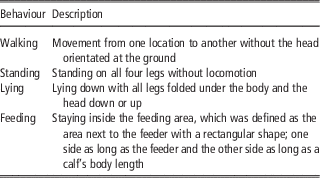
The calves’ behaviour was recorded by scan sampling at 10-min intervals during the 5 observation hours as listed above. Data were recorded for 15 times/day in each group. The behaviour was classified into feeding, lying, standing and walking (Table 1), though standing and walking were combined and are named standing/walking in the following. In each group, the number of calves performing each of these behaviours was counted at the current sample points. For each of the sampling points, the percentage of calves per group performing the respective behaviours was calculated. In year 1, data were recorded using video monitoring and in year 2 by direct observations. In both years all the vocalization and behavioural observations were recorded by the same person.
Ethogram of behavioural observations

Growth performance and slaughter traits
BW of each calf was recorded weekly starting 1 week before until 7 weeks after castration. Average daily gain (ADG) was calculated for 3 weeks following castration, and 3 weeks (weeks 4 to 7) following weaning.
The animals were slaughtered at 17 months of age at a commercial abattoir. BW at slaughter, ADG from birth to slaughter, carcass weight and dressing percentage were recorded. Following slaughter, the carcasses were graded based on the EU beef carcass classification system into the EUROP categories (E=5=excellent, U=4=very good, R=3=good, O=2=fair or P=1=poor) and the fat classes (1=low, 2=slight, 3=average, 4=high or 5=very high).
Statistical analysis
The 2×2 factorial design was analysed using the SAS program, version 9.2 (SAS Institute Inc., Cary, NC, USA). All variables were analysed using the MIXED procedure to test for differences. Data are presented as least square means and pooled standard errors. Multiple comparisons were done by applying the Tukey test with a probability level at P<0.05.
For behaviour traits, the group of calves was defined as experimental unit. Data were analysed considering the following model:
 $$y_{{ijklm}} =\mu {\plus}{\rm Y}_{i} {\plus}{\rm W}_{j} {\plus}{\rm C}_{k} {\plus}{\rm D}_{l} {\plus}{\rm W}_{j} {\times}{\rm C}_{k} {\plus}{\rm W}_{j} {\times}{\rm D}_{l} {\plus}{\rm C}_{k} {\times}{\rm D}_{l} {\plus}e_{{ijklm}} $$
where y ijklm is the the m th observation; µ the overall mean; Y i the fixed effect of year (i=1, 2); W j the fixed effect of weaning group (j=week 0, week 4); C k the fixed effect of castration group (k=castrates, bulls); D l the fixed effect of day after weaning (l=1, 2, 3); W j ×C k the interaction between weaning and castration group; W j ×D l the interaction between weaning group and day; C k ×D l the interaction between castration group and day; and e ijklm the random residual.
Haematological traits (haptoglobin, percentage of neutrophils and lymphocytes and neutrophil : lymphocyte ratio) were analysed using a repeated measures ANOVA (MIXED procedure) with the individual calf as experimental unit applying the following model:
 $$y_{{ijklm}} =\mu {\plus}{\rm A}_{i} {\plus}{\rm W}_{j} {\plus}{\rm C}_{k} {\plus}{\rm T}_{l} {\plus}{\rm W}_{j} {\times}{\rm C}_{k} {\plus}{\rm W}_{j} {\times}{\rm T}_{l} {\plus}{\rm C}_{k} {\times}{\rm T}_{l} {\plus}e_{{ijklm}} $$
where y ijklm is the l th observation; µ the overall mean; A i the fixed effect of year (i=1, 2); W j the fixed effect of weaning group (j=week 0, week 4); C k the fixed effect of castration group (k=castrates, bulls); T l =repeated effect of week (l=0 to 7); W j ×C k the interaction between weaning and castration group; W j ×T l the interaction between weaning group and week; C k ×T l the interaction between castration group and week; and e ijklm the random residual. Because the weaning group×week and weaning×castration interactions were not significant for any of the traits, it was deleted from the model. An unstructured covariance matrix was used within animal. The baseline values measured in week 0 were included as a covariate.
Performance data (BW, ADG) were analysed using the MIXED procedure with the fixed effects of year, weaning group, castration group and the interaction between weaning and castration group. Because the castration×weaning group interaction and the castration group×week interaction were not significant for any of the traits, they were deleted from the model.
The analysis for the carcass traits (conformation and fat classes 1 to 5) was done with the NPAR1WAY procedure and the treatment groups were compared pairwise with the Wilcoxon rank sum test assuming a probability level of P<0.05.
Results
Behaviour
The number of vocalizations during the first 3 days following weaning was affected by the castration (P<0.01) and weaning group (P<0.001), its interaction (P<0.01) as well as the interaction between castration and day (P<0.001) (Table 2). On day 1 after weaning, the number was higher in the CAS-WEA and BUL-WEA groups than in the CON groups that were weaned in week 4. From days 1 to 3, the vocalizations decreased steadily in all groups and nearly reached zero after this period. Only day affected time spent feeding (P<0.05). Feeding duration decreased from days 1 to 2 and increased again towards day 3 in all groups. The proportion of animals standing/walking was lower on days 1 and 2 in the WEA groups compared with the CON groups. On day 3, the calves of all groups spent about 30% of their time standing/walking. Weaning affected lying duration, too (P<0.001). Groups CAS-CON and BUL-CON spent 20% of the time lying on the 1st day after weaning compared with 40% in CAS-WEA and BUL-WEA animals, though the lying duration increased at a higher rate within 3 days after weaning in the former groups.
Effect of castration (CAS) and weaning (WEA) in beef calves castrated and concurrently weaned in week 0 (CAS-WEA); castrated in week 0 and weaned in week 4 (CAS-CON); not castrated and weaned in week 0 (BUL-WEA); and not castrated and weaned in week 4 (BUL-CON) on the behaviours during the first 3 days after weaning (n=16)

PSE=pooled standard error; C=effect of castration; W=effect of weaning; D=effect of day; ns=not significant.
*P<0.05; **P<0.01; ***P<0.001.
1 The number of calls was recorded for three 10-min periods/h for 5 h/day.
2 Feeding, standing/walking and lying were recorded by scan sampling at 10-min intervals for 5 h/day and the percentage of calves in each group performing each of these behaviours was calculated at the distinct sampling points.
Blood traits
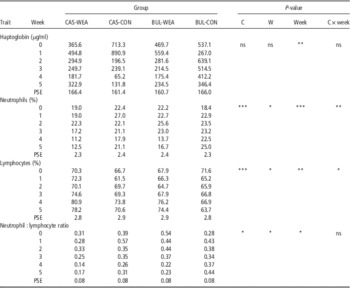
Haptoglobin concentrations decreased during the first 5 weeks of the experiment in all groups independent of castration, weaning group or its interaction (Table 3). The proportion of neutrophils and lymphocytes were affected by castration (P<0.001) and weaning group (P<0.05), week (P<0.01) and castration group×week interaction (P<0.01). In detail, the percentage of neutrophils decreased from the peak in weeks 2 and 3 in CAS-CON and CAS-WEA animals, respectively, whereas in BUL groups the change over time was less pronounced. The proportion of lymphocytes changed vice versa. Castration (P<0.05) and weaning group (P<0.05) as well as week (P<0.05) affected the neutrophil : lymphocyte ratio. Though the change over time was not different between castration and weaning groups, the ratio was greater in CAS when compared with BUL animals (P<0.05) and greater in WEA than in CON calves (P<0.05).
Effect of castration (CAS) and weaning (WEA) in beef calves castrated and concurrently weaned in week 0 (CAS-WEA); castrated in week 0 and weaned in week 4 (CAS-CON); not castrated and weaned in week 0 (BUL-WEA); and not castrated and weaned in week 4 (BUL-CON) on blood traits (n=16)

C=effect of castration; W=effect of weaning; PSE=pooled standard error; ns=not significant.
*P<0.05; **P<0.01; ***P<0.001.
Performance and slaughter traits
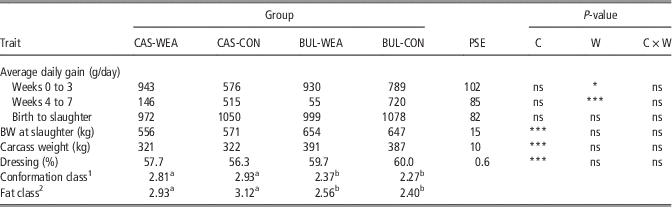
ADG during weeks 0 to 3 and weeks 4 to 7 were only affected by weaning (P<0.05). After the WEA groups were separated from their dams, they showed an increased weight gain during weeks 0 to 3 and a reduced weight gain during 4 to 7 weeks in comparison with CON animals that did not respond to weaning with reduced weight gains from weeks 4 to 7. For the ADG from birth to slaughter, none of the effects was significant (P>0.05). At slaughter, bulls were about 80 kg heavier than castrates (P<0.05). The carcass weight differed between castrates and bulls by about 70 kg (P<0.05). Consequently, the dressing percentage of bulls was superior to castrates by 2 to 3% (P<0.05). Castrates were also scored superior in the conformation and fat class than bulls (P<0.05; Table 4).
Effect of castration (CAS) and weaning (WEA) in beef calves castrated and concurrently weaned in week 0 (CAS-WEA); castrated in week 0 and weaned in week 4 (CAS-CON); not castrated and weaned in week 0 (BUL-WEA); and not castrated and weaned in week 4 (BUL-CON) on performance and slaughter traits (n=16)

C=effect of castration; W=effect of weaning; PSE=pooled standard error; ns=not significant.
a,bValues within a row with different superscripts differ significantly at P<0.05.
1 Conformation classes: E=5, U=4, R=3, O=2, P=1.
2 Fat classes: 1=low to 5=very high.
*P<0.05; **P<0.01; ***P<0.001.
Discussion
Behaviour
Our results showed that the determining factor for the number of vocalizations was weaning and the simultaneous castration and weaning of the animals did not intensify them. Thereby, calves that were already weaned in week 0 were observed with a higher number of calls than animals weaned in week 4. In the later weaned animals, a difference between castrated and intact bulls was not found. As mentioned by Watts et al. (Reference Watts, Stookey, Schmutz and Waltz2001), the number of vocalizations depends on several factors such as genotype, sex, age and weight of the animals. In agreement, Smith et al. (Reference Smith, Wiggers, Wilson, Comerford, Harpster and Cash2003) found the vocalizations decreasing with the age of the animals at weaning.
During the first 3 days following weaning, the vocalizations were characterized by a significant decrease in all groups. Without considering the effect of castration, Haley et al. (Reference Haley, Bailey and Stookey2005) observed a comparable number of vocalizations with 42 calls/h in calves weaned abruptly. Assuming the usefulness of vocalization as a stress indicator, the calves in our study got accustomed to their new social and physical environment after separation from their dams during the course of the 3-day observation period. This was supported by the lying and standing/walking behaviour that changed during the observation period and was affected by weaning. In contrast to our study, Price et al. (Reference Price, Harris, Borgwardt, Sween and Connor2003) also found a decrease in the time spent feeding as an indicator for weaning distress. On day 2, a lower feeding activity was observed compared with days 3 and 4 after weaning conducted with different methods. Although the behavioural measures used in this study, particularly the vocalizations, are valuable indicators for the responses caused by weaning and castration, further studies, including for example serum cortisol measurements are warranted to evaluate the effects of these management procedures in more detail. Again the age effect was determining with the CAS-CON and BUL-CON animals being in better physical condition than calves of the CAS-WEA and BUL-WEA groups. Nevertheless, the older weaned calves might have responded to weaning more distinctly because of their more pronounced mother–calf bond. Well in agreement with these results, Smith et al. (Reference Smith, Wiggers, Wilson, Comerford, Harpster and Cash2003) observed more locomotion in early than in later weaned calves. Enríquez et al. (Reference Enríquez, Ungerfeld, Quintans, Guidoni and Hötzel2010) found the strongest behavioural responses of calves weaned at 6 months of age during the first 2 days after weaning. The high number of vocalizations recorded on days 2 and 3 after weaning in the study of Haley et al. (Reference Haley, Bailey and Stookey2005) was accompanied by an increased locomotion activity during these 2 days, too.
Blood traits
Elevated concentrations of the acute-phase protein haptoglobin might be induced by weaning and castration. However, effects were not found in the present study. This might be partly due to different sampling times. In agreement with our study, Hickey et al. (Reference Hickey, Drennan and Early2003) did not detect an effect of abrupt weaning on haptoglobin concentration at 1, 2 and 7 days after weaning. Differences in haptoglobin concentrations between ring-castrated and intact calves measured at the same sampling times as in our study were not found by Marti et al. (Reference Marti, Velarde, de la Torre, Bach, Aris, Serrano, Manteca and Devant2010). Conversely, Ting et al. (Reference Ting, Earley, Veissier, Gupta and Crowe2005) observed increased haptoglobin concentrations in Burdizzo-castrated calves at 2.5 and 3.5 months of age during the first 7 days following castration, thereafter levels returned to baseline values. An increase in haptoglobin after Burdizzo castration was also reported by Pang et al. (Reference Pang, Earley, Gath and Crowe2008) during the first 3 days after the treatment.
In response to bacterial infections and stress, neutrophils increase and lymphocytes decrease. A clear indication that weaning or castration induced such changes was not supported by our finding. The castration group×week interaction even indicated a more pronounced decrease of the neutrophil and increase of the lymphocyte proportion in castrated than in intact calves. The course of the neutrophil : lymphocyte ratio did not show different changes during the study period between castration and weaning groups, too. Blanco et al. (Reference Blanco, Casasús and Palacio2009) weaned calves at 90 or 150 days of age and also did not find an effect of weaning on neutrophil or lymphocyte proportions until 1 week after weaning. A contrary observation was made by Hickey et al. (Reference Hickey, Drennan and Early2003), who found decreased lymphocyte and increased neutrophil proportions as well as increased neutrophil : lymphocyte ratios in weaned compared with control calves until 1 week after the treatment. Pang et al. (Reference Pang, Earley, Sweeney, Pirani, Gath and Crowe2009) reported a modest neutrophilia after Burdizzo castration, but no leucocytosis.
Shorter periods between blood samplings may be a possibility to further differentiate the effects of weaning and castration on the blood traits, particularly for the acute-phase protein haptoglobin. Requiring shorter sampling intervals, the serum cortisol level might be a further possibility to assess the responses to weaning and castration.
Performance and slaughter traits
Although weaning affected the weight gain of WEA calves that were weaned at an earlier age than CON animals, the ADG from birth to slaughter did not differ between treatments. An interaction between weaning and castration group was not found (P>0.05), and thus, weaning is considered to have a more pronounced effect on the performance than castration. The earlier weaned animals compensated for their reduced weight gain from weeks 4 to 7 until slaughter. The results indicate that the nutrient supply was more adequate for the earlier weaned animals immediately after weaning than for the calves that still suckled from weeks 0 to 3. In agreement with our study, Stafford et al. (Reference Stafford, Mellor, Todd, Bruce and Ward2002) did not find an effect of Burdizzo castration on weight gain. Observing an effect of Burdizzo castration, Ting et al. (Reference Ting, Earley, Hughes and Crowe2003) found a lowered ADG of castrated calves during the first days after castration, but thereafter no difference was observed compared with intact calves. Burdizzo-castrated calves showed a lower ADG compared with control calves in the study of Mach et al. (Reference Mach, Bach, Realini, Font, Furnols, Velarde and Devant2009), too. Contrarily, in 3-month old Holstein calves, Marti et al. (Reference Marti, Velarde, de la Torre, Bach, Aris, Serrano, Manteca and Devant2010) recorded a decreased ADG of ring-castrated animals in comparison with intact bulls during 7 weeks after the treatment. The effects of castration on the slaughter traits found here are comparable to other studies (Keane and Allen, Reference Keane and Allen1998; Kirkland et al., Reference Kirkland, Keady, Patterson, Kilpatrick and Steen2006).
Conclusions
Results showed that compared with Burdizzo castration, weaning had a greater effect on the number of vocalizations, standing/walking and lying behaviour, and daily weight gain. In comparison with undertaking the procedures separately, concurrent castration and weaning neither affected behaviour and haematological parameters nor impaired performance. There was no evidence that the concurrent application of both treatments in steer production systems markedly increased the stress response compared with their application at intervals of a few weeks.
Acknowledgements
The authors would like to thank the staff of the experimental farm Relliehausen of the Department of Animal Science of the Georg-August-University Göttingen for their support.