Introduction
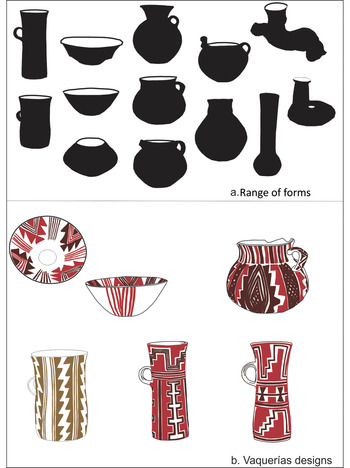
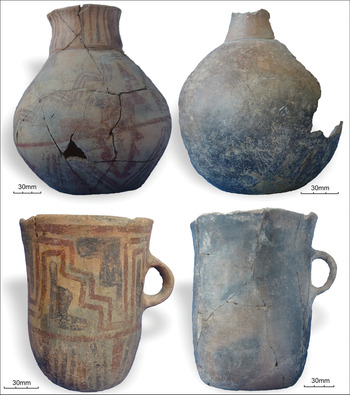
Vaquerías pottery is the oldest polychrome ceramic style in the Argentine Northwest and was manufactured by agro-pastoral village societies during the Early Formative period (seventh century BC to fifth century AD). The style is defined by bi- or tricolour painted pottery, with characteristic shapes and standardised profiles (Cigliano et al. Reference Cigliano, Raffino and Calandra1972; Heredia & Pérez Reference Heredia and Pérez1972; Heredia et al. Reference Heredia, Pérez and González1974; Korstanje Reference Korstanje1998; Bugliani & Pereyra Domingorena Reference Bugliani and Domingorena2012; Pereyra Domingorena et al. Reference Pereyra Domingorena2015) (Figure 1a). The visual representations of this ceramic are mainly geometric, with designs following the shape of the vessel (Figure 1b). The motifs are painted in black, brown and/or red and are applied over a light background that varies from white to light orange (Bugliani et al. Reference Bugliani, di Lello, Freire, Polla, Petragalli, Reinoso and Halac2012).
a) Range of forms; b) Vaquerías designs (figure by M.F. Bugliani).

This pottery is found in north-western Argentina and northern Chile (Figure 2) in middens, houses and tombs (Cigliano et al. Reference Cigliano, Raffino and Calandra1972; Heredia et al. Reference Heredia, Pérez and González1974; González & Baldini Reference González and Baldini1989; Korstanje Reference Korstanje1998). Its broad geographic distribution has prompted debate on the origin and circulation of these ceramics. The Lerma Valley in Salta (Figure 2), for example, has been suggested as the probable production area of Vaquerías ceramics (Heredia et al. Reference Heredia, Pérez and González1974; González & Baldini Reference González and Baldini1989). Korstanje (Reference Korstanje1998) proposed two manufacturing regions: the Lerma Valley and the Hualfín Valley in Catamarca. Cigliano et al. (Reference Cigliano, Raffino and Calandra1972) suggested an origin outside the Quebrada del Toro (Salta), based on the limited presence of Vaquerías ceramics in local archaeological assemblages. They also noted that the presence of complete vessels was due to their deposition in, and recovery from, tomb contexts. Cremonte (Reference Cremonte1996), however, observed similarities in the petrography of samples from Tafí Valley (Tucumán) and Quebrada del Toro, proposing the latter as a production centre.
Sites and locations with Vaquerías pottery (figure by M.E. de Feo).

The Vaquerías ceramics, along with other material and non-material goods (lithic materials, botanical remains, ceramic styles and iconography), were considered evidence for cultural interaction in the South-central Andes between the third and fifth centuries BC. González and Baldini (Reference González and Baldini1989), for example, argued that Vaquerías pottery formed part of a ‘cultural entity’ located in the Lerma Valley, that the pottery was made by specialised potters and that it had highly symbolic value due to its connection with fertility rites, the feline cult and the use of hallucinogens. These interpretations arise from the limited presence of Vaquerías pottery from excavations and surface collections at settlement sites, compared with assemblages from funerary contexts. Tartusi and Núñez Regueiro (Reference Tartusi and Regueiro1993) add that the spread of the pottery was facilitated by regional exchange linked to the movement of camelid caravans specialised in trading ritual goods. Tarragó (Reference Tarragó1984) proposed, based on the distribution of Vaquerías ceramics, the existence of an ‘axis of interaction’ that connected different regions of north-western Argentina, including the Quebrada del Toro and the Alto Valle Calchaquí, along with San Pedro de Atacama in Chile, where this pottery would be allochthonous.
The proposals outlined above use, more or less explicitly, the Modelo de movilidad giratoria to explain the wide distribution of the Vaquerías style. This model envisages that the agro-pastoral societies of the south-central Andes were linked by exchange networks using camelid caravans that connected different settlement axes across vast territories (Núñez & Dillehay Reference Núñez and Dillehay1979: 12). Furthermore, these proposals assume that the ceramic style was produced in a small area—for example, the Lerma Valley—from where it was distributed on a regional scale. More recent alternative models suggest that the Formative-period agro-pastoral societies of the Argentine Northwest “had a more generalized, non-hierarchical access to materials, resources, and skills than previously allowed” (Lazzari et al. Reference Lazzari, Pereyra Domingorena, Stoner, Scattolin, Korstanje and Glascock2017: E3918), including Vaquerías ceramics. Such models would be supported by archaeological evidence for multiple production areas and the circulation of goods in a variety of directions. This article analyses the production, spatial distribution and discovery contexts of Vaquerías pottery in Formative-period agro-pastoral societies, to provide further information about the ceramic's origin, circulation and consumption. We address this issue through stylistic, morphological and petrographic analyses of pottery fragments recovered from well-documented sites in the Quebrada del Toro, Lerma Valley and Cajón Valley in north-western Argentina.
This techno-stylistic perspective, combined with contextual analysis, constitutes an innovative method of addressing issues associated with widely distributed ceramic styles from different periods and regions (Bugliani & Pereyra Domingorena Reference Bugliani and Domingorena2012; Pereyra Domingorena Reference Pereyra Domingorena2012, Reference Pereyra Domingorena2015; Pereyra Domingorena et al. Reference Pereyra Domingorena, de Feo, Bugliani, Korstanje, Lazzari, Basile, Bugliani, Lema, Pereyra Domingorena and Quesada2015; De Feo & Pereyra Domingorena Reference de Feo and Domingorena2018).
The sample and methodology
Thirty-four Vaquerías ceramic fragments from the three areas mentioned above were analysed. Three sherds are from stratified Quebrada del Toro contexts: two from domestic enclosures at the West Mound of the Las Cuevas site, and the third from the midden area at Potrero Grande. Both village sites had occupation levels dated between 600 BC and AD 400 (Cigliano et al. Reference Cigliano, Raffino and Calandra1976; Raffino Reference Raffino1977). We also analysed a sherd recovered from the surface of La Encrucijada II, another Formative-period village site.
Three samples from the Lerma Valley were recovered from excavations at the Silisque Tilián 2 site, which dates to the Tilián phase (200 BC–AD 300) and is interpreted as a Formative-period, dispersed, agro-pastoral settlement (Escobar Reference Escobar2008). Finally, 25 fragments are from residential structures and surface assemblages in the villages of Cardonal and Bordo Marcial in the Cajón Valley (AD 1–300). We also analysed a fragment found on the surface at the site of Sajrapampa in the Cajón Valley and a sherd collected near the town of Tolombón in Salta, in the neighbouring valley of Santa María (Figure 1; see also Figure S1 & Table S1 in the online supplementary material (OSM)).
The samples were subject to stylistic, morphological and petrographic investigation. Ceramic morphology was analysed with reference to guidelines for identifying shapes (Convención Nacional de Antropología 1966; Balfet et al. Reference Balfet, Fauvet-Berthelot and Monzon1983), and by macroscopic examination of the sherds' surface and treatment. For the iconographic analysis, we identified the composition of the designs (Cremonte & Bugliani Reference Cremonte and Bugliani2006–2009; Bugliani Reference Bugliani2008). The objectives of the petrographic analysis were to classify the matrix background structure (Courtois Reference Courtois1976), to identify inclusions based on the optical properties of the minerals (Kerr Reference Kerr1965), and to provide a granulometric description using the Wentworth scale (taken from Adams et al. Reference Adams, MacKenzie and Guilford1997 [1984]). The resulting data were then subjected to a cluster analysis (for more detail, see the OSM).
Results
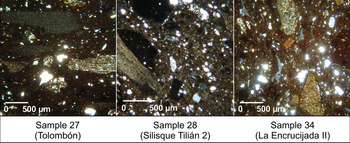
The petrographic analysis reveals three clusters of fragments and two outlying samples. The first cluster, which we call ‘metamorphic-quartzose medium mode’, contains samples 1–5, 8–13, 15, 17, 19, 21 and 23–26 from the Cajón Valley; sample 27 from the Santa María Valley; sample 28 from the Lerma Valley; and sample 34 from the Quebrada del Toro. This cluster comprises samples characterised by the addition of low-grade metamorphic rocks (e.g. slate and phyllite), sandstone, quartz and grog, as temper in different proportions. The density of inclusions fluctuates between 17.3 and 26.3 per cent. Most of the tempers have sizes between 125 and 2000μm (fine sand to very coarse sand) (Figure 3; see the OSM for more detail). Among the shapes found in this group, we identified a bowl with a thickened rim and a jar or pitcher with a narrow and straight neck marked by an excised line that emphasises the join between the neck and the body. A few straight rims belong to vessels that could not be reconstructed.
Photomicrographs of thin sections of samples corresponding to ‘metamorphic-quartzose medium mode’ (figure by L. Pereyra Domingorena).

We identified two spatial configurations regarding the designs applied to each vessel shape. One design covers the exterior of a bowl and the upper part of its interior. The other configuration is separated into two fields—a cylindrical neck and a globular body—in the case of short-necked jars. The recorded designs are triangles, diamonds, stair-like motifs, rows of triangles (flags) joined at one of their corners, multiple broken lines in a V-shape, staggered lines and vertical parallel lines. These designs were created by combining lines and solid figures painted in red or black over the natural background or over a yellowish white slip. Other fragments are bicolour. The most frequently recorded types of symmetry are translational (divisible into a sequence) and reflective (mirror image).
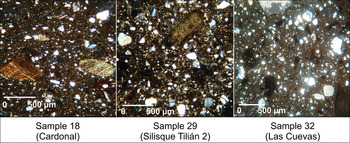
The second cluster, named ‘quartzose-metamorphic medium mode’, contains samples 14 and 18 from the Cajón Valley; sample 29 from the Lerma Valley; and samples 31–33 from Quebrada del Toro. This cluster is characterised by the appearance of quartz in greater relative abundance compared to metamorphic rocks and grog. The density of inclusions fluctuates between 21.7 and 26.8 per cent, and most of the tempers have sizes between 125 and 1000μm (fine sand to coarse sand) (Figure 4; for more detail, see the OSM). Recorded vessel shapes include a jar with a slightly thickened, everted rim and a vertical strip handle attached to the lip as well as an excised line emphasising the join between neck and body; a cylindrical vase with flat base; and an open shape, not identified further. We distinguished three locations for the design on the jar: one on the cylindrical neck, another over the body and a smaller one on the handle. The designs, painted in three colours, include solid geometric flags, and vertical lines delimiting spaces filled with zigzag lines, horizontal, vertical or staggered parallel lines. Translational symmetry was the predominant type of symmetry.
Photomicrographs of thin sections of samples corresponding to ‘quartzose-metamorphic medium mode’ (figure by L. Pereyra Domingorena).

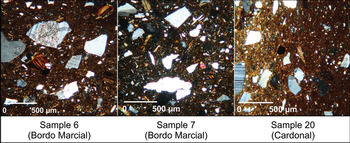
The third cluster, identified as ‘quartzose-granitic medium mode’ (samples 6, 7, 16 and 20 from the Cajón Valley), comprises fabrics characterised by different proportions of quartz, granitic lithoclast, biotite, plagioclase and potassium feldspar inclusions. The density of inclusions fluctuates between 18.9 and 21.3 per cent; most of the tempers are between 250 and 1000μm (medium sand to coarse sand) (Figure 5; for more detail, see the OSM). Although vessel shapes could not be reconstructed, two samples have designs on their interior surface, suggesting that these could belong to open-shaped pots. Rim sherds have a thinned profile. Designs include parallel lines of one or two colours and solid elements such as triangles or rectangles. The type of symmetry recorded is translational. In contrast to other groups, none of these sherds has a whitish, thick slip; instead, the surfaces are beige- or orange-coloured and are well polished.
Photomicrographs of thin sections of samples corresponding to ‘quartzose-granitic medium mode’ (figure by L. Pereyra Domingorena).

Two samples do not fit with the three clusters defined above. Sample 22 from the Cajón Valley contains grog, quartz and potassium feldspar inclusions. The density of inclusions is 20.3 per cent, and most of the inclusions have sizes between 250 and 2000μm (medium sand to very coarse sand) (Figure 6; for more detail, see the OSM). The sample is taken from the neck of a small, cylindrical vessel with an excised line, and the designs comprise thick, dark, painted parallel lines. Sample 30 from the Lerma Valley has a fabric made predominantly of grog, along with quartz, metamorphic lithoclasts (slate and phyllite) and granite. The density of inclusions is 41.8 per cent; inclusions have sizes between 15 and 2000μm (medium silt to very coarse sand) (Figure 6; for more detail, see the OSM). This sherd belongs to a closed vessel and displays flags and parallel line designs over a clear slip.
Photomicrographs of the thin sections corresponding to samples 22 and 30 (figure by L. Pereyra Domingorena).

Discussion
The results of the petrographic analyses demonstrate a regularity in the size (between medium and coarse sand) and quantity (between 17 and 27 per cent) of the inclusions across the sample. This allows us to define Vaquerías fabrics as medium fabrics, with variations depending on the types of temper used. Exceptionally, the analysis also revealed the use of coarse fabrics for the manufacture of Vaquerías vessels, as exemplified by sample 30 from the Lerma Valley. We can therefore conclude that the granulometric variability and proportions of the non-plastic inclusions found in these Lerma Valley fabrics are larger than in the samples from other areas examined in this study.
The inclusions may also indicate possible production areas. The geographic distribution of clusters of fabrics shows that the cluster with granite inclusions is found only in the Cajón Valley. Petrographically, this group resembles others employing similar techniques previously defined for this valley, including pieces from other styles corresponding to the local Formative period (Pereyra Domingorena Reference Pereyra Domingorena2012, Reference Pereyra Domingorena2015). This has been interpreted as local production, based on the presence of inclusions of quartz, granitic lithoclasts and potassium feldspar among other components, which occur in the lithology of the local Sierra del Chango Real. Moreover, two samples (7 and 20, third cluster) correspond to Lazzari et al.'s macro-group 2 (Reference Lazzari, Pereyra Domingorena, Stoner, Scattolin, Korstanje and Glascock2017) identified by previous instrumental neutron activation analysis. The authors of that analysis interpret this group as indicative of local ceramic production in the Cajón Valley, a suggestion supported by the results of petrographic analysis presented here.
Unlike the ‘quartzose-granitic medium mode’, only identified in the Cajón Valley, the ‘metamorphic-quartzose medium’ and ‘quartzose-metamorphic medium’ modes are represented in samples from all three analysed areas. The fabrics of these two clusters contain slate, phyllite, sandstone, quartz and grog as temper, and are similar in composition to other ceramic types from the Quebrada del Toro (i.e. Ordinario, Alisado, Gris Pulido Irregular types) and to a fragment of ordinary type from the Lerma Valley (De Feo & Pereyra Domingorena Reference de Feo and Domingorena2018). The presence of slate, phyllite and sandstone in the Puncoviscana Formation lithology (Blasco et al. Reference Blasco, Zappettini and Hong1996), which occurs throughout the Quebrada del Toro and the Lerma Valley, allows us to argue for the local production of Vaquerías ceramics in both areas. The same applies to sample 30, which contains slate and phyllite, but in lower proportions (Figure 6). The absence of slate, phyllite and sandstone in the Cajón Valley (Turner Reference Turner1973) suggests a non-local origin for the metamorphic-quartzose and quartzose-metamorphic Vaquerías fragments found in this valley.
Finally, although the inclusions in sample 22 do not allow us to suggest a possible provenance area, the presence of grog and the size and granulometry of the temper resemble fabrics of the San Francisco tradition (Cremonte et al. Reference Cremonte, Pereyra Domingorena, Scaro and Alconini2016). Defined in the San Francisco Valley (Jujuy Province, Argentina) and found throughout north-western Argentina, northern Chile and the Sud Lípez in Bolivia, this Formative-period ceramic tradition is characterised by polished surfaces and thick walls carrying predominantly incised and bicolour designs (Dougherty Reference Dougherty1977; Llagostera et al. Reference Llagostera, Barón and Bravo1984; Nielsen et al. Reference Nielsen, Vázquez, Avalos and Angiorama1999; Ortiz Reference Ortiz, Nielsen, Rivolta, Seldes, Vázquez and Mercoll2007).
In terms of ceramic styles, our analysis shows that the petrographic clusters are associated with a variety of shapes and designs, while the examination of the morphological and iconographic characteristics of the samples and clusters demonstrates no clear connection between repertoires and fabrics. Similarly, several variants of surface treatment cannot be associated with particular fabric groups. Fragments corresponding to the ‘metamorphic-quartzose’ and ‘quartzose-metamorphic’ modes, for example, have either a thick white, opaque slip, or a fine polish. Quartzose-granitic fragments from the Cajón Valley, which were defined petrographically as local, however, exhibit weathered paint and no slip. This contrasts with locally found fragments defined petrographically as non-local, which exhibit high-quality polishing.
Contextual analysis of the ceramic material indicates that, in some areas, the Vaquerías ceramics share morphological similarities with other styles found at the same site, while in other cases, there are clear differences in the range of shapes. In the Quebrada del Toro for example, simple-profile bowls and jars, and sub-cylindrical vases are identified both in Vaquerías style and other local types, thus suggesting a possible local origin for these pieces (Figure 7). Conversely, on Cajón Valley sites, there is a clear morphological distinction between Vaquerías forms and other ceramic types. The globular jars with cylindrical necks and bowls with a composite profile recorded in the Vaquerías style, for example, are not present in the local ceramic repertoire, which could indicate a non-local origin for the former. Based on Escobar's (Reference Escobar and Lagiglia1994, Reference Escobar2008) data concerning the Lerma Valley, it is possible to suggest that ceramic forms, including bowls with composite profile, flat bases and thickened rims, and, to a lesser extent, sub-cylindrical jars, are exclusively of the Vaquerías style during the first centuries of the first millennium AD. Nevertheless, such bases and rims have also been documented in monochrome types.
Repertoire of Vaquerías-style forms and other local types from Quebrada del Toro (figure by M.E. De Feo).
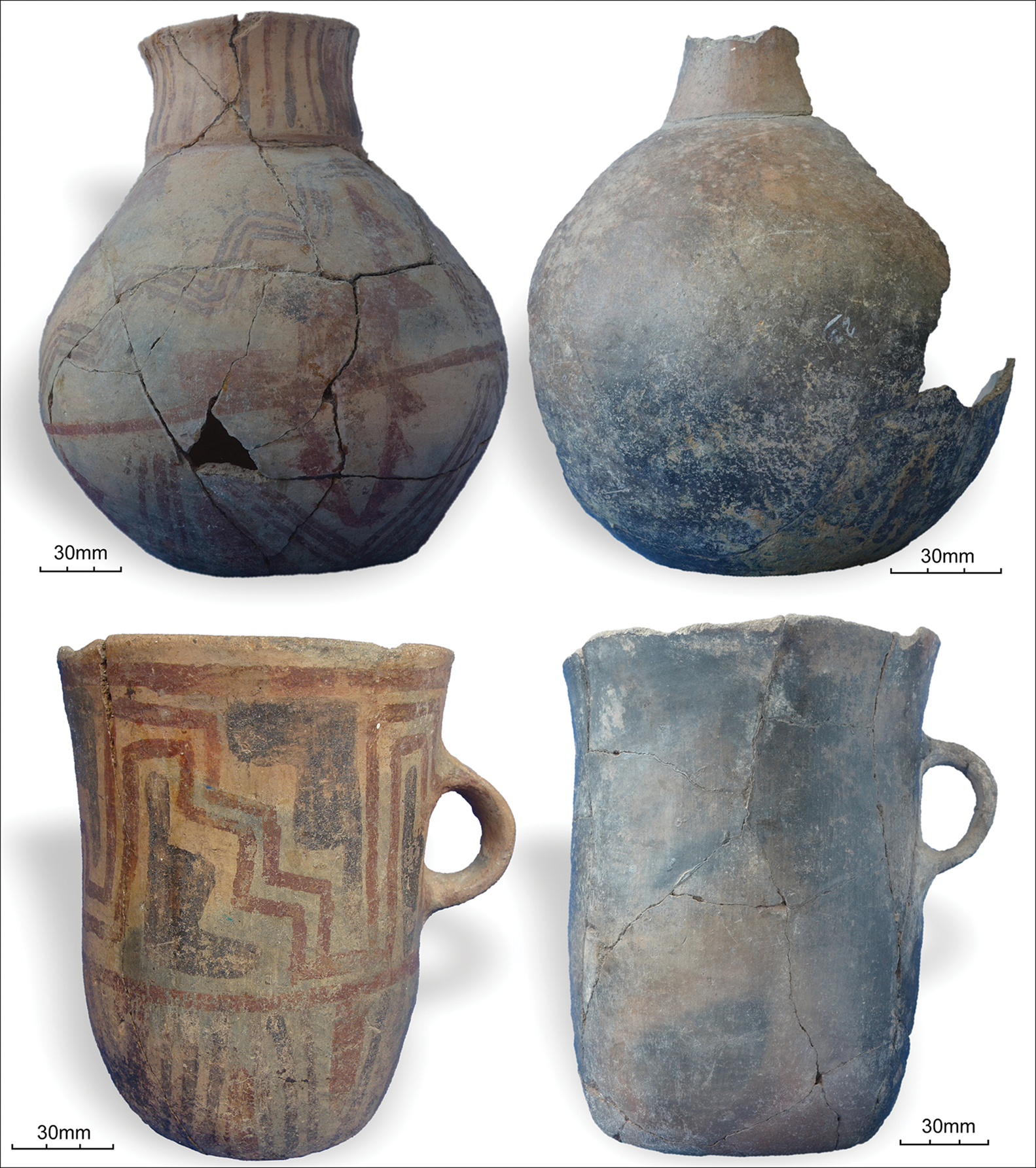
The analysis of the archaeological contexts from which the samples presented here were recovered allows us to identify how the Vaquerías ceramics circulated and were used. In the Quebrada del Toro, for example, the Vaquerías sherds were recovered from houses and rubbish-disposal areas. Pieces of this style were also found in funerary contexts at the Cerro El Dique and Potrero Grande sites (Raffino Reference Raffino1977). Tomb 3 at Cerro El Dique, for example, yielded a Vaquerías cylindrical vessel and a sub-globular pot accompanying the burial of an adult individual, along with a cylindrical vessel, a fragment of modelled pipe, a gold diadem with geometric engravings, a square mirror made of galena and a sub-globular polished pot. Tomb 11 at Cerro El Dique yielded a Vaquerías ceramic pipe with incised motifs and a ceramic vessel with a zoomorphic modelling appliqué, along with a gold bracelet, an anthropomorphic mask with delineated headdress, eyes, nose and mouth, and 30 beads made of malachite, azurite and bone. Finally, Tomb 1 at Potrero Grande contained an adult individual accompanied by a Vaquerías zoo- or anthropomorphic-modelled modelled vessel painted in three colours, along with a sub-globular pot of ordinary type (Raffino Reference Raffino1977). The analysed fragments from the Lerma Valley were recovered from two occupation areas, with evidence for floors, adobe walls and possibly stone plinths and roof remains (Escobar Reference Escobar and Lagiglia1994, Reference Escobar2008). Finally, ceramic sherds from Cajón Valley sites were also found in direct association with occupation floors in houses (Scattolin et al. Reference Scattolin, Cortés, Bugliani, Calo, Pereyra Domingorena, Izeta and Lazzari2009).
We have also been able to refine the chronology of the appearance and persistence of the Vaquerías style. The temporal range proposed for this style—from 200 BC–AD 400—was estimated indirectly from radiocarbon dates obtained in the 1970s from the Las Cuevas site (Quebrada del Toro) and from site 1 in Río Diablo in the Hualfín Valley (Cigliano et al. Reference Cigliano, Raffino and Calandra1972; Heredia & Pérez Reference Heredia and Pérez1972; Heredia et al. Reference Heredia, Pérez and González1974). This chronology is also supported by more recent dates obtained from Cajón Valley house floors with associated Vaquerías material. Recalibration of the Las Cuevas date (2150±80 BP, CSIC 121), however, extends its temporal depth, placing this occupation in the fourth century BC. Furthermore, a new radiocarbon assay from the upper levels of a midden in the southern mound of Las Cuevas I has dated Vaquerías-associated material to 1695±50 BP (GrN-5399). To summarise, these new dates confirm that Vaquerías is the earliest polychrome style found in this region of the Argentine Northwest, appearing between the fourth century BC and fourth century AD (for more details about the radiocarbon dates, see Table S2). We expect that information from yet undated contexts in the Lerma Valley will allow us to refine further the chronology of this style in this region of the south-central Andes.
The results of the current analysis complement previous petrographic studies. Pereyra Domingorena et al. (Reference Pereyra Domingorena, de Feo, Bugliani, Korstanje, Lazzari, Basile, Bugliani, Lema, Pereyra Domingorena and Quesada2015) defined a petrographic group composed of coarse fabrics, with slate, phyllite and quartz used as temper in ceramics from Tres Cruces I in Quebrada del Toro and Chimpa in the Santa María Valley. Although sherds from both sites have designs and colour combinations characteristic of the Vaquerías style, they also exhibit bright brown paint over a thick, yellowish-white, non-polished slip, dated typologically and by radiocarbon assay to after AD 500. Two samples from the Puente Río La Viña and San Nicolás 2 sites in the Lerma Valley also show these characteristics, and are dated to between AD 460 and 730 (LP-203: 1360±40 BP and LP-202: 1270±50 BP) (Escobar Reference Escobar2008). The technological, stylistic and chronological consistency of this group suggests that it should be excluded from the Vaquerías style, and instead assigned to the La Viña Negro sobre Crema ceramic type, as defined by Escobar (Reference Escobar and Lagiglia1994) for the Late Formative period (AD 400–1000).
Conclusions
We have so far identified five different fabrics used in the Vaquerías style of ceramics. Three of these form groups or clusters. These groups can be differentiated by the density and type of inclusions (quartz, slate and phyllite or granitic clasts). The shape and iconography of the vessels from which our samples were taken follow a limited repertoire, indicative of resources repeatedly reproduced in the analysed areas, irrespective of the petrographic clusters defined.
The diversity of the raw materials used corresponds to local technical traditions also known from other ceramic styles in each of the studied areas. We have been able to identify two geographically delineated production areas. The first, located in the Cajón Valley, is associated with ‘quartzose-granitic medium mode’ fabrics. The second, located in the Rosario-Lerma Basin and including archaeological sites in the Quebrada del Toro and the Lerma Valley, is associated with the ‘metamorphic-quartz medium’ and ‘quartzose-metamorphic medium’ modes. As these areas share the same lithology, it is not possible to identify local production sites within the Rosario-Lerma Basin more precisely. Further chemical determinations from clay samples and ceramic fragments from the Lerma Valley, however, would lead to better resolution. The presence of metamorphic inclusions that are absent in the lithology of the Cajón Valley indicates that locally discovered Vaquerías ceramics were produced in the Rosario-Lerma Basin, providing evidence for interaction between these two areas.
The results of the current study demonstrate that it is not yet possible to delimit a geographically or culturally defined style, as at least two possible production locations for Vaquerías vessels have been identified. The information available so far is insufficient to specify how this pottery circulated, but our research points to several mechanisms that may have been active during the Formative period. On the one hand, the discovery of non-local ceramics within archaeological contexts in the Cajón Valley indicates the movement of vessels; on the other, the use of local clay and temper to produce this pottery suggests the circulation of stylistic norms, materialised in the recurrence of configurations that combine a restricted range of shapes, colours and designs. In conclusion, the information obtained here suggests a non-centralised production of Vaquerías pottery.
Our results also help to improve our understanding of how these objects were used. Vaquerías pottery has been considered a prestige good, used in association with ceremonial activities. The analysis of the archaeological contexts of the samples presented here, however, suggests that Vaquerías ceramics were used in daily activities within village communities, as well as in mortuary contexts.
Our study has allowed us to characterise the earliest polychrome ceramic style in north-western Argentina, its techno-stylistic features, archaeological associations, chronology and production areas. It highlights the care taken in the production of pottery at an early stage in the pre-Hispanic cultural development of the Argentine Northwest, as well as aspects regarding its circulation and consumption in the wider south-central Andes. Our application of an integrated methodology to a broad geographic area, combining petrographic analyses with morphological, iconographic and contextual studies to characterise this Formative-period pottery, also provides a model that can be applied elsewhere and illustrates the potential of this approach to supplement traditional stylistic-morphological studies.
Acknowledgements
The authors would like to thank J.M. Escobar for providing the samples from the Lerma Valley. This research is supported by subsidies from the Universidad Nacional de La Plata (codes N806 and N815) and the Agencia Nacional de Promoción Científica y Tecnológica (PICT Raíces 2011-633 and 2016-343).
Supplementary material
To view supplementary material for this article, please visit https://doi.org/10.15184/aqy.2019.239