




No CrossRef data available.
Article contents
Neuropsychological changes following electrical injury
Published online by Cambridge University Press: 23 January 2006
Abstract
The clinical presentation of electrical injury commonly involves physical, cognitive, and emotional complaints. Neuropsychological studies, including case reports, have indicated that electrical injury (EI) survivors may experience a broad range of impaired neuropsychological functions, although this has not been clarified through controlled investigation. In this study, we describe the neuropsychological test findings in a series of 29 EI patients carefully screened and matched to a group of 29 demographically similar healthy electricians. Participants were matched by their estimated premorbid intellectual ability. Multivariate analysis of variance was used to assess group differences in the following neuropsychological domains: attention and mental speed, working memory, verbal memory, visual memory, and motor skills. EI patients performed significantly worse on composite measures of attention/mental speed and motor skills, which could not be explained by demographic differences, injury parameters, litigation status, or mood disturbance. Results suggest that cognitive changes do occur in patients suffering from electrical injury. (JINS, 2006, 12, 17–23.)
Information
- Type
- Research Article
- Information
- Journal of the International Neuropsychological Society , Volume 12 , Issue 1 , January 2006 , pp. 17 - 23
- Copyright
- © 2006 The International Neuropsychological Society
INTRODUCTION
The clinical presentation of electrical injury (EI) commonly involves physical, cognitive, and emotional complaints (Pliskin et al., 1998). Neuropsychological studies, including case reports, have indicated that EI survivors may experience a broad range of impaired neuropsychological functions, although there has been considerable variability across studies (Hopewell, 1983; Daniel et al., 1985; Hooshmand et al., 1989; Miller, 1993; Barrash et al., 1996; Crews et al., 1997; Pliskin et al., 1999; Martin et al., 2003). Indeed, deficits in attention and concentration (Crews et al., 1997), memory (Hooshmand et al., 1989), intelligence (Martin et al., 2003), and language abilities (Hopewell, 1983) have been variously reported in neuropsychological studies of EI patients (Primeau et al., 1995; Pliskin et al., 1998, 1999). In all of these studies, the exact relationship of these neuropsychological findings to the EI itself versus other injury-related factors such as comorbid head injury, anoxia due to cardiac arrest, the point of electrical contact (i.e., head or body) or noninjury factors such as low effort when taking neuropsychological tests has not been well established. Furthermore, electrical injury is associated with high psychiatric morbidity including major depressive disorders, anxiety disorders, and post-traumatic stress disorder (PTSD; Mancusi-Ungaro et al., 1986; Grossman et al., 1993; Kelley et al., 1994, 1999). However, most previous studies documenting neuropsychological deficits following EI have not controlled for the presence of mood disturbance in their samples (Daniel et al., 1985; Hooshmand et al., 1989; Barrash et al., 1996). Likewise, given the severity of peripheral nervous system injuries in this population, the role of motor impairment in neuropsychological test performance has not been examined. Finally, most studies reporting neuropsychological data on EI patients have either been archival in nature (Barrash et al., 1996), single case studies (e.g., Crews et al., 1997), or lacked comparison populations (Daniel et al., 1985; Hooshmand et al., 1989). In this study, we describe the neuropsychological test findings in a series of EI patients carefully screened and matched to a group of demographically similar healthy electricians.
METHOD
Research Participants
Participants in this study were 29 EI patients derived from a pool of 183 participants assessed by the Chicago Electrical Trauma Research Program and 29 noninjured electrician comparison group members. Individuals eligible for this study were EI patients who received emergency and acute care services at the University of Chicago Hospitals or the University of Illinois-Chicago Medical Center, as well as patients that were acutely managed at other institutions throughout the country and later referred for post-acute evaluation and treatment. All electrically injured patients were selected for this study based on of the following criteria: They had to be injured as a result of contact with domestic or commercial power sources, have experienced peripheral electrical contact injury only (i.e., were without evidence of direct electrical contact to the head), and have not sustained a closed head injury secondary to a fall or any other aspect of their electrical injury experience. For the purposes of this study, EI patients were matched to controls by their estimated premorbid IQ, which was based on their performance on a reading test believed to be resistant to cognitive decline (National Adult Reading Test: NART-FSIQ).
The 29 electricians that comprised the comparison group for this study were recruited from the local electrical workers' union. They were free of medical problems and were without a prior history of medically emergent electrical injury, fixed neurologic abnormality, or psychiatric disturbance. Electricians were selected as the comparison sample because many of the EI patients were electricians who had been injured in the course of their duties. Utilization of this control sample also permitted empirical control for the numerous random, minor electrical contacts experienced by patients previously employed as electricians and this is believed to increase the validity of the obtained results. Selected demographic data for the 29 NART FSIQ-matched EI participants and 29 electrician controls are summarized in Table 1.
Demographic characteristics of 29 NART-FSIQ-matched EI patients

Neuropsychological Evaluation
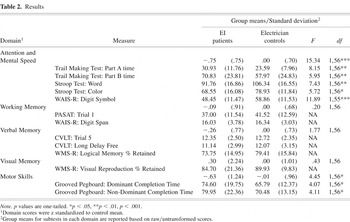
To ensure that all participants put forth adequate effort on neuropsychological tests, all participants successfully passed tests designed to detect suboptimal effort. The protocol for effort testing evolved over time; 16 patients passed the Rey 15-item exam (Rey, 1964) as this was the measure available when the study began, and then subsequently passed the Reliable Digit Span test (Mathias et al., 2002) to be included in the sample. Thirteen participants passed these measures and also passed the Victoria Symptom Validity Test (Slick et al., 1996) after it was added to the standard battery. The neuropsychological battery also included tests of intelligence, attention and mental speed, working memory, verbal memory, and visual memory, as well as estimates of premorbid intellectual abilities. The tests used to evaluate function in each of these neuropsychological domains are listed in Table 2. Based on a review of the literature that has reported deficiencies in attention, memory, problem solving, and motor skills, we selected measures that tapped these domains from a broader battery of neuropsychological tests described elsewhere (Pliskin et al., 1999). Clinically, neuropsychological testing was adapted to the abilities of individual electrically injured patients; some patients were given additional measures to further explore their difficulties, whereas others may not have been administered certain tests due to physical limitations. The average length of time between injury and neuropsychological examination was 18.8 months (range from 0 to 114 months).
Results

Data Analysis
To provide a standard metric for comparison across neuropsychological tests and domains, test scores were standardized (z-score) to the mean performance of the electrician controls. Following the standardization, scores for each neuropsychological function were computed as the mean of the variables comprising each domain using a previously described method (Saykin et al., 1994; Censits et al., 1997). Specifically, summary measures were calculated for attention and mental speed, working memory, verbal memory, visual memory, and motor skills. Significance values were reported for a one-tailed distribution, as our hypotheses were unidirectional in nature. A one-tailed alpha level of .05 served as the criterion for statistical significance.
Given the elevated rate of depressive symptoms previously reported within our sample (e.g., Kelley et al., 1999), the Beck Depression Inventory (BDI; Beck, 1987) was evaluated as a possible covariant within the planned statistical analyses. Preliminary analyses included a multivariate analysis of covariance (MANCOVA) to control for potential confounds related to depressive symptomatology by adding BDI scores as a covariate. Additional preliminary analyses were focused on potential confounds related to current intellectual level and litigation status. To assess group differences among neuropsychological domains, a multivariate analysis of variance (MANOVA) was planned with elements of neuropsychological function (attention and mental speed, working memory, verbal memory, visual memory, and motor skills) as dependent variables. To clarify significant findings at the domain level, follow-up analysis of variance (ANOVA) and MANOVA were planned for individual measures of the indicated neuropsychological domains.
RESULTS
Preliminary Analyses
Intellectual ability
The selection process resulted in a closely matched sample. As planned, there were no significant differences in estimated premorbid IQ [F(1,56) = .034, p = ns] between EI patients and electrician controls. However, the mean current FSIQ on the WAIS-R differed significantly between groups [F(1,56) = 6.52, p < . 05]. Although statistically significant, examination of the means indicates that the differences between EI patients and electrician controls are not clinically meaningful [EI FSIQ = 101.17 (SD = 11.69); Control FSIQ = 109.00 (SD = 11.66)]. Nevertheless, EI patients also demonstrated greater differences between their premorbid and current IQ than did members of the electrician comparison group [F(1,56) = 10.93, p < .01].
Influence of depression
EI patients endorsed significantly more depressive symptoms than controls [F(1,56) = 25.67, p < .001]. Given the group difference in depressive symptoms, BDI scores were considered for inclusion as a covariate in the main statistical analysis. However, BDI was not found to be a significant covariate when entered in a two-way MANCOVA [F(5,51) = .93, p = ns]. In the absence of a significant main effect of BDI, a more parsimonious approach to the data analysis was employed in which BDI was removed as a covariate and subsequent analyses reverted to the a priori planned MANOVA without covariation.
Influence of litigation
Given the high proportion of patients in litigation, a MANOVA was performed, with all neuropsychological domain scores as the dependent variables, to explore possible differences in cognitive and motor function between litigating and nonlitigating patients. There were no significant domain score differences between litigating and nonlitigating groups [F(5,23) = 1.26, p = ns]. Litigation status was also found to be unrelated to the expression of depressive symptoms [F(1,27) = 3.70, p = ns].
Main Analysis
Neuropsychological comparisons
Results of a MANOVA revealed significant omnibus differences in the neuropsychological functioning of EI participants and electrician controls [F(5,52) = 5.37, p < .001] with EI participants performing significantly worse on composite measures of attention and mental speed (see Table 2). However, EI participants and controls did not differ significantly in the domains of working memory, verbal memory, or visuospatial memory (see Table 2).
To clarify the overall findings for attention and mental speed, a planned MANOVA was conducted with the five variables comprising this domain as dependent variables. To preserve the experiment-wise error rate, a Bonferroni correction was applied and a revised alpha level of .025 was established as the significance criterion. EI participants demonstrated significantly poorer performance than controls on measures of sustained and divided attention, as well as mental processing and psychomotor speed (see Table 2).
Additionally, a MANOVA was computed to clarify significant domain level difference in Motor Skills. Planned comparisons revealed that EI patients demonstrated significant bimanual reductions of speed and manual dexterity as compared to controls (see Table 2). Given this finding, it is possible that psychomotor slowing had a differential effect on speeded attentional tests. Thus, we used a conservative approach and performed a post hoc analysis that covaried motor performance relative to speeded attention.
Post hoc analysis
Given that performance on the Trail Making Test and Digit Symbol involves a substantial motor component and given the observed motor slowing for EI patients, post hoc analyses focused on the degree to which motor skills contributed to poor performance on attention measures. ANCOVA was performed to covary motor skills on Trails A, Trails B, and Digit Symbol. Results were generally consistent with earlier analyses, as group differences for Trails B and Digit Symbol persisted when motor skills were statistically controlled [Trails A: F(1,55) = 2.204, p = .07; Trails B: F(1,55) = 6.21, p < .05; Digit Symbol: F(1,55) = 14.98, p < .05]. Therefore, it is unlikely that the reduced speed and manual dexterity of EI participants significantly influenced their performance on other domains of inquiry within the present study.
DISCUSSION
The results of this study indicate that electrically injured patients performed more poorly on select neuropsychological measures of attentional interference, mental processing speed, current Full Scale IQ, and motor skills when compared to a well-matched control group of healthy electricians. These findings could not be attributed to demographic differences since the groups were well matched for premorbid IQ level, age, educational level, and occupational background; in addition, those EI patients who sustained traumatic brain injuries because of EI-related falls were excluded from the study, thus the current findings are not the result of traumatic brain injury to the patient group. Likewise, factors such as preinjury psychiatric history, current distress level or upper extremity motor impairment could not statistically account for group differences in attention and mental processing speed. Moreover, all EI patients sustained their injury from peripheral electrical contact only. Only one member of our EI sample reported any preinjury history of psychiatric difficulties or treatment, and our measure of current distress (i.e., BDI) was independent of neuropsychological functioning. Additionally, despite the high rate of litigation involvement inherent in our population because of the work-related nature of many of these injuries, EI patients in litigation did not significantly differ in their performance in any of the measured cognitive domains or expression of depressive symptoms, and all EI patients passed measures designed to detect suboptimal test-taking effort. It is important to note that by design the EI patients included in our sample had sustained no direct mechanical contact of the power source to the head, no traumatic brain injury due to secondary falls, and only one patient in our sample suffered cardiac complications suggestive of possible anoxic injury (all potential causes of cognitive impairment themselves). Thus, the findings of this study indicating poorer attention and mental processing speed appear to reflect direct neuropsychological effects on the central nervous system caused by the electrical exposure itself.
Findings of neuropsychological difficulties in attention and mental speed closely mirror the symptom complaints commonly reported in electrically injured patients (Primeau et al., 1995; Pliskin et al., 1998). In one series, 49% of EI survivors reported difficulties with concentration, 46% reported problems thinking quickly, and 44% reported memory problems (Pliskin et al., 1998). Self-reported memory complaints often reflect problems with attention/concentration rather than anterograde memory dysfunction per se. It has been our experience that many of our EI patients do not complain that they are unable to pay attention or concentrate but rather that it is less automatic and requires greater effort to do so. Considering the occupational status of many of the patients in our sample, these impairments in attention and mental speed can pose challenges in the workplace where attention to detail and exertion of mental effort are critical for maintaining safe workplace practices.
It is possible that the deficits in attention and mental speed observed in our EI sample are interference-related effects secondary to the pain syndromes commonly experienced by electrically injured patients (Kim & Bryant, 2001). Indeed, many of our patients had complaints of chronic pain due to peripheral nervous system injuries, headaches, parasthesias, and lingering effects of burns (Pliskin et al., 1998), and chronic pain from multiple sources aside from electrical injury has been linked to decrements in neuropsychological test performance (McCracken & Iverson, 2001). Future studies of EI will need to employ chronic pain comparison groups (without CNS injuries) to clarify the relationship between neuropsychological test performance and chronic pain following EI.
As noted previously, electrical injury is associated with a high psychiatric morbidity, although most studies reporting neuropsychological deficits following EI did not control for the presence of mood disturbance in their samples. We utilized the BDI as a measure of general distress in our study. Although robust group differences in depressive symptoms were observed, covariation for depressive symptoms had no effect on group differences in cognitive performance, indicating no significant relationship between depressive symptoms and our outcome measures. It is possible that neuropsychological changes and psychological distress are coexisting but unrelated sequelae of EI, with distress being a common manifestation of any traumatic experience, but not significantly contributing to neuropsychological dysfunction. Yet, considering that none of the patients in our sample reported any preinjury psychiatric history, the emergence of new psychiatric difficulties in EI, particularly PTSD (Mancusi-Ungaro et al., 1986), could reflect changes to central nervous system (CNS) function. Future studies of electrical injury will need to consider the possible impact of PTSD on neuropsychological function.
Group differences in attention and mental speed observed in this study could not be attributed to premorbid intellectual level, psychiatric history, litigation status, depression, suboptimal test-taking effort, or demographic factors. Thus, the current data point to genuine CNS changes as a result of electrical injury. Yet, the pathophysiology underlying these impairments remains unclear. Demonstrable structural lesions are rare in this population following peripheral contact injuries, although there are isolated case reports of lesions detected on magnetic resonance imaging (MRI) following peripheral contact injuries (Sahiner et al., 2002). We hypothesize that neuropsychological and neuropsychiatric changes in EI relate to electrochemical alterations in brain systems. By way of comparison, electroconvulsive therapy (ECT) has been studied extensively and we speculate that ECT may serve as a model for understanding the impact of more extreme field strength exposure suffered by electrical injury patients.
ECT involves CNS exposure to a relatively small electrical field and produces positive alterations in emotional status and transient disruption of cognitive function with no overt evidence of structural damage to the CNS. Moreover, efficacy of psychiatric benefit is maximized when the current used is double that necessary to induce a seizure (Chanpattana et al., 2000). Behaviorally, neuropsychological dysfunction is prominent following ECT and primarily includes confusion, disorientation, and retrograde and anterograde memory disturbance (Sackeim, 1994; Rosen et al., 2003). Like electrical injury, prospective investigations of the effects of ECT on brain morphology using MRI have yielded negative findings (e.g., Coffey et al., 1988, 1991). These findings have led investigators to conclude that changes in neuropsychiatric and neuropsychological status following ECT result from electrochemical changes at a neuronal functional level rather than structural changes (Rami-Gonzales et al., 2003). Though the exact mechanisms mediating the therapeutic effect of ECT are currently unknown, several hypotheses have been offered including current-induced changes in cell membranes (i.e., electroporation; Johansson, 1987), up-regulation of serotonergic systems, reduction in dopamine autoreceptors which results in increase in dopamine release from nerve terminals (Ishihara & Sasa, 1999), and attenuation of GABA systems which is associated with a rise in seizure threshold (Fink, 2001). Based on the current findings, one may reason that a similar, but more severe pathophysiology is characteristic of electrical injury. That is, in EI, where field strength exposure far exceeds that administered during ECT, similar but more severe and long-lasting neurochemical alterations are likely to produce stable, nontransient neuropsychiatric and neuropsychological dysfunction in the absence of detectable structural lesions.
Finally, it is important to note that our findings may not be representative of the injury experience of all victims of EI. Our sample was comprised of mostly self-selected patients who have required medical intervention and/or exhibited long-term dysfunction. It remains unclear whether individuals who experience less severe injuries would demonstrate similar dysfunctions of attention, mental speed, and motor deficits as those who sought out the Chicago Electrical Trauma Research Program because of persistent cognitive and emotional complaints. Thus, our convenience sample may not reflect the broader experience of others sustaining electrical injury. Additionally, some cognitive domains were computed using variables from multiple measures whereas others were computed from multiple variables from a single measure. The extent to which method variance may have contributed to the findings is unclear and these findings need to be replicated. Finally, the relatively small number of participants in the study presents a potential limitation in power, meaning that the influence of litigation status or other potential confounds cannot be completely ruled out. Clearly, future research utilizing larger sample sizes is needed.
In sum, this study indicates that cognitive changes do occur in patients suffering from electrical injury. Previous studies have shown that EI victims who sustain a direct mechanical contact from the power source to the head, or those who sustain traumatic brain injuries secondary to falls or anoxia suffer from neuropsychological impairment (e.g., Grube & Heimbach, 1992; Duff & McCaffrey, 2001). However, to our knowledge, this is the first investigation to demonstrate the presence of cognitive impairment in the form of attention and mental speed deficits for EI patients who have sustained an electrical injury specifically through a peripheral point of contact (i.e., the extremities). Further research, especially longitudinal studies that follow EI survivors from the point of injury into the future will be most informative in clarifying what has been a challenging area for clinical neuroscientists and mental health providers.
References
REFERENCES
Barrash, J.,
Kealey, G.P., &
Janus, T.J.
(1996).
Neurobehavioral sequelae of high voltage electrical injuries:
Comparison with traumatic brain injury.
Applied Neuropsychology,
31,
75–81.Google Scholar
Beck, A.T.
(1987).
Cognitive models of depression.
The Journal of Cognitive Psychotherapy: An International
Quarterly,
1,
5–37.Google Scholar
Censits, D.M.,
Ragland, J.D.,
Gur, R.C., &
Gur, R.E.
(1997).
Neuropsychological evidence supporting a neurodevelopmental model of
schizophrenia: A longitudinal study.
Schizophrenia Research,
24,
289–298.Google Scholar
Chanpattana, W.,
Somchai Chakrabhand, M.L.,
Buppanharun, W., &
Sakeim, H.A.
(2000).
Effects of stimulus intensity on the efficacy of bilateral ECT in
schizophrenia: A preliminary study.
Biological Psychiatry,
48,
222–228.Google Scholar
Coffey, C.E.,
Figiel, G.S.,
Djang, W.T.,
Sullivan, D.C.,
Herfkens, R.J., &
Weiner, R.D.
(1988).
Effects of ECT on brain structure: A pilot MRI study.
American Journal of Psychiatry,
145,
701–706.Google Scholar
Coffey, C.E.,
Weiner, R.D.,
Djang, W.T.,
Figiel, G.S.,
Soady, S.A.,
Patterson, L.J.,
Holt, P.D.,
Spritzer, C.E., &
Wilkinson, W.E.
(1991).
Brain anatomic effects of ECT: A prospective MRI study.
Archives of General Psychiatry,
48,
1013–1021.Google Scholar
Crews, W.D.,
Barth, J.T.,
Brelsford, T.N.,
Francis, J.P., &
McArdle, P.A.
(1997).
Neuropsychological dysfunction in severe accidental electrical
shock: Two case reports.
Applied Neuropsychology,
4,
208–219.Google Scholar
Daniel, M.,
Haban, G.G.,
Hutcherson, W.L.,
Bolter, J., &
Long, C.
(1985).
Neuropsychological and emotional consequences of accidental,
high-voltage electrical shock.
The International Journal of Clinical Neuropsychology,
7,
102–106.Google Scholar
Duff, K. &
McCaffrey, R.J.
(2001).
Electrical injury and lightning: A review of their mechanisms and
neuropsychological, psychiatric and neurological sequelae.
Neuropsychology Review,
11,
101–116.CrossRefGoogle Scholar
Fink, M.
(2001).
Convulsive therapy: A review of the first 55 years.
Journal of Affective Disorders,
63,
1–15.Google Scholar
Grossman, A.R.,
Temperaeu, C.E.,
Brones, M.F.,
Kulber, H.S., &
Pembrook, L.J.
(1993).
Auditory and neuropsychiatric behavior patterns after electrical
injury.
Journal of Burn Care and Rehabilitation,
14,
169–175.Google Scholar
Grube, B.J. &
Heimbach, D.M.
(1992).
Acute and delayed neurological sequelae of electrical
injury. In
R.C. Lee,
E.G. Cravalho, &
J.F. Burke (Eds.),
Electrical trauma, the pathophysiology, manifestations and clinical
management.
Cambridge, UK:
Cambridge University Press.
Hooshmand, H.,
Radfar, F., &
Beckner, E.
(1989).
The neurophysiological aspects of electrical injuries.
Clinical Electroencephalography,
20,
111–120.Google Scholar
Hopewell, C.A.
(1983).
Serial neuropsychological assessment in a case of reversible
electrocution encephalopathy.
Clinical Neuropsychology,
5,
61–65.Google Scholar
Ishihara, K. &
Sasa, M.
(1999).
Mechanism underlying the therapeutic effects of ECT on
depression.
Japanese Journal of Pharmacology,
80,
185–189.Google Scholar
Johansson, B.
(1987).
Electrical membrane breakdown: A possible mediator of the actions of
electroconvulsive therapy.
Medical Hypotheses,
24,
313–324.Google Scholar
Kelley, K.M.,
Pliskin, N.,
Meyer, G., &
Lee, R.C.
(1994).
Neuropsychiatric aspects of electrical injury: The nature of
psychiatric disturbance.
Annals New York Academy of Sciences,
720,
213–218.Google Scholar
Kelley, K.M.,
Tkachencko, T.A.,
Pliskin, N.H.,
Fink, J.W., &
Lee, R.C.
(1999).
Life after electrical injury: Risk for psychiatric sequelae.
Annals of the New York Academy of Sciences,
888,
356–363.Google Scholar
Kim, C. &
Bryant, P.
(2001).
Complex regional pain syndrome (type I) after electrical injury: A
case report of treatment with continuous epidural block.
Archives of Physical Medicine and Rehabilitation,
82,
993–995.Google Scholar
Mancusi-Ungaro, H.R.,
Tarbox, A.R., &
Wainwright, D.J.
(1986).
Posttraumatic stress disorder in electric burn patients.
The Journal of Burn Care & Rehabilitation,
7,
521–525.Google Scholar
Martin, T.A.,
Salvatore, N.F., &
Johnstone, B.
(2003).
Cognitive decline over time following electrical injury.
Brain Injury,
17,
817–823.Google Scholar
Mathias, C.W.,
Greve, K.W.,
Bianchini, K.J.,
Houston, R.J., &
Crouch, J.A.
(2002).
Assessment,
9,
301–308.
McCracken, L. &
Iverson, G.
(2001).
Predicting complaints of impaired cognitive functioning in patients
with chronic pain.
Journal of Pain Symptom Management,
21,
392–396.Google Scholar
Miller, L.
(1993).
Toxic torts: Clinical, neuropsychological and forensic aspects of
chemical and electrical injuries.
The Journal of Cognitive Rehabilitation,
11,
6–17.Google Scholar
Pliskin, N.H.,
Capelli-Schellpfeffer, M.,
Law, R.T.,
Malina, A.C.,
Kelley, K.M., &
Lee, R.C.
(1998).
Neuropsychological symptom presentation after electrical
injury.
Journal of Trauma: Injury, Infection, and Critical Care,
44,
709–715.CrossRefGoogle Scholar
Pliskin, N.,
Fink, J.,
Malina, A.,
Moran, S.,
Kelley, K.,
Capelli-Schellpfeffer, M., &
Lee, R.C.
(1999).
The neuropsychological effects of electrical injury.
Annals New York Academy of Sciences,
888,
140–149.Google Scholar
Primeau, M.,
Engelstatter, G.H., &
Bares K.K.
(1995).
Behavioral consequences of lightning and electrical injury.
Seminars in Neurology,
15,
279–285.CrossRefGoogle Scholar
Rami-Gonzales, L.,
Salamero, M.,
Boget, T.,
Catalan, R.,
Ferrer, J., &
Bernardo, M.
(2003).
Patterns of cognitive dysfunction in patients during maintenance
electroconvulsive therapy.
Psychological Medicine,
32,
345–350.Google Scholar
Rey, A.
(1964).
L'examen clinique en psychologie [The clinical examination
in psychology].
Paris:
Presses Universitaires de France.
Rosen, Y.,
Reznik, I.,
Sluvis, A.,
Kaplan, D., &
Mester, R.
(2003).
The significance of the nitric oxide in electro-convulsive therapy:
A proposed neurophysiological mechanism.
Medical Hypotheses,
60,
424–429.Google Scholar
Sackeim, H.A.
(1994).
Central issues regarding the mechanisms of action of
electroconvulsive therapy: Directions for future research.
Neuropsychology Bulletin,
30,
281–308.Google Scholar
Sahiner, T.,
Kurt, T.,
Sinan Bir, L.,
Guzhanoglu, A.O.Akalin,
O., Celiker A., &
Ozdemir, F.
(2002).
Reversible hyperintense T2 MRI lesions of basal ganglia after an
electrical injury.
Burns,
28,
607–608.Google Scholar
Saykin, A.,
Shtasel, D.,
Gur, R.E.,
Kester, D.,
Mozley, L.,
Stafiniak, P., &
Gur, R.C.
(1994).
Neuropsychological deficits in neuroleptic naïve patients with
first-episode schizophrenia.
Archives of General Psychiatry,
51,
124–131.Google Scholar
Slick, D.J.,
Hopp, G.,
Strauss, E., &
Spellacy, F.J.
(1996).
Victoria Symptom Validity Test: Efficiency for detecting feigned
memory impairment and relationship to neuropsychological tests and MMPI-2
validity scales.
Journal of Clinical and Experimental Neuropsychology,
18,
911–922.CrossRefGoogle Scholar

Demographic characteristics of 29 NART-FSIQ-matched EI patients
Results
 You have
Access
- 43
- Cited by