Introduction
Political complexity probably had a deeper antiquity on the Andean coasts than in the highlands (Stanish Reference Stanish2001; Isbell Reference Isbell2008: 731). The importance of monumental pilgrimage centres such as Chavín de Huantar notwithstanding, few Andean archaeologists would therefore consider any highland society a ‘state’ prior to the rise of the Middle Horizon (c. AD 600–1000) Wari polity. In sharp contrast to anything that preceded it, the primate Wari settlement—located in Ayacucho (Peru)—is routinely described not just as a “city”, but as an “imperial capital” (Smith & Schreiber Reference Smith and Schreiber2006: 3–6). As perhaps the first empire to emerge in the Americas, the impact of the Wari upon the Andean world was profound, if regionally variable (Schreiber Reference Schreiber1992). Yet to look beyond the Andes to explain any of these developments—and to Amazonia no less—deviates significantly from the intellectual premises upon which Andeanist scholarship has long operated. Since the work of Julio C. Tello in the mid twentieth century, Andean state formation has been understood as a strictly autogenous process. While earlier generations of (European) archaeologists, such as Max Uhle, adhered to the idea that Andean civilisation had diffused from Mesoamerica or Oceania (Politis Reference Politis1995: 200), both local and foreign specialists have long since rejected such views.
In comparison with most other global areas traditionally associated with the development of ‘high cultures’, the Andes are often viewed as having been isolated from adjacent regions; hence, not only did Andean civilisation receive no meaningful outside impetus, it apparently had little influence upon its neighbours. Whereas other civilisations stimulated the formation of secondary states in their ‘less developed’ hinterlands, a similar narrative for the Andes with respect to Amazonia is virtually non-existent. This largely reflects the traditional scholarly understanding of Amazonia as a place so environmentally unsuited to complexity that the seeds of Andean civilisation fell on barren ground when transferred to the neotropical forests (Erickson Reference Erickson2008). Thus, the supposedly pristine Amazonian wilderness could not support civilisation even as a peripheral development (Denevan Reference Denevan1992: 373–75). Meggers (Reference Meggers1971), for example, stated that Amazonian ecosystems were incapable of supporting the intensive agricultural economies that were a prerequisite for complex society. It should, therefore, be clear just how dissident it is to argue for the reverse—that Amazonian developments actually influenced state emergence in the Andean highlands to the west.
The aim of this paper is not to offer a diffusionist argument; such paradigms were justly relegated to archaeology’s history some time ago. Instead, I propose an ‘interactionist’ model, which aligns broadly with research on state formation in other parts of the world. Revisionist work on ancient Nubia (e.g. O’Connor Reference O’Connor1993; Edwards Reference Edwards2003), for example, has argued that the polities of the southern Nile were early rivals to their Egyptian counterparts, and therefore that Nubia and Egypt influenced each other’s shifts towards greater political complexity. Likewise in East Asia, the pastoralist polities of the steppe nomads may have galvanised empire formation in the Chinese core, rather than the reverse (e.g. Honeychurch Reference Honeychurch2014). I therefore present the political fates of the Andes and Amazonia as being more closely linked than is typically allowed, which suggests that they were not so dissimilar to zones of state formation documented elsewhere.
More specifically, the paper will draw a spatial and temporal correlation between two major Andean and Amazonian prehistoric transformations. The first, on the Andean side, is the aforementioned rise of the Middle Horizon Wari empire, and the increasingly intense interregional interactions that it entailed—some have gone as far as calling this a period of ‘globalisation’ (Jennings Reference Jennings2010). In Amazonia, the parallel development was the spread of the Arawak languages, widely acknowledged as one of the most significant transformations in South American prehistory. Heckenberger (Reference Heckenberger2013: 111–13), for instance, considers it comparable to other tropical linguistic-agricultural expansions, such as the Bantu diffusion within sub-Saharan Africa, or the spread of Austronesian across Oceania. Similarly, Hornborg and Hill (Reference Hornborg and Hill2011: 6) have compared the Arawak expansion to the “Neolithic revolutions” found on other continents. The crux of my argument is therefore that the emergence of the Andean Middle Horizon and the spread of Arawak languages across Amazonia must be understood as related processes.
The emergence of the Arawak exchange system
The initial dispersal of the Arawak languages probably began around 3000 years ago, most likely from a homeland located in north-western Amazonia, along the middle stretches of the Orinoco River (Aikhenvald Reference Aikhenvald1999). The major period of Arawak expansion across greater Amazonia and the Caribbean is generally placed between 500 BC and AD 500 (Heckenberger Reference Heckenberger2002; Arroyo-Kalin Reference Arroyo-Kalin2010; Eriksen Reference Eriksen2011: 215–32). As with Neolithic expansions in general, debate surrounds the extent to which the spread of Arawak was a demic expansion (i.e. driven by population movements), as opposed to a broader cultural package adopted by successive unrelated groups. Hornborg (Reference Hornborg2005), for example, has argued for a largely non-demic model, wherein Arawak spread primarily as a lingua franca of exchange, and the Arawak peoples constructed a socio-economic niche for themselves as the preeminent riverine traders of ancient Amazonia. Others (e.g. Heckenberger Reference Heckenberger2005) prefer a ‘more-than-demic’ model, in which movements of people were important but still represented a single element within a broader cultural expansion.
Why these extensive, Arawak-dominated riverine and maritime exchange networks developed is less significant here than the fact that they developed at all. Furthermore, my concern is less with the overall dispersion of the Arawak languages, and more with the occupation of the eastern Andean piedmont by the family’s south-western branch—speakers of which became the primary communities intermediating between the highlands and Amazonia (Hornborg Reference Hornborg2005). According to most models, this was one of the terminal expansions of Arawak, and would have been completed by c. AD 500—a rather striking date, as it corresponds closely with the onset of the Andean Middle Horizon (c. AD 600). Moreover, both linguistic and genetic evidence suggest a very close relationship between Quechua speakers and certain Arawak groups of the piedmont (particularly the Yanesha’). This appears to be pre-Inca in date and therefore most probably occurred during the Middle Horizon (Adelaar Reference Adelaar2006; Barbieri et al. Reference Barbieri, Heggarty, Yang Yao, Ferri, De Fanti, Sarno, Ciani, Boattini, Luiselli and Pettener2014). Such data essentially confirm that the south-western Arawak dispersal was largely complete by the middle of the first millennium AD, and that intense interactions involving the ancestors of modern Quechua and Arawak populations began around this time.
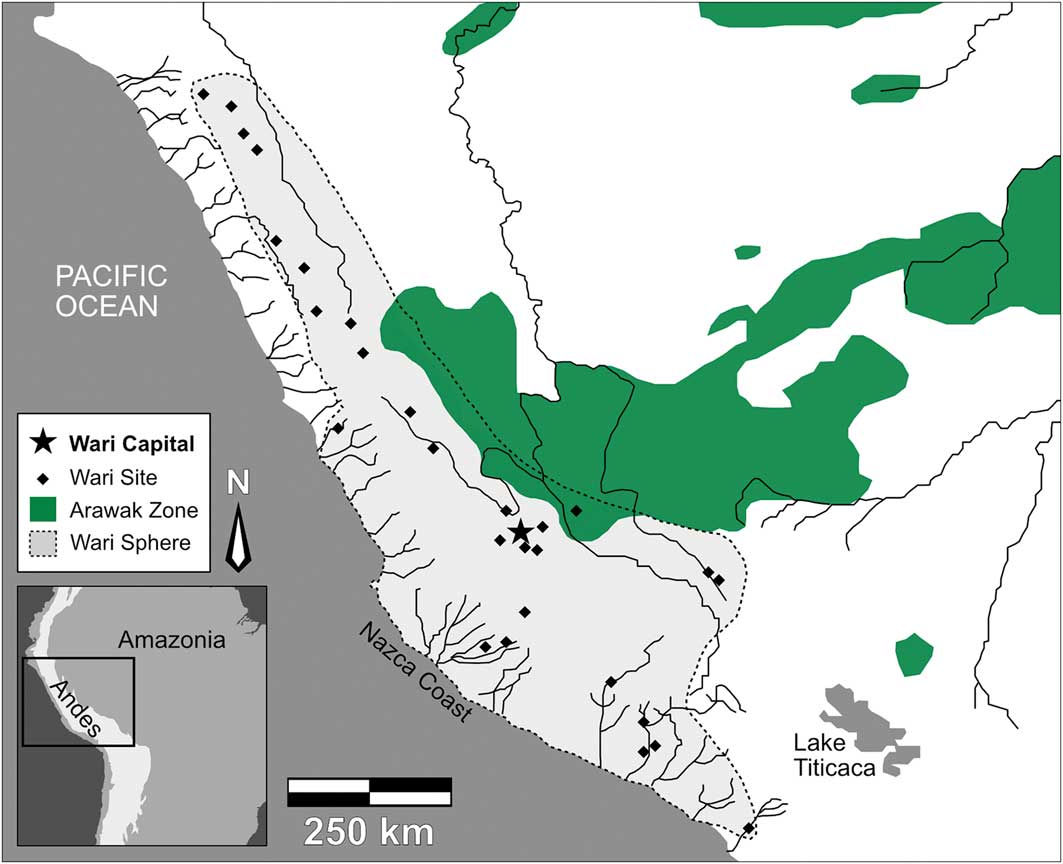
By the end of the Arawak expansion (c. AD 500), the eastern Andean piedmont was thus home to a far-flung, yet highly integrated, set of Arawak-speaking communities—themselves only one branch of a vast trading network. For the first time in Andean prehistory, the eastern slopes therefore hosted a sophisticated exchange system capable of supplying highland communities with tropical forest goods in bulk quantities, to a degree that would have previously been impossible. This transformation on the Amazonian side probably had profound effects on contemporaneous Andean socio-economic systems (Figure 1).
A map indicating the extent of the Wari polity (after Tung Reference Tung2012), with adjacent territories thought to have been occupied by Arawak-speakers by AD 1500 (adapted from Eriksen Reference Eriksen2011: 222).

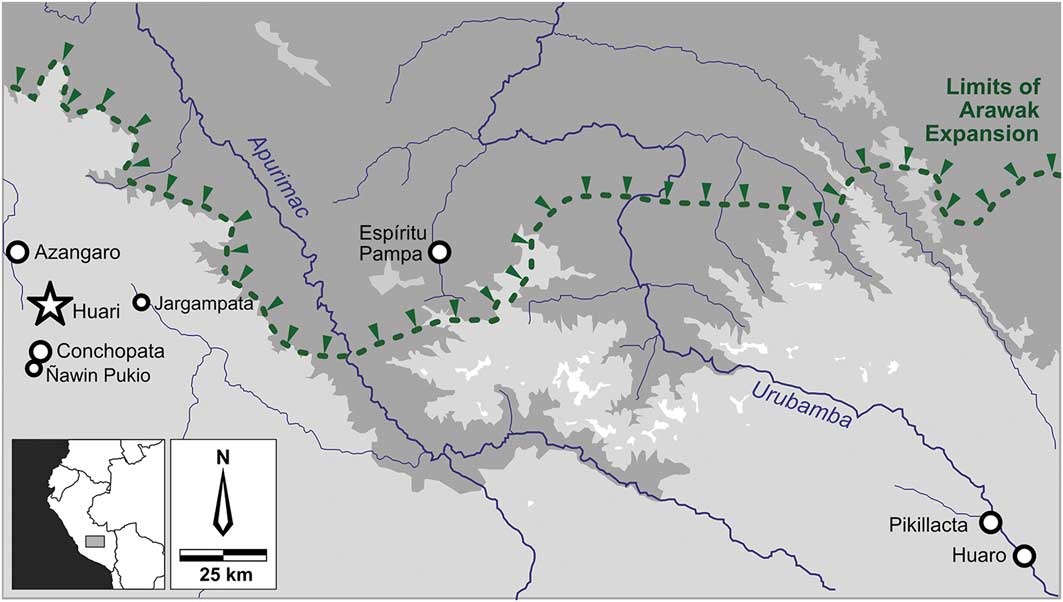
Discussions of Wari exchange links with western Amazonia would have been, until recently, somewhat speculative, at least with regard to direct archaeological evidence. But the recent discovery of a major Wari site at Espíritu Pampa (1500m asl) has provided the first major insight into the institutionalisation of Middle Horizon highland-lowland exchange links along the eastern slopes (Fonseca Santa Cruz & Bauer Reference Fonseca Santa Cruz and Bauer2013). Not only did the site incorporate classic forms of Wari ritual architecture, but it also yielded large obsidian projectile points and a high-status burial containing impressive quantities of gold and silver (Fonseca Santa Cruz & Bauer Reference Fonseca Santa Cruz and Bauer2013: 113)—prestige highland goods that were probably of interest to Amazonian exchange partners. Espíritu Pampa lies between the Apurímac and Urubamba Rivers, at the centre of the piedmont zone dominated by Arawak-speakers (Figure 2). These waterways were primary conduits of late prehistoric lowland-highland trade. If the purpose of Espíritu Pampa was to plug the Wari into the emerging Arawak-controlled lowland exchange networks, then it would be difficult to conceive of a more appropriate location.
The location of Espíritu Pampa in relation to the Apurímac and Urubamba Rivers (blue text), the major Wari sites of the imperial core zones (black text) and the territory believed to be occupied by Arawak-speakers by AD 1500 (green text and dotted line) (adapted from Eriksen Reference Eriksen2011: 222).

An empire of feathers
Exchange in exotic goods has long been considered a key impetus for state formation (e.g. Renfrew Reference Renfrew1972; Frankenstein & Rowlands Reference Frankenstein and Rowlands1978; D’Altroy & Earle Reference D’Altroy and Earle1985). The model presented here falls squarely within this tradition. More specifically, it is not general exchange between the Arawak and the Wari that is seen here as the major stimulus, but trade in one particular kind of prestige good—namely feathers from bird species native to the lowland neotropics. Bird feathers from highland species have always been used in Andean featherwork, most of which are either black or white in colour. Some species native to the Pacific coasts, such as the mountain parakeet (Psilopsiagon aurifrons), offered additional variety in the form of green plumage. But the main source for larger feathers of vivid red, yellow and blue was Amazonia. Specimens of the genera Amazona (Amazonian parrots), Ara (macaws), Ramphastos (toucans) and Tangara (tanagers) were particularly prized.
By the end of the pre-colonial era, Amazonian feathers (and even entire birds, both living and desiccated) were imported into the highlands in enormous quantities. Pedro Sancho de la Hoz (Reference Sancho de la Hoz1968 [1534]: 330), secretary to Francisco Pizarro and a direct witness to the Spanish conquest, suggested, for example, that the Inca storehouses in Cusco contained 100 000 dried birds at any given time. Similarly, Bernabé Cobo (Reference Cobo2010 [1653]: 122) records a single tribute payment to the Inca as including 1000 bird-filled cages. Ethnohistoric documentation of labour tributes extracted under the Incas also identifies feather workers as a major class of taxpaying artisan. For instance, according to an AD 1549 census, some 200 members (a third of all weavers) of the Chupachu ethnic group were dedicated to the production of feathered cloth (D’Altroy Reference D’Altroy1994: 182). If one provincial population could employ hundreds of feather artisans at any given time, there must have been thousands across the entire empire. If these figures are reliable, they speak to the consumption of vast quantities of avian products by Late Horizon (c. AD 1350–1532) highland elites. The use of neotropical feathers in Andean contexts is undoubtedly ancient—possibly dating to Preceramic times (Giuntini Reference Giuntini2006). The key question, therefore, is when did the bulk trade in exotic avian products originate? The appearance of Amazonian feathers as a bulk import was a later phenomenon, whose origins may lie at the beginning of the Middle Horizon (c. AD 600).
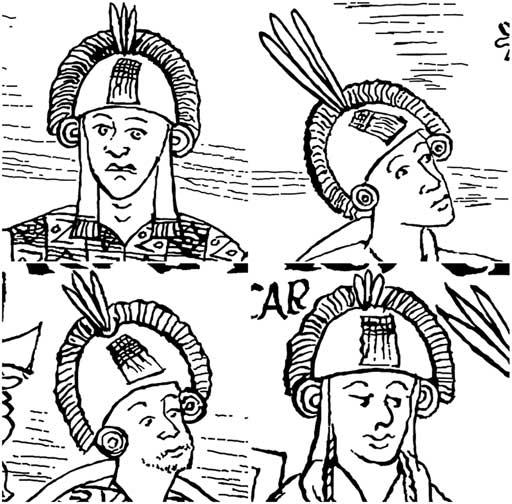
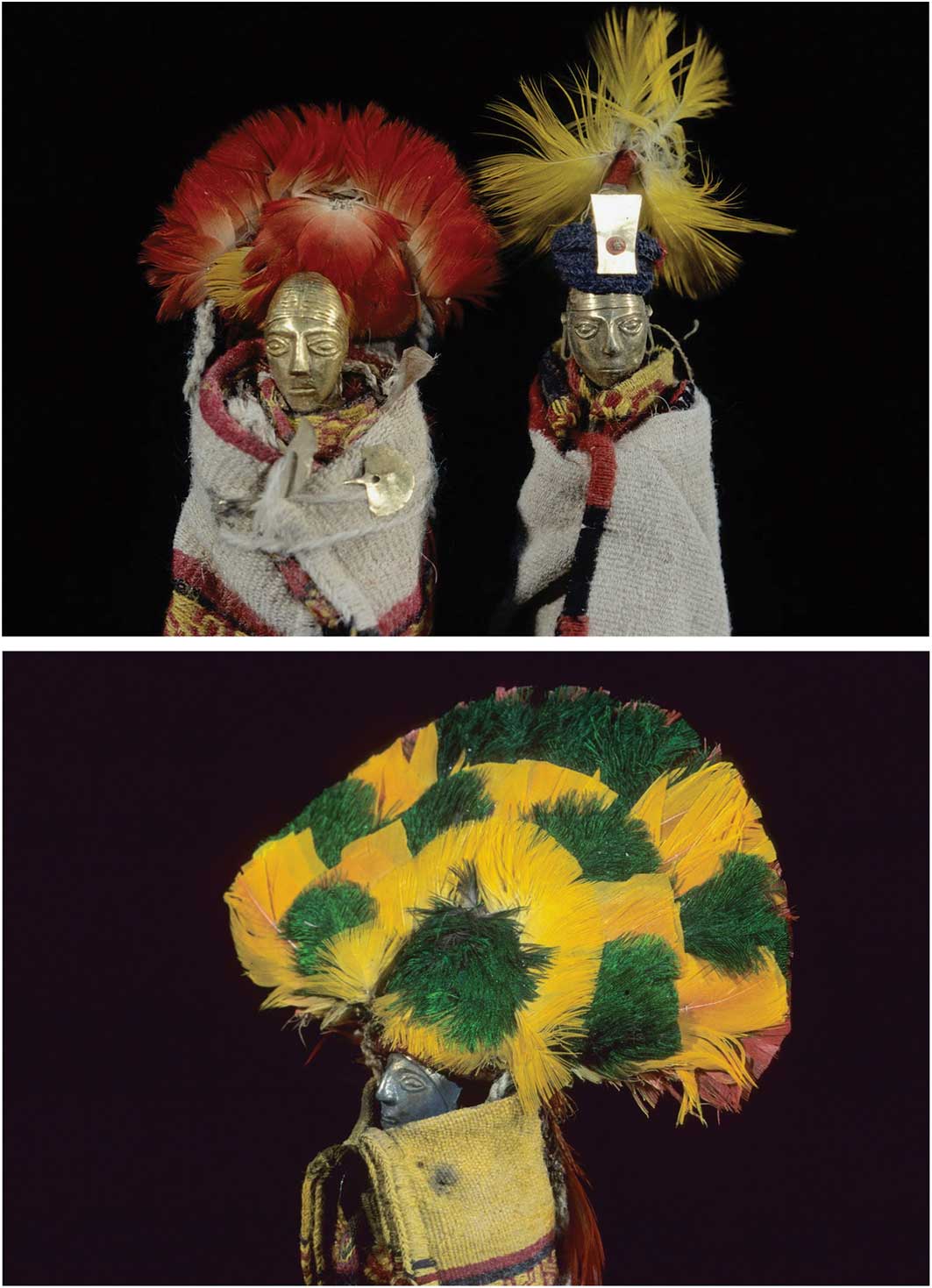
There is a certain logical attraction to this argument, as it implies that large, urbanised, imperial states would have had a much higher demand for exotic feathers than other Andean societies. The Wari, Chimú and Inca states would have required feathers in far greater quantities, due to their institutionalised practices of elite display and performance. Emperors needed the full measure of their pomp and finery to reinforce visually their claims to high status (Candler Reference Candler1991: 10–13). Indeed, much evidence suggests that under the Incas, elite bodies were necessarily feathered bodies. Guaman Poma de Ayala’s (Reference Guaman and F.1936 [1615]) seventeenth-century illustrations, for example, depict Inca rulers as consistently adorned with feathered headdresses (Figure 3). Similarly, archaeological finds of Inca-era human figurines, such as those from the high-altitude shrine at Llullaillaco in Argentina, represent high-status individuals wearing brilliantly coloured feathered regalia (Figure 4). Yet the importance of these feathers went beyond adorning aristocratic individuals in the imperial core. In state-formation models that rely on trade in exotics, elites monopolise certain precious goods, which they use to provide sumptuary gifts to subordinate or provincial elites, thereby locking them into relations of dependency and obligation. Large imperial states tend to have more secondary elites, who must be kept in the style to which they have become accustomed.
Depictions of Inca rulers from Guaman Poma de Ayala’s (Reference Guaman and F.1936 [1615]) illustrated account, indicating the prominent use of feathered headdresses.

Several metal figurines in the form of elite individuals from the high-altitude Inca shrine at Llullaillaco (Argentina). Note the Amazonian feathers used as headdresses (photographs courtesy of Johan Reinhard).

There is also empirical support for my argument. Simply put, the majority of Andean featherwork artefacts in museum collections have been assigned to either the Inca, Wari or (most commonly) Chimú (Candler Reference Candler1991: 2; King Reference King2012). For example, the New York Metropolitan Museum of Art’s collection of ancient Andean feathered textiles is believed to date primarily to the Middle Horizon or later (Giuntini Reference Giuntini2006). Unfortunately, very few prehistoric Andean feathered artefacts have been radiocarbon dated—a fact that impedes a firm chronological understanding of the highland-lowland feather trade. Still, a recent compilation of all the published radiocarbon dates for Andean featherworks (Newbury Reference Newbury2014) indicates that 21 of 23 specimens date to after AD 500. Notably, the two specimens dating to before AD 500 contained only white feathers, and were therefore probably from coastal, rather than Amazonian, species. The Paracas (700 BC–AD 1) and Nazca (AD 1–700) societies of the southern Peruvian coast had sophisticated featherworking traditions (Paul Reference Paul1990; King Reference King2012), despite their pre-Middle Horizon dates. Most of this very early featherwork, however, takes the form of smaller items of personal adornment, such as ‘fans’—many of which were probably components of elite regalia (Paul Reference Paul1990). Yet from the Middle Horizon onwards, there seems to have been a significantly greater investment in, and demand for, feathered textiles intended to adorn both bodies and architecture.
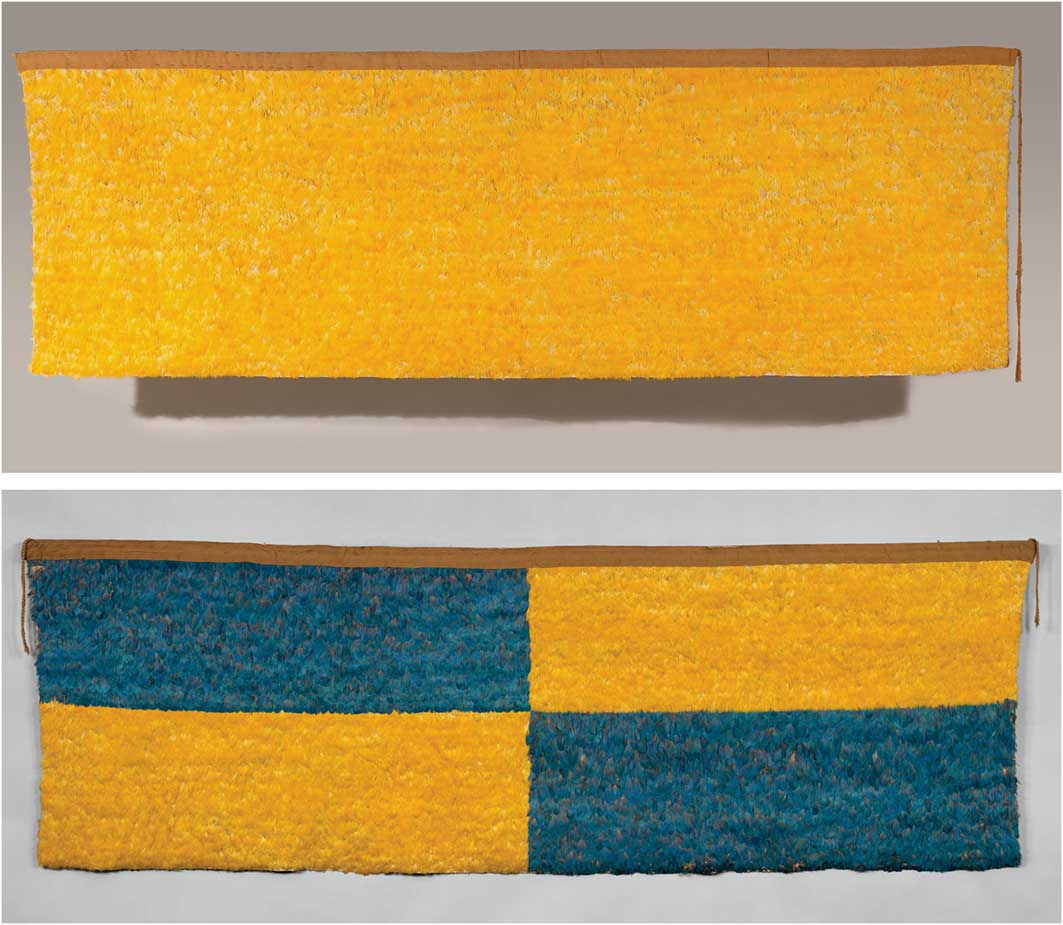
One of the most spectacular examples of this shift is seen in a funerary cache of approximately 96 Wari feathered panels from the Churunga Valley in southern Peru. Collectively, these would have covered an area of around 150 m2 (King Reference King2013). These panels would probably have adorned an important architectural space, in a manner not unlike European tapestries (Pasztory Reference Pasztory2008)—with remarkable visual effect (Figure 5). The feathers used in the Churunga panels are from the blue-and-yellow macaw (Ara ararauna). A typical individual of this species will yield around 1200 body feathers (Berdan Reference Berdan2006). Given that each panel required tens of thousands of feathers, this single cache of artefacts would have therefore required at least 2000–3000 birds. The scale of labour represented by such objects—not just in terms of their manufacture, but also in the capture and transport of thousands of Amazonian macaws—is enormous.
Examples of Wari feathered textiles from the Churunga Valley. Each panel measures approximately 0.74×2.12 m (photographs courtesy of the Metropolitan Museum of Art).

This scalar shift may simply reflect a bias in preservation, where featherwork is more common in later archaeological contexts. At the risk of ignoring any real patterns, however, we should be wary of attributing all regional and chronological variation in feathered textile collections to taphonomy alone. For example, it seems strange that very little featherwork has been found in Moche contexts (King Reference King2012: 20). Although the classic Moche polities of the north coast of Peru (c. AD 200–850) must have used feathered headdresses—such as those depicted in Moche art (Candler Reference Candler1991: 7–8)—few remains have been found. Some environmentally derived preservation bias must be at play here, but given that the largest cache of Chimú featherworks ever excavated was deposited within a Moche structure (King Reference King2012: 33), access to such avian products along the north coast during the early first millennium AD was probably relatively restricted.
The significance of the pre-Middle Horizon featherworking traditions of the Nazca region on the southern Peruvian coast should also be considered. The relationship between the Wari and the Nazca appears to have been a close one—much more so than for coastal regions farther north (Edwards Reference Edwards2013: 566–68). The limited scale of Wari architecture on the coastal plain itself suggests some form of indirect hegemony over the Nazca region, rather than conquest and military occupation. Although direct imperial control might often allow for the extraction of resources through violent means (which entails little reciprocity), clientage is rather different—in that although it may not be an equal relationship, it is still reciprocal. Edwards and Schreiber (Reference Edwards and Schreiber2014: 230) suggest that the Wari’s outposts near Nazca provided them with access to coastal products unavailable in the highlands, especially cotton. But what did the Nazca get in return? As the preeminent suppliers of Amazonian avian products to the wider Andean world, the Wari would have found in Nazca a place that had long valued feathered objects, and therefore a prime region in which to expand their interests. The impact of the Middle Horizon feather trade can therefore be seen to extend far beyond the relationship between the Wari and their Amazonian partners. It would also have been central in promoting Wari interests among other groups, including those on the coast. The bulk exchange of feathers would therefore have had knock-on effects across the entire Andean system, stimulating increased traffic in other products, such as cotton, coca and Spondylus shell.
The aim of this paper is to emphasise the Amazonian influences on the emergence of social complexity in the Andean highlands, rather than vice versa. That said, it is still an ‘interactionist’ model, and the influences should be considered to run both ways. Thus, the Arawak-dominated lowland trade networks of Amazonia and the Wari sphere in the highlands can be understood as two distinct but interdependent exchange systems. Exotic items would have flowed in both directions, in a symbiotic relationship. If feathers were the major precious commodity flowing into the Andes from Amazonia, metals and exotic lithics would have moved in the opposite direction. Unlike the Wari domain, the Arawak sphere was not a polity by any means, although in certain regions it did exhibit several markers of political complexity. In particular, areas with significant evidence for social stratification and monumental earthworks, such as the Bolivian Llanos de Mojos floodplains, the Upper Xingu River region in central Brazil, and Marajó Island on the Amazon Delta, have all been associated with Arawak groups (Denevan Reference Denevan1980; Erickson Reference Erickson1995; Heckenberger Reference Heckenberger2005; Schaan Reference Schaan2016: 158–66). In the Llanos de Mojos, for example, Andean-derived prestige goods—including gemstones and metal artefacts—have been found (Prümers & Betancourt Reference Prümers and Betancourt2014). Sites in the same region, such as the Lomo Salvatierra, have yielded cuprous artefacts dating to c. AD 500–1150 (Prümers & Betancourt Reference Prümers and Betancourt2014: 44–45). Andean exotics, therefore, may have had similar effects in promoting increased Amazonian social complexity.
Logistics of the Amazonian feather trade
In Andeanist scholarship, Amazonia is usually considered an undifferentiated source of raw commodities. Highland peoples desired lowland goods, including coca leaves, exotic bird feathers, beeswax and hallucinogenic plants, and Amazonia consistently met these demands. The literature may give the impression that Amazonia was a giant and well-stocked warehouse, always willing and able to supply the Andean world with goods in any quantities it required. This remains Amazonia’s basic narrative function, irrespective of the chronological context—be it Chavín in the tenth century BC, or the Incas in the fifteenth century AD. Yet the ‘Neolithisation’ of western Amazonia that occurred between the Andean Early and Late Horizons should have more influence in Andeanist accounts of interactions with the Amazonian lowlands. As the supply of any product does not magically rise to meet demand, the importance of the late prehistoric Arawak exchange networks of Amazonia lies precisely in their capacity to acquire and redistribute feathers on the requisite scale. If 100000 dried birds were stored in Inca Cusco at any one time, then a period of many decades would have seen millions of individual specimens transported into the highlands. The logistical requirements of such an endeavour were formidable, requiring an extensive and highly organised exchange network. For example, how large a trapping area would have been necessary to supply millions of Amazonian birds to the highlands during the final millennium of Andean prehistory? These issues are particularly relevant when considering wild species, where direct human intervention in their reproduction is limited.
González (Reference González2003) recorded the illegal trapping of 1718 parrots and macaws over four years from a 39km2 area in the Loreto region of modern Peru. Extrapolating, it would take an equally productive total harvesting zone of 2270km2 to produce 100 000 birds in a comparable timeframe. González (Reference González2003), however, also noted the highly destructive methods used by modern trappers, which entailed cutting down nesting trees to obtain juveniles. This led to a 75.6 per cent decline in the annual harvest between the first and fourth years. Either prehistoric trapping methods were more sustainable—which would have involved much larger areas—or they established new trapping zones every few years to avoid overexploitation. If the figure of 100 000 dried birds in Cusco at any one time represents the annual consumption rate for the entire Inca Empire, then Gonzalez’s data would imply an extraction zone of 90 800km2 over a period of 40 years.
As feather workers were apparently present in most provinces, perhaps only a small fraction of the total feather tribute was directed through the Inca capital. In which case, the total extraction area could be several times the estimated figure given above. The use of modern data as an analogue for pre-colonial trapping is problematic to say the least—and much depends on the assumptions made when interpreting the very limited data from Spanish sources. Even relatively conservative estimates, however, suggest a plausible (non-contiguous) trapping zone of approximately 100 000km2. Serious consideration should be given to establishing exactly when in South American prehistory it became feasible for western Amazonian communities to organise such a large-scale extraction and redistribution of wild faunal products. My suggestion is that the emergence of the vast Arawak trading network—and particularly the instantiation of its south-western branch along the Andean foothills by c. AD 500—provides the relevant terminus a quo.
How much did Andean feather consumption depend on exchange relationships with Amazonian communities? Did the Andean empires, for example, seek to establish captive bird-breeding programmes to reduce their dependency on the Amazonian supply networks? There is no clear evidence for such programmes on the Andean coast, although Amazonian birds are occasionally found at coastal sites. These include the Moche site of Dos Cabezas, the Middle Horizon site of La Real and the multi-period site of Beringa (Goepfert Reference Goepfert2012; Jennings et al. Reference Jennings, Tung, Yepez Alvarez, Quequezana Lucano and López Hurtado2015; Tung & Knudson Reference Tung and Knudson2018). These modest numbers from the Andean coast can be contrasted with the prehistoric American Southwest, where highly prized scarlet macaws from Mesoamerica were widely used in rituals and as a source of exotic feathers. Over 400 scarlet macaws have been identified from Southwestern sites, concentrated at major centres such as Chaco Canyon (New Mexico) and Paquimé (Chihuahua) (Watson et al. Reference Watson, Plog, Culleton, Gilman, Leblanc, Whiteley, Claramunt and Kennett2015). Unlike Chaco Canyon, however, the 322 individual specimens from Paquimé suggest that a local breeding programme was in effect, with carbon and oxygen stable isotope analyses confirming that the animals had lived at that site for their entire lives (Somerville et al. Reference Somerville, Nelson and Knudson2010). Despite excellent preservation conditions, nothing comparable has yet been reported for the Andean coasts. Although the limited written evidence emphasises imports from the lowlands, it remains unclear whether captive breeding programmes of Amazonian birds were ever established in the Andes; a matter that will only be settled through isotopic studies of Andean featherworks.
Conclusions
If we take seriously the premise that the material culture of power is fundamental to, rather than merely reflective of, elite status (e.g. Hodder Reference Hodder1982; DeMarrais et al. Reference DeMarrais, Castillo and Earle1996), then the beginning of the bulk trade in exotic feathers was no incidental event in Andean history. Such items facilitated—or at least greatly encouraged—new forms of social hierarchy and political dominance. Cobo (Reference Cobo1990 [1653]: 225) suggests that the Incas valued feathered cloth above all other kinds. Given the Incas’ extreme valorisation of fine textiles (or cumbi), this implies that it was the most prestigious artisanal medium in the empire. It is ironic, then, how little importance has been placed on featherworks in most archaeological accounts (see Pasztory Reference Pasztory2008). Indeed, most scholarly discussions of Wari prestige goods focus on bronze and gold objects, obsidian, Spondylus shell, polychrome pottery and textiles, while seldom mentioning featherworks. Yet it may have been the most important category of all. The basic resources for producing ceramics and woollen textiles are found virtually everywhere, and although sources of cotton, obsidian and metals are more geographically restricted, they are hardly exotic to the Andes in general. Ecuadorian Spondylus and Strombus shells and Amazonian feathers were the only true exotics, and it was only the supply of the latter that the Wari were able to monopolise effectively through their Arawak connections.
Here a contrast could be drawn between the considerable theoretical weight given to exotic birds in models of American Southwest social complexity and the relative lack of interest among Andean specialists in avian imports from Amazonia. Moreover, there is a parallel effort by Southwestern archaeologists to establish a greater spatial and chronological understanding of Macaw exploitation through radiocarbon and stable isotope analyses of excavated faunal remains. These two points are linked: archaeologists will devote resources to such analyses only if they appreciate the theoretical value of the resulting data. This article highlights the need for such data by outlining a model in which the establishment of a bulk trade in Amazonian feathers has major ramifications for later Andean prehistory. Although some evidence in support of this model has been provided, it is still partially speculative—a consequence of the acute lack of research on Andean feathered artefacts. The types of additional data needed to confirm or reject the model are quite clear, however. These include: 1) systematic radiocarbon dating of many more feathered artefacts to determine if the post-Middle Horizon scalar increase in consumption is indeed real; 2) isotopic studies to distinguish between feathers imported from Amazonia and those that could have been obtained through large-scale breeding programmes orchestrated by Andean elites. My model requires that Andean elites were largely dependent on Amazonian (especially Arawak) exchange networks for their supply of exotic feathers, and does not fit with the establishment of self-sufficient breeding programmes, such as those recorded at North American sites.
None of this is to suggest that the emergence of the Wari state had a single cause. Few scholars now imagine any state-formation processes to have been driven by one prime mover. Militarism, for example, was clearly a significant force in Wari political expansion, with the emergence of warrior elites dependent on the violent acquisition of trophy heads for the maintenance of their social status (Tung Reference Tung2012). Others have pointed to the role of a Wari religious-ideological hegemony maintained through ritual interactions with powerful entities within the sacred landscape, such as high-altitude bodies of water or mountain peaks (Glowacki & Malpass Reference Glowacki and Malpass2003; Williams & Nash Reference Williams and Nash2006). Moreover, although subsistence economies based on intensified maize agriculture pre-date the rise of the Wari state by more than a millennium, some still point to such fundamental economic shifts as the requisite basis for later political complexity (e.g. Finucane Reference Finucane2009). Explaining state formation requires the consideration of a balance of factors, although the precise weighting of each will probably always be debated. Regardless, the idea that Andean state formation was an almost entirely internal process with no significant supra-regional dimensions is surely flawed. This paper is one contribution to a long overdue re-evaluation of that model.
Acknowledgements
The author is grateful for the financial support of the Leverhulme Trust (ECF-2016-618). Terence D’Altroy and two anonymous reviewers provided valuable feedback on the article, which helped to improve the arguments considerably. All shortcomings remain my own.