Introduction
Gastrointestinal (GI) nematodiasis in ruminants is responsible for severe economic losses to poor farmers throughout the world, particularly in developing countries. GI nematodiasis has detrimental effects on animal health in terms of mortality and morbidity. GI nematode infection ranges from acute disease, frequently associated with high rates of mortality, premature culling and subclinical parasitic gastroenteritis. The subclinical parasitic gastroenteritis is the situation when overt clinical signs are absent but infections are associated with production losses (Vercruysse & Claerebout, Reference Vercruysse and Claerebout2001). Reduced feed intake is a well-known feature of trichostrongyle infections in ruminants (Coop & Holmes, Reference Coop and Holmes1996). Sheep are a treasure house of different GI nematodes such as Haemonchus spp., Trichostrongylus spp., Ostertagia spp., Oesophagostomum spp., Bunostomum spp., Gaigeria spp., Cooperia spp., Mecistocirrus spp., Marshallagia spp., Chabertia spp. Trichuris spp., etc. Most infections are mixed infections and involve several species of these nematode parasites. Some nematodes, especially those that suck blood, such as Haemonchus, Bunostomum and Gaigeria are responsible for specific clinical signs. Haemonchus is the most pathogenic of the blood suckers and infection with large numbers of this parasite often results in severe anaemia in the host. Severe blood and protein loss into the abomasum and intestine due to the damage caused by parasites often results in oedema in the submandibular region (Soulsby, Reference Soulsby1982).
The main methods for the control of GI nematodiasis are prophylactic treatment with synthetic anthelmintics. The worldwide emergence of anthelmintic-resistant strains and species of GI nematodes has led to a search for alternatives. The high cost of anthelmintic drugs and their uncertain availability complicates the problem further. There is an urgent need to discover alternative control strategies and treatments for GI nematodiasis in ruminants. Research has shown that the major potential lies within the field of natural medicine. There is a strong need for the scientific validation of anthelmintic activities of plant species in various parts of the world. Numerous plants from a number of countries have been listed as having anthelmintic activity, and many are currently being investigated. Achillea millifolium Linn. is used by farmers in traditional animal health care besides its use as vermifuge. The present study was carried out with the objective of evaluating the anthelmintic efficacy of entire plants of A. millifolium against the GI nematodes of sheep (Ovis aries L.) under both in vitro and in vivo conditions. The current study is part of a research programme aimed at evaluating the anthelmintic activity of available medicinal plants against the GI nematode parasites of small ruminants in Kashmir Valley, India.
Materials and methods
Achillea millifolium Linn. (Asteraceae), locally called ‘Pehl-ghasa’, is common throughout the Kashmir Valley in areas of high altitude – wastelands, agricultural lands and on open mountainous slopes, etc. It is a perennial herb, about 2–3 feet (60–90 cm) tall. The flowers are borne on dense terminals, flat-topped spikes, and both disc and ray flowers are small and white. Leaves are desiccated. The plant material was collected from the Aharbal area of southern Kashmir Valley in July 2005, identified and authenticated by a botanist (Dr Anzar A. Khuru) in the Department of Botany, University of Kashmir, Srinagar, India. The collected plants were processed for shade drying in a well-ventilated room (Drying Room, Indian Institute of Integrative Medicine, Sanatnagar, Srinagar). The dried plant parts were milled to a fine powder using an electric blender. The powdered plant material was stored in an airtight container/cellophane bags at 4°C until extraction.
Preparations of ethanolic extracts
Ethanolic extracts were prepared by dissolving 200 g of the powdered plant material in a conical glass percolator to which 1000 ml of 95% ethanol (EtOH) was added. The plant material was allowed to macerate for 16 h at room temperature and the percolate was collected by filtering through non-absorbent cotton wool. The process of maceration/percolation was repeated three times ( × 1000 ml). The combined filtrate was evaporated in a vacuum rotary evaporator under reduced pressure at 50°C to give a crude EtOH extract. The extract was scrapped off and transferred to a container and kept airtight for storage at 4°C until further use.
Preparation of aqueous extracts
Aqueous extracts were prepared by dissolving 100 g of the powdered plant material in 500 ml of distilled water in a glass percolator. It was allowed to macerate for 24 h at room temperature and the brew was filtered using Whatman #1 filter paper. The process of percolation was repeated three times ( × 500 ml). The combined filtrate was then concentrated in a water bath until the water had evaporated. The final crude aqueous extract was transferred to a vial and kept airtight for storage at 4°C until further use.
In vitro anthelmintic activity
For the evaluation of anthelmintic activity of crude aqueous and ethanolic extracts under in vitro conditions, the method adopted was a worm motility inhibition assay, as described by Iqbal et al. (Reference Iqbal, Lateef, Ashraf and Jabbar2004). The in vitro anthelmintic activity was carried out on adult Haemonchus contortus worms to determine the inhibitory effect of extracts against adult worms. Mature H. contortus worms were collected from abomasums of freshly slaughtered sheep in the local abattoir of Hazratbal, Srinagar. The worms were washed in phosphate buffered saline (PBS) and finally suspended in PBS. Twenty worms were exposed to each of the following treatments in separate Petri dishes at room temperature:
(1) albendazole at 0.55 mg ml− 1 (positive control);
(2) crude aqueous extract (CAE) at 25 mg ml− 1;
(3) crude ethanolic extract (CEA) at 25 mg ml− 1;
(4) PBS (0.1 m phosphate, 0.05 m NaCl, pH = 7.2) (negative control).
The crude aqueous extracts (CAE) were diluted in distilled water and the crude ethanolic extracts (CEE) in dimethyl sulphoxide (DMSO). There were three replicates for each treatment.
The inhibition of motility of worms was used as the criterion for anthelmintic activity. The motility was observed at 0, 1, 2, 4 and 8 h intervals. After exposure to different treatments, the worms were put in lukewarm PBS for 30 min in order to confirm the mortality. Percentage worm motility inhibition (%WMI) was determined according to Rabel et al. (Reference Rabel, McGregor and Douch1994) using the following formula:

Mortality index (MI)
The mortality index was calculated by the following formula:

Determination of 50% lethal concentration (LC50)
LC50 values of the individual plant extracts tested for anthelmintic activity were calculated by the following formula, as given by Assis et al. (Reference Assis, Bevilqua, Morais, Vieira, Costa and Souza2003):

In vivo anthelmintic activity
In vivo trials were performed by adopting the faecal egg count reduction (FECR) assay (Iqbal et al., Reference Iqbal, Lateef, Ashraf and Jabbar2004). Sheep of both sexes (female and male young stock ≤ 1 year) were used for in vivo trials. Before the experiment, animals were confirmed to be naturally infected with mixed species of GI nematodes by qualitative and quantitative faecal examination using standard parasitological procedures (Soulsby, Reference Soulsby1982). Only those animals with egg counts exceeding 750 eggs per gram of faeces (EPG) were used (Ademola et al., Reference Ademola, Fagbemi and Idowu2005).
Sheep used for the experiment were randomly divided into six groups of five animals each, on the basis of faecal egg counts, and assigned to different treatments. Group 1 received a single oral dose of CAE at 1.0 g kg− 1 body weight (bw). Group 2 received a single oral dose of CAE at 2.0 g kg− 1 bw. Group 3 received a single oral dose of CEE at 1.0 g kg− 1 bw. Group 4 received a single oral dose of CEE at 2.0 g kg− 1 bw. Group 5 was a positive control and was given a single dose of albendazole orally at 5 mg kg− 1 bw (Aldazole-2.5®, Ethicare Animal Health, New Delhi, India). Group 6 served as a negative control and received no treatment. The faecal samples of each group were collected in the morning, starting from day 0 post treatment (PT) and at days 5, 10 and 15 PT. The eggs per gram of faeces (EPG) were counted by Stoll's dilution method (Stoll, Reference Stoll1930). The faecal egg count percentage reduction (FECR %) was calculated using the following formula (Iqbal et al., Reference Iqbal, Lateef, Ashraf and Jabbar2004):

The data were analysed (statistical error of mean and significance tests) using the statistical package MINITAB software version 13.2 (Minitab, 2002; available at http://www.minitab.com). In all the analyses, the confidence level was held at 95% and P < 0.05 was set for significance.
Results and discussion
In vitro anthelmintic activity
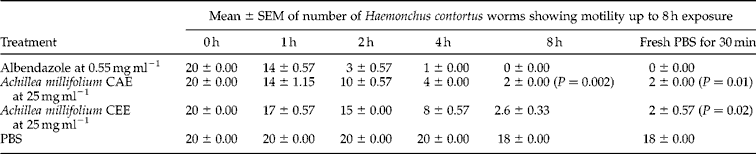
The crude aqueous extracts (CAE) and crude ethanolic extracts (CEE) of A. millifolium demonstrated the time-dependent anthelmintic activity (P < 0.05) against H. contortus as revealed from the inhibition of motility and/or death of the worms after treatment (table 1). The CAE of A. millifolium resulted in mean percentage worm motility inhibition (%WMI) of 94.44% while the CEE resulted in mean % WMI of 88.88%, as observed after the worms were put in lukewarm PBS for 30 min after exposure to different treatments. The mean mortality index (MI) of the CAE was 0.95 while for the CEE it was 0.9. The lethal concentration 50 (LC50) for the CAE was 0.05 mg ml− 1 and for the CEE was 0.11 mg ml− 1. Thus from the above tested parameters, we found that CAE showed greater activity than CEE (P < 0.01), and this could be due to the presence of a higher concentration of the water-soluble active molecule(s) in A. millifolium. The worms that were exposed to albendazole were found to be paralysed and/or dead at 8 h (100% mortality or paralysis). The result of in vitro anthelmintic activity of CAE and CEE of A. millifolium compared with albendazole was statistically non-significant (P>0.05), and was statistically significant (P < 0.05) compared with PBS [in earlier studies it was established that H. contortus is a good test worm for in vitro studies because of its longer survival in PBS (Iqbal et al., Reference Iqbal, Lateef, Ashraf and Jabbar2004)].
In vitro anthelmintic efficacy of crude aqueous and crude ethanolic extracts of Achillea millifolium on Haemonchus contortus of sheep.
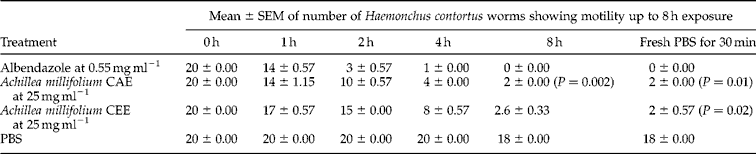
SEM, standard error of mean; PBS, phosphate-buffered saline; CAE, crude aqueous extracts; CEE, crude ethanolic extracts.
The time taken for the paralysis of H. contortus worms varied in different treatments. The paralysing effect of albendazole was much faster, and worms showed a complete loss of the movement/motility in albendazole at 4 h post incubation, remaining static thereafter and not regaining motility in lukewarm PBS. The survival time of negative control worms (PBS) was longer and did not show any normal mortality; but at 8 h, two worms out of 20 died because of the mechanical disturbance.
The motility of worms decreased gradually from the start of experiment in A. millifolium CAE and only two worms showed motility at 8 h. The worms, when put in lukewarm PBS did not regain motility to any major extent; just two worms regained their motility. However, in contrast, the worms in CEE did not show any significant mortality until 8 h and at this stage only 2.6 ± 0.33 showed motility. This indicated that the possible time required for the anthelmintic effect (mortality or paralysis of H. contortus) of CAE and CEE was 8 h after incubation, thus depicting the time-dependent anthelmintic activity of A. millifolium. The anthelmintic effect of extracts remained static then and thereafter, because no more than two worms (of either treatment) showed revival of motility in lukewarm PBS (table 1).
In view of the apparently conspicuous effect of CAE and CEE of A. millifolium on inhibition of motility of the H. contortus worms, the mortality of the worms was much faster in albendazole treatment than in CAE and CEE treatments. Our in vitro observations on the anthelmintic activity of A. millifolium against H. contortus of sheep are in agreement with the findings of various earlier workers who tested anthelmintic efficacy of various plant species against H. contortus of sheep and goats. Beriajaya et al. (Reference Beriajaya, Murdiati and Herawaty1998) reported the in vitro anthelmintic effect of different concentrations of Zingiber purpureum infusion and extract on adult H. contortus worms. Satrija et al. (Reference Satrija, Retnani, Ridwan and Tiuria2001) also reported the anthelmintic activity of Carica papaya, Morinda citrifolia, Ananas comosus, Coleus blumei, Codiaceum variegatum and Leucana leucocephala against H. contortus. Anita et al. (Reference Anita, Bharadwaj, Varshneya and Telang2005a, Reference Anita, Varshneya and Telangb, Reference Anita, Varshneya and Telangc) reported significant anthelmintic activity of methanol extracts of leaves of Bauhinia variegata, flowers of Tagetes patula and methanolic ether extract of Thuja orientalis leaf at different concentrations against H. contortus of sheep and goats at 5 h post incubation. Iqbal et al. (Reference Iqbal, Nadeem, Khan, Akhtar and Waraich2001) examined the in vitro anthelmintic activity of Allium sativum, Zingiber officinale, Cucurbita mexicana and Ficus religiosa methanol extracts against H. contortus of sheep. They revealed that Z. officinale killed all the test worms (H. contortus) within 2 h after treatment. Allium sativum and C. mexicana extracts were equally effective at 2 and 4 h after exposure; by 6 h after exposure, however, the former was 100% effective. Cucurbita mexicana could not kill all the worms and was only 83.4% effective. Ficus religiosa was 100% effective by 4 h after exposure and was as effective as A. sativum and Z. officinale by 6 h after exposure. Iqbal et al. (2005) reported the higher in vitro anthelmintic activity in crude aqueous extracts as compared to crude methanol extracts and crude powder against H. contortus, which they considered an indication of the presence of a water-soluble active ingredient in Calotropis procera latex. Eguale et al. (Reference Eguale, Tilahun, Debella, Feleke and Makonnen2007a) observed the greater in vitro anthelmintic activity in hydro-alcoholic extracts of the ripe fruits of Hedera helix on H. contortus of sheep as compared to the aqueous extract. Eguale et al. (Reference Eguale, Tilahun, Debella, Feleke and Makonnen2007b) also reported the greater anthelmintic activity of hydro-alcoholic extracts of the seeds of Coriandrum sativum on H. contortus as compared to the crude aqueous extract.
In the present investigation under in vitro conditions, the efficacy of plant extracts has been confirmed on the basis of the loss of movement and/or complete death of the worms. From the present in vitro study it can be suggested that both crude aqueous and crude ethanolic extracts of A. millifolium exhibited significant in vitro anthelmintic activity against H. contortus of sheep and have the potential for use as alternative anthelmintic agents for the control of GI nematodiasis of sheep and other ruminants.
In vivo anthelmintic activity
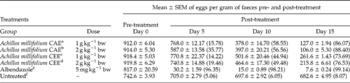
The in vivo anthelmintic activity (in terms of reduction of nematode egg output) of crude aqueous and ethanolic extracts of A. millifolium in sheep naturally infected with mixed species of GI nematodes demonstrated significant anthelmintic activity of both of the doses and extracts tested. In vivo anthelmintic activity of CAE and CEE of A. millifolium demonstrated a maximum faecal egg count reduction (FECR) of 88.40% in sheep (Group 2) treated with CAE at 2 g kg− 1 body weight on day 15 post treatment (PT), closely followed by FECR of 86.07% in Group 1 treated with CAE at 1 g kg− 1 body weight on day 15 PT. CEE was less effective and showed a FECR of 76.53% on day 15 PT at 2 g kg− 1 body weight (Group 4) while 1 g kg− 1 body weight (Group 3) showed FECR of 73.69% on day 15 PT (table 2). A progressive decline in the faecal egg count in all treated animals with extracts was observed from day 5 to day 15 PT. The effectiveness of these extracts were not comparable to the conventional albendazole which exhibited FECRs of 96.35% on day 5 PT and 99.14% on day 15 PT.
Mean±SEM of in vivo anthelmintic activity of crude aqueous extracts (CAE) and crude ethanolic extracts (CEE) of Achillea millifolium in sheep naturally infected with mixed species of gastrointestinal nematodes.

Figures in parentheses indicate egg count percentage reduction (ECR %).
aGroup 1; bGroup 2; cGroup 3; dGroup 4; epositive control (Group 5); fnegative control (Group 6); SEM, standard error of mean; bw, body weight.
The in vivo observations on the two extracts were consistent with those recorded under the in vitro conditions against H. contortus, where CAE also exhibited greater anthelmintic activity. In vivo observations on the anthelmintic activity of CAE and CEE in sheep naturally infected with mixed species of GI nematodes, in the present study, were also in agreement with the findings of others. Kato et al. (Reference Kato, Bowmann and Brown2000) observed that oral administration of Chenopodium ambriosoides oil produced a significant reduction in the number of Trichostrongyle EPG of faeces in treated lambs as compared with control lambs. Githiori et al. (Reference Githiori, Hoglund, Waller and Baker2003) observed a significant reduction in faecal egg counts of H. contortus of sheep after treatment with Albizia anthelmintica, Olea europaea, Annona squamosa and Ananas cosmosus water extracts. Iqbal et al. (Reference Iqbal, Lateef, Ashraf and Jabbar2004) observed a maximum faecal egg count reduction of 67.2% on day 14 PT with CAE of Artemisia absinthium at 3 g kg− 1 body weight. Iqbal et al. (Reference Iqbal, Lateef, Akhter, Gayur and Gilani2006a) showed that the crude powder and crude aqueous extracts of ginger exhibited a dose- and a time-dependent anthelmintic activity against GI nematodes of sheep, with respective maximum faecal egg count reductions of 25.6% and 66.6% on day 10 PT. Seeds of Butea monosperma administered as crude powder at doses of 1, 2 and 3 g kg− 1 body weight to sheep naturally infected with mixed species of GI nematodes also exhibited a dose- and a time-dependent anthelmintic effect (Iqbal et al., Reference Iqbal, Lateef, Jabbar, Ghayur and Gilani2006b). On day 2 PT, significant faecal egg count reduction of H. contortus was detected in the lambs treated with higher doses of crude aqueous and hydro-alcoholic extracts of Coriandrum sativum (Eguale et al., Reference Eguale, Tilahun, Debella, Feleke and Makonnen2007b). Two potential hypotheses have been put forward to account for the reduction of the parasitism in ruminants treated with plant anthelmintics. The first hypothesis views that the plant extracts/compounds may have direct anthelmintic effects on larval and/or adult parasites. The second hypothesis suggests that the consumption of certain plant extracts/compounds, such as condensed tannins, may benefit the parasitized sheep by improving protein availability to the host (Barry & McNabb, Reference Barry and McNabb1999).
As per the World Association for Advancement of Veterinary Parasitology (WAAVP) guidelines, a faecal egg count reduction of 99% or higher is considered to be highly efficacious, whereas an 80% reduction is just adequate (Githiori et al., Reference Githiori, Athanasiadou and Thamsborg2006). In the present study, crude aqueous extracts of A. millifolium produced faecal egg count reductions of more than 86.0% in both of the doses tested in sheep naturally suffering from GI nematode infection. When considering these guidelines, it can be suggested that A. millifolium possesses adequate anthelmintic activity and could prove a potential alternative to conventional anthelmintics in ruminants.
Various compounds have been identified and isolated from A. millifolium and any one of them could be the molecule showing potential anthelmintic activity. Various constituents such as α-pinene, α-thujene, β-pinene, α-terpene, geranial, eugenol, sesquiterpenes hydrocarbons, and guainol have been identified from its roots (Lourenco et al., Reference Lourenco, Figueiredo, Barasso, Pedro, Oliveira, Deans and Scheffer1999). Eugenol has been confirmed to possess anthelmintic activity (Asha et al., Reference Asha, Prashanth, Murali, Padmaja and Amit2001). The aerial parts of the plant growing in Kashmir have essential oil (0.014%) and the major constituents isolated are: camphor (28%), 1,8-cineole (12%), germacrene-D (12%) and cis-chrysanthenyl acetate (8%) (Shawl et al., Reference Shawl, Srivastava, Syamasundar, Tripathi and Raina2002). Many alkaloids and quaternary bases have also been isolated (Chandler et al., Reference Chandler, Hooper and Harvey1982). Aerial parts have also yielded a new sesquiterpene lactone-achilifolin (Ulubelen et al., Reference Ulubelen, Oksuz and Schuster1990). A glycosyl-neolignan dihydrodehydrodiconiferyl alcohol 9-O-β-d-glucopyranoside; four flavone derivatives (apigenin, apigenin-7-O-β-d-glucopyranoside, luteolin-4′-O-β-d-glucopyranoside and rutin) and two caffeic acid derivatives (3,5-dicaffeoylquinic acid and chlorogenic acid) have also been isolated (Innocente et al., Reference Innocente, Vegeto, Dall, Acqua, Ciana, Giorgetti, Agradi, Fico and Tome2007).
Various other biological activities have been reported in A. millifolium. The essential oil and methanolic extracts of A. millifolium have shown antioxidant and antimicrobial activity (Ferda et al., Reference Ferda, Mehmet, Bekta, Dimitra, Moschos, Atalay and Askin2003). Hepatoprotective, antispasmodic and calcium antagonistic activities have been reported in the aqueous-methanolic extracts (Yaeesh et al., Reference Yaeesh, Jamal, Khan and Gilani2006). The plant has also shown an anti-ulcer efficacy after chronic treatment in Wister rats (Cavalcanti et al., Reference Cavalcanti, Baggio, Freitas, Rieck, Sousa, Silva-santos, Vela and Marques2006) and the plant extract is also used as nasal drops in nasal congestion (Candan et al., Reference Candan, Unlu, Tepe, Daferera, Polissiou, Sokmen and Akpulat2003). The present study confirmed the anthelmintic activity of A. millifolium against nematode parasites.
In conclusion, extracts of the entire plant of A. millifolium possess significant anthelmintic activity that may support the use of the plant by local farmers in traditional animal health care, as vermifuge. Therefore, A. millifolium could be an alternative to the commercially available anthelmintics for the treatment of GI nematodiasis in sheep. Detailed phytochemical and pharmacological studies for the anthelmintic activity of A. millifolium and standardization of dose for drug development are recommended. Research is also recommended for anthelmintic studies on experimentally induced infection with particular species of GI nematodes in sheep and allied species.
Acknowledgements
The first author is highly thankful to the Council of Scientific and Industrial Research (CSIR) New Delhi, India for financial assistance. We are also highly thankful to Mr Rafiq Ahmad for his valuable contribution to plant collection and allocation of the animals.