1. Introduction
Compositional and perceptual studies have recently tended to absorb all conventional parameters of music, such as timbre, harmony, noise and spectrum, into a detailed but unified understanding of sound (Solomos Reference Solomos2013). Musical compositions are being conceived, performed and perceived by approaching the sound world as a complex whole rather than as an area having distinct and separately structured dimensions. A number of theoretical and creative works propose a description of a sonic materialism in which the attention moves towards sound-in-itself. Philosopher Christoph Cox has animated the debate on the materiality of sound, discussing a new theoretical stage capable of going beyond representation and signification (Cox Reference Cox2011). The composer Fausto Romitelli has insisted on the need to include materiality in musical practices: these activities should be enriched by the contribution of practical experience in order to develop a complex organism with a metabolism, carnality, density, thickness and grain character (Romitelli Reference Romitelli2001). Döbereiner, criticising the idea of a living character of sound, claims that sound-in-itself is accessible only through composition, and that the materiality of sound belongs neither to the subject nor to the object but remains in compositional practices ‘as material (re)configurings of the world’ (Döbereiner Reference Döbereiner2014).
I recently proposed a sonic correlation between contemporary instrumental and post-spectralist pieces and several offshoots of glitch-electronic and IDM (Wanke Reference Wanke2015). I believe these convergences have to do with a common focus on the sound-in-itself, providing access to a sonic materialism from different directions. Correspondences between figures such as Georg Friedrich Haas, Giovanni Verrando and Bernhard Lang, and performers coming from independent scenes such as Pan Sonic, Autechre and Raime concern a common focus on the sound-in-itself and its intrinsic characteristics and show similar choices such as the use of complex spectra and periodic movements within globally rich and sculptural textures (Wanke Reference Wanke2015). The sound, continuous or discrete, is conceived as a dense, tactile and three-dimensional matter that is moulded as if it were a physical substance. This idea of sound, which recalls Scelsi’s definition of spherical sound (Scelsi Reference Scelsi2006), touches both stable materialist and unstable ecstatic concepts in an apparent self-contradiction. Scelsi’s sound is profound and vibrant; it is typical of an exploration of the inner extent of sound itself, but is also characterised by its being intuitive and enigmatic as an almost mystical material. It behaves as if it were a living entity, typical of its nature, it is concrete (i.e. material) yet unstable (i.e. ecstatic).
This cross-genre viewpoint that I call the ecstatic-materialist (E-M) perspective is defined by specific musical characteristics. Some of them coincide with the main concepts expressed by spectralism, minimalism and musique concrète, while others emerge as typical only of this multi-genre perspective, marking it out within the variegated panorama of today’s music. By discussing these characteristics, that is, the materialist approach to sound, the conception of time and space, and the compositional and perceptual aspects, this article postulates the presence of an ecstatic-materialist domain by evidencing similarities among distant currents and disclosing crucial differences between contiguous styles.Footnote 1
2. The Ecstatic-Materialist Perspective
Abraham Moles, in his seminal book on information theory (Moles Reference Moles1968), presents two different theories that describe our perception of the external world: the theory of scanning and the theory of form. The first asserts that perception derives a message from the scanning of various distinct elements, perceiving them as a collection of separate elements, while the theory of form states that the message arrives as a unified form – a series of elements perceived as a whole unit and not as a collection. Moles shows different possible syntheses of these theories, but this dual representation is useful in making clear crucial aspects of the ecstatic-materialist perspective.
Certain practices within electroacoustic musicFootnote 2 conceive the structuring of a piece in a way that appears comparable to the theory of scanning. These methods proceed from a conception of various elements, mainly differentiated by their morphology, to a composing of a complex combination. A theory of a morphology of sounds has been developed not only for academic studies but also within the fields of perception and composition (Smalley Reference Smalley1997). Typo- and spectro-morphologies open up to processes based on articulation and construction using distinct sonic elements in collections.
In contrast, the E-M approach embodies the theory of form. Compositional methods as well as perceptual approaches are integrated processes in which composer and listener search for a unified sonic matter. The composer creates the sound as a single entity to be developed. There is often an intentional limitation of the sonic material and the music does not progress according to a functional design. Listeners approach the sound perceiving a single body that evolves. Sound is then a form conceived and appreciated as a whole and explored through its complex characteristics.
In addition to this parallel with the theory of form, the dual vision of this ecstatic-materialism rests mainly on a particular conception of sound and its positioning as the locus of convergence of composer and listener within various frameworks and contexts.
It is a materialism because both author and listener within this perspective intend to explore the substance of sound-in-itself, its consistency and presence, to confront dense masses and examine the constitutive elements of raw sonic matter. Materialist sound serves itself, but in embracing subjective experiences and extra-musical elements as part of the listening and creative processes it calls to a reality and carnality that it conveys through the expressivity of pure sound. Furthermore, it is an ecstatic materialism: for the composer, this refers to the unstable, ephemeral and personal nature of sound, its liminal aural characteristics and its intimate relation with time and evolution; E-M sound is to be understood as not just a sonic substance but also as an unstable and transitory experience. For the listener, ecstatic concerns the liberty to move within the intrinsic characteristics of sound: to freely associate insights, fleeting impressions and to penetrate an author’s sense of sound.
Sound is the common ground between creator and recipient in which the vital impact of raw sound and its intimate temporality and spaciousness incorporate the extra-musical and bodily aspects. Therefore, sound is both tangible, as physical material, and volatile, due to its ephemeral behavior in perception.
With the E-M perspective, the vision of music that claims an impersonal and scientific investigation of and approach to sound, detached from everyday life and ‘purified’ from extra-sonic traits, is left behind. Composers that fall within the E-M perspective convey elements of practical experience (Romitelli, Pan Sonic) and intimate discovery (Grisey, Scelsi) through sonic possibilities so that their music, even if it is founded mainly on research into purely sonic aspects, maintains a dramaturgy and a personal touch. Listeners, each within their own context, are engaged in a rich listening experience, free in their interpretations and sensations: they are faced with pure aural stimuli and, as a result of a specific cultural and aesthetic framework of communication, they get involved in intuitions and personal exchanges. Perception is far from normalised and automated, it is a captivating and inclusive sonic engagement that unfolds as an open, personal, unique and thoroughly involved participation, as a synthesis of temporary feelings and sociocultural habits.
In presenting a series of examples from contemporary instrumental music, post-spectralism, minimalism and electronic-glitch, I delineate this cross-genre E-M perspective by focusing on musical perception and conception, aural references, and extra-musical content, showing that several details frequently overlap, being essentially part of a single transversal vision of sound across several currents of today’s music, and belonging to both composer and listener.
3. Sound
Some practices within electroacoustic music, that is, those coming out of musique concrète, acousmatic music and sonic art, have started from the concept of reduced listening and have gradually moved towards the inclusion of several mimetic aspects (Emmerson Reference Emmerson1986; Landy Reference Landy2007) whilst still drawing on the Schaefferian definition of ‘sound object’. Some composers and scholars have criticised and developed this concept into that of ‘event’ or ‘image’, enhancing the debate around phenomenology (Bayle Reference Bayle1989; Kim-Cohen Reference Kim-Cohen2009; Voegelin Reference Voegelin2010; O’Callaghan Reference O’Callaghan2010; Bonnet Reference Bonnet2012), but still the legacy of musique concrète has led to a particular aesthetic and musical syntax. From a very general point of view, this aesthetic is grounded in the idea of composing the sound (composer, développer), creating a number of finite aural events combined together according to their morphology to constitute complex sonic arrangements. Horacio Vaggione states: ‘[t]he compositional, it seems to me, would be anything but articulable. […] To compose is then equivalent to generating genuinely singular events and articulating them in larger and larger groups without losing the sense of these singularities’ (Vaggione Reference Vaggione1998: 154; italics in original).Footnote 3
The parallel with Moles’s theory of scanning lies exactly in the ‘sense of these singularities’: pieces are built from units and elaborated through functional relationships that are operational within different domains (e.g. spectral, dynamic, temporal or spatial). This approach reaches a significant complexity of musical syntax that is intended to be perceived as an interconnected structure, a kind of language. Sound here is complex, elaborated, sometimes deceptive and ambiguous, multifaceted and to some extent functional and representational. Electroacoustic composers, such as Bernard Parmegiani and Denis Smalley, compose sonic events and arrange them in terms of relations, successions and differences.
On the other hand, within the E-M perspective I am considering, sound is not composed (composé, développé), it is posed (posé, déployé). I emphasise here the double parallelism, highlighted in the case of Scelsi and spectral music (cf. Murail and Bériachvili), between composing and posing (or de-posing) on the one hand, and between developing and deploying (arraying) on the other. Sound is created and left to unfold: the author conceives a unique form and proceeds to discover and disclose it (cf. Grisey Reference Grisey2008; Ferguson Reference Ferguson2007: 117). Sound, then, evolves and assumes organic characteristics (Bériachvili Reference Bériachvili2008). Even in the case of electronic music, for instance in some pieces by Pan Sonic, sound is natural, primordial, ancestral and instinctive. Mika Vainio and Ilpo Väisänen’s sound is raw, radical, textural and material, whether it is continuous or discrete. They shape a sound, manipulating its spectral range, partials and dynamics to achieve a sonic material that has a physical impact on the ear. They frequently exploit acoustic interferences based on the exploration of the auditory phenomenon of critical bands and, due to the pervasive effect of aural beatings, their sound gives the sensation that a concrete imprint has been left behind. These characteristics are typical of continuous musical episodes made up of sustained and overlapping tones that build as a kind of material thickening, layering up in perception.
When discrete sounds are employed, each piece (or episode) within the E-M perspective proceeds by developing families of sounds in such a way as to create an internal natural coherence in which each aspect is part of an integrated form. The tendency of convergence is often present: different sonic events balance each other, occasionally recur (periodically or not) and do not progress as a fast succession of many different sound types. It is common to find a couple of elements that are continuously repeated and that work as a support for other discrete elements, strengthening the musical flow, as in the case of IDM artists such as Pole (Stefan Betke) and Peder Mannenfeld. In general, the repetition of sound elements, both continuous and discrete, could be rhythmic (e.g. IDM, glitch), hypnotic, cyclic (e.g. drone music, spectralism) or sporadic (e.g. glitch).
The concept of sound in E-M pieces is far from being that of an immutable entity; sound could exist as continuous or discrete episodes, but as an organic substance it forms, thickens and changes even whilst being always present – sound is posed and its presence is almost atemporal, yet it continues to change. Sound could be absent but its essence could still be perceptible, expanding the present out to the horizons of linear perception (Bergson Reference Bergson1922), as Solomos perceptively describes in the case of Scelsi’s String Quartet no 4 (1964): ‘not only do I hear things at every listening, moreover, it is always difficult for me to know if what I hear (or believe to hear) is “there” (in the score or in the recording) or whether I imagine it’ (Solomos Reference Solomos2013: 261).Footnote 4 This appreciation of what I term the ecstatic combines the eternal and the temporary, an eternity contained in an instant with impressions that are temporary: ‘the D chord appears set for eternity. But it is a light eternity, as if suspended: some ears will never perceive this chord, because it is constantly subject to interference, worked upon by unfamiliar notes’ (Solomos Reference Solomos2013: 263).Footnote 5 Within this E-M perspective, sound is simultaneously permanent (i.e. material) and ephemeral (i.e. ecstatic).
The distinction I made earlier between posing and composing sound could be related to the epistemological debate between the intuitive and the axiomatic positions, in which the former is generally ascribed to Cage’s idea of ‘leaving the sound to be’ while the latter asserts the poietic intention to compose the sound (e.g. Xenakis) (Solomos Reference Solomos2013: 355). However, within the E-M outlook, the presence and the intention of the author are essential aspects; pieces such as the String Quartet no 2 of Haas or Pan Sonic’s Keskeisvoima reflect this characteristic (Verrando Reference Verrando2012: 195; Wanke Reference Wanke2015): these composers impose embodied movements onto the music, such as attacks, contrasts, vibrations, interferences; such that the impression given is of a material that is far from being autonomous or self-developing.
The sound artist Richard Chartier examines minuscule, unprocessed, ‘nonreferential and precultural’ sonic elements (Demers Reference Demers2010: 76) whose nature is so impersonal and neutral that they appear to some degree distant. In exploring the inaudible and microsonic world, Chartier sometimes appears to reach the coldness of scientific objectivity that sets his work slightly apart from the perspective that I propose. Within the E-M thinking, the author manipulates and engraves the sound, signalling its presence in a way that makes the sound vibrant and vivid even during slow evolutions. For example, in an apparently similar way to Chartier, Eliane Radigue, in Trilogie De La Mort, creates extremely gradual transformations of almost static blocks of sound that hold a sort of internal resonance and movement, describing linear and curved fluctuations that seem to mimic human breathing.
The authors that exemplify the E-M perspective forge a quasi-permanent sound; handling frequencies, noises, dynamic contrasts as well as fluctuating and enveloping textures, they explore the instability of sound from liminal aspects (spectralists) to interferences and collisions (glitch music) in a way that allows the music to pass through transitory moments and explore imperceptible flaws and illusory rifts of sound, evolving within a personal time flow.
4. Time
Time in music has always been a fundamental subject in compositional, perceptual and theoretical studies. This dimension has taken on a great importance in the last century, during which some composers renewed the seemingly primordial role of sustained and continuous sounds (e.g. Xenakis, Ligeti, Scelsi, Grisey), and others studied the effect of repetitive structures (e.g. minimalists).
Temporality in spectralism and minimalism has been explored through the use of repetitive structures creating hypnotic reiterations, periodic profiles or continuous shapes. One could associate these figures with the idea of flat evolutions where, based on Kramer’s definitions (Kramer Reference Kramer1988), the concepts of linearity and verticality of time lie more with the perception of music over time than with the shape of musical episodes themselves. He then associates minimalist and spectralist visions of time with the concept of ‘verticality’ (Kramer Reference Kramer1988: 55).
Kramer’s definition is very useful for a general distinction, but some terms of his exposition do not work properly in many cases (Bériachvili Reference Bériachvili2010: 100). In particular, the parallel between the lack of teleology and the absence of organisation and hierarchy does not always hold. Many works of spectralism and minimalism contain long musical passages that are substantially undifferentiated, but their development follows a strong dramaturgy creating musical forms that are ordered and organised.
There is a substantial, continuous gradation from pure linearity to extreme examples of verticality in music.Footnote 6 Within this range, many composers utilise repetition as a means of playing with a listener’s perception, and so it seems important to reconsider the meaning of adjectives such as linear, narrative, cyclic or teleological. Scelsi’s Quattro Pezzi, for example, shows a sense of dramatic construction (such as the ‘tension/resolution’ schema) typical of the Western musical tradition together with unconventional sonic metres commonly found in Eastern practices (Menesson Reference Menesson2008). Despite Kramer’s idea, there is in this piece a sort of expectation and structural hierarchy, the musical time is not linear but a progression of sound flow is discernible. There is a narrative but not a teleological profile (i.e. directionality): the listener is absorbed (or immersed) into a sonic discourse. In the case of the more recent in vain by Georg Friedrich Haas, musical time (and consequently the listener) moves at different rates: the succession of episodes with diverse profiles (e.g. circular, flat, accelerating), each one composed of repeated motifs, opens up to different temporalities and therefore to different perceptual dimensions.
I argue that authors such as Grisey, Scelsi, Radigue and Haas belong to the E-M vision and explore an idea of time that is internal and organic, intimate and vital. Bériachvili talks about the breath and the vibration of Scelsi’s sound, and Scelsi himself talked about the ‘right sound’ (suono giusto) that needs the right time to develop. Grisey founded his research on Bergson’s notion of duration (durée), in which the music is an expression of time and the musical material is a manifestation of pure duration (son-durée). Music is an organic process in which the sound is an ‘être vivant’, not fixed but ever becoming (Solomos Reference Solomos2003). Bergson’s inner time cannot be expressed as a line, and in Grisey’s music this idea of innermost time is realised through a distortion of a sound’s perspective (Hervé Reference Hervé2004) and through the process of revealing: from human dimension (microphonic) towards universal dimension (macrophonic).
In discussing these dualities, between personal/universal and subjective/objective, an interesting parallel between Xenakis and Grisey reveals that these two composers similarly capture the emergence of sound through ‘fullness’ and ‘presence’ (Solomos Reference Solomos2003). Their musical figures leave nothing behind; their compositions reject absence and are characterised by a continuity of matter and fusion of components (cf. Moles’s theory of form) that achieves a unique presence (‘un art de la présence’; Solomos Reference Solomos2003).
Sound in the music of Scelsi (from 1959) is concerned with a personal journey and an internal sense of time: the music of the Italian composer holds a sort of ‘warm’ and gravitational centre (Scelsi Reference Scelsi2006: 145; Bériachvili Reference Bériachvili2008; Solomos Reference Solomos2012). This concept of Scelsi’s intimate tension merges with the notion previously proposed of E-M sound as organic and vital. Solomos suggests a sort of bio-morphology for Grisey’s and Scelsi’s visions (Solomos Reference Solomos2013: 272): the former achieves the fusion of form and material through the process, while in the case of the latter this convergence is fulfilled as a private encounter at the centre of sound (‘au cœur du son’; Solomos Reference Solomos2012). Both composers find this unification in the sound, the return to it through repetition, as an integral phenomenon in which sound is a living entity. Cyclic forms and repetition define several aspects of our life (e.g. reproductive cycles) and regular recurrences such as heartbeat, breathing, walking and sleeping. All these shapes encompass the idea of the return to the original state and constitute ‘one of our most basic patterns for experiencing and understanding temporality’ (Johnson Reference Johnson1987: 121).
Within the E-M perspective, time could be seen as vertical, cyclic, intimate, organic, vital: this sense of time gives time for sound to develop. Music is characterised by its permanent presence and movement towards the private dimensions of perception rather than by any linear correspondence to chronometric time.
On the other hand, time conception in early minimalism shares several aspects with the E-M perspective but differs in several essential points. Structuralist minimalists (Reich, Glass) typically work with linear units (i.e. groups of notes) continuously reiterated and perceived vertically over time, exploring profiles more than textures. In contrast, materialist minimalists (Young, Tenney) use musical practices similar to those of spectralist and avant-garde artists, such as the minute exploration of sustained neighbouring frequencies (Corbett Reference Corbett2000). They achieve different results from the spectral composers in terms of how the notions of ‘stasis’, ‘teleology’ and ‘directionality’ are realised. But in some cases their aesthetic could be considered to be within E-M: figures such as Phill Niblock, Eliane Radigue and Alvin Lucier represent good examples of this correspondence.
Special attention should be taken when considering the notion of time in electroacoustic music. It is not possible to cover all typologies of this vast field of music, but it can be observed that the central focus within certain streams on composing sound directly affects musical syntax and temporal evolution. Sound is structured as interlaced events and, as previously mentioned, this functional arrangement could be created within the spectral domain as well as in spatial and temporal dimensions. For instance, a 360º multichannel piece could construct a virtual scenery in which a sound reverberates with a specific delay defining the geometry of space. In this case, the listener is immersed in a simulated reality with a corresponding time-frame. When this temporal simulation is disturbed by sounds of a different nature, holding, for instance, different delay times, the perceiver is puzzled and moved towards different temporal dimensions. In some cases, listeners are immersed in a multidimensional sonic design in which temporality appears to progress at different rates. Horacio Vaggione, for instance, presents his granular synthesis by introducing different temporalities (micro- and macro-scale) that depend on the morphology of sound (Solomos 1998, Reference Solomos2013: 403–14). When the succession of different sonic events is very fast, a listener’s immersion within a coherent sonic space is more difficult and the perception of the temporal flow becomes more confused. In these cases, a listener is not immersed in a unique aural landscape and the succession of finite events tends to bring temporal perception back to chronometric time. Sonic objects could be defined by their relationship with time (i.e. a sound that begins, develops and ends) such that their finiteness is part of their nature. Thus, their combination within a non-coherent simulation pushes the listener to perceive them in chronometric time: objects are arranged in mutual relations and they are perceived distinctly, finitely, pushing the listener out of an immersive virtual reconstruction.
The immense aural potential of electroacoustic music therefore leads some practices to touch on certain notions of E-M vision (e.g. verticality-duration, repetition, intimate time-frame), whereas other movements move towards a completely opposite aesthetic (e.g. narrative, figurative).
5. Space
Spatial features of music have been deeply developed within electroacoustic music in which spatial aural characteristics are studied from both internal and external points of view: sounds are combined, overlap and occupy discrete sections of both spectral and physical space.
The E-M perspective instead concentrates exclusively on the internal space of sound: spectral space enlarges and reduces based on sound’s evolution, sound exists within a compact space-matter (espace-matière) in which sound expresses ‘its colors, light effects, tactile sensations … all properties of a physical matter’ (Bériachvili Reference Bériachvili2010: 12). Space-matter, as one of many notions of musical space, is defined by Bériachvili as the extent to which sound possesses a quasi-objective presence and material nature: it is the place of palpable qualities of sound, its volume, its density and grain (2010: 32).
Historically, spatialisation has been developed in various ways. On the one hand, Stockhausen elevated it as a ‘proper’ parameter of music (together with pitch, duration, timbre, dynamic) by integrating spatial elements within combinatory and serial designs. On the other hand, Xenakis used spatialisation to explore architecture and enhance the impact of his pieces. Figures such as Chion, Bayle and Parmegiani introduced the design of virtual spaces: using a very large sonic palette, they constructed complex sounds and simulated aural spaces for perception.Footnote 7
The E-M vision restricts its research to sound-in-itself in a way that all external considerations are reflected back into internal aspects of sound. The immersive listening (Solomos Reference Solomos2013: 235–78) often invoked in many manifestations of multichannel diffusion here exists as a demand that listening move into sound: the immersion arises primarily in a sonic sense rather than a spatial sense. Pieces of the E-M perspective do not necessarily ask for a multi-directional experience (though it is not excluded, as in the case of Haas’s String Quartet no 3, in which the performers are placed in the four corners of the room with the audience in the centre), rather they solicit the listener to descend or enter into the internal space of sound (i.e. space-matter), simply by listening to a sonic source (be it natural, stereo or multichannel). The reification of space here occurs within the listener’s insight into the sound rather than the physical space. It is hard to exactly locate this space-matter: is it within our cochlea? Does it exist virtually as a synthesis of infinite reflections of sound waves during listening? It is not crucial for this study to identify the location of the space-matter, however, it is important to perceive and recognise it within music as a distinct manifestation of space beyond the physical layout or location of sound sources.
Some composers, such as Scelsi and Haas, focus on the space-matter, developing a sort of aesthetic of the consistency of sound. The exploration of space-matter relates to the suspension of Kramer’s temporal linearity and moves towards the reality of the instant. Space-matter is, in fact, where the inner characteristics of sound and short-time phenomena occur during an ‘apparent present’ (Bériachvili Reference Bériachvili2010: 41; Solomos Reference Solomos2013: 250). The music that extends this present towards a larger scale (i.e. an eternal instant) is actually based on static constructions, such as the repetition of elements, the use of sustained and interacting tones, and slow progressions (Wanke Reference Wanke2015). Those genres of music that use these practices enhance the exploration of the inner characteristics of sound. For instance, pieces such as Scelsi’s Okanagon (1968) and Parmegiani’s Ondes Croisées (1976) show differences not only in terms of material (i.e. acoustic and electronic) and construction but also more fundamentally in a different approach to sound.
Alvin Lucier’s music – in particular the pieces written for electronic and traditional instruments – is of interest here as it expands on the behaviour of sound waves within a physical space. But Lucier incorporates this behaviour within the sound material of the piece and not as a supplementary element of manipulation concerning the external physical layout of performance (Wanke Reference Wanke2016): the frequency interactions between electronic and acoustic contours in Two Circles (2012) act as veritable three-dimensional explosions within the sonic space-matter and not in the physical space. Lucier’s approach is far from sound design and his intention is not to re-create virtual sonic environments, rather his music reveals characteristics of the space through sound; it explores space within the boundaries of sound, almost as a sonic phenomenon.
To summarise, while, in electroacoustic and acousmatic music, space – be it physical, designed or virtual – is an element of design, movement and reconstruction, in the E-M perspective proposed here, the concept of space converges on a unique dimension: the inner spaciousness of sound. This domain is the realm of intrinsic aural properties that occur out of time.
6. Musical Communication: Creation and Perception
Musical communication is a multifaceted concept that rests on different aspects of creation and perception, and encompasses sociocultural systems and technologies. Many currents of experimental music aim to engage the listener in an immersive listening experience that could be at times corporeal (e.g. noise, minimal techno), hypnotic (e.g. drone music), ecstatic (e.g. glitch, sound art, spectralism), visual and multidimensional (e.g. acousmatic).Footnote 8 Listening as understood from the E-M perspective is a sort of grasping of the space-matter and the intrinsic characteristics of sound. However, this E-M perspective is cross-genre and encompasses pieces from post-spectralism and minimalism, as well as from glitch-electronic music, IDM and minimal techno, in which different aesthetics display divergent purposes and expectations. Thus, exploring the question of musical communication in this setting involves examining potential modes of creation and perception, defining movements and actions.
Artists included in the E-M perspective mainly operate within their own cultural environment: they use techniques typical of their context but do not necessarily expand on referential formulas; rather, they focus on the characteristics of sound.Footnote 9 The presence of models typical of each genre could be seen as the means through which the authors lay claim to a vitality of musical experimentation beyond the canons of mainstream and institutional contexts, expanding the modalities and contexts of communication for experimental art forms.
On the other hand, cross-cultural influences abound in current musical scenes and so the importance of a firm distinction between musical contamination and metabolisation is crucial to avoid oversimplification (Romitelli and Denut Reference Romitelli and Denut2005): Aphex Twin and Florian Hecker draw on Xenakian stochastic synthesis (Haworth Reference Haworth2010), and Romitelli and his colleagues have written music including interventions by Pan Sonic. These authors express themselves through their own musical language but are the proof of the vitality of genres: they are able to respond to stimuli from other contexts and elaborate on them in their own environments. The E-M perspective lives precisely in these connections as a sign of a shared sensitivity towards the sound-in-itself.
Moreover, the use of technology deeply impacts the nature of creative and perceptual practices. For instance, spectralists and electroacoustic sound artists explore the acoustics and psychoacoustics of sound through spectral analysis, moving from the rules of physics towards elements of musical grammar (Verrando Reference Verrando2012). On this matter, Romitelli found that a crucial dilemma for a composer today is to make technology personal and functional for one’s own creative requirements, avoiding the completely automated control of technology that leads to a uniformity in music (Romitelli Reference Romitelli2001). Pieces belonging to the E-M aesthetic match this idea of music that tends not to be representative of the technical equipment used. Technology, be it a question of new lutherie techniques, electronic devices or software, is a tool used to achieve a result: it is handled and often treated as if it were a handcrafted object. For instance, Haas’s in vain for 24 instruments shows quite well how careful orchestration can avoid revealing instrumental roles and can instead subordinate these to a global sonic result, in the same way that Pan Sonic’s Keskeisvoima uses a limited analogue filtering and stereo spatialisation in a way that creates a coherence among scattered sonic elements towards a global idea of sound.
More generally, a simple principle governs these methods: the larger the palette used to compose, the greater the exploration of the relations between elements (i.e. horizontal development); limiting compositional material, reducing the degree of freedom, favours focusing on the intrinsic qualities of those elements. This simplification does not imply that many composers do not employ a variety of strategies to enquire into the intrinsic qualities of sound. Xenakis, for instance, has explored technological, spatial and sonic aspects; he borders on the E-M paradigm when he explores the consistency and density of sound masses, or in his conception of an almost physical sonic presence (‘plénitude sonore’; Solomos Reference Solomos2003). On the other hand, his sound is complex, sometimes created through stochastic processes; even if it holds a sort of atemporal fullness, it is composed of sonic elements of different nature so as to achieve a global sound that reflects a non-organic naturalism (Solomos Reference Solomos2003; Bériachvili Reference Bériachvili2008).
The creative process within the E-M perspective is a movement towards sound as an act of discovery: creation is not a simple record of the conducts of sound previously tested but rather, as Grisey makes clear (2008: 84), it is an insight into sound, its disclosure and opening. Musical creation is a violent act aiming to set free the latent that is hidden in the sound (Manfrin and Piras Reference Manfrin and Piras2003; Grisey Reference Grisey2008: 84). Romitelli has also claimed that musical practices must incorporate practical experience in order to repossess reality and matter and to reinstate the role of the author, their decisions, intentions and personal traits: all contribute in creating a living, corporeal, violent entity (Romitelli 2005a, Reference Romitelli2005b). In other words, Romitelli tries to create a new efficacy in the expressivity of sound by incorporating experience. This concept relates to the notion of the active and raw character of sound and expands into a new concept of ‘experience’, articulated by Mark Johnson, that includes ‘basic perceptual, motor-program, emotional, historical, social and linguistic dimensions’ (Johnson Reference Johnson1987: xvi). I would extend this definition of ‘experi-ence’ and its domains of pertinence to the adjective ‘experi-mental’, and associate this meaning to the ecstatic-materialism in experimental music: E-M music is experimental in terms of how it encompasses practical research, driving forces and choices that allow the inclusion of extra-musical aspects as imprints on the sound material. Music of this kind conveys these extra-sonic aspects through a return to sound-in-itself, its expressivity and physical presence.
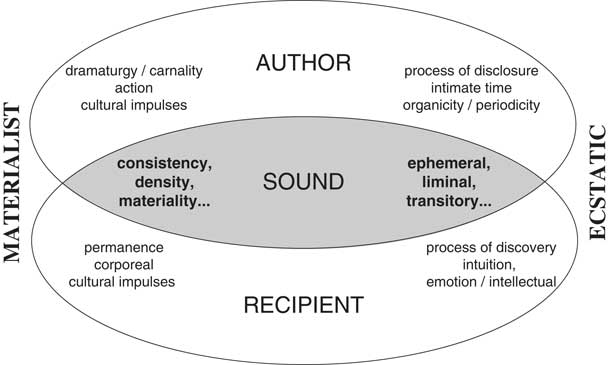
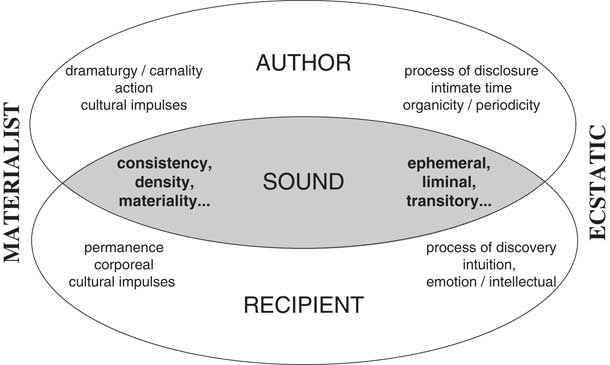
Therefore, as in a circular process, pieces of the experimental E-M domain begin from the sound (material), evoke the external and converge on the real through sound. They focus on sound and stimulate materialist and ecstatic sonic potentials (e.g. consistency, density, graininess, sonic transients and apparent overtones at the threshold of audibility); further, sound recounts intentions, processes and discoveries that come from the experience of both creator and recipient, thus enlarging on intuitions, dramaturgy, movement-related and cultural stimuli. But sound continues to be the medium and locus of expression and contact, and so from this frame of external references sound recalls the material and embodies the real (Figure 1). Sound exists as a territory of convergence between author and listener and it reaffirms itself within its internal space, its time and the experience of it. In this way, the sound, viewed as the irreducible connection between creator and recipient within various contexts, is the key element for the cross-genres nature of the E-M perspective.
Visual representation of the E-M model of communication.
Concerning musical communication, one leading stance in the current debate on the materiality of sound revolves around the non-representativeness of sonic events (e.g. Cox Reference Cox2011) that are directed towards the sound-in-itself. Within my proposition, sound-in-itself appears directly accessible when compositions are primarily developed using sound’s intrinsic properties, and I repeatedly observed that the presence of functional constructions, for instance, distance these pieces from the E-M perspective. Thus, it seems logical to favour an anti-representational premise in defining this ecstatic-materialism. Even so, E-M communication goes beyond the purely phenomenological and sensorial experience: the music of Georg Friedrich Haas, Riccardo Nova, Peder Mannerfelt or Mika Vainio defends a musical grammar typical of their genres, but each moves towards the sound-in-itself from different directions, making choices, using codes, ingraining personality, conveying subjectivity, intimacy, violence and practical motives.
In other words, E-M does not only inhabit the compositional process (Döbereiner Reference Döbereiner2014), but extends to the idea of a potential of sonic matter that is at times present as a transcendent character of sound (Scelsi), a process of disclosure through duration (Grisey), a physical substance concretely shaped (Pan Sonic), or a bloody organism with a metabolism, carnality and grain (Romitelli). However, as Döbereiner criticises the non-dialectical vision of sound that is exclusively seen as matter-energy, vital in itself, I also go further by picturing the sound as the convergence of the participants’ realities on a pure sonic matter.
7. Conclusions
The E-M approach focuses on sound-in-itself, the meeting in sound of composer and listener, the coexistence of the quasi-atemporal materiality and the fugitive perception of sound. It is a unified concept in which corporeal reactions, innermost discovery and personal experience come together within the pure sonic element.
Several movements or figures within today’s experimental music may come close to the E-M vision and match different characteristics of this perspective. There are no clear boundaries that limit this cross-genre proposition and the points discussed above work as parameters to evaluate a sort of degree of affiliation with ecstatic-materialism.
Ecstatic-materialism emerges from similarities (e.g. aural, poietic, perceptual) across several genres of music that go beyond techniques and instrumentations, allowing us as listeners, musicians and scholars to approach compositions of G. Verrando, M. Momi, G. F. Haas, B. Lang and pieces of Pan Sonic, Miles Whittaker, Oscar Powell, Oren Ambarchi and Peder Mannerfelt from a fresh point of view: considering their common focus on inner qualities of sound and recognising cultural patterns as models of communication. In presenting this transversal outlook, I hope to stimulate debates and connect didactic and academic contexts in order to propose new strategies to deal with the rapid changes in our musical culture.