Introduction
Traumatic cardiac arrest (TCA) is associated with a poor outcome. The management of TCA patients in the last decade has gone from withholding treatment on the basis of futility Reference Hopson, Hirsh and Delgado1,Reference Rosemurgy, Norris, Olson, Hurst and Albrink2 to actively identifying and treating the cause of the arrest. After prioritizing Basic Life Support (BLS) and Advanced Life Support (ALS), TCA management should focus on the potentially reversible causes.
In the particular context of trauma, these potentially reversible causes are considered to be hypovolemia, hypoxemia, tension pneumothorax (TPx), and tamponade. Reference Lockey, Lyon and Davies3 The development of algorithms for TCA management has focused on the interventions specifically aimed at treating the pathology underlying these causes.
In 2008, the Northern French Alps Emergency Network (RENAU) proposed a consensus for TCA management (Supplementary Material; available online only). The RENAU also has a cardiac arrest registry which compiles TCA cases. The aim of this study was to assess the impact of specific rescue measures on short-term outcomes in the context of resuscitating patients with a prehospital TCA treated by Emergency Medical Services (EMS).
Method
This retrospective study concerns all TCA patients admitted to two emergency medical units that formed part of the RENAU (emergency medical units of Annecy and St Julien, France) from January 2004 through December 2017. Non-traumatic cardiac arrests were excluded from the study.
Data Collection
The RENAU comprises all hospitals and emergency medical systems of three mountainous counties (Isère, Savoie, and Haute-Savoie, France) including 13 emergency medical units.
The RENAU cardiac arrest registry is an exhaustive registry Reference Savary, Ricard and Drouet4 in accordance with the Utstein Style previously described by Ageron, et al. Reference Ageron, Debaty and Gayet-Ageron5 Quality control of the RENAU database is performed by the clinical research associates in collaboration with data manager and responsible physician. The analysis is performed in accordance with the Utstein variables. All cases attended by ALS are identified and the digitalized medical reports are obtained from the EMS record system and reviewed. All the BLS manual paper records are collected and reviewed as well. Out-of-hospital cardiac arrest (OHCA) data are also cross-checked to ensure that all the non-reported treated OHCA in the EMS database are included. The percentage of cases included in the online database monitoring is periodically communicated to the emergency teams in order to increase the percentage of cases reported to the register. Since January 1, 2004, each OHCA case has been recorded in an electronic form completed by the emergency physician in charge of the patient and the dispatch center.
In order to be able to extensively describe TCA management, the sample was restricted to two emergency medical units (Annecy and St Julien) that have collected prehospital-specific rescue measures in TCA. These emergency medical units are in an area with a population of 302,000 inhabitants in 878 km2.
Variables
Utstein-relevant variables such as age (continuous), gender (male or female), bystander presence (yes or no), bystander cardiopulmonary resuscitation ([CPR] yes or no), location of OHCA (home or not), shockable rhythm (yes or no), intervention times, and advanced airway management (yes or no) were included.
Specific rescue actions in TCA were also collected: fluid administration (expansion >250ml or not), pelvic stabilization (yes or no), tourniquet application (yes or no), bilateral thoracostomy (yes or no), and the results in three categories: not performed, performed with the presence of a TPx, performed without a TPx, as well as thoracotomy procedures.
Outcomes
Patient status (alive/dead) and neurological outcome (using standardized Cerebral Performance Category [CPC] score) Reference Cummins, Chamberlain and Abramson6 were obtained at Day 30 from the receiving unit or phone follow-up interviews with research associates. When creating the registry, the ethics committee validated this method of monitoring patient survival. The primary endpoint was survival rate at Day 30 with good neurological status (CPC 1 and CPC 2). The secondary endpoint was the rate of patients admitted to the hospital alive.
Statistical Analyses
Continuous variables are described using mean and standard deviation (SD) values. Categorical variables are described as percentages. For primary and secondary endpoints, logistic regressions were performed to assess any differences in TCA management. Crude and adjusted odds ratios (OR) with their 95% confidence intervals (CI) using relevant variables, including TCA treatment, were estimated. The sample size is pre-determined due to study design. A P value <.05 was considered statistically significant. Sensitivity analyses using multiple imputations were planned using multiple imputation by chained equations (MICE; 20 imputations). Statistical analyses were all performed using SAS (Statistical Analysis Software, v. 9.4; SAS Institute Inc.; Cary, North Carolina USA), except for multiple imputation which used STATA software (version 16.0; StataCorp; College Station, Texas USA). The study complied with the Declaration of Helsinki and was approved by the ethics committee of the University Hospital of Clermont-Ferrand, Clermont-Ferrand, France (Independent Ethics Committee no. 5891).
Results
During the study period, in total, 23,772 cardiac arrests were reported in the RENAU registry, including 14% TCAs. A total of 3,856 OHCA cases were seen to by the two emergency medical units. Of those, 2,694 resuscitations were performed and there were 287 patients with TCA. Mean age was 46.8 years of age (SD = 20.4), ranging from 20 to 98 years of age. Of these patients, 285 (99.3%) were in cardiac arrest when the EMS staff arrived on the scene. In 172 (59.9%) cases, bystanders were present at the time of the event and in 79 (27.5%) cases, bystanders began the resuscitation rescue measures without delay (Table 1). The initially monitored heart rhythm was pulseless electric activity in 9.0% of cases (n = 22), asystole in 79.4% (n = 228) of cases, ventricular fibrillation in 7.7% (n = 22) of cases, and ventricular tachycardia in one (0.35%) case. The mean time from call to arrival at patient was 12.1 (SD = 7.8) minutes.
Description of Patients Admitted to Hospital Alive and 30-Day Survival with Good Neurological Status (CPC 1 and CPC 2)

Note: Bold P <.05.
Abbreviations: CPC, Cerebral Performance Category; CPR, cardiopulmonary resuscitation.
Endotracheal intubation (ETI) was attempted in all cases. Out of the 287 cases, there were seven failures (2.0%). If advanced airway support could not be provided, then basic airway support using airway adjuncts and bag-valve-mask ventilation was performed.
Prehospital-specific rescue measures were identified in 279 cases (Figure 1). During the study period, no transfusion or thoracotomy was performed in the prehospital setting.
Flow Chart of Inclusion in the Study.
Abbreviations: CPC, Cerebral Performance Category; OHCA, out-of-hospital cardiac arrest; ROCS, return of spontaneous circulation; TPx, tension pneumothorax.

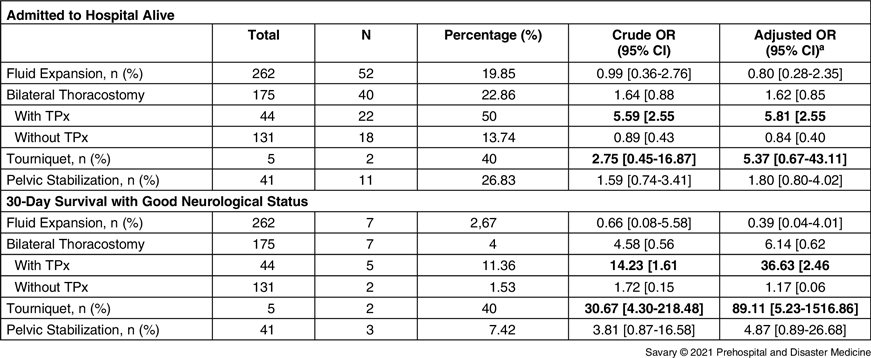
There were 57 (19.9%) patients admitted to the hospital alive. Survival with favorable neurological status (CPC 1 and CPC 2) at Day 30 was observed in eight (2.8%) of 287 patients. Primary and secondary endpoints for each prehospital-specific rescue measures are presented in Table 2. Thoracostomy was performed in 175 (61.0%) cases, pelvic stabilization in 41 (14.3%) cases, and tourniquet application in five (1.4%) cases, whereas fluid expansion was performed in 262 (91.3%) cases. Though the number of subjects was low, bilateral thoracostomy in the event of pneumothorax and tourniquet application were associated with the primary endpoint. Thoracostomy performed without pneumothorax showed no association with a favorable or unfavorable prognosis. Similar results were observed using MICE.
Trauma-Specific Measures and Characteristics in Patients Admitted to Hospital Alive and 30-Day Survival with Good Neurological Status (CPC 1 and CPC 2)

Abbreviations: CPC, Cerebral Performance Category; CPR, cardiopulmonary resuscitation; TPx, tension pneumothorax.
a Adjusted according to age, gender, shockable rhythm, bystander CPR, location at home, and time to CPR; each parameter in one separate model; bold P <.05.
Discussion
According to the authors, this is the first study describing the outcome of each additional trauma-specific measure performed at the event site, in addition to standard resuscitation measures, to treat the reversible causes of TCA. These results highlight that each action analyzed separately (thoracostomy, pelvic stabilization in patients with suspected pelvic fracture, or tourniquet application on a limb hemorrhage) improves survival regardless of fluid expansion. The results show that 19.9% of TCAs were admitted to hospital, 2.8% survived at Day 30, and surviving patients had a favorable neurological status (CPC 1 and CPC 2). The lower survival rate, compared to other cohorts, Reference Huber-Wagner, Lefering and Qvick7,Reference Kleber, Giesecke, Tsokos, Haas and Buschmann8 could be due to geographical intervention conditions and the fact almost all patients were in cardiac arrest at the time of treatment. This study was conducted in a specific area with a very low rate of penetrating trauma (7.6%) and a remarkable TCA rate from rural or mountain activities (18.0%) often with difficult and prolonged prehospital care. Reference Faucher, Savary, Jund, Carpentier, Payen and Danel9
Hypoxemia
The recommendations specify that definitive airway management with a tracheal tube should be achieved at the earliest opportunity if the health care provider is adequately trained in this intervention. In this trial, airway management was undertaken by trained emergency physicians in accordance with international recommendations. Reference Soar, Nolan and Böttiger10 The difficult intubation rate in the out-of-hospital setting was not researched, but the incidence of ETI failure was low (2.6%) and comparable to a recent European study. Reference Jabre, Penaloza and Pinero11 There are many causes of asphyxial cardiac arrest, but in the context of TCA, it is mainly due to airway obstruction and traumatic asphyxia. This represents 13.0% of traumatic cardiac arrest causes. Reference Kleber, Giesecke, Tsokos, Haas and Buschmann8 The authors hypothesized that the high rate of ETI increased oxygenation in the cohort.
Bilateral thoracostomy is part of the wider resuscitation effort which includes intubation and ventilation to increase oxygenation. Reference Kleber, Giesecke, Lindner, Hass and Buschmann12 The RENAU considered bilateral pleural decompression to be an essential measure to eliminate the reversible causes of cardiovascular arrest associated with trauma. Identifying patients with a TPx using only information from a mechanism of injury or a physical examination can be challenging in cardiac arrest patients. Incorporating ultrasound examinations into prehospital decision making for patients with TCA may facilitate the early identification of treatable causes. Reference Ketelaars, Hoogerwerf and Scheffer13 This requires equipping emergency teams with portable ultrasound machines and having emergency physicians with extensive ultrasound experience. Reference Gardner, Clattenburg, Wroe, Singh, Mantuani and Nagdev14 Such a practice remains controversial, especially if it wastes time. Reference Long, April and Koyfman15,Reference Huis In ’t Veld, Allison and Bostick16 Taking into account that bilateral thoracostomy was found to be useful in the event of pneumothorax and was not related to a poor prognosis, this intervention should be more widely used. Reference Mistry, Bleetman and Roberts17 It was observed that bilateral thoracostomy was only carried out in 61.0% of cases. This rate corresponds to that observed by Mistry, et al with a doctor present in the air ambulance crew. Reference Mistry, Bleetman and Roberts17 Several publications have claimed that implementation is too rare. Reference Kleber, Giesecke, Tsokos, Haas and Buschmann8,Reference Buschmann, Schulz, Tsokos and Kleber18 The proportion of TPx in cardiac arrest group was 15.3% (44/287), which is slightly higher than in the Berlin cohort (13.0%). Reference Kleber, Giesecke, Tsokos, Haas and Buschmann8 The outcomes in patients with TPx who underwent on-scene thoracostomy were favorable in this group: five patients survived to hospital discharge. Other publications have shown that such active management is more effective and improves survival. In view of the results, it appears that performing a bilateral thoracostomy does not worsen patient prognosis, even if it does not reveal a TPx.
Hypovolemia
Traumatic cardiac arrest caused by major hemorrhage has a very poor prognosis. Reference Lockey, Crewdson and Davies19 The majority of patients in this cohort have benefited from a re-expansion with at least 250ml of isotonic saline. Regardless of expansion success, this intervention showed no improvement in survival. This result concurs with other studies. Reference Lockey, Crewdson and Davies19,Reference Bickell, Wall and Pepe20 In profound hypovolemia, chest compressions are likely to be ineffective due to poor cardiac filling, Reference Luna, Pavlin, Kirkman, Copass and Rice21 but they are currently recommended. Reference Revell, Porter and Greaves22,23 A study on dogs has demonstrated that chest compressions do not improve survival in hypovolemic cardiac arrest. Reference Jeffcoach, Gallegos and Jesty24 Moreover, immediate diagnosis of severe hypovolemia may be difficult in the prehospital setting. In this study, there were no prehospital red blood cell transfusions. While different teams have shown an improvement in the rate of return of spontaneous circulation (ROSC) following TCA, a survival benefit has not been demonstrated. Reference Brown, Sperry, Fombona, Billiar, Peitzman and Guyette25
Although red blood cell transfusion was not an option, pelvic stabilization and tourniquet application significantly improved survival. Firstly, in mountainous areas, many cardiac arrests are associated with falls, Reference Faucher, Savary, Jund, Carpentier, Payen and Danel9,Reference Bouzat, Broux and Ageron26 and this mechanism often causes long bone and pelvic fractures as well as limb hemorrhages. In a recent German study, the authors concluded that more emphasis should be placed on temporary provisional external pelvic stabilization in TCA which was performed too rarely even though an instable pelvic ring was apparent during the post-mortem external examination. Reference Ondruschka and Baier27 However, 12.0% of patients in this study had received external pelvic stabilization, which is a much higher figure than the RENAU cohort. Probably, this action could have been proposed in several other cases. Secondly, the use of emergency trauma pressure dressings and tourniquets has been successfully proposed for battlefield settings. Reference Kragh, Littrel and Jones28 Delayed application of a tourniquet has been associated with poorer outcomes in several studies. Therefore, the role of the dispatch center is essential for accompanying bystanders to perform these essential actions early.
Cardiac Tamponade
The definitive treatment for traumatic cardiac tamponade causing cardiac arrest is a resuscitative emergency thoracotomy. Most cases of cardiac tamponade are secondary to penetrating trauma and are rarely described in France and in this geographical area. Reference Faucher, Savary, Jund, Carpentier, Payen and Danel9 This is in contrast to the United States where penetrating trauma may represent up to 30% of trauma patients and 45% of cardiac arrest patients. Reference Hoyt, Shackford, Davis, Mackersie and Hollingsworth-Fridlund29 However, cardiac injury has been described for up to 20% of patients involved in road traffic collisions, Reference Fitzgerald, Spencer, Johnson, Marasco, Atkin and Kossmann30 and this pathology should be considered in patients with significant blunt chest trauma. Thoracotomy is effective if it is carried out within a short timeframe, Reference Soar, Nolan and Böttiger10 which is not possible in this geographical area, although helicopter transport and mechanical chest compression devices have sometimes proved effective in reducing time to admission. Reference Tazarourte, Sapir and Laborne31 In different European countries, prehospital thoracotomy may be an option. Reference Coats, Keogh, Clark and Neal32 In France, this technique is currently only available in big cities such as Paris, Lyon, or Lille.
Limitations
This study has several limitations. Firstly, it was conducted in a specific population and area with few penetrating traumas and a high number of mountain-related injuries. In many centers in France, the rate of severe trauma is significantly lower because of a decrease in motor vehicle accidents, whereas TCA prevalence in this area remains steady. Thus, the results cannot be a perfect reflection of the reality in France and Europe. Secondly, since this was a retrospective observational study, it may have been subject to a selection bias relating to survival. In addition, TCA victims often have multiple injuries resulting in critical hypoxemia, TPx, or severe hypovolemia, and this study only measures the effects of each rescue action separately. Moreover, the number event per variable is low, which gives the multivariate model a lack of power. Finally, the RENAU cardiac arrest registry is not entirely exhaustive (only 81.8% of data were complete). While a rate higher than 75% is acceptable for a prospective registry, data are still missing for a number of cardiac arrest patients. Reference Faucher, Savary, Jund, Carpentier, Payen and Danel9,Reference Fourny, Belle and Labarère33
Conclusion
Among standard resuscitation measures to treat the reversible causes of cardiac arrest, the authors found that systematic bilateral thoracostomy and tourniquet application on a limb hemorrhage improved survival in TCA. A larger sample for pelvic stabilization is also necessary to be able to conclude on general application of the results and future guidelines evolution.
Conflicts of interest/funding
The authors declare that they have no competing interests. This study did not receive any grants or financial support.
Acknowledgements
The authors acknowledge their gratitude to Sabrina Pitet for help in structuring tables.
Author Contributions
All authors have made substantial contributions to the conception and design of the study. DS and AD contributed to study conception and design and performed the initial data analysis. DS, FM, and DD prepared the first draft of the manuscript. All authors gave their final approval of the version to be submitted. The manuscript has not been previously published and is not under consideration elsewhere. The study was performed in CHU Angers, Anger, France and CH Annecy Genevois, Annecy, France.
Supplementary Materials
To view supplementary material for this article, please visit https://doi.org/10.1017/S1049023X21001308