Phonological awareness is a key precursor of literacy development. It represents the awareness of, and the ability to, manipulate the phonological structure of words (Melby-Lervåg, Lyster & Hulme, Reference Melby-Lervåg, Lyster and Hulme2012). In order to develop this metalinguistic skill and become phonologically aware, automatic, unconscious (implicit) speech perception abilities need to transfer to intentional, conscious (explicit) phonological abilities, such as the ability to form new words by blending individual speech sounds (e.g., Carroll, Snowling, Hulme & Stevenson, Reference Carroll, Snowling, Hulme and Stevenson2003; Jusczyk & Luce, Reference Jusczyk and Luce2002). The depth of knowledge a child has about acoustic-phonetic properties of words and the ability she has to learn about those properties (together, “lexical specificity”) may support transfer from implicit to explicit phonological abilities. Implicit perception of acoustic-phonetic differences among speech sounds may be a prerequisite for the ability to learn about the detailed phonological specifications of spoken words and to store that knowledge in lexical memory. In turn, increasingly specific word representations may stimulate explicit phonological awareness.
Evidence for this process of transfer was found in two studies that focused on the effects of training in lexical specificity. The first intervention study included a group of 4-year-old monolingual Dutch children who were learning the target language as their first language (L1-Dutch; Van Goch, McQueen & Verhoeven, Reference Van Goch, McQueen and Verhoeven2014); the second intervention study included a group of 4-year-old bilingual Turkish–Dutch children who were learning the target language as their second language (L2-Dutch; Janssen, Segers, McQueen & Verhoeven, Reference Janssen, Segers, McQueen and Verhoeven2015). It could be the case, however, that the way in which implicit phonological abilities are transferred to explicit phonological abilities is affected by the nature of the phonological structures of the language(s) being learnt and by linguistic transfer from first to second language (e.g., Bialystok, Reference Bialystok, Bhatia and Ritchie2013; Branum-Martin, Tao, Garnaat, Bunta & Francis, Reference Branum-Martin, Tao, Garnaat, Bunta and Francis2012; Cheung, Chenb, Laib, Wong & Hills, Reference Cheung, Chen, Lai, Wong and Hills2001). We tested this hypothesis here in a comparison of L1-Dutch (monolingual Dutch) and L2-Dutch (bilingual Turkish–Dutch) learners.
Implicit and explicit phonological abilities in L1
In order to properly perceive what is spoken in the environment, acoustic information in speech needs to be categorized (decoded) into different, meaningful units, such as phonemes and, hence, words. The ability to discriminate speech sounds develops from an initial independency of the language spoken in the environment to language-specific speech discrimination during the first year of life as a function of language experience (Cheour, Ceponiene, Lehtokoski, Luuk, Allik, Alho & Näätänen, Reference Cheour, Ceponiene, Lehtokoski, Luuk, Allik, Alho and Näätänen1998). Speech decoding performance at an early age has been found to predict later language skills such as word understanding and word production (Tsao, Liu & Kuhl, Reference Tsao, Liu and Kuhl2004), and is a first step in the development of phonological awareness (Nittrouer, Reference Nittrouer1996; Studdert-Kennedy, Reference Studdert-Kennedy2002). Different stages of phonological awareness can be distinguished: awareness of syllables, rhyme awareness, and eventually, phoneme awareness (e.g., Carroll et al, Reference Carroll, Snowling, Hulme and Stevenson2003; Mark, Müller-Myhsok, Schulte-Körne & Landerl, Reference Mark, Müller-Myhsok, Schulte-Körne and Landerl2014). Phoneme awareness, however, is a better predictor of later reading skills than awareness of larger sound units (Hulme, Hatcher, Nation, Brown, Adams & Stuart, Reference Hulme, Hatcher, Nation, Brown, Adams and Stuart2002).
While speech decoding is an implicit perceptual ability, phonological awareness is an explicit phonological ability. The link between these two abilities may be in the specificity of lexical knowledge, not least because word recognition is the primary goal of speech decoding processes (McQueen, Reference McQueen and Gaskell2007). Since the set of potential utterances is unlimited, the only way the listener can interpret any one utterance is through recognizing its component parts: the words in that utterance. That in turn depends on the ability to decode the constituent speech sounds of words (McQueen, Reference McQueen and Gaskell2007). In order to define and keep apart the words in their vocabulary, and hence to be able to recognize them, children start to create specific phonological representations of words in memory that become more and more fine-grained as vocabulary grows (e.g., Goswami, Reference Goswami2000, Reference Goswami, Grigorenko and Naples2008; Metsala & Walley, Reference Metsala, Walley, Metsala and Ehri1998; Morais, Reference Morais2003; Thiessen, Reference Thiessen2007; Werker, Byers-Heinlein & Fennell, Reference Werker, Byers-Heinlein and Fennell2009). The ability to learn to recognize words based on only minimal acoustic-phonetic differences (i.e., lexical specificity) is therefore a key aspect of phonological and lexical development. Specific word representations may in turn help children to manipulate phonological structures in more and more detail. That is, they may support the development of phonological awareness (De Cara & Goswami, Reference De Cara and Goswami2003; Elbro, Borstrøm & Petersen, Reference Elbro, Borstrøm and Petersen1998; Garlock, Walley & Metsala, Reference Garlock, Walley and Metsala2001; Metsala & Walley, Reference Metsala, Walley, Metsala and Ehri1998; Walley, Metsala & Garlock, Reference Walley, Metsala and Garlock2003).
The relationships among speech decoding, lexical specificity and phonological awareness were recently explored (Van Goch et al., Reference Van Goch, McQueen and Verhoeven2014). Lexical specificity was measured dynamically via a lexical specificity training protocol. Four-year-old monolingual Dutch children were taught monosyllabic Dutch words with only minimal acoustic-phonetic differences. The new words could only be learned if the children picked up on the detailed phonological differences between the minimal pairs. This training in lexical specificity did not lead to improvement of speech decoding, but did lead to a higher level of rhyme awareness.
Implicit and explicit phonological abilities in L2
The same link from speech decoding through lexical specificity to phonological awareness may be expected in bilingual children. However, when children become fully immersed in the target L2 only after they start primary school, they may have difficulty discriminating speech sounds in that language. Recent research on speech perception in sequential bilingual children – that is, children who have not acquired two languages simultaneously from birth, but instead have learned a second language at a later point in time (e.g., Castilla, Restrepo & Perez-Leroux, Reference Castilla, Restrepo and Perez-Leroux2009) – has shown that an accumulation of experience with the target language is required for these children to be able to categorize L2 speech contrasts (McCarthy, Mahon, Rosen & Evans, Reference McCarthy, Mahon, Rosen and Evans2014).
In a similar vein, the phonological representations of L2 words in this group may be less specific than those of words in their L1 and those of monolingual children (Fowler, Reference Fowler1991; Metsala & Walley, Reference Metsala, Walley, Metsala and Ehri1998; Pallier, Colomé & Sebastián-Gallés, Reference Pallier, Colomé and Sebastián-Gallés2001; Wade-Woolley & Geva, Reference Wade-Woolley and Geva2000; Walley et al., Reference Walley, Metsala and Garlock2003). Sequential bilinguals typically categorize L2 sounds according to L1 representations (Best & McRoberts, Reference Best and McRoberts2003; Navarra, Sebastián-Gallés & Soto-Faraco, Reference Navarra, Sebastián-Gallés and Soto-Faraco2005; Simon, Sjerps & Fikkert, Reference Simon, Sjerps and Fikkert2014) and reorganization of existing linguistic knowledge – that is, knowledge about the phonological structure of a particular language – may be necessary in order to specify L2 and L1 phonological representations to the same extent (Carroll, Reference Carroll2008).
Sequential bilinguals may not be disadvantaged, however, in the development of a metalinguistic skill such as phonological awareness. Several studies showed that being frequently confronted with two language systems and their phonotactics at a pre-literate stage provides support for the development of phonological awareness (e.g., Campbell & Sais, Reference Campbell and Sais1995; Yelland, Pollard & Mercuri, Reference Yelland, Pollard and Mercuri1993). However, early exposure to a second language may be more beneficial for some aspects of phonological awareness than for others. Bruck and Genesee (Reference Bruck and Genesee1995), for example, found that, in kindergarten, bilingual English–French children performed better on onset-rhyme awareness than monolingual English children. In grade 1, this advantage had disappeared. At this point, however, higher scores on syllable segmentation emerged for the bilingual group, which was interpreted as the effect of second language input. The monolingual children had higher scores on phoneme awareness in grade 1. This was interpreted as the effect of literacy instruction. Bialystok, Majumber and Martin (Reference Bialystok, Majumber and Martin2003) found no overall effect of bilingualism when comparing phonological awareness of monolingual English, bilingual Spanish–English and bilingual Chinese–English children in kindergarten, grade 1 and grade 2. Rather, differences among the groups were due to language of instruction, task demands or the structural relation between two languages in the bilingual children. The authors concluded that, in bilinguals, the degree to which the two languages have a similar alphabetic orthographic system and phonological structure, and the bilingual's proficiency in both languages, are the two factors which most strongly affect the level of phonological awareness (also supported by e.g., Bialystok, Reference Bialystok2001, Reference Bialystok, Bhatia and Ritchie2013; Bialystok, Luk & Kwan, Reference Bialystok, Luk and Kwan2005; Branum-Martin et al., Reference Branum-Martin, Tao, Garnaat, Bunta and Francis2012).
Linguistic transfer
When examining relations among implicit and explicit phonological abilities in L2, transfer of phonological knowledge and abilities between first and second language (i.e., linguistic transfer) has to be taken into account (e.g., Cárdenas-Hagan, Carlson & Pollard-Durodola, Reference Cárdenas-Hagan, Carlson and Pollard-Durodola2007; Verhoeven, Reference Verhoeven2007). Although L1 and L2 are interdependent – that is, development in one language influences development in the other language, and vice versa – transfer from L1 to L2 has the greatest effect in sequential L2 acquisition (e.g., McLaughlin, Reference McLaughlin2013). According to the interdependency hypothesis (Cummins, Reference Cummins, Baker and Hornberger2001), development in L1 is likely to predict development in L2. The stronger the L1 when exposure to L2 begins, the better the acquisition of L2. Over the years, this hypothesis has been supported by several studies (e.g., Figueredo, Reference Figueredo2006; Proctor, August, Carlo & Snow, Reference Proctor, August, Carlo and Snow2006). Overall, phonological abilities in children's L1 have been found to be related to later phonological abilities in their L2 (Castilla et al., Reference Castilla, Restrepo and Perez-Leroux2009; Dickinson, McCabe, Clark-Chiarelli & Wolf, Reference Dickinson, McCabe, Clark-Chiarelli and Wolf2004; Gottardo, Yan, Siegel & Wade-Woolley, Reference Gottardo, Yan, Siegel and Wade-Woolley2001).
The current study tested bilingual Turkish–Dutch children. Such children are most often sequential bilinguals, learning Dutch when they enter school. In studies on language development of Turkish–Dutch sequential bilingual children, transfer from L1 Turkish to L2 Dutch has been demonstrated. In a longitudinal study, Scheele, Leseman, Mayo and Elbers (Reference Scheele, Leseman, Mayo and Elbers2010) examined the development of academic language, a term used by the authors “to refer to the configuration of lexical and grammatical resources which bring about knowledge exchanges in the school context” (p. 5), in Turkish–Dutch kindergarten children. They found that proficiency in L1 academic language predicted proficiency in L2 academic language. Verhoeven (Reference Verhoeven2007) investigated relations between L1 and L2 development and phonological awareness in Turkish–Dutch kindergartners. In several Dutch language proficiency tests, over time, the bilingual children's performance was similar to native speakers, but their L1 skills still contributed to their L2 skills. Furthermore, during the course of kindergarten, proficiency level in both the L1 and the L2 predicted variation in phonological awareness at the end of kindergarten. Janssen et al. (Reference Janssen, Segers, McQueen and Verhoeven2015) explored relations among speech decoding, lexical specificity and phonological awareness, and effects of linguistic transfer in Turkish–Dutch 4-year-old children. They used the same training protocol as in the previously described Van Goch et al. (Reference Van Goch, McQueen and Verhoeven2014) study with monolingual children. However, half of the trained words contained phonological overlap between Dutch and Turkish, whereas the other half of the words did not. It was found that lexical specificity training enhanced phoneme awareness in both Dutch monolingual and Turkish–Dutch bilingual children. Moreover, during training, Turkish–Dutch bilingual children caught up with the monolingual Dutch children on words that contained phonological overlap between L1 Turkish and L2 Dutch. This indicates that linguistic transfer occurs in L2 learning, next to transfer from implicit to explicit phonological abilities.
Comparing Turkish and Dutch phonology
Because of their phonological similarities and differences, Turkish and Dutch are interesting languages to compare with respect to linguistic transfer in the development of phonological abilities. The phonological structure of both languages is very regular (Booij, Reference Booij2002; Durgunoǧlu & Öney, Reference Durgunoǧlu and Öney1999). But differences can be found between the Dutch and Turkish phonological systems. In Turkish and unlike Dutch, only two levels of vowel height (high and low) are distinguished, Turkish contains no original (not loaned) diphthongs, and there is no contrast between lax and tense vowels in Turkish (Verhoeven, Reference Verhoeven1987). Consonant clusters do not occur at the beginning of words, and the Dutch consonants /ɣ/ and /ʋ/ do not exist in Turkish. Also, the status of rimes differs across the two languages. In Dutch, there is a flexible boundary between the onset and rime in a syllable, because many words are formed by changing these components (for example, huis, “house”, muis, “mouse”, luis, “louse”). Monosyllabic words tend to be more similar at the rime level than at the consonant-vowel level (Geudens, Reference Geudens2006). The Dutch language therefore has a greater proportion of rime neighbours than body neighbours, giving rise to a rime-biased lexicon (Martensen, Maris & Dijkstra, Reference Martensen, Maris and Dijkstra2000). Rime neighbours are monosyllabic words that overlap in the vowel in the center of a word (nucleus) and the consonants following the vowel (coda) (together referred to as “rime”), but not in the consonants at the beginning of the word (onset) (for example, huis-muis, “house-mouse”). Body neighbours are monosyllabic words that overlap in onset and nucleus (together referred to as “body”), but not in the coda (for example, huis-huid, “house-skin”). Because of this rime-biased lexicon, Dutch speaking children in general develop onset-rime awareness (for example, h-uis) prior to body-coda awareness (for example, hui-s) (Anthony & Francis, Reference Anthony and Francis2005; Geudens, Sandra & Martensen, Reference Geudens, Sandra and Martensen2005).
In Turkish, which is an agglutinating language, grammatical elements are connected to words as suffixes. These suffixes mark, for example, person and number in nouns. They are extremely variable due to vowel harmony (when there is more than one vowel in a word, the vowel of the grammatical morphemes assimilates to the stem vowel in frontness and rounding; for example, ellerin, (/e/-/l/-/l/-/e/-/r/-/i/-/n/) “hand”, /e/-/i/ are both unrounded, front vowels; Kızlar, (/k/-/ɯ/-/z/-/l/-/a/-/r/) “girl”, /ɯ/-/a/ are both unrounded, back vowels). Therefore, a very large number of distinct word forms exist in the Turkish language and onset-rime structure is much less important (Hakkani-Tür, Oflazer & Tür, Reference Hakkani-Tür, Oflazer and Tür2002). Turkish-speaking children appear to be more sensitive to body-coda information than onset-rime information. English-speaking children (similar to the Dutch language, English has a rime-biased lexicon) performed similarly on an initial and final phoneme deletion task, whereas Turkish-speaking children performed significantly better on the final phoneme deletion task (separating a word at the body-coda boundary) than on the initial phoneme deletion task (separating a word at the onset-rime boundary) (Durgunoǧlu & Öney, Reference Durgunoǧlu and Öney1999).
Language-specific phonological characteristics may have consequences for the relationships among implicit and explicit phonological abilities and lead to a specific pattern of linguistic transfer from L1 to L2. Only when children are able to perceive phonetic contrasts and have learned about the sound organization of a particular language, can they filter out phonological structures that form words, and create phonological representations of words in memory (Goswami, Reference Goswami, Grigorenko and Naples2008; Jusczyk & Luce, Reference Jusczyk and Luce2002). This implicit developmental process can be expected to be similar for the monolingual Dutch and bilingual Turkish–Dutch children. Links from implicit speech decoding ability and lexical specificity to explicit phonological awareness, in contrast, may be more variable due to differences in knowledge of the phonological structure of either one (Dutch) or two languages (Dutch and Turkish) (e.g., Cheung et al., Reference Cheung, Chen, Lai, Wong and Hills2001). Since Dutch has a rime-biased lexicon it can be expected that in monolingual Dutch households rime stands out as a particularly important language aspect, next to the individual phoneme, that occurs in daily speech and receives explicit attention in songs, stories and verses. This may be less so in bilingual Turkish–Dutch households, wherein both a rime-biased and non–rime-biased language are learned with the individual phoneme as a language aspect that is of importance in both languages (Leseman & Van Tuijl, Reference Leseman and Van Tuijl2006). Increasingly fine-grained phonological representations of words may support awareness of those phonological units that are most salient in the young child's language repertoire. This may provide support for the results of Janssen et al. (Reference Janssen, Segers, McQueen and Verhoeven2015) and Van Goch et al. (Reference Van Goch, McQueen and Verhoeven2014), that increases in lexical specificity improved both rhyme awareness and phoneme awareness in monolingual Dutch children, but only phoneme awareness in bilingual Turkish–Dutch children. Linguistic transfer may play a role in this process as well. Transfer from implicit to explicit phonological abilities in L2 may be affected by phonological abilities that have already been developed to a certain extent in the L1. Because phonemes are meaningful and easily identifiable in Dutch and in Turkish, development of phoneme awareness receives support from both languages, whereas development of rhyme awareness is more strongly supported by the Dutch language.
The current study
To find out whether lexical specificity supports transfer from implicit to explicit phonological skills and whether this process is affected by the nature of the phonological structures of the language(s) being learnt, we explored relationships among speech decoding, lexical specificity and phonological awareness in 4-year-old L1-Dutch and L2-Dutch learners.
The following research questions were addressed:
1. How do phonological abilities differ between L1-Dutch and L2-Dutch learners in the first year of kindergarten?
2. What are the effects of implicit phonological ability (speech decoding) and lexical specificity on explicit phonological abilities (rhyme awareness and phoneme awareness) in Dutch in L1-Dutch and L2-Dutch learners?
3. What is the role of L1 (Turkish) phonological abilities in L2 (Dutch) phonological development?
Regarding the first question, it was expected that the L2-Dutch learners would perform lower on speech decoding and lexical specificity than the L1-Dutch learners, as well as on rhyme awareness, but not on phoneme awareness (e.g., Bialystok et al., Reference Bialystok, Majumber and Martin2003; Bruck & Genesee, Reference Bruck and Genesee1995; Durgunoǧlu & Öney, Reference Durgunoǧlu and Öney1999; Janssen et al., Reference Janssen, Segers, McQueen and Verhoeven2015). Regarding the second question, it was expected that speech decoding would predict lexical specificity which in turn would predict rhyme awareness and phoneme awareness in the L1-Dutch learners (in line with the intervention findings of Janssen et al., Reference Janssen, Segers, McQueen and Verhoeven2015, and Van Goch et al., Reference Van Goch, McQueen and Verhoeven2014). In L2-Dutch learners, similar effects were expected, but now it was expected that lexical specificity would predict phoneme awareness but not rhyme awareness (e.g., Bialystok, Reference Bialystok, Bhatia and Ritchie2013; Durgunoǧlu & Öney, Reference Durgunoǧlu and Öney1999; Geudens et al., Reference Geudens, Sandra and Martensen2005; Janssen et al., Reference Janssen, Segers, McQueen and Verhoeven2015; Jusczyk & Luce, Reference Jusczyk and Luce2002). Regarding the third question, it was expected that, when L1-Turkish speech decoding, rhyme awareness, and phoneme awareness were taken into account, lexical specificity would predict L1-Turkish phoneme awareness, which in turn would predict L2-Dutch phoneme awareness. In a similar vein, L1-Turkish speech decoding would predict L2-Dutch speech decoding, and L1-Turkish rhyme awareness would predict L2-Dutch rhyme awareness. In other words, linguistic transfer from L1 to L2 would occur because explicit phonological abilities that are developed to some extent in L1 should support development of explicit phonological abilities in L2 (e.g., Gottardo et al., Reference Gottardo, Yan, Siegel and Wade-Woolley2001; Verhoeven, Reference Verhoeven2007).
Method
Participants
Seventy-five L1-Dutch kindergarten children (36 boys, 39 girls) and 64 L2-Dutch kindergarten children (33 boys, 31 girls) participated. The L2-Dutch kindergarten children all had Turkish as their first language. The mean age of the L1-Dutch children at the start of testing was four years, 11 months (range: four years, one month – five years, ten months, SD = 5.15 months). The mean age of the L2-Dutch children at the start of testing was five years, one month (range: three years, nine months – six years, five months, SD = 6.33 months). The difference in age between the groups was significant, t (137) = −2.59, p =.011, d = −.44.
In the Netherlands, kindergarten is a two-year program prior to Grade 1. Children start this program in the year they turn 4 years old. Since children can enter kindergarten on their fourth birthday, most of them are kindergartners for more than two years, but less than three, resulting in mixed-age kindergarten groups. All children who participated in this study were in the first year of kindergarten. The children were divided over 25 kindergarten groups from thirteen primary schools, in ten different cities in municipalities in which 4%–12% of the families are of Turkish origin (Centraal Bureau voor de Statistiek [Statistics Netherlands], 2015; retrieved from: http://www.cbs.nl/nlNL/menu/themas/dossiers/allochtonen/cijfers/extra/aandeel-allochtonen.htm), distributed throughout the Netherlands. In each participating school, the population of children was of mixed origin, coming from families with various levels of SES. No school with a population of exclusively L1-Dutch speaking children was included in the recruitment process. The parent(s) gave informed consent for participation of their child. Teachers indicated that participating children did not have any developmental, hearing or language related problems.
Questionnaire on SES and Dutch language exposure at home
In the schools, children were immersed in a Dutch speaking environment. All teachers spoke Dutch and communicated in Dutch with the parents; they did not speak or understand Turkish. Parents were asked to fill out a short questionnaire on SES and Dutch language use at home, to gauge relative Dutch input for the L2-Dutch children compared with that for the L1-Dutch children. Seventy-six percent of the parents of the L1-Dutch children and 74% of the parents of the L2-Dutch children responded. A distinction was made between high level professional education (3), intermediate level vocational education (2) and low-level primary school education of the parents. (1) On average, parents of the L1-Dutch children were educated at an intermediate to high level (mother: M = 2.44, SD = .54, father: M = 2.42, SD = .54), parents of the L2-Dutch children were educated at intermediate to low level (mother: M = 1.79, SD = .68, father: M = 1.81, SD = .65). This difference was significant (mother: t (103) = 5.44, p < .001, d = 1.07, father: t (97) = 5.16, p < .001, d = 1.05).
In 91% of the L1-Dutch households that responded to the questions (52/57 households), both parents spoke only Dutch to their child. In 9% (5/57) of these L1-Dutch households sometimes a different language was spoken to the child, next to Dutch (English, Papiamento, Thai, Bengali, Cantonese, Indonesian, Arabic, or German). In 51% of all L2-Dutch households that responded to the questions (24/47 households), both parents spoke only or mostly Turkish to their child. In the remaining 49% (23/47) of these households, use of the Turkish and Dutch language was mixed, but L2-Dutch children knew on average 28 out of 60 words (SD = 6.42) on a standardized Turkish receptive vocabulary task (Toets Tweetaligheid [Test Bilingualism], Verhoeven, Narain, Extra, Konak & Zerrouk, Reference Verhoeven, Narain, Extra, Konak and Zerrouk1995), which indicates medium to high proficiency in Turkish, compared with monolingual Turkish norms in the beginning of the first kindergarten year (medium level norm scores: 24–30, high level norm scores: 31–60).
Finally, parents in the 57 L1-Dutch households and in the 23 L2-Dutch households in which Turkish and Dutch language use was mixed indicated on a 6-point scale how much time per week (0 = never, 6 = more than three hours), on average, they spent on language activities with their child in Dutch (i.e., singing songs and listening to music together, watching TV together, playing (computer) games together, going shopping together), reading activities (i.e., reading fictional stories to the child, reading non-fictional information to the child, reading picture books to the child, talking with the child about what is happening in the books, pointing out words to the child, reading words phoneme-by-phoneme), and talking with their child about certain topics in everyday life (i.e., what happens at school, daily chores and games with brothers/sisters, what happens in the world, emotions, also, explaining what difficult words mean, and paying attention to the child's pronunciation of words and sentences). Reliability of the questionnaire was good, with an alpha of .92. A Principal Component Analysis with oblique rotation (Direct Oblimin) showed that 62% of the variance was explained by three components corresponding to the three main categories (“Activities”, “Reading”, and “Talking”). Factor scores on each of the three components were added up to form one measure, “Dutch language exposure at home”. A Univariate Analysis of Variance (ANOVA) on this measure with language (L1-Dutch, L2-Dutch) as between-subject factor showed that there was no significant difference in Dutch language exposure at home between the L1-Dutch and L2-Dutch groups, F (1,78) = .13, p = .721, η²p = .00. This measure was used as a control covariate in the main analyses (for the children with a score, and as a missing value for the remaining children).
Materials and procedure
Dutch language proficiency
Receptive vocabulary
The receptive vocabulary test of the Taaltoets Alle Kinderen [Language Test for all Children] (Cronbach's alpha = .97, Verhoeven & Vermeer, Reference Verhoeven and Vermeer2006) was used. With each item, the child had to identify the picture that was asked for, out of four pictures. A total of 52 items with increasing difficulty (42 nouns, 10 verbs) were presented. The task was ended if the child did not give a correct response to five successive items. The total score on the test was the number of correctly identified pictures.
Speech decoding
Speech decoding was assessed with a phoneme discrimination task that measures the perception of minimal phonemic differences. L1-Dutch children received the (Dutch) subtest Auditieve Discriminatie [Phoneme Discrimination] of the Screeningstest voor Taal- en Leesproblemen [Diagnostic Test for Language and Literacy Problems] (Verhoeven, Reference Verhoeven2005). L2-Dutch children received the same subtest for Dutch, as well as a comparable subtest in Turkish, the subtest Auditieve Discriminatie [Phoneme Discrimination] of the Toets Tweetaligheid [Test Bilingualism] (Verhoeven et al., Reference Verhoeven, Narain, Extra, Konak and Zerrouk1995). (Cronbach's alpha Dutch version = .82, Verhoeven, Reference Verhoeven2005; Cronbach's alpha Turkish version = .90; Verhoeven et al., Reference Verhoeven, Narain, Extra, Konak and Zerrouk1995). Minimal pairs of monosyllabic words, differing with respect to only one phoneme (e.g., val-wal, “fall-quay”, bay-pay, “mister-part”) were presented auditorily to the child, via headphones (two practice items, 30 test items). The child was asked to indicate whether the words in a word pair were the same or different. Before the test started, the child was presented with two practice items to check that the child knew the meaning of ‘different’ and the meaning of ‘the same’. Also, via these practice items, it was made sure that the child applied these terms to the sounds of the words, not their meaning (“appel-peer, klinken deze woorden hetzelfde of verschillend?” [apple-pear, do these words sound the same or different?]; “appel – appel, klinken deze woorden hetzelfde of verschillend?” [apple – apple, do these words sound the same or different?])
Lexical specificity
In order to assess lexical specificity in Dutch, children in both groups were presented with a word-learning task (Cronbach's alpha = .77, Janssen et al., Reference Janssen, Segers, McQueen and Verhoeven2015, based on Van Goch et al., Reference Van Goch, McQueen and Verhoeven2014). Via this task, new word pairs with only minimal phonological differences were taught (minimal pairs). Stimuli were twenty-four quadruplets of monosyllabic Dutch words with corresponding pictures (see for an overview of all the quadruplets: Janssen et al., Reference Janssen, Segers, McQueen and Verhoeven2015). A quadruplet existed of two unfamiliar target words differing on one acoustic-phonetic feature (e.g., lier-nier, [lyre-kidney], these words differ in manner of articulation), one unfamiliar control word (e.g., pier, [earthworm]) and one familiar control word (e.g., bier, [beer]). The control words differed on two acoustic-phonetic features from both target words. All stimulus words were selected from the Streeflijst voor 6-jarigen [Target list for 6-year-olds] (Schaerlaekens, Kohnstamm, Lejaegere, de Vries, Peeters & Zink, Reference Schaerlaekens, Kohnstamm, Lejaegere, de Vries, Peeters and Zink1999). Words in this list received a familiarity rating, the percentage of agreement among teachers about familiarity of the word to 6-year-olds (second-year kindergarten children). A word with a percentage over 75 was considered as familiar and suitable as a familiar control word. A word with a percentage under 75 or a word that did not occur in the list was considered as unfamiliar and suitable as an unfamiliar control word or target word. Half of the quadruplets contained consonant distinctions and half of the quadruplets contained vowel distinctions. Quadruplets were matched on type (i.e., manner, place or voice) and place of articulation (i.e., initial or final (for the consonants) and medial (for the vowels)). Finally, half of the quadruplets contained distinctions that occur in both Dutch and Turkish, whereas the other half of the quadruplets contained distinctions that occur only in Dutch.
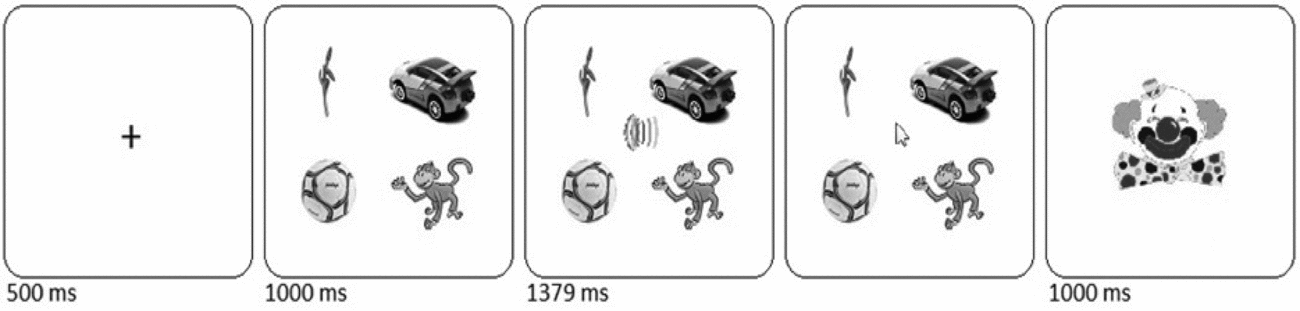
The word-learning task consisted of a practice phase and a training phase. Each trial in the practice and training phase started with presentation of a fixation cross (500 ms), after which four pictures were presented (1000 ms). Two of the pictures represented highly familiar filler items (e.g., a ball and a car; see Figure 1) that were phonologically and semantically unrelated to the experimental items, and the other two pictures represented the experimental items (target and control words). During presentation of the pictures the following auditory question was played (mean duration: 1379 ms): “Wat is denk je een [TARGET]” [What do you think is a [TARGET]?]. Then the child had to press one of the pictures on the computer screen in response to the question. If the correct picture was pressed, positive feedback was provided by a picture of a clown that appeared on the screen (1000 ms). If an incorrect picture was pressed, no feedback was provided. The next trial started right away (for an example trial, see Figure 1). In the practice phase and the training phase, feedback on correct answers was provided.
Trial design for the lexical specificity word-learning task, for a trial in the first block of the training phase.

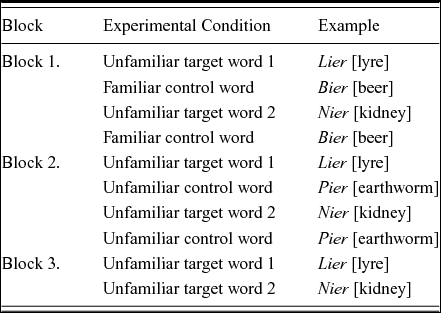
The practice phase (5 trials) was used to familiarize the children with the game. The training phase consisted of three blocks of experimental trials (48, 48 and 24 trials respectively) that increased in difficulty in two ways. First, the number of acoustic-phonetic features the words differed in (i.e., place or manner of articulation, or voicing) gradually decreased. Initially, children would be confronted with words that differed in more than one acoustic-phonetic feature (e.g., the initial consonants of lier [lyre] and bier [beer] differ in manner of articulation (lateral approximant versus plosive) and in place of articulation (alveolar versus bilabial)), but later they would encounter words that differed in only one acoustic-phonetic feature (e.g., lier and nier [kidney] differ only in manner of articulation). Second, in the first block of the training phase the unfamiliar target words were presented together with the familiar control words (e.g., lier and bier), but in the second and the third block only unfamiliar words were used (e.g., lier and pier [earthworm]). This design forced the children to attend to the phonological make-up of the words in more and more detail and they would only be able to acquire the meaning of each pair of target words if they learnt the specific one-feature difference between them (e.g., lier and nier). In Block 1, each target word of a quadruplet was presented once, combined with its familiar control word and two filler words. In Block 2, each target word of a quadruplet was presented once, combined with its unfamiliar control word. In Block 3, the two target words of a quadruplet were presented together, each couple of target words was presented once, along with two filler words (for the structure of the training phase, see Table 1). For this last block, in half of the trials target word 1 had to be identified, and in the other half of the trials target word 2 had to be identified. Throughout the word-learning task, the target items were presented in a pseudo-randomized order, taking the Dutch/Turkish–Dutch distinction, the vowel/consonant distinction, the type of articulation (place, manner or voice) and the place of articulation (initial, medial or final) into account. Also, the position of the target items on the computer screen was pseudo-randomized. Next to the experimental trials, nine highly frequent and familiar filler trials were randomly distributed throughout the training phase. In total, 134 trials were included (practice and training phases combined). On average, the word-learning task took about 15–20 minutes to be completed.
Lexical Specificity Word-Learning Task: Experimental Design and Examples.

Phonological awareness
To assess phonological awareness in Dutch the rhyme awareness and phoneme blending (ability to construct words based on their individual phonemes) tasks of the Screeningsinstrument Beginnende Geletterdheid [Diagnostic Instrument for Emergent Literacy] (Vloedgraven, Keuning & Verhoeven, Reference Vloedgraven, Keuning and Verhoeven2009) were used (Cronbach's alpha > .90, Vloedgraven & Verhoeven, Reference Vloedgraven and Verhoeven2007). Awareness of larger sound units (rimes) was measured with the rhyme awareness task (two practice items, 15 test items). On each trial, three pictures were presented on the computer screen. A female voice pronounced the words represented by the pictures. Then a fourth word was pronounced, a word that rhymed with one of the three pictures on the screen. The child had to find the rhyming picture and press it. The total test score was the number of pictures the child correctly identified.
Awareness of smaller sound units (phonemes) was measured with the phoneme blending task (two practice items, 15 test items). On each trial, three pictures were presented on the computer screen. A female voice pronounced the words represented by the pictures. Then the name of one of the pictures was pronounced phoneme by phoneme. The child had to find the correct picture and press it. The total test score was the number of pictures the child correctly identified.
In the L2-Dutch children, awareness of larger and smaller sound units was also measured in Turkish. A Turkish rhyme awareness task and a phoneme blending task were created. Both Turkish tasks were programmed in Presentation (Neurobehavioral Systems, Albany). The construction and procedures of the tasks were similar to the Dutch ones. To make sure the words used in the tasks were existing Turkish words of high frequency that were familiar to the L2-Dutch children, we selected the words together with a female native Turkish speaker and checked whether the Dutch translations of the words occurred on a target word list for kindergartners, namely the Basiswoordenlijst voor Amsterdamse Kleuters (BAK) [Basic Vocabulary List for Kindergarten Children of Amsterdam] (Mulder, Timman & Verhallen, Reference Mulder, Timman and Verhallen2009). Monosyllabic, three-phoneme Turkish words were used in the rhyme awareness task. Only 12 items (two practice items, 10 test items) could be created with words that met the criteria. Cronbach's alpha of the rhyme awareness task was acceptable (.51) considering the small number of items in the task (Gliem & Gliem, Reference Gliem and Gliem2003). There were nine monosyllabic words and six disyllabic Turkish words in the phoneme blending task. For this task, 17 items (two practice items, 15 test items) could be created. Cronbach's alpha was .71, which was acceptable (Gliem & Gliem, Reference Gliem and Gliem2003).
General Procedure
The children were tested individually. Testing took place in a quiet room at their primary school. During tasks that were presented via the computer, children were wearing headphones. The tasks were administered in different sessions. Each session took about 15–20 minutes. In the first test session the Dutch receptive vocabulary, rhyme awareness, phoneme blending and phoneme discrimination tasks were administered. In the second session the lexical specificity training was administered. Finally, in the third session, the Turkish rhyme awareness and phoneme blending tasks were administered. Only the L2-Dutch children received the third test session.
Data Analysis
First, extreme outliers were removed (values greater than three standard deviations from the mean). Missing values occurred when children missed out on test sessions, because they were ill, or unable or unmotivated to do a specific task. There were no more than 2% outliers and 6% missing values on any one test. Then Pearson's r correlations, with pairwise exclusion of cases to include all available cases per test, among age, and the measures of receptive vocabulary in Dutch, speech decoding, lexical specificity and phonological awareness were calculated. Finally, Structural Equation modeling (SEM) using LISREL software (Jöreskog & Sörbom, Reference Jöreskog and Sörbom2012) was performed to explore structural relations among implicit and explicit phonological abilities in L1 and L2. To evaluate data fit, several goodness-of-fit indices were examined (MacCallum, Browne & Sugawara, Reference MacCallum, Browne and Sugawara1996). For good fit, the chi-square test should be over .05 (Ullman, Reference Ullman2001), and the Non Normative Fit Index (NNFI), Comparative Fit Index (CFI), and Goodness of Fit Index (GFI) should all exceed .90 (Hu & Bentler, Reference Hu and Bentler1999). The Adjusted Goodness of Fit Index (AGFI) should be at least .85. The Root Mean Square Error of Approximation (RMSEA) should be smaller than .06, and the Standardized Root Mean Square Residual (SRMR) should not be over .08 (Jaccard & Wan, Reference Jaccard and Wan1996).
Results
Level of phonological abilities in first year of kindergarten
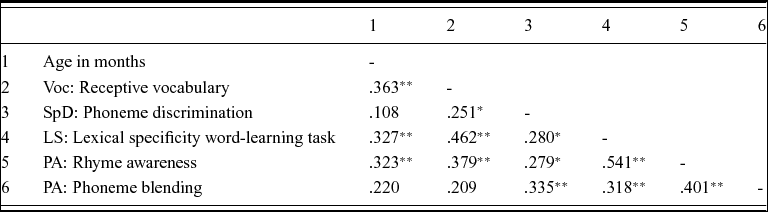
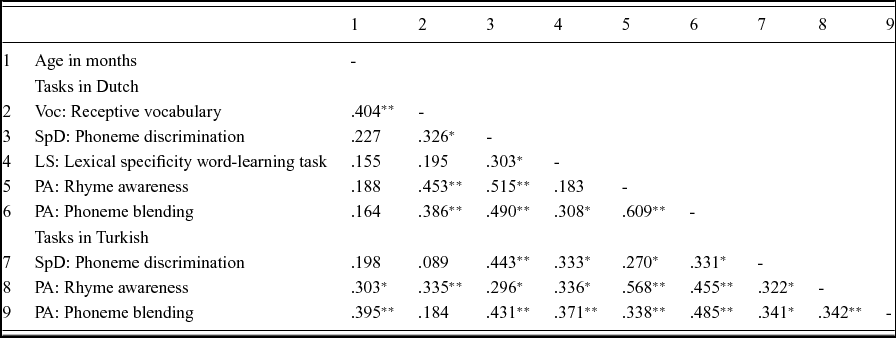
Pearson's r correlations among age in months and the measures for the L1-Dutch children (see Table 2) and L2-Dutch children (see Table 3) were calculated. Since the analyses did not reveal any correlations above .80, multicollinearity was not a problem (Grewal, Cote & Baumgartner, Reference Grewal, Cote and Baumgartner2004). Significant positive associations among the Dutch speech decoding, lexical specificity, and phonological awareness measures for the L1-Dutch children (p < .05 and p < .01), and among the Dutch and Turkish measures of speech decoding and phonological awareness for the L2-Dutch children (p < .05 and p < .01) were found. Although for the L2-Dutch children significant associations were found between measures of lexical specificity and Turkish rhyme awareness and phoneme awareness, no association was found between measures of lexical specificity and Dutch rhyme awareness. In the L1-Dutch children, age correlated significantly with measures of vocabulary, lexical specificity, and rhyme awareness (p < .01). The measure of vocabulary correlated significantly with age, and with measures of speech decoding, lexical specificity, and rhyme awareness (p < .01). In the L2-Dutch children, age correlated significantly with measures of vocabulary, and Turkish rhyme awareness and phoneme awareness (p < .05 and p < .01). The measure of vocabulary correlated significantly with age, with the Dutch measures of speech decoding, rhyme awareness, and phoneme awareness, and with the Turkish rhyme awareness measure (p < .05 and p < .01).
Pearson's r Correlations among Age, Dutch language exposure at home, Receptive Vocabulary and Measures of Phonological Skills for L1-Dutch (n = 75) Children.

* p < .05 ** p < .01
Note. Voc = Vocabulary, SpD = Speech decoding, LS = Lexical specificity, PA = Phonological awareness
Pearson's r Correlations among Age, Dutch language exposure at home, Receptive Vocabulary and Measures of Phonological Skills for L2-Dutch (n = 64) Children.

* p < .05 ** p < .01
Note. Voc = Vocabulary, SpD = Speech decoding, LS = Lexical specificity, PA = Phonological awareness
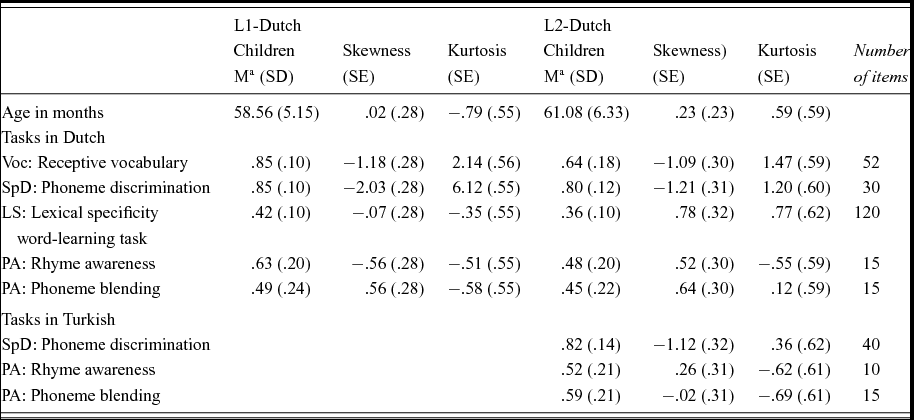
In Table 4, means and standard deviations and skewness and kurtosis values of age, and the measures for vocabulary, speech decoding, lexical specificity and phonological awareness can be found. Skewness and kurtosis values were within the range of univariate normality; therefore, it is justifiable to assume multivariate normality (Kim, Reference Kim2013). Levene's Test showed that, regarding the measures in Dutch, variance-covariance matrices were not equal across groups for receptive vocabulary, F (1,123) = 18.73, p < .001. To take this variation into account, Hotelling's Trace was reported as the test statistic (Hakstian, Roed & Lind, Reference Hakstian, Roed and Lind1979).
Descriptive Statistics for the L1-Dutch (n = 75) and the L2-Dutch (n = 64) Children.

Note. Voc = Vocabulary, SpD = Speech decoding, LS = Lexical specificity, PA = Phonological awareness
a Proportion of correct trials
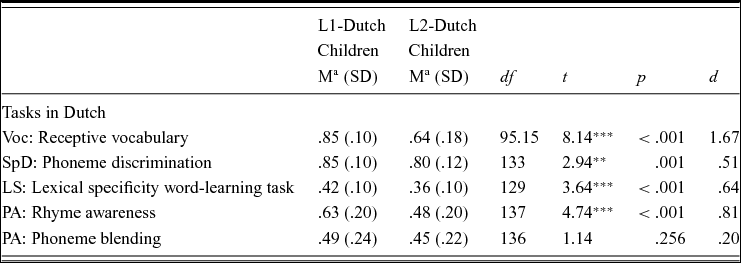
Results of a Multivariate Analysis of Variance (MANOVA), with Bonferroni-correction, on the vocabulary, speech decoding, lexical specificity and phonological awareness measures in Dutch with language (L1-Dutch, L2-Dutch) as between-subjects factor, revealed a main effect of language, F (5, 119) = 15.88, p < .001, η²p = .40. After controlling for SES (Educational level of the parents), Dutch language exposure at home, and age in a Multivariate Analysis of Covariance (MANCOVA), with Bonferroni-correction, the main effect of language remained, F (5,55) = 2.44, p = .046, η²p = .18. There was no main effect of educational level of the mother, F (5,55) = .71, p = .621, η²p = .06, or Dutch language exposure at home, F (5,55) = .20, p = .961, η²p = .02, however, there were main effects of educational level of the father, F (5,55) = 2.39, p = .049, η²p = .18, and age, F (5,55) = 3.40, p = .010, η²p = .24.
To further investigate which measures the L1-Dutch and L2-Dutch children differed on, Univariate Analyses of Variance (ANOVAs), with Bonferroni-correction, were carried out separately for each measure with language (L1-Dutch, L2-Dutch) as a between-subjects factor. The L2-Dutch children scored lower than the L1-Dutch children on all measures, except for the measure of phoneme awareness (see Table 5). These results did not change after the differences in educational level of the father and age between the groups were controlled for. Paired-samples t-tests on the Dutch and Turkish measures for the L2-Dutch children revealed that there were no significant differences in scores between the Dutch and Turkish measures of speech decoding, t (54) = −.72, p = .476, d = −.20, and Dutch and Turkish measures of rhyme awareness, t (58) = −1.20, p = .236, d = −.31. The L2-Dutch children had significantly higher scores on the Turkish measure of phoneme awareness than on the Dutch measure of phoneme awareness, t (58) = −4.66, p < .001, d = −1.22.
Results of t-tests for Independent Samples; and Cohen's d.

*p < .05 **p < .01 ***p < .001
Note. Voc = Vocabulary, SpD = Speech decoding, LS = Lexical specificity, PA = Phonological awareness
a Proportion of correct trials
Effects of implicit phonological abilities on explicit phonological abilities in Dutch as L1 and Dutch as L2
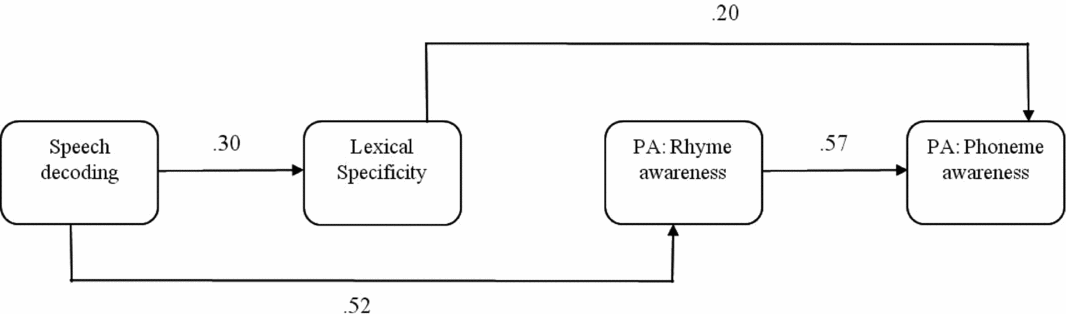
To find out what effects are of implicit phonological abilities on explicit phonological abilities in Dutch as L1 and Dutch as L2, measures of speech decoding, lexical specificity, and phonological awareness were included in multi-group SEM analyses. The model was restricted in such a manner that the structural paths among the variables were the same for both L1-Dutch and L2-Dutch children (see Figure 2 for the specified model). These analyses did not result in a good fit. The goodness of fit statistics for the L1-Dutch children showed a 21% contribution to the overall chi-square value (χ2 (4, N = 75) = 25.64, p < .001, CFI = .80, NNFI = .40, GFI = .96, RMSEA = .29, SRMR = .09), whereas the goodness of fit statistics for the L2-Dutch children showed a 79% contribution to the overall chi-square value (χ2 (4, N = 64) = 25.64, p < .001, CFI = .80, NNFI = .40, GFI = .88, RMSEA = .29, SRMR = .19). Structural paths among the variables appeared not to be identical between the two groups, so they were analyzed separately. The models that resulted from these analyses can be found in Figures 3 and 4. Only significant paths (p < .05) are depicted in the models.
Specified structural relations among implicit and explicit phonological abilities in Dutch as L1 and Dutch as L2.

Structural relations among implicit and explicit phonological abilities in Dutch as L1.

Structural relations among implicit and explicit phonological abilities in Dutch as L2.

Figure 3 shows the model for the L1-Dutch children. This model had a good fit (χ2 (2, N = 75) = 2.57, p = .28, CFI = .99, NNFI = .96, GFI = .98, RMSEA = .06, SRMR = .05). Speech decoding affected lexical specificity and phoneme awareness. Lexical specificity affected rhyme awareness, which in turn affected phoneme awareness.
Figure 4 shows the model for the L2-Dutch children. The model had an acceptable fit (χ2 (2, N = 64) = 2.96, p = .23, CFI = .98, NNFI = .95, GFI = .98, RMSEA = .09, SRMR = .04). The model for the L2-Dutch children showed some different paths compared to the L1-Dutch children's model. Speech decoding affected lexical specificity and rhyme awareness. Lexical specificity affected phoneme awareness. Again, rhyme awareness affected phoneme awareness.
To rule out that differences in structural relations among phonological abilities between L1-Dutch and L2-Dutch children can be explained by age, level of receptive vocabulary in Dutch, and Dutch language exposure at home, these variables were added as independent variables to the L1-Dutch and the L2-Dutch model. Adding these did not change the structural relations in the models. Also, to control for differences in language input at home among the L2-Dutch children, the children whose parents filled out the questionnaires on SES and Dutch language exposure at home were divided into two groups: a group wherein the children received mixed Dutch and Turkish language input at home (23 of the 64 L2-Dutch children), and a group wherein the children received mainly Turkish language input at home (24 of the 64 L2-Dutch children). In both groups, structural relations among speech decoding, lexical specificity, and phonological awareness were similar to the relations shown in Figure 4.
Effects of L1 phonological abilities on L2 phonological abilities
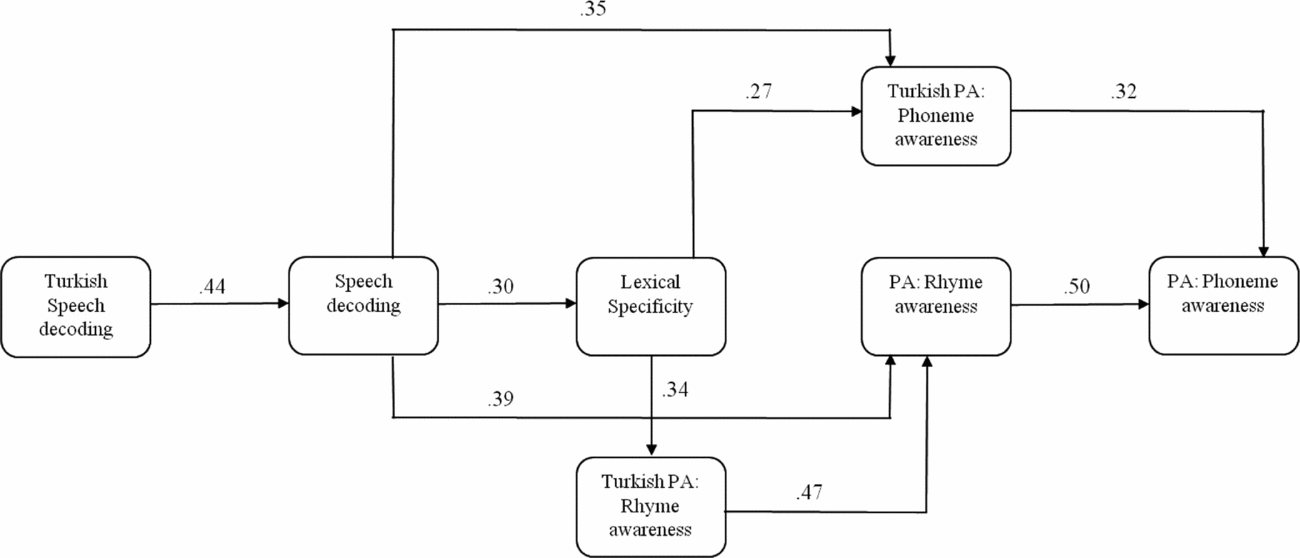
To examine the role of L1 phonological abilities in learning Dutch as an L2, measures of speech decoding and phonological awareness in Turkish were added to the model for the L2 children. The extended model is depicted in Figure 5. Only significant paths (p < .05) are shown. The extended model had an acceptable fit (χ2 (12, N = 64) = 16.18, p = .18, CFI = .97, NNFI = .95, GFI = .94, RMSEA = .07, SRMR = .12). L2 speech decoding affected lexical specificity, which in turn affected L1 rhyme awareness and phoneme awareness. L1 (Turkish) speech decoding affected L2 (Dutch) speech decoding, L1 (Turkish) rhyme awareness and phoneme awareness affected L2 (Dutch) rhyme awareness and phoneme awareness. The direct effect of lexical specificity on L2 phoneme awareness disappeared. Again, to rule out that the pattern of structural relations among phonological abilities is driven by age, level of receptive vocabulary in Dutch, and Dutch language exposure at home, these variables were added as independent variables to the extended L2-Dutch model. As in the previous models, structural relations remained the same.
Structural relations among L1 (Turkish) and L2 (Dutch) implicit and explicit phonological abilities.

Discussion and Conclusion
The aim of the present study was to unravel relationships among implicit and explicit phonological abilities and the role of lexical specificity in L1-Dutch and L2-Dutch children, taking into account transfer from first to second language for the L2-Dutch children. Results showed that L2-Dutch children scored significantly lower than the L1-Dutch children on measures of speech decoding, lexical specificity, and rhyme awareness, but not on a measure of phoneme awareness. Comparing scores on the Turkish and Dutch measures for the L2-Dutch children, we found significantly higher scores on the Turkish than on the Dutch measure of phoneme awareness. Importantly, SEM analyses revealed that for both the L1-Dutch and L2-Dutch children, performance on the lexical specificity measure was predicted by performance on the speech decoding measure. In contrast, performance on the lexical specificity measure predicted performance on the rhyme awareness measure for the L1-Dutch children, but performance on the phoneme awareness measure for the L2-Dutch children. When the Turkish measures were included in the analysis for the L2-Dutch children, performance on the L2-Dutch speech decoding measure predicted performance on the lexical specificity measure. In turn, performance on the lexical specificity measure predicted performance on the L1-Turkish measures of rhyme awareness and phoneme awareness. Performance on the L1-Turkish speech decoding, rhyme awareness, and phoneme awareness measures predicted performance on the L2-Dutch speech decoding, rhyme awareness, and phoneme awareness measures. Finally, examining the L2-Dutch model as a whole, performance on the speech decoding measures was found to be predictive of performance on the phonological awareness measures, both in L1 (Turkish) and L2 (Dutch).
Our first hypothesis was that the L2-Dutch children would perform lower than the L1-Dutch children on all measures, except that for phoneme awareness (i.e., performance on the phoneme blending task). This was indeed the case. It appears that the Turkish–Dutch bilingual children could not profit (much) from abilities already developed in Turkish when carrying out the speech decoding, lexical specificity and rhyme awareness tasks in Dutch. First, implicit phonological abilities, such as speech decoding, are attuned to the native language (e.g., Cheour et al., Reference Cheour, Ceponiene, Lehtokoski, Luuk, Allik, Alho and Näätänen1998). Second, since rhyme is less salient and meaningful in Turkish, this language aspect may not stand out as an important language aspect in Turkish–Dutch households and therefore presumably receives less explicit attention in language activities undertaken with the child (e.g., Leseman & Van Tuijl, Reference Leseman and Van Tuijl2006).
The individual phoneme, on the other hand, is highly meaningful in both Turkish and Dutch, and phoneme awareness had already developed to some extent in the Turkish language. Indeed, the L2-Dutch children had higher scores on phoneme blending in Turkish than in Dutch. This latter effect can possibly be explained by the characteristics of the Turkish language, and mainly by considering the difference in syllable structure between the Turkish and the Dutch language. Of all Turkish syllables, 98% belong to either the simple vowel, vowel-consonant, consonant-vowel or consonant-vowel-consonant form, with over 50% having the consonant-vowel form. Thus, syllabic boundaries within Turkish words are very clear. Although Dutch syllable structure is relatively simple as well, common syllable types include consonant clusters, for example strik, “snare”, straat, “street”, school, “school”, schoen, “shoe”. This is not the case in Turkish (for example, yay, “snare”, sokak, “street”, okul, “school”, ayakkabı, “shoe”). Therefore, phonemes within the syllable may be easier to identify in Turkish than in Dutch (Booij, Reference Booij2002; Durgunoǧlu & Öney, Reference Durgunoǧlu and Öney1999), possibly leading L1-Turkish children to develop phoneme awareness to a higher extent in Turkish than L1-Dutch children in Dutch. When carrying out the phoneme awareness task in Dutch, Turkish–Dutch bilingual children could probably profit from their phoneme awareness ability so far acquired in Turkish (e.g., Janssen, Bosman & Leseman, Reference Janssen, Bosman and Leseman2013; Janssen et al., Reference Janssen, Segers, McQueen and Verhoeven2015).
The results also supported our second hypothesis. Lexical specificity performance predicted rhyme awareness scores in the L1-Dutch children and phoneme awareness scores in L2-Dutch children. It seems that the ability to learn and remember fine-grained phonological representations of words supports the aspect of phonological awareness that is most salient, and therefore most meaningful, in the children's language repertoire. For the L1-Dutch children, the ability to recognize words based on only minimal acoustic-phonetic differences was predictive of the ability to make rhyme judgments because of the rime-biased nature of the Dutch language and the, presumably, strong stimulation of rhyme awareness development in the home environment (Booij, Reference Booij2002; Leseman & Van Tuijl, Reference Leseman and Van Tuijl2006). Performance of the L1-Dutch children on the lexical specificity task was predictive of performance on the phoneme awareness task only indirectly via performance on the rhyme awareness task. This may indicate that, for L1-Dutch children, rhyme awareness is a crucial part of phonological awareness that needs to be mastered before the next level of phonological awareness can be reached. For the L2-Dutch children, the ability to recognize words based on only minimal acoustic-phonetic differences was predictive of the ability to make judgments about words based on their individual phonemes. Although phoneme awareness is considered to be a more difficult phonological ability than rhyme awareness (e.g., Carroll et al., Reference Carroll, Snowling, Hulme and Stevenson2003), the former is more meaningful in the Turkish language than the latter (Durgunoǧlu & Öney, Reference Durgunoǧlu and Öney1999). Moreover, because of the similar status of the phoneme in both Dutch and Turkish and the simpler syllable structure in Turkish, phoneme awareness is strongly susceptible to linguistic transfer. This is reflected in the L2-Dutch children's performance, as their phoneme awareness performance overall (taking both the Dutch and Turkish measures into account) is better than their rhyme awareness performance, whereas for the L1-Dutch children it is the other way around.
In addition to the path from speech decoding via lexical specificity to phonological awareness, speech decoding also had a unique effect on phonological awareness in both the L1-Dutch and L2-Dutch children. Discrimination of speech sounds in itself is thus also predictive of phonological awareness, in line with prior findings (Mayo, Scobbie, Hewlett & Waters, Reference Mayo, Scobbie, Hewlett and Waters2003; Nittrouer, Manning & Meyer, Reference Nittrouer, Manning and Meyer1993; Nittrouer & Miller, Reference Nittrouer and Miller1997).
The third hypothesis was that there would be evidence for linguistic transfer in the Turkish–Dutch group. Cummins (Reference Cummins, Baker and Hornberger2001) states in his interdependency hypothesis that the stronger the L1 when exposure to L2 begins, the better the acquisition of L2. In several studies, phonological abilities in children's L1 have been found to be related to later phonological abilities in their L2 (e.g., Castilla et al., Reference Castilla, Restrepo and Perez-Leroux2009). Our results were in line with our hypothesis: lexical specificity predicted L1-Turkish phoneme awareness which in turn predicted L2-Dutch phoneme awareness. Also, L1-Turkish speech decoding and rhyme awareness predicted L2-Dutch speech decoding and rhyme awareness. It was not expected that lexical specificity would predict L1-Turkish rhyme awareness. But this finding may perhaps also be explained by the difference in phonological structure of the two languages. Possibly, the ability to recognize words based on only minimal acoustic-phonetic differences predicts explicit phonological abilities in the L1 and the L2 when these are more meaningful in the child's language repertoire (as is the case with phoneme awareness), but it predicts explicit phonological abilities only in the L1 when these are less meaningful in the child's language repertoire (as is the case with rhyme awareness). Note that the fact that the lexical specificity task measured the ability to recognize Dutch words (even though half of the phonetic distinctions used occur both in the Dutch and in the Turkish language) may have played a role here as well. Performance on this task may predict the children's rhyming ability because the measure reflects the ability to form phonological representations of words in the rime-biased L2. Furthermore, the children's level of rhyme awareness overall may simply have been too low for lexical specificity to predict L2 rhyme awareness. A final effect of linguistic transfer involved speech decoding ability. In the L2-Dutch model as a whole, speech decoding was found to be predictive of phonological awareness, both in L1 (Turkish) and L2 (Dutch). This result indicates that, in addition to transfer of L1 phonological abilities to L2 phonological abilities as the effects of the awareness tasks attest (and see also Scheele et al., Reference Scheele, Leseman, Mayo and Elbers2010; Verhoeven, Reference Verhoeven2007), implicit abilities in L1 and L2 transfer to explicit abilities in L1 and L2. Although different patterns of transfer from implicit to explicit abilities occur, overall, implicit abilities precede explicit abilities in phonological development (e.g., Carroll et al., Reference Carroll, Snowling, Hulme and Stevenson2003).
To be able to attribute differences in L1-Dutch and L2-Dutch children's performance on and structural relations among measures of phonological skills to differences in the phonological structure between the Dutch and Turkish language, it is important to consider influence of possible confounding factors such as age, SES, Dutch language proficiency (with level of receptive vocabulary in Dutch as a measure of Dutch language proficiency), and Dutch language exposure at home. Adding these factors as covariates in the ANOVA analyses, and adding them as independent variables in the SEM analyses, did not diminish the effect of language group and did not provide an explanation for the differences in structural relations among phonological skills between L1-Dutch and L2-Dutch children. The questionnaire on Dutch language exposure in the home environment used in this study, however, has some limitations. Questions were semi-structured and parents answered them based on their own evaluation of their language use. Social desirability tendencies and inaccurate estimation of the time spent on language activities with their child may have led to biased answers. Also, no information on the quality of the Dutch language input in the home environment was collected. Studies on this topic have shown that input from non-native speakers supports language acquisition less than input from native-speakers (e.g., Hoff, Rumiche, Ribot & Welsh, Reference Hoff, Rumiche, Burridge, Ribot and Welsh2014; Paradis, Reference Paradis2011; Place & Hoff, Reference Place and Hoff2011), and that book reading habits are influenced by the cultural background of the family. Results of a study by Bus, Leseman and Keultjes (Reference Bus, Leseman and Keultjes2000) showed that book reading habits diverge greatly between Dutch and Turkish–Dutch parents. For example, Turkish–Dutch parents were more inclined to paraphrase the text and discuss the reading procedure, but initiated discussions less than Dutch parents. Dutch parents were more inclined to initiate discussions than Turkish–Dutch parents, discuss the content of the text, and to connect the story with information that goes beyond the text. Moreover, the extent to which quantitative and qualitative variation in parent-child book reading habits and problem solving interactions affect cognitive skills of kindergarten children may also differ between families dependent on their socio-economic status and cultural background, with children from Dutch families with a higher SES being less affected than children from Turkish–Dutch families with a lower SES (Leseman & Van den Boom, Reference Leseman and Van den Boom1999). How exactly phonological abilities and the relations among them are, or are not, affected by variation in quantity and quality of both Dutch and Turkish language input in Dutch and Turkish–Dutch children could be examined more in depth in future studies.
There are several more directions that future research could take. In the current study lexical specificity was measured dynamically. Children received training to learn new minimal pair words. By using both a static measure (e.g., mispronunciation detection, Walley et al., Reference Walley, Metsala and Garlock2003; Simon et al., Reference Simon, Sjerps and Fikkert2014) and a dynamic measure of lexical specificity, the role of both specificity of phonological representations that are already in the lexicon and increases in detailed phonological knowledge over time, in phonological development, could be examined. A lexical specificity word-learning task in Turkish would allow speech decoding, lexical specificity, and phonological awareness to be measured entirely in Turkish. If similar tasks were created in other languages as well, it would be possible to examine relationships between implicit and explicit phonological abilities in different L1-L2 combinations.
The results of the present study need to be interpreted with caution for several reasons.
First, the participants-to-number of variables ratio for estimation of parameter values in the SEM analyses needs critical evaluation. Although we managed to include two large groups of children as participants in our study (n = 75 for the L1-Dutch children, n = 64 for the L2-Dutch children), larger group sizes are preferred in SEM analyses. According to Wolf, Harrington, Clark, and Miller (Reference Wolf, Harrington, Clark and Miller2013), however, smaller sample sizes can already reveal important relationships among variables. Second, since the goal of the study was to explore structural relations among more than three variables, SEM was chosen as the analysis method. This method does not allow conclusions to be drawn about the mediation of one variable between two other variables. Based on the SEM models, however, more specific hypotheses on the indirect effects of one variable on the other can be formulated and tested via mediation analyses in future studies. Finally, since the data were all collected at one point in time, no causal conclusions can be drawn. A longitudinal follow-up study could reveal the development of the interrelatedness between implicit and explicit phonological abilities over time, as well as examine the impact of these relationships on literacy.
To conclude, lexical specificity appears to link implicit speech decoding abilities with explicit phonological awareness abilities in L1 and L2 phonological development. To come from speech sound discrimination to manipulation of the phonological structure of words, being able to learn to recognize words based on minimal acoustic-phonetic differences may be an important intermediate step. However, different patterns of implicit to explicit transfer emerge as a result of language-specific characteristics and transfer of phonological abilities from L1 to L2 in bilingual children. This study showed that lexical specificity plays an important role in phonological awareness and that language-specific characteristics need to be taken into account when examining phonological development, and, presumably, when stimulating phonological development at school in both monolingual and bilingual children.