

Introduction
Over the past decade one of the key aims of the New Labour government in the UK has been to widen participation in decision making on policy issues (HM Government, 1999; Lowndes, et al., Reference Lowndes, Pratchett and Stoker2006). This has been generally welcomed by stakeholder groups, such as voluntary sector organisations, that were previously excluded from these deliberations, although there have been recent complaints of consultation fatigue and concerns about capacity for involvement (McCurry, Reference McCurry2001). At the same time, New Labour has pursued reforms across the public sector that have increasingly incorporated voluntary sector organisations into the planning and delivery of public services and provided additional incentives for them to maintain good working relationships with government (Kendall, Reference Kendall2000).
In response, those working within the voluntary sector have argued that groups should form links and alliances to represent the interests of their members (Leat and Passey, Reference Leat and Passey2000). However, these links are formed in the context of competition for resources and influence within New Labour's reform agenda and raise questions of whether groups that ordinarily compete for resources are able to work together to influence policy. Using the example of the UK Health Consumer GroupFootnote 1 (HCG) sector, this paper argues that even voluntary sector organisations with conflicting interests will network, cooperate and join alliances in circumstances where they perceive there is sufficient benefit. Drawing on theories from sociology and political science, this paper shows how in recent years the working environment of HCGs has had a role in shaping cooperation. However, acting through an alliance carries opportunity costs – resources expended here cannot be used elsewhere – and doubts remain about their ability to survive once these external stimuli disappear.
While this paper addresses campaigning alliances within the HCG sector, its findings offer useful insights for the wider voluntary sector. Health services have been at the heart of the government's reform agenda and it is likely that consequences for voluntary organisations here will be shared elsewhere. Most voluntary organisations face similar issues: the unequal distribution of resources, concerns about increasing fragmentation and the tension between service provision and adopting a campaigning role (Kendall, Reference Kendall2003).
The government's reform agenda
Since its election in 1997, the New Labour Government has increasingly pursued a modernisation agenda within public services. New forms of regulation, planning and accountability have all been adopted within the ideology of the Third Way (Giddens, Reference Giddens1998; Clegg, Reference Clegg, Powell, Bauld and Clarke2005). Public service delivery has been opened up to both private and voluntary sector providers. Kendall (Reference Kendall2000) argues that since the late 1990s, the relationship between government and the voluntary sector has been transformed. In 1998 a Compact – in effect a memorandum of understanding – outlined their different roles in the development and maintenance of a strong civil society (ACU, 2000a). In accompanying guidelines, the right of voluntary organisations to campaign on behalf of their members was acknowledged and groups were encouraged to ‘cooperate with each other through intermediary bodies . . . to streamline the consultation process’ (ACU, 2000b: 4). It was also suggested that these organisations could provide support and build capacity in smaller groups. Within the health sector, additional agreements which further contextualise this relationship have been published on issues such as partnership working (DoH, 2004; DoH, 2005).
In a parallel agenda, Government has also reformed decision making in particular policy areas. Within health, the document Patient and Public Involvement in the New NHS (DoH, 1999) was a continuation of a Conservative programme to involve patients and the public in all levels of health care decision making (DoH, 1996). This statement of intent was given a legal basis in 2001 when the Health and Social Care Act made it a statutory duty for the NHS to consult with patient, user and carer groups. New structures for patient and public involvement have also been introduced, although concerns about their efficacy have been raised (Baggott, Reference Baggott2005). Nationally, the Department of Health has continued to involve various stakeholder groups, including voluntary organisations and the professions in decision making. The inherent assumption has been that HCGs would be willing and able to respond to requests for participation.
Drawing on an ESRC studyFootnote 2 on HCGs’ involvement in the national policy process, this paper focuses on coalitions and alliances created by groups to lobby government. In general, the social policy literature has focussed on understanding partnership and inter-agency collaboration between groups working at local level within a specific service delivery context (Huxham, Reference Huxham1996; Taylor, Reference Taylor2006). This paper provides additional evidence on inter-organisational working, from the perspective of voluntary sector organisations undertaking campaigning activity.
Theoretical perspectives on collaborative working
Following Sullivan and Skelcher (Reference Sullivan and Skelcher2002), joint-working has been conceptualised as taking place on a continuum from intermittent cooperation on particular issues at one end, to membership of formally constituted alliances at the other. While this paper draws on theories relating to campaigning alliances, broader partnership theories also offer useful insights on why groups collaborate (cf. Glendinning et al., Reference Glendinning, Powell and Rummery2002). Of particular interest are internal and external pressures for cooperation, that is the extent to which groups are ‘forced, or encouraged or incentivised’ (Powell and Glendinning, Reference Powell, Glendinning, Glendinning, Powell and Rummery2002: 6) to work together.
Internal factors play a key role in the decision to collaborate. From a rational actor perspective, organisations lacking the resources to lobby alone will seek partners (Gray and Lowery, Reference Gray and Lowery1998). Hojnacki (Reference Hojnacki1997, Reference Hojnacki1998) argues that a decision to join a campaign is based on a balanced assessment of costs and benefits. This will not only be driven by financial considerations, but by an appraisal of the strategy required to achieve success. Groups will join an alliance if they face a strong opposition, to gain access to opinion formers or to benefit from publicity. Conversely, groups campaigning on contentious issues will seek allies to limit public exposure (Heinz, Reference Heinz1993). This interdependence – the need to work with others to meet organisational goals – is a key theme of partnership working (Hudson and Hardy, Reference Hudson, Hardy, Glendining, Powell and Rummery2002). If groups believe success requires cooperation, they will seek alliances, although only in the context of their own objectives (Rummery, Reference Rummery, Glendinning, Powell and Rummery2002). This perspective links with rational actor theories that argue success is not only determined by a positive policy outcome but by a maintenance of organisational goals (Hojnacki, Reference Hojnacki1997).
It has been argued in the policy studies literature that alliances are more common in crowded policy environments where interests must compete for access, resources and status (Baumgartner and Jones, Reference Baumgartner and Jones1993). However, competition may encourage some groups to distinguish themselves by becoming experts in a niche area (Browne, Reference Browne1990). Social movement theory suggests environmental factors such as support from external bodies also influence cooperation. Permanent or temporary alliances are necessary, as the majority of actors lack sufficient power to work alone (Staggenborg, Reference Staggenborg1986). Similarly, within partnership theory, external pressures, such as the need to respond to official consultations, provide incentives for collaboration. This interaction can help break down barriers between groups and encourage trust relationships to form (Taylor, Reference Taylor2006).
Trust may be derived from previous experience of successful joint action, but may also be structured through rules and regulations (Rummery, Reference Rummery, Glendinning, Powell and Rummery2002; Levi and Murphy, Reference Levi and Murphy2006). However, the extent to which rules are a prerequisite of trust is disputed. From a partnerships perspective, Powell and Exworthy (Reference Powell, Exworthy, Glendinning, Powell and Rummery2002) argue that trust cannot be assured by formal agreements, successful cooperation is preconditioned on shared culture and experience. However, Levi and Murphy argue that within campaigning alliances ‘trust cannot come without institutional arrangements to ensure member reliability’ (2006: 657). In other words, to succeed, there must be rules for managing conflict and these rules may reinforce or be substitutes for trust (Levi and Murphy, Reference Levi and Murphy2006). Craig and Taylor (Reference Craig, Taylor, Glendinning, Powell and Rummery2002) argue that longstanding relationships that exist prior to external pressures to coalesce will endure. However, Staggenborg suggests that once incentives disappear, competition and ideological disputes ‘are likely to cause conflicts within coalitions which may lead to their dissolution’ (1986: 388).
Any decision to work with other organisations also carries opportunity costs (Riker, Reference Riker1962). Groups may have to compromise on their agenda and there is a danger of loosing organisational identity. Salisbury (Reference Salisbury1987) argues that the downside to joint-working is that any policy success must be shared between the collaborators. Other decision costs include: time costs, resource constraints and political costs (e.g. of revealing one's stance on an issue) (Hojnacki, Reference Hojnacki1997).
In summary, these theoretical perspectives offer insights into why and how collaboration occurs and its critical success factors. Prior to the presentation and analysis of empirical evidence, the research methods are now described.
Research design and methods
This paper draws on research undertaken in three phases between late 1999 and summer 2001. First a postal questionnaire survey was undertaken of 189 HCGs (response rate 66 per cent) identified in five condition areas (arthritis, cancer, heart/circulatory disease, maternity/childbirth, and mental health), plus groups with broad health interests encompassing all condition areas and ‘umbrella’ groups or alliances. This was followed by semi-structured interviews with representatives of 39 HCGs selected on characteristics such as condition area, date of formation and size. The third phase consisted of semi-structured interviews with 31 key policy actors (including civil servants and MPs). To support the development of grounded theory, the interview transcripts were entered into QSR Nvivo qualitative data analysis software. The data were sorted into categories relating to internal and external relationships and themes within those identified. This paper draws on themes relating to barriers and facilitators of collaboration. More detail on the methodology is provided elsewhere (Baggott et al., Reference Baggott, Allsop and Jones2005).
Links between HCGs
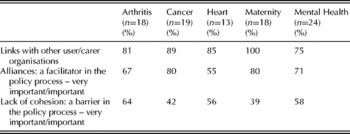
The research revealed that there is a high degree of interconnection between groups within the HCG sector, and that for the most part this contact is highly regarded. Table 1 summarises questionnaire data on the links, and their perceived value, between groups in the five condition-areas examined in the study.
Links between HCGs in different condition areas

Source: Questionnaire data-set 1999. The data-set also included 31 groups whose interests spanned condition areas.
The interview data showed that interaction took place within various institutional arrangements:
• cooperative networks – intermittent activity on a case-by-case basis;
• informal alliances – groups having regular meetings, sharing administrative costs, but with no formal structure or staffing;
• formal alliance organisations (FAOs) – organisations whose membership consisted of other HCGs, with their own staff and office space.
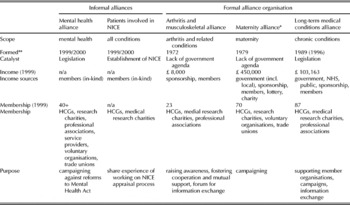
Eleven FAOs were identified in the questionnaire data-set, bringing together groups within specific condition areas or across the whole sector. By virtue, cooperative networks were ad hoc and ephemeral, however; Table 2 summarises the key characteristics of some of the informal and formal alliances operating in the HCG sector, illustrating the range of incomes, membership and purpose. The questionnaire showed that the majority (82 per cent) of FAOs stated that their main priority was to influence policy, compared with only 16 percent of all groups.
Key characteristics of informal alliances and FAOs in the HCG sector

Notes: *closed December 2005 **date in brackets FAO creation, prior to this informal alliance.
Drivers of collaborative activity in the HCG sector
The findings show that a number of internal and external factors has helped bring the HCG sector together. As groups have become increasingly concerned with policy, they have recognised the value of working together and have created informal and formal organisational linkages to accommodate this. In addition, new ways of working have evolved as a consequence of government participation strategies and stronger relationships with other health care stakeholders.
External incentives
The majority of HCGs were formed to provide advice and support on living with particular conditions, however interviews also showed that groups were interested in members’ and the public's experience of health care (Baggott et al., Reference Baggott, Allsop and Jones2005). For some groups this led to an interest in policy issues, such as access to treatment. Recognition that these concerns were shared with other organisations could lead to the formation of alliances, for example the Maternity Alliance was formed to lobby for improved maternity services and parental rights.
As the pace of change in the policy environment has quickened over the past two decades, incentives for groups to come together have also increased. The introduction of market mechanisms and service standards and the assessment of the efficacy of health technologies have persuaded groups of the need to work together to understand this new environment. For example the Long-term Medical Conditions Alliance's (LMCA) representative explained that it had evolved out of an informal alliance of groups concerned that the NHS internal market would mean those with long-term chronic illness would be viewed as too expensive to treat, but:
By working together the organisations could perhaps find what they had in common and speak with a common voice and have a stronger voice.
New mechanisms for consultation through for example the National Institute for Health and Clinical Excellence (NICE) appraisal processes or the working parties created to develop national service frameworks in a number of condition areas have also provided incentives for groups to cooperate. They have been required to learn the ‘rules of the game’ in order to ensure their continued seat at the decision making table. They recognised that traditional lobbying tactics were unlikely to work within these settings and a more professional approach such as the collection of evidence and the suggestion of policy solutions were required. Again, groups came together to ensure that lessons were learned and shared. For example, the informal alliance, Patients Involved in NICE, was established to provide a forum to share experiences of working with NICE.
Incorporation into consultation processes has also enabled leaders of HCGs to develop contacts and forge links, which have led to further partnerships, not just with other HCGs but with other stakeholder organisations. This has been particularly true within the mental health sector where differences between groups has been the subject of speculation in the national press (Fazackerley and Parker, Reference Fazackerley and Parker2001). However, New Labour's agenda to reform mental health services brought groups together within new consultative frameworks. As a consequence, groups found they shared areas of agreement:
A consensus came about I think because those people were meeting, discussing things in an objective way and realising that they all knew what good practice was and they all agreed on it. (HCG interview, 23)
Recognition that government may prefer to work through one organisation has also created incentives for groups to coalesce. Indeed in recent years the membership of key FAOs has grown (Baggott et al., Reference Baggott, Allsop and Jones2005). As the respondent from the LMCA said: ‘we get asked to nominate people to high profile committees and so it gives them [other HCGs] access through us’. Yet the Government's desire for a coordinated sector was not without problems; in 1999 it provided funding for the Patients Forum, a cross-sector FAO, to transform it into the main umbrella group for patient and carer organisations in the UK. Within four years its membership had more than doubled (Baggott et al., Reference Baggott, Allsop and Jones2005). However, in recent months the Patients Forum has instigated a review, fearing its rapid growth has caused it to lose focus not just in terms of policy agenda, but also in responsiveness and accountability to members (Hogg et al., Reference Hogg, Loosemore-Reppen and Rowan2006).
Internal incentives
The findings also showed that the need to work together was driven by internal resource considerations. These included financial problems, a lack of policy expertise and the need to mobilise a wider support base. Unsurprisingly many of the interviewees from smaller groups believed alliances offered their only opportunity for policy influence: ‘we have to work together because all groups have limited resources’ (HCG interview, 6). The few groups in the interview sample that did not join alliances cited resource constraints as a major factor. Alliance leaders were aware of this, and some cross-sector FAOs provided networking opportunities and support for smaller HCGs attempting to pull groups into membership. Cooperation provided access to each others’ expertise, particularly in relation to influencing policy, one member organisation described LMCA as having: ‘intellectual capital’ (HCG interview, 16) on which they could draw. In addition, many groups only represented a small membership but believed: ‘there's strength in numbers’ (HCG interview, 40) – working together put them on par with other stakeholders in the health care arena.
Groups recognised that as a campaign strategy joint-working could be more successful than working individually, because coordinated inputs were welcomed by other stakeholders. For example, groups worked together on maternity issues in parliament because: ‘we were treading on peoples toes, we realised this was stupid, so we get together as a group every six weeks or so’ (HCG interview, 26). Presenting a common voice meant it was also difficult for government to divide and rule, for example, during the deliberations on the National Service Framework for Older People; HCGs met regularly to coordinate their input. Joint-working also enabled groups to retain an interest in issues at the periphery of their agenda. For example one member organisation said of the Maternity Alliance, it would: ‘take the lead on things like parental leave . . . and we would support them’ (HCG interview, 35).
Sector specific incentives
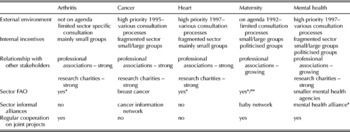
So far the paper has explored how alliance-building across the health sector has been prompted by policy and resource considerations, and the implicit assumption has been that the government's reform agenda has persuaded groups to work together. However the micro-politics of a particular condition area could also effect collaboration. For example, there was a history of fragmentation in some condition areas and cooperation in others, some conditions were government priorities and others were not. Table 3 summarises the various internal and external motivations for cooperation in each condition area.
Incentives for building alliances within different condition areas

Notes: *includes non-HCG as members/**closed in December 2005.
Although the questionnaire findings suggested that links between groups were common across all sectors, the interview data showed that they were strongest in the arthritis, maternity and mental health sectors. No one type of alliance was more common in a particular condition area, but links were stronger in areas where groups regularly cooperated on an ad hoc basis.
The lack of interest from government had prompted arthritis groups to push their agenda through broader cross-condition alliances. There was recognition that groups serving any chronic condition would share similar concerns such as access to new treatments and self-management and being part of a broader alliance would ensure wider support. Maternity groups were also members of broader alliances, but they tended to pursue their concerns within the sector. There was a long history of working together to influence policy, for example on the Changing Childbirth agenda in the early 1990s, and although governments' interest in maternity issues had waned they were able to use the links they had built with each other and with civil servants to their advantage. Groups were also beginning to work more closely with professional bodies to pursue a shared agenda on issues such as rising caesarean rates.
The three condition areas that were government priorities had different levels of interaction. In mental health, previous attempts at creating a formally constituted alliance had stalled. However, in the late 1990s, four groups did begin to coordinate their parliamentary activity along with the Royal College of Psychiatrists. In addition, groups began undertaking a number of research projects to gain evidence for their joint policy work. Around the same time concerns about proposed reforms to mental health legislation had the gearing effect of bringing groups across the sector together in the Mental Health Alliance. Initiated by HCGs, the informal alliance also included professional associations and research charities.
For the most part links between cancer groups remained weak and their roles in broad alliances were less strong. Interviewees acknowledged the lack of cooperation and suggested that competition between groups for funding and public attention reduced motivation. Each group wanted to maintain their own niche. However, respondents denied lack of coordination could impact on influence: ‘in some cases it is only going to strengthen things if different organisations are saying the same thing’ (HCG interview, 31). It was suggested by one stakeholder interviewee that cancer groups failed to see the harm fragmentation did to their cause. Heart and circulatory disease groups were well served by alliance organisations; however, in a similar way to the cancer sector, groups did not work closely together to influence policy. Even the smaller organisations in this sector had access to government – they were pushing at an open door, and perhaps they felt less need to cooperate as there was no pressing reason to do so.
Maintaining alliances in the HCG sector
While HCGs shared similar concerns and beliefs such as the need to ensure equity in access to health services and adopted similar ways of working, tensions between groups remained. They routinely competed for resources and public attention, and within some condition areas had differing views on what constituted appropriate treatment. As one interviewee suggested: ‘if there were absolutely no tensions, then somebody would suggest that we all become one organisation and save on our overheads’ (HCG interview, 23).
There was a suggestion that there was a limit to what alliances could achieve, due in part to inherent competition and the need to reach consensus. Competition between groups meant that joint-work was contingent on the nature of the issue. Sharing information on policy was easier than sharing access to the media where public exposure could lead to increased resources. The desire to maintain a united front meant that groups attempted to reach consensus on issues of importance. Therefore in some instances FAOs decided not to pursue certain agendas, or took on an internal informing role rather than an external campaigning role. As one respondent said of the Patients Forum: ‘[it] can only . . . carry out a coordinating role . . . because each of the members are going to have very, very different views’ (HCG interview, 9).
This need to reach agreement was a cause of frustration for policy makers who on the one hand wanted a coordinated response from groups, but on the other were concerned that compromises would weaken their input. Groups also had concerns about the need to work through one organisation. In particular they were worried their own agenda may be lost. However, alliance leaders were astute enough to realise groups should sometimes decide to go it alone. There was also concern that once the ‘issue’ that had brought groups together had been overcome, then alliances would fall into abeyance. While HCGs involved in the Mental Health Alliance were hopeful it would continue indefinitely, a stakeholder interviewee remained sceptical: ‘[the] vision is always wonderful . . . but very soon differences become too important’ (Stakeholder interview, 28).
Finally, alliances faced similar organisational maintenance issues as other HCGs such as income and staffing. In December 2005, the Maternity Alliance closed. Government's decision to pursue competitive project funding rather than the provision of core-grants, meant the alliance was competing with and losing out to other charities in the maternity sector for income (Volresource, 2005).
Discussion and conclusions
The changing health and social policy arena has placed additional demands on HCGs within particular condition areas and across the health sector. Increasingly, due to the pressure to respond to consultations, groups are facing opportunity costs (Riker, Reference Riker1962) and have to choose between activities of equal concern. Through cooperation and collaboration, HCGs aim to ensure that their views are represented in the policy process. However questions remain – in what circumstances are groups more likely to cooperate, what are the implications for the representation of interests in the policy process and, finally, are alliances a permanent feature of the HCG landscape?
The circumstances that promote cooperation
The findings support arguments that the decision to cooperate is based on a rational assessment of costs and benefits (Hojnacki, Reference Hojnacki1997). In the HCG sector, this may be strategically, financially or tactically driven. The sharing of common policy agendas encouraged coalescence, although groups would work alone if compromises threatened to weaken their message. Resources could be both an incentive and an impediment to participation, with some groups seeking to share the financial burden of policy activity and others unable to afford even this. Where groups recognised there was strength in numbers they were more likely to cooperate. In effect interdependence between groups was a key driver of collaboration (Rummery, Reference Rummery, Glendinning, Powell and Rummery2002); leaders were astute enough to realise when cooperation was warranted and when it was not necessary. However groups’ recognition of this interdependence was also influenced by external factors.
The political environment of groups held particular incentives to form alliances (Staggenborg, Reference Staggenborg1986). Groups were more likely to coalesce around legislative change – perhaps because of the immediacy of the issue and the need for rapid response – and in response to particular policy agendas such as NICE. Government's desire to work through FAOs also provided incentives to collaborate, as witnessed by the growth in membership of cross-sector alliances, suggesting that, where a large number of actors exist, cooperation will follow (Baumgartner and Jones, Reference Baumgartner and Jones1993).
However, the micro-politics of conditions also influenced collaboration. For example, in cancer and heart disease, there was little history of working together and groups were less likely to cooperate. Here, competition for resources and attention meant groups preferred working alone (Browne, Reference Browne1990). However, in mental health, with a similar history of poor relationships, alliances did occur. Here leaders were aware that unless they worked together they could not challenge government plans. In arthritis, where there was a history of collaboration, groups were also likely to coalesce, possibly because the condition did not feature high on the government's agenda. That groups in all condition areas joined cross-sector alliances suggests that collaboration was valued especially when dealing with generic issues. This suggests that organisational interdependence can also be influenced by the type of policy issue at hand (Rummery, Reference Rummery, Glendinning, Powell and Rummery2002).
The representation of interests in the policy process
Given the number of formally constituted alliances within the HCG sector that have grown out of informal alliances, it would appear that groups are attempting to create a structured interest able to compete with other more powerful stakeholders in the policy process. Many of the informal and formal alliances identified in the research had undergone a period of rapid growth of membership, and leaders developed mechanisms to maintain cohesion and rules of engagement to deal with tensions that might arise, in particular from members concerned about a change in focus. For example, where FAOs allowed non-HCGs to join, voting rules gave priority to the interests of HCGs. These findings support Levi's and Murphy's (2006) arguments about the necessity for institutional arrangements to underpin campaigning alliances.
A permanent feature of the HCG landscape?
Within campaigning alliances evidence shows that the political environment has a significant impact on whether and how groups collaborate. Despite the growth of alliances, questions remain about whether they can continue to survive once issues disappear from the agenda (Staggenborg, Reference Staggenborg1986). At the time of the research particular incentives were bringing groups together at national level; however, as policy agendas shift so too will the desire to collaborate – for example, in the future how will competition for grants and funding affect what is in the main positive collaboration on policy issues? There is already evidence that if alliance organisations are forced down this path of competing for funding with members, they will not survive. Government may need to rethink the financial support it offers these organisations.
However, the fact that different levels of collaborative activity were identified suggests that groups recognise the benefits of collaboration. Trust is an implicit feature of the HCG landscape and is based on a long history of working together: groups knew each other's strengths and weaknesses, and this is likely to foster good relationships for some time to come. In addition, the development of formally constituted alliances over the past decade or so – and the capacity building role adopted by some – suggests there is a move within the HCG sector to structure and strengthen joint-working arrangements and consequently to ensure enduring influence in the policy process.
Acknowledgements
Thanks to Rob Baggott, DMU, Leicester; Judith Allsop, University of Lincoln and the two anonymous referees for their useful comments on this paper.