


Introduction
Important work has been done in recent years on the conditions under which states that already possess nuclear weapons may overcome societal aversion toward their use.Footnote 1 In this study we address a related but different general question: can hypothetical deterioration in the international security circumstances of a country without a nuclear arsenal induce an abatement in what otherwise is a highly robust societal aversion toward nuclear proliferation?Footnote 2 We explore in particular possible international security conditions that may influence support among members of the Japanese public for their country's acquisition of a nuclear arsenal.
Perhaps especially because theirs is the only country that has sustained nuclear attacks, the percentage of Japanese who express approval of the idea of the acquisition of nuclear weapons has long been and remains very low. For example, an opinion survey administered in 2018 by Genron, a prominent Japanese think tank, found that only 11 percent of Japanese expressed support for the acquisition by Japan of nuclear weapons (Genron NPO 2018a, 31). However, for three reasons, this polling result may not fully reveal the changing nature of nuclear aversion among members of the Japanese public.
First, in recent years there has been a modest increase in Japanese support for nuclear weapons identified in annual Genron polls: while only 5 percent of respondents expressed support for a Japanese nuclear arsenal in 2016, about 11 percent did so, as noted above, in 2018 (Genron NPO 2017, 2018a). Moreover, during this period there was a substantial increase in “don't know” responses to the Genron nuclear-acquisition question, from about 15 percent in 2016 to 23 percent in 2018. Second, and very significant from our viewpoint, the Genron polling results are inconclusive regarding the causes of Japanese public attitudes toward nuclear weapons for their country. In particular, Genron provides very little policy context to Japanese respondents when asking for their views about the acquisition by Japan of nuclear weapons. This prevents us from knowing why Japanese do not support the acquisition of nuclear weapons, or why there might be modest recent changes in the structure of Japanese public opinion on this subject. Third, there is a sign of “duality” in the Japanese nuclear aversion. According to Genron survey in 2017, 11 percent of Japanese supported acquiring nuclear weapons if North Korea does not give up its own nuclear program. Yet, at the same time, 21 percent of the respondents supported the placement of US nuclear warheads in Japan, and 52 percent supported a similar placement of US nuclear weapons in South Korea (Genron NPO 2018b, 12).
To what extent does the Japanese public possess an immutable aversion toward nuclear weapons, and under which conditions might we observe a diminution in Japanese anti-nuclear sentiment? To address these questions, we focus on Japan's external security environment as a factor that might influence Japanese perceptions regarding the necessity of nuclear armaments. Rich scholarship on the United States (Press, Sagan, and Valentino Reference Press, Sagan and Valentino2013; Sagan and Valentino Reference Sagan and Valentino2017) and Japan (Tago and Ikeda Reference Tago and Ikeda2015; Matsumura and Tago Reference Matsumura and Tago2019) has demonstrated that public support in both countries for the use of force is strongly affected by what people are told is the security context in which the decision to use force is being made. Using a survey experiment, we examine the effect of plausible forms of deterioration of Japan's security environment on Japanese public support for the acquisition of nuclear weapons. We focus on three such external-security dimensions: North Korea's nuclear and missile programs, the Japan–US Security Treaty, and South Korea's nuclear status.
Japan's nuclear aversion
The argument that a country such as Japan might possess a strong anti-nuclear sentiment is consistent with the scholarly view that, at least for substantial periods of time, national communities may possess widely shared norms that influence their respective foreign policies, such as Chinese “cultural realism” (Johnston Reference Johnston1995) or in some democracies a preference for revenge in the face of being wronged (Stein Reference Stein2015). Katzenstein (Reference Katzenstein1996) emphasizes the role of the “peaceful cultural norms” in Japan, which were fostered through intense controversies over the country's identity after 1945. Similarly, Berger (Reference Berger1993, Reference Berger and Katzenstein1996) contends that “cultures of antimilitarism” have critically restrained Japan's assertiveness in security issues in the international system.
Japan provides a strong basis for an investigation of the societal-aversion thesis as it pertains to nuclear proliferation. As noted above, in general, the Japanese public expresses extremely negative views regarding nuclear weapons. This societal aversion is reflected in and is likely reinforced by the Japanese constitution, which is highly anti-militaristic in spirit and stipulates severe limits on the use by Japan of military force.Footnote 3 In addition, Japan's Atomic Energy Basic Law specifically prohibits the manufacture or possession of nuclear weapons. Japanese anti-nuclear sentiments are also retained and reproduced through anti-nuclear educational themes that are stressed in schools and in the wider popular culture. Japan in its foreign policy has reinforced its stance as a non-nuclear state, for example, by signing the Treaty on the Non-Proliferation of Nuclear Weapons in 1970 and the Comprehensive Nuclear-Test-Ban Treaty in 1996—but not, interestingly, the 2020 Treaty on the Prohibition of Nuclear Weapons. Overall, by virtue of its history, constitutional and legal institutions, and educational and cultural practices, we would not expect Japanese public opinion to be inclined to shift away from its anti-nuclear position. Therefore, it might be especially interesting and insightful to learn whether changes in Japan's external circumstances might induce changes in Japanese public opinion on the nuclear option.
Possible conditionality of Japanese nuclear aversion
Scholars have made important progress in recent years in highlighting the factors that likely affect the motivation of states to possess nuclear weapons. For example, in a cutting-edge large-N study, Jo and Gartzke (Reference Jo and Gartzke2007) presented numerous statistical models that highlighted a range of possible national determinants of going nuclear. In the same vein, but in a more country-specific style of analysis, Hughes (Reference Hughes2009) argues that numerous international and domestic constraints usually but not always operate to impede national nuclear-weapons development. Machida (Reference Machida2018) productively employed survey data to explore the possible conditionality in Japan's aversion to the acquisition of nuclear weapons, but in pursuing this matter elected not to employ an experimental approach. Ko (Reference Ko2018), in contrast, made excellent use of experimentalism in identifying and exploring the sources of variation in public preferences for nuclear weapons in South Korea (see also Sukin Reference Sukin2020). Such an experimental approach as deployed by Ko in connection to South Korea and nuclear weapons affords important leverage, we believe, in identifying more precisely the causal impact of external circumstances on Japanese public views on this subject.
Important scholarship has already highlighted the point that Japan's societal aversion toward nuclear option is due at least in part to the enjoyment of a largely favorable international security environment (Berger Reference Berger1993, Reference Berger and Katzenstein1996; Miyashita Reference Miyashita2007; and Machida Reference Machida2018). We build on this basic finding and anticipate that changes in their understanding of Japan's external security environment can affect Japanese public views about the acquisition of nuclear weapons. We explore this possibility below with the aid of an original survey experiment, and in particular we seek through the use of that method to ascertain what impact, if any, change in three external-security dimensions might have on Japanese nuclear views: threats from North Korea, the reliability of the US alliance commitment, and prospects of nuclear acquisition by South Korea.
North Korea
In general, foreign nuclear threats constitute the most common and most parsimonious explanation for nuclear proliferation (Reference SaganSagan 1996/1997, 57). Studies have shown that external threats might change Japan's public opinion on military policy. For example, Hughes (Reference Hughes2009) contends that threat perceptions of North Korea greatly matter in persuading the Japanese public to support an enhancement in the capabilities of the Japanese self-defense force.
North Korea has undertaken nuclear-weapons tests and missile launchings in 2006, 2009, 2013, 2016, 2017 (Haworth, Sagan, and Valentino Reference Haworth, Sagan and Valentino2019, 179), and as recently as June 2022. Hence, it is possible that, for many members of the Japanese public, North Korea's growing nuclear and missile capabilities represent a serious threat and to counter that threat it might be reasonable to support Japan's attainment of nuclear weapons.
The United States
The second dimension we consider is Japan's security relationship with the United States. While the empirical evidence is mixed, it seems likely that, even among states that are facing external security threats, third-party security guarantees provided by allies may powerfully intervene to shape national preferences regarding nuclear proliferation (Reiter Reference Reiter2014). That is, insofar as a nuclear ally's deterrence capabilities are extended to non-nuclear allies, the latter may believe that they can avoid nuclear threats, and thus have a reduced sense of need for nuclear weapons of their own. Mochizuki (Reference Mochizuki2007, 305) argues that Japan's decision to forgo nuclear weapons has been linked to its enjoyment of US extended deterrence. Hence, Japan's military alliance with the United States since 1952 may be rendering moot Japanese reflections on the idea of possessing its own nuclear arsenal.
Yet, the presence of an alliance agreement does not necessarily mean that credible nuclear deterrence is being offered to a protected state (Reiter Reference Reiter2014). In this regard, there has been increased uncertainty about America's assurance of its security commitment to Japan, especially with the election to the US presidency of Donald Trump in 2016, who as President reportedly mused about abolishing the US alliance with Japan (Bass Reference Bass2019). Thus, one might imagine that declining faith in the US nuclear umbrella might significantly boost Japanese support for a nuclear arsenal.
South Korea
The third dimension we explore is the nuclear status of a neighboring country, South Korea. In a manner that corresponds to the operation of a security dilemma, a country's attempt to acquire nuclear weapons creates by itself a potential nuclear threat to other states in the region, which in turn encourages the latter's own nuclear development to maintain their national security. This creates a chain reaction that presses neighboring states to consider the nuclear option, even if there is no initial national demand for such weapons and even if, from a security-threat viewpoint, there is no immediate threat that would prompt neighbors to think about the acquisition of nuclear weapons.
Facing grave threats from North Korea and being in possession of the technologies necessary for nuclear weapons and associated delivery systems, South Korea has both the motive and the means to acquire nuclear weapons. In addition, as is the case in Japan, so too in respect to South Korea there has developed uncertainty about the credibility of the US security guarantee. If South Korea were no longer able to rely on extended deterrence by the United States, it is possible that South Korea might someday seek to develop nuclear weapons. Indeed, South Korea appears to have pursued nuclear weapons in the 1970s when the United States withdrew some US troops from the country. Importantly, public support within South Korea for developing its own nuclear weapons is relatively high. In a poll conducted in 2018, for instance, 43.3 percent of South Korean respondents answered in the affirmative the question “Should South Korea acquire nuclear weapons?” although this marks a decrease from 67 percent in the previous year (Genron NPO 2018a, 31).
In addition, if a state seeks nuclear weapons not only for national security, but also for political status (Reference SaganSagan 1996/1997), norms concerning prestige might encourage Japanese to consider or even justify possessing a nuclear program. Acquiring nuclear weapons may represent a strategy of states to acquire status in regional or international affairs (O'Neill Reference O'Neill2006; Dafoe, Renshon, and Huth Reference Dafoe, Renshon and Huth2014; Renshon Reference Renshon2017), and quantitative research has provided evidence of a status-driven motivation on the part of at least some states to seek nuclear weapons (Jo and Gartzke Reference Jo and Gartzke2007, Singh and Way Reference Singh and Way2004).
Moreover, a form of status-seeking can escalate with nationalist or rivalry sentiments. While his analysis is focused on political leaders, Hymans (Reference Hymans2006, 2) argues that, for some nationalistic politicians, seeking nuclear weapons is not just a matter of a cost–benefit calculation, rather “[d]riven by fear and pride, oppositional nationalists develop a desire for nuclear weapons that goes beyond calculation, to self-expression.” It is possible that ordinary citizens might also have nationalistic sentiments against neighboring countries when their country's diplomatic relationship with those countries is unfavorable. Consequently, citizens might support the development of nuclear weapons in part as a function of the holding of nationalist sentiments.
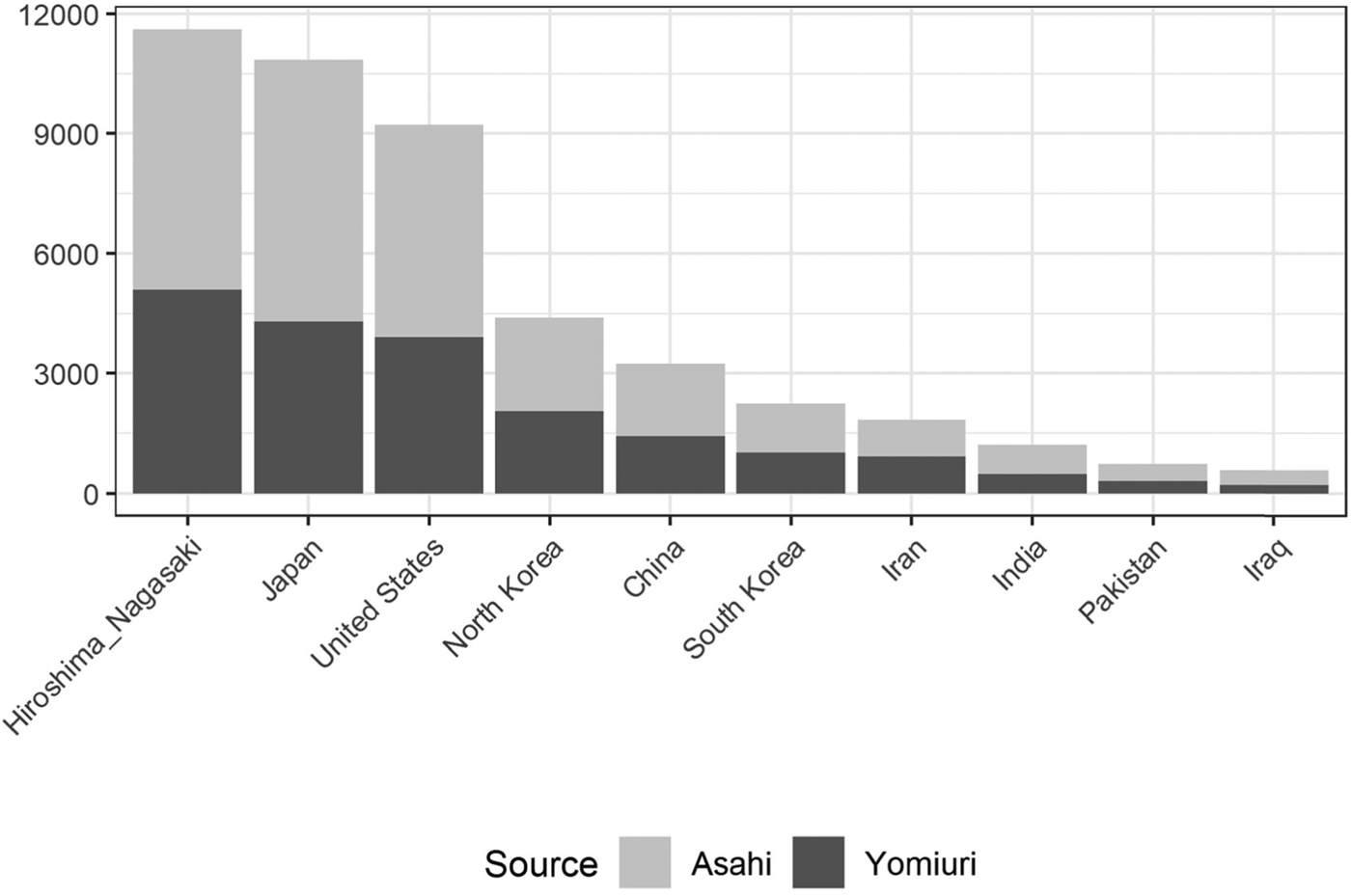
These three security dimensions are theoretically relevant factors that might motivate Japanese support for the acquisition of nuclear weapons. However, one might wonder whether Japanese actually are aware of these external security conditions. Thus, we investigated how the issues of nuclear weapons were covered by Japan's mass media. Conducting a simple textual analysis of newspaper articles during a five-year period between 2014 and 2018, we examined whether news stories discussed nuclear weapons with reference to any of three countries mentioned above. To do so, we collected news stories that contained the phrase “nuclear weapons” from the national edition of two leading national daily newspapers: Yomiuri Shimbun (Yomiuri) newspaper and Asahi Shinbun (Asahi) newspaper,Footnote 4 and applied a simple dictionary that assigns the names of places (i.e., cities, countries, and their capitals) and related figures (i.e., national leaders who are in power during our observational period) to each category. In this dictionary, for instance, “North Korea,” “Pyeongyang,” “Kim Jong-un” were defined as the keywords for North Korea. Similarly, “the United States,” “America,” “the White House,” and “Donald Trump” were defined as the keywords for the United States.Footnote 5
We present the results from this exercise in Figure 1. Each bar in the figure represents the number of news stories that included the keywords in the dictionary. We can observe in the figure that the news stories in both Yomiuri and Asahi are highly likely to refer to Hiroshima and/or Nagasaki when they talk about the issue of nuclear weapons, though the number of articles referring to Hiroshima and/or Nagasaki seems slightly higher in Asahi than in Yomiuri. At the same time, both Yomiuri and Asahi also refer to the United States, North Korea, and South Korea, while their reference to South Korea is less frequent compared to the other two countries. Although the mere appearance of the names of countries and their national leaders in news stories does not necessarily mean that those stories discuss the three security dimensions as we described them above, it provides some evidence that Japanese are exposed to such news.
Countries/Cities Appeared in News Articles about Nuclear Weapons
Note: Our coding procedure yielded 19,692 articles for Yomiuri and 26,211 articles for Asahi published in the period from 2014 to 2018. Among those articles regarding nuclear weapons, 4,299 articles in Yomiuri and 6,547 articles in Asahi include “Hiroshima” and/or “Nagasaki” at least one time.

Hypotheses on the conditionality of Japanese nuclear aversion
At the broadest level, if there is an immutable nuclear aversion among the Japanese public, then expressed levels of support among the Japanese public for the acquisition of nuclear weapons should be unresponsive to hypothetical changes in Japan's external circumstances. Hence, the following hypothesis may be evaluated:
Hypothesis 1: Members of the Japanese public offer little support for the acquisition of nuclear weapons regardless of the information they receive about Japan's security environment.
However, as discussed above, Japanese perceptions about their security environment might exert influence on their nuclear views and, specifically, information convening unfavorable changes in security conditions might induce some increase in Japanese support for the acquisition of nuclear weapons. Hence, we may assess the following hypothesis.
Hypothesis 2: Members of the Japanese public are more likely to support Japan's acquisition of nuclear weapons if they are given reasons to believe that Japan's security environment is deteriorating.
Since attributes of the security environment may be expected to interact with each other, it may be helpful to develop predictions that take into account changes along several external dimensions simultaneously. For instance, among members of the Japanese public, high abandonment fears regarding the United States, coupled with imminent threats originating from North Korea may have a stronger effect on Japanese attitudes toward the nuclear option than would information about only one of these two dimensions. By the same token, we might expect that the combination of low reliability of the US security commitment, high threats from North Korea, and high South Korea's nuclear ambition might be especially potent in driving Japanese public opinion in the direction of nuclear weapons insofar as this would represent the sharpest deterioration of Japan's security environment. We do not have a prior expectation as to whether one of these two mixed-security context treatments would be more consequential than the other.
Hypothesis 3: Japanese support for Japan's acquisition of nuclear weapons is likely to be highest relative to the control group and other treatment groups when presented with a treatment that includes deterioration along all three security dimensions.
Experimental design
To address the question of whether Japanese views about nuclear weapons vary as a function of information about the external security environment, we developed and implemented a survey experiment. An experiment of this type allows us to generate a hypothetical security scenario in which we can hold most relevant facts about the scenario constant while varying only one aspect of the security environment (regarding North Korea, the United States, and South Korea). Doing so allows us to isolate the effects of these variables on the public's support for or opposition to the acquisition of nuclear weapons.
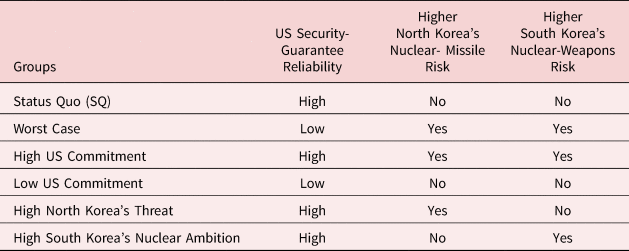
In our experiment, each respondent read a mock newspaper editorial in which international relations experts identify the top three security concerns for Japan. The first dimension concerned a security threat from North Korea: respondents were told either that North Korea was continuing its moratorium on nuclear-weapon and missile tests, or that North Korea had resumed such tests. The second dimension consisted of the reliability of the US security commitment toward Japan: respondents were told either that the US commitment to Japan, including the use of nuclear weapons on Japan's behalf, was robust, or that the US commitment was no longer reliable. The third dimension related to the nuclear status of South Korea: respondents were told either that South Korea continues to eschew developing its own nuclear weapons, or that South Korea may be moving to acquire such weapons.Footnote 6
While we have three dimensions and two conditions (status quo or not) for each dimension, which generates nine possible combinations of treatments, we have identified theoretically important six treatments, summarized below in Table 1.Footnote 7 The Status Quo (SQ) treatment, which is a combination of a reliable security guarantee from the United States, no immediate threat from North Korea, and no movement of South Korea's nuclear development, serves as the control.
Security environment treatment groups

Note: All treatments plus a placebo (a news report on Japan and the natural environment as a foreign policy issue) and a Hiroshima-Nagasaki reminder were employed in the experiment.
In addition to these six treatments, we prepared two auxiliary treatments; a foreign-policy placebo and a Hiroshima-Nagasaki remainder. Respondents in the placebo group were assigned a mock news editorial in which international relations experts identify three top international concerns: global warming, trade wars, and poverty and economic development. The placebo treatment matches the six treatments in word count and structure, but it does not contain any information about the security environment.
In the Hiroshima-Nagasaki reminder group, respondents were given a news editorial that reminded them of the nuclear bombings in 1945 against Hiroshima and Nagasaki, and it reminded them of Japan's long-standing three non-nuclear policy principles—that is, Japan should neither possess nor build nuclear weapons, nor should it permit another country to bring nuclear weapons into Japanese territory. This treatment was prepared to examine whether the Japanese nuclear aversion is a social norm or if it is an instance of social desirability bias (SDB)—that is, an instance of a widespread Japanese expression of aversion toward nuclear weapons that arises because individual Japanese believe that such an expression of aversion is the socially acceptable or appropriate stance to hold. If we observe that, compared to the SQ treatment or foreign-policy placebo treatment, the Hiroshima-Nagasaki reminder is associated with higher support for Japan's non-nuclear policy, this could be evidence of the operation of an SDB. Respondents were randomly assigned into one of these eight conditions with approximately 200 subjects in each condition (see Online Appendix A1 for the full wording of treatments used in this experiment).
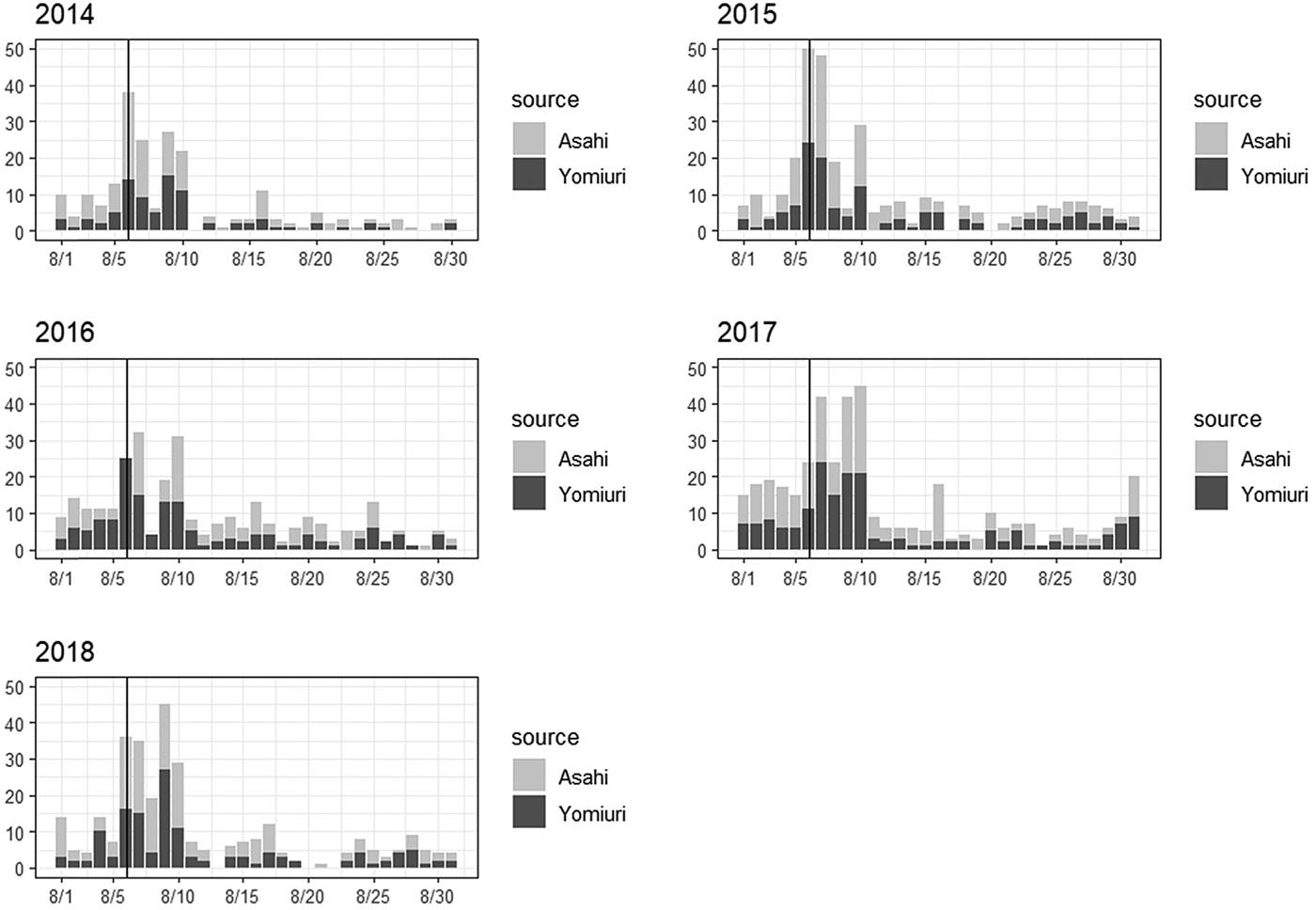
We conducted the experiment through a Japanese national polling firm, Nikkei Research Inc. (www.nikkei-r.co.jp/english/), which identified a nationally representative random sample of 1,700 Japanese persons. The survey was implemented from August 9 to 14, 2019, that is, the period right after the memorial days of the atomic bombings in Hiroshima (August 6) and Nagasaki (August 9), during which we anticipated that public consideration of nuclear matters might be prompted.Footnote 8 This expectation is buttressed by the data in Figure 2, which suggests that the number of news articles about nuclear weapons in Yomiuri and Asahi newspapers largely increased during this period. We expect that the commemoration acts as a catalyst for the nuclear aversion social norm, which provides us a hard case to test our hypotheses.
New Articles about Nuclear Weapons
Note: Figure 2 shows the number of news stories in Yomiuri and Asahi newspapers that were published during August in each year and contained the words of “nuclear weapons.” The black vertical line is drawn on August 6, a day of the first atomic bombing in the city of Hiroshima.

After the mock news editorial was presented, two outcomes were measured utilizing both a 6-point scale (ranging strongly disapprove, disapprove, somewhat disapprove, somewhat approve, approve, and strongly approve, together with “do not want to answer”) and a binary choice. Respondents were asked about their support for acquiring indigenous nuclear weapons.Footnote 9 Second, we asked respondents whether they support or oppose the stationing of US nuclear weapons in Guam for the purpose of defending Japan.
We also examined how responses might vary by the respondents’ individual-level characteristics, such as gender, age, education, party affiliation, and general orientation toward the use of force. Besides those standard socio-demographic features, we measured the respondents’ social dominance orientation (SDO). It is possible that a country's decision to develop an independent nuclear deterrent is driven by concerns about national prestige as well as by systemic variables (Hughes Reference Hughes2007). As Renshon reports (2017), a higher SDO is positively correlated with individual attitudes toward thinking about state status and anti-outgroup, hawkish orientation for a national security policy. A higher SDO may therefore be related to attitudes toward a faltering nuclear aversion in Japan. To measure respondents’ SDO, we used the 4-item short SDO scale created by Pratto et al. (Reference Pratto, Stewart, Zeineddine and Aranda2013).Footnote 10 The SDO scale is comprised of two items concerning the endorsement of inequality among groups (“We should not push for group equality,” and “Superior groups should dominate inferior groups”) and two items regarding the endorsement of equality among groups (“In setting priorities, we must consider all groups,” and “Group equality should be our ideal”). Respondents indicated their reaction to each item from 1 (strongly agree) to 7 (strongly disagree). With these responses we created a composite index of SDO. We provide a summary statistic of all relevant variables for our analysis in Online Appendix A2.
Manipulation checks
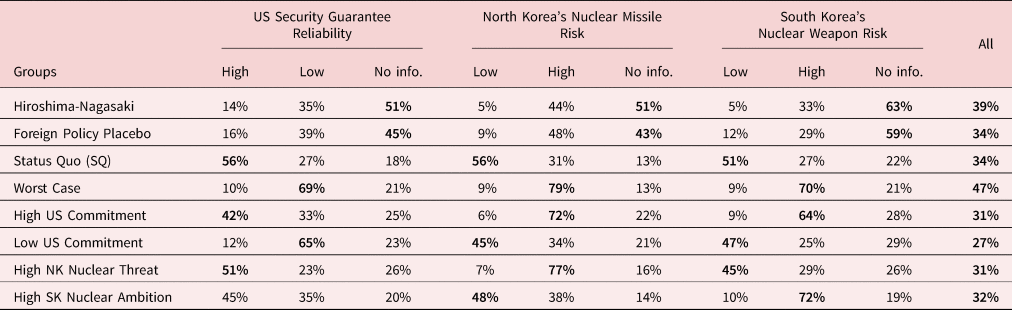
To ensure that the treatment conditions presented a capacity in principle to evoke reactions from respondents as we had anticipated, we included three manipulation questions to ascertain whether the respondents correctly understood the mock newspaper editorial assigned to them. Table 2 displays the results. Approximately 27 to 47 percent of the respondents correctly answered a follow-up question checking whether they apprehended the meaning of the mock news editorial in terms of whether they related to nuclear-missile threats from North Korea, the US alliance commitment, and the nuclear status of South Korea. The relatively high failure rate associated with our manipulation questions raises a concern that respondents may not have read the vignette carefully. However, we obtained almost identical results even when we dropped respondents who failed their manipulation check (see Online Appendix A4, also see Aronow, Baron, and Pinson (Reference Aronow, Baron and Pinson2019) for potential issues surrounding the dropping of respondents who failed manipulation checks). The average response time of participants in the survey was 5.87 minutes, with an observed minimum of 0.65 minutes to complete the survey and a maximum of 230 minutes to do so.
Manipulation checks

Note: The cells of correct answer are shown bold.
Results and discussion
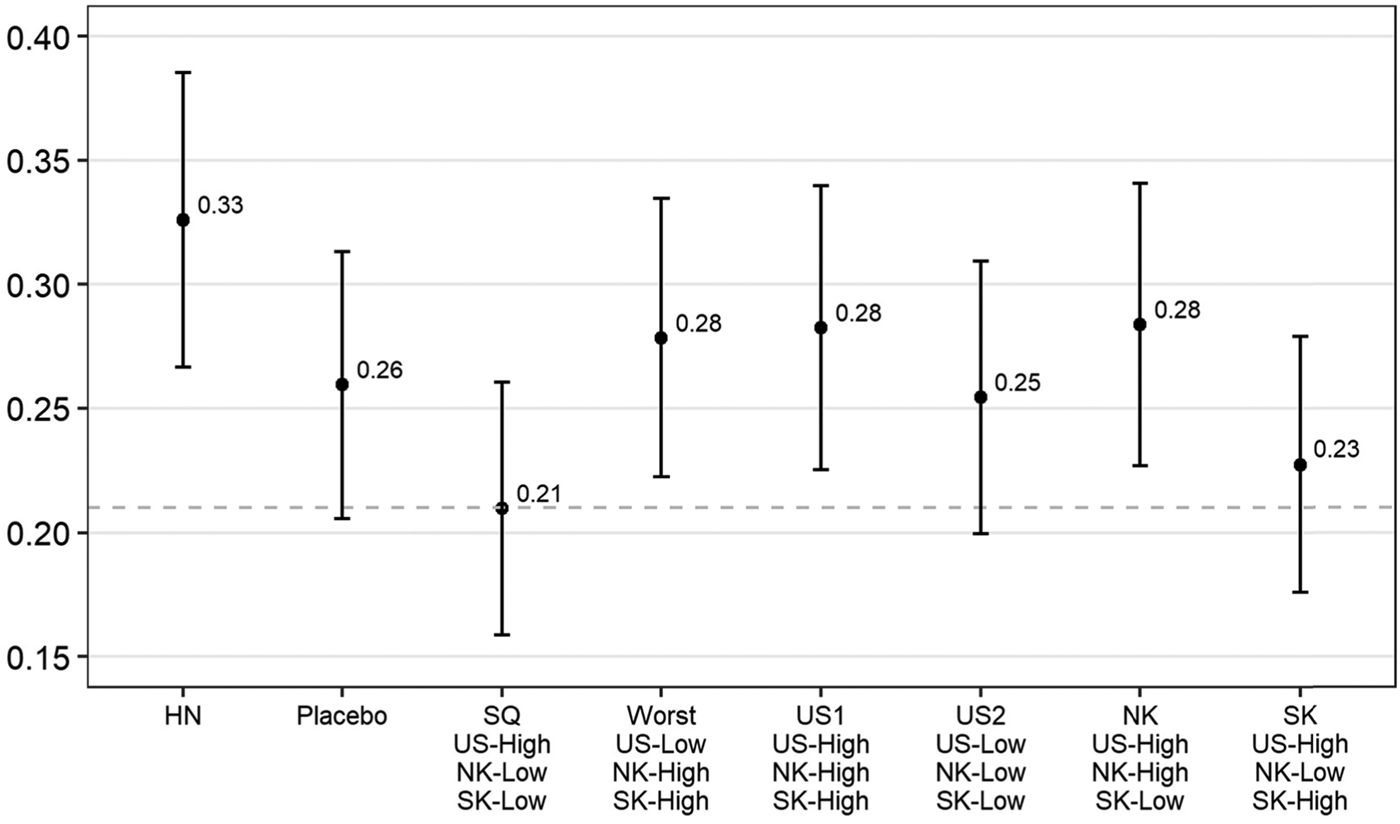
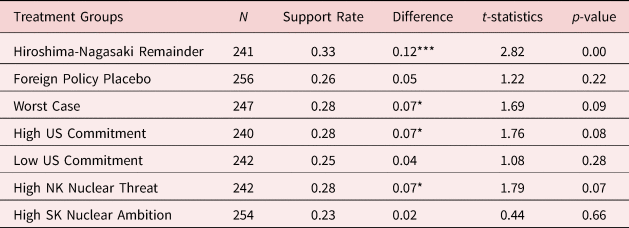
Figure 3 and Table 3 show the percentage of respondents who approved of Japan's acquisition of nuclear weapons across each of the eight treatment groups, along with the associated 95 percent confidence intervals. What is noticeable is that, across all the groups in our experiment, Japanese support for the acquisition of nuclear weapons never exceeds 33 percent. This would suggest that the Japanese do indeed exhibit a substantial aversion toward nuclear weapons.Footnote 11
Support for Japan's Acquisition of Nuclear Weapons
Note: The dashed-line represents the SQ treatment effect. It serves as the reference line to aid in the visualizing of the impact of other treatments.

Approval rates by treatment group, using the SQ treatment as a baseline

*p < 0.10, **p < 0.05, ***p < 0.01.
Although these results are indicative of a widespread nuclear aversion in Japan, other findings suggest that this aversion is not immutable or unconditional and thus may not constitute a deeply engrained Japanese socio-cultural norm. Among those who received the SQ treatment, 21 percent of the respondents supported Japan's acquisition of nuclear weapons; among those who received the worst-case treatment, the level of support reached 28 percent, an increase over the SQ treatment of seven percentage points (p-value = 0.09). This finding would appear to press in the direction of being in accord with Hypothesis 2, and less so with Hypothesis 1. Our inference from the finding is that, for many Japanese, the acquisition of nuclear weapons is not unthinkable, rather it is an option that a certain number of Japanese are ready to support if the country faces a deteriorating security situation.
However, when we seek to assess the specific sources of variation in the impact on Japanese nuclear views of the six forms of deterioration in external-security environments, we obtain ambiguous results. In particular, we could not determine statistically which among the six treatment-patterns encapsulating different security environments had the greatest impact on Japanese respondents. On the one hand, t-tests of difference between the worst-case treatment and the SQ treatment group exhibit a moderately statistically discernible difference. However, contrary to our expectation in Hypothesis 3 that Japanese support for the acquisition of nuclear weapons would be highest when all three security dimensions deteriorate, in the current experiment we did not observe statistically differences across the treatment groups. This result suggests that there might be very little interactive or cumulative impacts on Japanese nuclear views that arise from being exposed to multiple security concerns.
We do note, however, that an enhanced threat perception regarding North Korea by itself helped boost public support for the possible acquisition of nuclear weapons. A comparison between the SQ treatment and the NK treatment exhibits a significant impact of high nuclear threat from North Korea (p-value = 0.07). Similar comparisons between the SQ treatment and other two dimensions, the US alliance commitment and South Korea's nuclear ambition, did not produce meaningful differences.Footnote 12
Particularly surprising are the responses from those members of our Japanese sample who were primed about the nuclear attacks against Hiroshima and Nagasaki. In marked contrast to our expectation that their support should be the lowest because of social-desirability bias, those respondents actually expressed the highest average level of support for the acquisition of nuclear weapons compared to the six security-context treatments. How can we explain this unexpected result? One possible explanation can be found in the “reactance” literature in political psychology. Reactance is “an unpleasant motivational arousal that emerges when people experience a threat to or loss of their free behaviors” (Steindl et al. Reference Steindl, Jonas, Sittenthaler, Traut-Mattausch and Greenberg2015, 205). Further, Steindl et al. (2015, 209–210) argue that when attempts are made to persuade people by using a forceful message, this message motivates people to present arguments against the persuasive attempt. Applying the idea of reactance to our experiment, it is possible that some respondents might have understood the Hiroshima-Nagasaki remainder as a forceful message that restricts Japan's freedom of choice as a means of national defense. Consequently, the reminder might have elicited markedly negative attitudes toward the priming message, which in turn triggered an intention to behave contrary to the message.Footnote 13
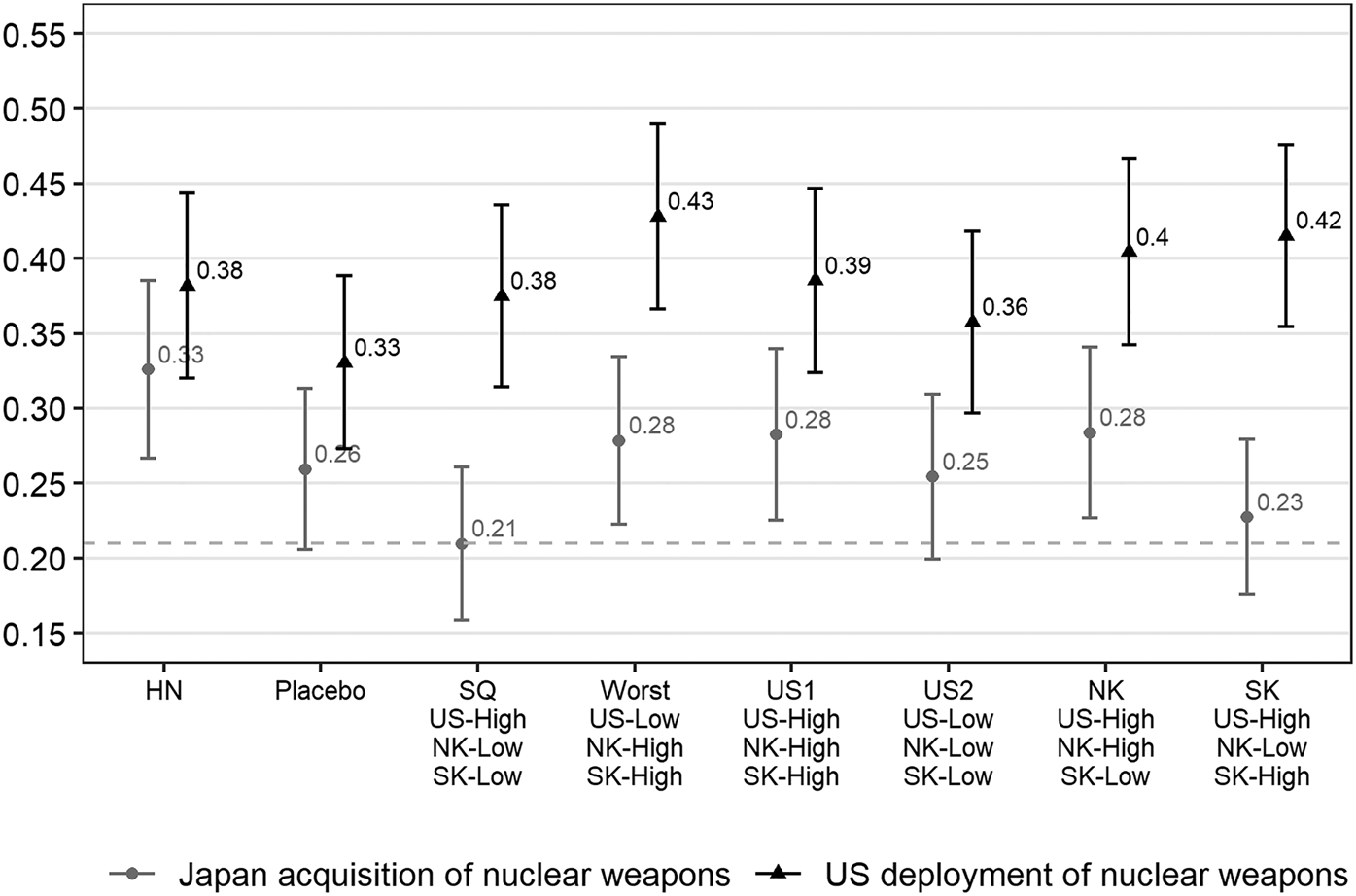
We next turn to support expressed by respondents for the use of nuclear weapons by the United States in defense of Japan. Figure 4 provides strong support for the expectation that Japanese nuclear aversion is relatively weak with respect to the US use of nuclear weapons if doing so is intended to defend Japan. Respondents provide higher support scores for the US deployment of nuclear missiles in Guam to defend Japan compared to their support for Japan's acquisition of nuclear weapons. In the worst-case treatment, 43 percent of respondents supported such deployment by the United States. This result is consistent with the argument regarding a possible “nuclear duality” in Japan, referring to the possession on the part of many Japanese of an anti-nuclear position for Japan itself in combination with confidence in extended deterrence provided by the United States (Hoey Reference Hoey2016, 486).
Support for Nuclear Weapons
Note: The dashed-line represents the SQ treatment effect. It serves as the reference line to aid in the visualizing of the impact of other treatments.

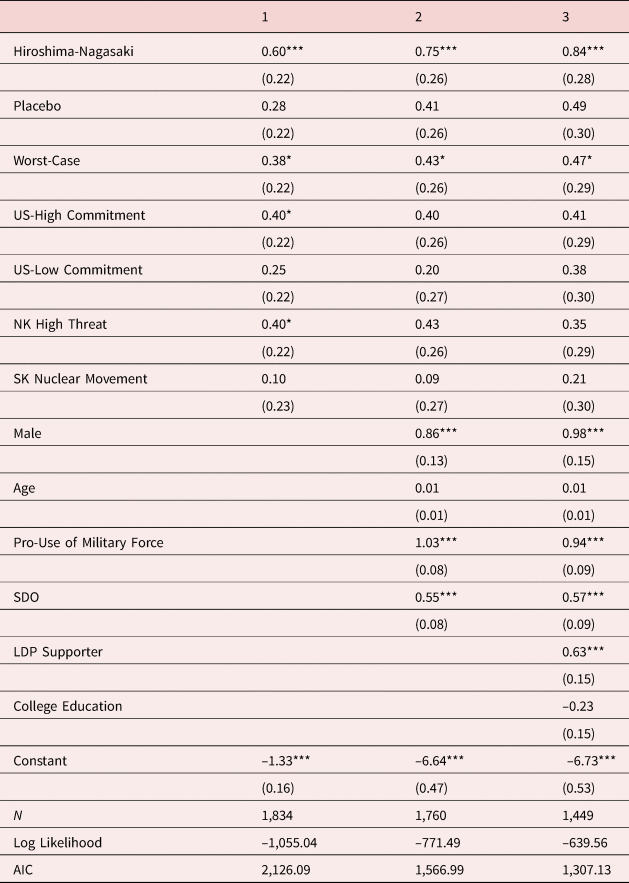
To assess the impact of variation in the security environment on Japanese nuclear views more precisely, we estimated a series of regression models using the binary measure for attitudes toward nuclear weapon acquisition as the dependent variable. Table 4 displays the results of a logistic regression on this matter. For this analysis we included the external-environment treatments and a number of standard socio-demographic characteristics that have been employed in recent literature that seeks to account for variation in public preferences for the use of force. In particular, we included respondents’ gender, age, college education, self-reported level of support for the Liberal Democratic Party (LDP), the governing party of Japan, and preferences regarding the use of force. We also included a measure of the level of SDO presented by respondents in line with recent research Renshon (Reference Renshon2017) that suggests that SDO is a key individual-level determinant of national-security policy attitudes.
Security Environment, Demographic Characteristics, and Support for Nuclear Weapons, Logistic Regressions

*p < 0.10, ** p < 0.05, *** p < 0.01.
Note: Standard errors in parentheses
Models 1 to 3 in Table 4 show that, consistent with our earlier discussion, the worst-case treatment increased Japanese public support for the acquisition of nuclear weapons. It also appears that respondents in our sample with certain socio-demographic characteristics were more or less likely to support the acquisition of nuclear weapons. In particular, we found the following:Footnote 14
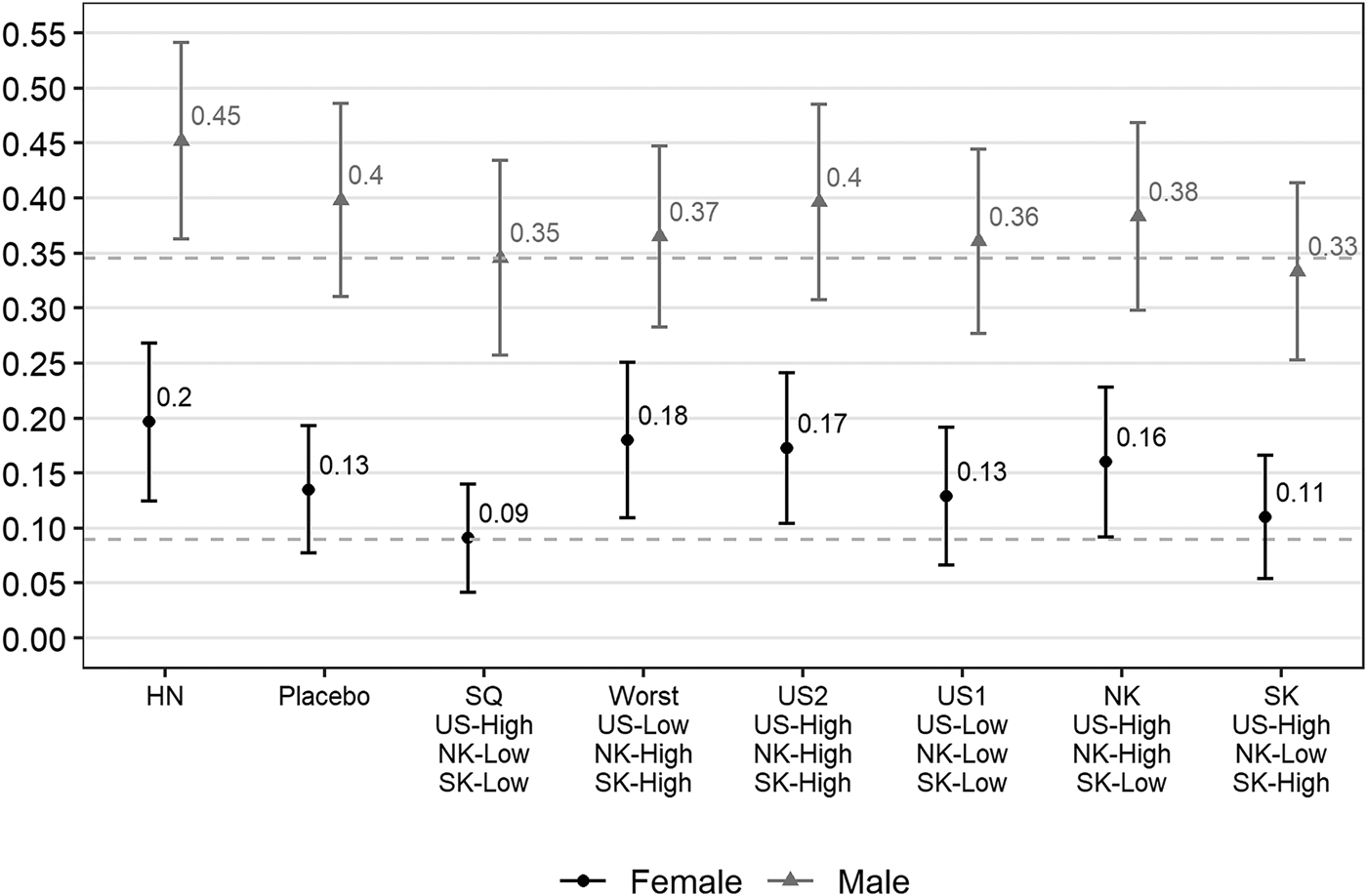
Gender: Many studies have found that, in general, individuals who identify as female are less likely to support the use of military force abroad than are individuals who identify as male (for explorations of this matter see for example Eichenberg Reference Eichenberg2003, Reference Eichenberg2016, and 2019, especially chapters 5–9; Brooks and Valentino Reference Brooks and Valentino2011; Press, Sagan, and Valentino Reference Press, Sagan and Valentino2013; Sagan and Valentino Reference Sagan and Valentino2017, and Barnhart et al. Reference Barnhart, Trager, Saunders and Dafoe2020; on intra-state violence, see Ben Shitrit, Elad-Strenger and Hirsch-Hoefler Reference Ben Shitrit, Elad-Strenger and Hirsch-Hoefler2017). We anticipated and indeed observed in our experiment that, regardless of the external security-environment treatment, Japanese males were more supportive than Japanese females of the acquisition of nuclear weapons. However, as we discuss in more detail below, our experiment, in accord with recent scholarship on gender and war, revealed that females, in expressing a view about Japanese acquisition of nuclear weapons, responded more forcefully than Japanese males to our treatment stipulating a deterioration in Japan's external security environment.
Use of Force Preference: Those individuals in our experiment who expressed support for the use of force in world politics as a general matter provided higher support for the acquisition by Japan of nuclear weapons. In the status-quo treatment, for example, 45 percent of pro-force respondents expressed support for Japan's acquisition of nuclear weapons (see Online Appendix A5).
SDO: There is a strong and positive correlation between the expressed preferences of respondents for nuclear weapon acquisition and their expressed level of SDO. Japanese with high SDO scores—that is, they possessed negative attitudes toward non-Japanese and appeared to be highly sensitive to Japan's status in international relations—were more likely to prefer acquiring such weapons than those with low SDO scores.
What could be the link between SDO and approval of nuclear weapons? The prospect of acquiring nuclear weapons might relate to polarized attitudes toward Asian neighbors and the risk of decreasing status of Japan in Asian regional relations. If a person thinks that nuclear weapons generate a sense of being a major power and key actor in world politics, developing such a status through attainment of nuclear weapons will be more likely to be supported by those who care about the status of Japan in the hierarchical order of international relations (Renshon Reference Renshon2017). This preliminary finding highlights the need for more in-depth analysis as to when and why an individual's SDO may have an impact on support for acquiring nuclear weapons.
LDP Supporter: Those who expressed support for the LDP were more likely to express support for the acquisition of nuclear weapons than those who did not support the party.
Age: The age of respondents in the experiment appears not to have been an important factor affecting respondent views on Japanese nuclear weapons. It might be reasonable to expect that older people would have on average a higher level of nuclear aversion than members of younger age cohorts, since the latter did not directly experience the tragedy and the memories of Hiroshima and Nagasaki. However, our finding on age was not consistent with this expectation.
Collage Education: Press, Sagan, and Valentino (Reference Press, Sagan and Valentino2013) reported that, in their experiment conducted in the United States, people with higher educational levels expressed stronger opposition to the use of nuclear weapons. However, we did not find such an effect of educational attainment in Japan on nuclear-proliferation public preferences.
We would like to return to an interesting empirical finding we identified with regard to gender and expressed preference for nuclear weapons. To do so we rely on Figure 5, which displays the effect of change in the security environment on our Japanese sample when divided by reported gender.Footnote 15 It may be observed in the figure that males and females reacted differently as we shift from the status-quo to the worst-case treatments regarding Japan's external security condition. Males in the status-quo and worst-case treatment groups did not materially differ from one another in their average level of support for Japan's nuclear-weapon acquisition: 35 percent for males in the status-quo group versus 37 percent in the worst-case group. In marked contrast, we can observe in Figure 5 that, among female respondents, we do observe a statistically discernible increase in support for a Japanese nuclear arsenal as we shift from the status-quo treatment group (9 percent support for nuclear weapons) to the worst-case treatment group (18 percent support) (p-value = 0.046). Thus, Japanese females appear to start with a lower baseline-level of support than male counterparts for a Japanese nuclear option, but they may have a higher elasticity of offering such support in the face of a heightened sense of international threat.
Support for Japan's Acquisition of Nuclear Weapons by respondents' gender
Note: The dashed-line represents the SQ treatment effect. It serves as the reference line to aid in the visualizing of the impact of other treatments.

This possible difference across self-reported genders in individual-level elasticity to external threat requires more research. At this point it may be said that the finding is consistent with survey and experimental-based research that we cite above on the relationship between gender and public opinion on military matters. For example, Eichenberg (2013, Reference Eichenberg2016, and Reference Eichenberg2019) emphasizes that while females residing in the United States in general are less supportive of the use of force than are US-based males, the former are not unconditionally pacifists–they are willing to support the use of force, and especially if the usage entails humanitarian missions to defend foreign civilians or to counteract foreign aggression directed against the United States (Eichenberg Reference Eichenberg2016, 138–140; and Reference Eichenberg2019, 87). Brooks and Valentino (Reference Brooks and Valentino2011) also have found that females are influenced by external conditions in assessing the possible use of force by the United States, and in particular whether the use is directed toward humanitarian protection and if it has garnered UN approval. Press, Sagan, and Valentino (Reference Press, Sagan and Valentino2013) have found that US-based females do not differ from males in supporting the use of nuclear weapons if doing so reduced the risk that terrorists could build and use nuclear weapons against an American target. Finally, Sagan and Valentino (Reference Sagan and Valentino2017) found that US females were at least as willing, if not more so, to support a hypothetical US nuclear attack on an Iranian city (producing massive civilian fatalities) if such an attack would allow the United States to avoid sustaining high US military casualties in the midst of a hypothetical US–Iranian land war. Hence, there appears to be a pattern: females on average may be less likely than males to support the use of force (and possibly to acquire new forms of military force), but among females there may operate substantial elasticity in such preferences in the face of new and negative information about the external environment.
Conclusions
At least three conclusions can be derived from the discussion above. First, even in the Japanese case, where we might expect to see not just a robust but an immutable aversion toward the acquisition of nuclear weapons, movement from the status-quo to a highly unfavorable new hypothetical external-security scenario is associated with a significant increase in Japanese public support for nuclear weapons. This observed shift, from roughly 21 percent to 28 percent support, by itself augurs no change in Japan's current policy on nuclear weapons. But it does by itself raise the possibility that Japan's nuclear aversion, while currently robust and probably deeply engrained, should not be viewed as immutable. Instead, as reported by astute observers such as Berger (Reference Berger1993), Miyashita (Reference Miyashita2007), and Machida (Reference Machida2018), we find using an original survey experiment that Japan's societal aversion to nuclear weapons is likely to be closely related to the threats Japan faces from abroad and the perceived robustness of its military alliance with the United States.
Second, additional work remains to be completed on identifying the precise forms of deterioration in Japan's international security environment that may have differentiated levels of impact on Japanese public support for nuclear weapons. In particular, real-world developments in 2022 highlight the point that it would be valuable to learn how the Japanese public reacts to changes in threats emanating from Russia. It would also be especially helpful to study in greater detail how hypothetical threats from China might influence Japanese public opinion about their country's nuclear future. For example, how might a hypothetical Chinese use of force against Taiwan affect Japanese public views about nuclear weapons? Equally important, to what degree would hypothetical variation in US responses to such a Chinese attack on Taiwan affect Japanese public inferences about the desirability of a Japanese nuclear arsenal?
Third, while it is quite possible that public support may vary in response to perceptions of Japan's external environment, there are strong grounds to believe that such responses are likely to be mediated by individual-level characteristics of members of the Japanese public. We believe, for example, that the question of the role of gender in mediating between external threat developments and public opinion on national security strategy in Japan and other countries could provide important opportunities to understand how members of the public (and ultimately, at least in democratic states, national governments) perceive changes in the outside world and adapt to those changes.
Overall, then, developing a fuller understanding of how the international environment affects the robustness and stability of what at present is a generally widespread but conditional and possibly abating anti-nuclear weapons sentiment in Japan demands investigative attention in the years ahead. In attaining that more complete understanding of Japan's security situation and its nuclear option, we might be in a better position to offer practical advice on how to maintain international peace and security in Asia and throughout the world.
Acknowledgments
This research was supported by the JSPS KAKENHI grant 18KK0040. Upon publication, we will upload the replication materials for analyses mentioned in the text and footnotes to the authors’ dataverse and Journal of East Asian Studies’ website.
Conflicts of Interest
The authors declare none.
Supplementary Material
The supplementary material for this article can be found at https://doi.org/10.1017/jea.2022.40