Introduction
As consumption of and demand for energy resources continue to rapidly increase worldwide, the development of materials that can store energy in a clean and sustainable fashion has become a priority for many material scientists. Metal–organic frameworks (MOFs) are considered to be novel energy-storage materials. Due to their high porosity, MOFs can adsorb and trap combustible gases, such as hydrogen and various hydrocarbons. Reference Ma and Zhou1 Therefore, most studies in this field have focused on the use of MOFs as gaseous energy carriers for alternative fuels in vehicles. In contrast, in another fast-growing field, electrical energy-storage materials or battery electrode materials, the potential of MOFs has barely been explored, because previous research has suggested that most MOFs are insulators. Reference D’Alessandro, Kanga and Caddy2
Recent research advances in electronic, Reference Talin, Centrone, Ford, Foster, Stavila, Haney, Kinney, Szalai, Gabaly, Yoon, Léonard and Allendorf3 protonic, Reference Hurd, Vaidhyanathan, Thangadurai, Ratcliffe, Moudrakovski and Shimizu4 and ionic conductive Reference Wiers, Foo, Balsara and Long5 MOFs have demonstrated the feasibility of applying MOFs as components in electronic devices. Despite their low electrical conductivity, the main feature of MOFs, porosity, is attractive for battery electrode materials as it permits a higher ionic diffusion rate in these solid-state electrode materials. The merits of MOFs include high crystallinity and tunable structures with functionality, allowing these materials to be perfect models for studying ion-transfer dynamics and structural electrode changes. In this article, we briefly overview recent examples of the incorporation of MOFs as battery electrode materials. Given that the performance of MOFs still does not match that of traditional electrode materials based on lithium metal oxides or phosphates, this article will focus on recently discovered novel electrochemical mechanisms and the approach to structural design that they have inspired.
Design strategies for anode materials
Currently, lithium-ion (Li-ion) batteries possess the largest energy density and the highest output power among portable power sources. Reference Dunn, Kamath and Tarascon6 Monovalent cation batteries such as potassium- or sodium-ion batteries and divalent cation batteries such as calcium- or magnesium-ion batteries are emerging as low-cost alternatives, due to the more abundant resources of these elements in the earth. Reference Larcher and Tarascon7 The conventional anode material in Li-ion batteries is graphite, which has a low gravimetric capacity of 372 mA h·g–1 and shows poor performance at high current rates. For other batteries with alternative mobile cations, graphite is not capable of accommodating larger ions without severe decomposition. Since MOFs appear to exhibit remarkable accommodation of various metal ions via their nanoscale pores while graphite can only adsorb Li ions without significant decomposition, MOFs hold great promise as potentially competitive anode materials. The structural robustness and chemical stability of MOFs guarantee low lithiation potentials, generally lower than 0.5 V (Referenced with V–Li + /Li), allowing MOFs to serve the role of anode materials.
To date, observed Li-ion storage processes can be described in terms of two schemes—a conversion scheme and an ion-intercalation scheme. In the conversion scheme, the storage of Li or Na ions is associated with reduction reactions and the decomposition of anode materials. This scheme applies in the first example of a MOF anode material: MOF-177, with the formula Zn4O(BTB)2(DEF) m (H2O) n (BTB = benzene-1,3,5-tribenzonate, DEF = N, N-diethylformamide). Reference Li, Cheng, Zhang and Chen8 In the electrochemical process, MOF-177 is degenerated by lithium while producing zinc-metal particles and Li2O. Since this is an irreversible reaction, it is not surprising that a sharp decline in discharge capacity is observed, from 425 mA h·g–1 to 105 mA h·g–1, even in the second cycle.
A similar situation was observed in the case of M3(HCOO)6 (M = Zn, Co, and Zn0.5Co0.5) Reference Saravanan, Nagarathinam, Balaya and Vittal9 and M-LCP (M(tfbdc)(4,4′-bpy)(H2O)2, M = Mn, Reference Liu, Yu, Wang, Ji, Horvat, Cheng, Jia and Wang10 Co, Reference Shi, Xia, Xue, Liu and Liu11 tfbdc = tetrafluoro-1,4-benzene dicarboxylic acid, bpy = bipyridine). The metal cations were replaced by Li ions, forming Li(HCOO) and Li-tfbdc compound, respectively. The stabilized capacities for these two materials were as high as 560 mA h·g–1 (Zn3[HCOO]6) and 490 mA h·g–1 (Co-LCP), with the improvement in capacity arising from the reactive lithium salts that were produced in the reduction step, which guaranteed a reversible electrochemical process for these MOF-based anodes.
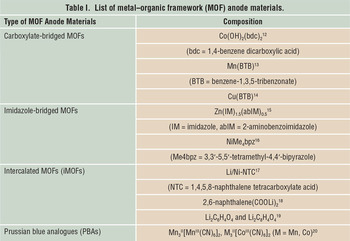
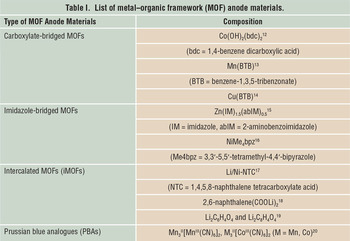
All other MOF-based anode materials adopt the second scheme, the ion intercalation scheme, in which the alkali-metal ions are inserted into the framework as in the case of graphite. Various MOFs have been investigated for this; see Table I . Reference Gou, Hao, Shi, Ma, Fan, Xu, Li and Wang12–Reference Nie, Shen, Luo, Ding, Xu, Wang and Zhang20
List of metal–organic framework (MOF) anode materials.
Using 2,6-naphthalene-(COOLi)2 as an example, Reference Ogihara, Yasuda, Kishida, Ohsuna, Miyamoto and Ohba18 the lithiation spots in the intercalated MOF (iMOF) are between the layers of stacked naphthalenes and tetrahedral LiO3C clusters formed with the inserted Li ions and surrounding atoms. The advantage of this iMOF is an ultrasmall volume expansion of 0.33% under the lithiated state, which prevents lithiation-induced decomposition of MOF leading to 96% capacity retention after 100 cycles. For carboxylate-linked MOFs and imidazole-linked MOFs, the lithiation positions were generally between the two oxygen atoms of carboxylate groups and the nitrogen atoms on the ligands, respectively. Reference Gou, Hao, Shi, Ma, Fan, Xu, Li and Wang12–Reference An, Wang, Tang, Wang, Zhang and Zheng16 In the case of Prussian blue analogues (PBAs), the metal cations were reduced to an unusual M(I) oxidation state, and the super-reduced scaffolds were stabilized by the strong coordination bond connection of cyanide groups.
We can summarize the approach to synthesizing MOF anode materials as follows. Since it is difficult to predict the electrochemical reactions in the conversion-type scheme, especially under such a high reduction overpotential (∼0.01 V versus Li+/Li), it is more effective to invest effort in preparing MOFs using the intercalation scheme. Among the various MOF anode materials, the carboxylate MOFs and iMOFs exhibited unprecedented high gravimetric capacity (>500 mA h·g–1) with numerous oxygen atoms of multiple carboxylates participating in redox reactions. In contrast, the capacity of imidazole-bridged MOFs and PBAs was significantly lower due to the limited number of redox-active sites.
Although the iMOFs exhibited excellent cyclic stability and rate performance, we should note that the advantage of iMOFs is the extremely small volume expansion after the lithiation, which may not be applicable for larger mobile metal ions. To broaden the applications, nanoporous MOFs with carboxylate linkers would be more competitive as anode materials in sodium- or potassium-ion batteries. In addition, to enhance the cyclic behavior, MOFs with structural robustness are clearly favorable.
Design strategies for cathode materials: Redox-active metal cations
Over the last decade, there has been increasing demand for the development of novel cathode materials with better efficiency and lower cost. In commercial Li-ion batteries, the cathodes possess much lower gravimetric capacities than the anodes (∼150 mA h·g–1 for cathodes versus >300 mA h·g–1 for anodes), and as a result, they become the main weight-determining components in energy-storage devices. Reference Tarascon21 The electrical power (P) of an energy-storage device can be expressed as P = V(dQ/dt), where V is the operation voltage, Q is the capacity, and t is the time, and is generally decided by the reduction potential of the active material. Therefore, a higher reduction potential versus the counter electrode is desirable for the cathode materials.
Conventional cathode materials in Li-ion batteries, such as LiCoO2 (layered), LiMn2O4 (spinel), and LiFePO4 (olivine), exploit the redox event of 3d transition metals and typically provide an output voltage in the range of 3.5–4 V. It seems reasonable that a similar strategy could be adopted using MOFs, since most MOFs contain transition-metal cations or clusters at the junction of networks.
The largest family of zeolitic coordination polymers that have been investigated adopting the previously mentioned strategy is Prussian blue (PB) and PBAs, which are also mentioned in the section on anode materials. In 1988, Kaneko et al. first used the original PB (FeIII 4[FeII(CN]6)3), as an electrode material and assembled a secondary battery. Reference Kaneko and Okada22 The electrochemical reaction consisted of the reduction of Fe(III) cations to Fe(II) at the cathode, with the reverse reaction occurring at the anode. In 1999, Imanishi et al. tested the performance of PB in a Li-ion battery, Reference Imanishi, Morikawa, Kondo, Takeda, Yamamoto, Kinugasa and Yamagishi23 but the battery lost 30% of its capacity in 10 cycles. This capacity fade came from structural decomposition upon Li-ion insertion. Such a phenomenon did not occur with potassium ions. Eftekhari fabricated a potassium-ion battery and found the cell exhibited excellent stability, Reference Eftekhari24 in which the initial capacity decayed by only 12% in 500 cycles.
More recently, scientists began to introduce PBAs for applications of sodium-ion batteries. Cui and co-workers studied the behavior of CuHCF (HCF = hexacyanoferrate) as a cathode, and found an 83% capacity retention after 40,000 cycles, even at a 17C rate (the current rate at which the battery electrode materials will be completely reacted [i.e., 100% electrochemical reactivity in 1/17 h]). Reference Wessells, Huggins and Cui25 Goodenough et al. conducted a systematic study on MHCF (M = Fe, Co, Ni, Mn, Zn) and obtained a flat discharge capacity of >70 mA h·g–1 for these low-cost cathodes. Reference Lu, Wang, Cheng and Goodenough26 To achieve complete cation extraction in the charge step, they replaced the potassium ions with sodium ions and reported two Na x MnFe(CN)6 PBAs: Reference Wang, Lu, Xu, Cheng, Zhang and Goodenough27 NMHFC-1 with x = 1.72 adopted a rhombohedral structure, while NMHFC-2 with x = 1.40 showed a cubic structure. The sodium ions were removed upon the charging of half-cells (cell containing one specific electrode material and electrolyte, enabling independent investigation of the properties of that electrode material) containing these two compounds. As a result, higher initial capacities of 134 mA h·g–1 and 123 mA h·g–1 were achieved for NMHFC-1 and -2, respectively.
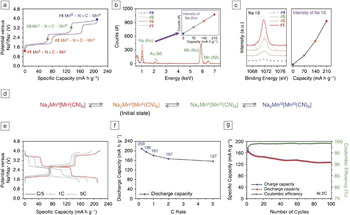
Cui et al. recently reported a sodium-ion intercalated PBA with the formula Na2MnII(MnII[CN]6). Reference Lee, Wang, Pasta, Lee, Liu and Cui28 Three voltage plateaus were observed during the charge and discharge process, at ∼1.8, 2.65, and 3.55 V ( Figure 1a), representing the switch between four different oxidation states: MnII-NC-MnI, MnII-NC-MnII, MnII-NC-MnIII, and MnIII-NC-MnIII (Figure 1d). This multiple valence change resulted in a remarkable capacity of 209 mA h·g–1 at the C/5 rate, and the material also exhibited excellent rate performance and retained a capacity of 157 mA h·g–1 at the 5C rate (Figure 1e–f). These examples demonstrate that PBAs are promising cathode materials with reasonable energy density, exceptional stability, and satisfactory performance at a high current rate.
(a) Charge/discharge profile of MnHCMn at C/5, which illustrates the stepwise valence change of the Mn species in the electrode material. (b) Energy dispersive spectroscopy and (c) x-ray photoelectron spectroscopy data of MnHCMn at different oxidation states. The inset of (b) and the right part of (c) indicate an increase in Na-ion intensity upon discharge, which confirms the Na-ion insertion process. (d) Summarized scheme of the electrochemical reactions. (e) Rate-dependent charge/discharge profile and (f) capacity, suggesting small fade-in discharge capacity at higher C rates and an outstanding rate-dependent performance. (g) The cyclic performance of MnHCMn at 2C, which shows its high stability during the electrochemical reactions. Reprinted with permission from Reference Reference Lee, Wang, Pasta, Lee, Liu and Cui28. © 2014 American Chemical Society.

In addition to the studies on PBAs, utilization of the redox activity of metal cations in conventional carboxylate-bridged MOFs have also been examined. Férey and Tarascon first examined the performance of MIL-53(Fe) ([FeIII(OH)0.8F0.2(bdc)]·H2O; MIL = Materials Institut Lavoisier) as the cathode of a lithium battery. Reference Férey, Millange, Morcrette, Serre, Doublet, Grenèche and Tarascon29 Similar to PB, the Fe(III) species were partially reduced to Fe(II) upon the Li-ion insertion and discharge, while only 0.6 Li+ could be introduced per formula (i.e., for the given MOF formula, one equivalent of the MOF will accept 0.6 equivalent of Li ions) without irreversible electrochemical events. This fact led to a relatively low capacity of 75 mA h·g–1. Doublet and co-workers Reference Combelles, Ben Yahia, Pedesseau and Doublet30 conducted a follow-up theoretical study that provided the reason: with a certain amount of Li ion inserted, the electron localized (Li0.5FeIII 0.5FeII 0.5[OH]0.8F0.2[bdc]) mixed-valence state was stabilized with a distortion of the FeO6 octahedral coordination sphere. In this case, several types of Li-ion insertion sites could not be reached by Li ions at the same time. The same issue was observed for the electrochemical behavior of MIL-101(Fe), confirmed by an in operando EXAFS (extended x-ray absorption fine structure) study. Reference Shin, Kim, Cirera, Chen, Halder, Yersak, Paesani, Cohen and Meng31 The MIL-101(Fe) could adsorb ∼0.65 Li ions per formula in the initial cycle, but this number was degraded to 0.35 after five cycles.
Another MOF cathode material that utilizes the FeIII/FeII redox pair is MIL-68, but in this case, the number of accommodated Li ions is even smaller—0.35 per formula. Reference Fateeva, Horcajada, Devic, Serre, Marrot, Grenèche, Morcrette, Tarascon, Maurin and Férey32 The reason for this degradation in behavior may involve the different shapes of the pores—triangular/hexagonal for MIL-68 versus uniform tetragonal for MIL-53. In short, based on the redox event of transition metals, MOF-based cathode materials could be prepared with good rate performance and cyclic stability, yet the weight-based capacity and energy density would be significantly lower than those of commercially available materials. This issue is apparently caused by redox innocent (no redox activity) bridging ligands, which only contribute to the molar weight, but not the electron uptake.
Design strategies for cathode materials: New electrochemical mechanisms
Since redox-innocent ligands decrease the gravimetric capacity, a simple approach to improve the electron uptake number is to involve the ligands in the electrochemical process. Toward synthetic design, the preliminary work on redox-active polymer cathode materials could provide inspiration for preparing coordination polymers by incorporating similar functional groups with reversible electrochemical events on the bridging ligands. Reference Suga, Ohshiro, Sugita, Oyaizu and Nishide33 Ditchel et al. provided an example with a β-ketoenamine-linked covalent organic framework (COF) with functionalized anthraquinone as linkers. Reference DeBlase, Silberstein, Truong, Abruña and Dichtel34 This COF was utilized as a pseudocapacitive material, and it exhibited excellent reversibility over 5000 cycles.
Nevertheless, even if the ligand is designed as a derivative of an electrochemically active molecule, reversible redox activity may not be fully attained because of the interactions between the metal and ligands. Férey et al. Reference Nguyen, Demir-Cakan, Devic, Morcrette, Ahnfeldt, Auban-Senzier, Stock, Goncalves, Filinchuk, Tarascon and Férey35 prepared an example of MOFs based on tetrathiafuvalene-tetracarboxylate (TTF-TC) ligand. Although the TTF molecule is known for its reversible two-step oxidation, only the first step that oxidizes TTF-TC to TTF-TC+ was achieved reversibly for this ligand, as the decarboxylation was involved in the second oxidation step. For the alkali metal-based coordination polymers M2(TTF-TC)H2 (M = K, Rb, Cs), the galvanostatic charge–discharge experiment suggested a reversible 0.6 e – insertion for one ligand.
We next consider 3d transition-metal coordination polymers {(M[H2O]4)2(TTF-TC)}·4H2O (M = Ni, Co). Although all electrochemical events, including the reduction of M(II) to M(I) and two-step oxidation of TTF appeared to be reversible in cyclic voltammetry, the Ni-containing polymer exhibited only 0.25 e – insertion per TTF ligand within the same electrochemical window for testing K2(TTF-TC)H2. Reference Nguyen, Devic, Mialane, Rivière, Sonnauer, Stock, Demir-Cakan, Morcrette, Livage, Marrot, Tarascon and Férey36 It is proposed that the low capacity was likely caused by the strong interactions between the divalent cations and carboxylates, which prevented the exchange between M+ and Li+ that occurs in alkali–metal-based polymers. As mentioned earlier, a rationally designed architecture should take the properties of secondary building units, functionalized ligands, and the metal–ligand interactions into consideration.
Our group carried out the first attempt from this perspective by introducing carboxylate groups on anthraquinone molecules and preparing a Cu(II)-based MOF with the formula {Cu(2,7-AQDC)} (AQDC = anthraquinone dicarboxylates). Reference Zhang, Yoshikawa and Awaga37 In the solid-state electrochemistry process of this MOF, we observed a fully reversible cyclic voltammetry with two groups of peaks within the voltage window of 4.0–2.0 V. When the voltage range was expanded to 4.0–1.7 V, these redox events weakened with increasing cycle number. An in situ x-ray absorption near-edge structure (XANES) spectroscopy experiment suggested that the reduction peak at a high voltage represented a stepwise reduction of Cu2(OAc)4 subunits, where the valence of the copper–dimer varied from the Cu (II, II) to the Cu (II, I) state and finally arrived at the Cu (I, I) state. From the charge–discharge performance, we realized that even if the reductions of both copper and quinone were reversible, the charge process was unable to remove the numerous adsorbed Li ions from the framework. This was due to the low ionic conductivity of the MOF material when the cell was discharged to a lower voltage and three Li ions were inserted per formula. We thus observed an initial cell capacity of ∼147 mA h·g–1, which rapidly dropped to ∼105 mA h·g–1 in 10 cycles and remained around this value over the next 40 cycles. Despite the capacity fade, this is the first report of a MOF with multiple redox sites on both metal cations and functionalized ligands. Reference Zhang, Yoshikawa and Awaga37 The total number of electrons that were adsorbed by multiple electron-accepting sites promoted the total gravimetric capacity and hence a MOF-cathode material with larger energy density.
Low-electronic conductivity was indeed the primary issue for MOF-based electrode materials, and this could not be easily solved, since the preparation of a conducting MOF is itself challenging. Regarding the ionic conductivity, a few preliminary studies indicated that MOFs with high Li-ion conductivity could be achieved, yet the tert-BuOLi treatment that significantly improved the ionic diffusion rate of MOFs was not universal and not applicable in the presence of an ethylene carbonate-based electrolyte. Reference Wiers, Foo, Balsara and Long5
Accordingly, an innovative approach is to adopt an alternate scheme of electrochemical reactions in the operation process of batteries. Such an approach was first used for a cathode material of sodium-ion batteries, CaFeO z (2.5 ≤ z ≤ 3). Reference Hibino, Harimoto, Ogasawara, Kido, Sugahara, Kudo, Tochigi, Shibata, Ikuhara and Mizuno38 Whereas Li ions are inserted in traditional cathode materials, in CaFeO z , oxygen atoms were extracted from the framework upon discharge and reinserted in the charging step. This mechanism took advantage of the much faster movement of oxygen atoms and avoided the slow Na-ion diffusion speed in the cathode material. This mechanism was designated the “dual-ion” mechanism, as both Na ions and O2– are mobile in the batteries.
The same concept could also be adopted by MOFs. Long et al. applied this “dual-ion” mechanism to Fe2(dopbdc) (dobpdc4− = 4,4′-dioxidobiphenyl-3,3′-dicarboxylate). Reference Aubrey and Long39 They found that both Fe(II) cations and ligands could be oxidized, while only the former were reversible. Meanwhile, the framework captured electrolyte anions to balance the extra positive charge in the charged state. These anions were subsequently released in the discharge step, and hence the MOF may act as the cathode of a chemical battery. Some intriguing phenomena have been observed, such as an ultrahigh initial open-circuit voltage strong anion dependence of the cell voltage, and a linear potential drop with the reduction process. These are clearly the ionic diffusion characteristics in MOF materials. This fully reversible anion insertion in Fe2(dopbdc) led to a Na-ion half-cell with a decent 90 mA h·g–1 capacity and 316 kW/kg energy density in 50 cycles at a C/20 rate.
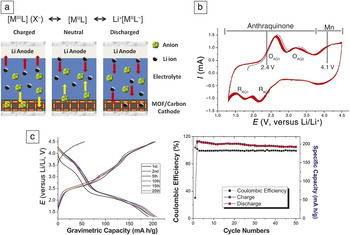
Our group also independently reported a new redox-active MOF with the formula MnII 7(2,7-AQDC)6(2,6-AQDC)(DMA)6, Reference Zhang, Yoshikawa and Awaga40 (DMA = N, N-dimethylacetamide). Subsequently, we discovered an even more complicated mechanism in this MOF-based battery and named it the “bipolar charging” mechanism. Since the initial OCV of the cell was ∼3.2 V, the Mn(II) species was oxidized to Mn(III) while the cell was charged to 4.5 V, and the PF6 – from the electrolyte was inserted into the structure. In the discharge process, anions were first released, followed by a reduction of the anthraquinone groups and the intercalation of Li ions ( Figure 2a–b). A total gravimetric capacity of 190 mA h·g–1 was achieved by combining the contribution of two individual redox events (Figure 2c). Compared with the “dual-ion” mechanism, this new scheme involved not only the movement, but also the insertion of both anions and Li ions into the cathode material. The critical point of this scheme was that it achieved a less crowded trafficking of ions during the diffusion in the solid-state material. Only one-third equivalent anions and two-thirds equivalent Li ions needed to be transported for a certain amount of electron uptake.
(a) The scheme of a “bipolar charging mechanism” showing the involvement of both Li ions and anions. (b) Twenty cycles of cyclic voltammetry with the redox events of Mn(AQDC) metal–organic framework (MOF) labeled as RAQ1 and RAQ2 for reduction and OAQ1 and OAQ2 for oxidation. A small decrease in current intensity suggests highly reversible electrochemical events. (c) Discharge profile and cyclic performance of a Mn(AQDC)-based battery, which illustrates a high gravimetric capacity of 200 mA h/g and small capacity drop over 50 cycles. Reference Zhang, Yoshikawa and Awaga40 Note: M, metal; L, ligand; X, electrolyte anion; AQ anthraquinone; AQDC, anthraquinone dicarboxylate; E, potential; I, current.

Interestingly, in the rate-performance test, the capacity deduction ratio of two steps at a higher rate was similar, which suggested that the diffusion speed of bulky PF6 – was comparable with Li ions in the MOF. These two instances perfectly illustrate the special behaviors that can be achieved by these novel electrochemical schemes and will significantly encourage the development of redox MOFs containing electron-donating components. In addition, the anion-dependent performance of these MOFs is expected to inspire the development of unconventional electrolytes and to lead to revolutionary battery architectures with high valent mobile cations, such as Mg Reference Mizuno, Okubo, Hosono, Kudo, Oh-ishi, Okazawa, Kojima, Kurono, Nishimura and Yamada41 and Al batteries. Reference Lin, Gong, Lu, Wu, Wang, Guan, Angell, Chen, Yang, Hwang and Dai42
Summary and future perspectives
Thirty years have passed since the invention of the first model of modern Li-ion batteries. Although the manufacturing technologies in this sector have matured, only limited improvements have been realized for the performance of portable cells. Reference Armand and Tarascon43 As a family of multifunctional porous materials, the population of MOFs is growing rapidly and its field of applications are being significantly extended. As promising energy-storage materials, MOFs are exciting research subjects due to their potential applications in electronic energy-storage systems with low carbon emissions and high sustainability. Compared with conventional electrode materials, MOFs are complex and expensive to prepare, and thus few MOF materials are industrially competitive. However, the future of MOFs is not simply as a substitute for current materials.
With their tunable functional groups, pore size, and topology, specific redox-active MOFs could allow the adoption of uncommon electrochemical mechanisms or schemes. Such new mechanisms could yield unusual physical phenomena and thereby resolve some long-standing issues encountered by conventional batteries. Therefore, with alternative schemes of electrochemical reactions, the future of MOF-based electrode materials falls on the creation of new battery architectures.
The versatility of MOF materials may provide the capability to accommodate various electrolytes, allowing MOFs to play a role as the electrode materials in sodium-ion batteries, potassium-ion batteries, Mg batteries, Al batteries, anion-insertion batteries, pseudocapacitors, and multi-ion batteries. These new models of batteries could be transformative in terms of energy-storage density, lifespan, production cost, and environmental impact. In summation, by reviewing MOF-based anode and cathode materials, we organized the attempted approaches toward the development of high-performance battery electrodes and summarized the strategies by analyzing the electrochemical mechanisms and behaviors of these MOF materials. New combinations of ligands, metal cations, and connectivity should be realized in the future development of new MOFs, and practical batteries may be achieved by selecting suitable battery structures.
Acknowledgments
We acknowledge financial support from a Grant-in-Aid for Scientific Research from the Ministry of Education, Culture, Sports, Science, and Technology on our study of MOF-based battery electrode materials. This work is also supported by the JSPS Core-to-Core Program A, Advanced Research Networks.

Zhongyue Zhang joined Nagoya University in 2013 as a postdoctoral researcher, and was promoted to assistant professor in 2015. He received his BS degree from Peking University in 2011, and his PhD degree from Texas A&M University, focusing on the development of charge-transfer coordination complex conductors. His current research interests include molecule-based porous electrode materials. Zhang can be reached by phone at +81-52-789-5106 or by email at zhang.zhongyue@i.mbox.nagoya-u.ac.jp.

Kunio Awaga has been the Director of the Research Center for Materials Science at Nagoya University since 2013. He received his DSc degree from The University of Tokyo in 1983. In 1988, he was a research associate at the Institute for Molecular Science. In 1992, he returned to The University of Tokyo as an associate professor in the Department of Pure and Applied Sciences, and moved to Nagoya University as a professor in the Department of Chemistry in 2001. His research interests include solid-state proprieties of organic radicals, organic electronics/spintronics based on novel operation principles, and solid-state electrochemistry and materials science in molecule-based batteries. Awaga can be reached by phone at +81-52-789-2487 or by email at awaga@mbox.chem.nagoya-u.ac.jp.