Oral secretions may protect an insect from predators and parasitoids (Eisner et al. Reference Eisner, Johnessee, Carrel, Hendry and Meinwald1974) or contain epideictic pheromones (Prokopy Reference Prokopy, Nordlund, Jones and Lewis1981) to repel competitors from overcrowded resources (Corbet Reference Corbet1971). Larvae of spruce and western spruce budworms, Choristoneura fumiferana (Clemens) and C. occidentalis Freeman (Lepidoptera: Tortricidae), produce oral secretions that repel conspecific larvae in the field (L.M. Poirier, personal observation) and in the laboratory on foliage and artificial diet (Poirier and Borden Reference Poirier and Borden1995). Larvae of both species avoided feeding stations treated with con- and hetero-specific secretions in a dose-dependent manner (Poirier and Borden Reference Poirier and Borden1996, Reference Poirier and Borden2001). Larvae reared on artificial diet responded to secretions from diet- and foliage-reared larvae; foliage-reared larvae responded only to secretions from other foliage-reared larvae (Poirier and Borden Reference Poirier and Borden2000).
Poirier and Borden (Reference Poirier and Borden2001) speculated about the bioactive components in the larval oral secretions but did not determine the chemical nature of the repellent substance. Repellency is strongly influenced by larval rearing medium (Poirier and Borden Reference Poirier and Borden2000) and is probably associated with one or more dietary components. Others have found that diet influences various oral secretions (e.g., Merkx-Jacques and Bede Reference Merkx-Jacques and Bede2004; Babic et al. 2008). We tested this hypothesis for C. occidentalis larvae reared on artificial diet, from which single components could be separated.
Laboratory-reared C. occidentalis were obtained from the Canadian Forest Service laboratory colonies (Sault Ste. Marie, Ontario) maintained at high population densities. All insects were reared in the laboratory on agar-based artificial spruce budworm diet (Bio-Serv Inc., Frenchtown, New Jersey) in 30 mL disposable vials (two per vial, approximately 24°C, 60% RH, photoperiod 16L:8D). The proportions of the ingredients used were based on similar artificial diets for spruce budworm larvae (McMorran Reference McMorran1965; Grisdale and Wilson Reference Grisdale and Wilson1991). From the manufacturer's list of ingredients, casein, linseed oil, and wheat germ were chosen for testing.
Five diets were prepared: one standard artificial diet, one diet of agar only, and three diets of agar supplemented with either casein, linseed oil, or wheat germ in the same proportions as the complete artificial diet (3.5%, 0.5%, and 3.0%, respectively). Third- to fifth-instar larvae reared on artificial diet were placed on the media and allowed to feed for at least 2 days. Using 5 μL micropipettes (Poirier and Borden Reference Poirier and Borden1996), oral secretions were collected from larvae fed on each of these five media.
Bioassay chambers (Poirier and Borden Reference Poirier and Borden1996) contained a pair of noninverted diet stations spaced with their centres 3 cm apart. In experiment 1, one station in each chamber was treated with either distilled water (control) or 2 μL of oral secretions (Poirier and Borden Reference Poirier and Borden1996) from larvae fed one of the five diets; the second station was left untreated. One third- to fifth- instar, randomized with respect to age, was placed in the centre of each bioassay chamber and left undisturbed for 24 h; test larvae were taken from the main laboratory colony that had fed on complete artificial diet only. Twenty chambers were assessed for each treatment. After 24 h, stations were checked for signs of feeding or establishment (e.g., feeding cavities or silk feeding tunnels). Larvae that did not establish on a feeding station were included, unless they had molted or pupated over the 24 h period. Evidence of feeding or establishment on both stations in a single chamber was never observed; thus, larvae were categorized as not feeding, feeding on the untreated station, or feeding on the treated station.
In experiment 2, one diet station in each chamber was treated with 2 μL of either distilled water, a 0.5% or 1.0% shaken suspension of raw linseed oil in distilled water, or 100% raw linseed oil; the second diet station in each dish was untreated. Larvae were selected and tested, and 20 chambers were assessed for each treatment, as in the first experiment.
For both experiments, numbers of larvae in the three categories were compared between experimental and control (distilled water) chambers using Fisher's exact test for a 2 × 3 contingency table, ∞ = 0.05 (Mehta and Patel Reference Mehta and Patel1983; Schlotzhauer and Littell Reference Schlotzhauer and Littell1987).
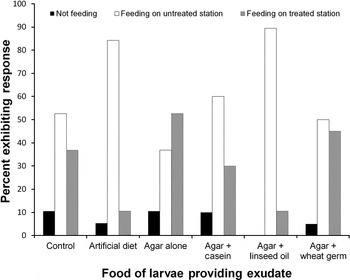
In experiment 1, larvae preferentially established on untreated stations when placed in chambers with stations treated with secretions from larvae reared on artificial diet (P = 0.025) or secretions from larvae fed on a diet of agar and linseed oil (P = 0.036; Fig. 1). Larvae placed in control chambers and in chambers with stations treated with secretions from insects fed on agar alone, agar with casein, or agar with wheat germ fed on the diet stations randomly (P > 0.05).

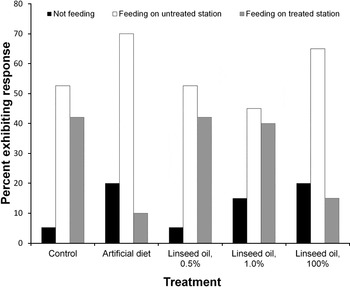
As expected, larvae in experiment 2 avoided diet stations treated with secretions from larvae reared on artificial diet (P = 0.031, Fig. 2). Low linseed oil concentrations (0.5% or 1.0%) had no effect on feeding or establishment distribution. Higher concentrations of linseed oil (100%) appeared repellent (P = 0.043), but large quantities of silk were present around almost every treated diet station and the oily surface appeared to deter the larvae.

Both experiments suggested that repellency of oral secretions from larvae reared on artificial diet is associated with raw linseed oil in the diet, but that the oil itself is not repellent at the concentrations in the diet (Fig. 1). Although 2 μL of 100% raw linseed oil did appear repellent (Fig. 2), the larvae may have been deterred by the physical characteristics of the oil rather than by its chemical constituents.
Linseed oil is an important component of the artificial diet; when linolenic acid is absent from lepidopteran diets, larvae do not complete pupal development properly (Dadd Reference Dadd, Kerkut and Gilbert1985). Linseed oil consists of glycerides of several fatty acids, including linolenic (55%), linoleic (17%), oleic (13%), palmitic (9%), stearic (5%), and myristic (1%) acids (Gunstone Reference Gunstone1958). Fatty acids are important in lepidopteran chemical communication systems (e.g., Xu et al. Reference Xu, Li, Liu and Xing2006; Guo and Li Reference Guo and Li2009) and linolenic acid is a component of volicitin (Alborn et al. Reference Alborn, Jones, Stenhagen and Tumlinson2000). Because recently ingested foregut contents are as repellent as the oral secretions (Poirier and Borden Reference Poirier and Borden2001), larvae are probably responding to a newly released free fatty acid or a relatively simple metabolite. The differences in bioactivity between secretions from diet-reared and foliage-reared larvae (Poirier and Borden Reference Poirier and Borden2000) could be explained by differences in the relative amounts of fatty acids in the diet or the presence of additional compounds in the secretions of foliage-reared larvae.
This research, conducted in 1995, was supported in part by the Natural Sciences and Engineering Research Council of Canada, the Canadian Forest Service, Phero Tech Inc., the Coast Forest and Lumber Sector, the Cariboo Lumber Manufacturers Association, the Interior Lumber Manufacturers Assocication, Canadian Forest Products Ltd., International Forest Products Ltd., Northwood Pulp and Timber Ltd., TimberWest Ltd., Tolko Industries Ltd., Western Forest Products Ltd., and Weyerhaeuser Canada Ltd. The authors are grateful to G.J.R. Judd, K.N. Slessor, and A.S. Harestad for their advice and support and for review of an earlier version of the manuscript.