Turkey's recent referendum is the third, but arguably the most substantial, change to its constitution since the country's ruling Justice and Development Party (Adalet Kalkınma Partisi, or AKP) and its leader Recep Tayyip Erdoğan came to power in 2002. The inclusion of voters in the referendum process seemingly justified and legitimized the democratic nature of the changes for the party. However, almost two centuries after the emergence of universal suffrage as a political ideal, the implications of some critical democratic processes, such as plebiscites, continue to be a contentious matter. Turkey is not an exception. The number of nationwide referendums held since the turn of the twentieth century exceeds a total of three hundred and is likely to increase further.Footnote 1 Increasing use of referendums by populist groups (a category Turkey's ruling party falls under) expands such groups' claim to represent the people as opposed to the “others” who speak for particular interests while the anti-populist groups face accusations of elitism and disrespecting the general will. While the prudence of the elected few with respect to that of the masses might be equally questionable, yet, a decision taken by a majority of the popular vote lacks accountability and the leaders can utilize direct democracy to monopolize the public sphere. Dubbed as the democratic paradox, making legislation by including the voters directly does not necessarily empower the people in general. On the contrary, a referendum might easily deteriorate into a strategy to surpass the parliamentary opposition and suppress critical voices.Footnote 2
The recent Turkish referendum was held amidst various concerns ranging from the convenience of a new constitutional agenda introduced under a state of emergency to the potential repercussions of the referendum on the political system and to its polarizing effects in general. Although polarization and conflict are nothing new, the 2017 referendum proved to have more unpredictable aspects than were previously assumed. The opposition mobilized an unprecedented number of people compared to previous elections and referendums, and the amendments passed with a very slim majority. This article is a rejoinder to the few existing analyses of these events and aims to scrutinize further what we know and indeed what we still do not know about the 2017 referendum. In particular, it addresses why the referendum was held in 2017 rather than earlier; whether it is empirically meaningful to analyze the outcome given the irregularities; how different the voters of both camps were from each other; how the parties framed the referendum to mobilize their supporters; and the impact of referendums held in polarized systems.
Question #1: Why Did Turkey Hold A Referendum for the Constitutional Amendments in 2017?
Since its inception in 2001, the AKP has characterized itself as the party of people invested in sustaining Turkey and its development. These ideas appear both in the party's name and in each and every election manifesto since 2002.Footnote 3 The amalgamation of progressive goals (i.e., increasing the power of civilians), normalization, and democratization formed the basis for the two earlier referendums,Footnote 4 which aimed to strengthen the position of the presidency vis-à-vis the military and bureaucracy as the existing constitution was imposed by the military. The packages of the 2007 and 2010 referendums were limited in content, however, they set the stage for a full-scale constitutional change. The party campaign denoted the constitution in effect as one prepared and imposed by the military establishment.Footnote 5 The AKP's sweeping victory in the 2011 elections boosted preparations for a new constitution; Erdoğan had promised that a new constitution would be drafted after the elections.Footnote 6 Nevertheless, it took seven years for the AKP to introduce a large-scale amendments package and hold a new referendum.
The Turkish military's relative strength in the past might be considered as a potential explanation for the referendum's deferral, however, neither the purge of the top military elite through the Ergenekon and Balyoz court cases,Footnote 7 which were proved to be based on fabricated evidence, nor the legal reforms curtailing the privileged position of the army in politics led to a coup attempt in the period from 2010 to 2017.Footnote 8 By the end of 2013, the power of the National Security Council and the jurisdiction of the military courts dwindled substantially through a series of reforms begun in 2003.Footnote 9 Considering the successful demilitarization (i.e., the situations where the military establishment's official powers dwindle, but the government tries to further militarization with a new formation), it is hard to attribute the timing of the referendum and the nature of its proposed amendments to any anxiety concerning the reaction of the army.
If the delay cannot be explained via possible military responses, another proposed reason might be the difficulty in securing the support of the other parliamentary parties. Although Turkish parties are notorious for avoiding compromise and agreement in general, they have been in unison about the 1982 constitution lacking popular legitimacy and creating problems rather than providing solutions. Their disagreements remained limited to certain articles rather than to the need for revisions in the constitution as a whole. Thus, a general accord concerning constitutional revisions led to eighteen successful amendments two of which were taken to the voters previously under AKP rule in 2007 and 2010. It is therefore possible to argue that neither civil–military relations nor parliamentary opposition delayed the introduction of the referendum to 2017. Instead, it seems that the AKP waited for more conducive conditions to convince the voters of the necessity of a presidential system.
Question #2: Did the Voters Favor the Presidential System?
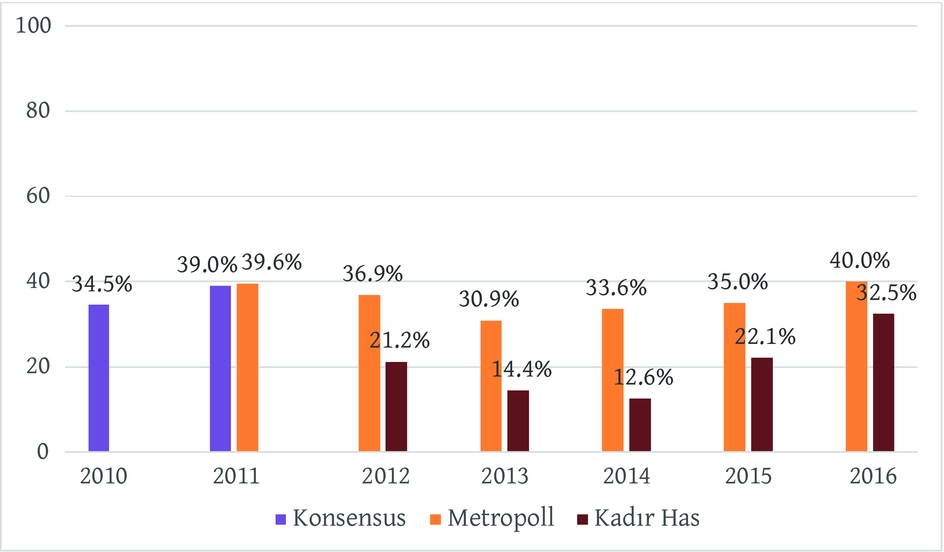
Public opinion polls indeed support the argument that the AKP felt the need to persuade the voters that adopting a presidential system was imperative given the conditions. Existing research on the support for presidentialism converge to suggest that affirmative support remained quite low until 2016. According to two different polling companies, Metropoll and Konda, this score did not increase above 30 percent until the year before the referendum.Footnote 10 Regular surveys conducted by the Kadir Has University give different levels of support for the earlier years; but concur that the level hovered at about 30 percent in 2016.Footnote 11 However, estimates closer to the referendum date indicate that support had increased to 46.9 percent.Footnote 12
These shifting numbers suggest that the AKP's concern for the low level of support for the presidential system in Turkey might be linked to its decision to defer a large-scale constitutional amendment that included a transition to the presidential system. If this is indeed the case, then it becomes more difficult to explain how the support for presidentialism increased to 51.4 percent in April 2017. Either the alleged irregularities in the 2017 vote itself account for the affirmative outcome or the “Yes” camp convinced the electorate. In the next section, we analyze the existing answers to these two questions.
Procedural Irregularities of the 2017 Referendum
We need to clarify the effect of the suggested procedural irregularities during the referendum vote before we focus on voter behavior, as otherwise any analysis will be spurious. Two sets of major criticisms emerged concerning irregularities. One addressed the content of the amendment package and the circumstances under which the referendum was held, and the second focused on the abnormalities or malpractices that occurred during the voting itself.
Aside from a lack of effective checks and balances on the executive power, the Venice Commission (European Commission for Democracy) and the Office for Democratic Institutions and Human Rights (OSCE/ODIHR) both criticized the uneven conditions of campaign.Footnote 13 A report prepared by the OSCE emphasized the negative effect of the state of emergency and the decrees adopted during the referendum process, which made radical changes to election-related laws and gave enormous powers to local administrators.Footnote 14 The report added that the media landscape was dominated by state-owned agencies and private organizations owned by business groups dependent on the government.Footnote 15 Apart from the “non-pluralist” environment of the state of emergency, the OSCE observers also presented some factual evidence about alleged malpractices such as the facts that the Ballot Board Council (BBC) chairpersons were not allocated fairly between the government and opposition parties,Footnote 16 and voters, especially in the Southeastern regions, could not be registered. This was mainly due to internal displacement, the report cited a figure between 355,000 and 500,000, or because voters had to cast their ballots in the special security zones established in the region (670,000 voters were required to do so).Footnote 17
The “No” camp led by the Republican People's Party (Cumhuriyet Halk Partisi/CHP) declared the referendum illegitimate and fraudulent due to the contentious decision of the Supreme Board of Elections (SBE) to declare unstamped ballots as valid.Footnote 18 The CHP further released a report of abnormalities that occurred at the ballot-box level.Footnote 19 According to the report, in 960 ballot boxes (94,585 votes), all voters voted “Yes,” and the majority of these boxes are located in the northern and southern parts of Eastern Anatolia. In many ballot boxes, participation rates seem to be 100 percent or higher, and they too are located in the same region.Footnote 20 Analyses based on the referendum results also identify unconventional patterns,Footnote 21 though with a low magnitude, especially in small polling stations (the basic unit of elections in Turkey) and certain provinces.Footnote 22 Observational reports and preliminary analyses thus suggest that the campaign period led to unfair conditions and that there were irregularities pertaining to the SBE decisions such as the behavior of local administrators and internal displacement due to the conflict in the southeast region. Yet, the empirical evidence is not enough to adequately determine the magnitude of the effect of these irregularities and whether they actually changed the referendum outcome. As such, we should focus instead on exploring the other question: how did the support for presidentialism increase?
Question #3: Who Said “Yes” and Who Said “No” in 2017?
Despite the complexity of the proposed eighteen amendments, the choice offered in the referendum was defined as “Yes/No” with “Yes” indicating an acceptance of the proposed amendments and “No” representing an objection to all proposals. The post-referendum surveys demonstrate that conventional indicators differentiated the two camps; higher education and income levels increased the possibility of an outright rejection of the referendum.Footnote 23 In addition to the role played by demographic and socioeconomic differences, religious voters overwhelmingly supported the proposal, whereas the support of groups such as the Kurds or Alevis for the amendments was very low.Footnote 24 However, both reports, prepared on the basis of surveys held in the post-referendum period, establish that the voters cast ballots along partisan lines. According to these reports, more than 90 percent of AKP voters and nearly 30 percent of the Nationalist Movement Party (Milliyetçi Hareket Partisi, or MHP) supporters chose “Yes,” reflecting the factional splits in MHP unlike other parties. However, approximately 95 percent of CHP and 90 percent of HDP voters preferred “No.” A more detailed research account that relied on panel data collected before the referendum also confirms an initially low level of support for presidentialism and thus the success of the AKP and MHP in mobilizing “Yes” voters.Footnote 25 In addition, Aytaç, Çarkoğlu and Yıldırım argue that the public did not have a high enough level of information about the proposed amendments to make their own determinations and thus partisan cues compensated for this lack of understanding.Footnote 26 So, how did AKP and MHP convince the substantial part of their electorate to prefer partisan lines and leave behind their earlier skepticism about the presidential system?
Studies on the referendums and the elections indicate that issue-based voting might not overlap with voter preferences in the general elections. We might expect voter support for a given political party in the latest elections to transfer at similar levels to ballots counted in a referendum only if: the voters are reasonably familiar with the issues at hand; the party follows clear ideological lines and conveys its motives clearly; and/or the conventional alignments of the political parties have been stable for a long time.Footnote 27 When the voters are not familiar with the issues or not yet convinced of their party's motives, framing the issue as a partisan conflict might close the gap between electoral- and issue-based voting.Footnote 28
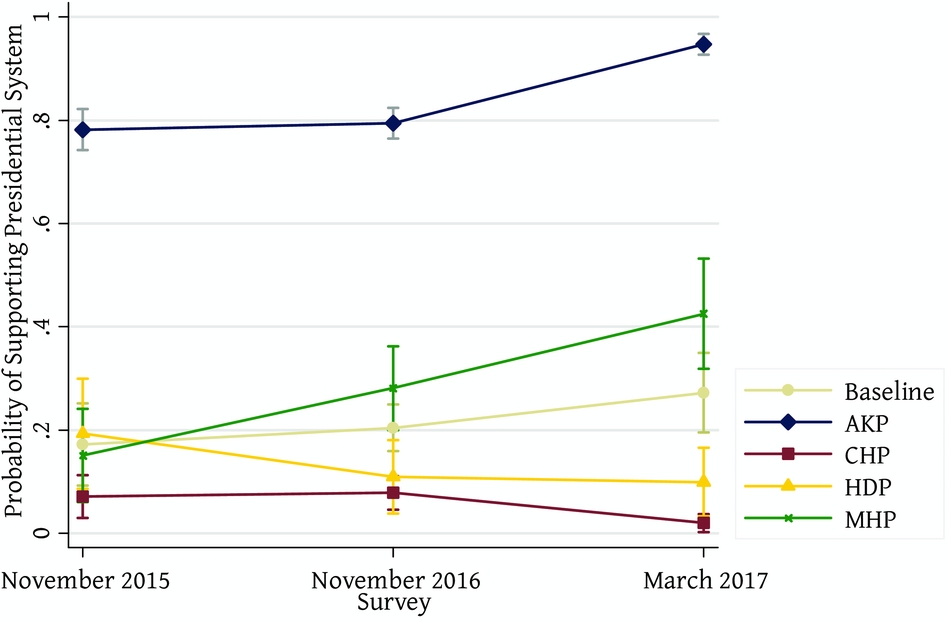
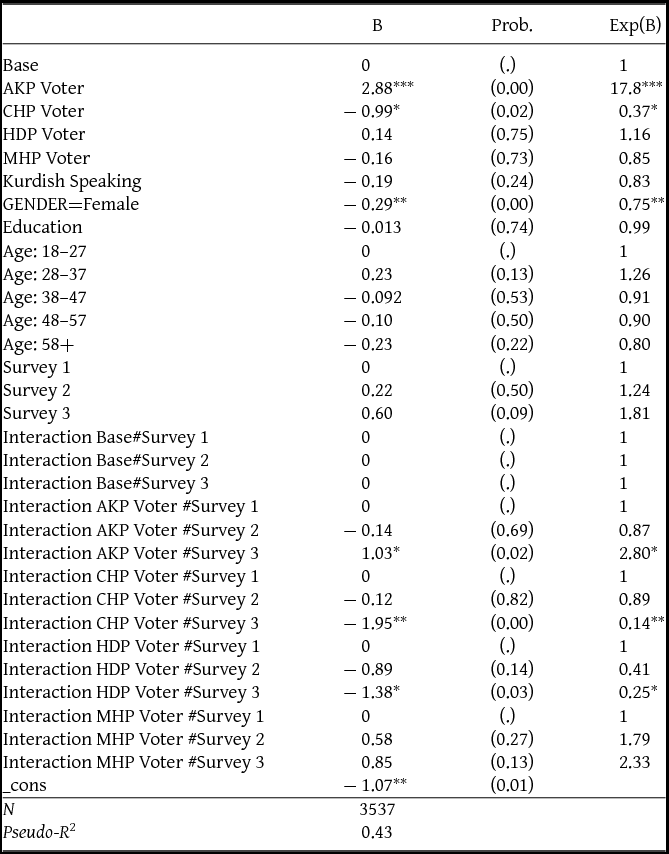
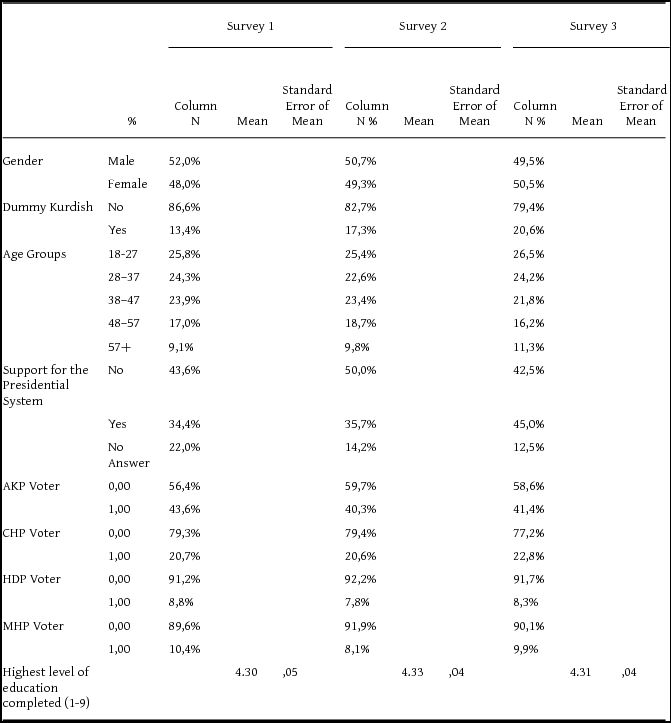
We analyzed three further surveys to assess if and how voters’ decisions to support or not to support the referendum was affected by party preference using party preferences of voters as independent variables in addition to the variables of gender, level of education, age, and Kurdish ethnicity.Footnote 29 In all surveys, the most important factor determining support for the constitutional amendments and thus to a presidential system was the stated party preference of the respondents [Figure 1]. These analyses indicate (throughout the campaign) that the partisan gap widened along with polarization of the political rhetoric. By March 2017, the propensity of voting in support of presidentialism was forty-nine times higher for an AKP voter compared to unaffiliated voters (those who do not affiliate themselves with any party, baseline category). The negative tendency of the CHP voters even increased in time compared to the baseline (i.e., unaffiliated voter) category. In other words, being affiliated with a party made the real difference. The impact of partisan polarization also became more visible with the other parties in various forms, e.g., aligning themselves with the ruling party and increasing their internal divisions. Propensity of an MHP voter is two times higher, putting them in the “Yes” camp, another indicator of the realignment in the party system.
Support for the presidential system from 2010–2016.

The graph in Figure 2 presents data on how the effect of party identification increased over time, capturing the effect of polarization in general. As presented above, the support of the AKP constituency increased overtime whereas the MHP constituency became more affirmative between November 2015 and March 2017 (right before the referendum), with a steady change in position. On the opposition side, there was little change in the CHP constituency—their voting members consistently rejected the amendments. The HDP voters became significantly more critical of the amendments towards the end of the campaign. This differentiation clearly shows that the campaign period ended with increased polarization on a critical issue of the referendum.
Predictive margins of party choice over three waves of surveys.Footnote 30

Our finding is also supported by analysis of vote transitions (i.e., transfer of votes from one block to another) at the macro level using district level results. Analysis of district level ballots show that the majority of “Yes” votes came from the AKP constituency (46 percent–47.8 percent of the valid votes) and partly from the MHP bases. On the other hand, the “No” camp was composed of the CHP (24.5 percent–25.3 percent), the HDP (8.1 percent–9 percent), and the part of the MHP voters (7 percent–9 percent). This macro-level analysis confirms that the polarization is centered around the AKP constituency and the opposition block. In other words, the reason why “Yes” won over “No” despite a continuously low level of support for presidentialism just a year before the referendum might be due to the AKP's strategy of deliberately intensifying polarization on other issues so that the party's electoral base would perceive the referendum as a matter of partisan principle and as an outright election rather than as a decision on one single issue. A significant faction in the MHP defected the party line and joined “No” block indicating the potential of new coalitions.
Question #4: How did the Parties Frame the Referendum?
Did party leadership actually frame the referendum as a perceived presidential election rather than as a mere amendment to the constitution in order to win? The AKP's campaign- and referendum-related booklets focused on the amendments’ function of strengthening the government by eradicating the divisions within executive governance and the judiciary.Footnote 31 It also invoked nationalist and anti-Western sentiments by escalating the outcry over the obstruction of pro-government rallies in European cities, using frequent references to the relation between the referendum and the larger “sacred cause,”Footnote 32 and by vilifying the opposition as a clandestine conspiracy of various terrorist organizations acting in coordination with the opposition parties (CHP and HDP).Footnote 33 The MHP's campaign was even more outspoken than the AKP's. While the AKP's official campaign booklet seemed content with only a few occasional references to the putsch attempt of 2016, the MHP's campaign capitalized by and large on the putsch and presented the constitutional change as a panacea while widening its internal fragmentation, although without explaining how the amendment package would succeed in preventing future coup attempts. Hence, there was heightened emphasis on threats against economic and political stability, and against civilianization and national integrity if the referendum was defeated.
The campaign of the “No” camp also implied that the opposition was aware that the AKP government had been playing on intensive polarization between the voters. The CHP leadership explicitly warned party members to refrain from vilification of the personality of Erdoğan and to focus instead on potential abuse by future presidents. Furthermore, its field campaign avoided using the CHP flag in an attempt to expand the “No” camp into an alliance of democrats.Footnote 34 The party elaborated on the proposed article amendments and emphasized that the proposal lacked adequate checks and balances on executive power thereby laying the groundwork for further authoritarianization.Footnote 35 The HDP, while carefully refraining from adopting the discourse of the CHP, rephrased the party's objection in terms of the amendments’ lack of measures to secure human rights and civil liberties.Footnote 36 Hence, both key opposition parties were aware of the fact that polarization worked in favor of the AKP and tried to form a non-partisan and non-ideological discourse focused on nationwide dangers, civil liberties, and the negative consequences of the package for Turkey's democratization.
Concluding Remarks: Who Won?
Opinion polls held since 2010 reveal that public support for presidentialism was nearly 15 points lower than the actual “Yes” vote's recorded percentage in 2017. International reports establish that disturbances both during the campaign period and on the referendum day created an uneven ground for competition and heightened doubts over the integrity of the voting process. Macro level analyses conducted after the referendum vote revealed some patterns and irregularities, though these were limited to small districts mainly in the areas that were impacted by the national and regional conflicts and displacement. These are the aspects of the referendum that we know and can verify empirically. What we do not know is to what extent the procedural irregularities affected the outcome. If the procedural irregularities affected the results, the impact appears to be limited and accounts for only a small magnitude of the voters according to the existing research. On the other hand, the pre- and post-referendum surveys indicate that the parties of the “Yes” camp, especially the AKP, managed to mobilize its electorate enough around partisan lines in order to secure the majority of the valid (i.e., legally accepted) votes. What we also know is that the “No” camp, especially the CHP, was also able to mobilize its voters to participate in the referendum while trying to refrain from following polarizing rhetoric or partisan politics. In other words, the CHP's mobilization was not about giving a “No” vote, we know that the CHP electorate has been overwhelmingly and consistently against the presidential system. The real success of the party was to convince its supporters to go to the ballot box on the referendum day bringing forth the highest turnout in the history of referendums since 1988. Then, if both Yes and No camps maximized their appeal, they are right to declare a victory while begging the question who lost or what was lost in a referendum in which victory was so slim, compelling us to remember Canovan's democratic paradox.
Appendix
Determinants of the Support for the Presidential System (Logistic Regression Results, Combined Model)

Descriptives of Models Survey 1