One of the more shadowy moments in Lowland Maya history is the beginning of the Early Classic period. Important scholarly volumes devoted to this topic have appeared in each of the last three decades (Braswell Reference Braswell2003a; Grube Reference Grube1995a; Willey and Mathews Reference Willey and Mathews1985). From these, it has become increasingly clear that the Early Classic period began in domino fashion, with one center, Tikal, creating a social vortex through which other Lowland communities passed in staggered succession. The material traits typically ascribed to the Early Classic period—Initial Series stelae, vaulted architecture, roof combs, talud-tablero architecture, cylindrical tripods, green obsidian—are widely distributed across the region but seem to appear first and in greatest quantity at Tikal.
Thus, ample reasons exist to trace the origin of many Early Classic period lifeways to Tikal. For four decades Mayanists have used a.d. 250 to mark the inception of the Early Classic period (Willey et al. Reference Willey, Culbert and Adams1967). This date was arbitrarily established to accommodate Tikal Stela 29, the oldest known Cycle 8 stela, which possesses a Long Count date of a.d. 292. But recent epigraphic and archaeological findings imply that a later sequence of Tikal-centered events beginning in a.d. 378 had a more widespread, if not profound, impact on Lowland Maya society than the era of Tikal's third century rulers. A pivotal event was the arrival of the foreigner Siyaj K'ak from the west on the precise death date of Tikal's reigning lord Chak Tok Ich'aak on January 16, a.d. 378 (Stuart Reference Stuart, Carrasco, Jones and Sessions2000). This latter event ushered in a new cultural order distinguished by the political expansion of a militant junta of native and foreign-born Teotihuacan-inspired leaders who established a power base at Tikal (Martin Reference Martin and Sabloff2003; Martin and Grube Reference Martin and Grube2000). Elements such as fully phoneticized glyphic monuments, dynasticism, and specialized prestige good industries were clearly more prevalent in the central lowlands than elsewhere during the first three centuries a.d. These features spread rapidly to the north, south, east, and west in the late fourth century following the arrival of Siyaj K'ak. It stands to reason that these elements did not become a cultural reality for most lowlanders until the end of that century.
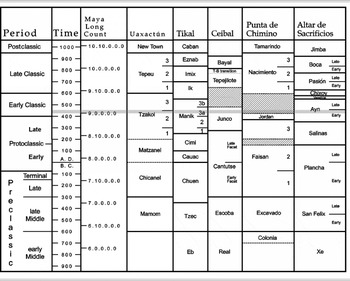
Given this observation, events before a.d. 378 at Tikal and before a.d. 400 in other lowland zones are herein treated as “Protoclassic” in nature. The Protoclassic was a time when Mexican influence was isolated, sporadic, and probably of little social consequence in most sectors of the Maya lowlands. During this time many small and moderately sized Maya communities produced ascendant leaders in an effort to distance themselves from Preclassic megacenters. What emerged was an environment of political atomization and social upheaval—an atmosphere contrasting with earlier centuries of Preclassic period political cohesion (Bachand Reference Bachand2006; Reese-Taylor and Walker Reference Reese-Taylor, Walker, Masson and Freidel2002). Thus, in addressing the onset of the Early Classic period, I refer specifically to Tikal's dynastic expansion, implemented with greatest zeal and regional impact between a.d. 378 and 450, a timespan that corresponds to Tzakol 2 at Uaxactun and Manik 2 and 3a at Tikal (Table 1).
Selected ceramic sequences in the central and southern Maya lowlands. Gray band designates the time period of interest. Hatching represents inferred settlement abandonments. Cultural periodization follows Bachand (Reference Bachand2006). Long count corresponds to the Goodman-Martínez-Thompson correlation. Uaxactun sequence is after Smith and Gifford (Reference Smith, Gifford and Wauchope1965). Tikal sequence combines findings of Culbert (Reference Culbert and Sabloff2003) with Early Classic ceramic subdivisions of Laporte (Reference Laporte and Sabloff2003:290). Punta de Chimino sequence is a refinement of Foias (Reference Foias1996): Ceibal sequence is derived from Sabloff (Reference Sabloff and Willey1975), and the Altar de Sacrificios sequence is taken from Adams (Reference Adams1971).

THE EARLY CLASSIC ON THE PASIÓN RIVER
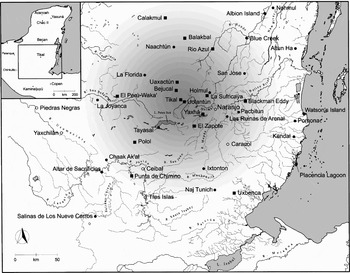
The southern Maya lowlands can be divided into five geographic regions from west to east: the Lacandón Forest, the Salinas-Pasión River region, the Dolores-Poptún Plateau, the Toledo District of southern Belize, and the Lake Izabal basin (Figure 1). Although settlement surveys and preliminary tests have been undertaken in each region, only a dozen or so sites have received large-scale stratigraphic excavation. All of these, save Lubantun, are located in the Salinas-Pasión River zone. Our clearest understanding of Early Classic period happenings in the southern Maya lowlands consequently derives from this region.
Selected sites in the Central and Southern Lowlands around a.d. 400. Squares are sites with Cycle 8 era monuments. Rings are sites with Cycle 8 calendrical statements.

Primary data on the Pasión Early Classic period originate from a handful of projects conducted since the 1960s (Demarest Reference Demarest2006; Demarest and Barrientos Reference Demarest, Barrientos, Laporte, Escobedo and Arroyo2002; Johnston Reference Johnston2006; Ponciano et al. Reference Ponciano, Inomata and Triadan2005; Willey Reference Willey1973, Reference Willey and Willey1990). Pasión sites continue to be found with Early Classic period remains, but the overall historical picture has changed little, as finds are often isolated and fragmentary. The largest Early Classic period site on the Pasión River was unquestionably Altar de Sacrificios (Willey Reference Willey1973). This center established close political and economic ties with Salinas de los Nueve Cerros on the upper Chixoy-Salinas River (Dillon Reference Dillon1979) and with the central Petén. Interestingly, the preeminent Protoclassic centers of Ceibal (anglicized Seibal) and Chaak Ak'al exhibit no evidence of public construction, carved monuments, or sizeable settlement during the Early Classic period (Johnston Reference Johnston2006; Willey Reference Willey and Willey1990); the same is true of the modest Preclassic center of Itzan (Johnston Reference Johnston2006). But a variety of Early Classic period remains have been documented around Lake Petexbatun, a subregion of the Pasión, at the sites of Aguateca, Dos Pilas, Arroyo de Piedra, Tamarindito, and Punta de Chimino and in surrounding caves and grottos (Brady et al. Reference Brady, Luin, Foncea, Wright, de Brady, Demarest and Houston1990, Reference Brady, Rodas, Wright, Emery, Lopez, Stiver, Chatham, Demarest, Inomata, Palka and Escobedo1991; Demarest Reference Demarest2006; Eberl Reference Eberl, Laporte, Escobedo, de Suasnavar and Arroyo2000; Escobedo Reference Escobedo1997a; Foias Reference Foias1996; Ishihara et al. Reference Ishihara, Guerra, Palomo, Young, Ponciano, Triadan and Inomata2005; Triadan and Kopka Reference Triadan, Kopka, Ponciano, Triadan and Inomata2005; Valdés Reference Valdés1997). Upriver, the diminutive site of Tres Islas has several Early Classic stelae but only small traces of earlier settlement (Tomasic and Fahsen Reference Tomasic, Fahsen, Laporte, Arroyo, Escobedo and Mejía2004). Northward, the minor site of Polol was ceramically aligned with the Middle Pasión in the Protoclassic period, at which time its inhabitants probably erected a most unusual stela (August Reference August1982; Pahl Reference Pahl and Cordy-Collins1982; Patton Reference Patton1987). Unlike other sites discussed here, Polol appears to have constructed small palatial buildings during the Early Classic period. These eleven localities and a few cave sites provide the corpus of evidence from which the following inferences are drawn.
Tres Islas is an enigma among the above sites and bears special mention. It has three small mounds that rise to 1.5 m, and these are located 200 m from a cluster of exquisitely carved monuments (Tomasic and Fahsen Reference Tomasic, Fahsen, Laporte, Arroyo, Escobedo and Mejía2004). Its three stelae were erected around a.d. 470 but contain puzzling references to events transpiring in a.d. 400, 402, 415, and 416. Protagonists on two stelae are clad in Mexican military costume and grasp arrow bundles in their hands. An Early Classic cache associated with Stela 2 consisted of a lip-to-lip vessel offering containing, among other things, nine black obsidian cores (Tomasic and Fahsen Reference Tomasic, Fahsen, Laporte, Arroyo, Escobedo and Mejía2004:820). Early Classic caches with nine obsidian objects have been found at Tikal, Uaxactun, Copan, and Piedras Negras. Tres Islas may have had a small Protoclassic occupation, as suggested by nearby traces of Chicanel pottery. Its size was of no consequence, but its location permitted the monitoring of traffic down the Pasión's eastern tributaries, the Machaquilá and San Juan Rivers. Because of its size, Tres Islas could not have overtaken Ceibal, Chaak Ak'al, or even Punta de Chimino. Current evidence implies that Tres Islas was established on the Pasión River by a formidable, nonlocal polity with Mexican affiliations concurrent with the Middle Pasión abandonments mentioned above.
PUNTA DE CHIMINO
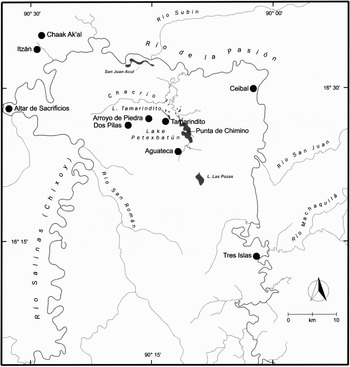
Punta de Chimino is situated on a peninsula extending into Lake Petexbatun (Figure 3). The lake is 8 km south of the Pasión River but is linked to this river by a narrow meandering tributary (Figure 2). The region's richest soils are found along the margins of Lake Petexbatun, an Upper Oligocene graben where thick organic sediments, the so-called Sarstun Series soils, have accrued in a perennially wet or swampy environmental regime. The area is pluvious, receiving approximately 2500 mm of rainfall annually. Heavy rains on the western upland horst known as the Petexbatun Escarpment trickle down into sinkholes and caverns and reemerge in springs at the base of the precipice (Dunning et al. Reference Dunning, Rue, Beach, Covich and Traverse1998). Lake Petexbatun drops to its dry season low in April and rises steadily during the rainy season, submerging the lowest 5 to 7 m of the Punta de Chimino peninsula by October. The lake is the biological nucleus of the Río Petexbatun floodplain; it provides habitats for many species of fish, reptiles, waterfowl, and mollusks.
The Pasión Region showing sites mentioned in the text.

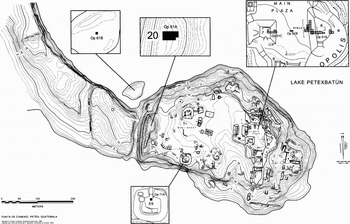
Map of Punta de Chimino showing 2004–2005 excavation locations (after Inomata et al. 1989).

The site's ruined monuments are concentrated on the peninsula's wide bulbous end (Figure 3). They are sharply separated from the peninsula's narrow neck and mainland by a colossal wall flanked by a deep outer ditch. The mounds are divided between two ceremonial plazas, the elevated Acropolis terrace and the West Group. On its mapped surface, Punta de Chimino resembles a ceremonial center with little or no space for residential settlement. Two additional barriers are found on the narrow neck west of the principal embankment, but no significant mounds or evidence of Preclassic occupation have been found in this location (Demarest et al. Reference Demarest, Sears, Rasmussen, Demarest, Valdés and Escobedo1995). The small island north of the principal embankment was likely created with dirt excavated from the adjacent ditch when the ditch and embankment were formed at an unknown moment in time (Bachand Reference Bachand2006:218–235).
Prior Investigations
Excavations began at Punta de Chimino in 1989 when a team of archaeologists from Guatemala's Instituto de Antropología e Historia tested the Acropolis plaza and drafted a preliminary map of the site (Velásquez Reference Velásquez, Laporte and Escobedo1994). Later that season, the site was extensively mapped and reconnoitered by an archaeological team from Vanderbilt University (Inomata et al. Reference Inomata, Johnston, Houston, Demarest and Houston1989). The presence of substantial Preclassic period occupation was already evident in early tests (Foias in Inomata et al. Reference Inomata, Johnston, Houston, Demarest and Houston1989; Velásquez Reference Velásquez, Laporte and Escobedo1994). The scaled map and preliminary ceramic assessments established a baseline for subsequent Vanderbilt University excavations in 1990, 1991, 1995, and 1996 under the direction of Arthur Demarest (Reference Demarest2006). Though extensive throughout the site, Vanderbilt's excavations were mainly shallow or surficial in nature, being designed to address the Terminal Classic collapse. Important traces of Preclassic, Protoclassic, and Early Classic occupation were nevertheless encountered in Mounds 7 and 70 (Demarest et al. Reference Demarest, Castellanos, Escobedo, Demarest, Escobedo and O'Mansky1996; Escobedo Reference Escobedo, Demarest, Escobedo and O'Mansky1996, Reference Escobedo, Laporte and Escobedo1997b; Morgan Reference Morgan, Demarest, Escobedo and O'Mansky1996).
The Present Research
In 2004 and 2005, I conducted a series of deep stratigraphic tests and horizontal exposures in Mounds 6, 7, and 59, the large embankment, and the small island (Figure 3). This work formed the basis of my doctoral dissertation (Bachand Reference Bachand2006), which was a component of a regional study of Aguateca (Inomata et al. Reference Inomata, Triadan, Ponciano and Aoyama2007). The Punta de Chimino project focused on accurate dating and expanded documentation of the site's pre-Classic cultural remains. Its theoretical goal was to explore how changes in public monumental space signaled changes in community identity and attachment to a place over time.
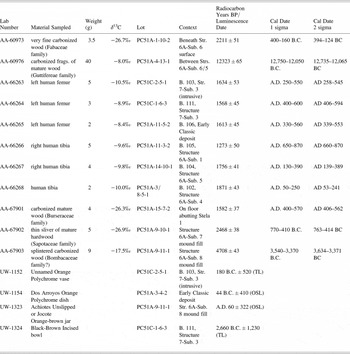
Fieldwork centered upon Mounds 6 and 7 in the Acropolis plaza. The form, size, and arrangement of these mounds resembled that of a public ritual complex known as an E-Group (Aimers and Rice Reference Aimers and Rice2006; Chase and Chase Reference Chase, Chase and Grube1995; Fialko Reference Fialko1988; Hansen Reference Hansen and Houston1998; Laporte Reference Laporte and Laporte1996; Lowe Reference Lowe and Adams1977; Stanton and Freidel Reference Stanton and Freidel2003). Excavations in Mound 6, the long eastern mound, provided details of a 1,200-year occupational sequence dating back to the start of the late Middle Preclassic period. Episodes of monument construction, refurbishment, desecration, and abandonment were observable throughout the mound's depositional sequence. Eleven AMS and four luminescence readings were acquired from a temporally staggered series of burials, caches, and special deposits in the two E-Group mounds (Table 2). Radiometric error terms were reduced with the aid of Bayesian statistical models, a process that has enabled further refinement of the site's history (Bachand Reference Bachand2008). The most accurately dated portion of the radiometric sequence corresponded to the Preclassic-Early Classic period transition, or what is alternatively called the Protoclassic period (Table 1).
Radiometric age determinations for Punta de Chimino, Guatemala. Calibrated dates derived from OxCal version 4.0.5 using the IntCal04 calibration curve (Reimer et al. Reference Reimer2004). Botanical identifications made by Dr. Lee A. Newsom, Pennsylvania State University

The Protoclassic ceramic stages outlined by Brady et al. (Reference Brady, Ball, Bishop, Pring, Hammond and Housley1998) correspond closely with marked changes in site formation, construction methods, and the meaning of public space at Punta de Chimino. Hence, the Protoclassic ceramics are but one aspect of observable changes in site history. Beyond Punta de Chimino, ample evidence demonstrates that many social behaviors, attitudes, and practices were altered at this time, even at sites where Protoclassic pottery was scarce or absent (Bachand Reference Bachand, Laporte, Arroyo, Escobedo and Mejía2003, Reference Bachand2006). For these reasons, I believe the term Protoclassic has significant, if not primary, relevance as a culture-historical period in which many Mesoamerican socieites, the Lowland Maya especially, were dramatically reshaped (Wauchope Reference Wauchope1951; Willey Reference Willey and Adams1977).
I begin, then, by describing the Protoclassic developments that led up to a decisive Early Classic period abandonment of Punta de Chimino. I then compare these findings to discoveries in other localities.
Early Protoclassic Period (ca. 75 b.c.–a.d. 150/175)
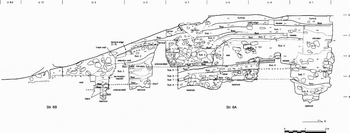
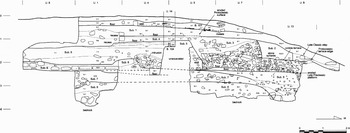
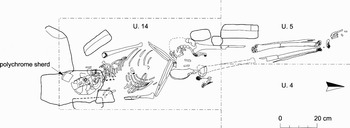
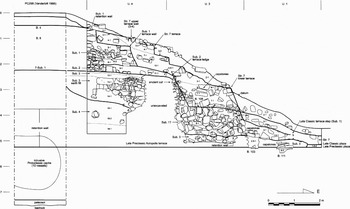
Early Protoclassic period activity at Punta de Chimino is mainly represented by a resurfacing and reterracing of the large Late Preclassic building within Mound 6. This Protoclassic period construction, designated Structure 6A-Sub 4, commenced with the interment of an adolescent (Burial 104) in the upper fill of the previous construction (Figures 4, 5, and 6). The deceased was laid supine with head to the south. Arms and legs were crossed at the wrists and ankles. The person's frontal bones, right femur, and left foot bones were missing. No funerary items were found in the grave.
North wall of main trench in Mound 6.

South wall of main trench in Mound 6.

Plan drawing of Burial 104, an early Protoclassic (Faisán 2) grave intrusive into Structure 6A-Sub 5.

Across the plaza, we discovered a Flor Cream ring base and numerous Y-shaped gancho rims in the fill of Structure 7-Sub 4, indicating that Mound 7 was originally constructed in the Early Protoclassic period (Figure 7). Early ring bases are rare but generally assignable to Protoclassic 1 (Kosakowsky and Pring Reference Kosakowsky and Pring1998:64; similar Flor Cream examples are illustrated in Adams Reference Adams1971:Chart 3–4b and Forsyth Reference Forsyth1989:Figure 15z). Sub 4 was badly eroded, but the sherds in question were encountered in a deep, undisturbed portion of the building's hearting. Thus, the two-mound E-Group arrangement does not appear to have been in place before the Early Protoclassic period.
North wall of main trench in Mound 7.

The majority of ceramic elements isolated in these levels are Chicanel-like in form and surface finish. Yet a number of new types and modes debuted at this time (Bachand Reference Bachand2007). Newly introduced types included Iberia Orange, Sacluc Black-on-orange, Metapa Trichrome, Caribal Red-on-orange, and San Martín Variegated Brown. The last two types most likely appeared in minor quantities at the end of Faisán 2. The final type mentioned, San Martín Variegated Brown, is of particular culture-historical importance. This very distinctive type with dull, tan-to-buff finish and chunky calcite temper is found most abundantly and almost exclusively at Ceibal, where Sabloff (Reference Sabloff and Willey1975:102–105) assigned it to the Early Classic Junco phase (Figure 8).
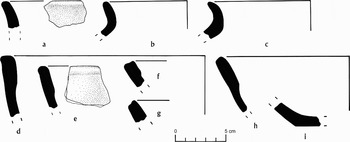
San Martín Variegated Brown potsherds from Punta de Chimino: (a) from the Early Classic mask wall termination deposit; (b) and (c) from Str. 6A-Sub 2 fill (Protoclassic 2); (d) from Str. 7 fill (Late Classic); (e) from Str. 6B fill (Protoclassic 2); (f) from Str. 7-Sub 3 fill (Protoclassic 2); (g) from Str. 7-Sub 1 fill (early Late Classic); (h) from Str. 7-Sub 1 fill (early Late Classic); (i) from the Stela 1 basal pit (Protoclassic 2). Not illustrated is a San Martín sherd from a sealed Protoclassic 1 fill context within Str. 6A-Sub 4. Drawings by Alfredo Román.

By the close of this period we detect the first significant sign of site abandonment. Both E-Group buildings exhibit major deterioration, erosion, and slumping on their plaza-facing sides (Figures 4, 5, and 7). Bayesian analysis of two closely spaced radiocarbon assays suggest the hiatus lasted less than fifty years and began closer to a.d. 200 than to a.d. 150 (Bachand Reference Bachand2008:15–17, 24). The two assays, AA-66268 and AA-66267, date well-preserved long bone samples from Burials 102 and 104. The timing of this event corresponds with a postulated regional abandonment of the Petexbatun region (Foias Reference Foias1996)—an event contemporaneous with severe deforestation along the lake margin (Dunning et al. Reference Dunning, Rue, Beach, Demarest, Inomata, Palka and Escobedo1991, Reference Dunning, Rue, Beach, Covich and Traverse1998).
Late Protoclassic (ca. a.d. 200/250–375)
Sometime during the Late Protoclassic Faisán 3 phase, Punta de Chimino's ceremonial precinct was revitalized by either a group of local people with long distance ties or by a group of nonlocal Lowland Maya. A marked change occurred in construction techniques. Faisán 3 additions were structurally inferior to the densely packed cell wall fills and well-paved surfaces of earlier Faisán buildings. Extensions to Structures 6A-Sub 4 and 7-Sub 4 were composed of a loose rubble fill capped with a layer of small unshaped cobbles and course gravel (Figures 4, 5, and 7). The stucco coatings on these monuments vanished completely during the more decisive abandonment that would soon follow.
Faisán 2 and 3 constructions were minimally altered symbolically. The function of Structures 6A and 7 as E-Group counterparts was clearly recognized and improved upon. The elongated E-Group platform was widened and possibly lengthened with the addition of distal-end stairways (Figures 9 and 10). The platform's north-south orientation was adjusted, perhaps to correct a solstitial alignment, and its western façade was embellished with large heads or “masks” of probable Protoclassic humanoid form. A triangular arrangement of three spherical stones was placed in the fill on the platform's east-west centerline. Finally, and perhaps most significantly, Faisán 3 builders did not cover the sunken court cresting this range platform. They reused it and probably incorporated its prior purposes into the remodeled structure. Thus, the symbolic qualities and social functions of the earlier Protoclassic building were well recognized and enhanced by Faisán 3 occupants.
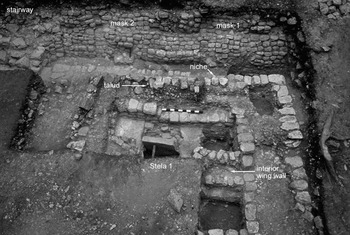
Photograph of Mound 6 stela enclosure and mask wall.

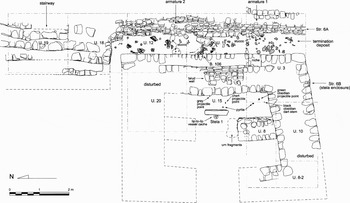
Plan drawing of artifacts associated with the mask wall corridor and Stela 1 enclosure beneath Mound 6.

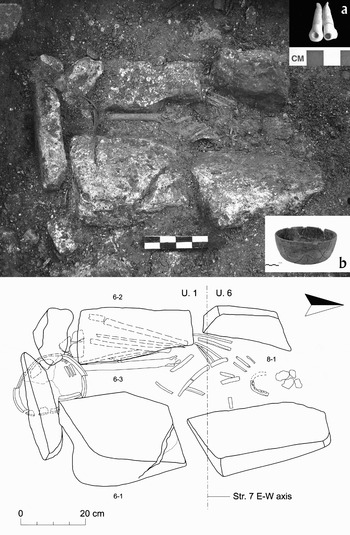
Across the plaza, a hole was dug into the west side of the slumping Structure 7-Sub 4 to insert a Protoclassic vessel cache (Demarest et al. Reference Demarest, Castellanos, Escobedo, Demarest, Escobedo and O'Mansky1996; Escobedo Reference Escobedo, Demarest, Escobedo and O'Mansky1996, Reference Escobedo, Laporte and Escobedo1997b). Then something unprecedented happened: the pyramid became funerary or, more accurately, the pyramid's basal platform became funerary. The monument was quite likely appropriated by a single corporate group, perhaps a prominent lineage. In Burial 111 an adult individual of undetermined sex was interred in a carefully prepared centerline cist with a bowl placed upright near the feet (Figures 7 and 11). The person's legs were crossed in lotus fashion, an increasingly fashionable sign of authority in the Maya lowlands by Protoclassic times. Instead of being seated, the person was reclined with his/her head facing north. Iron pyrite disk inlays in the person's upper incisors, a trait associated with elaborate burials on this time horizon, confirmed his or her socially elevated status. The waxy brown bowl and pyrite inlays, common southwest highland items, imply that this person and/or his or her interrers may have had ties to the south.
Burial 111, a late Protoclassic (Faisán 3) grave in Mound 7: (a) upper incisors with pyrite disk inlays; (b) waxy brown bowl with a preslip, circumferentially incised line below the rim.

At this time few people resided in the Petexbatun region, or if they did, they certainly did little to mark their place on the landscape. Unlike previous occupations at Punta de Chimino when new ceramic types accrued in sizeable quantities before they were incorporated into monumental construction, few Faisán 3 types were found in the earliest Faisán 3 construction fills. The new builders may not have lived on the peninsula long enough to accumulate modest quantities of refuse. The activities of Faisán 3 builders were restricted to the Acropolis E-Group and Structure 70 in the West Group plaza—the former symbols of local power. The labor investment involved in these alterations, although considerable, was nothing on par with Faisán 1 Acropolis construction.
Elements appearing for the first time were green Pachuca obsidian (one prismatic blade found in fill encapsulating Burial 111), iron pyrite (Burial 111 dental inlays), and minor quantities of Aguila Orange pottery. As mentioned, San Martín Variegated Brown (Playa Dull Ware) and Caribal Red (early Petén Gloss) probably attained their maximum popularity in Faisán 3. These types were joined by minor quantities of the first true Petén Gloss types—Actuncan Orange Polychrome, Aguila Orange, Balanza Black, and Pucte Brown. Cream underslips were common, especially on orange slipped vessels. Basal flanges, basal ridges, and ring bases occurred with minor yet increased frequency (ring bases reached their greatest frequency in the Jordan complex). Z-angle flanges appeared for the first time. The first miniature vessel, a Balanza Black bowl with dimple base, dated to this facet. Noteworthy was the sudden appearance of a wide-range of ritual censer pots: ladle censers, modeled face censers, spiked/horned censers, and a square incense burner base. Pronounced changes also occurred in the unslipped ceramic inventory with grittier, coarser, thicker-walled ceramic vessels and dish forms now competing with jar forms. I estimate that no more than 40% of the Faisán 3 ceramic industry was comprised of Chicanel pottery (Bachand Reference Bachand2006:299–301).
Sometime in the latter half of Faisán 3 a stela was erected in front of the long E-Group building. The monument was housed or “framed” in a two-chamber masonry enclosure (Structure 6B) that rose one meter off the plaza floor (Figures 4, 9, 10, and 12). The enclosure's rear came within 50 cm of the Structure 6A-Sub 3 mask wall. This action obscured one's view of the masks from the plaza and created a private ritual corridor between the two buildings. The latest ceramics found in Structure 6B's fill and wall collapse were Faisán 3 in date (89 of 164 sherds). The same was true for the stela pit (23 of 47 sherds), except for a cluster of Saxche/Palmar Orange polychrome sherds that were laterally intrusive from an adjacent Late Classic burial.
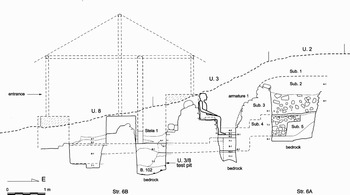
Profile drawing of the Structure 6B stela enclosure in Mound 6.

Masonry stela enclosures are common enough in the Maya lowlands. They occur in public plazas or palace groups, are usually multichambered, and are often described as shrines, sanctuaries, or temples (Fash Reference Fash2001; Pendergast Reference Pendergast1988; Ricketson and Ricketson Reference Ricketson and Ricketson1937:164–165, Figure 107; A. L. Smith Reference Smith1950:15, 24–25, Figures. 19b and 78b). Early Classic period stelae at Calakmul, Balakbal, and Tikal were reset into Late Classic period enclosures (Jones and Orrego Reference Jones and Orrego C.1987; Laporte Reference Laporte, Sabloff and Henderson1993:308, Figure 1; Pincemin et al. Reference Pincemin, Marcus, Folan, Folan, Carrasco, Rosario and López1998:319, Figure 12). The earliest stela enclosures probably derive from the Tikal area (Martin Reference Martin, Colas, Delvendahl, Kuhnert and Schubart2000), but these have not been precisely dated. Punta de Chimino's Stela 1 was undoubtedly contained within Structure 6B during the latter half of that building's existence (ca. a.d. 300–430). With no evidence of a dismantled roof, archaeological evidence suggests that Structure 6B had no roof, and was in this regard similar to Late Classic twin-pyramid stelae installations at Tikal (Jones Reference Jones1969). Several modifications were rendered to the enclosure during its use-life. A pair of interior walls was added, creating two chambers; A masonry talud wall was added to the rear wall, and a small bench-like niche was cut out on the building's rear ledge, directly across from mask 1 on Structure 6A-Sub 3. Three radiocarbon dates anchor Structure 6B to Faisán 3, making it the earliest stela enclosure on record in the Maya lowlands. The stela itself fits archaeologically within Cycle 8 (8.10.0.0.0–9.0.0.0.0 or a.d. 238–435), making it the earliest stela of record in the Pasión region (Mathews Reference Mathews, Willey and Mathews1985:25, Figure 4; Mathews and Willey Reference Mathews, Willey and Culbert1991:54). The monument's closest regional equivalent is Polol Altar 1, a misnamed stela with a badly eroded Initial Series date that portrays two elaborately adorned protagonists facing a central glyph column (Pahl Reference Pahl and Cordy-Collins1982:Figures 1a,b and 2a,b; Patton Reference Patton1987:Figures 63–65).
Completion of the stela enclosure initiated spatial practices that were unorthodox for Petexbatunites. If the enclosure supported a perishable superstructure, only a few individuals would have observed the stela at one time. Even if the stela was uncovered, the dual chambers and single entrance channeled movement around the monolith. In addition, the narrow passage behind the enclosure required a person to enter the corridor to obtain a full frontal view of the symbolic art gracing Structure 6A-Sub 3. The small cutout or niche on Structure 6B's rear ledge fronted mask 1 and probably served as a seat for divining while facing the image (Figures 10 and 12). These newly designed spaces were conducive to more exclusive ritual activities in the plaza—activities probably carried out by ritual specialists. The demographic picture suggests that these specialists had a small following.
The presence of a stela implies that an ascendant leader laid claim to the peninsula and perhaps the surrounding countryside. Modest quantities of San Martín Variegated Brown pottery connote continued ties to Ceibal, the probable place of origin for this ceramic type. Classic period inscriptions from Ceibal Structure A-14 indicate that the city's dynastic origins hearken back to one K'an Mo' Balam or “Yellow Macaw Jaguar” who appears to have ruled around a.d. 415, just prior to that city's hypothesized abandonment (Graham Reference Graham and Willey1990:15–16; Grube Reference Grube and Grube1995b:2; Mathews and Willey Reference Mathews, Willey and Culbert1991:49–50, 54; Stuart Reference Stuart and Houston1998:398 and note 13). E-Group modifications at Punta de Chimino appear to predate the establishment of Ceibal's royal line, but Stela 1's chronometric placement remains loose enough to accommodate a temporal link with Ceibal's dynastic founding ca. a.d. 415.
In summary, people with an appreciation and knowledge of the previous monumental edifices at Punta de Chimino carried out the Faisán 3 renovations. The disjunction in construction methods and materials is perplexing and seems to suggest a lapse in cultural knowledge, perhaps indicating that Faisán 3 residents were Lowland Maya from another locale. This interpretation is reinforced by the realignment of Structure 6A and the transformation of Structure 7 into a funerary monument, a practice not engaged in by previous Punta de Chimino residents. Although the structural work on these E-Group buildings was inferior to that of earlier periods, the iconographic elements were probably detailed and skillfully rendered. It is highly conceivable that new social elements arrived to fill an occupational and political void created by the previous Early Protoclassic period desertion. These elements were elitist and ecclesiastic. Ironically, there is little to suggest even a modest population on or near the peninsula at this time. An ascendant leader had a shrine built to himself and/or his liege in the plaza directly in front of the center's most sacred edifice. Judging from the size, shape, stone quality, and solid installation of this monument, and the special treatment afforded it in its removal, it was probably as highly skilled in execution as its enclosure. Such skills and concepts were mastered first in the Tikal-Uaxactun region. The association of Aguila Orange pottery, a Cycle 8 stela, and a stela enclosure suggest a more direct relationship with this region by the end of Faisán 3. Curious, however, is the absence of Aguila Orange pottery and Cycle 8 stela at Ceibal. Punta de Chimino and Ceibal were surely in contact during this time, as suggested by their sharing of San Martín Variegated Brown pottery and other Faisán 3 ceramic traits.
Early Classic Events (ca. AD 375–430)
The succeeding Jordan phase at Punta de Chimino ended shortly after it began. A series of well-preserved and dated archaeological contexts sketch a partial, yet telling image of this opaque moment in Pasión River history. Bayesian simulation of four radiometric assays ordered the following events, since their contexts were stratigraphically contemporaneous and impossible to arrange sequentially (Bachand Reference Bachand2008:12). The following description utilizes this ordering starting with the first or earliest event.
Burial 103
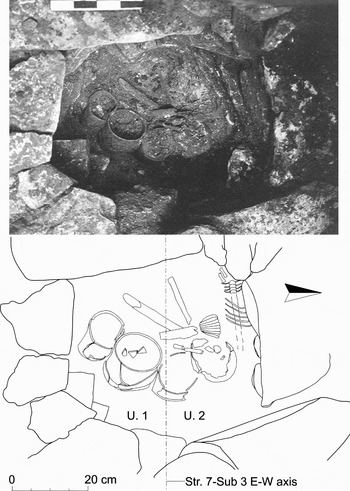
The most perplexing find of the 2004 field season was Burial 103, a cylindrical stone-lined cavity that was carved into the late Protoclassic basal platform of Structure 7 (Figures 7 and 13). The cist was 50 cm in diameter, 60 cm deep, and ringed with well-shaped stones from top to bottom. It was sealed by a cluster of thick slab-like capstones that rested upon the Sub 3 platform surface. Initially thought to be a chultun, this grave contained the disintegrated skeletal remains of an adult individual of undetermined sex. Judging by the cavity's cramped dimensions and the position of the cranium in relation to other skeletal components, the person was seated upright with knees bent to the chest and head facing west/southwest. A calibrated radiocarbon range of a.d. 250–550 (2 sigma, 95% probability) was acquired from the occupant's left femur (1634 ± 53 BP, AA-66263). Bayesian simulations accounting for the stratigraphic primacy of Burial 111 placed the death of Burial 103's occupant in the early fifth century around a.d. 430 (Bachand Reference Bachand2008:18–19).
Burial 103, an Early Classic circular stone paved crypt in Mound 7.

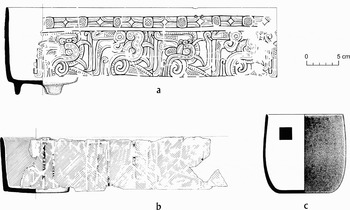
The deceased was interred with three Tzakol vessels and an unmodified marine bivalve shell of the Atlantic species Dinocardium robustum (Kitty Emery, personal communication 2007). One vessel was a Balanza Black vase with a rounded, slightly concave base. Another was a squat, cylindrical vase with a series of red vertical bands and a red rim band on an orange background that overlaid a cream underslip. This vessel's shape, with flat base, vertical walls, and direct rim, was somewhat infrequent in the lowlands, although nine examples were discovered in Tikal's Problematical Deposit 50 (Culbert Reference Culbert1993:Figure 130), a secondarily deposited grave with “strong” Mexican qualities dating between a.d. 386 and 426 (Coggins Reference Coggins1975:177–181). The third vessel was a cylindrical tripod with an exquisite plano-relief design detailed with light fugitive incisions. In the design, the stylized head of a saurian creature or serpent is repeated four times below a band of repeating quatrefoil elements (Figure 14a). This serpent is nearly indistinguishable from one carved on a late Protoclassic period roller stamp from Altar de Sacrificios (Willey Reference Willey1972:Figure 89a, b). The tripod vase has a highly polished, unslipped surface (although a reddish-brown slip may have been applied between the rim and quatrefoil band). It has thin walls and an ashy-gray paste with volcanic inclusions, suggesting highland manufacture or lowland assembly with highland materials. The solid square feet are unusual, as they are located inward away from the vessel's edge. Similarly shaped supports appeared on late Protoclassic Maya vessels in the Belize Valley (e.g., Gifford Reference Gifford1976:Figure 65e, f), but other evidence suggests that they originated in the Maya highlands prior to the Mexican entrada at Tikal in a.d. 378 (Braswell Reference Braswell and Braswell2003b:87, 102, and 104-note 12; Foias Reference Foias1987; Laporte and Fialko Reference Laporte, Fialko, Rice and Sharer1987:140; Laporte et al. Reference Laporte, Hermes, de Zea and Iglesias1992:30; Varela and Braswell Reference Varela Torrecilla, Braswell and Braswell2003:259–260).
Burial 103 vessels: (a) unnamed carved-incised cylindrical tripod, (b) unnamed orange polychrome “cup,” and (c) Balanza Black vase. Drawings a and b by Hiro Iwamoto, c by Alfredo Román.

The repetitive serpent motif is a common theme on Maya-style vessels found at Teotihuacan (Taube Reference Taube and Braswell2003:305–308, 312–313). Dark brown to black plano-relief versions with serpent designs are nimbly executed yet scarce and may have been the work of a small group of artisans or a master potter who resided in the Chiapas-Guatemala highlands around a.d. 400 (Agrinier and Bryant Reference Agrinier, Bryant, Bryant, Clark and Cheetham2005:409–410; Quirarte Reference Quirarte and Graham1973). At Teotihuacan, direct-rim cylinder tripods with well-executed plano-relief designs are restricted to elaborate graves (Sempowski Reference Sempowski, Sempowski and Spence1994:254).
In preliminary reports and publications we described Burial 103 as Teotihuacan-like (Bachand and Anavisca Reference Bachand, Anavisca, Ponciano, Triadan and Inomata2004; Bachand et al. Reference Bachand, Román, Castañeda, Anavisca, Laporte, Arroyo and Mejía2006). A strontium isotope test was subsequently conducted at the University of North Carolina, indicating that the deceased spent his/her adolescence in the central Maya lowlands and migrated to Punta de Chimino later in life (Wright and Bachand Reference Wright and Bachand2009). Further assessment of Punta de Chimino's Early Classic period contexts, including this unusual burial, support the interpretation that the alien features observed are Mexican elements introduced by another Lowland Maya group.
Stone-lined circular grave pits are certainly rare in the lowlands during the Early Classic period, and known examples are found at sites with an abundance of “Mexicanized” material effects. Such graves are located in prominent public spaces, and they often contain foreign-made items that signal a more direct link to central Mexico (Fash Reference Fash and Houston1998; Fash and Fash Reference Fash, Fash, Carrasco, Jones and Sessions2000; Smyth and Rogart Reference Smyth and Rogart2004). Burial 103's grave style and body posture are wholly uncharacteristic for the early Lowland Maya. The deceased's body position, marine shell, and tripod cylinder fall within the parameters of the Teotihuacan tradition, but the stone-lined cist does not. Teotihuacanos were seated in irregularly shaped oval earthen pits or fosas during Tlamilmilolpa times between a.d. 200 and 400 (Cabrera Castro Reference Cabrera Castro, Manzanilla and Serrano1999:506–507; Sempowski Reference Sempowski, Sempowski and Spence1994:132–133, 140–141, 209). As for body posture, there is another key difference: Teotihuacanos faced east, not west.
The closest counterparts in time, form, content, or context to Burial 103 are found at Tikal and Copan. Tikal's Burial PNT-168 dates to the Manik 3A subphase, between a.d. 378 and 480 (Laporte et al. Reference Laporte, Hermes, de Zea and Iglesias1992:41–43). It too contained an adult individual seated in an east-west position and accompanied by pots and a marine bivalve shell—an item almost exclusively associated with adult males at Teotihuacan (Sempowski Reference Sempowski, Sempowski and Spence1994:155–156). The grave was a carved chultun-shaped bedrock pit capped by four thick capstones and covered by a small square ceremonial platform in the center of an Early Classic palace courtyard. Like Punta de Chimino's grave, the vessels were placed upright to the southeast of the occupant. The second example, Problematical Deposit 50, is rumored to be of the same cylindrical shape and size as Copan's Motmot crypt (Fash and Fash Reference Fash, Fash, Carrasco, Jones and Sessions2000:443; Fash et al. Reference Fash, Fash, Davis-Salazar, Bell, Canuto and Sharer2004:68–72). Illustrations and descriptions of this deposit await publication in Tikal Report 23F, Investigations of Area of Stela 29. Coggins (Reference Coggins1975:177) described PD 50 as a redeposited tomb placed in a “dump” west of the North Acropolis and cited it as a possible Mexican-style cremation. The deposit contained portions of seven skeletons and numerous funerary items, including two Teotihuacan-style incensarios and two imported tripod cylinder bowls displaying Mexican imagery—one exhibited two intertwined rattlesnakes with avian head plumes; the other displayed the famous Teotihuacan emissary scene (Coggins Reference Coggins1975:179–181; Culbert Reference Culbert1993:Figure 128; Greene and Moholy-Nagy Reference Greene and Moholy-Nagy1966). As mentioned, PD 50 contained numerous examples of the squat, cup-like vessel shape found in Burial 103. It also contained several of the Aguila Orange cache vessels that are diagnostic of this time period (see below). Tikal's PD 50 is roughly contemporaneous with Burial 103 and its contents were probably extracted from a grave within the Mundo Perdido complex or North Acropolis. Neither of the Tikal interments were stone paved, but both were chultun-shaped and contemporaneous with Burial 103.
A final peculiar feature of Burial 103 was that it was not covered by construction until a.d. 600 or so. Its capstones remained on the Sub. 3 surface for 150 to 200 years. Four small excavation lots on Structure 7's apex appeared to correspond to a discontinued Early Classic period resurfacing of Sub 3 (Figure 7). Thus, Burial 103 seems to have been dedicatory for an Early Classic construction that was never finished.
Stela 1 fire ritual
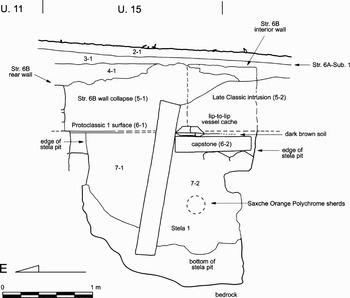
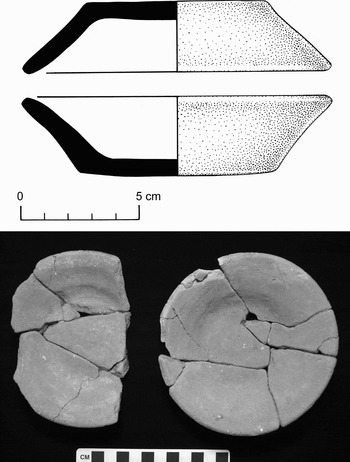
The uncarved lower portion of a stela (designated Stela 1) remained securely planted on Structure 6B's central axis at a distance of 0.75 m from the back wall (Figures 9, 10, 12, and 15). The butt was buried beneath the wall collapse of the surrounding Protoclassic enclosure on its top, right, left, and back sides. Its front, however, was partly surrounded by Late Classic period fill from a massive Tepeu 2 construction that eventually engulfed Structure 6A's mask wall and all of Structure 6B (Figure 15). When found, the butt was listing forward, despite being firmly reinforced in 2.8 m3 of solid stone rubble. An empty lip-to-lip vessel offering comprised of two small Aguila Orange vessels was discovered on a large flat capstone positioned just beneath floor level in front of the monument (Figures 10, 15, and 16). Similarly shaped Aguila Orange vessels were a common feature of Protoclassic/Early Classic period caches and problematical deposits at Tikal (Culbert Reference Culbert1993; Laporte and Fialko Reference Laporte, Fialko, Rice and Sharer1987), Uaxactun (Smith Reference Smith1955), and Tayasal (Chase and Chase Reference Chase, Chase, Rice and Sharer1987)—two central lowland sites. The frequent occurrence of this cache form at Tikal suggests that it was an Early Classic Tikal trademark.
Profile drawing of Stela 1 excavation.

Aguila Orange cache vessels discovered at base of Stela 1. Drawing by Alfredo Román.

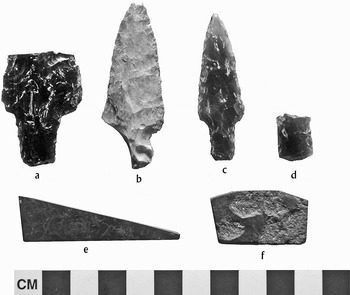
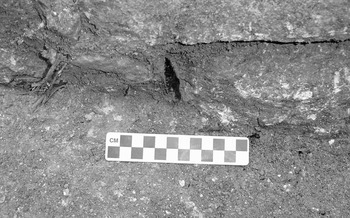
A number of important artifacts were found in situ on the floor around Stela 1's broken base (Figures 10 and 17). These were a chert dart point, a triangular iron pyrite plaque piece, a six-sided pyrite plaque piece, a green Pachuca obsidian biface, and a gray obsidian biface stem. An unbroken obsidian arrow point was also found embedded in the rear wall of Structure 6B approximately 1–2 cm above the floor (Figure 18). There is little doubt that these objects were collectively involved in Stela 1's demise.
Artifacts found on floor near Stela 1: (a) green obsidian stemmed biface; (b) chert projectile point; (c) gray obsidian projectile point; (d) black obsidian point stem; (e) triangular pyrite plaque piece; (f) six-sided pyrite plaque piece with cratered surface.

Gray obsidian projectile point embedded in rear wall of Structure 6B stela enclosure just above the floor.

The projectile points have no local antecedents, and similar points were not discovered at Altar de Sacrificios or Ceibal. Lightweight points like these are ideal candidates for Teotihuacan atlatl weaponry represented in Early Classic period iconography. The stemmed Pachuca biface is similar to Stemmed Biface A types at Teotihuacan (Spence Reference Spence1996:Figure 2b; see also Tolstoy Reference Tolstoy, Ekholm and Bernal1971:Figures 2, 3) and nearly identical to a stemmed Mexican Otumba point found at Tikal (Moholy-Nagy Reference Moholy-Nagy1999:Figure 2e; Reference Moholy-Nagy2003:Figure 66s). According to Moholy-Nagy (Reference Moholy-Nagy1999:310), thin bifaces made of obsidian from Mexican sources were imported into the Maya lowlands as finished products, but prismatic blades were not. Occurring exclusively in public ritual contexts, green obsidian evoked primary symbolic meanings among the Early Classic Maya (Moholy-Nagy Reference Moholy-Nagy1999:310; Spence Reference Spence1996:33). In the present case, the broken Pachuca biface was located in the southeast quadrant of the four-part enclosure on the same axis as mask armature 1 and its complementary niche or ritual “seat” (Figure 10).
At least two—possibly three—objects near Stela 1 were exposed to intense, direct heat prior to deposition. Heat fracture lines on the green Pachuca point terminate where the tip has broken off (John E. Clark, personal communication 2005). The chert dart point has a heat spall on its stem. A physical connection between fire and Early Classic period projectile points is not too surprising, considering the “burning dart” held by Yax K'uk' Mo' on Copan's Altar Q (Taube Reference Taube, Bell, Canuto and Sharer2004:Figure 13.1). One pyrite plaque piece has a cratered surface that may have resulted from direct, rapid heating (Figure 17f). Curiously, aside from the slight trace of randomly scattered charcoal flecks on the floor, there was little evidence of burning around Stela 1 or in the overlying wall collapse.
The presence of pyrite is particularly noteworthy in this context. Being 53.4% sulfur (S), the brassy-yellow mineral emits sparks when struck. Pyrite is pyromagnetic—its magnetism is dependent upon its temperature. Pyrite is diamagnetic at low temperatures; it becomes antiferromagnetic and emits sulfur dioxide (SO2) fumes when heated up to 315°C (its strongest magnetic level), and it transitions to paramagnetism beyond this temperature (Pearce et al. Reference Pearce, Pattrick and Vaughan2006). Pyrite will oxidize and burn at higher temperatures and begin to liquify at around 740°C (Fleet Reference Fleet2006). These physical properties were likely recognized by the Maya.
Nuttall (Reference Nuttall1901) noted long ago that Mesoamerican pyrite mosaics were emblematic of the sun and fire making. The thin slate backing attached to the triangular pyrite piece behind Stela 1 confirms that the piece was originally tessellated in a mosaic. Coggins (Reference Coggins1985) linked numerous iconographic and archaeological elements to the Toltec (or Teotihuacan) New Fire Ceremony that marked the completion of the 52-year Mexican calendrical cycle. Among them were burning reed bundles, fire drills/cords, censers, pyrite mirrors (represented by the Kan cross), the number seven, Tlaloc imagery, Mexican “year signs,” and warfare. Curiously, the verb for “censing” in Classic Mayan texts is partly comprised of a bowl-like element or spiked cylinder with a k'in infix symbolizing Yax or “yellow” and Sun, whose central hole is not unlike that found on the Kan cross pyrite insignia described by Coggins (see Stuart Reference Stuart and Houston1998:Figure 11). Research by Karl Taube (Reference Taube1983; Reference Taube and Berlo1992; Reference Taube, Carrasco, Jones and Sessions2000) has demonstrated that pyrite mirrors played a central role in Early Classic period divination and warfare at Teotihaucan. Pyrite disintegrates in most archaeological contexts, but it may have been an integral part of Lowland Maya fire rituals. Such fire rituals, which came to be associated with “living” buildings, social renewal, and death (Stuart Reference Stuart and Houston1998), may have been enacted with iron pyrite mirrors at the onset of the Early Classic period.
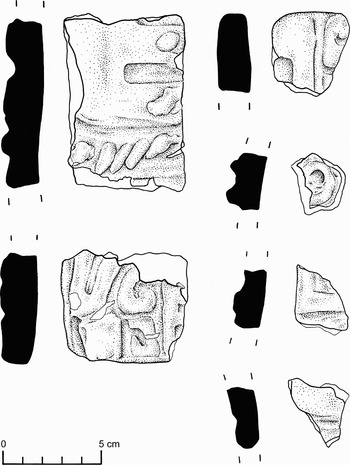
No Early Classic period Jordan-phase sherds were found on the floor surrounding Stela 1. Present, however, were several partly restorable Miseria Appliquéd-modeled censers (Figures 10 and 19). The censer fragments were discovered beneath wall collapse on the southwest side of Stela 1. One censer was identical to the hollow-cylinder, modeled-face censer types assigned to the Protoclassic-Early Classic period Ayn complex at Altar de Sacrificios (Adams Reference Adams1971:53–55, Figures 29i, 95c, d, e, g, 96a–f, 97a, b, 98a–e, 99a–c). This censer, the first of its kind reported in the Petexbatun region (see Foias Reference Foias1996:467), was unslipped and had a hard gritty orange paste with sand aplastics and a thick unoxidized core.
Miseria Appliquéd censer fragments discovered beneath structural collapse near Stela 1 base. Illustrations by Alfredo Román.

An AMS date of 1582 ± 37 BP (cal a.d. 406–562, 2 sigma 95% confidence) was acquired from a thin sliver of carbonized wood extracted from a dark soil patch encircling the southern edge of Stela 1. The dated material was a splinter of resinous wood identified by Lee Newsom (personal communication 2005) as likely belonging to the Burseraceae family, which includes resinous, aromatic hardwoods such as P. copal (copal, incienso). Although its exact species is unknown, this charred wood probably was interred in this highly symbolic context because of its resinous aromatic qualities.
The specimen that yielded the above AMS result was positioned stratigraphically between two specimens with AMS determinations that corresponded to the construction and demise of Structure 6B. When run together in a series of Bayesian simulations, the determinations placed Stela 1's destruction around a.d. 430 (Bachand Reference Bachand2008:19–23). Curiously, the baktun ending date of 9.0.0.0.0 (a.d. 435) is only five years later than this chronological projection. Nikolai Grube (Reference Grube, Colas, Delvendahl, Kuhnert and Schubart2000) and David Stuart (Reference Stuart and Houston1998:403–404) have noted the clustering of Classic Maya fire rituals around important calendar ending dates as opposed to specific astronomical events. According to Grube (Reference Grube, Colas, Delvendahl, Kuhnert and Schubart2000:101), “More than half of the Fire Sequences are found in Initial Series [texts] recording the end of a Tun or K'atun.” These so-called Initial Series Fire Sequences describe patron-deity rituals involving sacred fire and the burning of incense (Grube Reference Grube, Colas, Delvendahl, Kuhnert and Schubart2000:105). Ritual burning associated with stela removal or defilement is well attested in the Maya region, and the earliest cases are documented at Tikal (Coe Reference Coe1962:495; Jones and Orrego Reference Jones and Orrego C.1987; Pendergast Reference Pendergast1988).
The position of the unbroken obsidian arrow point found behind Stela 1 is unlikely to have resulted from a velocity impact (Figures 10 and 18). It is difficult to imagine how or why this biface would become affixed to the interior wall in this manner unless it was done intentionally. In sum, multiple aspects of the Stela 1 termination suggest premeditated or prescribed ritual destruction. Although we do not see the haphazard deposition one might expect from sudden attack, violent conflict cannot be ruled out as a precursor to ritual termination.
Mask wall corridor refuse deposit
A dark organic deposit containing an abundance of Early Classic potsherds filled the narrow corridor between Structure 6B and the mask wall (Figures 4 and 10). Some sherds pertained to partly restorable vessels, but most were unrelated fragments. A gamut of vessel types from unslipped domestic jars to simple monochrome pots to elaborately painted polychrome dishes was represented. Modest quantities of faunal bone and lithic manufacturing debris were randomly mingled throughout the deposit. Prismatic obsidian blades were few in number. Tiny specks of carbon were prevalent, but no sizeable pieces of burned wood were found. The deposit was fairly uniform in artifact density and thickness and rose to the top of Structure 6B's rear ledge. In short, the deposit bore all the characteristics of redeposited Early Classic period midden.
Fragments of modeled-painted plaster were found at the bottom of the deposit in front of the two mask armatures. During excavation we noticed that a swath of stones was missing across the bottom right half of mask armature 1 (Figures 10 and 12). Potsherds from the Early Classic deposit were pressed into this void. The lower half of mask armature 2 was also noticeably disfigured, with stones either missing or moved out of position (Figure 10). Aside from these locations, the stone facade exhibited little modification or disruption.
The location of this plaster at the base of the disfigured armatures indicated that the masks were defaced prior to inundating the corridor with refuse. A series of partly reconstructible vessels encountered in front of armature 1 may have been smashed against the mask, as some of the best plaster fragments were found among the sherds. It is unclear whether the mask wall's upper half was also mutilated at this time. It could have disintegrated after centuries of neglect. Once desecrated and filled-in, the mask wall corridor ceased to function as before. The same was true for Structure 6B, the stela enclosure, now toppled and missing its symbolic centerpiece. The concentration of artifact-rich midden debris in this ritual space discouraged future activity in the area for more than a century. Unclear, of course, is whether this action resulted in complete or partial abandonment of Punta de Chimino. The destruction does, however, seem to mark a decline in the community's political fortunes and regional standing and, more importantly, a break with its Preclassic social heritage.
The disarticulated skeletal remains of a toddler (Burial 106), were found in the top of the refuse deposit against rear of Structure 6B (Figure 10). The interment may have been secondary since it was difficult to determine whether the bones were in their precise anatomical positions. The bones nevertheless exhibited exceptional preservation (no carnivore marks) and were tightly clustered. The individual either died prior to or concurrent with the refuse deposition episode. An AMS date on the individual's left femur yielded an uncalibrated radiocarbon age of 1613 ± 45 BP (AA-66265). This date falls between a.d. 339 and 553 at the 2 sigma range or 95.4% confidence interval, and provides a terminus ante quem for the destruction of Stela 1, Structure 6B, and the Structure 6A-Sub 3 mask wall. The deceased's identity remains a mystery, but one can hardly resist the thought that he or she was somehow tied to the local leadership or was perhaps the political heir.
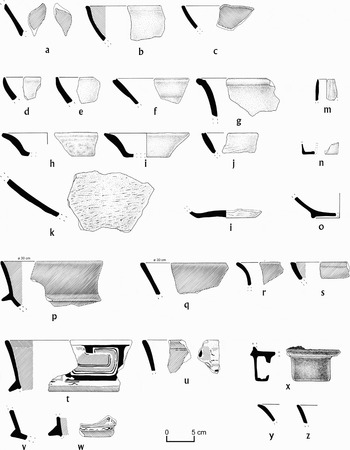
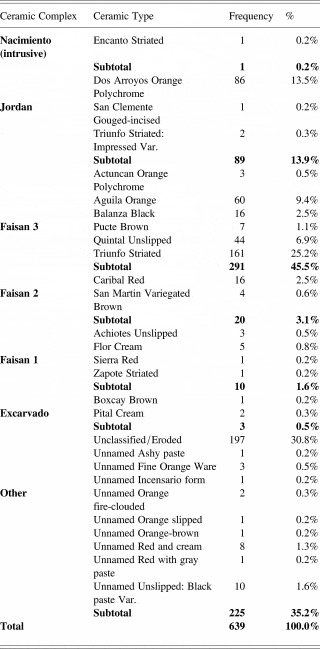
The dense artifact deposit contains the largest quantity of Jordan pottery yet uncovered at Punta de Chimino (Table 3). No fully restorable vessels are present. Most sherds are heavily eroded and few Aguila Orange sherds have slip remnants. Slipped serving vessels are common but hardly dominant. A good number of unslipped Quintal-Triunfo jars is present. We noted no spatial patterning aside from a concentration of three partial basal flange bowls (Dos Arroyos Orange Polychrome, Aguila Orange, and Balanza Black) at the base of mask armature 1. This ceramic picture, in conjunction with the murky organic soil, lithic waste, and random faunal remains, lead me to interpret this layer as secondarily deposited domestic refuse. Hence, I believe garbage was transported from a nearby Early Classic domicile and dumped in the corridor. As mentioned, the large quantity of Faisán 3 types is noteworthy. Many now exhibit the Tzakol 2 modes described above (Figure 20). Also of interest, but of no great numerical value, is the assortment of unclassified types—a sign of ceramic experimentation and innovation at this time. I believe this deposit presents a reasonably accurate snapshot of the early Jordan assemblage. Preclassic sherds are negligible; the dozen or so examples are probably acquisitions from earlier refuse or are the remains of heirlooms. This ceramic profile supports Foias's (Reference Foias1996:366–367) observation that waxy and Tzakol gloss pottery did not coexist in the Petexbatun region during most of the Early Classic period.
Potsherds extracted from the Early Classic refuse deposit at the base of mask armature 1: (a) Caramba Red-on-orange; (b) and (c) Caribal Red; (d–i, k–l) Quintal Unslipped; (j) Triunfo Striated; (m–n) unnamed miniatures; (o) eroded ring base; (p–s) Aguila Orange; (t–w) Dos Arroyos Orange Polychrome; (x) Balanza Black; (y–z) unnamed fine orange. Illustrations by Alfredo Román.

Ceramic types found in the Early Classic mask wall refuse deposit

SUMMARY
Burial 103 and other contemporaneous finds at Punta de Chimino represent the culmination of numerous long-distance ties forged at the end of the Protoclassic era. The pseudo-Mexican nature of this interment and central lowland birthplace of its occupant suggest the arrival of Maya people with ties to the west. Multiple lines of evidence—a Cycle 8 era stela, the Structure 6B stela enclosure, the Burial 103 strontium isotope evidence, Aguila Orange pottery, and a lip-to-lip Aguila Orange cache—suggest that the Mexican elements observed at Punta de Chimino (green obsidian, seated circular grave, and dart-like projectile points) derive from the Tikal region. Three sources of data—stratigraphy, ceramic seriation, and Bayesian corrected radiometric dates—place Punta de Chimino's Early Classic period abandonment in the early part of the fifth century a.d. near the completion of the eighth baktun in a.d. 435. Findings suggest that the acropolis destruction was performed by Tikaleños or a Tikal-affiliated group.
The current study encourages reassessment of Ceibal's Early Classic occupation and abandonment. Present radiometric and stratigraphic findings indicate that most Junco-phase ceramic types described by Sabloff (Reference Sabloff and Willey1975) are already present at Punta de Chimino in the third facet of the Faisán Chicanel phase. This is not surprising, as Sabloff (Reference Sabloff and Willey1975:232) acknowledged that certain Junco types—namely, Quintal Unslipped, Triunfo Striated, and San Martín Variegated Brown—showed strong Late Cantutse (Chicanel) continuities. Sabloff (Reference Sabloff and Willey1975:234) also observed that the rest of Junco did not fall into “strong and cohesive types,” with the exception of Triunfo Striated and San Martín Variegated Brown. These observations alone suggest that most of Junco falls into a third Cantutse facet comparable to Faisán 3 at Punta de Chimino. Junco seems to have been too brief and inconsequential to allow accumulation of sufficient quantities of decorated Tzakol pottery. This might explain the complete absence of Aguila Orange pottery at Ceibal. Importantly, no unmixed, primary Junco deposits were found in the entire Ceibal settlement zone, and the total number of Junco sherds, the majority of which are of probable terminal Cantutse date, did not exceed two thousand (Sabloff Reference Sabloff and Willey1975:233). Adjustments to this portion of the Ceibal sequence may be called for since Ceibal and Punta de Chimino were probably abandoned simultaneously or in close succession. The Punta de Chimino data offer the first chronometric gauge of this decisive moment in Middle Pasión history, which now appears to have transpired about 100 years earlier than Sabloff (Reference Sabloff and Willey1975:15) projected.
Closer scrutiny of the Altar de Sacrificios evidence provides hints of a similar occupation lull between a.d. 400 and 450 (Adams Reference Adams1964:374–375; Reference Adams1971:127, 129; Sabloff Reference Sabloff and Willey1975:233; Willey Reference Willey1973:64). Early Ayn is closely aligned with Jordan and Junco in sample size and ceramic mode content. Willey (Reference Willey1973:64) noted that “the general lack of large ceremonial construction at Altar in the earlier Ayn phase is out of developmental synchronization with the building that was going on in the northeast Peten at this time.” Importantly, no calendrical monuments appeared at Altar de Sacrificios before a.d. 455 (9.1.0.0.0) when monumental construction finally resumed in earnest, shifting to the A Group. It seems that Altar de Sacrificios was also adversely affected by early fifth-century Pasión River events but was revived in late Ayn times around a.d. 455 when Initial Series stelae and Teotihuacanoid vessels suddenly appeared there in substantial quantities.
CONCLUSION
The late Gordon Willey (Reference Willey and Willey1990:262) posed three unresolved questions in Early Classic Pasión archaeology. (1) What is the precise dating of Tzakol pottery at Ceibal, in the Pasión drainage, and elsewhere in the Maya lowlands? (2) What are the relationships between Tzakol pottery and Initial Series stelae? (3) What is the possibility or degree of a Chicanel-Tzakol overlap? Data from Punta de Chimino provide plausible answers to each of these questions. As for the first, Punta de Chimino's findings indicate that Tzakol 2 pottery arrived late at that site (ca. a.d. 400) and in limited quantities prior to site abandonment. A similar course of events probably transpired at Ceibal, Itzán, and Chaak Ak'al, given the nearly identical ceramic profiles and settlement histories of these sites. Tzakol 2 pottery appeared at least a half century earlier in the Tikal region, as confirmed by work in the Mundo Perdido zone (Laporte and Fialko Reference Laporte, Fialko, Rice and Sharer1987). Regarding the second question, Punta de Chimino's findings suggest that Aguila Orange pottery and Initial Series stelae arrived in the south in rapid succession (pottery then monuments) around a.d. 400 at the end of Protoclassic 2 or what used to be called Tzakol 1. The newly introduced monuments and dull to glossy Aguila Orange pots were incorporated into material assemblages containing markedly reduced quantities of Chicanel pottery and ever increasing proportions of Protoclassic domestic and ceremonial wares. During Punta de Chimino's short-lived Tzakol 2 occupation, local Chicanel production seems to have ceased altogether, but curated waxy-ware vessels probably remained in circulation. Punta de Chimino's findings corroborate data from lowland sites beyond the pale of the Tikal heartland where radiometrically dated ceramic contexts consistently indicate that the Chicanel-Tzakol overlap is mainly confined to the end of Tzakol 1 or Protoclassic 2 (a.d. 300–400) in the lowland cultural continuum (Brady et al. Reference Brady, Ball, Bishop, Pring, Hammond and Housley1998). Punta de Chimino's findings challenge the notion that Chicanel pottery continued to be extensively made or used during Tzakol 2–3 times in the southern Maya lowlands (Laporte Reference Laporte, Laporte and Escobedo1995a, Reference Laporte and Laporte1995b; Lincoln Reference Lincoln, Willey and Mathews1985).
In the Petexbatun subregion, there was a pause in public construction and probably rural settlement between a.d. 430 and 500. Small residential communities were established once again at Aguateca, Tamarindito, and Arroyo de Piedra at the end of the Early Classic period (Escobedo Reference Escobedo1997a:308–309, 316; Foias Reference Foias1996:357–367; Triadan and Kopka Reference Triadan, Kopka, Ponciano, Triadan and Inomata2005). On the Pasión River, a small settlement existed far upriver at Tres Islas, but the large Middle Pasión polities of Ceibal and Chaak Ak'al remained deserted. Meanwhile, at the Chixoy-Pasión confluence, Altar de Sacrificios experienced remarkable growth stimulated by more direct ties to the central lowlands.
Present evidence converges on a primary cause for the pronounced demographic shift observed in the Middle Pasión region at the onset of the Early Classic period—heightened, if not overbearing, central Petén involvement in Pasión River affairs, most likely from Tikal. Political domination of the region and surveillance of river activities may have served to establish untrammeled communication and trade between Tikal and its new ally Copan around a.d. 430. Although located some distance from the Pasión River, Punta de Chimino's leadership must have acted out of step with emerging political forces in the region. The leadership structures of Punta de Chimino (and probably Ceibal and Chaak Ak'al) were stamped out to make way for a new cultural order from the north.
These inferences admittedly raise a stream of questions regarding the role of Punta de Chimino and the Petexbatun region in the fourth and early fifth centuries a.d. Why were central Petén elements present before the site's destruction? What would the Petexbatun region offer to a powerful polity like Tikal? What was the role that Ceibal (or other Pasión centers) played in the events that transpired at Punta de Chimino? These and other questions await further elucidation.
RESUMEN
La profanación del centro ceremonial de Punta de Chimino, alrededor del año 430 d.C., se ha asociado a la presencia de obsidiana verde de Pachuca, fragmentos de espejos de pirita, puntas de proyectil, un escondite de cerámica en estilo tikaleño y un entierro peculiar que presenta semejanzas con el centro de México. Se removió una estela protoclásica que había sido colocada en una base de mampostería como parte de un acto ritual premeditado que involucró el uso selectivo de fuego. Además, se destruyeron algunos mascarones monumentales que habían adornado la fachada de la plataforma larga del Grupo E en un rito de terminación que empleó cantidades grandes de basura doméstica. El descuido subsiguiente de la plataforma larga del Grupo E y la restauración incompleta de su pirámide complementaria sugieren que el sitio fue abandonado bruscamente. El abandono de este lugar de suma importancia ceremonial coincidió con una reducción de los asentamientos en toda la región de Petexbatun y con el abandono de los centros circunvecinos de Ceibal, Itzan y Chaak Ak'al, que se ubican a lo largo del río Pasión. Los descubrimientos recientes en Punta de Chimino proporcionan más detalles concernientes a la naturaleza de dichos abandonos, y sugieren que fueron provocados por la creciente implicación de gentes de las tierras bajas centrales en los asuntos locales del río Pasión hacia el final del siglo cuarto. Aunque las verdaderas identidades de los protagonistas de dichos acontecimientos continúan siendo desconocidas, es probable que algunos de ellos, o tal vez los principales, tuvieran una afiliación fuerte o directa con Tikal. Por lo menos, los nuevos hallazgos de Punta de Chimino brindan apoyo a la idea de que la transición del período preclásico al clásico temprano en las tierras bajas mayas estuvo marcada por cambios sociales dramáticos y también por un marcado incremento de la inestabilidad.
ACKNOWLEDGEMENTS
Gratitude is expressed to Lic. Ervin Salvador López and the Instituto de Antropología e Historia de Guatemala for permission to excavate at Punta de Chimino and export laboratory samples to the United States. Field research was funded by grants from the National Science Foundation (BCS-0404027), Brigham Young University's New World Archaeological Foundation, and the University of Arizona. The project benefited immensely from the magnanimity of Mynor Pinto and the owners of Chiminos Island Lodge, who provided food, lodging, storage, and assistance at the site. I am grateful to Takeshi Inomata, Daniela Triadan, and Erick Ponciano, directors of the Aguateca Archaeological Project, for their support, advice, and camaraderie over the years. Guatemalan field archaeologists Otto Román, Paco Castañeda Tobar, and José Maria Anavisca proved able recorders and interpreters of the remains encountered at Punta de Chimino. Beyond the field, Lori Wright, Kitty Emery, Kazuo Aoyama, Greg Hodgins, James Feathers, Lee Newsom, and John Clark contributed their specialized knowledge of pertinent archaeological findings. The impact of my dissertation advisors, Takeshi Inomata, Suzanne Fish, and Jeffrey Dean, on the present work is inestimable. Gratitude is expressed to Arthur Demarest, George Cowgill, and Karl Taube for offering their insights on specific aspects of this work. The opinions of these and other colleagues are complexly woven into this paper, and the present version undoubtedly departs from their exact assessments. Though absolved from errors in fact or interpretation, these people helped shape the picture rendered here, and for that I am truly appreciative. Finally, I am grateful to Alfred Román and Hiro Iwamoto for providing the illustrations in this paper and to Lynneth Lowe for improving the Spanish resumen.