Introduction
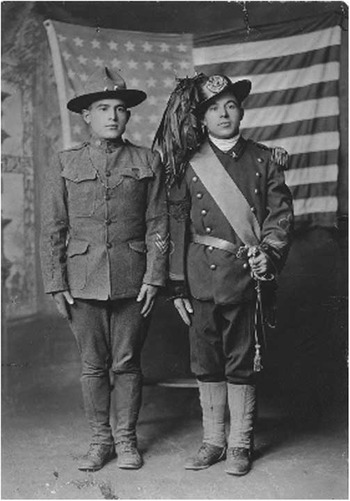
A photograph portrays two young men in a photographic studio at the beginning of the twentieth century. One is wearing the uniform of the American doughboys, and the other the uniform of the rifle regiment (bersaglieri) in the Italian army. The American flag stands tall behind them (Figure 1). This is a portrait that suggests composure and patriotism during the First World War. The subjects’ frontal pose and gaze evoke order and a symmetry that reflects their new military life, comprised of discipline, martial formalities, ritualisation and repetitions. Their presence is defined by their public roles as soldiers and fighters for two national causes. The picture is a photographic studio portrait that speaks to a public viewer (i.e. State, institution, press or archive) and to a private one (family and acquaintances), and that contains visual codes (i.e. flag, uniforms) that define its social and collective significance.
Unknown photographer, c. 1918. Italian-American twin brothers (born 1899). Nd. With kind permission of Fondazione Paolo Cresci per la storia dell’emigrazione italiana, Lucca.

The two young men are Italian-American twin brothers. Beneath their different uniforms and choices, they not only mirror each other physically, they also share the same Italian heritage and country of residence. This is, therefore, a photographic portrait representative of a particular collective experience and of the condition of many Italians living abroad who, during the war, joined their adopted country’s army or decided to fight for their country of origin. It evokes migration and war, mobility and mobilisation.
Involving around 50 countries within the Entente and Central Powers (with their colonies and diverse ethnic groups), the First World War was the first global conflict during which mobilisation and mobility complemented each other.Footnote 1 From the beginning of the new century, the conflict evolved alongside a period of transnational movements. Between 1815 and 1939, more than 50 million people departed from Europe to non-European destinations, mostly to North and South America, but also to South Africa and Australia, in search of a better life. About 14 million Italians emigrated between 1871 and 1914, and about 23 million left their country in the hundred years since unification in 1860. In 1896, with the end of the international depression, unskilled, mostly male, Italian rural workers moved to other parts of Europe and overseas in order to work in construction, mining, industry or on plantations, or even in search of cheap land in fertile plains (Hatton and Williamson Reference Hatton and Williamson1998; Baily Reference Baily1999; Hoerder Reference Hoerder2002). The outbreak of the war, however, saw hundreds of European emigrants, including Italians, return to their motherland through conscription or as volunteers, to serve in its army. Others, having obtained citizenship or naturalisation abroad, served in their adopted country.
By using the portrait of the Italian-American twin brothers as a starting point, this article seeks to explore the tensions of the photographic language in this ordered representation of modern war and migration. The portraits analysed, in particular, capture the very specific liminal moment when the people pictured are neither civilians any longer nor yet soldiers on the battlefield. While many studies of war photos exist, there is, in fact, very little literature on migrants framed in the post-civilian, pre-battlefield instant. Examples are drawn primarily from the migration of Italians to America and Australia. Although they were produced in different geographical and social contexts, all these images have many commonalities as they are all products of similar mechanisms and are exposed to the same discourse. They are all spaces of appearance for the production of private and public imagination, and for the organisation of a set of relations between knowledge, body and power (Lalvani Reference Lalvani1996; Hariman and Lucaites Reference Hariman and Lucaites2016). At the same time, the fixed image that we see is subject to continuous transformations according to the context (i.e. propaganda, military, commemorative, or private and vernacular) in which the photograph appears (Sekula Reference Sekula1975; Burgin Reference Burgin1982; Tagg Reference Tagg1993). However, how are mobility and mobilisation captured through the visual language of photographic portraits of war and migration? And to what extent do the subject’s interior reality and individuality emerge from the reassuring surface imagery of photography and war?
Photography’s otherness
The Great War produced an extraordinary number of images. It was the first time a war was represented, idealised and documented through such a large range of figurative materials: drawings made by soldiers in the trenches; exhibitions of military art organised to support the war; postcards and posters; illustrations in magazines as well as satirical cartoons and caricatures in daily papers. It was, above all, the ‘war of the camera’ (Thomas Reference Thomas2014, 8). The conflict was recorded, framed and commercialised through new technology and advanced chemistry. Faster lenses, films and papers, and the advent of hand-held cameras allowed professionals, amateur photographers, photo-journalists, officials and soldiers to shoot places, military objects and bodies in and around the battlefields. The ‘shooting’ of pictures accompanied and documented the physical (and psychological) shooting of people. In her book on the uses and meanings of images of war Susan Sontag states how ‘there is no war without photography’. As she reminds us, quoting from Ernst Jünger, there is an irrepressible connection between shooting a subject with a camera and shooting a human being with a gun (Sontag Reference Sontag2004, 59–60).
From official photographs (and cinematographic representation), imbued with rhetoric and propaganda, to professional studio portraits and private photographs made by the soldiers themselves to be sent home from the front, photography emerged as a powerful means for documenting and idealising a modern, anonymous form of war.
At the dawn of the new century war photography – in its varied types and formats – was a modern project aimed at educating ‘the senses to perceive order in a field of destruction and unprecedented disorder’ (Hüppauf Reference Hüppauf1993, 143). On one hand, the new language and technology of modern photography shaped and changed people’s way of seeing and their perception of violence and devastation. For instance, bodies and battlefields were, for the first time, caught, displayed and categorised through new visual devices such as Machine Gun sights, observation balloons and aerial photography. On the other hand, war photography offered a space to depict the ordinary soldier and scenes of ordinary life. It established a new visual code that normalised the body, the human face and military objects during wartime.Footnote 2 In Italy, for example, the popular illustrated periodical Illustrazione italiana devoted around 75 per cent of each weekly issue during the war to photos that depicted towns, troops marching or relaxing in trenches, or enemy soldiers surrendering. It almost never showed troops firing, apart from German and French troops. Similarly, the popular colourful sketches by Achille Beltrame in the Domenica del Corriere participated in the construction of a romanticised, honourable image of Italians at war (Leoni and Zadra Reference Leoni and Zadra1986; Miele and Vighy Reference Miele and Vighy1996). Such a representation provided the language for an idealisation of war, soldiers and battlefields, and war photography inevitably became a promotion of war itself (Gilardi Reference Gilardi1980, 42; Schwarz Reference Schwarz1986).
In Italy, throughout the conflict, the need for information and propaganda created an increasing distribution of illustrated periodicals and volumes (for example, La Guerra sociale or La Guerra: pubblicazione settimanale, illustrata), as well as the production of photo-postcards with war and patriotic themes, often distributed for free in order to encourage consensus among soldiers and the public. A number of these publications were destined for Italians abroad or celebrated the contribution of the Italian community abroad to the Italian war.Footnote 3 Printed in magazines and pamphlets, and displayed in exhibitions, images depicting the reassuring, honourable and patriotic face of the war provided a visual articulation of community belonging and the fabrication of a national identity in Italy and its community overseas.
The endorsed ordinariness of the war, as offered through photography, can be seen as an aspect of what Eric Leed, in his seminal No Man’s Land (1979), called the ‘otherness’ of war, that is the construction, displaying, and framing of ideas and images of the conflict as an alternative world shaped by the ‘realities of economic, political, and social life’ (67). The war mobilised a logic that presented the conflict as a positive, alternative realm ‘that asserted the social and existential “otherness” of war as an alternative and curative to life in civil society’ (193).
Photography’s ‘otherness’ was the order and ordinariness it offered in motionless and flat images where, paradoxically, mobilisation and mobility were fixed in between reality and fabrication. This ‘otherness’ can be seen, for instance, in group photographs taken outdoors, as well as in photographic studio portraits. The latter, particularly in the subject’s posture and performance in the neutral space of the enclosed photographer’s studio, enhance the paradox and ambiguity of the photograph and create an image that reflects the complexities of displaced identities.
Moving to the warfront
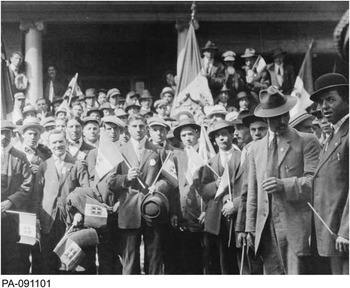
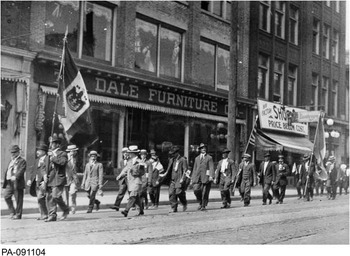
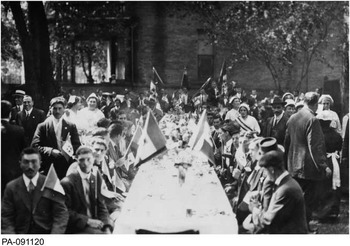
A number of photographs taken in 1915 show Italian reservists in Toronto. Some march along streets in support of the war, others sit around a table on the occasion of a dinner organised by the Italian Red Cross in Canada, or just stand in groups in front of the camera (Figures 2, 3, 4). The surface imagery that is given to the viewer is one of union and support for a national cause. The subjects hold flags and banners to materially reinforce their hypothetical, patriotic involvement. The photographs (available at Library and Archives, Canada) are part of the collection of Eugenio D’Angelo (also said to be the photographer), secretary to the Italian Consul and treasurer of the Italian Red Cross in Toronto, at the time.
Italian-Canadian reservists preparing for the First World War, Toronto, Ontario, c.1915. Eugenio D’Angelo Fonds, Library and Archives Canada, PA-091101.

Italian-Canadian reservists marching off to First World War. Yonge and Dundas Streets, Toronto, Ontario, c. 1915. Eugenio D’Angelo Fonds, Library and Archives Canada, PA-091104.

Italian-Canadian reservists enjoying dinner given by the women of the Italian Red Cross Society, Toronto, Ontario, 1915. Eugenio D’Angelo Fonds, Library and Archives Canada, PA-091120.

In these images, war is presented in its normality and indistinctness through the reservists’ ordinary suits and hats, their composed gathering and anonymity. They are all framed together, in large groups with no emphasis on individuality. These images anticipate the more military-esque photographs where they will be captured in their uniforms, in even larger groups. The displaced and liminal body of the migrant is here reappropriated and mobilised by a central power. According to the Italian nationalists and their propaganda, moreover, the exemplary soldier was part of an organic system whose aim was to fight for the nation. Novelist, militant journalist and nationalist political figure Enrico Corradini – whose ideology was an integral source of the original fascism of 1919 – declared: ‘Tutti uguali nel combattimento e nella morte, uguali nel sacrificio, tutti di uguale gloria a voi, uguali tutti nella gratitudine della Patria’ (‘All are equal in the fight and death, all are equal in the sacrifice, glory and gratitude for the patria’) (Corradini Reference Corradini1925, 319; Roccucci Reference Roccucci2007, 115–137).
Male emigrants and their sons – even if born abroad – were all considered to be reservists and soldiers for the Italian army, and subjects to be recalled at any time by the Italian king (Choate Reference Choate2008, 6–9). Similar photographs that represent the riservisti or richiamati (recalled) marching with flags in streets in New York or Buenos Aires, can be easily found in the print media of the time, in Italy (such as in Illustrazione italiana and Il Giornale d’Italia) and abroad (for instance in Patria degli italiani published in Buenos Aires). Reproduced and multiplied, these photographs promoted the image of an expatriate network of ‘Italians Abroad’– made up of emigrants, exiles, expatriates to the colonies, and the unredeemed – in order to spread the idea of a ‘Greater Italy’ uniting all members of the Italian nation, at home and abroad (Choate Reference Choate2008).
In general, however, poor information on Italy’s position, and the consequent lack of sensibility towards the conflict, made the Italians abroad weak supporters of Italy’s intervention, at least until 1917, a year characterised, among other events, by the Italian military disasters at Caporetto. In order to raise support from Italians abroad, one of the initiatives – promoted by Prime Minister Vittorio Emanuele Orlando, who was appointed in 1917 – was the creation of an Undersecretary for the Propaganda and Press Abroad (Sottosegretario per la Propaganda all’estero e per la Stampa). In 1918, regular telegraphic services were set up in Paris, New York, London, Washington and Buenos Aires, together with photo-cinematographic services. Between 1917 and 1918, around one million postcards and over 700,000 publications, including leaflets and illustrated journals representing the various technical and political aspects of the Italian contribution to the conflict, were sent overseas.Footnote 4 Gallenga, the Under-Secretary of State for overseas propaganda and a right-wing Liberal, believed that all the Italians abroad had to be propagandists of their own native country once the emigrants grasped that
although dispersed in the Argentinian Andes, or in the Russian Steppes, or in the Californian mines, or in the Brazilian ‘facendas’, or in the deserts of Egypt, their own government is the best protector, the most trusted and generous cooperator of its people and patriots. (Quoted in Tosi Reference Tosi1971, 519–542)Footnote 5
Overseas, Italians’ reactions to the war and propaganda varied, depending on diverse cultural influences and social conditions, including communication links with the Italian government through consuls, ethnic press, and the church (Douki Reference Douki2007, 91–114).
According to data registered by the Italian Ministry of War, around 303,900 soldiers repatriated to Italy from 24 May 1915 to 31 December 1918 (around 200,000 in 1915 and only 25,000 in 1917), of which 51.1 per cent arrived from Northern and Latin America, and around 42.3 per cent from European countries (Statistica dello sforzo militare italiano 1927; Nicosia and Prencipe Reference Nicosia and Prencipe2009, 100–112).
The imperfectly recorded numbers of Italian migrants returning to Italy from America during the First World War vary from region to region, with a low percentage of departures from Brazil as compared to those from Argentina, the United States and Canada.Footnote 6
As part of the immigrant world, the Church had the power to influence the Italian reservists and to reinforce Italian patriotism. Religious periodicals (such as Corriere della Domenica in New York, or Osservatore Cattolico in California) also reported the Italians’ heroism during the war, convincing their readers that Italy and its emigrants would emerge as a better nation (Sterba Reference Sterba2003, 48–51). At the same time, Italian newspapers in America (for instance, Il progresso Italo-americano, Bollettino, La Follia, Il Giornale Italiano, Il Carroccio, as well as Patria degli italiani in Buenos Aires, and Fanfulla in San Paulo) reinforced the attitude of the American press regarding the German atrocities and the need for a free Northern Italy with its terre irredente.Footnote 7
Many Italian Americans, however, had kept strong emotional and family ties to their place of origin in Italy, and contributing to the American war effort was in effect also a way to maintain their faithful attachment to their ancestral country and to aid it in its struggle. For example, in his letters (preserved in the Archivio Ligure della Scrittura Popolare, Genoa) Americo Orlando, who was born in Brazil and whose family was originally from Abruzzo, wrote to his mother: ‘[...] hai un figlio che si trova a difendere i diritti e la libertà dei suoi fratelli che si trovano al gioco straniero’ (‘you have a son who is defending the rights and freedom of his brethren who are at the mercy of a foreign game’) (in Rossi Reference Rossi2007, 48; see also Gibelli Reference Gibelli2016).
At the same time, following Woodrow Wilson’s drafting against the German Empire in 1917, for many Italians, who sought to conform to the American ways and to be more readily accepted, getting involved in the war could be an opportunity to demonstrate loyalty and devotion to the new homeland (Ventresco Reference Ventresco1978; Sterba Reference Sterba2003; Laskin Reference Laskin2010). The American press had influence in appealing to the patriotism of the immigrants, even though a high percentage of Italians was not able to read English (Luconi Reference Luconi2007, 475–476). Fighting for the American army could also guarantee faster access to citizenship and offered an opportunity to integrate.
A different example is offered by the Italian community in Australia (a very small community in 1914, compared with the US and Latin America) where more complex social and economic conditions characterised the Italians’ attitudes to the war. Before the Great War, many Italian migrants were completely isolated from events happening in Italy and in most cases they did not demonstrate particular interest in Italian affairs, especially due to illiteracy (Cresciani Reference Cresciani2003). The geographic dispersal of Italians in Australia, the lack of significant social infrastructure, associations and societies, as well as the difficult integration the migrants also experienced in parish life, did not encourage particularly patriotic feelings for Italy at war. Moreover, very few topical journals circulated in Australia at the turn of the century: those that existed included Uniamoci, L’Italo-Australiano and Oceania, published in very few issues in Sydney until 1915. At the turn of the century, various young Italian males had also migrated overseas to escape the enforced post-unification conscription law. As studied by Agutter (Reference Agutter2006), a very small number of Italians volunteered in 1915 to fight in Italy. Between 1917 and May 1918, around 500 Italian men were forced to repatriate to Italy and enrol in the Italian army by the Australian government.
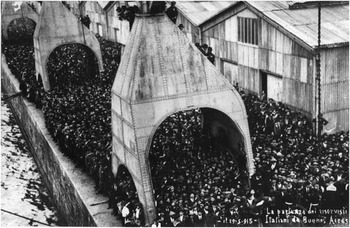
It is within the context of a new mobilisation of media and images that photographs of groups and crowds of Italian migrants, whether civilians or servicemen, gathered at departing docks (Figure 5), consular and conscription offices, undergoing medical examination, or assembled in dormitories and refectories before being embarked to be sent to the Italian front, reveal their ideological language as propaganda.Footnote 8 These photographs circulated in the form of postcards and exhibitions, and responded to the mechanisms of warfare and power in order to influence public opinion, to sway viewers to nationalistic sentiment and to influence Italians abroad to fight for their country of origin. In Said’s sense, representations of war and migration are misrepresentations because they are ‘embedded first in the language and then in the culture, institutions, and political ambience of the representer’ (Said Reference Said1979, 272). Moreover, these photographs of groups and masses of Italian reservists and recalled portray an ‘anonymous corporeality’ that hides individuality and identity (Malkki Reference Malkki1996). They are not so different from the hundreds of photographs framing groups and large crowds of Italian migrants in landing docks and immigration stations (such as at Ellis Island, where they were processed, medically inspected and classified) or in Italian harbours and train stations waiting to depart to far away lands, at the turn of the nineteenth century.Footnote 9 These photographs were taken by sociologists, journalists and officers, and were often part of official projects and social surveys in which, according to John Tagg, photography is complicit in the discourses which function to exert social and political control (Tagg Reference Tagg1993). They offered to the viewer people framed in enabled forms of surveillance and disciplinary power.
La partenza dei riservisti italiani da Buenos Aires, 1915. With kind permission of Fondazione Paolo Cresci per la storia dell’emigrazione italiana, Lucca.

In all these representations of migration and war, bodies are visualised and turned into a spectacle as both part of a national project (i.e. making a Greater Italy abroad) and a politics of order and control (i.e. inspecting and regulating immigration).
Accordingly, in the photographs of the Italian Canadian reservists, bodies can be seen as symbolic of the body of Italy, reunified to fight for a nation-building project. In his essay Il nostro soldato, Agostino Gemelli – friar, physician and psychologist – wrote of how ‘the soldier stops being a man and becomes part of a whole […] the soldier loses his individual identity and physiognomy to become one of a thousand, mixed up in the large mass’ (Gemelli Reference Gemelli1917, 37). In these photographs individuality seems concealed. Yet the more anonymous they are, the more these photographs seem to suggest the interior displaced conditions of their subjects. Beyond the public surface, the sombre, distracted or pensive expressions of the Italian Canadian reservists seem to weaken the atmosphere of patriotic commitment. We can see that some of the men are better dressed than others; this is indicative of different social status and different experiences in the new country. The outdoor public places where they are photographed take on the space of their adopted country, previously a land of arrival for them and now a land of departure. These photographs possess a sense of transition in their representation of Italian migrants on their journey to becoming soldiers, and in their passage from one diaspora (their migration from Italy to the new country and the subsequent condition of displacement) to another. The war will keep the migrant soldiers away from their new home and create a new diaspora that will disseminate them in trenches, battlefields, prison camps and hospitals, within and outside national borders. The photographs are, consequently, emblematic of ‘the experience of the dissolution of subjectivity and its traditional patterns of orientation and values’ and of ‘a gigantic rite of passage into the modern condition’, as discussed by Hüppauf (Reference Hüppauf1995, 110).
It is in pursuit of a space to construct an enduring image of himself – in opposition to the indistinctive group photograph – that the soldier enters, whenever possible, the organised and enclosed photographic studio. Supervised by the photographer, the migrant soldier learnt to see himself as ‘an image’, and to see himself in the eyes of others (Trachtenberg Reference Trachtenberg1990, 29; Kozloff Reference Kozloff2007, 168).
Portraits of displacement
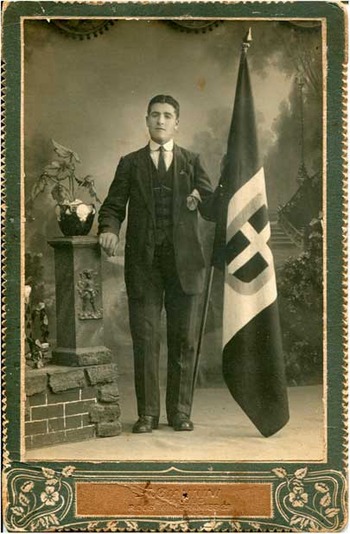
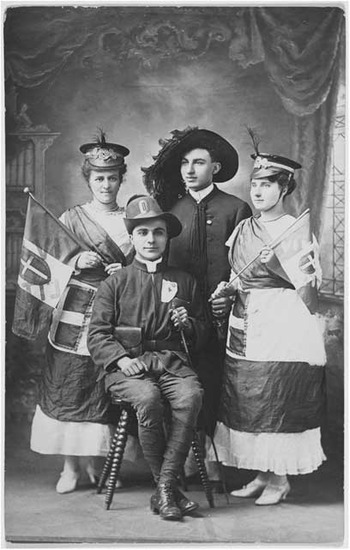
A photographic portrait shows a young man of Italian origin living in Brazil. It was taken before his departure as a volunteer, in an Italian photographic studio in San Paulo, in 1918. The subject poses self-confidently, holding the flag of the Italian kingdom (Figure 6). Another tattered black-and-white photograph shows two young women and two men, all of Italian origin, posing in a photographic studio in Sydney in 1917 (Figure 7). Their pose is rigid and they are smiling. The women are wearing traditional Italian clothing, and the men are in military uniforms, holding Italian flags, at a fundraising occasion during the First World War.
Unknown photographer. Angelo A. before departing as volunteer for the war, Brazil, 1918. With kind permission of Fondazione Paolo Cresci per la storia dell’emigrazione italiana, Lucca.

Unknown photographer. Macinante family members, Sydney, 1917. State Library of New South Wales, ML MSS 5288 Add-on 1967.

In thousands of similar portraits, preserved in private and public archives (in Italy and abroad), the subjects pose with backdrops representing unidentified romantic interiors or outdoor spaces or war camps and artefacts. It is a performance where aesthetic and visual codes reflect the constructions of honour, order and self-sacrifice promoted by the conflict. It also intends to demonstrate loyalty to the new culture or the native, and – through the presence of the female figures – a shared devotion to a national cause. Within the controlled neutrality of the enclosed studio, a private self is presented in a public context. Similar to the photographs of Italian reservists in Canada, these ones are, in fact, also a description of social identity. They fix the public selves within the image of a collective experience, that was, however, as explained earlier, diverse and complex.
The portraits described above, as in the case of the studio portrait of the Italian-American twin brothers, belong to different geographical and social contexts, and moments or conditions of production (i.e. light or particular optical and chemical devices). However, they all mirror the way in which war culture grants order, ‘status and meaning’ on the photographed individual, ‘while the subject as image floats problematically between exterior and interior identities’ (Clarke Reference Clarke1992, 1–5; 72–74).
Portraits in particular can become powerful, flexible and an easily accessible means for identities to be negotiated and constructed. In these images, as in many others, the subject of Italian origin poses in front of the photographer in uniform or in plain clothes; expressions vary from severity, pride, self-confidence to diffidence, timidity and subjection. As Graham Clarke points out, the portrait offers the ‘promise of the individual through a system of representation which at once hides and distorts the subject before the lens’ (Clarke Reference Clarke1992, 3). The mannerisms, poses and expressions – all representational codes of the photographic portrait widely known everywhere (Henisch and Henisch Reference Henisch and Henisch1994) – have, in turn, already framed and fixed the individual.Footnote 10
The anonymity of many of these portraits imbues them with an artificial objectivity and makes us wonder what more lies under the surface image and the face that is offered publicly, as in the group photographs of Italian reservists. What is displayed in the portrait hides a deeper subjective condition that, in our case, is one of somebody forced to negotiate the complexities of war, home and nation.
With regard to migrant soldiers enrolling into the Italian army, as in the case of the subjects of the two portraits made in San Paulo and Sydney (Figures 6 and 7), the return to their motherland from another continent to fight the war resulted in trauma for the majority of reservists and conscripts, and in great disillusionment, even for the most enthusiastic of volunteers. In common with many Italian soldiers at the warfront, Italian migrants’ correspondence from the military front is frequently studded with outbursts – often circumventing censorship guidelines – addressed to Italy, its rulers and the army elite, as excerpts from thousands of soldiers’ letters demonstrate. Examples from volumes (Procacci Reference Procacci2000; Antonelli Reference Antonelli2014; Gibelli Reference Gibelli2016), archives such as Archivio ligure della scrittura popolare (ALSP), in Genoa, and digital collections that, throughout the years, have gathered precious correspondence, diaries and memoirs (including photographs) of Italian soldiers, show strong feelings of disappointment, disgust, horror and anger towards the war (Wilcox Reference Wilcox2012, 171–184). For instance, the word macello (slaughter) appears constantly in letters written by semi-literate correspondents, as in the following extracts:
They take us to the slaughter but I can run away to Austria and make myself prisoner and then return to America […] otherwise life here is not saved. If you could only see how many prisoners from one side and the other – you have asked about a photograph of me and I cannot have it done right now, because there is nowhere to have it done. (Letter from war zone to Pittsburgh, USA, from the trenches, 2 April 1916, in Procacci Reference Procacci2000, 399)
[…] and where am I now? I am in the slaughter house of the ambitious powers – I am devoid of any form of freedom? (Letter from war zone to Buenos Aires, 24 April 1916, in Procacci Reference Procacci2000, 400–401)
I remember the old times and how different they are to the present! Why have I come to Italy? What terrible sin have I committed to be punished in such a way? If I had known of such a thing, I would have stayed in America […] Dear nephew, you are well, and think it over carefully before you get it into your head that you want to come to these countries. Here civilisation has disappeared completely, […] I curse the moment I returned here. You know very well that I have always been abroad and lived well: but once I returned to Italy, can you see I was rewarded? […] I am very regretful that I repatriated […] Censorship or not, I cannot speak well of this war. And don’t trust the papers that always report the opposite of what people think […] Enjoy your America and forget about these warmongers. […] Here these are barbaric countries, full of exploiters and of all that is bad in this world. (Letter from Zona di Guerra to Oakland (US), from the front, 20 September 1916, in Procacci Reference Procacci2000, 420–421)
The letters capture the destructive, displacing mobility (‘Where am I now?’; ‘Why have I come to Italy?’) caused by both modern migration and war. A sense of death and loss, and a condemnation of the absurdity of the conflict, is in stark contrast to the naive or utilitarian idea of the war many nurtured before departure or that was often cultivated by relatives and friends left abroad and influenced by war propaganda. For instance:
After having seen so many horrible scenes with my own eyes, I am convinced my feet will never again walk on the streets of Buenos Aires, and my eyes won’t see friends I would like to see and to talk to, of many, many things. […] You must know with what great enthusiasm I left Buenos Aires. Can you tell where those days have gone? I have seen so many things, things that I cannot tell you here, otherwise censorship would stop this letter and it is better I keep quiet […] I was one of the most patriotic people otherwise I would not have left Buenos A. (Letter from Zona di Guerra to Buenos Aires, 2 August 1916, in Procacci Reference Procacci2000, 412–413)
In the memoirs of Giovanni Arru, who worked in America, it is possible to read his ambivalence between remaining in the adopted country and leaving it to return to his family in Italy through enrolment. Once enrolled ‘I regretted it as soon as I arrived in Italy because they sent me to the front without letting me see my beloved ones’ (Giovanni Arru, ‘Ricordo della mia infanzia’, 1915 [193-]. Manuscript, Fondazione Archivio Diaristico Nazionale, Pieve Santo Stefano; Serra Reference Serra2007).
What emerges from these records – and what helps us to understand the deeper meaning of the photographs – is how, for many migrants, their return to Italy was a return to another world, to an unrecognisable native country, and a condition of physical and psychological suffering they had never experienced before. Part of a larger narration of the impossible nostos, this unease with Italy at their return is intrinsic to the experience of migration itself. In particular, as often pointed out within the context of migration studies and criticism, an ambivalence characterises the existence of the migrant who lives in-between here and there, home and host country. When moving from his/her native place to another country or town, the migrant has to face a process of reconstructing home, adapting to the new world and, at the same time, modifying his/her relationship with the native place. Returning to their ancestral country (Italy, in this case) is, nevertheless, important for the redefinition of a migrant’s identity. The migrant constantly carries a longing for a place and time when living somewhere else (White Reference White1995, 3). For migrant soldiers, such a displaced, ambivalent condition is exacerbated by having to witness the horrifying face of modernity as it appears through the war. Returning to Italy, and confronting a reality they cannot recognise, they barely identify with the native land they nostalgically mythicised from a distance. Paradoxically, it is now the family and the new house in the adopted country that are idealised as a secure place. In many migrant soldiers’ letters, as seen above, the adopted country appears as an imagined community, idealised against fragmentation and alienation. The migrant soldiers’ desire is, therefore, at this point, positioned not only towards their adopted land and life, but also to a time (in America, Australia or somewhere else) that does not correspond with their past before migration, their present and, likely, not even with their uncertain future.
As observed by Eric Leed, the experience of war offered a stage where cultural polarities emerged and were redefined (Leed Reference Leed1979). The soldiers’ letters to relatives and friends, the journals and diaries penned from the warfront, show how fear, disorientation and passivity were also often coupled with aggressive attitudes. Antonio Gibelli, for instance, points to the pleasure in killing the Austrian enemy that is candidly expressed in the letters of the Italian-American Americo Orlando, mentioned earlier (Gibelli Reference Gibelli2016, 6).
Perceptions of known and unknown, good and bad, familiar and foreign, past and present, as well as inclusion and exclusion, acquired new meanings and dimensions. For Leed, at the front, the antithesis between society and community was transformed into the antithesis of ‘home’ and ‘front’ (1979, 72). Yet the perception of ‘home’, ‘homeland’ and in particular of patria – with its patriotic and militaristic overtones – together with that of national identity, was a complex concept for the Italian migrant of humble origins, as for the majority of Italians of the time.
Many of the soldiers’ primary loyalties were to the family, the village and the region, the paese. Agostino Gemelli wrote of how ‘talking of patria for these simple men does not have any meaning. These are humble men who have not studied, they certainly do not have a national awareness, or an historical vision of the fate of the patria’ (1918, 38–39). As also observed by Martyn Lyons, although patriot soldiers fought on the Italian front, entire collections of correspondence written by soldiers do not mention key words like ‘victory’, ‘motherland’ or even ‘Italy’ itself (Reference Lyons2013, 113). Consequently, the Italian migrant could often be excluded from concepts of italianità (Italianness), since many migrants had not participated in the process of unification because they left Italy earlier. As a result, Italian migrants developed their own versions of (hybrid) Italianness abroad (Gabaccia Reference Gabaccia2003; Foot Reference Foot2014, 37). The identification with the new, distant Italian nation remained limited to urban, educated, and bourgeois people. Outside the borders of the nation-state, emigrants created their own ‘little Italies’, although the absence of some attachment to Italy, once the migrants arrived in a foreign country, did not necessarily mean that they were unable to eventually identify themselves with their ancestral country (Luconi Reference Luconi2007), as mentioned earlier.
However, national identities were subject to renegotiation in contact with other cultures, languages and territories. If emigrants returned to Italy, these identities changed again, temporarily or permanently. For Italian migrants and their male children, returning – often deported, as for the Italians in Australia – to the mother country to fight in the war, patria and the ‘front’ ended up overlapping.
It is this complex, displaced identity and the ambivalence of an individual who is twice the product of diaspora that needs to be considered in the portraits of Italian soldiers which very often accompanied migrants’ letters. The migrant and the soldier, the result of both transnational mobility and global mobilisation, are offered through the visual means of technology, military organisation, war and state. However, beyond the impression of order, resoluteness, glory and national pride constructed by the photographer, in the photographic studio (and by the institutions that often distributed these images), a displaced individual emerges with, often, a confused national awareness and sense of belonging.
The subjects of these portraits are captured at a liminal moment, neither in peace nor yet on the battlefield. They are no longer simply migrants nor yet simply fully soldiers. Yet it is possible to imagine these same subjects posing for similar portraits after they had just arrived in their new destination country, in search of a better life. Exposed to racial, cultural, and linguistic barriers, many Italian migrants saw the photographer’s studio as a place where they could assert control over their own visibility in opposition to dominating strategies of order and representation, as mentioned earlier. Posing in their best attire and surrounded by conventionalised props and painted backdrops – to show or fake an achieved social status – the migrant attempted to construct not only a desired social and economic identity, but also a coherent space in which to endure the spatial and temporal rupture and dispossession caused by migration (Alù Reference Alù2014; see also Campt Reference Campt2012, 158–168).
Like the migrant’s condition of displacement caused by diaspora (with all the cultural and linguistic conflicts it implies), a condition of estrangement and isolation also caused by war is masked in the photographic portraits of migrant soldiers. These images rely on the visual codes of pictorialism to emphasise the human presence and express ideals of order, service, courage and loyalty. They create an aesthetic realm that transcends the chaos and destruction caused by modernity (Dixon Reference Dixon2012, 152–153). They are indeed emblematic of a crisis of representation.
For Hüppauf there is no longer a space of humanity or of nature outside war (1995). The modern conflict is, consequently, unrepresentable in the old codes of traditional photography. In Hüppauf’s sense, photographic portraiture, in particular, is regressive as it represents nostalgically archaic, pre-modern ideas of the individual and community that the modern industrial war has, instead, annihilated. Looking at the parallel visual codes of war photography and migration photography, it can be argued, though, that the destructive power of war is already prefigured in the related destructive mobility of migration, which similarly obliterates old, centred notions of self, community and nation.
A suspended condition
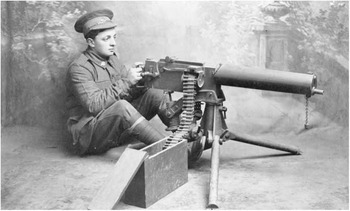
A black-and-white studio photograph, taken in 1917, shows a young soldier sitting on the floor, leaning on the wall behind with a backdrop reproducing a romantic garden. He holds a Machine Gun. He has a vacant and humble expression and his gaze is directed towards an unidentified point. This photograph shows Private Antonio Augustine Picone, a young Italian-Australian man who was born in Italy (according to public records), and who fought in the Australian Imperial Forces, the only all-volunteer army in the First World War (Figure 8).Footnote 11
Postcard with image of Tony Picone dressed in Australian Imperial Forces [AIF] uniform and posing with a Machine Gun. Inscribed on verso: ‘To dear Vince with best wishes from Tony 1917’. Reproduced with permission of Co.As.It. – Italian Historical Society Collection, Melbourne.

Only around 150 Italians living in Australia volunteered for service in the Australian Infantry Force. The ‘call to arms’ in the Australian press and through the War Precautions Act made Italian reservists who refused to render service guilty of an offence. Italians, in general, were not permitted to join the AIF (unless they were naturalised), and some of those who did manage to enlist were dismissed or transferred to the Italian forces from France (Agutter Reference Agutter2006).Footnote 12
The photographic portrait of Picone is emblematic of the mise en scène of the war with its mechanisation and materialism (Bollati Reference Bollati1979, 50) where the human body and the machine (here as both weapon and photography) becomes one entity. As in the case of all the portraits seen thus far, this photograph is also an image of a suspended condition in between reality and imagination. It captures an order where mobilisation and mobility interlace, moulding the modern subject and subjugating their individuality to uniform, mechanical laws of production and warfare.
Photography reflects the interchangeable relation between reality and representation, imagination and real experience. Like the other photographs discussed above, this one is also a performance of staged order during which the viewer is charmed by the military clothing, the peaceful setting, the theatrical backdrop of the photographic studio, and the composed pose of the serviceman. Like the ‘theatre of war’, as defined by Fussell, the photograph is a stage for presenting the reassuring face of the war where the brutality of the conflict could be re-imagined and the ‘unspeakable could to a degree be familiarised and interpreted’ (2013, 199).
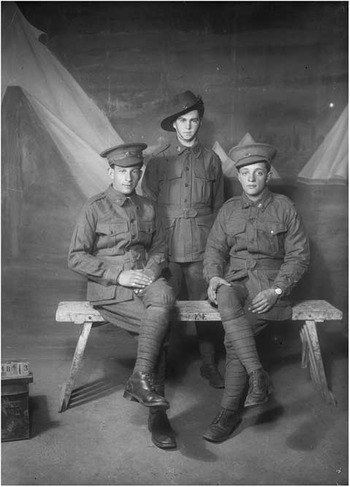
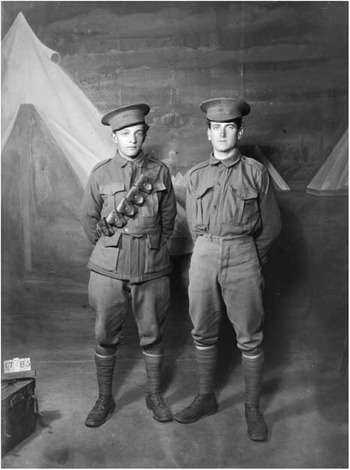
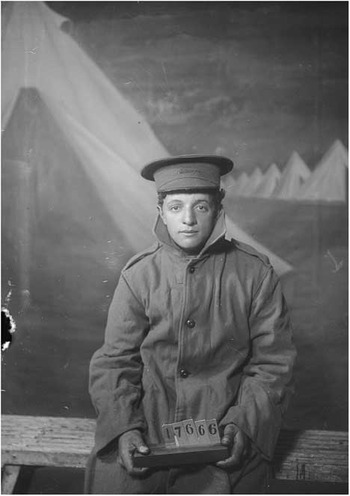
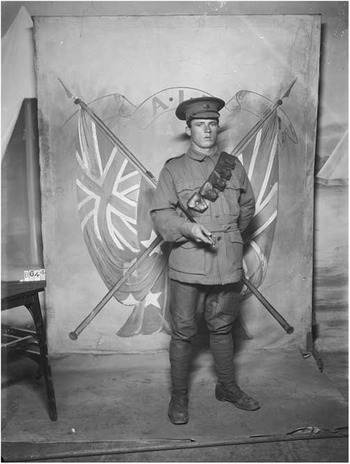
The repeated and serialised theatrical performance in all these photographic portraits is accentuated in the photographs taken by professionals in army camps. One striking example is offered by the Darge Photographic Company in Australia. Algernon Darge had the permission to take photographs of men at the Broadmeadows and Seymour army camps prior to their embarkation for overseas service (Figures 9, 10 and 11). In the 1930s, the Australian War Memorial purchased the original glass negatives from Darge, along with the photographer’s notebooks. The notebooks contain brief details, usually a surname or unit name, for each negative.Footnote 13 Hundreds of photographic studio portraits show recurring, stagnant poses and settings that seem to reproduce the repetitive rhythm of the war, its ritualisation, slow pace and endless actions (shooting, advancing in trenches, endless waiting for orders and action). Soldiers pose standing or sitting, alone, in small groups, with members of their family, nurses or other senior servicemen; the same backdrop portraying military tents hangs behind them constantly. One just needs to go through these images and read their captions – and related Embarkation Rolls – to discover soldiers of Italian origin. Whether first- or second-generation Italian-Australian, they are part of the same pantomime, in which the individual takes a romanticised, idealised role according to warfare’s requirements and publicity.
Darge Photographic Company. Group studio portrait of three Australian soldiers, c. 24 July 1917. The only soldier identified is 808 Private (Pte) Antonio Augustine Picone, 6th Machine Gun Company from Stawell, Victoria (born in Italy) on the right. Australian War Memorial. DA18413. https://www.awm.gov.au/collection/DA18413/

Darge Photographic Company. Group portrait of A. Picone and V. Presser, c. 3 May 1917. Australian War Memorial, DA17785. https://www.awm.gov.au/collection/DA17785/

Darge Photographic Company. Studio portrait of 808 Private (Pte) Antonio Augustine Picone, 6th Machine Gun Company from Stawell, Victoria (born in Italy), c. 1 May 1917. Australian War Memorial, DA17666. https://www.awm.gov.au/collection/DA17666/

It is this ‘otherness’ that emerges, in the first place, from photographic portraits of Italian migrant soldiers. In the Darge photographs – unlike other photographic portraits of migrants enrolled in the Italian army, as seen earlier – racial differences seem annulled. Here the foreign or naturalised migrant, numbered and catalogued by the photographer, mingles with the others to become one whole entity. Any visual mark of his Italian heritage seems to have disappeared. The migrant subject’s body becomes a fragment of the collective experience of the global war and a product of its mass production. Photography, here, is clearly a means to catalogue and record through acts of repetition; it reflects the infinite duplication of objects achieved by mass industrialisation and warfare. During the war, photography itself was, more than ever, used to serve mechanisms of destruction, terror, labour and surveillance, and the organisation of men and objects. It became part of the ‘total’ experience of the war and, together with other machines, it was a means that arranged and modelled the world independently of individuals’ wills or needs.
With the war, we witness the multiplication and fragmentation of visual images. For the first time, an event was presented to contemporary and future generations in a ‘multiple refraction’; it was both amplified and fragmented and its meaning was multiplied (Gibelli Reference Gibelli2007, 11). The Darge portraits, with their repetition, reflect this multiplication. In these portraits, the fragmentation of the object joins that of its subject, and reality intersects with its representation. The subject’s photographic portrait is also part of the triumph of the machine over the human. Private Picone’s portrait posing with his (almost prosthetic) Machine Gun can be seen as a metaphor for the power of the weapon and mechanisation over the individual.
In between life and performance, each Darge photograph of Private Picone – as in the case of the war – proffers a fictional ‘otherness’, a constructed world where the Italian migrant’s individuality seems to have disappeared.
In the case of the portraits of Picone, as well as of other soldiers of Italian origin like Private Camillo Giovanini (Figure 12), wounded and killed in action in 1916, the caption under the photograph offers further clues about the subject’s private history. The text seems to stabilise the image and provides the viewer with a social and historical map that partially restores the subject’s individuality. The caption (added more recently by the AWM archive; https://www.awm.gov.au/collection/DA08644/) and other documentation of the time (such as Embarkation Rolls, Red Cross Wounded and Missing registers and other archival material) can constitute a narrative that anchors the photograph to a linguistic message or social and historical context, as argued by Sekula (Reference Sekula1975) and Tagg (Reference Tagg1993). However, although these short texts yield written fragments of the subject’s private life, such as his Italian origins and evidence of a dislocated existence as a soldier, they are part of the torn narration of migrants’ stories and of the re-appropriation of their bodies by institutional and political powers.Footnote 14 Passports, visa permissions, enrolment records and official death communications can be seen as acts of erasure and exclusion. For instance, in the military documents of Picone, his place of birth is also indicated as Australia, and in Giovanini’s documents, the soldier’s Italian surname is repeatedly misspelt.
Darge Photographic Company. Studio portrait of 606 Private (Pte) Camillo Giovanini, 24th Battalion, of Melbourne, Victoria (originally from Massa, Italy), c. 6 May 1915. Australian War Memorial, DA08644. https://www.awm.gov.au/collection/DA08644/

Taken before they joined the army, while travelling to the military front, or in their assigned camp, all the portraits discussed thus far point to a stage that is in between the subject’s pre-war life (as a displaced individual, subject of global mobility) and post-war life (as an disoriented individual and, as in the case of Giovanini, a victim of global mobilisation). The photograph, and the photographic studio, similarly to the war itself, expresses a state of suspension and interruption between all that came before and all that will happen after; it is an ‘in parenthesis’ condition, as David Jones defined his experience during the war in his epic poem of 1937 (Leed Reference Leed1979, 94; Fussell Reference Fussell2013, 144–154).
Nevertheless, paradoxically, it is within this state of suspension that the subject seeks a way to express his individuality. Whether the subject presented in all these portraits is fighting, or going to fight, for the army of his host country or for Italy, all these portraits, surprisingly, seek a private self.
The portrait is the ‘description of an individual and the inscription of social identity’. It is both ‘a commodity’ and an ‘adornment, ownership of which itself confers status’ (Tagg Reference Tagg1993, 37). At the same time, these photographs of war and migration provide us with a dimension that, like Barthes’s punctum, is hardly absorbed by official meanings (Barthes Reference Barthes1981) – the idealised representation of the war – and that, somehow, holds the subjectivity of the photographed individual. The portrait photograph inscribes the subject visually and aspires to grant the migrant soldier ownership of himself. As already discussed, this happens, for instance, in letters and postcards (many of these portraits are themselves printed in the format of postcard, like the portrait of Picone with a Machine Gun) that are spaces through which the portrait acquires a personal meaning and an interior register.
These images are, like all photographs, systems of representation that continuously (re)produce and disseminate meanings, not only within the context in which they are made but also in which they appear and are used (Tagg Reference Tagg1993; Edwards and Hart Reference Edwards and Hart2004). When we see them within letters or as postcards sent home to family, these photographs are a means of inclusion (Gibelli Reference Gibelli2016, 8), affection and family relations, beyond a national or patriotic performance displayed in the public exterior.
Photographs were bridges between past and present, known and unknown, peace and war (Moriarty Reference Moriarty2004, 30–47). Likenesses of migrant soldiers helped First World War combatants and their families to confront an uncertain future and offered them some semblance of continuity to their new lives in the host country by confirming the social relationships critical to their displaced, ambivalent identities. Together with photographs of their dislocated family these portraits initially helped the migrant soldiers to establish ‘a sense of spatial and temporal orientation in their emotional landscape’ (Hüppauf Reference Hüppauf1995, 108). The portrait is also a visual inscription of the subject’s corporeal presence (in absence) and emotions. Picone’s and Giovanini’s posture, facial expression and stance reflect aspects of their bodies in relation to their humble origins, status and lack of self-confidence. Their almost blank expression seems to comment on the dislocating, brutal and annihilating world of which the migrant soldier is forced to be a part. This is, in fact, what also emerges from some of the letters by migrant and non-migrant soldiers. For instance, we can read:
You are right my dear mother, in my first photograph I always had a happy face, and now, you’ve understood, I am not as happy as I was in the past. The reason is that I always cry because I am so far away and because I fear I can never again come back home to see you […]. (in Rossi, 34)
Until now, I too am in good health as you can see looking at my miserable photographs I sent you. I was really reluctant to send them having myself realised that I’ve become too serious […]. This is owing to the discomforts I experienced in the Karst; it is for this reason that my facial expression is too serious. (Correspondence of Demetrio D. [called Luigi or Luigin] with his wife Agnese. Manuscript in ALSP; Gibelli Reference Gibelli2016, 55).
The extracts above demonstrate the way in which photographs became indicators of people’s states of mind, something that words could not often express. The photograph uttered a visual desire to be seen in a specific way. At the same time, it accompanied and complemented an attempt to keep individuality and a sense of order in the face of chaos and annulment. The photograph was a (suspended) space within which the subject could re-imagine himself although origins and belonging were levelled in the surface image. These portraits, therefore, gave the Italian migrant soldiers multiple opportunities to cast their identities and, in turn, to search for an ideal Self made visible.
In the studio portraits taken by Darge the Italian-Australian Picone appears willingly, alone or in small groups. He accepts being portrayed and participating in his own mise en scène. Paradoxically, the composure, order and performance – and the ‘otherness’ of the war – provide a sense of coherence, just as processes of repetition and serialisation reinforce the subject’s visibility and presence. Wanting to pose and be framed for his own family and acquaintances was a way for the Italian migrant soldier to re-capture agency, his body and soul. The photograph and the photographic studio make the migrant sitter-subject complicit in his/her own estrangement from him/herself and in the creation of a ‘disembodied image’. According to Barthes:
I constitute myself in the process of ‘posing’, I instantaneously make another body for myself, I transform myself in advance into an image […] I pose, I know I am posing, I want you to know that I am posing […] For the photograph is the advent of myself as other: a cunning dissociation of consciousness from identity (Barthes Reference Barthes1981, 10–11).
The subject performs his identity formation through repetition (part of a mechanised process) and difference (his passage from migrant to soldier and, later, his desire for family re-inclusion and affection). We see, therefore, how the individual seeks a way to survive the rupture and alienating experience of the war. Through the portrait the migrant soldier aspires to (re)gain his individuality and diversity. Indeed, the photographic portrait seems to suggest a suspended subjectivity that can be an alternative to predetermined concepts of national and mass identity.
What the migrant soldier continues to experience, however, is a ‘disintegration of the culturally conditioned self’ (Hüppauf Reference Hüppauf1995, 108). Looking at themselves, or at familiar others, in these photographs ‘soldiers’ imaginations were no longer able to create the context necessary for these photos to become suggestive parts in personal memories and stories’ (Hüppauf Reference Hüppauf1995, 108). The destructive, displacing modernity of which they are the victims, initially through migration and subsequently through war, can be seen, besides, in their own written attempts (‘Where am I now?’) to regenerate contexts of emotional orientation, as well as in the disjointed narrative provided by institutions and official documents.
The individuality these images attempt to memorialise, and the portrait the migrant soldier anxiously clings on to, belong to past visual codes that evoke an order that is essentially denied by the displacing mobility and mobilisation. The subject is, therefore, irremediably trapped in the overpowering, industrial modernity that these photographs are incapable of reflecting in its entire devastating reality.
Conclusion
It is in between transnational movements of people and the industrialised warfare of mobilisation and random death, that photography played a crucial role in the imaginary representation of a conflict that defined the nature and experience of the modern individual.
The photographic portrait of Italian-American twin brothers, preserved in the Cresci archive in Lucca (Figure 1), is emblematic of the experience of many Italians living abroad who fought during the First World War. Together with other portraits analysed here, this one is representative of Italian migrant soldiers who were forced to negotiate the complexities of war, home and patria, at the beginning of the twentieth century. This image speaks of inclusion and exclusion, belonging and displacement. It is an image symbolic of the ambivalent condition of the migrant soldiers, as well as of their existence between mobility and war mobilisation. It embodies the paradox of any photograph existing between surface and depth and among multiple meanings. The portrait of the twin brothers, with their similarities and differences, also works metaphorically for the repetition and reiteration, as well as ambivalence, involved in photography, war and migration.
We can read its immediate meaning within a public context. In this case, the migrant’s body is a militarised body subjected to the fabrication of an idealised national identity and to mechanisation and mass industrialisation. Seen as a public product, and within a set of visual codes, the surface image apparently hides the reality and individuality of the subjects.
By analysing photographs of Italian migrants who either joined Italy’s army or enrolled in their adopted country’s army, as is the case in the Australian portraits, the ‘otherness’ of the war – its artificial face of idealised glory, honour, and ordinariness, as presented through the portrait’s aesthetic codes – seemingly supplants the ‘otherness’ of the migrant individual, that is, their ambivalent life in between different cultures, traditions and identities. On the surface of the photographic image, the Italian migrant’s social and cultural realities, together with his/her private and emotional life, seem to vanish, dismantled by a system of representation and the public performance of discipline, order and ordinariness.
Yet, beyond the physical and psychological annihilation of the war, the photograph offers traces of the subject’s individuality: their desire for respect and affection and to be seen in a specific way; their resistance to destruction and homogenisation; and their ambivalent condition. In this portrait, the subject takes part in the theatrical construction and turns the photograph, with its fabricated order and ‘otherness’, into a means of giving order to his dislocation and diasporic existence, in a suspended time and space. The photograph thus becomes a locus that marks the intractable presence in absence of the person portrayed, and his subjectivity between reality and imagination. In the photographic portrait he is the transnational soldier migrant who is facing modernity through his own otherness. Yet the redundancy of the humanist language of portraiture, on to which the individual anxiously relies, discloses a complex crisis of representation generated by a displacing modernity that has already destroyed all that these pictures try to memorialise.
Acknowledgements
Research for this article was funded by the Faculty of Arts and Social Sciences Research Support Scheme, University of Sydney. I thank the anonymous reviewers for their helpful comments and Robert Dixon for his insightful advice on aspects of this topic.
Note on contributor
Giorgia Alù is Senior Lecturer in Italian Studies at the University of Sydney. Her publications focus on the relationship between literature and photography, visual culture, women’s writing and travel writing.