Introduction
The education of Emergency Medical Services (EMS) professionals in the discipline of pediatrics is a complex process given the evolving physiologic and psychological development of this patient population. Ensuring student competence across this spectrum of patients necessitates that students be exposed to the medical conditions they later will be responsible to care for in clinical practice. Traditionally, educators have utilized subgroups of the pediatric population, based on age or developmental stage, to target their didactic and clinical curriculums. With the shift in medical education from a quantity-based to a competency-based educational paradigm, it is critical to determine how best to categorize diverse patient populations such as pediatrics. This is important to maximize educators’ ability to focus curriculum, target resources, identify deficiencies, and individualize assessment methods that will ensure medical professionals are competent in treating pediatric patients.
Age commonly is used to subdivide the pediatric population; however, there is wide variability in the age groupings used.Reference Ernest, Brazelton, Carhart, Studnek, Tritt, Philip and Burnett 1 , Reference Contopoulos-Ioannidis, Seto and Hamm 2 The National Institute of Child Health and Development (NICHD; Bethesda, Maryland USA) lists eight age-based subgroups of pediatric patients while the accrediting body for paramedic training programs in the United States, the Committee on Accreditation of Educational Programs for the Emergency Medical Services Professions (CoAEMSP; Rowlett, Texas USA) lists six groupings.Reference Williams, Thomson and Seto 3 , 4 In discussing the treatment of community-acquired pneumonia in previously healthy children, the American Academy of Family Physicians (AAFP; Leawood, Kansas USA) describes four age groups while the Pediatric Infectious Diseases Society (PIDS; Arlington, Virginia USA) and the Infectious Diseases Society of America (IDSA; Arlington, Virginia USA) only stratify children into two age groups. 5 , Reference Ostapchuk, Roberts and Haddy 6 Groupings of pediatric patients based on age, while convenient, does not always reflect the significant clinical characteristics of disease pathologies. For instance, bimodal age distributions within the pediatric population of pathologies, ranging from cancers to cervical spine fractures, suggest that age alone is not a good way to categorize many pediatric pathologies.Reference Bradley, Byington and Shah 7 , Reference Schneider, Calaminus and Koch 8
Ensuring competence in pediatric care requires training programs to expose students to appropriate volumes of pediatric pathology. Ultimately, the goal of these programs is to graduate entry-level paramedics that possess a baseline competence in the assessment and treatment of pathologies encountered throughout the spectrum of the pediatric population. Prior work has shown that increased exposure to pediatric patients and pediatric-specific continuing education improves the comfort level of practicing paramedics with this patient population.Reference Brown, Brunn and Garcia 9 Currently, the CoAEMSP requires paramedic students be exposed to a minimum number of patients in specific age groups. However, if the goal is competent care, perhaps there is a way to group pediatric patients that would require students to demonstrate their assessment and treatment of pathologies in the context of specific developmental stages rather than merely demonstrating their exposure to a specific age group. In order to accomplish this goal, it is essential to first understand which pathologies are most commonly encountered as a function of age in the prehospital environment. To this end, it was hypothesized that among patients assessed by paramedic students, there are unique clusters of pathologies found in different age groups.
Methods
After receiving approval by the Institutional Review Board (IRB) of Inver Hills Community College (Inver Grove Heights, Minnesota USA), a retrospective review of prospectively collected data from Fisdap (Field Internship Student Data Acquisition Project; Saint Paul, Minnesota USA), a national, clinical skills tracking system for paramedic students, over a one-year period was performed. Currently, there are more than 900 EMS education programs spread throughout all 50 states within the United States that use Fisdap, including the majority of accredited paramedic programs. Detailed descriptions of the Fisdap data collection process have been described previously.Reference Stevens and Alexander 10 , Reference Wang, Seitz, Hostler and Yealy 11 The student’s paramedic field preceptor reviews the student’s documentation in Fisdap. The entered data are audited a second time by the student’s course instructor who reviews the documentation, checks for anomalies or inconsistencies, and discusses any concerns with the student and/or field preceptor who was on the call. If the course instructor is satisfied that the Fisdap documentation is thorough, complete, and accurate, they check a box in Fisdap indicating the data are appropriate for research use. Since data are collected in real time during the internship phase for each student, these records mirror the patient care data recorded on the actual patient care report by the supervising paramedic providing patient care on-scene. This “carbon copy” patient care record allows for a unique glimpse into paramedic clinical practice nationwide. The Fisdap dataset has been compared to patient care databases of large, private ambulance providers and was shown to be similar in composition with respect to patient age and primary impression.Reference Salzman, Page, Kaye and Stetham 12
Pediatric patients were defined arbitrarily as those between the ages of 0-16 years. Patients were eligible to be included in this analysis if they were within the pre-determined age range, were encountered during a field internship or clinical rotation, had a reported primary impression, and had data flagged as appropriate for research by an instructor. A patient encounter during a field internship was defined as the paramedic student-patient interaction occurring while the student was working with their field preceptor. A clinical rotation was defined as a learning experience that occurred in a fixed medical facility such as a clinic or hospital. Primary impression was defined as the EMS provider’s evaluation of the patient based on signs and symptoms, chief complaint, and mechanism of injury. The primary impression selection options in Fisdap correspond with those used in the National EMS Information System (NEMSIS; Salt Lake City, Utah USA). All paramedic student primary impressions recorded in Fisdap for patients aged 0-16 years during a one-year period were abstracted and included in the analyzed data.
After all the data points were identified, they were subsequently aggregated by cross-tabulation of primary impression by each year of patient age. Each of the primary impressions was treated as a separate binomial outcome variable. Logistic regression was used to estimate the increase in the log odds of each impression as a linear function of age. Tests were two sided, with α = .05. Primary impressions that demonstrated a statistically significant variation with age were identified. To focus the analysis on the most commonly encountered clinical scenarios, the primary impressions that accounted for at least five percent of all primary impressions and that showed a statistically significant variation with age were identified. Primary impressions that had a statistically significant variation with age but that accounted for less than five percent of all patient contacts were excluded from further analysis as the goal was to identify the most common pathologies encountered in each age group. The data were subsequently plotted for empirical probabilities of impression types that accounted for more than five percent of all impressions and were statistically significant in logistic regression. Analysis was performed using the statistical software R (R Project; Vienna, Austria) version 2.13.0.
Results
There were 71,683 patients aged 0-16, of which 20.4% (95% confidence interval [CI], 20.1-20.7) were less than one year of age and 37.4% (95% CI, 37.1-37.8) were under three years of age. Children 7-11 years of age were observed less frequently (Wilcoxon test vs all other ages; P=.008).
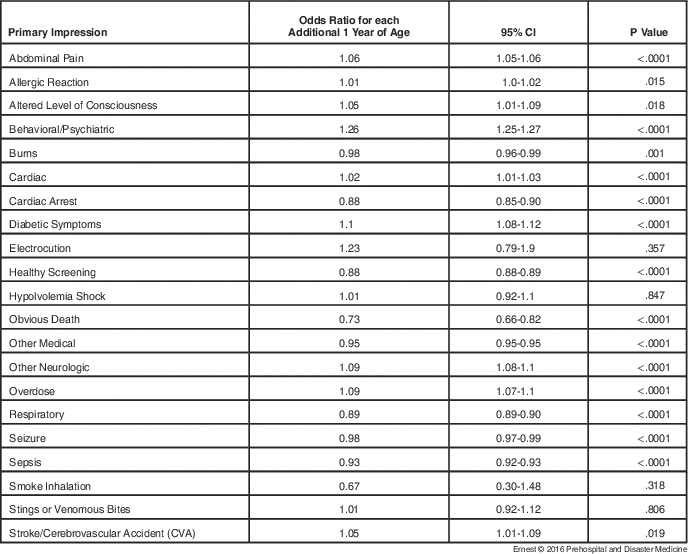
There were 16 primary impressions that had a statistically significant trend with age. These trends were not necessarily linear. Eight primary impressions had a statistically significant increase in prevalence with each additional one year of patient age while eight had a decrease (Table 1). Odds of allergic reaction, electrocution, hypovolemic shock, smoke inhalation, and venomous bites or stings did not exhibit a significant linear trend with age.
Statistical Significance of Primary Impressions as a Function of Age

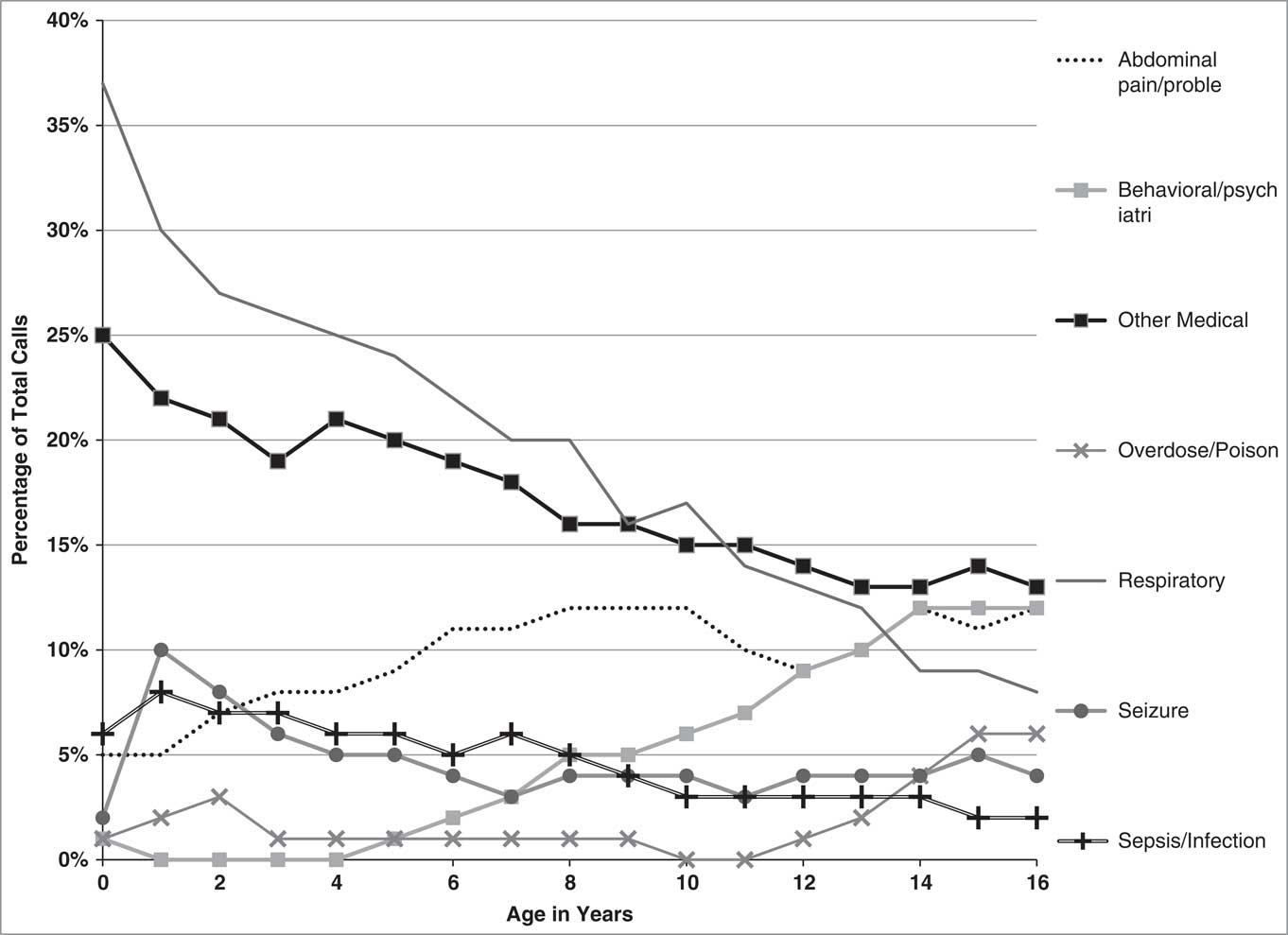
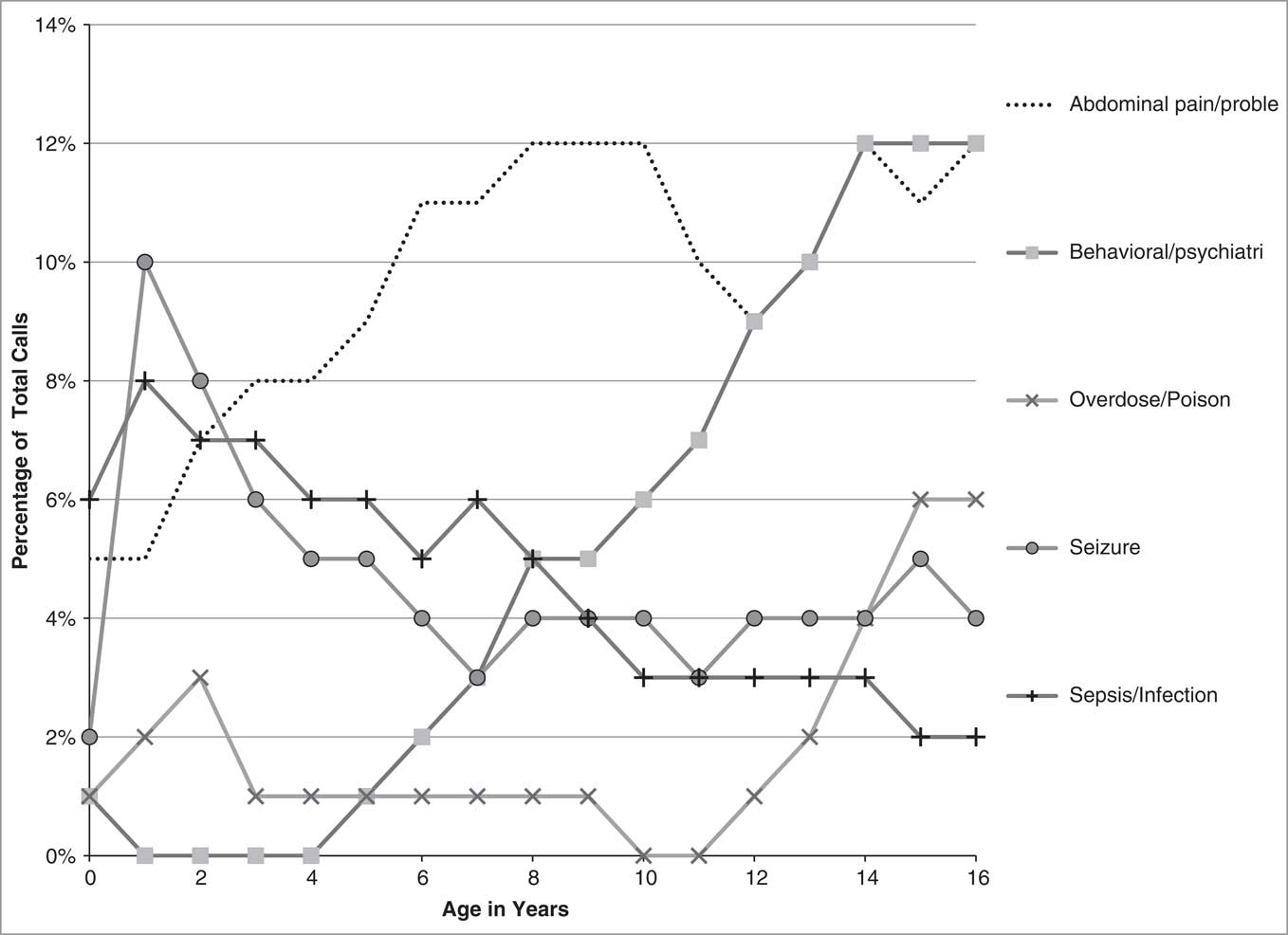
The 16 primary impressions that demonstrated a statistically significant association with age were encountered with varying frequency as a percentage of total pediatric runs. Figure 1 represents the seven primary impressions which had a statistically significant trend with age and were encountered in at least five percent of all pediatric runs for at least one age. There were several primary impressions clustered in the <10% prevalence range and Figure 2 focuses in on this subset of Figure 1 for ease of viewing. Consistent trends were seen across ages for respiratory, other medical, sepsis, and abdominal pain. In contrast, behavioral/psychiatric was deterministic with a threshold age of five years needing to be reached before emergence of this primary impression was seen. After the threshold age of five years was reached, behavioral/psych steadily increased in terms of percentage of total calls. Overdose/poison showed a bimodal distribution with the first peak identified at approximately two years of age and another rise occurring at approximately 12 years of age. Seizure was encountered most often in the age group typically associated with febrile seizure, while a primary impression of sepsis was most common in the youngest children.
Primary Impressions with Statistically Significant Trends Encountered in at least Five Percent of all Patients vs Patient Age.

Primary Impressions with Statistically Significant Trends Encountered in ≥5%-10% of all Patients vs Patient Age.

Discussion
In the present study, paramedic student primary impression was used as a proxy for the types of patient pathologies the students were encountering during their field and clinical rotations. Results focused on primary impressions that had a statistically significant variation with age and accounted for more than five percent of all calls in an attempt to identify the most common pathologies encountered in each age group. The results of the study indicate statistically significant variation in primary impressions in different pediatric age groups. In the pediatric population, patient assessments must be tailored to the unique physiologic and psychological development of the patient. Stranger anxiety, language development, and opposition to authority are examples of interpersonal and communication challenges during a child’s development that have the potential to affect the ability of EMS providers to conduct an adequate assessment. Treatment interventions, including dosing of medications and sizing of equipment, also vary greatly across the pediatric spectrum.
Understanding and emphasizing which pathologies are most frequently encountered in specific pediatric populations allows educators to target instruction to specific pathologies in the context of the developmental characteristics of the population in which that individual condition is most often encountered. For example, in adolescent patients, an increase in the prevalence of overdose, as well as increasing levels of behavioral/psychiatric primary impressions, is observed. With this knowledge, educators should emphasize to their students the importance of assessing for ingestion in adolescent patients when the student has a primary impression of behavioral/psych. Similarly, when instructing on seizures in the pediatric population, the recognition that this primary impression is encountered most frequently in the patient age associated with febrile seizures will guide instruction by emphasizing the divergence in pathophysiology for febrile vs epileptic seizures. Interestingly, some conditions such as overdose have bimodal distributions (six months to three years and 12 years to 16 years) which allow instructors to guide students with strategies specific to each of the age groups in which they are likely to encounter this specific pathology. Specific to overdose, interviewing techniques used in the adolescent and young adult population may focus on identifying suicidal ideation, which would not be appropriate in the toddler and preschool age patient.
In the educational era of competency-based evaluation, understanding the clustering of primary impressions by age can help determine the specific areas in which students must demonstrate competency. Currently, paramedic students must demonstrate exposure to a predetermined number of patients in each of four pediatric categories grouped by age. Unfortunately, students must only show exposure to patients of this age with no requirement for encountering specific pathologies. With an understanding of what types of pathology students are most likely to see in specific age groups during field practice, educators may focus on ensuring students can recognize and treat conditions based on the unique developmental characteristics of the age group in which the condition is most often seen. This would improve assessment by incorporating typical developmental milestones for the age, impact treatments (acetaminophen vs benzodiazepines for seizure), and help prioritize differential diagnoses. This would furthermore allow the educator to target particular field and clinical requirements and may be able to better manage resource utilization in ensuring the paramedic student is exposed to a variety of pathologies across the various developmental groups.
Among the primary impressions that showed a statistically significant variation in frequency in different age groups, there were several pathologies that demonstrated more clinically relevant trends. It is impossible to educate students in every possible scenario that they may encounter in clinical practice; however, ensuring that preclinical education addresses the most commonly encountered pathologies is critical. Focusing education on those primary impressions that are encountered most frequently should maximize the probability that student’s preclinical education will cover the pathologies they are most likely to encounter in clinical practice. Of course there will always be low-frequency, high-risk situations, such as cardiopulmonary resuscitation (CPR), shock, and airway management, which EMS providers will need to be proficient in for all age groups.
Limitations
Limitations of this study include that the data were self-reported by paramedic students and that the paramedic student (and paramedic preceptor’s) primary impressions were not correlated with final patient diagnosis. Although limited by the fact that the primary impressions were not verified by a physician diagnosis, the authors believed that the methodology provided valuable insight into the general categories of pathology students were exposed to across the pediatric spectrum. Also, the Fisdap program is not currently employed in all paramedic training programs across the United States. A third limitation is that the analysis was not able to sub-divide the patients seen in a field internship versus a clinical rotation. Finally, the primary impressions of “other medical” and “other neurologic” do not provide detail as to the specific pathology that the patient presented with. The primary impression of “other neurologic” accounted for less than five percent of all primary impressions, limiting its contribution to the uncertainty of the results; however, “other medical” was present in 12%-25% of calls. It is likely that these patients had pathologies that were not clearly represented by the more specific primary impression options, but it was impossible for the authors to categorize with more specificity the pathologies represented by this subgroup.
Conclusions
There are statistically and clinically significant variations in paramedic student primary impression across the pediatric age range. Paramedic training programs can use this data to focus curriculum and individualize assessment methods to ensure specific pathologies are presented within the physiologic and psychosocial context of the age group in which they are most commonly encountered.