I. INTRODUCTION
Separately, the structure and properties of barium titanate (BT) and bismuth ferrite (BF) have been widely studied.Reference Gray1–Reference Jaffe5 The discovery of the process for poling BT led to development of the first polycrystalline piezoelectric ceramics.Reference Gray1, Reference Roberts2 Despite large piezoelectric coefficients in BT ceramics (d 33 > 700 pC/N achieved in grain-oriented BaTiO3 with submicron domain sizeReference Wada, Takeda, Muraishi, Kakemoto, Tsurumi and Kimura6) its application for piezoelectric actuators is limited due to multiple polymorphic phase transformations (PPT) and low Curie temperature (T C = 130 °C). BF is a rhombohedral perovskite with a large local spontaneous polarization (P S = 100 μC/cm2) and high Curie temperature (T C = 870 °C).Reference Michel, Moreau, Achenbac, Gerson and James7–Reference Shvartsman, Kleemann, Haumont and Kreisel9 BF has been extensively studied due to the potential to exploit the multiferroic properties reported in this system. Both bulk and thin film BF materials have been developed, which simultaneously exhibit ferroelectric and ferromagnetic properties.Reference Wang, Neaton, Zheng, Nagarajan, Ogale, Liu, Viehland, Vaithyanathan, Schlom, Waghmare, Spaldin, Rabe, Wuttig and Ramesh8–Reference Hill10 It has been speculated that these materials could be used in high-density nonvolatile memory applications. In practice, however, low direct current (dc) electrical resistivity (attributed to the presence of the multivalent Fe cation) generally leads to difficulty in experimental observation of ferroelectric switching and the inability to pole bulk BF ceramics.
Bulk ceramic bismuth ferrite-barium titanate (BFBT) solid solutions have previously been shown to form an extensive perovskite solid solution.Reference Kumar, Srinivas and Suryanarayana11, Reference Itoh, Shimura, Sakamoto and Yogo12 The room temperature symmetry of the perovskite phase is reported to be rhombohedral at low BT content, switching to cubic at ~0.30 mol fraction BT, and eventually becoming tetragonal for BT content greater than 0.92 mol.Reference Kumar, Srinivas and Suryanarayana11, Reference Horibe, Nakayama, Hosokoshi, Asaka, Matsui, Asada, Koyama and Mori13, Reference Kitagawa, Ozaki, Horibe, Yoshii and Mori14 As in pure BF, processing difficulties and poor dc resistivity prevented observation of ferroelectric switching, piezoelectric strain loops, and lead to an inability to pole samples. However, doping with Mn and improved processing conditions have been reported to significantly increase the dc resistivity allowing high field poling of BFBT ceramics.Reference Kumar, Srinivas and Suryanarayana11, Reference Leontsev and Eitel15 Ferroelectric switching and piezoelectricity have been confirmed in Mn-doped BFBT ceramics in a previous publication.Reference Leontsev and Eitel15 Interestingly, even the x = 0.33 mol BT composition, which was reported to be cubic by electron, x-ray, and neutron diffraction,Reference Horibe, Nakayama, Hosokoshi, Asaka, Matsui, Asada, Koyama and Mori13, Reference Kitagawa, Ozaki, Horibe, Yoshii and Mori14, Reference Yoneda, Yoshii, Kohara, Kitagawa and Mori16 exhibited clear ferroelectric switchingReference Yoneda, Yoshii, Kohara, Kitagawa and Mori16 and large unipolar piezoelectric strain coefficients.
This work describes the behavior and origins of the high-field piezoelectric response in BFBT and reports the evidence of an electric-field-induced phase transformation from a disordered pseudocubic phase to an ordered ferroelectric state. Specifically, the intrinsic (lattice) and extrinsic (domain wall) contributions to the converse piezoelectric response in Mn-doped BFBT ceramics are investigated. The field dependence of the converse piezoelectric response (α) and low-field piezoelectric coefficients (d int) were calculated using the Rayleigh approach.Reference Damjanovic and Demartin17–Reference Eitel, Shrout and Randall19 The first Rayleigh coefficient (α) provides a relative measure of the magnitude of extrinsic piezoelectric response, due to the motion of non-180° domain wall contributions. The second Rayleigh coefficient (d int) quantifies the reversible (nonhysteretic) piezoelectric response, and may include both intrinsic and extrinsic contributions. In the current work, the role of dc bias field (E bias) on the Rayleigh coefficients (α and d int) on a series of BFBT compositions is compared to the same response in a soft commercial piezoceramic actuator lead zirconate titanate (PZT) material (TRS200HD-Navy Type-II, TRS Ceramics, State College, PA).
II. EXPERIMENTAL PROCEDURE
A. Ceramic processing
Manganese-modified BFBT ceramics with the overall composition (1–x)BiFeO3–xBaTiO3 + 0.1 wt% MnO2 in the range 0.22 < x < 0.35 mol BaTiO3 were fabricated using conventional solid-state ceramic processing methods. Aqueous suspension of the raw oxides and carbonates, Bi2O3 (Varistor Grade, Bismuth Oxide, MCP Metalspecialties, Fairfield, CT), Fe2O3 (99.8%, Alfa Aesar, Ward Hill, MA), BaCO3 (Inframat Advanced Materials LLC, Willington, CT), TiO2 (CR-EL, Ishihara Corporation, San Francisco, CA), and MnO2 (99.9%, Alfa Aesar), were mixed/milled using a vibrating laboratory mill (Sweco VibroEnergy ML16-5, Sweco, Florence, KY) and zirconia milling media. Following milling, the suspensions were dried in an oven and then calcined at 750 °C for 4 h. Manganese modification was made by adding 0.1 wt% of MnO2 to calcined powders before the final milling step. Ceramic pellets were prepared by uniaxial pressing and sintering at 950 °C for 2 h. Phase purity of the sintered samples was confirmed on crushed sintered pellets via x-ray diffraction (XRD; model-D500, Siemens diffractometer, Munich, Germany). Disks for electrical measurements were prepared by grinding samples to 0.5 mm thick and applying a fired-on silver electrode paste (6160, DuPont, Research Triangle Park, NC). Further processing details are provided in a previous publication.Reference Leontsev and Eitel15 Ferroelectric polarization and strain loops were measured at frequency 0.2 Hz using a modified Sawyer–Tower circuit with a linear differential variable transformer (LDVT) for strain measurement. Poling was done in a silicon oil bath at 60 °C and 60 kV/cm for 15 min.
B. Biased piezoelectric strain measurements
Rayleigh measurements and determination of Rayleigh coefficients (α and d int) were conducted following the methods previously described.Reference Eitel, Shrout and Randall19, Reference Eitel and Randall20 Following the work of Damjanovic,Reference Damjanovic and Demartin17, Reference Damjanovic21 this technique was modified to include a superimposed dc bias field. (The current application of a dc electrical bias is directly analogous to the well-accepted practice and methods described by Damjanovic in describing the Rayleigh law dependence of the direct piezoelectric response in ferroelectric ceramics. In these works a large compressive preload was applied, following which the induced piezoelectric charge is measured as a function of a superimposed stress.Reference Damjanovic and Demartin17, Reference Damjanovic21) Specifically, samples were measured at a range of alternating current (ac) field amplitudes (E 0), 0–10 kV/cm, at several different dc bias fields (E bias), applied parallel to the poling direction. The piezoelectric strain coefficient at each ac field amplitude (E 0) was determined by recording the converse piezoelectric response (strain-field loop). The in-phase component (real part) of the peizoelectric response (d 33′) was obtained from both the peak strain (proportional to d*33) and the hysteresis loop area (proportional to d 33″) and plotted as a function of the applied field E 0. Specifically, the complex piezoelectric response (d*33) at each ac field (E 0) was obtained using Eq. (1) by measuring the peak-to-peak strain (x p–p).
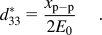
The imaginary piezoelectric coefficient (d 33″) at each ac field was obtained from Eq. (2) by using the data collection software to integrate the area bound by the strain-field hysteresis loop (A EM).
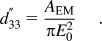
The Rayleigh coefficients were then extracted at each bias field (E bias) by fitting to the linear portion of the d′33 over E 0 plots, where α is the slope and d int is the y-intercept. In practice, the d int value obtained from the Rayleigh measurements shows strong agreement with low-field piezoelectric coefficients obtained using the IEEE resonance method or Berlincourt d 33 meter.Reference Hall18, Reference Eitel, Shrout and Randall19, 22, Reference Pramanick, Damjanovic, Nino and Jones23
III. RESULTS AND DISCUSSION
XRD data and scanning electron microscopy (SEM) analysis confirmed pure perovskite phase and dense grain structure (approximate grain size of 1 μm) in the present BFBT ceramics.Reference Leontsev and Eitel15 High-temperature dielectric constant measurements revealed Curie temperatures (T C) above 500 °C and depolarization temperatures (T d) [The depolarization temperature (T d) describes the temperature at which a poled ferroelectric material completely or partially depolarizes. This temperature typically coincides with the ferroelectric Curie temperature. However, in materials exhibiting one or more polymorphic phase transitions below the ferroelectric Curie temperature but above room temperature T d refers to the temperature of the lowest of these phase transitions.Reference Dai, Zhang, Shrout and Zhang24–Reference Takenaka, Nagata and Hiruma27 Accurate determinations of T d can be made by measuring the pyroelectric current of poled samples on heating.Reference Dai, Zhang, Shrout and Zhang24] above 400 °C.Reference Leontsev and Eitel15 Data on the room temperature dielectric constant, dc resistivity, and piezoelectric coefficients for Mn-modified BFBT ceramics are summarized in Table I.Reference Leontsev and Eitel15
Room temperature dielectric constant and tanδ data (measured at 1 kHz), estimated Curie (T C) and depolarization (T d) temperatures, dc resistivity, high- and low-filed piezoelectric coefficients for unmodified and Mn-doped BFBT ceramics.

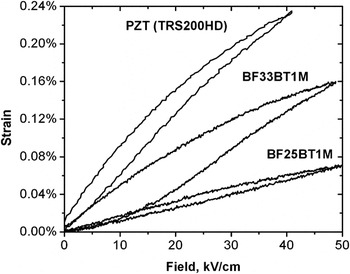
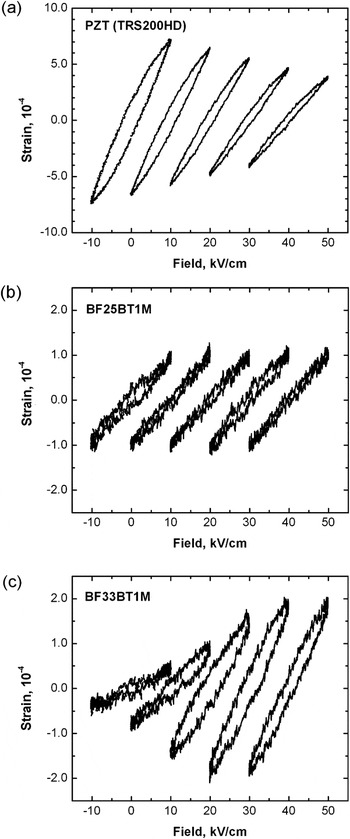
In Fig. 1, high-field unipolar strain loops of poled Mn-modified (1–x)BiFeO3–xBaTiO3 samples with x = 0.25 and 0.33 mol BaTiO3 (abbreviated as BF25BT1M and BF33BT1M, respectively) are compared to commercial TRS200HD piezoceramic. The unipolar strain data for BF25BT1M samples show a large linear piezoelectric strain (d 33 = 140 pC/N), low hysteresis, and an appropriate 2:3 ratio between low-field (Berlincourt) and high-field d 33 coefficients (see Table I).Reference Hollenstein, Davis, Damjanovic and Setter31, Reference Li, Bhalla, Newnham and Cross32 In BF33BT1M samples a large unipolar d 33 is observed, however there is significant hysteresis and a large discrepancy between the low-field and high-field d 33 values, 43 and 300 pC/N, respectively. This suggests significant domain switching contributions to the high-field response and poor stability of the poled domain state in the x = 0.33 composition. The PZT sample exhibits a large high-field piezoelectric coefficient (d 33 = 600 pC/N), moderate hysteresis, and 2:3 ratio between low- and high-field d 33 coefficients, consistent with expectations for a well poled soft PZT.
Unipolar strain data measured on poled Mn-modified BFBT ceramics. Data for PZT (TRS200HD) ceramics is given for comparison.Reference Zhang, Wang, Kim and Cross30

A. Compositional dependence of the piezoelectric nonlinearity in BFBT
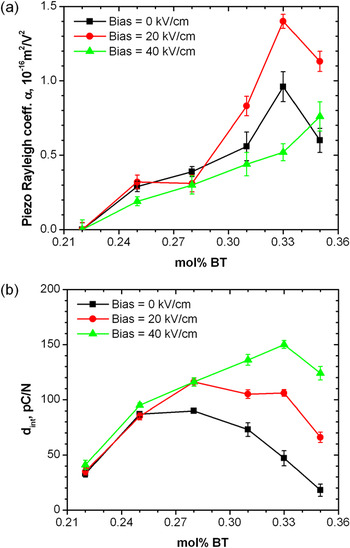
To determine the composition and dc bias dependence of the low- and high-field piezoelectric coefficients in the BFBT system biased Rayleigh measurements were conducted, as described previously. The converse piezoelectric response in BFBT for 0.22 < x < 0.35 mol fraction BT was measured as a function of ac field amplitude (E 0) at dc bias fields (E bias) of 0, 20, and 40 kV/cm. The resulting variation of the Rayleigh coefficients (α and d int) with BaTiO3 content at the different dc bias fields is shown in Fig. 2.
(a) Variation of the piezoelectric Rayleigh coefficient α and (b) extrapolated low-field piezoelectric coefficient d int for Mn-doped BFBT ceramics with the molar fraction of BaTiO3.

Figure 2(a) shows the composition and bias field dependence of the extrinsic piezoelectric response (α-coefficient). It can be clearly observed that the α-coefficient is increasing with the increasing BT content. This is indicative of increased extrinsic (non-180° domain) contributions to the piezoelectric response. Specifically, for the composition with x ≥ 0.31 mol BT increasing dc bias from 0 to 20 kV/cm leads to a significant increase in extrinsic response with the peak α-coefficient observed for the composition with x = 0.33 mol BT. A further increase in the dc bias, to 40 kV/cm, leads to a reduction in the extrinsic domain wall contributions evidenced by the reduced α-coefficient for compositions with x ≥ 0.31.
The low-field piezoelectric coefficient (d int) is also shown to depend on both composition and dc bias field, see Fig. 2(b). For compositions with x ≤ 0.25 BT d int is largely independent of E bias. For compositions with x > 0.25 mol BT increasing dc bias leads to a significant increase in d int with the peak values shifting toward higher BT content with increasing dc bias. The peak low-field piezoelectric coefficient is observed for BFBT with x = 0.33 mol BT exhibiting a maximum d int of 150 pC/N at bias of 40 kV/cm. Further increases in dc bias (not shown) did not improve the low-field piezoelectric coefficient.
B. Comparison of dc basis effects in PZT and BFBT
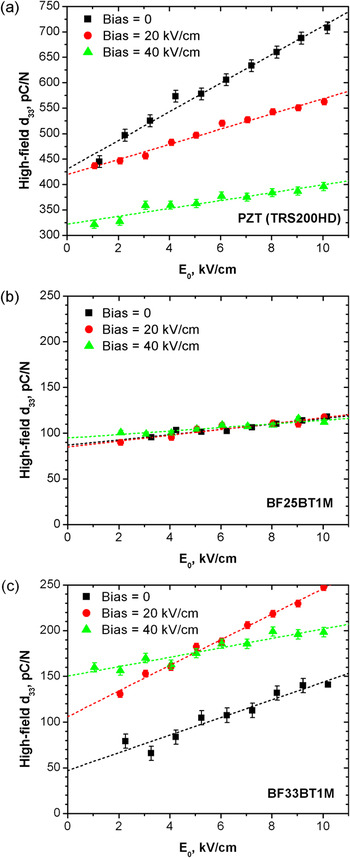
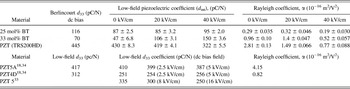
Detailed results of the converse piezoelectric measurements in the BFBT system and a comparison to equivalent measurements of a soft PZT are shown in Fig. 3 and Table II. Two BFBT compositions were selected including BF25BT1M representing a large low-field d 33 composition with minimal field dependence of the piezoelectric response and BF33BT1M, which had both the largest high-field piezoelectric properties and greatest dc field dependence of the piezoelectric response. A soft commercial PZT was selected for comparison due to its large high-field piezoelectric coefficient and to illustrate expected Rayleigh and dc bias field behavior in a material with large extrinsic piezoelectric contributions. Numerical values for both d int and α coefficients, as well as the low-field d 33 coefficient, for each of the aforementioned compositions are summarized in Table II. Several literature values of Rayleigh coefficients and field dependant piezoelectric properties of both hard and soft PZTs are also included.Reference Pramanick, Damjanovic, Nino and Jones23, Reference Zhang, Pan, Jang and Cross33, Reference Perrin, Troccaz and Gonnard34
In-phase component of the piezoelectric strain coefficient (d 33) as a function of ac field amplitude (E 0) for PZT (a) (TRS200HD), (b) BF25BT1M, and (c) BF33BT1M ceramics at different values of dc bias (E bias).

Berlincourt (d 33) and extrapolated low-field (d int) piezoelectric coefficients, piezoelectric Rayleigh parameter (α) for BFBT and PZT ceramics.

In Fig. 3(a), increasing dc bias for the soft PZT (TRS200HD) leads to a decrease in the ac field dependence of the piezoelectric response (the slope or α-coefficient) and reduced low-field piezoelectric coefficient (intercept, d int). This is in agreement with the expectation that the large extrinsic domain contributions in a soft PZT would be suppressed by the large dc bias. Furthermore, the unbiased (E bias = 0) and biased (E bias > 0) piezoelectric coefficients (d int) are consistent with measured and published low-field piezoelectric coefficients (d 33) obtained using standard Berlincourt and IEEE resonance techniques.Reference Pramanick, Damjanovic, Nino and Jones23, Reference Zhang, Pan, Jang and Cross33, Reference Perrin, Troccaz and Gonnard34 Note that in Table II literature values for a hard PZT (PZT4D) show both a low Rayleigh coefficient (α = 0.82 × 10⁻¹⁶ m2/V2) and little dependence of the piezoelectric coefficient on dc bias, as expected for hard materials with reduced domain wall contributions.
Unbiased converse piezoelectric measurements for BF25BT1M [Fig. 3(b)] shows good agreement between the d int and the low-field Berlincourt d 33 coefficient (~100 pC/N). With increasing dc bias no significant changes in d int or α coefficients were observed. These results are indicative of a stable domain ferroelectric phase, effective poling, and low extrinsic piezoelectric contributions in BF25BT1M ceramics.
In BF33BT1M, the low-field piezoelectric coefficient (d int) is ~50 pC/N consistent with Berlincourt measurements [Fig. 3(c)]. However, in contrast to either PZT or BF25BT1M, with increasing bias field both the field dependence (α) and low-field piezoelectric response (d int) in the BF33BT1M composition increase. For a bias field of 40 kV/cm the low-field piezoelectric coefficient shows a maximum (d int = 150 pC/N). This enhancement of the low-field piezoelectric response in BF33BT1M is likely due to increasing stability of the ferroelectric state provided by the external bias field. The dc bias produces a large effective “remnant” polarization leading to improved intrinsic and extrinsic contributions to the piezoelectric strain response.
C. Strain field dynamics in PZT and BFBT: Bipolar strain at subcoercive fields
To further clarify the dc bias effect and contribution to the dynamic strain field response, bipolar strain-field hysteresis loops for each of the aforementioned compositions were measured at a fixed ac amplitude (E 0 = 10 kV/cm) and at different dc bias fields (E bias), presented in Fig. 4. In PZT ceramics [Fig. 4(a)] with increasing dc bias, the mean slope of the strain-field loop is decreasing, corresponding to reduced high-field piezoelectric coefficients (d 33). In addition, the hysteresis (quantified explicitly by numerical integration of the loop area) of the strain-field loops is also decreasing with increasing dc bias. Both of these observations are consistent with suppressed extrinsic domain contributions due to clamping of domain wall motion by the large dc bias field. Prior studies in the PZT system suggest that even at low drive fields up to 50% of the piezoelectric coefficient in a soft PZT may be due to extrinsic domain wall contributions, with a typical magnitude of the intrinsic contribution to the piezoelectric response of ~200 pC/N.Reference Zhang, Wang, Kim and Cross30
Piezoelectric strain-field data for PZT 9 (a) (TRS200HD) and (b, c) Mn-doped BFBT ceramics taken at maximum ac field amplitude (E 0 = 10 kV/cm) and different dc biases (E bias = 0–40 kV/cm).

In contrast to the observations in PZT, the strain field response in the BF25BT1M composition shows little visible change with increasing dc bias [Fig. 4(b)]. The slopes of the strain-field loops remain consistent for the bias fields in the range E bias = 0–50 kV/cm and no significant change in loop areas is observed. These findings are consistent with a well poled hard piezoceramic with low extrinsic domain contributions to the converse piezoelectric response. The observed low field dependence and the small α-coefficient suggest that nearly all of the observed piezoelectric response in the BF25BT1M composition is due to intrinsic contributions.
Finally, dc bias dependence of the strain-field loops of the BF33BT1M composition [Fig. 4(c)] displays highly unusual behavior. Initially, the slope of the strain-field loops is actually increasing with increasing dc bias, showing an increase in the high-field piezoelectric coefficient with large dc bias. For a bias field E bias = 20 kV/cm the slope of the strain-field loop and hence the high-field piezoelectric coefficient reaches a maximum value of 250 pC/N. The strain-field hysteresis also shows nonlinear dc bias response. Initially the hysteresis is increasing with increasing dc bias, consistent with increasing domain wall contributions to the piezoelectric response. At dc bias fields above 20 kV/cm, the hysteresis gradually decreases consistent with the onset of clamping of domain wall contributions. These results suggest that both intrinsic and extrinsic contributions to the piezoelectric response can be enhanced compared to the zero bias state in the x > 0.33 BFBT composition. Large hysteresis and field piezoelectric coefficients at moderate bias fields demonstrate the potential to achieve large extrinsic piezoelectric contributions. Additionally, large low-field piezoelectric coefficients (d 33~150 pC/N) coupled with low hysteresis at a high dc bias suggests substantial intrinsic contributions to the piezoelectric response.
D. Local structure and field-induced phase transformations
In ferroelectric ceramics, the piezoelectric response and hysteretic behavior are inherently related to the crystal structure and domain configuration. Understanding the mechanisms underlying the observed strain field dynamics and the origin of ferroelectric ordering in BFBT ceramics is important to optimize electromechanical properties in this material. The strong high-field strain response observed in the BF33BT1M composition attracts interest in BFBT material as a potential lead-free piezoelectric, however, high nonlinearity and large hysteresis in strain-field behavior requires further understanding of field-dependent microstructural processes in BFBT ceramics. Detailed structural studies using synchrotron XRD and high-resolution transmission electron microscopy (HRTEM) revealed existence of nanoscale rhombohedrally distorted regions within a nondistorted cubic matrix in BFBT close to x = 0.33 composition.Reference Yoneda, Yoshii, Kohara, Kitagawa and Mori16, Reference Ozaki, Kitagawa, Nishihara, Hosokoshi, Suzuki, Noguchi, Miyayama and Mori35 These studies conclude that rhombohedral regions possess locally ordered dipolar moments, as in pure BiFeO3. However, the correlation between polar regions showed a strong compositional dependence possessing reduced long-range order with increasing BaTiO3 concentration.
In the current work, the compositional dependence of the Rayleigh coefficients, shown in Fig. 2, reveals local maxima of both the d init and α coefficients for the composition with x = 0.33. The composition of these maxima is coincident with the reported morphotropic phase boundary between rhombohedral and pseudocubic phases in the BFBT system. This local enhancement of the piezoelectric response is likely due to a softening of the crystal lattice, associated with the coexistence of two phases of similar free energy. However, the fact that these local maxima in the Rayleigh coefficients occur for different values of the applied dc bias suggests additional underlying structural complexity.
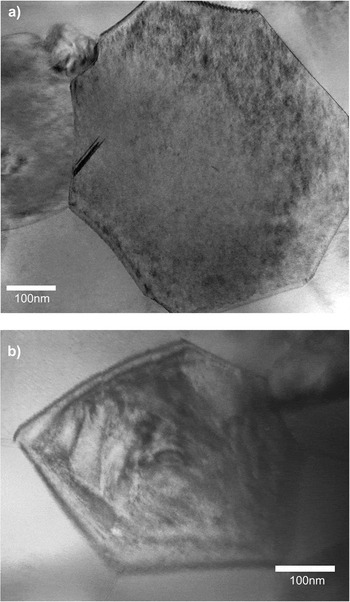
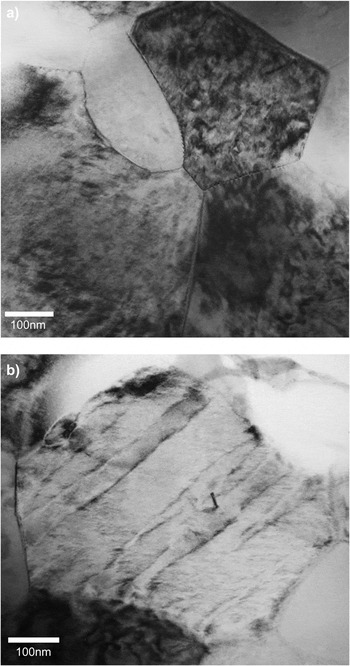
To investigate the structural origins of field-induced changes in BFBT ceramics, the microstructures of unpoled and poled samples were compared using diffraction contrast TEM imaging, Figs. 5 and 6. In unpoled BF33BT1M samples, a highly frustrated nanoscale domain structure is observed [Fig. 5(a)]. The domain contrast is more diffuse and less discrete compared to a BFBT composition with lower BaTiO3 concentration, BF25BT1M [Fig. 6(a)]. The nanoscale domain size and decrease in domain contrast with higher BaTiO3 content corresponds to the dimensions of the nanopolar rhombohedrally distorted regions and compositional dependence of their long-range correlation previously reported.Reference Yoneda, Yoshii, Kohara, Kitagawa and Mori16, Reference Ozaki, Kitagawa, Nishihara, Hosokoshi, Suzuki, Noguchi, Miyayama and Mori35
Bright-field TEM image of (a) unpoled and (b) poled BF33BT1M ceramics.

Bright-field TEM image of (a) unpoled and (b) poled BF25BT1M ceramics.

In poled samples, a transition from frustrated nanoscale domain patterns to long-range ordered bands of uniform polarization is observed. The composition BF25BT1M shows large preferentially oriented (in the poling direction), ordered ferroelectric domains with alternating light-dark contrast [Fig. 6(b)], similar to those observed in other rhombohedral ferroelectrics. However, there remains significant short range subdomain contrast indicating local fluctuations of the polarization. The residual banding observed in poled BF33BT1M samples [Fig. 5(b)] also indicates field-induced long-range ordering; however, it is of a more diffuse and weakly ordered nature compared to BF25BT1M composition, which is consistent with suppressed piezoelectric properties at zero dc bias in the BF33BT1M.
Extrapolation of TEM results suggests the field dependence of the piezoelectric response in BFBT compositions near the MPB (x~0.33) could be explained through a field-induced phase transformation into an ordered ferroelectric state, at large dc bias fields. Initially composition near the MPB exhibit low reversible and moderate domain wall contributions, consistent with a disordered mixture of rhombohedral and pseudocubic regions. With increasing bias field both the low field and domain contributions are enhanced, consistent with field-induced ordering of the ferroelectric domain state (evidenced by residual ferroelectric banding observed in poled BFBT samples). Eventually, a peak in the low-field piezoelectric response (BF33BT1M) is observed (d init = 150 pC/N) at a field of ~40 kV/cm, 50% higher than BF25BT1M and a threefold improvement over the zero-field value in unbiased samples. This large change in low-field piezoelectric response provides the strongest indication of a field-induced phase transformation from a disordered psuedocubic into a long-range ordered ferroelectric state.
V. CONCLUSION
The role of dc bias field on the converse (strain-field) piezoelectric response in the lead-free (1–x)BiFeO3–xBaTiO3 system has been reported and compared to a soft commercial PZT material. The results of this study clearly show the ability to achieve large piezoelectric coefficients in a high Curie temperature lead-free piezoelectric material. Although the high-field strain coefficients of the BFBT materials are currently not competitive with a well-developed soft PZT ceramic, both large low-field piezoelectric coefficients (d 33~100 pC/N) and large ferroelectric domain wall contributions were observed. Ultimately, under dc bias a peak high-field piezoelectric strain coefficient of 250 pC/N (E bias = 20 kV/cm) and a peak low-field piezoelectric coefficient of 150 pC/N were observed, both in BFBT with x = 0.33 mol fraction BaTiO3. The origin of the observed field enhancement of the piezoelectric response has been discussed in terms of a field-induced phase transformation under large dc bias. Similar phase transition-induced enhancement of the piezoelectric strain responses have been observed in other lead-free piezoceramic systems containing a disordered psuedocubic regionReference Zhang, Kounga, Aulbach, Ehrenberg and Rodel36, Reference Zhang, Kounga, Aulbach, Jo, Granzow, Ehrenberg and Rodel37 and in bismuth ferrite thin films in which a stress-induced phase transformation lead to coexistence of tetragonal and rhombohedral phases.Reference Scott38, Reference Zeches, Rossell, Zhang, Hatt, He, Yang, Kumar, Wang, Melville, Adamo, Sheng, Chu, Ihlefeld, Erni, Ederer, Gopalan, Chen, Schlom, Spaldin, Martin and Ramesh39
The large piezoelectric response reported here for BFBT ceramics is particularly significant considering the Curie temperature (T C) for this composition is 645 °C and the nearest observed polymorphic phase transition temperature (T d) is 430 °C, both larger than Curie temperature in undoped PZT (T C = 368 °C). These high transition temperatures are also among the highest transition temperatures reported in any high performance binary piezoelectric ceramic system. Although other lead-free systems reported with large piezoelectric d 33 coefficients all rely on the close proximity to a polymorphic phase-transformation temperature,Reference Akdogan, Kerman, Abazari and Safari40 as is the case for the original piezoelectric ceramic BaTiO3. It is suggested that continued compositional development and improved understanding of domain structure and phase stability may lead to viable lead-free piezoelectric actuator materials based on the (1–x)BiFeO3–xBaTiO3 system.
ACKNOWLEDGMENTS
The authors would like to thank Ishihara Corporation USA for providing titania powder, MCP Metalspecialties Inc. for providing bismuth oxide powders, and TRS Ceramics for providing the TRS500HD samples used in this study.