1. Introduction.
The so-called adjectival or stative passive (Zustandspassiv) in German has recently become subject of revived empirical and theoretical interest. Traditionally, the adjectival passive is conceived of as a second passive form in addition to the verbal, or eventive passive (Vorgangspassiv) as shown in 1.Footnote 1 This perspective is taken by virtually all grammars of German, such as Zifonun et al 1997, Helbig & Buscha 2001, and Duden 2005.
- (1)
a.

b.

Authors like Rapp (1997, 1998), Kratzer (2000), and Maienborn (2007) have criticized this view, arguing that constructions such as 1a do not contain a passive verbal form at all but involve, instead, adjectival conversion. According to this view, what is traditionally dubbed “adjectival” or “stative passive” actually turns out to be a copula sentence with an adjectivized verbal participle. Current research draws on this view, focusing on the semantics of the adjectival passive and its combinatorial behavior (see, for example, Kratzer 2000; Schlücker 2005; Maienborn 2007, 2009, 2011; Gehrke, to appear).
A question that needs to be addressed under the adjectival conversion approach, and which has not yet received due attention, is which verbs can form adjectival participles. According to the traditional view, adjectival passive formation is a subcase of passivization and as such is reserved for a subset of transitive verbs. Under the adjectival conversion approach this is no longer a natural assumption. A particularly intriguing case in point is the class of unaccusatives, that is, intransitive verbs that form their perfect tense with the perfect auxiliary sein ‘to be’ (see Haider 1985, 2010). For example, the sentence in 2 has, first of all, a present perfect tense analysis. The question is whether it can also receive an adjectival conversion analysis. Can the verbal participle gestorben also be adjectivized and then combine with the copula sein? In other words, are sentences such as in 2 ambiguous between a present perfect tense and a copula analysis or can they only receive a present perfect reading?
(2)
This is the starting point of the present investigation. We provide an indepth study of the adjectivization of participles formed from intransitive sein-verbs, which would eventually lead to a new perspective on the grammatical and pragmatic conditions of the so-called adjectival passive formation in German. More specifically, we provide corpus-linguistic evidence showing that participles of intransitive sein-verbs are legitimate candidates for adjectivization. This then raises the question to what extent these verbs take part in adjectival conversion. At first glance, this option seems available only for some unaccusatives. For instance, verbs such as schwellen ‘to swell’ lend themselves more readily to adjectivization than, for example, platzen ‘to burst’. This observation is corroborated by an acceptability rating study that uses durational seit-adverbials versus deictic vor-adverbials as a diagnostic for disentangling the copula reading from the present perfect reading of an intransitive sein-verb. While schwellen combines readily with both seit- and vor-adverbials, platzen sounds odd with seit, which suggests that it has only a present perfect reading (see 3).
- (3)
a.
b.
Yet, on closer examination it turns out that what determines the availability of a copula reading is not lexical or grammatical factors, but pragmatics. This view is further substantiated by the results of two additional rating studies, in which contextual factors were systematically manipulated. These findings lead us to the conclusion that it would be misleading to exclude some (or even all) unaccusatives from the formation of what is known as the adjectival passive construction. Rather our studies support a new perspective on the grammar/pragmatics interface, according to which the adjectivization of verbal participles is a grammatically fairly unrestricted word formation process that is also open to virtually all intransitive sein-verbs and that is characteristically shaped and controlled by pragmatic factors.
This paper is organized as follows. Section 2 first presents a short overview of some facts and assumptions concerning the German adjectival passive construction that constitute the background for the present study. Then it summarizes the traditional arguments in favor of an adjectival conversion analysis. In section 3, the relevant diagnostics are applied to unaccusatives. Empirical evidence is provided mainly by corpus data.Footnote 2 Section 4 is devoted to the question to what extent unaccusatives take part in the adjectivization of verbal participles and what the governing factors are. The discussion draws on the results of a series of acceptability rating studies. Section 5 concludes the paper by linking our findings on the formation of adjectival passives to a genuinely pragmatic account of their interpretation.
2. On the Adjectival Nature of the Adjectival Passive.
2.1. Preliminaries.
The German adjectival passive differs from its English counterpart in several ways. It is crucial to keep this in mind throughout the paper. Whereas English expresses both verbal and adjectival passives by an -en/-ed participle in combination with a form of to be, as shown in 4, German uses werden ‘to become’ in the former case, as in 5, and sein ‘to be’ in the latter, as in 6.
(4)
a.
b.
(5)
a.
b.
(6)
a.
b.
The English sentence in 4 is ambiguous between an eventive and a stative reading, and can only be disambiguated by the linguistic or extra-linguistic context, as in 4a versus 4b. In 4a, the manner adverbial quietly and the agent phrase by the thief select the verbal passive, whereas in 4b, the durative adverbial for years combines with the adjectival passive form.Footnote 4 The situation is more transparent in German because verbal and adjectival passives are expressed by different means. Hence, a sentence like 6 only has a stative reading.
Another point to bear in mind is that in German, the adjectival passive formation is a very productive process. Adjectival passives coexist readily with primary adjectives, as in 7. Forms such as geleert sein ‘to be emptied’ and geöffnet sein ‘to be opened’ are not blocked by the existence of the respective primary adjectives and are completely regular.
- (7)
a.
b.
Finally, note that German also allows for so-called impersonal adjectival passives of unergative verbs, that is, intransitive verbs that form the present perfect tense with the auxiliary haben ‘to have’. Some examples are given in 8.
(8)
We do not have the space here to discuss the intricacies of these impersonal constructions. For our present purposes it suffices to point out that adjectival passive formation is a broadly available grammatical option in German.Footnote 5
2.2. Adjectival Conversion.
According to the traditional analysis, the “adjectival passive” construction belongs to the verbal paradigm, that is, it is built up from a verbal participle (Vpart) and a passive auxiliary sein ‘to be’. Thus, the under-lying structure is assumed to be the one given in 9.Footnote 6
(9)
The alternative view, for which we argue here, treats the adjectival passive as a combination of the copula sein with an adjectivized participle, as in 10. Under this approach, the term “adjectival passive” is obviously a misnomer; however, since it is well established in the literature we continue to use it in the remainder of this article.
(10)
The adjectival conversion analysis in 10 follows Lieber 1980 in deriving the adjectival participle from its verbal counterpart via zero-affixation.Footnote 7 This structure allows us to derive the semantics of adjectival passives compositionally by applying the semantic content of the adjectival zero-affix to the verbal participle (see Kratzer 2000 and Maienborn 2009, 2011 for two proposals).Footnote 8
The debate over which of the two analyses of adjectival passive should be preferred has given rise to a large collection of diagnostics which provide ample evidence for the adjectival status of the participle (see, in particular, Höhle 1978, Litvinov & Nedjalkov 1988, Lenz 1994, Kratzer 1994, 2000, Rapp 1997, 1998, Maienborn 2007). Hence, current accounts all adhere to some version of the adjectival conversion analysis schematized in 10. In what follows, we present a representative sample of these diagnostics to illustrate the behavior of standard adjectival passives based on transitive verbs. We focus on the following four diagnostics:Footnote 9
(i) Adjectival negation
(ii) Adjectival gradation
(iii) Coordination with genuine adjectives
(iv) Adjectival word formation
Let us first consider adjectival negation. Unlike its English cousin, the German negative affix un- only combines with adjectives (and nouns), but not with verbs. Thus, in 11 the combination of a participle and un- clearly indicates that adjectival conversion of the participle has taken place.
- (11)
a.
b.
c.
As far as adjectival gradation is concerned, adjectival passives may also display comparative or superlative morphology, as shown in 12. This, again, is a clear indication that the participle has turned into an adjective. Even though the relevant data are rare, that is, adjectivized participles are semantically not particularly well-suited for adjectival gradation (they pattern with other ungradable adjectives in this respect), the mere existence of regularly formed comparative or superlative forms in 12 is sufficient to establish the adjectival status of these participles.
- 12
a.
b.
c.
The next diagnostic, coordination with genuine adjectives, also supports the adjectival status of the participles in question. Since only elements of the same category can be conjoined coordination is a reliable diagnostic for establishing the category of a word (see, among others, Lang 1984). In 13, adjectival passives are coordinated with genuine adjectives within coordinated copula structures. Once again, this is strong evidence for the adjectival nature of the participles.
- 13
a.
b.
c.
If 13a—c were instances of cross-categorial coordination, where the finite form of sein ‘to be’ is simultaneously a passive auxiliary and a copula, this should lead to a highly marked structure. Sentences 14 and 15 exemplify such cases of cross-categorial coordination, in which a homonymous word receives two readings at the same time. In 14, haben ‘to have’ is used both as a full verb and a perfect auxiliary. In 15, sein ‘to be’ is first interpreted as an identificational copula and then needs to be reanalyzed as a predicational copula.
(14)
(15)
As 15 shows, even if a minor shift is required, that between an identificational use of the copula and its predicational use, a clear grammatical defect arises. In contrast, no such deviance is observed in 16, where an NP is coordinated with an AP and a PP. Since these phrases are all used predicatively there is no need for any reanalysis. Here, sein may consistently be interpreted as a predicational copula, hence the well-formedness of 16.
(16)
The observations regarding 14—16 strongly suggest that no cross-categorial coordination is at work in the case of 13. The respective participles are readily conjoined with regular adjectives to form complex predicative APs. This requires prior adjectival conversion of the verbal participles.
Furthermore, the participles in adjectival passives take part in a typical adjectival word formation process. They build adjectival compounds with nouns or adverbs as non-heads, as shown in 17.
- (17)
a.
b.
c.
This word formation pattern is highly productive in German. Besides more or less lexicalized forms such compounds are also readily built “online” as shown by the occasional compounds schwedentrainiert ‘sweden-trained’ or Diana-bereinigt roughly: ‘Diana-purged’ in 18. For instance, the intended interpretation of schwedentrainiert in 18a is that the Japanese referred to was “trained” in Sweden and thus got used to drinking (lots of) alcohol.
- (18)
a.
b.
Note that there is no analogous word formation pattern for verbs. The compounds in 17 have no finite verbal counterpart, as shown in 19 (see Maienborn 2007 for more details).
- (19)
a.
b.
c.
Once again, we are led to conclude that the participle must have undergone an adjectival conversion process. This opens up the possibility for the particular kind of adjectival word formation illustrated in 17 and 18.
Up to this point, we have provided ample empirical evidence for the adjectival nature of adjectival passives. The results of all four diagnostics consistently point towards an analysis of the adjectival passive in terms of a copula construction whose predicate is formed by an adjectivized verbal participle (see the schema in 10).Footnote 10
In Stolterfoht, Gese, & Maienborn 2010, we provided additional psycholinguistic evidence for the claim that adjectival passives rely on an adjectival conversion process. With a self-paced reading study, we tested the hypothesis that conversion leads to additional processing costs and that, therefore, adjectivized participles are processed more slowly than their verbal counterparts in verbal passives. For the processing of the sentences in 20 we predicted longer reading times for the participle verschüttet Ôspilled’ after sein than after the passive auxiliary werden since the process of adjectival conversion is necessary for the adjectival passive in 20a but not for the verbal passive in 20b. The behavior of the participles in combination with sein and werden was compared with that of genuine adjectives as in 21, where no additional processes are involved and therefore no reading time differences are expected.
- (20)
a.
b.
- (21)
a.
b.
As predicted, the results of our self-paced reading study showed significantly longer reading times for the participle after sein in the adjectival passive condition in 20a than after the passive auxiliary werden in the verbal passive condition in 20b, whereas no significant reading time differences were observed for the sentences with adjectives in 21. Alternative frequency-based explanations for the observed effects could be excluded on the basis of corpus studies. Thus, we concluded that the reading time differences reflect an additional processing effort in the case of adjectival passives due to adjectival conversion (for further details see Stolterfoht, Gese, & Maienborn 2010). These psycholinguistic findings fit neatly into the picture of adjectival conversion developed so far on the basis of corpus data.
3. Adjectival Conversion of Unaccusatives: Corpus-Based Evidence.
3.1. The Four Diagnostics Applied to Unaccusatives.
Having provided sufficient empirical evidence in support of the claim that so-called adjectival passive constructions are, in fact, copula sen-tences with an adjectivized verbal participle, we now turn to the question which verbs can be adjectivized in this way. More specifically, we are interested in whether the participles of unaccusatives, that is, intransitive sein-verbs, can be converted into adjectives that show up in copula structures as well. To this end, we apply the set of adjectival tests to unaccusatives.Footnote 11
Let us start with the case of un-affixation. As the examples 22—25 show, we do, in fact, find instances of un-affixation with unaccusatives.
(22)
(23)
(24)
(25)
Examples of this kind are admittedly quite rare. Nevertheless, existing examples are perfectly grammatical and follow the regular formation and interpretation pattern. Thus, we can safely conclude that there are at least some unaccusatives, whose participle can (under certain circumstances, as discussed in section 5) be converted into an adjective, which in turn can be used predicatively together with the copula sein.
The same picture emerges with respect to adjectival gradation. Once again, we find well-formed instances of comparative or superlative mor-phology with unaccusatives, as shown in 26–29.
(26)
(27)
(28)
(29)
Next, let us determine whether unaccusatives can combine with genuine adjectives in coordination structures. Examples 30—33 show copula structures with unaccusatives that show up as a conjunct within a predicative phrase.
(30)
(31)
(32)
(33)
If the participles of the unaccusative verbs vereinsamen, zufrieren, abwandern, and verreisen in 30—33 had retained their original verbal status the finite form of sein ‘to be’ would have to be analyzed simultaneously as a perfect tense auxiliary and a copula. This would lead to a highly marked structure (see the remarks on cross-categorial coordination and the discussion of 14—16 in section 2.1). The sentences in 30—33 are perfectly grammatical, which strongly suggests that no cross-categorial coordination is at work in the case of unaccusatives. We can safely conclude that the participles do not show up as perfect tense verb forms here—which would require a reanalysis of sein—but were converted into adjectives, which can conjoin freely with other APs and PPs to form complex predicative phrases.
Finally, participles of unaccusatives also take part in the adjectival word formation process discussed in section 2. Sentences 34—37 show participial compounds with nouns or adverbs as non-heads. As we saw in section 2, this requires that the respective participles gereift, verstaubt, erkrankt, gereist be converted into adjectives first. That is, 34—37 are regular copula sentences, whose predicate consists of an adjectivized unaccusative.
(34)
(35)
(36)
(37)
So far we have provided ample corpus-based evidence that the ability to form so-called adjectival passives is not limited to (a subclass of) transitive verbs but is also shared by at least some unaccusatives. Our results suggest that these constructions should be considered independent from verbal passives in several respects: First, they definitely do not belong to the passive paradigm but are specific instances of adjectival copula constructions. Second, the adjectivization pattern in question is not limited to verbs that form passive forms but has a broader appli-cation.
3.2. Unaccusatives and Temporal Adverbials.
So far our investigation suggests that a combination of sein with a participle of an unaccusative verb as in 38 is ambiguous. It can be interpreted either as a present perfect tense sentence or as a present tense copula sentence. Temporal adverbials help distinguish between the two readings. In 38a, the deictic adverbial vor zwei Wochen ‘two weeks ago’ serves to locate the verbal referent before the utterance time. It is incompatible with a present tense copula reading, and can only combine with the present perfect variant. In contrast, in 38b, the durational adverbial seit zwei Wochen roughly ‘since two weeks ago’ marks the left temporal boundary of a homogeneous situation (that is, a process or state). It conveys that the time interval for which the situation holds extends over the relevant reference time (which for our purposes may be identified with the utterance time). Thus, the seit-adverbial combines with the copula variant of 38.Footnote 13
(38)
a.
b.
In what follows, we use the distributional difference with respect to vor- and seit-adverbials as a diagnostic for teasing apart present tense copula sentences and present perfect sentences. We also use this dia-gnostic to control a reader's preference for a stative reading of the copula over a present perfect eventive reading of a combination of sein and unaccusative participle.Footnote 14
So far we have demonstrated that unaccusatives do occasionally show up in so-called adjectival passive constructions. The question to be answered next is whether all or only some unaccusative verbs can form adjectival passives. Note that whereas verbs such as verreisen ‘to go on a trip’ combine naturally with both vor- und seit-adverbials (see 38 above), there are other unaccusative verbs that can only combine with vor-adverbials, as in 39. When combined with seit-adverbials they sound quite odd, as shown in 40.
- (39)
a.
b.
- (40)
a.
b.
The incompatibility of unaccusatives such as platzen ‘to burst’ or ent-stehen ‘to come about’ with seit-adverbials suggests that these verbs do not form adjectival passives.
Having established that unaccusatives have the potential to form adjectival passives we now turn to a more detailed analysis of their adjectivization behavior. In particular, our goal is to establish whether adjectivized participles of unaccusative verbs constitute a somewhat marginal case, or whether they follow the regular pattern. In section 4, we present the results of a psycholinguistic study that shed some light on the exact linguistic conditions that govern the adjectival conversion of unaccusatives.
4. Adjectival Conversion of Unaccusatives: Psychological Evidence.
4.1. Two Groups of Unaccusative Verbs.
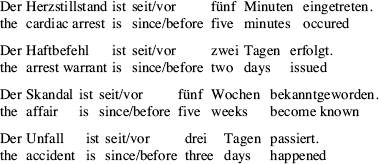
In order to find out whether the introspective judgments in 38—40 can be empirically substantiated, and to what extent unaccusative verbs take part in adjectival passive formation, we conducted an acceptability rating study. Based on our corpus findings we identified two sets of un-accusatives. The first group, Unaccusative 1, comprised participles of unaccusative base verbs that occurred in our corpora in combination with seit-adverbials. The second group, Unaccusative 2, consisted of unaccusative participles that did not show up with seit-adverbials in the corpora. The two groups of unaccusative verbs are given in 41 and 42.
(41) Unaccusative 1
wachsen ‘to grow’, welken ‘to fade’, verreisen ‘to go on a trip’, verschwinden ‘to vanish’, ablaufen ‘to expire’, verstreichen ‘to elapse’, versinken ‘to sink’, erlöschen ‘to extinguish’, anlaufen ‘to start’, schwellen ‘to swell’, wegfallen ‘to drop out’, vergehen ‘to pass by’, abwandern ‘to migrate’, entbrennen ‘to break out’, weichen ‘to give way’, einkehren ‘to stop for a bite’, verstummen ‘to fall silent’, abreißen ‘to break off’, steigen ‘to rise’, sinken ‘to fall’
(42) Unaccusative 2Footnote 15
entstehen ‘to arise’, erscheinen ‘to appear’, kommen ‘to come’, fliehen ‘to run away’, zusammentreffen ‘to meet’, fallen ‘to tumble’, umkommen ‘to perish’, platzen ‘to burst’, sitzenbleiben ‘to remain seated’, hochspringen ‘to jump up’, explodieren ‘to explode’, geschehen ‘to happen’, auftauchen ‘to show up’, einsteigen ‘to board’, gelingen ‘to succeed’, anreisen ‘to arrive’, eintreten ‘to enter’, erfolgen ‘to take place’, bekannt werden ‘to emerge’, passieren ‘to come about’
While the corpus data support the availability of a copula reading in addition to the sein-perfect for the verbs of the Unaccusative 1 group, for the members of the Unaccusative 2 group such an option was not attested in the corpora. The goal of our acceptability rating study was to find out whether the participles in the Unaccusative 2 group really behave differ-ently with respect to adjectival conversion, or whether the lack of seit-adverbials is just an accidental corpus gap. More specifically, we tested the following hypothesis: If there is a (sub)set of unaccusative verbs (presumably, those from the Unaccusative 1 group) that form fully acceptable adjectival passives, for these verbs there should be no dif-ference in acceptability ratings between combinations with seit- and vor-adverbials. In contrast, for the members of the Unaccusative 2 group there should be a clear rating difference, that is, there should be a preference for combinations of such verbs with vor-adverbials.
4.2. Acceptability Rating Study: Copula versus Sein-Perfect.
Methods: The participants were 40 undergraduate students at the University of Tübingen who participated in the study for course credit. All were native speakers of German. The materials manipulated the type of the temporal adverbial (seit- or vor-adverbial) and the type of unaccusative verbs (Unaccusative 1 verbs versus Unaccusative 2 verbs). Some exam-ples are given in 43 and 44.
(43) Unaccusative 1
a.
b.
(44) Unaccusative 1
a.
b.
In total, we had 40 pairs of sentences with unaccusative verbs, 20 items from each group. The complete set of experimental sentences is provided in the appendix. The 40 experimental items were combined with 40 filler sentences. Two presentation lists were created and randomized in parallel two times. Each participant saw only one version of each sentence (that is, either with a seit- or with a vor-adverbial) counterbalanced across the two groups of sentences.
Procedure: The questionnaires were distributed to students in an intro-ductory linguistics class. The participants were instructed to read the sentences carefully and to rate them on a scale from 1 to 6. If the sen-tence was easy to understand, made sense, and seemed to be in “good,” natural German, then they should rate it as 1. If the sentence did not make sense, or if they thought it was in “bad” German, then they should rate it as 6.
Results: The results are presented in table 1.
Mean ratings for the four experimental conditions. (scale 1-6; 1 = good/natural, 6 = bad)

A repeated measures ANOVA revealed a highly significant main effect of adverb type (F1 (1,39) = 282.29, p1 < .001; F2 (1,19) = 159.07, p2 < .001). Sentences with the vor-adverbial were rated better than sentences with the seit-adverbial (1.6 versus 3.3). This effect is due to the sentences in the “Unaccusative 2” condition.
The ratings also showed a highly significant effect of verb type (F1 (1,39) = 90.28, p1 < .001; F2 (1,19) = 30.30, p2 < .001). Sentences that contained verbs from the Unaccusative 1 group were rated better than sentences with verbs from the Unaccusative 2 group (1.9 versus 2.8). Again, this is due to the sentences in the “Unaccusative 2” condition with the seit-adverbial.
Additionally, we found a highly significant interaction of adverbial type and verb type (F1 (1,39) = 256.18, p1 < .001; F2 (1,19) = 69.29, p2 < .001). Sentences with seit were rated much better if they contained a verb from the Unaccusative 1 group (see table 1). Since the interaction was significant, we performed more focused tests. We compared the different adverbials separately for the two verb types. For the verbs from the Unaccusative 1 group the comparison yielded no significant effect of adverbial type (F1 (1,39) = 1.99, p1 = .17; F2 (1,19) = .12, p2 = .73). However, for verbs from the Unaccusative 2 group there was a highly significant effect of adverbial type (F1 (1,39) = 374.14, p1 < .001; F2 (1,19) = 291.74, p2 < .001).
For the comparison of rating differences between seit- and vor-adverbials for the two verb types (see table 2), a highly significant effect of verb type was found (F1 (1,39) = 256.18, p1 < .001; F2 (1,19) = 69.29, p2 < .001).
Rating differences (seit - vor) for the two verb types.

Discussion: The goal of our rating study was to find out whether and to what extent unaccusative verbs can form fully acceptable adjectival passives. The results showed a highly significant effect of the type of unaccusative verb. The rating difference for sentences such as 43a versus 43b was smaller than for sentences such as 44a versus 44b. There was only a significant effect of the type of adverbial for sentences such as 44. There was no significant difference among sentences such as in 43 that contain verbs from the Unaccusative 1 group: They were judged fully acceptable with both the seit-adverbial and the vor-adverbial. These results add, first of all, psycholinguistic evidence to our corpus linguistic findings reported in section 3—they suggest that unaccusatives take part in the adjectival passive formation. Second, the results of this first rating study suggest that the adjectival conversion of the verbal participle is restricted to a certain subset of unaccusatives and, thus, is not fully avail-able for all unaccusatives. This conclusion calls for further investigation.
4.3. Pragmatic Factors.
The question is what are the characteristics of the subgroup of unaccusatives that readily form adjectival passives, and what differ-entiates them from those that do not. The verbs that exhibit the sein-perfect/copula ambiguity (as indicated by their compatibility with both vor- and seit-adverbials) and the verbs that exhibit a clear preference for seit-adverbials form two fairly heterogeneous sets of verbs (see the lists in 41 and 42). Note, for example, that verbs with resultative prefixes or particles such as er-, auf-, um-, an-, ein- can be found in both groups. Thus, a resultative meaning alone apparently does not guarantee that a verb can combine with a seit-adverbial and, thus, readily form an adjectival passive. In fact, there seem to be no clearly detectable semantic constraints determining group membership.
Note, furthermore, that our data disconfirm the few existing generalizations found in the literature. On the one hand, Nogami (2000:98) proposes that the unaccusatives that take part in adjectival passive formation are incremental theme verbs, like zufrieren ‘to freeze up’. On the other hand, von Stechow (1998:27) characterizes the relevant class as non-causative achievements, such as einschlafen ‘to fall asleep’. Neither generalization turns out to be correct. Nogami's proposal cannot account for the data in 45. These unaccusatives are not incremental theme verbs. Yet, they belong to the Unaccusative 1 group and were judged equally good with vor- and seit-adverbials in our rating study.
- (45)
a.
b.
c.
The data in 46 and 47 are problematic for von Stechow's general-ization. On the one hand, the sentences in 46 express non-causative accomplishments, which should not be compatible with seit-adverbials according to von Stechow. Yet, they belong to the Unaccusative 1 group and received good ratings. The sentences in 47, on the other hand, express non-causative achievements. Nevertheless, they received bad ratings in combination with seit-adverbials.
- (46)
a.
b.
- (47)
a.
b.
We conclude that there is no lexical and/or grammatical distinction at work here. Instead, the crucial factors are of a pragmatic nature. More specifically, the (in)ability of an unaccusative verb to form an adjectival passive turns out to be highly dependent on the linguistic and discourse context. Let us consider the verb platzen ‘to burst’. Without any contextual information, sentence 48a is not acceptable. This might sug-gest that the unaccusative platzen does not form an adjectival passive. Yet, if we replace the subject of the sentence with an alternative expression, as in 48b, or embed the same sentence in a specific context that makes the resulting state of the balloon's bursting relevant in a certain sense (see below) as in 48c, the sentence's acceptability increases considerably.
- (48)
a.
b.
c.
Two further rating studies provide empirical evidence in support of the pragmatics approach. We show that the grammaticality of sentences judged problematic in the first study (that is, sentences that contain verbs from the Unaccusative 2 group) improves significantly if the adjectivized participle expresses a relevant property either by choosing a suitable alternative subject expression, as in 48b, or by manipulating the extra-sentential context, as in 48c. The details of these two rating studies are expounded in Gese, Stolterfoht, & Maienborn 2009. Here we provide a summary of those results that are relevant for our present purposes.
Rating Study 2 Context Variation: In our second rating study, sentences with participles from the Unaccusative 2 group were embedded in either a neutral context, as in 49, or in a context that made the resulting state more salient, as in 50. The verbs were used with both vor- and seit-adverbials, as in 51.Footnote 16
(49) Neutral context
Schichtwechsel in der Kardiologie-Abteilung des Krankenhauses. Der Arzt, der gerade anf—ngt, erkundigt sich bei seinem offensichtlich aufgeregten Kollegen, was in der letzten Schicht mit dem Herzinfarkt-Patienten geschehen sei. Dieser antwortet:…
ÔChange of shifts in the cardiology department of the hospital. The doctor that is taking over is asking his visibly agitated colleague what happened to the cardiac patient. The colleague answers: …’
(50) Resultative context
Wie jeder Arzt weiß, sind Wiederbelebungsmaßnahmen nur selten von Erfolg, wenn ein Herzstillstand l—nger als fünf Minuten anh—lt. Bei der Ankunft eines Herzinfarktpatienten erkundigt sich der diensthabende Arzt beim Rettungssanit—ter, ob denn noch Hoffnung bestehe. Der Sanit—ter verneint und fügt hinzu: …
ÔEvery doctor knows that resuscitation attempts are rarely successful in cases when cardiac arrest lasts more than five minutes. As a cardiac patient is brought in, the doctor on duty asks the paramedic whether there is any hope. The paramedic denies and adds: …’
- (51)
a.
b.
Sentences with vor-adverbials such as 51b did not show any rating difference between the two types of contexts in 49 and 50. However, sentences with seit-adverbials as in 51a received significantly better ratings when embedded in a resultative context such as 50. Thus, the second rating study reveals a context effect: The context has an impact on the acceptability of copula sentences with adjectivized participles of unaccusative verbs.
Rating Study 3 Subject Variation: In our third rating study, we tested the hypothesis that a figurative use of a participle from the Unaccusative 2 group would lead to a better rating of the respective adjectival passive. The rationale behind this hypothesis was that a figurative interpretation of the participle is more costly and must therefore be properly legitimated by referring to a particularly informative resultant state (see section 5). To trigger a figurative interpretation of the participle we used abstract subjects. For a concrete interpretation we chose concrete subjects. This is illustrated in 52.
- (52)
a.
b.
The results confirmed our hypothesis: Adjectival passives based on verbs from the Unaccusative 2 group received significantly better ratings in the figurative context.
In sum, both pragmatic factors—an appropriate context and a figurative interpretation—triggered the same effect: The acceptability ratings of sentences with adjectival passives based on verbs from the Unaccusative 2 group increased significantly. These findings support our claim that adjectival passive formation is not constrained primarily by grammar, and that it requires a pragmatic explanation. The question as to which verbs form an adjectival passive is not to be answered categor-ically, on a strictly grammatical basis. Rather, any verbal participle, except those mentioned in note 5 above, can undergo adjectival conversion. In particular, we conclude that adjectival passive formation can apply, in principle, to unaccusatives from both the Unaccusative 1 and the Unaccusative 2 group, and the degree of acceptability of any particular construction depends crucially on pragmatic conditions.
5. Toward a Pragmatic Account of the Adjectival Passive Formation.
The task of legitimating and interpreting the formation of adjectival passives in context is basically the task of pragmatics. Our findings concerning the adjectival passive formation for unaccusatives fit neatly into the pragmatic account of the interpretation of adjectival passives developed in Maienborn 2007, 2009, 2011. This proposal capitalizes on the insight that adjectival passive constructions are special instances of copula sentences. Adjectival passives assign a pragmatically salient, event-based ad hoc property to the subject referent. This property is conceived of as the result of the event named by the original verb. That is, while a standard copula sentence with a predicative adjective assigns a lexicalized property to the subject referent, which has a fixed place in the subject referent's property space (see Maienborn 2005 for the semantics of the copula), adjectival passives are a grammatically supplied means of creating ad hoc new, event-based properties, whose exact import, and therefore the place they occupy in the subject referent's property space, is more or less shaped by the context and by our contextually available world knowledge.
Certain verbs, particularly resultatives, which already specify a resultant state from which a relevant property can be derived, will require less (or virtually no) support from pragmatics to license the adjectival passive formation. This is the case, for example, of geschlossen sein ‘to be closed’ or abgerissen sein ‘to be broken off’, to take one of our Unaccusative 1 verbs. With other verbs, more contextual support is needed for identification of a suitable ad hoc property. An example of such a verb is explodieren ‘to explode’ from our Unaccusative 2 group. Without a relevant context it is hard to imagine a distinctive property that could be the result of something having exploded. Consequently, a sen-tence such as 53a sounds out of the blue. Yet, if the subject triggers a figurative interpretation of the verb as, for example, the oil price does in 53b, the adjectival passive becomes fully acceptable. According to our world knowledge, if the oil price explodes it remains high as a result. Thus, we are able to derive a sufficiently informative resulting property. This provides the necessary pragmatic legitimation for the adjectival passive formation.
- (53)
a.
b.
Depending on the meaning of the original verb, such ad hoc properties can be more or less salient: In some cases, the relevant property follows naturally from the verb's lexical semantics, while in others, the interpretation relies heavily on contextual and world knowledge. How-ever, the general pattern of forming and interpreting adjectival passives is the same in all these cases.
Our case study of unaccusatives provides evidence for a new perspective on the formation of adjectival passives. This word formation process is far less grammatically controlled than generally assumed: First, not only transitive verbs but also unaccusatives can form adjectival passives. Second, whether or not adjectival passive formation is possible is largely a matter of pragmatics. This latter conclusion paves the way for a more comprehensive account of the semantics and pragmatics of adjectival passives. With the adjectival conversion of a verbal participle the grammar provides a systematic means of deriving potentially new, deverbal adjectives that express an event-based ad hoc property.
APPENDIX
Materials of the Rating Study
Unaccusative 1


Unaccusative 2