Visiting artists in schools and art partnership programmes have been important in arts education for many years (Watson & Forrest, Reference WATSON and FORREST2008; Espeland, Reference ESPELAND2010). In Norway, a national programme for arts and culture called the ‘Cultural Schoolbag’Footnote 1 is now nearly 15 years old. The Ministry of Culture and the Ministry of Education collaborated to design the Cultural Schoolbag programme to provide pupils in primary and secondary schools with opportunities to experience artistic and cultural productions at a professional level (Christophersen et. al., Reference CHRISTOPHERSEN, BREIVIK, HOMME and RYKKJA2015). Its purpose is to function as a supplement to, not a substitute for, the arts in compulsory education (St.meld. nr. 8, 2007–2008). Experience is a key term in the programme, and social activities are increasingly viewed as important learning sites in music education. For example, both the Norwegian curriculum and education act are built on principles of democracy and equality, where abilities and talents are to be developed individually and collaboratively.Footnote 2 Still, there seems to be little research on creative composition projects in such arenas.
This article reports on a case study involving nearly 50 pupils in two primary school groups.Footnote 3 A contemporary music ensemble had developed a project offered to schools focusing on composition as a part of the Cultural Schoolbag programme. Two experienced visiting artists/musicians from the ensemble facilitated the week-long project. At the end of the project, the two groups of pupils came together and gave a concert where they performed their newly composed piece. The music the participants created was built around principles of contemporary music and the avant-garde.
In this article, the research question ‘How do mediating tools take shape in creative musical practices?’ is examined through a sociocultural perspective. I describe the methodological and analytical approach used to collect and analyse the data from the case study. Next, through examples from the collected data, I examine graphic notation, musical motifs, gestures, meaning and transformation of experiences as material and psychological signs, systems and tools. Finally, I discuss the mediating tools in this study as situated: a toolbox consisting of cultural tools, symbols and signs, but also as authoritative systems.
A sociocultural perspective on mediating tools
In sociocultural research, a central task is the study of how cultural tools and technologies are used and transformed through specific community practices (Rogoff, Reference ROGOFF2003). Our world view is mediated by tools and artefacts formed by previous knowledge and experience in a social culture (Säljö, Reference SÄLJÖ2006). Mediation is a central term in Vygotsky’s writings, which involves the theory of how we interact with and in the world through processes that can be described as both social and historically situated (Wertsch, Reference WERTSCH, Daniels, Cole and Wertsch2007). Mediating tools, also in previous research examined as communicative tools (Wallerstedt, Reference WALLERSTEDT2010, Reference WALLERSTEDT2013), are central in understanding how we perceive and understand the world. In a learning context, cultural tools can be seen in the resources introduced to the child and in a scaffolding mediation and appropriation process supported by the teacher (Wallerstedt, Pramling, & Säljö, Reference WALLERSTEDT, PRAMLING and SÄLJÖ2014). Within music education research, cultural tools are important to examine when understanding how our learning actions and interactions are shaped within a cultural frame (Barrett, Reference BARRETT and Barrett2011). Studying mediating tools in learning contexts can provide insight into how humans learn and think (Mars, Reference MARS2016). For example, Hultberg (Reference HULTBERG2002) shows how scores and notations can function as mediators of traditions. Further, the performance, the instruments and, not least of all, teachers can function as bearers and mediators of cultural information and tradition (Hultberg, Reference HULTBERG and Barrett2011). By playing music examples, the teacher introduces the pupil to ways of performing that can be understood as ‘representative practice’ (Hultberg, Reference HULTBERG and Barrett2011, p. 117). When listening to such musical gestures, the student develops an understanding of how expressions and structures in music function.
The musical gestures of a conductor can also be described in terms of mediating means among the participants in an ensemble (Bygdeus, Reference BYGDEUS2015). Skills and abilities of performance and instruments are, according to Burnard and Younker (Reference BURNARD and YOUNKER2008), mediated actions central to composition and arranging activity systems. Different types of notation, traditional and invented, may also function as mediators of meaning among learners (Wallerstedt & Pramling, Reference WALLERSTEDT and PRAMLING2015). Mediating activity is central in developmental processes, and Kozulin (Reference KOZULIN and Vygotsky1986) describes the role of psychological tools and interpersonal communication in Vygotsky’s theories. Psychological tools transform, for example, gestures, language, signs, mnemonic techniques and decision-making systems internally. Both psychological and material tools can be considered artificial formations: ‘While material tools are aimed at the control over processes in nature, psychological tools master natural forms of individual behaviour and cognition’ (Kozulin, Reference KOZULIN and Vygotsky1986, p. xxv).
Experiences of natural functions are, according to Vygotsky, transformed into higher cultural functions in a process of internalisation. The learner’s thoughts and actions change when the learner encounters new tools (Kozulin, Reference KOZULIN, Kozulin, Gindis, Ageyev and Miller2003). From a sociocultural perspective, the process of learning is explained through the concept of appropriation. When the focus in a study is on learning, the analysis is based on situated activities (Säljö, Reference SÄLJÖ2006). The ‘building blocks’ of cultural functions can be found by external means, such as psychological and material tools, supporting the development of attention, decision making and memory (Kozulin, Reference KOZULIN and Vygotsky1986).
While Vygotsky (Reference VYGOTSKY1978, Reference VYGOTSKY and Kozulin1986) emphasised the semiotic nature of psychological tools in learning interactions, the understanding of how mediation can take shape has in more recent theories been expanded to include organised learning activities involving other humans. The concepts of scaffolding and apprenticeship have been well established (Kozulin, Reference KOZULIN, Kozulin, Gindis, Ageyev and Miller2003, p. 17), and Rogoff (Reference ROGOFF1990) discussed developmental processes and apprenticeship as shared activity (p. 195). Shared activity could be examined as an appropriation process consisting of social exchanges where children participate through communicative activities. The product, which is also the process where information and skill are transformed, is jointly produced, but individually appropriated. When a group of participants engage in social interaction and appropriation of cultural practices, they simultaneously transform the culture (Rogoff, Reference ROGOFF1990, p. 198). In social relations, cultural tools are not merely cognitive strategies and scripts but need also to be considered in terms of values and authority (Wertsch & Rupert, Reference WERTSCH and RUPERT1993). As mediational means, cultural tools are provided by a sociocultural context (Wertsch, Reference WERTSCH2004). They can be of material, symbolic or intellectual character and may also include gestures and behaviours connected to particular uses in specific contexts (Rogoff, Reference ROGOFF2003). Cultural tools are artefacts with physical and semiotic aspects (Säljö, Reference SÄLJÖ2006). In creative activities, children can combine different elements from experience to construct new structures. Education plays a crucial role in providing children with broad foundations for generating creative products (Vygotsky, Reference VYGOTSKY2004).
The complexity of mediation can be connected to Bruner’s (Reference BRUNER1996) explanation of a box of tools rather than multiple single tools. A continuously expanding array of cultural tools is embedded in the historical, social and cultural contexts a composer works within, including compositions, performances, musical material, notation techniques, instruments and methods for constructing music. The pupils use tools that are already influenced by culturally specific ways of thinking and acting; the invention of ‘new’ symbols and systems is transferred and reshaped (Rogoff, Reference ROGOFF1990) from conventional thinking and action into making sense and meaning in the new context.
Collection and analysis of data material
This article reports on a time- and location-specific project where professional artists and pupils collaborated to compose music. The case study approach is typically used when the phenomenon of interest is situated within a bounded system (Stake, Reference STAKE1995). As Yin (Reference YIN2014) explains, case studies can rely on different sources. Interviews and video observations were chosen as the main sources for the current study, including recorded sounds and different types of notations from pupils and facilitators.
I interviewed the professional artists involved, Christian and Anna,Footnote 4 and a focus group consisting of a total of six volunteer pupils (two groups of three), during and after the project period, utilising a semi-structured interview guide (Kvale & Brinkmann, Reference KVALE and BRINKMANN2009). Christian was interviewed before the project began. I had a non-participant observer role in the project. The pupils’ curiosity about my, and the recording equipment’s, appearance did not allow for writing notes during observations. In the analysis, videos and audio recordings therefore became a valuable detailed source of the musical material developed in the process.
The analysis began with the transcription of interviews and selected parts of the observation material. Next, the transcriptions were arranged into ad hoc themes, noting important keywords from the transcriptions (Stake, Reference STAKE2006). The interviews provided important insights from different perspectives, assisting the interpretation of the empirical data (Bresler & Stake, Reference BRESLER, STAKE and Colwell1992). An early focus in the analysis was the interactions between the participants and the development of musical material. As I proceeded, I wondered how I could approach the data analysis holistically, including the music as an important part of the analysis.
In an attempt to solve this problem, the final performance functioned as a starting point for understanding the process retrospectively. Using video- and audio-recordings, the final performance was transcribed in detail. In this part of the analysis, I used mediational means such as traditional notation, written text and adapted signs and symbols derived from the case material. Transforming experiences of music into writing and notation (providing a ‘gloss’) can never replace the original sound (Kress, Reference KRESS2000, p. 339); however, in the analysis, these transcriptions functioned as tools for approaching the case systematically. The categories and focus areas in the final presentation of the results in this article emerged from the data material analysis.
Case description
The reported case took place in a Norwegian school, with two fifth-grade groups (age 10—11 years old) of approximately 25 pupils each. The groups worked separately through the first four days, but on the final day, their musical contributions were merged and performed as a whole piece.
The teacher of the class, who had some musical background, told me informally that she found the demands of the national music curriculum challenging. In the Norwegian curriculum, composition is defined as one of three main areas of the music subject.Footnote 5 The activities within composing include, for example, improvisation with instruments and voice and composing with simple musical forms and motifs utilising graphic notation. The pupils are to learn basic musical elements and instruments, work with musical patterns, express imaginative abilities and reflect on their musical experiences (Utdanningsdirektoratet, 2006). The teacher participated mainly as an observer and organiser in Group A, and a few other teachers followed Group B.
Of the two facilitators in the project, Christian had the role of ‘Composer 1’ (project leader), and Anna was ‘Composer 2’ (assistant composer). They both had experience from similar projects in the Cultural Schoolbag programme and were professional artists and musicians. They had not worked together before and first met a few days before project began.
The project was scheduled to last five days: two school hours including breaks (total of 1 hour 50 min) per group for the first four days, and four school hours before the performance the final day where they heard each other’s contributions to the final piece for the first time (except for a few musical units introduced across the groups by Christian and Anna during the week). Most of the time, the groups assembled in a music classroom in the school basement. The room was sparsely equipped, with a few Orff instruments, hand drums, a djembe and single staves of metal chimes; there were two pianos in the room, one of them out of tune. The second day, pupils were encouraged to bring their own instruments, which added two guitars, a ukulele, a few more drums and, eventually, an electric bass.
Mediating tools in creative music making
The facilitators announced the project task on the first day as an assignment ‘similar to a composer’s task’. Christian and Anna explained how composers often receive a project assignment: a performance date and the desired orchestration for the piece. Similarly, the pupils were introduced to a frame for the project initiated by Christian; the topic was to be ‘board games’. The piece should be composed for the available instruments and was to be performed the following Friday.
The pupils suggested several games to work with in the initiating idea session, such as Poker, Chess, Ali Baba, Ludo, Yahtzee, Monopoly, the Labyrinth, and Chutes and Ladders. In the final concert, the units were interwoven and performed as a continuous piece. They were introduced to graphic notation in full-group sessions, where Christian and Anna described and drew how sound ideas could be notated through abstract lines and dots. The pupils were divided into smaller groups of four to five working on the basis of the board games suggested. First, they were encouraged to work on ideas just using their voices and bodies. Each group received pen and paper, and the facilitators circulated, encouraging the work and explaining the task.
The result section is organised in a total of three main themes from the analysis: notation signs and systems as cultural tools, music-making actions and interactions mediating cultural tools, and mediating meaning and aesthetic experiences as cultural tools. A selection of a few music units from the project will serve as focus examples.
Notation signs and systems as cultural tools
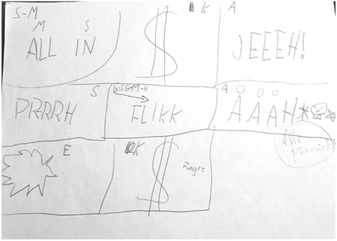
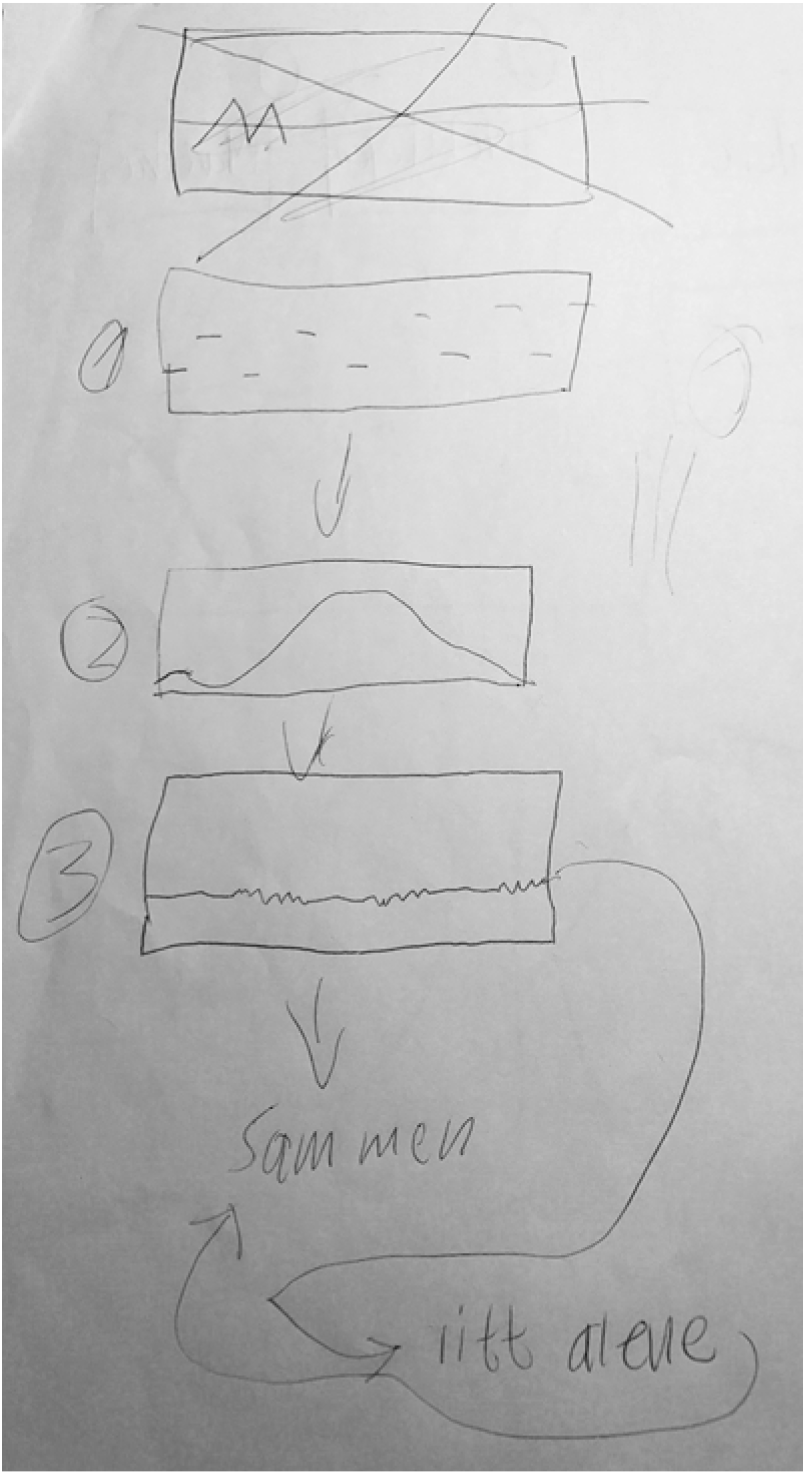
The participants worked with ideas using a variety of tools, including graphic notation to connect their ideas to the overarching theme of creative work, to produce or memorise the musical material under development and to develop ideas further. The graphic notation samples collected from the initial sessions showed that the pupils, to varying degrees, used combinations of writing and drawing to express their ideas. The different words had several purposes, for example, explaining game play progression: referring to different stages and actions playing the game such as ‘dice throwing’, ‘down/up the ladder’, ‘winning!!’, either standing for itself or accompanied by a drawing. There were also verbalisations resembling actual sounds (onomatopoeia) in the musical context: ‘ooooooh’, ‘flick’, ‘brrrr’, ‘yeah’.
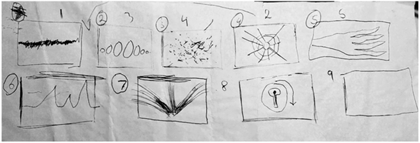
Finally, there were also samples of instructional writing, pointing to how the different sequences should be performed, such as ‘together’, ‘little alone’ and indications as shown above with initial letters of the pupils who were participating at that particular sequence.Footnote 6 Other groups, like the Ali Baba group, had less text and more abstract lines and dots as seen in Fig. 2.
Graphic notation from a group working with Poker

Graphic notation from a group working with the Ali Baba gameFootnote 8

There are several similarities between these drawings and those found in Barrett’s (Reference BARRETT2001) study where four types of strategies in the graphic notations of children were identified: symbolic representation, adopted symbols and enactive representation, combining several types of strategies, and modified representations of instruments. Similar strategies were found in the current study except that representations of instruments as graphic notations were only produced in the idea-gathering phase before instruments were implemented. In addition, as shown in the aforementioned samples, the drawings were all arranged on a timeline, organising the different events in music ideas either vertically or horizontally. Symbols used were both abstract drawings such as lines and dots, but also representations such as a money sign, spider web and keyhole. Framed by little boxes for each ‘sound image’, some of the musical stories, such as those in Fig. 3, look like short cartoon sketches.
Graphic notation from a group working with the Labyrinth board game

Vygotsky (Reference VYGOTSKY1978) explains how the relationship between signs and tools is interconnected:
The tool’s function is to serve as the conductor of human influence on the object of activity; it is externally oriented; it must lead to changes in objects. The sign, on the other hand, changes nothing in the object of a psychological operation. It is a means of internal activity aimed at mastering oneself; the sign is internally oriented. (Vygotsky, Reference VYGOTSKY1978, p. 55)
Similarly, the graphic notations in the current study were caused by, and led to, changes in the musical material. In the preceding example, the pupils combined systems and symbols that could be connected to their previous experiences which functioned as a cultural and social repertoire of tools supporting the mediating activity of musical ideas. First, the pupils built a story of playing a game, engaging in the different symbols of that particular game, how the game proceeds and important turning points and expressions of feelings connected to the game. Next, mediated through graphic symbols and signs internally interpreted into musical gestures and sounds, the signs functioned as a mediating tool and mnemonic technique for the performance of the music. The participants organised these signs into a system. The meaning of each sign could be seen as a psychological operation of memorising, musical idea gathering and transformation found in processes of learning in Vygotsky (Reference VYGOTSKY1978).
When the pupils were to perform their work from their invented notation the first day, I observed that the participants seemed to have some trouble remembering and following all of their own ideas through the symbols. Vygotsky (Reference VYGOTSKY2004) explains how challenging creative literacy can be, which was also evident in this study where the graphic notation was a new way of expressing musical ideas for the participants. In a focus-group session, the pupils talked about how they had felt a little embarrassed showing their ideas to the others. As one of the pupils said:
Yes, we [were] insecure about what to draw. Because there were many lines and then ‘a little bit alone’ and then ‘together’, so we thought, ‘Huh? What does she mean about that?’ So, we just look at the sheet of paper and then we thought, ‘if we are going through this, we just have to pretend’, so, that’s how it went, we stood pretending to speak and blah-blah. (Pupil 1, Group B, Ali Baba)
At the same time, the (mis)interpretation of their own graphic inventions allowed for new musical ideas to emerge; the mediated action and interaction resulted in new understandings of the signs. Wallerstedt and Pramling (Reference WALLERSTEDT and PRAMLING2015) also found that in a music performance project, a notation system with little information could support the development and transformation of musical ideas for both the individual pupil and within the group. The pupil from the Ali Baba group described a process we could recognize as shared activity (Rogoff, Reference ROGOFF1990): When the link between the external tool (the graphic notation), and the process of internal sign interpretation failed, the group quickly found a solution by creating and transforming musical ideas on the spot together. For the final performance, Christian created a full graphic notation score which he used when he conducted the merged groups of pupils, with several references to the original symbols and signs made in the first phase.
Like graphic notation systems and other techniques for noting, preserving and transforming ideas when composing, signs and symbols are developed by participants in a culture and community of creative practices. Similar systems are used in professional practice, and learning graphic notation is expressed as a goal in the curriculum. The pupils also made use of their extended knowledge of how ideas could be arranged progressively in time. They developed and expressed a musical ‘story’ through different signs and systems specifically designed for the purpose of supporting memory and visualising sound ideas. The pupils were thus in the learning process socialised through experiences of the mediating tools of the culture they were situated in, understanding how signs and symbols can support different interpretations and new musical interactions.
Music-making actions and interactions as mediating tools
The sound-making possibilities were expanded on the second day from body and voice to the physical musical instruments available. The facilitators had the idea that one of the groups would work mostly with rhythmical instruments, while the other used more melodic instruments. This choice of material tools for each group also set a frame for what kind of sounds the groups would be able to produce.
Ali Baba
The first sound we hear, after Christian has pointed in the direction of a small group located in the back of the ensemble, is from the ukulele playing a D major chord on beat in an arpeggio-style. She plays four beats, and then the bass player joins in at D at every fourth beat. Then, in the fourth measure, the piano players also play a D, both in the lower and upper pitches. When they have played for 10 measures, the metallophone player joins in at the 11th measure (a little off beat), playing the Ali Baba motif, following Christian’s conducting gesture, raising his hands:
A djembe drummer joins in at the rhythmic motif, along with a few of the other pupils. Anna sits beside the djembe drummer with a small hand drum. She moves her lips, mouthing a text fit for the rhythmic motion (‘tårnet tar hesten, tårnet tar hesten tårn’)Footnote 7 while they beat the drum rhythm together.
The conducting gestures used during performance (by Christian, Anna and two volunteer pupil conductors in selected parts of the music) were a combination of traditional conductor signs and invented signs made up by the participants during the week. In a similar way, Bygdeus (Reference BYGDEUS2015) describes the actions of a choir leader as visible expressions mediating a dynamic relationship between thought and language. The idea of a tool becomes a verb; the mediation of meaning happening through conducting gestures in the preceding example was developed from traditions where these kinds of signs are used to communicate musical concepts. At the same time, the use was transformed in the social and musical interactions to support the musical performance of ideas in this particular practice. The gestures functioned as extensions of thoughts developed in the shared, creative activity. The conducting gestures and mouthing exercise described in the example from the preceding performance show how the participants have dynamically developed a relationship between the gestures and interpretation of musical meaning involved in the particular interaction.
Anna’s text supporting the complex rhythm in the Ali Baba motif had several functions as an interactional mediating tool. Time and metre could be seen, from a sociocultural perspective, as a scientific concept (Wallerstedt & Pramling, Reference WALLERSTEDT and PRAMLING2012), here transformed using a text into a rhythmic tool with a mediating function. The pupil djembe drummer and others joining in the sequence used the text as a psychological tool when performing a complex rhythm. At the same time, the chanting and drumming exercise also became a mechanical tool (Hultberg, Reference HULTBERG and Barrett2011) for achieving the correct rhythmical emphasis. The compound action also created a link to musical expression of the theme for the creative process, board games with the group subtheme, Chess. Such a blending of tools could be understood in terms of Bruner’s (Reference BRUNER1990, Reference BRUNER1996) descriptions of a tool box, rather than separate tools, culturally mediated in the situated context.
From a sociocultural perspective, learning can be seen as a continuously ongoing process of developing and organising learning results into cultural functions (Vygotsky, Reference VYGOTSKY1978). Adapted to the particular situation in the empirical material described earlier, the signs and symbols developed through the creative interaction became crucial for the musicking event to take place. The music in the performance depended on how musical ideas were expressed and interpreted; physical signs functioned as psychological tools mediating meaning in the situated context. The music gestures in the final performance symbolised interactions extending the thoughts and ideas in the shared process of making the musical material.
One of the groups had some trouble proceeding with their ideas during the creative process. Anna took charge of the situation and used dice to create a piece of music with the group. This is how Anna described the session:
It was that simple; we had two dice, both of them going up to the number eight. Then we had a glockenspiel that went from C to C. I think that is a very nice range for the children to sing. So, that was our starting point. … Then we started throwing the dice and counted. Everyone got to throw a die. I wrote number one, which was tone number 8; number two was a 3, and then 4 and 5, and so on. Then we had a verse that we sang several times, on ‘doo-doo’, and then we needed a sort of a refrain. (Anna, interview 1)
The dice became a psychological tool for decision making in the creative process, but they also functioned as a material tool with which the participants interacted physically in order to create a concrete melody to be sung. The dice had a cultural function connected to the game but were transformed into a new compositional function in the creative process. Vygotsky also mentioned decision-making systems with dice-throwing as an example of a psychological tool (Kozulin, Reference KOZULIN and Vygotsky1986, p. xxv), describing these as natural psychological functions that could lead to higher functions and learning. In the example described earlier, the participants in the decision-making process made use of the dice as a cultural tool for creating new music. In addition, as discussed in the next section, the process had another cultural dimension. The pupils made the final decisions in the creation of the melodic material from what appeared to them as meaningful in the situated context.
Mediating cultural tools of meaning and experiences
The dice in the previous example could be described as a natural, material tool of random numbers used in game play, which turned into a cultural function from which a musical material could be constructed. But, when Anna described the initially random action and interaction, she also mentioned how creative choices were steered by a psychological tool connected to what was experienced as meaningful in the musical context:
And there was, there could be a tone that the pupils didn’t like, that just, immediately it didn’t sound right. I don’t remember what it was, but it was something that ‘cut out’ from the rest. And then we … tried it out, first the one, then the other [alternative], and then it became sort of obvious. (Anna, interview 1)
Meaning could therefore be understood as implicit in the tones the pupils chose, or discarded, for the melody they were working on. The approach was explorative, interpretive and based on personal judgement, similar to how piano players work with printed scores mediating meaning (Hultberg, Reference HULTBERG2002).
The participants in the current study connected several levels of cultural and social meaning through the creation of musical sounds and textures. The pupils transformed experiences into the creation of meaningful musical expressions. In the same way, Vygotsky (Reference VYGOTSKY2004) explained how children’s play could be described as ‘creative reworkings’ rather than merely imitations or echoes of their experiences (p. 11). The next example shows how what we could call creative reworkings, or transformative use of cultural tools, functioned in the case studied.
Yahtzee
Anna comes in from the far left in the orchestra, where she has been playing a djembe. Her body is crouched forward as she enters with exaggerated silent steps, fluttering a large sheet of paper in her right hand. When the performers become aware of her appearance, they pick up their own sheets of papers and start fluttering theirs as well. While this soundscape is established, Anna signals to two girls sitting behind xylophones. They start playing by throwing several dice down the xylophones, providing a warm, descending sound of the dices hitting the instruments’ wooden staves. The paper flutters in the rest of the group follows Anna’s hands gestures, quieting down, moving their paper sheets slower.
The xylophone players connected two separate material tools, the dice and the xylophone, originally artefacts representing two different contexts: game playing and sound production. This combination created a distinct, soft-textured sound, which was originally developed from the dice throwing in the board game, Chutes and Ladders. How the idea came about was a bit unclear. The pupils in focus Group A started, in a retrospective interview, to talk about how Christian helped them to develop their ideas, but concluded by saying, ‘We all agreed, together. And we found, yes, I don’t really remember who came up with the idea. All of us’ (Pupil 4, Group A).
There were several more examples of how meaning and experience became important mediating tools in the creative process. For example, one pupil proposed an idea on the first day that later became an important theme in the final piece. To represent a feeling of excitement in the game, he repeatedly sang the two recognisable tones that make up the motif in the blockbuster movie Jaws. This melodic citation was picked up by the facilitators and transformed during the process into a theme played by a girl on electric bass in the performance. In the interview, the pupil explained as follows:
Pupil 2, Group B: But there is one thing I feel I’m really ready to do, that I know very well, and that’s from the Labyrinth where we will play ‘dun-dun-dun-dun …’ (singing the theme motif from the movie Jaws), I’m pretty prepared for that. Or, that is the one I know what to do.
Researcher: Why are you more prepared for that?
Pupil 2: No, because we have rehearsed that part a lot. And it is much easier to play, because I know the sounds and when I’m going to play, so I think that’s much easier.
Researcher: Where does that sound really come from?
Pupil 2: It is probably coming from a lot of movies, and then it is known for some people, then there is a shark coming, then there is a du-du-du-du-du (singing the same motif a little faster). And then the shark eats the human, so, it [the sound] is from there. Hehe.
An experience with a shared cultural reference, a movie theme, became a tool for expressing a feeling in a meaningful way in the musical material under development. Previous experience in the new context is used in a way this pupil explains as ‘easier’ to play, providing a strong association that made the musical material more meaningful. The interplay between experience and the present is central for learning in a sociocultural perspective (Mars, Reference MARS2016). Pupil 2 said she learned this motif best because of two features of musical learning practices, the rehearsals and that she ‘knows’ the sounds. The motif becomes a tool with several aspects: a cultural experience connected to a particular meaning, interpreted and transformed in the work with new musical material, played on an instrument the pupil is familiar with, and thus with a new function in the piece they have created.
Discussion
This article is an examination of the research question ‘How do mediating tools take shape in creative musical practices?’ The findings presented in the article suggest that mediating tools in the case studied took shape through material and psychological signs in three different ways: (1) as symbolic signs, such as graphic notation; (2) through music-making actions and interactions such as the introduction and development of conducting gestures; and (3) mediation of meaning and experiences as cultural tools in the creative musical practices. In the discussion section, I will focus on how the mediating tools take shape first. Second, I discuss how cultural tools also need to be discussed as authoritative systems when implemented in new communities of practice.
The way the theme for the collaborative creative work was promoted to the groups was clearly meant as a tool for idea generation, structuring and shaping the imaginary stories behind the musical material. In similar ways, Hultberg (Reference HULTBERG and Barrett2011) reports how a teacher uses an image of a landscape to get the pupils to understand the general character of a song (p. 122). Hultberg (Reference HULTBERG2002, Reference HULTBERG and Barrett2011) describes how pupils also used instruments as mechanical tools rather than to express musical meaning when interpreting new pieces for performance. In this project, where the pupils engaged in creative practice, most of the pupils’ instrumental skills were at the novice level. Nevertheless, it is interesting to discuss some of the actions in terms of the ideas proposed here. The pupils were, as described in the Ali Baba and Yahtzee sections vignettes, very occupied with trying to follow the progression of the music in the final performance. The direction of their gaze was almost continuously at the conductor. They appeared to be waiting for the agreed-upon cues regarding what they were supposed to do and doing it ‘right’ in terms of what they had rehearsed. The mediating tools took shape as a continuous dialogue between the participants, through actions and interactions that were both implemented through the process and also transformed when the participants implemented their own meanings into the musical parts they were performing. The line between mechanical and psychological tools therefore seems blurred. As Säljö (Reference SÄLJÖ2006) points out, cultural tools have both physical and intellectual sides, but should not be seen as separate entities (p. 28).
Christian and Anna functioned as facilitators of the creative musical practice. The activities built on relationships with tools the pupils brought to the context, such as the physical instruments they played, experienced examples of music such as the Jaws theme and an oriental sounding melody in the Ali Baba theme, a ‘sense’ of what could be considered meaningful in the music under development, and different semiotic systems that could be adapted to the new context. In addition, Christian and Anna were mediators of cultural tools belonging to the musical, music educational and compositional community of practice. They functioned as connectors of relationships with an established way of working and thinking as professional music makers. Cognition is regarded as situated in a sociocultural perspective, which means the cultural tools in a specific context must be analysed in terms of understanding the activities of that particular practice. The dynamic interactive relationship, or connection, between thinking and the actual situation is both built on references from previous experience and cultural tools mediated by the participants (Rogoff, Reference ROGOFF2003). The mediating tools in the creative musical practice were reshaped and transformed in the shared experiences of the participants.
Physical instruments can be considered material tools produced in and transformed through historical and social use. According to Rogoff, ‘They are representatives of earlier solutions to similar problems by other people, which later generations modify and apply to new problems, extending and transforming their use’ (Rogoff, Reference ROGOFF2003, p. 276). When the pupils played instruments, they took part in these ‘earlier solutions’ and adapted them to their own use (e.g. the changing of staves on the metallophone in Ali Baba or the rolling of dice on a xylophone). It became a shared activity where the pupils also brought cultural tools to the context. As Bruner (Reference BRUNER1996) points out, schools often fail to ‘take account of the enabling nature of human culture as a toolkit for active, questing children seeking mastery over their worlds’ (p. 81).
Although my interpretations of the graphic notations used in the idea phase were not discussed with the pupils, such a dialogue could have provided insight into their invented graphic signs and symbols as expressions of meaning (Barrett, Reference BARRETT2001). As a mnemonic technique, the pupils had difficulties in appropriating the link between the symbols in the graphic notations and the sounds. This could be connected to the limited time of the project, not allowing the pupils to actually, in Vygotsky’s term, ‘internalise’ the mediating cultural symbols and signs in the project. The twofold mediation function of graphic notation in the current study suggests that a symbiotic relationship between the externalisation and internalisation processes would be better explained with Rogoff’s (Reference ROGOFF1990) idea of ‘shared activity’. The notations functioned both in the way traditional notation is described in Hultberg (Reference HULTBERG2002), as ‘a cultural tool mediating real music to its interpreters (p. 186), but also as a cultural tool mediating an expression of meaning and experiences in a new musical form.
As this project uses an art form far from the pupils’ own music, an important question concerning cultural tools is, why is the avant-garde used as an approach? Anna concludes by claiming that the avant-garde is an inclusive way of creating musical material that opens up many possible solutions. This idea can be traced back to modernism, via the influential theories of John Paynter, where the innocent, open-minded approach of the creative child became an ideal (Kanellopoulos, Reference KANELLOPOULOS and Wright2010). Previous research has criticised ‘school music’ as distanced from the ‘real-world’ music of the students (Allsup, Reference ALLSUP2003; Green, Reference GREEN2009). The cultural tool analysis and the sociocultural perspective on creative practices show that this kind of musical composition approach can actually enable the creative use of the cultural, social and historical repertoire each pupil brings to the new context. The cultural tools are shaped, inherited and transformed, and they ‘must be adapted to the specific activity’ (Rogoff, Reference ROGOFF2003, p. 51).
At the same time, cultural tools need to be discussed as authoritative systems (Wertsch & Rupert, Reference WERTSCH and RUPERT1993) in the creative practice. Anna and Christian, as the facilitators of this creative practice, can be seen as the ‘experienced representatives of the music tradition’ (Hultberg, Reference HULTBERG and Barrett2011, p. 136). The pupils, early in the process of learning the cultural tools belonging to the compositional paradigm, did not seem to gain independence in order to handle these tools for themselves. For example, even though the graphic notation idea was an attempt to help the pupils develop their musical ideas (as specified in the curriculum), it did not seem that they immediately understood the connection between what they drew and the sounds they made. The tool was not immediately experienced as a meaningful cultural tool according to the activities they were bound to be doing. Still, it was implemented as a necessity by the facilitators of the project. Conventional notation was not used, but there seemed to be similar problems as found in Hultberg (Reference HULTBERG2002), that is, ‘familiarity with musical practice is a presumption for coping independently with the printed score’ (p. 196). The pupils were, in the short project this study investigated, introduced to some cultural tools but were not yet equipped to continue the learning. Mars (Reference MARS2016) finds a similar problem in her study where students were capable of, to some extent, using the same tools as their teacher, but did not gain full comprehension of why and how the tools were used.
Final thoughts
Implications from the findings in this study suggest that creative practices should be enduring rather than short and limited. These critical aspects (time and context) also connect to the social involvement and meaningful participation emphasised in sociocultural perspectives of learning. The analysis of mediating cultural tools provides important insights into the complex situated practices pupil participants take part in both inside and outside of school, which make up a large, compound box of tools in creative projects. At the same time, the crucial role of the facilitator in situated practices of creativity needs to be studied and discussed in context with the pupil participants. The study of shared activities, actions and interactions involving symbols and signs, based on experiences and meaning, can develop our understanding of how learning and mediating tools take shape in creative practices.