Introduction
Obstructive sleep apnoea (OSA) is a sleep disorder characterised by repetitive episodes of partial or complete upper airway collapse during sleep. These episodes result in intermittent hypoxia and oxyhaemoglobin desaturations.Reference Garvey, Taylor and McNicholas 1 , Reference Dempsey, Veasey, Morgan and O'Donnell 2 The chronic intermittent hypoxia occurring in OSA stimulates transcription factors, such as nuclear factor κB, which trigger the production of proinflammatory mediators.Reference Semenza 3 , Reference Htoo, Greenberg, Tongia, Chen, Henderson and Wilson 4 Cytokine dysregulation, inflammation and oxidative stress are thought to be the main causes of the cardiovascular morbidity and mortality observed in patients with OSA.Reference Garvey, Taylor and McNicholas 1 , Reference Ryan, Taylor and McNicholas 5
Proinflammatory cytokines, such as interleukin (IL)-1β, IL-6 and tumour necrosis factor-α, form a bridge between innate immunity and adaptive immunity, and significant elevations in the serum levels of these markers have been seen in patients with OSA.Reference Nadeem, Molnar, Madbouly, Nida, Aggarwal and Sajid 6 – Reference Kataoka, Enomoto, Kim, Yokoi, Fujimori and Sakai 9 During the activation of adaptive immunity, the anti-inflammatory process is triggered to limit immune activation.
Cytokine profiles divide T helper cells into two basic functional subgroups : T helper 1 (Th1) lymphocytes, which secrete predominantly IL-2 and interferon-γ, and T helper 2 (Th2) lymphocytes, which secrete IL-4 and IL-10.Reference Swain, Bradley, Croft, Tonkonogy, Atkins and Weinberg 10 The IL-2 and interferon-γ cytokines produced by Th1 cells have inflammatory properties, whereas IL-4 and IL-10, which control and suppress inflammation, have anti-inflammatory properties.Reference Girón-González, Moral, Elvira, García-Gil, Guerrero and Gavilán 11 Interferon-γ and IL-10 also regulate activation of these cytokines by inhibiting the proliferation of Th2 clones and Th1 clones, respectively.Reference Swain, Bradley, Croft, Tonkonogy, Atkins and Weinberg 10
Many studies have compared serum levels of inflammatory markers before and after continuous positive airway pressure (CPAP) treatment in patients with OSA.Reference Yokoe, Minoguchi, Matsuo, Oda, Minoguchi and Yoshino 7 , Reference Arias, García-Río, Alonso-Fernández, Hernanz, Hidalgo and Martínez-Mateo 12 – Reference Karamanlı, Özol, Ugur, Yıldırım, Armutçu and Bozkurt 22 However, very few studies have examined the effects of surgical treatment on systemic inflammation in OSA.Reference Kataoka, Enomoto, Kim, Yokoi, Fujimori and Sakai 9 , Reference Chu and Li 23 , Reference Constantinidis, Ereliadis, Angouridakis, Konstantinidis, Vital and Angouridaki 24 The present study aimed to investigate the inflammatory/anti-inflammatory cytokine balance in patients with OSA before and after surgical treatment, as well as during CPAP treatment. We hypothesised that if surgical therapy is effective, as confirmed by post-operative polysomnography, then the inflammatory process ought to be interrupted as well. By contrast, if the inflammation continues despite significant improvements in OSA severity after surgery, this would suggest that the inflammation process in OSA depends on other underlying pathologies, which need to be taken into consideration.
This study is the first in the English-language literature to investigate the effect of relatively new reconstructive surgical techniques on systemic inflammation, and to assess the effect of treatment on the Th1/Th2 cytokine balance, in adult patients with OSA.
Materials and methods
Subjects
Sixty patients with newly diagnosed OSA were prospectively enrolled in the study at a tertiary referral hospital. All subjects were evaluated with a history review, a detailed physical examination, blood tests (including glucose, liver enzyme, lipid level, renal function and thyroid function tests), chest radiography and electrocardiography.
Patients were excluded if they had chronic pulmonary disease, heart disease, inflammatory disease, renal disease, rheumatological disease, hypertension, diabetes mellitus, dyslipidaemia, a history of OSA surgery, central sleep apnoea predominance in polysomnography, long-term use of medications, were aged less than 18 years or more than 65 years, or had a body mass index (BMI) of more than 35 kg/m2.
Snoring was subjectively evaluated using a visual analogue scale (VAS), and daytime sleepiness symptoms were measured with the Epworth Sleepiness Scale, before and after treatment.
Patients were divided into two groups according to treatment: a CPAP group and a surgery group. The local ethics committee approved the study protocol, and all participants provided written informed consent.
Surgery group
The surgery group consisted of 30 prospectively enrolled patients with OSA who could not tolerate or were unwilling to use CPAP. The type of surgery was determined based on the clinical findings, anatomical properties and upper airway characteristics of the patients. Twenty-one patients underwent expansion sphincter pharyngoplasty, five underwent anterior palatoplasty, one underwent submucosal minimally invasive lingual excision, two underwent expansion sphincter pharyngoplasty with submucosal minimally invasive lingual excision, and one underwent anterior palatoplasty with submucosal minimally invasive lingual excision.
Post-operative polysomnography was performed three months after surgery. Surgical success was defined as a more than 50 per cent reduction of the apnoea/hypopnoea index, to fewer than 20 events per hour. An OSA cure was defined as a post-operative apnoea/hypopnoea index of fewer than 5 events per hour. The surgery group was divided into two subgroups based on surgical success: successful and non-successful surgery groups.
The anterior palatoplasty procedure was suggested to patients if they had: a redundant soft palate, smaller tonsils (grade 0–2), a vertical or intermediate shaped palate, and primarily antero-posterior velopharyngeal collapse. A 4 × 1 cm horizontal rectangular strip of mucosa was excised from the soft palate and then the stripped area was sutured with 10–15 vicryl sutures. The muscle layer was completely protected in this procedure. None of these patients underwent tonsillectomy or any other procedures concomitantly.
The expansion sphincter pharyngoplasty procedure was suggested to patients if they had: lateral pharyngeal wall hypertrophy, grade 0–4 tonsil size, Friedman tongue position 1 to 2, an oblique-shaped palate and narrowing at the distal velopharyngeal sphincter. First, a bilateral tonsillectomy was performed. Then, the palatopharyngeus muscle was identified; its inferior end was transected horizontally, rotated superolaterally, isolated from an inferior to superior direction by monopolar cautery, and left with its superior part attached to the posterior horizontal pharyngeal constrictor muscles. For the rotation of the palatopharyngeus muscle, a tunnel was prepared through an incision made on the anterior surface of the soft palate medial to the hamulus. The first suture for attachment of the muscle was a submucosal, horizontal mattress suture, and the second one was a vertical mattress suture to the fibrous tissues. Finally, the anterior and posterior tonsillar pillars were opposed with vicryl sutures.
In the submucosal minimally invasive lingual excision technique, the intraoral surgical field was visualised with a 30° rigid telescope. For tongue retraction, one retention suture was placed in the midline to pull the tongue anteriorly. After a midline incision was performed by monopolar cautery, two additional traction sutures were placed on the lateral edges of the incision. Submucosal lingual tonsil tissue was removed using a coblator posteriorly and laterally, avoiding mucosal damage to the tongue. After tissue resection was completed, two or three vicryl sutures were placed anteriorly to prevent bulging and to reduce dead space in the midline. The posterior tongue wound was left open to allow any drainage of minimal bleeding or fluids, and to prevent the possibility of any collection that may risk airway safety.
Continuous positive airway pressure group
Thirty newly diagnosed OSA patients, who had no history of prior OSA treatment, were prospectively enrolled. Three months of data recorded during the treatment period were obtained from the patients’ devices to determine CPAP compliance (percentage of days with at least 4 hours’ CPAP use per night). After the determination of mean compliance, the CPAP group was divided into two subgroups: a successful compliance group, comprising patients whose compliance was above the mean compliance value, and a non-successful compliance group, comprising patients whose compliance was below the mean compliance value.
Sleep study
Polysomnography, conducted using a Comet AS40-Plus Amplifier System (Grass Technologies, Astro-Med, West Warwick, Rhode Island, USA), was performed and scored according to the American Academy of Sleep Medicine 2012 guidelines.Reference Berry, Budhiraja, Gottlieb, Gozal, Iber and Kapur 25 The apnoea/hypopnoea index, lowest oxygen saturation, mean oxygen saturation, oxygen desaturation index and the percentage of sleep time with oxygen saturation below 90 per cent were recorded.
Inflammatory markers
Peripheral blood samples were obtained from the surgery group before surgery and three months after surgery, and were obtained from the CPAP group before treatment and after three months’ recording with the CPAP device. Blood was collected into tubes between 8 and 9 am, and centrifuged at 3000 revolutions per minute for 10 minutes. The supernatant serum was stored at −80 °C in the laboratory until analysis. The levels of all markers were determined by enzyme-linked immunosorbent assays, using the following kits: Human IL-2/IL-4/IL-10/TNF-α (Orgenium, Vantaa, Finland) and Human Interferon-γ (DIA Source, Louvain-la-Neuve, Belgium).
Statistical analysis
Statistical analyses were performed using SPSS for Windows software, version 15.0 (SPSS, Chicago, Illinois, USA). Student's t-test was used for the comparison of continuous variables between two groups. Comparisons between more than two groups were assessed by analysis of variance. The comparison of discrete variables between groups was conducted using Fisher's exact test or Pearson's chi-square test. The dependent samples t-test for continuous variables and the McNemar test for discrete variables were used for the comparison of dependent groups. Correlations between variables were explored using the Spearman correlation test. Significance was defined as p < 0.05.
Results
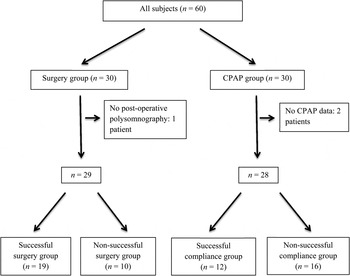
Two patients in the CPAP group were unable to provide compliance data; hence, a total of 28 patients in that group completed the study. One patient who underwent anterior palatoplasty did not want to undergo post-operative polysomnography; therefore, a total of 29 patients in the surgery group completed the study.
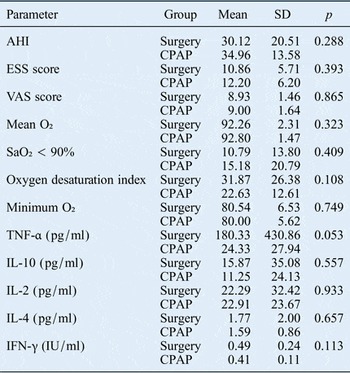
Of the total 57 patients, 53 (93 per cent) were male and 4 (7 per cent) were female, and their ages ranged from 22 to 64 years (mean ± standard deviation (SD) = 42.7 ± 10.2 years). The mean (± SD) ages for the surgery and CPAP groups were 39 ± 9.5 years and 46.4 ± 9.7 years, respectively; this age difference between the groups was statistically significant (p = 0.005). No significant differences were noted between the two groups in terms of BMI, apnoea/hypopnoea index, Epworth Sleepiness Scale score, VAS score, serum levels of cytokines or saturation parameters at baseline (all p > 0.05) (Table I).
Clinical features, saturation parameters and inflammatory markers at baseline

SD = standard deviation; AHI = apnoea/hypopnoea index; CPAP = continuous positive airway pressure; ESS = Epworth Sleepiness Scale; VAS = visual analogue scale; mean O₂ = mean oxygen saturation; SaO₂ < 90% = percentage of sleep time with oxygen saturation below 90 per cent; minimum O₂ = lowest oxygen saturation; TNF = tumour necrosis factor; IL = interleukin; IFN = interferon
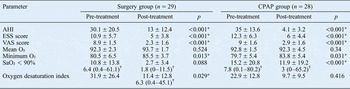
The mean (± SD) apnoea/hypopnoea index values in the surgery group before and after treatment were 30.1 ± 20.5 events per hour and 13 ± 12.4 events per hour, respectively, and this difference was statistically significant (p < 0.001) (Table II). Surgical success was achieved in 19 of the 29 patients (65.5 per cent), with a cure of OSA achieved in 8 of those 19 patients (27.6 per cent in 29 patients). The mean (± SD) apnoea/hypopnoea index values in the CPAP group at baseline and during treatment were 35 ± 13.6 events per hour and 4.1 ± 3.2 events per hour, respectively, and the difference was statistically significant (p < 0.001). The apnoea/hypopnoea index improved to fewer than 5 events per hour in 24 patients with CPAP treatment (85.7 per cent). The mean compliance was 40.9 per cent (range, 12.8–91.4 per cent) and the mean daily usage time of CPAP was 4 hours and 59 minutes.
Clinical features and saturation parameters before and after treatment

Data represent means ± standard deviations, unless indicated otherwise. *Indicates statistical significance (p < 0.05). †Median (range) values. CPAP = continuous positive airway pressure; AHI = apnoea/hypopnoea index; ESS = Epworth Sleepiness Scale; VAS = visual analogue scale; mean O₂ = mean oxygen saturation; minimum O₂ = lowest oxygen saturation; SaO₂ < 90% = percentage of sleep time with oxygen saturation below 90 per cent
Both surgical and CPAP treatments resulted in significant decreases in Epworth Sleepiness Scale scores, VAS scores and lowest oxygen saturation levels. In addition, the surgical treatment significantly decreased oxygen desaturation index levels (p = 0.029), and the CPAP treatment significantly improved the percentage of sleep time with oxygen saturation below 90 per cent (p < 0.001) (Table II). No significant BMI changes were noted after treatment in the study population overall.
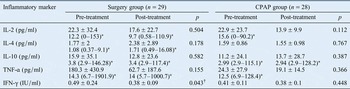
Surgical treatment resulted in a significant decrease in serum interferon-γ levels (p = 0.043). However, the reduction in the serum levels for this marker was not statistically significant in the CPAP group. The serum levels of the other inflammatory markers did not change significantly in either group (Table III). In the CPAP group, the tumour necrosis factor-α decrease was significantly higher in the patients with a BMI above 30 kg/m2 than in those with a BMI of less than 30 kg/m2, independent of apnoea/hypopnoea index (p = 0.014). In the surgery group, the VAS scores were negatively correlated with serum interleukin (IL)-10 levels (r = −0.386, p = 0.039).
Inflammatory markers before and after treatment

Data represent means ± standard deviations, unless indicated otherwise. *Median (range) values. †Indicates statistical significance (p < 0.05). CPAP = continuous positive airway pressure; IL = interleukin; TNF = tumour necrosis factor; IFN = interferon
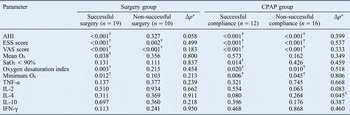
The successful and non-successful surgery groups consisted of 19 and 10 patients, respectively, and the successful and non-successful CPAP compliance groups consisted of 12 and 16 patients, respectively (Figure 1). The improvements in apnoea/hypopnoea index, VAS scores, Epworth Sleepiness Scale scores, mean oxygen saturation, lowest oxygen saturation and oxygen desaturation index levels were statistically significant in the successful surgery group, but only VAS and Epworth Sleepiness Scale scores were significantly improved in the non-successful surgery group. Improvements in the apnoea/hypopnoea index, VAS scores, Epworth Sleepiness Scale scores, lowest oxygen saturation and oxygen desaturation index levels were observed in the successful and non-successful CPAP compliance groups, and these improvements were statistically significant. Successful CPAP compliance also significantly reduced the percentage of sleep time with oxygen saturation below 90 per cent (p = 0.014). The change in serum IL-4 levels between the successful and the non-successful CPAP compliance groups was statistically significant (p = 0.045) (Table IV).
Flowchart of the patients. CPAP = continuous positive airway pressure

Changes in successful surgery and CPAP compliance subgroup parameters before and after treatment

Data represent the p-values for the changes in parameter values before and after treatment, unless indicated otherwise. *Δp represents ‘the difference of differences’. †Indicates statistical significance (p < 0.05). CPAP = continuous positive airway pressure; AHI = apnoea/hypopnoea index; ESS = Epworth Sleepiness Scale; VAS = visual analogue scale; mean O₂ = mean oxygen saturation; SaO₂ < 90% = percentage of sleep time with oxygen saturation below 90 per cent; minimum O₂ = lowest oxygen saturation; TNF = tumour necrosis factor; IL = interleukin; IFN = interferon
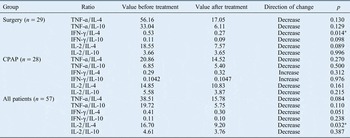
After surgery, all six proportional indicators of inflammatory/anti-inflammatory cytokine balance showed decreases. The only significant change was observed in the interferon-γ/IL-4 ratio in the surgery group (p = 0.014). After CPAP treatment, four of six proportional indicators of this balance were decreased, while two of the six were slightly increased. No significant differences were observed in the ratio changes in the CPAP group. Analysis of the ratios in all 57 patients, independent of their groups, revealed a reduction in all six ratios, with a statistically significant decrease in the IL-2/IL-4 ratio (p = 0.032) (Table V).
Inflammatory/anti-inflammatory cytokine ratios before and after treatment

*Indicates statistical significance (p < 0.05). TNF = tumour necrosis factor; IL = interleukin; IFN = interferon; CPAP = continuous positive airway pressure
When we divided the surgery group into two subgroups according to multilevel or single-level surgical interventions, we found that three patients who underwent multilevel surgery did not show significant improvement in their inflammatory markers. However, single-level surgical treatment resulted in a significant decrease in serum interferon-γ levels (p = 0.029) (Table VI).
Inflammatory markers in multi- versus single-level surgery subgroups

Data represent means ± standard deviations, unless indicated otherwise. *Indicates statistical significance (p < 0.05). IL = interleukin; TNF = tumour necrosis factor; IFN = interferon
Discussion
Systemic inflammation has been thought to play a key role in the process that extends co-morbidities in patients with OSA.Reference Ryan, Taylor and McNicholas 5 , Reference Calvin, Albuquerque, Lopez-Jimenez and Somers 26 Obtaining an answer to the question ‘how does the inflammatory and anti-inflammatory balance change following treatment for OSA?’ was the main goal of our work. However, one should take into account that the post-treatment serum levels of inflammatory cytokines evaluated in this study were obtained from a population with a surgical success rate of 65.5 per cent and a mean CPAP compliance of 40.9 per cent. This result should be considered when interpreting the changes in inflammatory and anti-inflammatory markers.
Tumour necrosis factor-α (TNF-α) is one of the most studied proinflammatory cytokines in OSA. Studies have shown that serum levels are closely associated with OSA severity, independent of obesity,Reference Minoguchi, Tazaki, Yokoe, Minoguchi, Watanabe and Yamamoto 27 , Reference Ciftci, Kokturk, Bukan and Bilgihan 28 and are linked to nocturnal hypoxemia.Reference Vgontzas, Papanicolaou, Bixler, Kales, Tyson and Chrousos 8 , Reference Constantinidis, Ereliadis, Angouridakis, Konstantinidis, Vital and Angouridaki 24 , Reference Alberti, Sarchielli, Gallinella, Floridi, Mazzotta and Gallai 29 Kataoka et al. showed that uvulopalatopharyngoplasty reduced plasma TNF-α levels.Reference Kataoka, Enomoto, Kim, Yokoi, Fujimori and Sakai 9 Another study reported that treatment with a TNF-α antagonist decreased excessive daytime sleepiness in patients with mild OSA.Reference Vgontzas, Zoumakis, Lin, Bixler, Trakada and Chrousos 30 In our study, the TNF-α levels were reduced in both groups after treatment, but the reduction was not statistically significant. No significant correlation was observed between the changes in TNF-α levels and the changes in apnoea/hypopnoea index. Assessment of the CPAP group independent of apnoea/hypopnoea index revealed that the decrease in TNF-α levels was significantly greater in patients with a BMI above 30 kg/m2 than in those with a BMI less than 30 kg/m2 (p = 0.014). This result reveals that TNF-α, a cytokine with great reserves in adipose tissue, becomes more sensitive to treatment in patients with a higher BMI. Tumour necrosis factor-α has the potential to be the earliest activated cytokine in OSA in response to hypoxia and desaturation. Alberti et al. found a significant increase in the plasma levels of TNF-α in OSA patients immediately after the first apnoea episode.Reference Alberti, Sarchielli, Gallinella, Floridi, Mazzotta and Gallai 29 However, we suggest that interleukin (IL)-2 and interferon-γ may be more useful as indicators of a chronic disease such as OSA because these inflammatory cytokines are activated by adaptive immunological responses in the long run.
Interleukin-2 exerts its inflammatory properties by stimulating the synthesis of other cytokines and promoting the proliferation of T cells after the body's interaction with an antigen.Reference Wagner, Hardt, Heeg, Pfizenmaier, Stotter and Rollinghoff 31 A limited number of studies in the literature have reported the IL-2 serum levels in adult patients with OSA, but we have not found any studies demonstrating changes due to treatment. One interesting study revealed that OSA patients who failed to show drops in blood pressure levels during the night had increased serum IL-2 levels, independent of their OSA severity.Reference Sarinc Ulasli, Sarıaydın, Gunay, Halici, Celik and Koyuncu 32 In our study, serum IL-2 levels were decreased after surgery and after CPAP treatment, but this reduction was not statistically significant in either group. Tumour necrosis factor-α, as the initiator of the inflammatory response, and IL-2, as one of the indicators of the adaptive inflammatory response, showed a significant correlation with each other in both the surgery (p = 0.038) and CPAP (p = 0.006) groups before treatment.
Interleukin-4 and IL-10 are anti-inflammatory cytokines.Reference Ransom, Fischer, Mosmann, Yokota, DeLuca and Schumacher 33 , Reference de Waal Malefyt, Abrams, Bennett, Figdor and de Vries 34 Studies on OSA have mainly focused on IL-10, which exerts its anti-inflammatory properties by inhibiting proinflammatory cytokines.Reference de Waal Malefyt, Abrams, Bennett, Figdor and de Vries 34 Increased expression of IL-10 in T-lymphocytes reportedly showed a negative correlation with OSA severity.Reference Dyugovskaya, Lavie and Lavie 35 In addition, IL-10 is known to have beneficial effects in patients with acute coronary syndrome by suppressing over-activation of the proinflammatory signalling system.Reference Heeschen, Dimmeler, Hamm, Fichtlscherer, Boersma and Simoons 36 , Reference Potteaux, Deleuze, Merval, Bureau, Esposito and Scherman 37 A review investigating the diagnostic capability of inflammatory markers in the assessment of OSA suggested that IL-10 plasma level has the potential to be a good biomarker for identifying or excluding the presence of OSA in adults.Reference De Luca Canto, Pacheco-Pereira, Aydinoz, Major, Flores-Mir and Gozal 38 The answer to the question ‘what causes the increased inflammation in OSA: an increase in proinflammatory cytokines due to chronic intermittent hypoxia or a decrease in the production of anti-inflammatory cytokines due to an unknown mechanism?’ remains elusive. A recent study by Jiang et al. demonstrated that the TNF-α/IL-10 ratio increased in line with OSA severity.Reference Jiang, Cao, Wang, Liu, Cao and Chen 39 In our study, the TNF-α/IL-10 ratio decreased in both groups after treatment, but this reduction was not statistically significant.
The increase in serum IL-4 levels in the successful CPAP compliance group after treatment was greater than that in the non-successful compliance group. We found that successful CPAP compliance resulted in a greater increase in serum IL-4 levels, which supports the idea that improvement in oxygen saturation with continuous use of CPAP may trigger the anti-inflammatory response by way of IL-4. Serum IL-4 levels were positively correlated with lowest oxygen saturation levels, and were negatively correlated with the percentage of sleep time with oxygen saturation below 90 per cent. The positive correlation between lowest oxygen saturation and IL-4 demonstrates that desaturations may lead to suppression of IL-4 levels in OSA patients. We found no correlation between oxygen saturation values and serum IL-10, but we hypothesise that IL-4 may be more sensitive to inflammation in OSA, and its serum levels cannot be maintained against an inflammatory challenge.
Interferon-γ enhances Th1 cell mediated immunity by affecting macrophages, and leads to the release of proinflammatory cytokines.Reference Billiau 40 , Reference Gately, Warrier, Honasoge, Carvajal, Faherty and Connaughton 41 A limited number of studies have shown a relationship between OSA and interferon-γ; these were focused on the elevated interferon-γ serum levels observed in children with OSA.Reference Tam, Wong, McBain, Bailey and Waters 42 , Reference Waters, Mast, Vella, de la Eva, O'Brien and Bailey 43 A study by Kohler et al. demonstrated that four weeks of CPAP treatment did not significantly alter serum interferon-γ levels.Reference Kohler, Ayers, Pepperell, Packwood, Ferry and Crosthwaite 13 To the best of our knowledge, no study available in the literature has evaluated the changes in serum interferon-γ levels after surgical treatment in patients with OSA. When we examined the data for all 57 patients, the only marker that showed significant changes in serum levels after treatment was interferon-γ. The serum interferon-γ levels were decreased after surgical treatment, and this reduction was statistically significant (p = 0.043). However, CPAP treatment did not result in any significant difference in serum levels of interferon-γ, in agreement with the study by Kohler et al.Reference Kohler, Ayers, Pepperell, Packwood, Ferry and Crosthwaite 13
No studies in the English-language literature have evaluated the effect of treatment on the Th1 (TNF-α, interferon-γ and IL-2) / Th2 (IL-4 and IL-10) cytokine balance in adult patients with OSA. We detected some decreases in the TNF/IL-4, TNF/IL-10, interferon-γ/IL-4, interferon-γ/IL-10, IL-2/IL-4, and IL-2/IL-10 ratios after treatment. The interferon-γ/IL-4 ratio significantly decreased in the surgery group (p = 0.014), which represents a concurrent increase in the serum levels of an anti-inflammatory cytokine or a decrease in the serum levels of an inflammatory cytokine, even with a moderate success rate of 65.5 per cent. The reduction in the IL-2/IL-4 ratio in the study group overall was also statistically significant. These results are important as they demonstrate the effect of treatment in adult OSA patients and indicate a shift to an anti-inflammatory state.
The number of patients undergoing multilevel surgery was rather low in this study, but we can comment on the impact of multilevel surgery on inflammatory markers compared to single-level surgery. As seen in Table VI, single-level surgical treatment resulted in a significant decrease in serum interferon-γ levels (p = 0.029), while three patients undergoing multilevel surgery did not show significant improvements in inflammatory markers. As shown in Table III, the p value for serum interferon-γ levels in the surgery group overall (n = 29) was 0.043. It seems that the data for the three patients undergoing multilevel surgery worsened the p value, reflecting the change of interferon-γ levels in the surgery group. Further prospective studies with large case series are needed to improve power analysis and present exact results of multilevel surgical treatment.
Our study showed that the main indicator for evaluating the inflammation process in OSA was not the apnoea/hypopnoea index. Instead, a change in the serum levels of inflammatory markers had a greater correlation with Epworth Sleepiness Scale and VAS scores, and saturation parameters. Likewise, a change in the saturation parameters was associated with Epworth Sleepiness Scale and VAS scores. In the surgery group, the VAS scores were negatively correlated with serum IL-10 levels. Those patients who ranked their snoring with a higher score also had decreased IL-10 levels and a decreased anti-inflammatory response. Multiple factors that affect the apnoea/hypopnoea index, such as saturation parameters and clinical predictors, can therefore also influence the inflammatory/anti-inflammatory balance.
-
• The effect of surgical treatment or continuous positive airway pressure on T helper 1 (Th1)/T helper 2 (Th2) cytokine balance in adult obstructive sleep apnoea (OSA) patients is not known
-
• This study demonstrates the effect of treatment on the Th1/Th2 cytokine balance
-
• It also shows the effect of relatively new reconstructive surgical techniques on inflammation
-
• Successful surgical treatments for OSA may interrupt the inflammatory process by changing the Th1/Th2 cytokine balance towards the Th2 direction
This study has some limitations. When we assessed the groups according to surgical success and success in CPAP compliance, the subgroups consisted of a relatively lower number of patients. Additionally, more successful surgical procedures or better CPAP compliance could provide greater amelioration of inflammation, and could demonstrate the exact anti-inflammatory response. Thus, the study design should be adapted to select only those patients who undergo successful surgery or have excellent CPAP compliance.
Conclusion
This study shows that surgical treatments for OSA may affect and interrupt the inflammatory process by changing the Th1/Th2 cytokine balance towards the Th2 direction, to an anti-inflammatory state. The most effective factor in this process – whether it is intermittent hypoxemia or another factor – will be the subject of further studies. A larger study population is needed to uncover the exact effect of successful surgery and CPAP compliance. If the present study, with a surgical success rate of 65.5 per cent and a CPAP compliance of 40.9 per cent, can reveal these promising results, a more successful treatment for OSA may further reduce the inflammation and systemic co-morbidities associated with this condition.
Acknowledgements
The authors are grateful to Dr Sinan Yetkin for his careful polysomnographic analysis and to Dr Turker Turker for his professional statistical analysis. This research was supported by a Gulhane Medical School Research grant (AR-2013/49).