Introduction
Are strong local food systems better for the environment than conventional food systems where relatively close proximity between points of production and consumption is not a defining characteristic? Despite growing support—among policymakers, farmers, researchers and activists—for efforts to strengthen local food systems (Feenstra, Reference Feenstra1997; Curtis, Reference Curtis2003; Lyson and Guptill, Reference Lyson and Guptill2004), surprisingly little is known about the relationship of local food to environmental sustainability. In particular, nearly all studies evaluating the sustainability of local food have focused on comparing the energy consumed through transportation and storage across local and conventional food systems. But the concept of ‘food miles,’ while undeniably important, represents just one part of the overall ecological footprint of agriculture. In terms of energy consumed, emissions produced and impacts on human and ecosystem health, the question of whether local food systems involve fewer inputs of agricultural chemicals and fertilizerFootnote 1 than conventional food systems matters as much as, if not more than, food miles (Pelletier et al., Reference Pelletier, Audsley, Brodt, Garnett, Henriksson, Kendall, Kramer, Murphy, Nemecek and Troell2011; Avetisyan et al., Reference Avetisyan, Hertel and Sampson2014). But the relationship of local food systems to chemical and fertilizer use has to date not been a subject of systematic research.
In this paper, I address this gap in the literature on local food by using longitudinal data from the US Census of Agriculture to explore whether growth in local food systems is associated with decreased on-farm use of agricultural chemicals. Drawing on county-level data from 1997 to 2012, I find that an increase in the strength of local food systems—whether measured as the number of farms that market products directly to consumers, or as the total value of direct-market products—has been broadly associated with a decrease in spending on agricultural chemicals in the USA as a whole and in each of nine US farming regions, as defined by the US Department of Agriculture (USDA). But the magnitude of the relationship between direct marketing to consumers and changes in agricultural chemical use has dwindled over time, to the point where it is not clear whether contemporary local food systems are still incentivizing farmers to reduce their use of pesticides. Overall, this study lends new credence to the idea that robust local food systems can benefit the environment, independent of what has been vigorously debated in the literature on food miles. But even where just one dimension of agriculture's impact on the environment is concerned, the characteristics of local food systems appear to have varied over time—a qualification that argues strongly for further research into the relationship of local food to agricultural practice.
Local food: a vision of sustainability
There is no doubt that interest in food seen as locally grown, sourced, or produced has emerged as one of the most important food-related social movements of the past 20 years (Low et al., Reference Low, Adalja, Beaulieu, Key, Martinez, Melton, Perez, Ralston, Stewart, Suttles, Vogel and Jablonski2015). Any number of statistics tell the tale. The number of subscribers to community supported agriculture (CSA) cooperatives in California's Central Valley, for instance, jumped from 673 in 1990 to 32,938 in 2010 (Galt et al., Reference Galt, O'Sullivan, Beckett and Hiner2012); likewise, the number of farmers markets in the USA has more than quadrupled, from under 2000 to over 8000, between 1994 and 2014 (Agricultural Marketing Resource Center, 2014). Surging consumer interest in ‘local food’—a term whose meaning can vary considerably across consumers, organizations and regions—has caught the eye of policymakers in high places: between 2009 and 2015, USDA invested over US$78 million in local and regional food businesses and related infrastructure projects as part of its ‘Know Your Farmer, Know Your Food’ initiative. By some accounts, the market for local food is expected to top US$20 billion by 2020 (Vilsack, Reference Vilsack2016).
The notable trendlines for local food can be understood as a function of the fact that local food appeals to many different constituencies, and appears to align with a diverse set of values concerning what an ‘ethical’ food system ought to be. Written works that provided a philosophical foundation for the local food movement have made the argument that local food could emerge as a linchpin of sustainability broadly construed, uniting the social, economic and environmental aspects of livable communities (Nabhan, Reference Nabhan2002; Lyson, Reference Lyson2004; Berry, Reference Berry2010). Seen through the lens of both foundational early essays and subsequent academic research, four main advantages have been ascribed to strong local food systems. First, making the purchase of local food a thoughtful focus of one's consumption activity has been portrayed as a way for people to reconnect with the unique geography and history of where one happens to live (Kloppenburg et al., Reference Kloppenburg, Hendrickson and Stevenson1996; Sumner et al., Reference Sumner, Mair and Nelson2010). Second, buying local food will, it is often hoped, provide an economic lifeline for small farms and rural communities, while helping to preserve place-specific crops, food products and environmental knowledge (O'Hara, Reference O'Hara2011; O'Hara and Pirog, Reference O'Hara and Pirog2013). Third, local food has increasingly been incorporated into initiatives to increase access to healthy, fresh fruits and vegetables for underserved urban areas (Allen, Reference Allen1999; Environmental Protection Agency, 2016).
Finally, it is often claimed that local food is better for the environment. In part, this claim is rooted in the intuitive idea that local food travels fewer miles ‘from farm to fork.’ But a second element is the contention that farmers who support local food systems are better stewards of the land, because they are more likely to employ ‘regenerative’ or ‘agroecological’ practices such as cover cropping, crop rotation, reduced tillage and biological pest control, in addition to minimizing the use of chemical inputs to manage pests and maintain soil fertility (Lappé and Lappé, Reference Lappé and Lappé2002; Halweil, Reference Halweil2004; Forssell and Lankoski, Reference Forssell and Lankoski2014; Good Earth Food Alliance, 2016; Sustainable Table, 2016). Indeed, as a social movement closely related to the broader push for organic food (Heckman, Reference Heckman2005; Youngberg and DeMuth, Reference Youngberg and DeMuth2013), the practices of farmers who participate in local food systems—who sell their produce at farmers markets and CSAs, as well as through food hubs and direct-to-institution networks—have been the subject of some of the most foundational claims made by proponents of local food. Nor are these claims purely the domain of theorists and advocates for ‘buying local.’ Numerous surveys of consumers have confirmed that local food is viewed as contributing to social justice and environmental responsibility, while at the same time offering the simple pleasures of fresh, delicious food (Thilmany et al., Reference Thilmany, Bond and Bond2008; Adams and Salois, Reference Adams and Salois2010; Bean and Sharp, Reference Bean and Sharp2011).
Local food and the environment: how much do we know?
As public and private efforts to promote local food systems have multiplied, the claims made on behalf of local food have become the subject of empirical research (Hunt, Reference Hunt2015; McCaffrey and Kurland, Reference McCaffrey and Kurland2015). Some of these claims have emerged as relatively uncontroversial. It seems clear, for instance, that buying local food does indeed help to support small farms and rural communities (Martinez et al., Reference Martinez, Hand, Pra, Pollack, Ralston, Smith, Vogel, Clark, Tauer, Lohr, Low and Newman2010; Johnson et al., Reference Johnson, Aussenberg and Cowen2012), even if larger farms and retailers might also benefit. The argument that local food is better for the environment, however, has received at least as much criticism as support (Born and Purcell, Reference Born and Purcell2006; Lilico, Reference Lilico2008; Rankin, Reference Rankin2009; McCaffrey and Kurland, Reference McCaffrey and Kurland2015).
As noted above, the environmental advantages of local food systems would, in theory, relate to two distinct segments in the lifecycle of food: how food is grown on the farm, and how it gets to people who eat it. Of these two parts to the food system, the former is at least as significant as the latter, environmentally speaking. Simply with respect to energy consumed, on-farm food production, compared with post-farm food distribution, has been estimated as responsible for up to 83% of greenhouse gas emissions from food systems, due to the energy-intensive manufacture of chemical inputs and the carbon storage capacities of different soils (Weber and Matthews, Reference Weber and Matthews2008; Edwards-Jones, Reference Edwards-Jones2010; Foley et al., Reference Foley, Ramankutty, Brauman, Cassidy, Gerber, Johnston, Mueller, O'Connell, Ray, West, Balzer, Bennett, Carpenter, Hill, Monfreda, Polasky, Rockström, Sheehan, Siebert, Tilman and Zaks2011; Pelletier et al., Reference Pelletier, Audsley, Brodt, Garnett, Henriksson, Kendall, Kramer, Murphy, Nemecek and Troell2011; MacRae et al., Reference MacRae, Cuddeford, Young and Matsubuchi-Shaw2013; Chang et al., Reference Chang, Li, Yao, Zhang and Yu2016).
Beyond energy use and contributions to climate change, however, farming practices—the manner in which crops are grown—matter enormously for other environmental reasons (Edwards-Jones et al., Reference Edwards-Jones, Canals, Hounsome, Truninger, Koerber, Hounsome, Cross, York, Hospido, Plassmann, Harris, Edwards, Day, Tomos, Cowell and Jones2008; Cleveland et al., Reference Cleveland, Carruth and Mazaroli2015). In particular, heavy reliance on agricultural chemicals to manage pests, weeds and crop disease has been found to be associated with a wide range of detrimental outcomes (Stehle and Schulz, Reference Stehle and Schulz2015; Watts and Williamson, Reference Watts and Williamson2015). Neonicotinoid insecticides, while effective deterrents against insects considered to be pests, can also have dramatic effects on non-target invertebrates at very low concentrations—potentially contributing to population declines in pollinators and insects that are natural predators of pests (Lexmond et al., Reference Lexmond, Bonmatin, Goulson and Noome2015; Pisa et al., Reference Pisa, Amaral-Rogers, Belzunces, Bonmatin, Downs, Goulson, Kreutzweiser, Krupke, Liess, McField, Morrissey, Noome, Settele, Simon-Delso, Stark, Sluijs, Dyck and Wiemers2015; Hallmann et al., Reference Hallmann, Sorg, Jongejans, Siepel, Hofland, Schwan, Stenmans, Müller, Sumser, Hörren, Goulson and Kroon2017). Pesticides that work by disrupting the endocrine systems of targeted insects—including DDT and more than 100 other chemicals—have been linked to developmental disorders and diminished fertility in reptiles, fish, birds and mammals (Hamlin and Guillette, Reference Hamlin and Guillette2011; Mnif et al., Reference Mnif, Hassine, Bouaziz, Bartegi, Thomas and Roig2011; Adeel et al., Reference Adeel, Song, Wang, Francis and Yang2017). Ultimately, declines in animal, insect and plant species due to pesticide and herbicide applications can have widespread effects on entire ecological communities, as species higher up the food chain are deprived of prey and habitat (Gibbs et al., Reference Gibbs, Mackey and Currie2009; Köhler and Triebskorn, Reference Köhler and Triebskorn2013; Chagnon et al., Reference Chagnon, Kreutzweiser, Mitchell, Morrissey, Noome and Sluijs2015; Hester and Harrison, Reference Hester and Harrison2017). Conversely, severely restricting the use of agricultural chemicals can result in greater abundance and diversity of wildlife, both on-farm and in downstream aquatic environments (Bengtsson et al., Reference Bengtsson, Ahnström and Weibull2005; Hole et al., Reference Hole, Perkins, Wilson, Alexander, Grice and Evans2005; Duru et al., Reference Duru, Therond, Martin, Martin-Clouaire, Magne, Justes, Journet, Aubertot, Savary, Bergez and Sarthou2015). The environmental benefits of reduced reliance on agricultural chemicals extend to life too small to see with the naked eye: microbial soil life is healthier and more diverse on organic than on conventional farms, with significant consequences for natural resistance to pests and crops’ ability to convert nutrients into biomass (Maeder et al., Reference Maeder, Fliessbach, Dubois, Gunst, Fried and Niggli2002; Biswas et al., Reference Biswas, Ali, Goswami and Chakraborty2014).
In sum, while the development of synthetic pesticides has helped to usher in a new era of high-yield agriculture, intensive reliance on agricultural chemicals presents significant long-term dangers for the global environment (Stehle and Schulz, Reference Stehle and Schulz2015). Indeed, minimizing the use of agricultural chemicals is an important goal of contemporary schools of thought regarding what ‘sustainable’ agriculture might look like, including agroecology, permaculture and biodynamic and organic agriculture (Crosson, Reference Crosson1989; Rodale Institute, 2014; Wezel et al., Reference Wezel, Casagrande, Celette, Vian, Ferrer and Peigné2014; Watts and Williamson, Reference Watts and Williamson2015).
The greatest environmental impacts of agriculture are clearly to be found not in how food is transported, but rather in how it is grown. Perhaps surprisingly, given this fact, the debate over what the environmental characteristics of local food systems actually are has focused almost entirely on whether a reduction in ‘food miles’ represents a compelling reason to prefer local food (Mariola, Reference Mariola2008; Schnell, Reference Schnell2013). In comparison, few if any studies have attempted to determine whether local food systems are characterized by reduced use of agricultural chemicals, relative to conventional food systems. The resulting gap in knowledge has led Peter Singer, among others, to observe that ‘pesticide use may be less subject to checks when food is grown by small local farmers than by a corporate giant supplying Wal-Mart’ (Singer and Mason, Reference Singer and Mason2007, p. 140). Indeed, the notion of a ‘local trap’ has gained traction precisely by seizing on the lack of compelling evidence that local equals sustainable or just (Brown and Purcell, Reference Brown and Purcell2005; Born and Purcell, Reference Born and Purcell2006). In the absence of evidence one way or another, critical observers of the local food movement are justified in pointing out that no a priori reason exists for why farmers who participate in local food systems should use fewer agricultural chemicals, or farm differently in other ways, as compared with farmers who do not (Edwards-Jones et al., Reference Edwards-Jones, Canals, Hounsome, Truninger, Koerber, Hounsome, Cross, York, Hospido, Plassmann, Harris, Edwards, Day, Tomos, Cowell and Jones2008).
But if studies have not yet been conducted to determine whether local food systems actually are different from conventional food systems, in terms of agricultural chemical use and other farming practices, writing on local food does provide several reasons to think that this might be the case. First, farmers involved in local food systems may simply be unusually committed to agroecology, organic farming and other farming philosophies that emphasize environmentally benign or even environmentally beneficial alternatives to the intensive use of agricultural chemicals. Indeed, this connection is directly suggested by historical research that portrays the ideas of ‘organic’ and ‘local’ food as tightly intertwined (Heckman, Reference Heckman2005; Youngberg and DeMuth, Reference Youngberg and DeMuth2013). Secondly, consumers may view as more credible claims regarding quasi-organic or low-input growing practices made by farmers with whom they share a community or region (Jarosz, Reference Jarosz2000; Carolan, Reference Carolan2006; Papaoikonomou and Ginieis, Reference Papaoikonomou and Ginieis2017). This trust, in turn, may enable farmers who participate in local food systems to reduce their use of agricultural chemicals, and to charge a premium for the resulting product, without incurring the costs associated with official organic certification.
Finally, people who make it a priority to regularly buy local food do so at least partly out of concern for the environment and the effects of pesticides on human health (Hunt, Reference Hunt2007; Thilmany et al., Reference Thilmany, Bond and Bond2008; Baker et al., Reference Baker, Hamshaw and Kolodinsky2009). The belief that produce grown with pesticides is less healthy than produce which is pesticide-free is also a major driver of surging consumer interest in fruits and vegetables that are ‘certified organic’ (Hughner et al., Reference Hughner, McDonagh, Prothero, Shultz and Stanton2007; Rodman et al., Reference Rodman, Palmer, Zachary, Hopkins and Surkan2014; Hemmerling et al., Reference Hemmerling, Hamm and Spiller2015). Farmers who sell directly to these consumers, whether through farmers markets, CSAs, or other means, would have an additional incentive to reduce their use of agricultural chemicals.
Put together, the mechanisms described above lead to what I term the ‘local = green hypothesis’: farmers who participate in local food systems may use fewer agricultural chemicals, other things being equal, than those who do not. If this hypothesis were correct, then we would expect to see, net of other factors that might influence farming practices, the use of agricultural chemicals decrease over time in areas where local food systems grow in strength.
There are theoretically defensible reasons to think that local food systems may be associated with reduced use of agricultural chemicals. But there are also good reasons to think that they may not. For instance, it may no longer be—or never have been—the case that farmers engaged in local food systems are especially committed to regenerative or low-input agriculture. Or it could be that the social forces—including how consumers think about the relationship of pesticides to the environment and human health—thought to connect local food to sustainable farming is not equally strong in all parts of the country. What is needed is empirical research that moves the debate over the sustainability of local food beyond the narrow if the important topic of food miles, and toward an evidence-based understanding of how farmers who grow food for local markets may be practicing their craft.
Data and methods
Source and scope of data
This study uses two-way fixed effects models to test the hypothesis that growth in local food systems is associated with a reduction in the use of agricultural chemicals. Data come mainly from the US Census of Agriculture. Since 1997, the Census of Agriculture has been conducted every 5 years by the USDA National Agricultural Statistics Service (NASS); it is a complete count of the production, farming practices and economic characteristics of farm and ranch operations in the USA. For the purpose of the census, a farm is defined as a place from which US$1000 or more of agricultural products were produced and sold, or normally would have been sold, during the census year. Similar to the US Decennial Census, the Census of Agriculture collects data from individual farm operations, and then aggregates these data to higher geographical levels, including zip code, county, watershed and state.
The dataset for this study consists of county-level records from the Census of Agriculture—supplemented by data from other sources—conducted in 1997, 2002, 2007 and 2012. Prior to 1997, the US Census Bureau, and not NASS, was responsible for the Census of Agriculture and differences in methodology make it difficult to compare data on direct market sales using pre- and post-1997 census records. All counties in the 48 contiguous US states were included in the dataset; only Broomfield County, Colorado, a small consolidated city-county that came into existence in 2001, was excluded. The final dataset contained 3069 counties and 12,276 total observations, because each county was observed at four points in time. Data management and analysis were carried out using Stata/MP 14.
Model estimation
The goal of this study is to explore whether change over time in the strength of local food systems is associated with change over time in the use of agricultural chemicals. As a type of regression, two-way fixed effects modeling of panel data describes relationships between how variables change over time, while controlling for both unobserved, time-invariant characteristics of geographical units and unobserved, unit-invariant characteristics of time periods (Allison, Reference Allison2009; York and Rosa, Reference York and Rosa2012; Bell and Jones, Reference Bell and Jones2015). Two-way fixed effects models are therefore used for all analyses in this study; regression coefficients describe the effect of a 1-unit change of each independent variable on the change in the dependent variable, net of (or controlling for) both time-invariant characteristics of each county and county-invariant characteristics of each census year. Models were estimated using the ‘xsmle’ command in Stata (Belotti et al., Reference Belotti, Hughes and Mortari2013). In all models, cluster-robust standard errors were estimated, using ‘vce(robust)’, to minimize the impacts of autocorrelation and heteroskedasticity in the error term (Stock and Watson, Reference Stock and Watson2008; Griffin et al., Reference Griffin, Pavela and Arroyo2015; UCLA: Statistical Consulting Group, 2015).
When using spatial data in regression models, it is necessary to control for two ways in which spatial autocorrelation—also called spatial clustering—might lead to violations of the assumption of independent observations (Dormann et al., Reference Dormann, McPherson, Araújo, Bivand, Bolliger, Carl, Davies, Hirzel, Jetz, Kissling, Kühn, Ohlemüller, Peres-Neto, Reineking, Schröder, Schurr and Wilson2007; Golgher and Voss, Reference Golgher and Voss2016). First, spatial autocorrelation might exist in the values of the dependent variable. Secondly, spatial autocorrelation might occur in the values of the regression residuals; this, in turn, might indicate the presence of one or more omitted independent variables with spatially distinct effects. Spatial autocorrelation of either kind can lead to deflated estimates of standard errors and subsequent Type 1 error (Anselin, Reference Anselin2002). In order to control for both kinds of spatial autocorrelation, I included a spatial lag and a spatial error term in all regression models (Dormann et al., Reference Dormann, McPherson, Araújo, Bivand, Bolliger, Carl, Davies, Hirzel, Jetz, Kissling, Kühn, Ohlemüller, Peres-Neto, Reineking, Schröder, Schurr and Wilson2007; Golgher and Voss, Reference Golgher and Voss2016). Following Clement et al. (Reference Clement, Ergas and Greiner2015), I used a row-standardized, first-order queen contiguity spatial weights matrix to calculate the weighted effect of the relevant values of each observation on those of its neighbors; the spatial weights matrix was generated using the Stata command ‘spmat’ (Drukker et al., Reference Drukker, Peng, Prucha and Raciborski2013).
Dependent variable
The dependent variable for these analyses is the amount spent (in US$1000s) on agricultural chemicals, including insecticides, herbicides, and other pesticides, in a given county in a given year. For this variable, values for 2002, 2007 and 2012 have been indexed to 1997 dollars using NASS's Prices Paid Index for Agricultural Chemicals; values used in the models are therefore county-level ‘real expenditures,’ in 1997 dollars, on agricultural chemicals (National Agricultural Statistics Service, 2011; Zulauf and Rettig, Reference Zulauf and Rettig2015). Spending was used because the census does not collect data on the actual amount of chemicals applied to crops. As described below, dummy variables for census year (fixed effects for the time) control for such aggregate (consistent across counties) time trends as the evolving effectiveness of chemicals on the market. In the context of two-way fixed effects models, the change in real expenditures on chemicals over time, therefore, represents an excellent proxy for how usage over time has also changed.
The items from the Census of Agriculture on which these dependent variables are based do not distinguish between conventional and organic agricultural chemicals. What these measures capture, therefore, is the extent to which farmers rely on chemical inputs, generally speaking, as a means of managing pests, weeds and disease. Whether conventional or organic, heavy reliance on chemical inputs is widely seen as environmentally inferior to accomplishing these same goals through the adoption of low-input practices such as cover crops, crop diversification and biological pest control (Guthman, Reference Guthman2004; Wezel et al., Reference Wezel, Casagrande, Celette, Vian, Ferrer and Peigné2014; Robertson, Reference Robertson2015). Indeed, one criticism of USDA organic standards has been that, by pinning ‘organic farming’ solely to the absence of synthetic inputs, farmers may actually be incentivized to make extensive use of naturally-occurring pesticides rather than adopt low-input methods that were tightly integrated into the organic movement prior to the introduction of USDA organic certification (Buck et al., Reference Buck, Getz and Guthman1997; Guthman, Reference Guthman2004; Johnston et al., Reference Johnston, Biro and MacKendrick2009). The dependent variable for this study thus creates an opportunity to explore whether local food systems may have followed contemporary organic agriculture along a path toward greater ‘conventionalization’ (Constance et al., Reference Constance, Choi and Lyke-Ho-Gland2008).
Main explanatory variable
Local food has historically not been a main focus of the Census of Agriculture. However, beginning in 1997, the Census of Agriculture has included the following item: ‘Did you produce, raise, or grow any crops, livestock, poultry, or agricultural products that were sold directly to individual consumers for human consumption? Include sales from roadside stands, farmers markets, pick your own, door to door, Community Supported Agriculture (CSA), etc.’ (National Agricultural Statistics Service, 2014, p. B-46). Farm operators who answered ‘yes’ to this question were asked to provide the gross value of these direct sales.
These items make possible two measures of the strength of local food systems: (1) the number of farms in each county that market products directly to consumers; (2) the total direct market sales (in US$1000s) in each county. Theoretically speaking, these variables capture related but distinct dimensions of the ‘strength’ of local food systems, and how this strength might change over time. In order to take full advantage of the fact that two different measures of local food systems are available, I run two different sets of models. In the first set of models, the main explanatory variable is the number of farms marketing products directly to consumers. In the second set of models, the main explanatory variable is the total sales of direct market products; for this variable, values for 2002, 2007 and 2012 have been indexed to 1997 dollars using NASS's Prices Received Index for Food Commodities (National Agricultural Statistics Service, 2011). Importantly, all models also control, as described below, for changes in the number of farms and total farm sales.
Control variables
The purpose of control variables in these analyses is to control for factors other than the growth of local food systems that might influence changes in the amounts of agricultural chemicals that farmers use on their crops. Three main groups of control variables are included. First, changes in spending on chemical inputs in a given county may be associated with changes in the underlying economic strength, or basic economic characteristics, of agriculture in that region. Indeed, in conventional farm operations, intensive use of agricultural chemicals is often considered a defining characteristic of large, modern farms organized to achieve maximum yields. For farm operations that have come to rely on synthetic external inputs to control pests or augment soil fertility, changing their approach to farming, even when a desired goal, may be made prohibitively difficult due to fixed costs associated with investments in certain types of equipment and machinery. And as already noted, the corporatization of organic agriculture in many parts of the country raises the question of whether organic operations have become similarly reliant on non-synthetic chemical inputs permitted under USDA rules.
With the likely relationship of the economic strength of agriculture and characteristics of farms to chemical use in mind, I control for county-level changes in the number of farms, total farm sales (in US$1000s), average farm sales, total acres of harvested cropland and average estimated value of all farm machinery and equipment. Values for farm sales variables have been indexed to 1997 dollars using NASS's Prices Received Index for All Farm Products (National Agricultural Statistics Service, 2011). Values for the farm machinery and equipment variable have been indexed to 1997 dollars using the US Bureau of Labor Statistics Producer Price Index for Agricultural Machinery and Equipment (U.S. Bureau of Labor Statistics, 2017).
Second, different crops are associated with different amounts and kinds of chemical inputs; changes in the county-level prevalence of different crops might, therefore, influence county-level spending on agricultural chemicals. In many cases, changes in the prevalence of different crops in a given region might be a market-driven response by farm operations to changes in output price; in other cases, farmers might be responding to variation in the climate or health of the soil. Regardless of why changes in the prevalence of different crops occur, however, the potential influence of these changes on agricultural chemical use is something that must be accounted for. It is particularly important to control for changes in the prevalence of the kinds of crops that food marketed as ‘local food’ is most likely to be, i.e., fruits and vegetables. Finally, land taken entirely out of production or turned over to livestock would no longer be considered, by any farm operation, as potentially requiring any agricultural chemicals at all. I, therefore, control for changes in the acres of farmland devoted to: (1) vegetables harvested for sale; (2) orchard fruits; (3) wheat for grain; (4) soybeans for beans; (5) corn for grain; (6) pastureland; (7) woodland; (8) land enrolled in conservation reserve or wetlands reserve programs.
Third, demographic controls are included to account for the possibility that agricultural chemical use might be affected by proximity to centers of population. Specifically, I include a measure of county population from the US Census, and also dummy variables, based on rural-urban continuum codes formulated by USDA, for whether a county is metropolitan or adjacent to a metropolitan area; the reference category is counties that are completely rural.
Finally, dummy variables for three of the four census years are included to incorporate a fixed effect for time (Allison, Reference Allison2009); the reference year is 1997. The inclusion of period dummies is what makes these fixed effects models ‘two-way’ models.
Assessing temporal and spatial variation in local food systems
A central goal of these analyses is to provide insight into whether the relationship of local food systems to agricultural chemical use has changed over time or varied across space. In order to address the first question, I generate period interaction terms for each set of models. For the first set of models, the census year dummy variables interact with the independent variable for the number of farms marketing products directly to consumers. For the second set of models, the census year dummy variables interact with the independent variable for the total sales of direct market products. The resulting interaction terms test for the possibility that the relationship between local food systems and agricultural chemical use might have increased or diminished in strength over the 15-year period covered by the data.
In order to address the question of spatial variation in the environmental characteristics of local food systems, I similarly interact the explanatory variables for the strength of local food systems with dummy variables for nine regional groups of counties. In 2000, USDA published a new typology of counties in the 48 contiguous states that ‘identified where areas with similar types of farms intersected with areas of similar physiographic, soil, and climatic traits’ (Economic Research Service, 2000). Counties with broadly similar farm operations and farming environments were organized into nine ‘Farm Resource Regions’ that were not constrained to follow state lines, as was the case with older USDA typologies (Beam et al., Reference Beam, Thilmany, Pritchard, Garber, Metre and Olea-Popelka2016). These Farm Resource Regions are the basis for the regional dummy variables used in this study. Because the Farm Resource Region dummies are themselves time-invariant, they automatically drop out of fixed effects models, which inherently control for time-invariant characteristics of counties. But the interaction terms created from these regional dummies do vary over time, and fixed effects models are able to estimate their effects. For this study, the interaction terms produced by the local food variables and the regional dummies test for the possibility that the relationship between local food systems and agricultural chemical use might be different in different parts of the country. The reference group is the ‘Northern Crescent’ Region, which includes all counties in the New England states, New York, New Jersey, Michigan and Wisconsin, substantial portions of Pennsylvania, Minnesota and Maryland, and the northeast corner of Ohio (Fig. 1)Footnote 2.
USDA farm resource regions.

Variable transformation
To reduce skewness in the data, all model variables with the exception of the year dummies are transformed by taking their cube root. Transformation by cube root is preferable to the more common log transformation when some variables in the data have a value of 0 for a non-trivial number of observations, because the log of 0 is undefined and results in missing data (Cox, Reference Cox2011).
Missing data
USDA requires that it be impossible to use Census of Agriculture data to learn about sensitive characteristics of specific farm operations. USDA, therefore, reports as ‘missing’ variable values that, due to the number or relative importance of farms in a given geographical unit, might plausibly be attributed to a particular operation. The proportion of observations in this study with missing data was relatively small—below 5% for most variables (See Table 1). Spatial regression models, however, require that panel data be strongly balanced (no missing data). I used multiple imputations by chained equations (MICE) to impute missing values. All imputation models were compatible with corresponding regression models; that is, all variables used in a particular regression model were included in the imputation model that produced imputed data for that regression (Allison, Reference Allison2002; White et al., Reference White, Royston and Wood2011). Since all variables with missing data were continuous, predictive mean matching (PMM), a method shown to produce distributions of imputed values that closely match distributions of observed values (Royston and White, Reference Royston and White2011; White et al., Reference White, Royston and Wood2011), was used in all imputation models. Interaction terms and variable transformations were calculated prior to imputation (Von Hippel, Reference Von Hippel2009).
Missing data (all continuous variables cube-root transformed)

A widely cited rule of thumb is that the number of imputed datasets should equal or exceed the percentage of incomplete cases for the variable with the most missing information (Graham et al., Reference Graham, Olchowski and Gilreath2007; Bodner, Reference Bodner2008). While the percentage of cases with missing data was below 5% for most variables, the variables for agricultural machinery and for acres devoted to vegetables, orchards, wheat, soy and corn, had missing values for between 13% and 25% of cases. Therefore, analyses were ultimately conducted using 25 imputed datasets. All imputation was carried out using the ‘mi’ package of commands in Stata.
Results
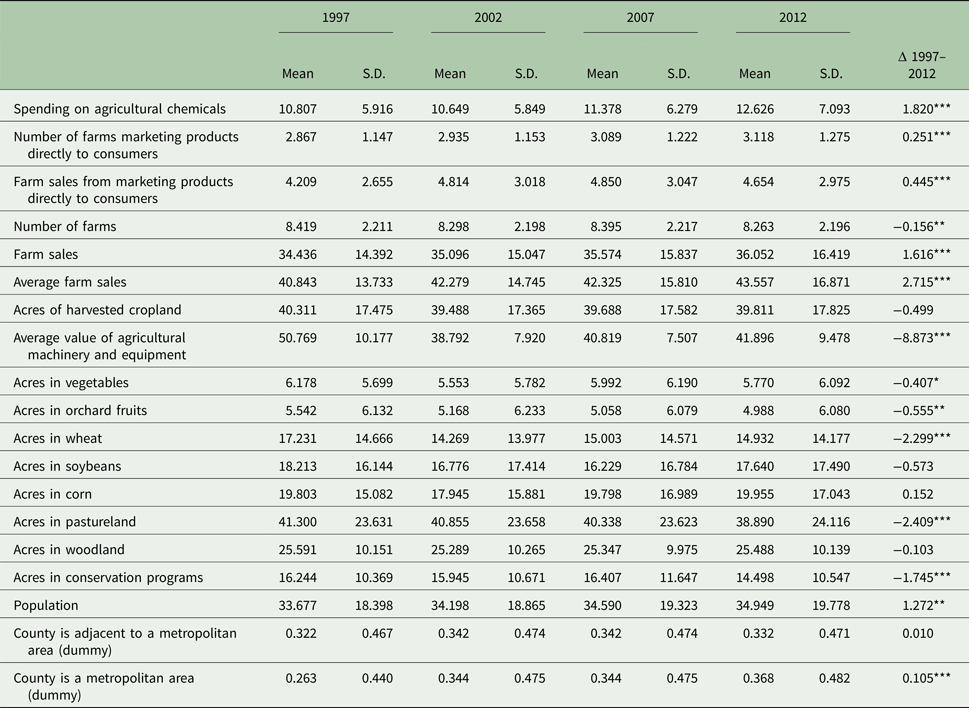
Table 2 reports descriptive statistics for all variables in the models except the census year dummies and the interaction terms. Table 3 reports the results of three models where the main explanatory variable of interest is the number of farms marketing products directly to consumers. Table 4 reports the results of three models where the main explanatory variable of interest is the total sales of directed market products. In Tables 3 and 4, Model 1 and Model 4 (respectively) do not include any interaction terms; Model 2 and Model 5 add interaction terms between the main explanatory variable and census year (the excluded category is 1997); and Model 3 and Model 6 add interaction terms between the main explanatory variable and the Farm Resource Region regional dummies (the excluded category is the Northern Crescent). Following guidelines for imputed datasets (White et al., Reference White, Royston and Wood2011), coefficients of determination (r 2) were first calculated for each imputation and then combined using Rubin's rules to produce a measure of fit for each final model (Harel, Reference Harel2009; Cañette and Marchenko, Reference Cañette and Marchenko2016). Thorough sensitivity analyses for all models indicated that none of the samples included any overly influential cases.
Descriptive statistics (all continuous variables cube-root transformed)

N = 3069 for each year.
***P < 0.001, **P < 0.01, *P < 0.05 (two-tailed paired t-tests).
Direct market farms and agricultural chemical use

Robust standard errors in parentheses ***P < 0.001, **P < 0.01, *P < 0.05, +P < 0.1.
Direct market sales and agricultural chemical use

Robust standard errors in parentheses ***P < 0.001, **P < 0.01, *P < 0.05, +P < 0.1.
Looking at the USA as a whole over all years covered in the data, Model 1 and Model 4 indicate that the relationship between the strength of local food systems and spending on agricultural chemicals, when no interaction effects are considered, is negative and statistically significant. More specifically, for every one-unit increase in the cube root of the number of farms selling direct market products in a given county, the cube root of spending on insecticides, herbicides and other pesticides decreases by 0.087. For a one-unit increase in the cube root of total direct market sales, the decrease in the dependent variable is 0.025. If one assumes, as Model 1 and Model 4 do, that the relationship between local food and agricultural chemical use has itself been time-invariant, then this result offers some support for the hypothesis that growth in local food systems is associated with farmers reducing their use of agricultural chemicals.
The results of Model 2 and Model 5, however, complicate this picture. In these models, the ‘main effect’ of farmer participation in local food systems—measured either way—now represents just the effect of a change in local food systems for 1997. In this, the first year for which census data are available, the relationship between local food and spending on agricultural chemicals is actually stronger, in terms of absolute magnitude, than when time-invariance for this effect is assumed. Specifically, in 1997, a one-unit increase in the cube root of the number of farms participating in local food systems is associated with a 0.303 decrease in the cube root of spending on agricultural chemicals. For a one-unit increase, in 1997, in the cube root of total direct market sales, the decrease in the dependent variable is 0.157.
For both sets of models, however, the period interaction terms for 2002, 2007 and 2012 are all positive and statistically significant, meaning that the coefficients for these terms must be added to the coefficient for the local food variable in 1997—the main effect—in order to estimate the effect of local food system change on agricultural chemical use in the second, third and fourth periods represented in the data. In 2002, the estimated effect of farms selling direct market products (Model 2) is therefore −0.199 (main effect of −0.303 + interaction term of 0.104); in 2007, the estimated effect is −0.048; and in 2012, the estimated effect is 0.044. In other words, growth in local food systems in 2012 is actually associated with a small increase in spending on agricultural chemicals. The same is true for Model 5, where the value of direct market sales is the main explanatory variable. The main effect of direct market sales in 1997 is −0.157. But the effect of direct market sales on spending on agricultural chemicals steadily increases (becomes less negative) as statistically significant interaction effects are added to account for changes in this relationship in 2002, 2007 and 2012. These findings, the pattern of which is essentially the same for both ways of representing the robustness of local food systems, strongly suggest that an association between the county-level growth of local food systems and declines in agricultural chemical use, insofar as it exists or has ever existed, has weakened over time.
Model 3 and Model 6 test for whether the relationship between local food systems and agricultural chemical use has varied across space, as well as over time. No statistically significant regional variation is found, however. The main effect of the local food variable in these models, representing the effect of growth in local food systems for counties in the Northern Crescent Farm Resource Region, is statistically significant and similar in magnitude to that when regional interaction terms are not included (Model 2 and Model 5). None of the regional interaction terms achieves statistical significance in either Model 3 or Model 6.
The findings of both sets of models were also largely consistent with regard to other control variables. Looking at Model 2 and Model 5, where period interaction terms are included but regional interaction terms are not, the variables for change in the total sales of farm products, acres of harvested cropland and the average value of agricultural equipment and machinery, all had a positive and significant relationship to change in agricultural chemical use. Clearly, as the total number of acres being farmed in a county, or the total economic output of farms, increases over time, spending on agricultural chemicals increases, as well. Changes in acres dedicated to vegetables, orchard fruits, soy and corn were also positively and significantly related to change in the dependent variable, net of other factors, but changes in acres devoted to wheat were not. This finding suggests that, for the time period covered by the data, counties that saw an expansion in acres devoted to specialty crops, and most but not all field crops, also saw an increase in the use of agricultural chemicals. None of the controls for population density were significant in saturated models.
Discussion and conclusion
Ambitious local food initiatives, spearheaded by advocates for environmental responsibility, community economic development, small farmers and food insecure populations, frequently take for granted the idea that vibrant local food systems carry significant environmental benefits. And consumers tend to buy into the narrative of green, socially beneficial local food (Cranfield et al., Reference Cranfield, Henson and Blandon2012; Megicks et al., Reference Megicks, Memery and Angell2012; Meas et al., Reference Meas, Hu, Batte, Woods and Ernst2015; Baumann et al., Reference Baumann, Engman, Huddart-Kennedy and Johnston2017), even seeing participation in the locavore movement as a kind of ‘small-p politics’ that affords apolitical people a way to quietly create spaces for social change (Kennedy et al., Reference Kennedy, Johnston and Parkins2017). But the claims of local food advocates and the beliefs of consumers belie a surprising fact: profound disagreement exists over what the relationship between robust local food systems and positive environmental outcomes might actually be (Born and Purcell, Reference Born and Purcell2006; Lilico, Reference Lilico2008; Rankin, Reference Rankin2009; McCaffrey and Kurland, Reference McCaffrey and Kurland2015). Indeed, according to a major interdisciplinary report, the research community has yet to ‘quantify the co-benefits of food systems change in terms of health, environment, and economics’ or determine ‘the full costs and benefits to society of agriculture done in an alternative way’ (Story et al., Reference Story, Hamm and Wallinga2009, p. 477).
This paper represents the first systematic inquiry into whether growth in local food systems is associated with declines in the use of agricultural chemicals. The use of chemical inputs to control pests, weeds and disease represents one of the major ways in which agriculture can impact the environment at all levels, from soil-dwelling microbial organisms to entire ecological communities of interdependent plants, insects and animals. Results of two-way, fixed effects regression models indicate that, in the USA as a whole, growth in local food systems, whether measured as an increase in the number of farms selling direct market products or as an increase in the total value of direct market sales, was strongly associated with declines in spending on agricultural chemicals in 1997. Across the country, however, the magnitude of this relationship steadily dwindled over the next 15 years.
The study described in this paper was not designed to directly address questions about why growth in local food systems might exhibit a particular relationship with the use of agricultural chemicals. Rather, hypotheses about potential mechanisms connecting these two properties of food systems were used to motivate the analyses conducted. And so crucial questions about what might be driving, or can explain, the findings of this study, can only be answered through future research. Nevertheless, if we grant, even provisionally, that these findings may be a valid indication of what the relationship between local food and agricultural chemical use has actually been, then at least one question must be considered. Which is: What could explain why the inverse relationship between local food and spending on agricultural chemicals appears to weaken after 1997?
One possible explanation—which must be treated as, at most, a hypothesis in need of further exploration—is that as the social movement for local food gathered steam after 1997, it increasingly attracted producers, consumers and marketing outlets which did not necessarily prioritize quasi-organic or low-input farming practices. When the first surveys used in this study were collected in the late 1990s, ‘local food’ and ‘organic food’ were essentially synonymous. For Robert Rodale, Wendell Berry, William Albrecht and other pioneers of organic farming, it would have made little sense to distinguish between ‘local’ and ‘organic,’ because only small farmers well outside mainstream, conventional agriculture were pursuing an alternative form of commercial farming that attempted to minimize use of synthetic inputs (Heckman, Reference Heckman2005; Youngberg and DeMuth, Reference Youngberg and DeMuth2013).
Since the early 2000s, however, the idea of ‘local food’ has evolved in unexpected ways and has arguably, in some manifestations, acquired some separation from the idea of organic food. According to a recent review of research into local food consumers (Adams and Salois, Reference Adams and Salois2010), people who buy local food—whether at farmers markets, through CSAs, or on the shelves of large grocery stores—prioritize freshness, nutrition and supporting small farmers over buying food that is grown without agricultural chemicals or other synthetic inputs. Moreover, while food quality tends to be valued more than any perceived ethical advantages, it is clear from the studies surveyed that ‘benefiting the environment’ ranks below ‘helping small farmers’ and promoting locally-based growers and entrepreneurs as an ethical goal (Schneider and Francis, Reference Schneider and Francis2005; Wolf et al., Reference Wolf, Spittler and Ahern2005). At the same time, the halo surrounding local food has made it an attractive marketing segment for grocery store chains, food manufacturing companies and even big-box stores—the very parties whose involvement with organic food production led to the branching off of ‘local food’ in the first place (DeLind, Reference DeLind2011; Bloom and Hinrichs, Reference Bloom and Hinrichs2017). But when Wal-Mart stocks Georgia peaches in Georgia or Idaho potatoes in Idaho, there is no obvious reason why these items would have been produced in anything but a conventional way (Mitchell, Reference Mitchell2009).
The recent emergence of ‘local food’ as a distinct social movement, and indeed a marketing category, thus provides one possible context for interpreting the findings of this paper. Contemporary consumers of local food appear to be less interested in the environment or agricultural chemicals, generally speaking, than in getting food that is absolutely fresh and which comes from—they believe—small, local farmers. Given this development, it would be reasonable to wonder if farmers growing produce with the market for local food in mind would have felt less of a need, over time, to reduce their use of agricultural chemicals and in their place to rely on more labor-intensive, non-chemical ways of controlling pests. If this was the case—if the local food movement did, in fact, become less associated with regenerative agriculture, broadly speaking, from 1997 to 2012—then we would expect to see the relationship between farmers joining the movement and declines in the use of agricultural chemicals gradually atrophy over the time period covered by the data. And this is exactly what emerges from the analyses reported above.
As further research into these topics is considered, it is crucial also to take into account ways in which shortcomings in the data available for this study limit the conclusions that can be drawn. The most significant issues concern the dependent variable. Most importantly, the dependent variable—spending on agricultural chemicals—does not capture which pesticides, insecticides, herbicides and fungicides may have been purchased by farmers in general in any given year, or how the amounts purchased of particular chemicals may have varied, either across counties for a particular census period or across time for each county. The fact that the Census of Agriculture does not collect data on these topics, but only captures total spending on all agricultural chemicals, places important limitations on the how the results of the above analyses can be interpreted.
First, changes over time in the chemical composition of pesticides available, or variation over time in the nature and degree of the threats to crops that pesticides are intended to address, may have influenced how much farmers in a given geographical area spent on agricultural chemicals in any given year. It is possible, for instance, that change in the effectiveness of pesticides, or in their means of application, resulted in smaller (or larger) amounts being needed in 2012 or 2007, relative to 2002 or 1997. It is also the case that some years are high pest years, or bad growing years for other reasons, for some crops and not others, and in certain places but not others. The inclusion in the regression models of fixed effects for time (the period dummies) was intended to control for confounding influences on spending on agricultural chemicals which could accurately be characterized as unit-invariant within time periods. For instance, changes over time in the effectiveness of available pesticides would in many cases have affected farmers in all US counties in much the same way. To the extent that time trends relevant to farmers’ decisions about how much to spend on agricultural chemicals could indeed be characterized as consistent across counties, then the fixed effects for time—the period dummies—would have controlled for the relationship of this trend to change in spending on agricultural chemicals.
An example of a time trend that was not necessarily unit-invariant would be the chance that some areas of the country suffered a high pest year while others did not. In this case, the fixed effect for time would not have been adequate to control for this confounding factor. It is with this possibility in mind that the results of Model 3 and Model 6 seem especially important, because in these models interaction effects were included for differences in local food systems across nine Farm Resource Regions. If the threat posed by pests, weeds and disease may have varied in any given year across all US counties, then this variation would likely have been less pronounced, at least, within the counties of, say, just the Heartland Region—the ‘breadbasket’ of the country. Yet in Model 3 and Model 6, the relationship between growth in local food systems and change in agricultural chemical use was not significantly different, in the Heartland Region, than in the reference region of the Northern Crescent.
In sum, in addition to time-invariant county characteristics which were inherently controlled for by the inclusion of unit fixed effects, this study incorporated a range of hedges against confounding phenomena which could have influenced change in spending on agricultural chemicals. But future research, whether quantitative or qualitative in nature, should continue to search for ways to separate the consequences, if any, of growth in local food systems, from the consequences of other features of farms and the social, economic and technological context in which they operate.
Secondly, it must also be noted that the overarching question motivating this study was not, at root, how local food systems are related only to agricultural chemicals, but rather how local food systems are related more generally to sustainable, agroecological, or regenerative agriculture. Spending on agricultural chemicals—the dependent variable for this study—is at best a direct measure for only one way in which agriculture impacts the environment. As discussed earlier, the enormous and growing literature on sustainable farming has described a wide range of ways in which the adverse environmental impacts of commercial agriculture might be mitigated—or, indeed, in which the entire nature of the often exploitative relationship between agriculture and ecosystems might be turned on its head. Farmers who use fewer agricultural chemicals must find other ways to manage pests; and adopting practices, such as cover crops and crop rotation, which were widespread until the introduction of synthetic pesticides, is one way to do so. So it is reasonable to hypothesize that reduced spending on agricultural chemicals in a given area may be a sign that more farmers are turning (or returning) to regenerative agriculture.
But while this is a defensible hypothesis, it is not the case that change in reliance on agricultural chemicals, net of other factors, is necessarily an indication that agroecological methods for managing pests and weeds are becoming more widely utilized. Moreover, change over time in the toxicity of pesticides could mean that controlling pests with synthetic chemicals is becoming less environmentally damaging (of course, the opposite could also be true). USDA did not regularly collect nationwide data on cover cropping, crop rotation, alternatives to frequent tillage, or other aspects of sustainable farming, during the time period examined in this paper; and, as mentioned, the Census of Agriculture does not collect data on the specific types of chemicals being bought or used. Thus, for a study that sought to look for patterns covering very wide geographic areas over a long period of time, aggregate spending on agricultural chemicals was the best available measure of environmental impact. Future studies, however, might make use of deeper and more exhaustive data covering much smaller regions or shorter periods of time, and so look to address the same question about local food and the environment with a more comprehensive set of measures for how farming does, in fact, relate to the natural world.
A final limitation of the data used for this paper is that, due to NASS guidelines for maintaining the confidentiality of census records, information on individual farm operations was not available. NASS data have many advantages: nationwide coverage, replication of identical census items over time, and very high response rates (due to the mandatory nature of the Census of Agriculture), to name a few. But counties are obviously large areas, and actions taken by large, well-resourced farms—for instance, to apply more or fewer pounds of pesticides in a given year—could conceivably mask or overwhelm those taken by smaller farms. Moreover, it is also possible that the correlation observed between county-level growth in the direct marketing of farm products and declines in agricultural chemical use is, despite controls included in the models, simply an artifact of some other county-level phenomenon that happens to occur in tandem with the change in the reach of local food systems. It may be, for instance, that local food systems grow in strength in areas where farmers are adopting regenerative farming practices for other reasons. Ideally, the questions posed by this paper will at some point be addressed not only with publicly available macro-level data, but also with data on individual farm operations. Perhaps, indeed, future studies will be able to take advantage of original survey or qualitative data gathered expressly for this purpose.
By opening a window onto farming practices associated with local food systems, this study shows that it is possible to move debates about the sustainability of local food beyond the ubiquitous concept of food miles. Ultimately, questions about local food systems can only be fully resolved when a great deal more research has been done. The present study, however, has begun to answer the call—sounded ever louder in recent essays—for more detailed investigation into whether efforts to promote local food are actually achieving environmental and social goals (Follett, Reference Follett2009; DeLind, Reference DeLind2011; Peterson, Reference Peterson2013; Schnell, Reference Schnell2013; Forssell and Lankoski, Reference Forssell and Lankoski2014). The stakes in this debate are quite high. From shoppers filling their grocery carts (or reusable bags) to community groups and state departments of agriculture, interest in local food shows no sign of waning. Policymakers, farmers and consumers deserve to know whether assumptions about the environmental value of local food systems are, for food that is local to a particular place, supported by what can be learned from available data. The question ‘is local food better for the environment?’ has no simple answer. But the more complete an answer we have, the better for the environment our food systems can become.
Acknowledgements
The author gratefully acknowledges the support of the Dow Sustainability Fellows Program, the Erb Institute for Global Sustainable Enterprise and the Water Center at the Graham Sustainability Institute, during a postdoctoral fellowship at the University of Michigan. The author also would like to thank faculty at Rutgers University, New York University, North Carolina State University and the RAND Corporation, for helpful comments on earlier versions of this research.