INTRODUCTION
Approximately 2,600 children undergo bone marrow transplants (BMT; BMT is synonymous with hematopoietic stem cell transplants in this article). in the United States annually. The typical length of stay for pediatric BMT is 4–6 weeks. BMT is expensive, with a total median cost of $302,822 (Majhail et al., Reference Majhail, Mau and Denzen2013).
BMT has a known negative psychological impact on patients and families (Devine et al., Reference Devine, Manne and Mee2016; Packman et al., Reference Packman, Weber and Wallace2010). For patients, BMT is associated with anxiety, depression, posttraumatic stress, and declines in health-related quality of life. Siblings are at risk of developing posttraumatic stress disorder, anxiety, and low self-esteem (Pentz et al., Reference Pentz, Alderfer and Pelletier2014); they also report loneliness, limited comprehension of BMT, and lack of parental attention (Packman et al., Reference Packman, Crittenden and Fischer1998). There is also significant impact on parents (Barrera et al., Reference Barrera, Atenafu and Doyle2012; Heinze et al., Reference Heinze, Rodday and Nolan2015; Kaziunas et al., Reference Kaziunas, Buyuktur and Jones2015; Lindahl Norberg et al., Reference Kearney, Salley and Muriel2014; Manne et al., Reference Manne, Mee and Bartell2016), who report emotional concerns (worry, guilt, fear of losing child or of relapse), financial burdens, work-related changes, and logistical concerns (relocating to transplant center, commuting to transplant center, concurrently caring for siblings).
Although parents are key members of the health care team in cooperative care models because they provide individualized care with reduced costs and reduced length of stay (Schmit-Pokorny et al., Reference Schmit-Pokorny, Franco and Frappier2003), they also bear the burden of the patient's daily physical and psychosocial needs after hospitalization (Gemmill et al., Reference Gemmill, Cooke and Williams2011; Myers & Davies, Reference Myers and Davies2009; Schmit-Pokorny et al., Reference Schmit-Pokorny, Franco and Frappier2003; Von Ah et al., Reference Von Ah, Spath and Nielsen2016). Children are discharged with the expectation that parents will administer medications throughout the day, monitor hydration status, provide parenteral nutrition or fluids through central lines, and/or draw blood. To our knowledge, there is no standard of care for staff to address the parents’ emotional stress of providing these critical nursing services at home.
CASE REPORT
A 10-month-old Latino boy with classic Wiskott-Aldrich syndrome was admitted to a pediatric hospital for BMT. He had one prior hospitalization for HSV-1 at 3 weeks of age, thrombocytopenia, severe eczema, and failure to thrive. He received 11/12 matched cord blood during a 10-week course complicated by mild skin graft versus host disease.
The boy lived with his 4-year-old sister and parents, who were highly educated, financially stable professionals. His mother was a psychiatrist on faculty at the hospital and his father was a filmmaker. The parents educated themselves about coping with this “marathon” and talked to various experts (pediatric rheumatology, pediatric BMT, child psychology) about how to proactively minimize the negative impact of transplant on the family. They created a detailed schedule so that they could share overnight duties in the hospital by 24-hour shifts with the highly involved extended family. To maintain good communication and emotional support in their marriage, the grandmothers were asked to provide two hours of respite care in the hospital most days so the parents could leave for a lunch break together. Family and friends provided in-house support (laundry, food shopping) and help via an online support network. This schedule allowed each parent time for daily exercise, sleep at home every other night, weekly psychotherapy, quality time with their healthy daughter, and time together daily as a couple.
Despite this significant support and opportunities for self-care, the family reported disrupted sleep in the hospital and significant challenges with the disposition at home (nasogastric tube for feeds, 15 medications with various regimens, central line care). In addition, the parents felt the team missed opportunities to provide emotional support. For example, the staff did not regularly ask about their emotional well-being during the hospitalization, even during very stressful clinical situations. The mother did have her own psychiatrist, a critical part of her coping with transplant, where she felt comfortable expressing her fear about her son dying; anger at insensitive family, friends, and staff; frustration at the disruption of her home life; and vicarious trauma from exposure to other patients who died. This psychiatrist met the mother weekly, learned about BMT from other colleagues so as not to overburden the mother, and recommended titration of Lexapro and Klonopin during particularly stressful periods of the BMT process.
DISCUSSION
Psychosocial care of parents is considered an essential standard in caring for children with cancer (Kearney et al., Reference Lindahl Norberg, Mellgren and Winiarski2015), in particular for families of children undergoing BMT (Devine et al., Reference Devine, Manne and Mee2016; Gemmill et al., Reference Gemmill, Cooke and Williams2011; Mangurian & Cowan, Reference Mangurian and Cowan2013; Packman et al., Reference Packman, Weber and Wallace2010). However, neither research nor clinical care has addressed the challenge of delivering this support given the unusual circumstance in which the parent is bound to a specific location and has difficulty accessing care (eg, hospital isolation room, isolation at home) (Mangurian & Cowan, Reference Mangurian and Cowan2013). Although in this case the family had the financial means to see a private psychiatrist, many families do not have these resources and might need to receive care at the bedside. Unfortunately, psychiatric care for parents at their children's bedside is complicated by systemic and billing issues because they are adult outpatients, located in an inpatient pediatric setting.
In one randomized controlled trial, a bedside cognitive behavioral intervention for parents of children undergoing BMT was helpful for parents with high pretransplant anxiety (Manne et al., Reference Manne, Mee and Bartell2016). There is limited evidence about how psychosocial support affects costs, which compounds the problem because cost-savings drive hospital staff hiring practices. There are additional studies about bedside interventions using problem-solving skills for mothers of pediatric patients with cancer, but these have not specifically been applied to the transplant population (Sahler et al., Reference Sahler, Dolgin and Phipps2013).
This case describes a well-resourced family entering BMT with strong supports (medical training, psychologically sophisticated, social supports). The efforts to organize and provide resources and respite to the family, and their residual distress despite these seemingly “ideal” supports, vividly describes one very resilient family's journey. In our experience, the myriad of needs (eg, practical, psychological, health-related, parenting) are common to all families going through BMT, usually with a fraction of the resources described previously. Following are suggestions for improving care for all caregivers.
Suggestions to improve care for caregivers
1. Screen for mental illness and emotional distress. Although social workers and child-life specialists serve supportive roles on BMT teams, they do not provide psychiatric assessments. We believe that social workers could implement emotional “check-ins” on patients weekly. This could include screening of caregivers for depression and/or posttraumatic stress disorder using validated instruments [eg, Patient Health Questionnaire-9 (PHQ-9), PTSD Check List for DSM 5 (PCL-5)]. Through regular check-ins, caregivers will have their stress acknowledged, which in and of itself may relieve distress.
2. Child psychologist or psychiatrist on the BMT team. There is no member of the BMT treatment team that can provide psychiatric treatment of parents. Child psychiatric consult-liaison teams are the most likely to encounter these patients and their families, and they must begin to use a family-centered approach (Schor, Reference Schor2003). Creative systemic solutions are necessary, such as the development of holistic family-centered billing structures, treatment of parents at the bedside by child or adult psychiatrists, provision of respite care, transportation to access local services, or telepsychiatry.
3. Sleep hygiene. Peer-reviewed publications outline the importance of sleep for mental and physical well-being (Steptoe et al., Reference Steptoe, O'Donnell and Marmot2008). Although critically ill children need constant monitoring, hospitals must start protecting the sleep of patients and caregivers by “clustering care” overnight (Ritmala-Castren et al., Reference Ritmala-Castren, Virtanen and Leivo2015). Parents should be educated and encouraged to use sleep hygiene techniques (Carter, Reference Carter2006; Irish et al., Reference Irish, Kline and Gunn2015). Sound machines, meditation, massage, mindfulness, and/or prescription medications for insomnia should be explored.
4. Family's quality of life. The BMT team should help families prepare for hospitalization by working with them to develop a plan for parental self-care, such as: alternating hospital duties between caregivers, getting a full night's sleep at home, prioritizing time with siblings, taking breaks to spend time together (as a couple), scheduling time for exercise and psychotherapy, and enlisting friends and family to help with chores. Hospitals could provide respite care for parents and exercise passes to gyms. Further research on how to best support single-parent families is needed (Wiener et al., Reference Wiener, Viola and Kearney2016), but clearly respite care is critical when only one parent is involved. Staff should connect families with foundational support, such as Lotsa Helping Hands (Lotsa Helping Hands, 2015) and Be The Match (National Marrow Donor Program, 2016). It is clearly important that specific strategies be tied to family needs; a combination of these strategies would be important to use.
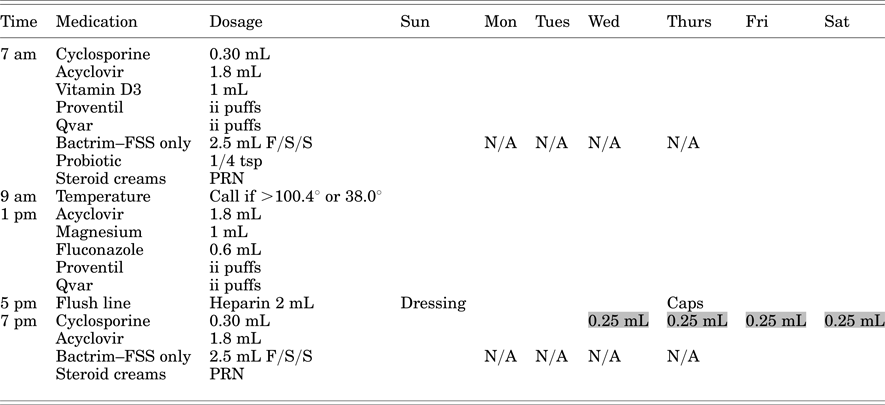
5. Transition of care to the home. Parents experience an abrupt change from 24-hour-a-day multidisciplinary supportive care in hospitals to outpatient care after discharge. Research should explore whether home nursing care after discharge could reduce readmission rates from line infections, medication errors, or adherence issues in the posttransplant period. It is imperative that pharmacists and physicians develop tools to help families manage medication, such as a tool created by the mother in the case for her son after discharge (Table 1).
Table 1.Sample medication management tool


CONCLUSIONS
Enhanced integration of psychosocial and medical care for families and children undergoing BMT is critical for their psychological well-being, and may improve quality of life. These unmet needs should be systematically addressed in the holistic care of all chronically hospitalized patients and families.