With the turn of the millennium computer music has become ubiquitous. Advances in computer technology allow composers not only to distribute their music more widely (by creating sound files for instant dissemination or posting on the internet) but also to create and shape sound itself into seemingly infinite forms. From this plethora of sonic bits and bytes a new generation of composers has emerged. These composers perform in concert and create recorded tracks using the laptop computer as their primary instrument.
Laptop composition has its roots in, and could be viewed as a sub-branch of, computer music or electronic music.Footnote 1 It is a sub-branch defined primarily not by style or genre, but historically, from around 1995, and in terms of the possibilities offered by the technology itself – including its portability, which encourages appearances in social settings in a way that earlier computers did not. Although a journal issue and two books have already been published on the subject,Footnote 2 the field of laptop composition is still in the process of being defined. In his introduction to a themed issue of the journal Contemporary Music Review, entitled ‘The Laptop and Electronic Music’, Kim Cascone resists turning it into a category, discussing the laptop primarily as a performance instrument and describing the music on the CD supplement to the issue as ‘a cross-section of electro-acoustic music made predominantly on laptop or enabled by computer technology’.Footnote 3 Martin Delaney defines laptop music more broadly still, as covering ‘all music-related activities that happen on laptop computers – performing, recording, composing, and just plain listening’.Footnote 4
Although these recent publications discuss and examine laptop music from a number of vantage points (including aesthetic, historical, cultural, sociological, political, linguistic, and spatial), none analyses the sound content of any laptop composition. One of the main goals of this article is to demonstrate the analytical potential of this music's sonic structures. While laptop composition is not genre specific, I argue that two compositional features figure prominently in much laptop computer music at the turn of the millennium, and especially in that of the composers examined here.Footnote 5 One is the prevalent use of repetition, operating on both the small and the large scale. The other is the consistent use of noise, understood in an acoustic sense. Noise, often saturating the musical texture, emerges as one of laptop music's primary sonic characteristics.
Repetition is defined as the exact physical replication of a sound. Unlike the marked repeats that appear in notated music, which will inevitably result in at least slight variations in execution when a human performer is involved, repeated digitized sound remains an exact physical copy of the original. The word ‘physical’ is emphasized because, while the repetition of digitized sound may be physically exact, the percept of experience will differ between the first and second, and between the second and fiftieth, repetition (perceptual variation is discussed later in this essay). In more colloquial terms this type of physical repetition is often referred to as a loop.
Noise can be defined in two ways: culturally and acoustically. In cultural terms noise is any unwanted or uncomfortable sound. As Merzbow, one of the musicians discussed in this article, succinctly states, ‘If noise means uncomfortable sound, then pop music is noise to me.’Footnote 6 This cultural definition, since it is subjective and will vary depending on the listener and the context, is less helpful here than the acoustic definition. Acoustically, noise is defined as a sound wave that does not repeat. Unlike a tone, which is periodic and has an unambiguous perceived fundamental with respect to its harmonics, a noise contains energy across the frequency spectrum, inharmonic and broadband.Footnote 7 Because a noise is not periodic, no single fundamental frequency can be reinforced or perceived. Noise is typically modelled as a stationary stochastic process. White noise, for instance, has a uniform power spectrum when averaged over time. For our analytical purposes this acoustic definition of noise will be used.
Repetition and noise, however, are not new in computer-generated music, Western classical music, or non-Western music. On the large scale most Western classical music forms such as sonata-allegro and rondo are defined by repetition, and on the small scale the motive, a recurring melodic and/or rhythmic unit, is often the basic cell that permeates an entire musical work. Complex waves or noise are heard in percussion instruments as well as in the attacks of such instruments as the violin (bow noise) or the piano (hammer noise). Classic electronic and computer works from previous generations such as Pierre Schaeffer's Étude aux chemins de fer (1948), Edgard Varese's Poème électronique (1958), and Iannis Xenakis's Hibiki Hana-Ma (1970, with orchestra) also use repetition and noise, cohesion being created by the reiteration and transformation of specific sounds, many of which consist of complex waves or noise used separately and/or in combination with more harmonic sounds.Footnote 8 What differentiates the music of previous eras and generations from turn-of-the-millenium laptop compositions is the way in which these elements interact with one another. Laptop composers of the late 1990s and the early twenty-first century fuse the elements of repetition and noise together for the duration of the entire piece, creating shorter repeating loops. These loops often result in regular rhythmic pulses that define the tempo of the piece and form larger phrases and sections. In this way their music is structurally different from that of the previous generation of electronic and computer composers.Footnote 9 For instance, although Varèse's Poème électronique uses a variety of sounds ranging from sine tones to bells to noise, which are repeated in various transformations, the repetitions are not constant, do not create a regular pulse, and do not structure the entire composition. The elements of repetition and noise are never fused together in order to act as structural determinants for the composition as a whole. As will be shown in this article, for the younger generation of laptop composers it is precisely this repetition of loops that creates and defines both large- and small-scale structures. The elements of repetition and noise act in tandem, generating constantly evolving textures that articulate the structural form.
But who are the new innovators of laptop composition? How, specifically, do repetition and noise operate in their music? What methodologies can be used to analyse the physical properties of their works, and what is the relationship between their music and computer technology? In order to address these questions, this paper explores the music of laptop composers Oval (Markus Popp), Merzbow (Masami Akita), and Kid606 (Miguel De Pedro) and discusses salient compositional features of their work that have been little addressed in the literature on them to date.Footnote 10
These three musicians were chosen for a number of reasons. All are laptop composers who were born in the second half of the century – Oval in 1968, Merzbow in 1956, and Kid606 in 1979 – and gained widespread popularity around the turn of the millennium. Each composer is an innovative representative of a distinct genre within the field of laptop composition. Oval is a pioneer of the so-called ‘glitch’ genre, which uses, among other techniques, the sound of skipping CDs as a structuring element. Merzbow is an exponent of the ‘noise’ genre, which uses highly complex non-repeating sound waves to create compositions. Kid606 is in the forefront of the intelligent dance music (IDM) genre, which employs complex pulses and fast textural shifts. They all come from a non-academic musical background in the sense that they lack degrees in composition and do not teach music or work at research institutes (Oval and Merzbow both attended art school). This is perhaps one reason why these composers have been largely ignored by the academic musical community, at least in relation to music analysis.Footnote 11 Each has gained popularity through CD and digital download sales, concerts, and touring. Finally, they live and compose on different continents: Oval is from Germany, Merzbow is from Japan, and Kid606 was born in Venezuela but brought up in the United States. Their geographical and cultural differences underline the global influence and extent of laptop composition, at least in economically affluent countries.Footnote 12
This article begins with a discussion of methodologies of music analysis using spectrograms, computer images of musical sound that have emerged as one of the most useful tools with which to examine non-notated computer music. Next, three representative compositions – Oval's ‘Untitled #2’, Merzbow's ‘Cow Cow’, and Kid606's ‘Powerbookfiend’ – are analysed in relation to frequency content and structure. These tracks were chosen specifically because they were created at about the same time (2000–2003), they are short enough in duration to be discussed in their entirety within the confines of this article, and, most importantly, they provide an excellent example of each composer's distinctive style. While sonically diverse, all three project a fusion of repetition and noise to create the musical design. Finally, repetition and noise are discussed in relation to musical structure, computer technology, and philosophy, highlighting specific connections and offering possible avenues of thought that connect them in multiple ways. As will be demonstrated, the layout and structure of software interfaces can be viewed as influencing the layers of repetition within the musical structure. Drawing on specific concepts of the philosopher Gilles Deleuze, the seemingly opposed concepts of repetition and noise are brought into a symbiotic relationship by demonstrating how each exists within the other.
Analytical methodology
In his foreword to Electroacoustic Music: Analytical Perspectives Jean-Claude Risset, a French pioneer of computer music, states: ‘This new [electroacoustic] music has been little discussed in writing, in part because much of electroacoustic music does away with the score, a document that had heretofore seemed essential. The lack of an objective representation makes it difficult to study these works.’Footnote 13 The music of Oval, Merzbow, and Kid606 likewise exists solely in the form of audio or digital sound files. Because of this, alternative methodologies must be developed and utilized in order to analyse their music. One useful strategy involves the imaging of musical sound using Fourier or spectrum analysis. The resulting images, or spectrograms, show the entire frequency content of the musical sound over time, including sets of harmonics as well as noise bands. The intensity (energy) estimated at particular frequencies at a particular time is shown by the corresponding shading at the x = time, y = frequency position of the plot. Spectrograms create a visual representation of the composition that can then be analysed in conjunction with the heard experience of the music.Footnote 14
Spectrograms were developed at Bell Laboratories in the 1940s and 50s to study the language sounds of speech.Footnote 15 The first applications of the technology to music, made in the 1960s by Risset and Max Mathews, also at Bell, focused on the spectral profile of brass instruments.Footnote 16 The first book devoted entirely to the spectrographic analysis of musical structure and performance was Robert Cogan's New Images of Musical Sound, which developed a theory of tone colour using these images as corroborating evidence. Borrowing from linguistic phonology, it established a table of thirteen ‘sonic oppositions’, which it used ‘as a way of interpreting spectral phenomena and of encompassing music's entire tone color domain’.Footnote 17 Today the use of spectrographic images for music analysis is becoming increasingly popular in the study of both Western and non-Western music, as well as non-notated computer-generated music.Footnote 18
Cogan has discussed the double function these images can play in computer music analysis:
First, they provide a notation for the content of synthesized music – a notation that clearly specifies, as no other does, the orientation, motion, duration, and spectral makeup of each element of the music. Second, spectrum photos provide an analytic base, with data and evidence, for conclusions about the sonic character and structural function of the sonorities and features that they picture.Footnote 19
Using spectrographic images, Cogan analyses an excerpt from Milton Babbitt's Ensembles for Synthesizer, the movement ‘Fall’ from Jean-Claude Risset's computer suite Little Boy, and No Attack of Organic Metals, his own composition for organ and taped sounds. Two recent publications also use spectrograms to analyse non-notated electronic/computer music: Thomas Licata's Electroacoustic Music: Analytical Perspectives, in which, out of nine analyses, four use spectrographic images,Footnote 20 and Analytical Methods of Electroacoustic Music, edited by Mary Simoni, in which five out of six analyses use spectrograms to image the precise frequency and intensity content of the sound signal, before drawing conclusions regarding timbre, rhythm, tuning, structure, and form.Footnote 21 Spectrographic methods have also been used by composers from the so-called ‘spectral school’ of composition, such as Hugues Dufourt and Tristan Murail, who use data from their analyses to determine harmonic and timbral combinations in acoustic instrumental works.
While spectrograms are certainly useful for the analysis of computer music, there is a difference between such images and the experience of listening. Spectrograms are physical pictures made from a sonic signal, whereas human hearing is a perception mediated by a physiological auditory representation. These images do not show us what we hear, though they do provide supporting evidence for our musical perceptions. Furthermore, each image can be subtly or radically altered depending upon the software settings used, including sensitivity to the incoming signal and resolution. It is best, therefore, to think of spectrograms as models of the work, like any other analytical graph or chart (Schenkerian, neo-Riemannian, etc.), which do not represent any final, absolute truth about the music concerned.
For this article spectrograms are used as an aid in revealing repetition and noise operating on both the small- and the large-scale structure of the music. As with the previous spectrographic analyses mentioned, precise frequency content is discussed in relation to brief passages, longer sections, and the form of the composition as a whole. Perceptual terms such as ‘bright’ and ‘dark’ are used throughout to describe specific sounds and/or textures. These perceptual terms can be related to the physical frequency content of the music. Higher frequencies are often perceived and described as brighter, while lower frequencies are often perceived and described as darker.Footnote 22 We also see separate associations with brightness in the intensity plots for the spectrographic images themselves. For the monochrome mapping in the spectrograms accompanying this article, greater intensity is displayed as darker grey or black and lesser intensity as lighter grey. Musically, these terms are used to connect the frequency content of a sound, passage, or entire piece to the way it would typically be perceived by a listener. Analytically, it is important to make these connections, so that the physical structure revealed by the spectrographic image conveys some type of musical meaning in relation to timbre, the context of a passage/phrase, or form. Still, these terms are intended only as relative indicators in the descriptions that follow, and not as absolute values of sound quality.
Oval, ‘Untitled #2’
Markus Popp, born and brought up in Germany, is considered one of the pioneers of the genre called ‘glitch’ music.Footnote 23 ‘Oval’ was originally the name of a trio consisting of Popp, Frank Metzger, and Sebastian Oschatz, but Popp later worked alone under the same name.Footnote 24 Glitch is a term used to describe a genre of music that incorporates and highlights errors or glitches in audio technology as a structuring device in the music. As Cascone writes, ‘more specifically, it is from the “failure” of digital technology that this new work has emerged: glitches, bugs, application errors, system crashes, clipping, aliasing, distortion, quantization noise, and even the noise floor of computer sound cards are the raw materials composers seek to incorporate into their music.’Footnote 25 This relates to theorist Paul Virilio's concept of the ‘accident’ in relation to technology. According to Virilio, with every technological advance (cars, aeroplanes, cyberspace) there is the inherent existence of a failure or accident involving that technology. As he states, ‘To get what is heavier than air to take off in the form of an aeroplane or dirigible is to invent the crash, the air disaster.’ When new technology is invented, the first accident of this new technology (such as the in-flight explosion of the space shuttle Challenger in 1986) is the ‘original accident’.Footnote 26
Glitch music can be viewed as a musical manifestation of Virilio's accident: the highlighting of computer glitches or accidents as the sonic foundation for musical compositions.Footnote 27 Musical explorations of technological failure are, of course, not new. Pierre Schaeffer, John Cage, and Christian Marclay all experimented with vinyl record manipulation, and Yasunao Tone prepared CD surfaces with scotch tape to create unpredictable skips and glitch sounds that subvert normal playback (a technical approach similar to Oval's, but with different aesthetic goals and results).Footnote 28 Glitch as a genre grew out of the 1990s and is intimately linked with the proliferation of computer and electronic technology. Cascone views the glitch genre as having originated from DJs and composers of electronica, who soon became familiar with electronic music from composers such as Karlheinz Stockhausen, Morton Subotnick, and John Cage.Footnote 29 The implementation of glitches, whether ‘crackles, pops, pocks, combustions, gurgles, buzzes, amplitude tautenings, power spikes’, could soon be heard in a plethora of electronic music with a wide range of styles. As Young states, glitches can be found in ‘underground digital music […] post-Acid House […] [and] 4/4 Tech-pulse’.Footnote 30 In the mid 1990s artists such as Pita, Fennesz, and Oval, and labels such as Mego and Touch, were pioneering and popularizing laptop music of this kind with numerous releases.
Eschewing synthesis (or computer-generated sounds) in favour of sampling (or recorded sounds), Oval intentionally scratches and mutilates CD recordings in order to record the sounds of the CDs skipping. He then uses these sampled skips or glitches to create repetitive, pulsating rhythmic patterns that help structure his music by defining both smaller phrases and larger sections.Footnote 31 This technique, as well as other sampled sounds, can be heard in many of his releases, including his earlier CDs Diskont and Systemisch, which helped create and define the glitch genre of laptop composition.Footnote 32 For these earlier releases Oval was using commercial music software such as Peak and Logic. In the late 1990s he became interested in music conceived as an object or CD, and music conceived as a process or as software. In 2000 he released the CD Ovalprocess, which is both a CD and a software program, developed in collaboration with Richard Ross.Footnote 33 The release of the CD and software highlights his interests in both the musical end product and the technical computer process used to create it.Footnote 34 Oval views the programming code and computer operating systems as more important, at least in terms of affecting the musical result, than experimental or aesthetic/musical concepts.Footnote 35 (This raises an interesting point in relation to aesthetics and technology and is discussed in the last section of this article.Footnote 36) To create his music Oval uses small audio files of sampled sounds that he edits and assembles on his laptop computer, and these are then combined to create longer files. For ‘Untitled #2’ and every piece on the CD Ovalprocess these longer files are arranged, layered together, and repeated to create complete tracks using his customized software.
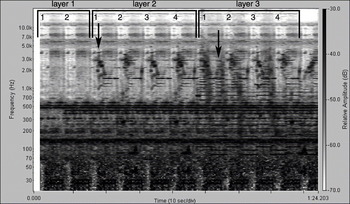
‘Untitled #2’ is structured for the most part on repeating loops composed of both noise-like and harmonic sounds that are layered together. Example 1 shows a spectrogram of the beginning of the track.Footnote 37 As indicated at the top of the image, the opening of the track consists of three layers of repeating material that accumulate as the piece progresses. Within each layer, sound loops that extend throughout the entire frequency range are repeated and indicated by numbers: layer 1 (0′00″–0′15″) contains two statements of material, layer 2 (0′16″–0′47″) four statements, and layer 3 (0′48″–1′23″) four statements. The piece begins with two statements of a loop consisting of black horizontal lines representing perceivable pitches at 150 Hz and 400–500Hz, and complex, noise-like sounds from 100 Hz and below. From 600 Hz and above, lighter grey complex sounds are seen reaching as high as 20 kHz. Within these higher frequencies the sound of a CD skip is heard, creating a regular pulse in the music. A grey vertical rectangular shape is seen twice, reflecting the repetition of the noise-like sound loop. Layer 2 introduces a high-pitched sound, indicated by an arrow, between 1 and 3 kHz (possibly the recorded sound of a low baud rate computer modem from the 1990s negotiating a network connection using modulated tones over an analogue telephone line). The sounds of layer 2 are heard four times. Layer 3, also heard four times, introduces higher pitched harmonic material, seen as thin horizontal black lines between 600 Hz and 10 kHz and again indicated by an arrow. Two important characteristics emerge from this image. First, Oval's sounds are noise-like and dense, consistently activating the entire audible frequency range from 20 Hz to 20 kHz, albeit with some harmonic sounds as well. Second, each entrance of new repeating material adds to the previous repeating material, creating an accumulation of repetitive loops. For instance, the initial dark harmonic lines in layer 1 (at 150 Hz and 400–500 kHz) also appear in layers 2 and 3, but each new layer adds new material. The addition of sonic layers results in a gradual accumulation of repetitive noise-like and harmonic sounds, which increases the density of this opening.
Oval, Untitled #2, spectrographic image of opening.

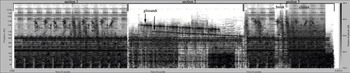
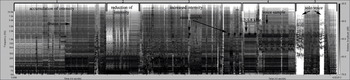
Oval, Untitled #2, spectrogram of complete track.

Example 2 zooms out from this detailed view of the beginning and shows a spectrogram of the complete composition. From this large-scale perspective three clearly defined sections, indicated by brackets with numbers above, emerge. As discussed above, section 1 is characterized by an accumulation of repetitive loops – visible in the vertical patterns created in the spectrographic image – and black horizontal lines around 150 Hz and 400–500Hz, with complex sounds at 100 Hz and below. As noted above, the entire audible frequency range (20 Hz–20 kHz) is almost constantly activated, resulting in a relatively dense texture.
Section 2 immediately reduces the number of upper frequencies (3 kHz and above). This results in a less dense and perceptibly darker sound overall. While repetitive loops continue to pulsate in section 2, two drones appear at 1 and 2 kHz, indicated by arrows. These drones slowly descend, creating two simultaneous glissandos throughout most of the section. The drone heard in Section 1, between 400 and 500 Hz, continues in section 2, but harmonic drones also emerge as low as 40 Hz, seen as thin, black horizontal lines. Notice that at 10 kHz a high-pitched pulsating loop continues from section 1 into section 2, seen as a light grey horizontal dashed line. Finally, the low frequency portion of section 2 (500 Hz and below) shifts from moments of medium intensity (seen as medium grey) to low intensity (seen as lighter grey) to high intensity (seen as black), followed by a brief moment of low intensity that shifts back to lighter grey. These distinct lower frequency shifts create a three-part form for section 2, and invoke interesting parallels with the large-scale form discussed below.
Section 3 marks a return of material similar to that already heard in section 1: black harmonic lines around 150 Hz and 400–500Hz, complex sounds at 100 Hz and below, and the activation of higher frequencies extending up to 20 kHz, with the reintroduction of the pulsating CD skip sound. Unlike section 1, section 3 has a break in the middle (indicated in the image), caused by a subtraction of repetitive loops, just before reaching a climax near the end of the piece. This climax is quickly followed by a series of distinct drops in sonic/spectral density caused by a subtraction of loops, which reduces the spectra down to an upper frequency peak of 2 kHz and then 100 Hz.
Overall the large-scale form is marked by an accumulation of loops with medium intensity (section 1), a subtraction of loops with low intensity (section 2), and an intensified accumulation of loops with high intensity (section 3), followed by a short, low-intensity ending. Using more traditional nomenclature this could be described as ABA′. Sections A and B are distinct because two defining features of section A, the higher frequencies containing the pulsating CD skip sound and the lower harmonic frequencies at 150 Hz and 400–500 Hz, are absent in B. Sections A and A′ are similar because the two defining features of A return in A′ but with a distinct break in the texture and the addition of complex sounds to create a climax. Through their prolonged inclusion and/or absence the use of specific samples and loops on the small scale shape the large-scale form of the entire piece. Viewed in this way the large-scale, three-section design of ‘Untitled #2’ is reflected in the small-scale design of section 2, while the three-part form of section 2 (medium intensity, low intensity, high intensity, with a short low intensity ending) is a smaller version of the piece as a whole – a fractal design that is, in conception at least, recursive in nature. Within the seeming chaos of this music and its spectrographic image, Oval thus creates a carefully constructed three-part form, through the accumulation and subtraction of repeating noise-like loops that both generate and define the musical structure.
Merzbow, ‘Cow Cow’
Masami Akita, known as Merzbow, is a pioneer of the genre known as ‘noise’ music and is currently its most famous proponent. According to Paul Hegarty, ‘Masami Akita, aka Merzbow […] is the paragon of noise, its “godfather”, its master.’Footnote 38 Noise as music, however, is not a recent development and can be traced back to Luigi Russolo's 1913 Futurist manifesto ‘The Art of Noises’.Footnote 39 Russolo's aesthetic approach to noise diverged notably from the Western concept of classical dissonance. As Hegarty explains, Western dissonance is a relative indicator contingent upon the ‘newness’ of the pitch context, whereas noise, in the Russolo sense, is not dependent upon pitch: here noise becomes primary and pitches secondary.Footnote 40 Throughout the twentieth century a variety of other composers, including Pierre Schaeffer, Edgard Varèse, and John Cage, experimented with and incorporated mechanical sounds and/or noise into their music. Noise also later infiltrated popular musical genres, especially in the 1970s and 80s.Footnote 41 The pioneering band Throbbing Gristle used, among other things, looped samples on tape to create high levels of distortion, while Whitehouse and Nurse With Wound also created noise textures in their music. In 1975 Lou Reed released a double album called Metal Machine Music, which consisted entirely of guitar feedback. But according to Hegarty it was ‘with the vast growth of Japanese noise’, a phenomenon traceable back to the 1980s, with artists such as Keiji Haino, Hijokaidon, Masonna, and Merzbow, that ‘finally, noise music bec[ame] a genre’.Footnote 42 In ‘Japanoise’, as it came to be known, noise, again defined acoustically in terms of complex non-harmonic sound waves, becomes the predominant sonic component.Footnote 43
Born and brought up in Tokyo, Merzbow studied art theory and painting at Tamagawa University and was influenced by the Surrealist and Dadaist movements, rock and roll, and electronic music by composers including Stockhausen and Xenakis.Footnote 44 After graduating he began experimenting with new modes of expression: ‘I quit rock and oil painting in the 70s and started making sound and visuals in a totally different way. So, my idea was to create something anti, but representing the brutal sound spirit of rock music.’Footnote 45 He adopted the name ‘Merzbow’ (deriving from Kurt Schwitters' Dadaist ‘Merzbau’ installations) for his music in the early 1980s. Early Merzbow recordings also involved other musicians, including Kiyoshi Mizutani.Footnote 46 Inspired by cheap pornography advertisements, he initially distributed his music in cassette tape form as a fetish for people through the mail under his own label, Lowest Music & Arts. As he later commented, ‘My earliest concept for Lowest Music & Arts was supposed to be very similar to the underground porno service. I liked the idea that art/music is something representational of the perversion/unconsciousness of humanity.’Footnote 47 Merzbow views noise as the unconscious of music and draws parallels between noise, eroticism, and pornography: ‘pornography is the unconsciousness of sex. So, noise is the unconsciousness of music. […] [F]or me noise is the most erotic form of sound.’Footnote 48 To begin with, he created his music using instruments such as guitars and analogue sound sources such as tape recorders and speaker feedback, but in the late 1990s he started to use laptop computers. He has been notably prolific, releasing numerous recordings every year for more than two decades. A testament to the volume of his output is the 50-CD box set released in 2000 by the Extreme record label, which spanned his entire career up to that point.
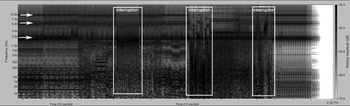
‘Cow Cow’, from the critically acclaimed CD Amlux, was composed in 2002, shortly after Merzbow had turned to using laptops. Throughout ‘Cow Cow’ noise-sounds are manipulated by means of repetition (a particular characteristic of his post-analogue period), interruption, and transformation. Like Oval's ‘Untitled #2’, the composition consistently activates the entire audible frequency range (20 Hz to 20 kHz). Within this range certain frequency bands are emphasized, creating distinct sound patterns that define sectional divisions. Example 3 shows the beginning of the track.
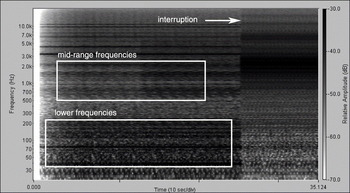
Merzbow, Cow Cow, opening, with emphasis on lower and higher frequency bands.

Within the consistent noise texture at the opening of the track two particular frequency areas are emphasized (indicated in the example). The first is lower and extends from 40 Hz to 200 Hz, with specific frequencies at 40 Hz and 100 Hz appearing in harmonic relation at 80 Hz and 200 Hz respectively. The second is mid-range, extending from 600 Hz to 2 kHz and starting just above 3 kHz, though the intense energy above 3 kHz is not consistently present. Above 3 kHz black horizontal lines indicate perceivable pitched frequencies. This sonic texture, with the low frequency energy (40–200 Hz) combined with the mid-frequency energy (600 Hz–2 kHz), creates the defining sound for section 1. There is only one interruption of this texture, also indicated in Example 3, where the low and middle frequency texture drops out and is replaced by an intensification of the frequencies between 1.8 kHz and 2.9 kHz. The original opening texture then returns.
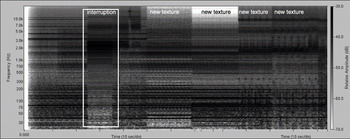
Merzbow, Cow Cow, section 1.

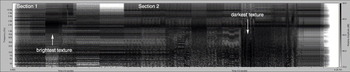
Example 4 expands outwards to show section 1, which encompasses the first half of ‘Cow Cow’ (0′00″–2′05″). From this vantage point Merzbow's use of repetition, noise, and texture shifts are clearer. Noise textures are created through short repeating noise loops, which generate the sustained block-like shapes that characterize the spectrographic image. Unlike in ‘Untitled #2’ by Oval, the repetition of noise loops is not obviously heard, but is used instead to create seemingly sustained textures. Shifts in frequency emphasis immediately change the spectrographic image when different repeating noise loops begin, forming a new texture. The shift from the first texture to the first interruption, perceived as a shift from a darker (lower and mid-range frequency emphasis) to a brighter sound (with higher frequency emphasis), is a striking example of these abrupt textural shifts created through repeating noise loops, which define and structure the entire composition.
Merzbow, Cow Cow, section 2.

Example 5 shows section 2, which encompasses the second half of ‘Cow Cow’ (2′06″–4′18″). Section 2 is characterized by an intensification of the frequencies between 1.8 kHz and 2 kHz, which create harmonic resonances at 5 kHz to 6 kHz and 8 kHz to 9 kHz (indicated by arrows). Also, section 2 de-emphasizes the defining lower (40 Hz to 200 Hz) and mid-range (600 Hz to 2 kHz) frequencies of section 1. These three bands of noise, which define the second half of the piece, actually enter in section 1, overlapping with the original texture from the first section. Throughout section 2 these frequency bands are consistently present, except for three brief interruptions indicated on the spectrogram. Each interruption increasingly mutates and transforms the three upper frequencies as the section progresses. The first interruption (2′22″–2′34″) disperses the upper three frequencies somewhat, the second interruption (3′01″–3′14″) increases the amount of dispersion and transformation, and the third interruption (3′40″–3′49″) transforms the three upper frequencies so completely that they are unrecognizable both visually and perceptually.
While the two sections of ‘Cow Cow’ are characterized by specific frequency bands with only brief interruptions, the piece is in no way static. Within each part constant variations occur around the emphasized frequencies. For instance, in section 1 (see Example 4) at the second ‘new texture’ indication, although the general range of frequency intensification remains the same, there is a sudden de-emphasis of higher frequencies, seen as lighter shades of grey, with the very highest frequencies (12 kHz and above) erased altogether. This results in a darker sound and is the only point in the piece, except for a few seconds at the end, which does not activate frequencies of 12 kHz and higher. The second ‘new texture’ is immediately followed by the entrance of the higher frequencies of section 2, creating an intense opposition of low and higher frequency sounds.
Merzbow, Cow Cow, spectrogram of complete track.

Example 6 shows a spectrogram of the complete ‘Cow Cow’, which clarifies important structural characteristics. Section 1 is defined by lower frequencies extending from 40 Hz to 200 Hz and mid-range frequencies extending from 600 Hz to 2 kHz. Overall, section 1 projects a darker sound. Section 2 is defined by intense, higher frequencies extending from 1.8 kHz to 2 kHz, which create harmonic resonances at 5 Hz to 6 kHz and 8 kHz to 9 kHz. It therefore projects a brighter sound. This darker/brighter contrast between sections is seen in the spectrographic image in the change of emphasis from lower and mid-range frequency bands in section 1 (seen as black horizontal lines) to higher frequency bands in section 2. Within each section, however, textural interruptions juxtapose the brightest and darkest textures with the overall darker and brighter sections. As indicated in the spectrogram, the interruption in section 1 is the brightest texture for the entire piece and occurs within the darker section. The second interruption in section 2 is the darkest texture for the entire piece and occurs within the brighter section. The brightest and darkest moments of the piece are thus nested within the darker and brighter sections (sections 1 and 2) respectively. This increases not only the amount but also the intensity of contrast in the music.
‘Cow Cow’ emerges as a cogent piece structured by a multitude of noise textures, exhibiting both static and dynamic elements that lend cohesion and variety to the composition. Although essentially binary in design, it features specific interruptions nested within the constantly shifting textures of each section. Using noise as its basic musical material, subjected to repetition in the form of noise loops, ‘Cow Cow’ provides an excellent example of the compositional techniques used at the beginning of Merzbow's laptop computer period.
Kid606, ‘Powerbookfiend’
Kid606, born Miguel De Pedro in Venezuela and brought up in the United States, is one of the pioneers of what became known as ‘intelligent dance music’ (IDM), which is characterized by complex dance-like rhythms, drum sounds, samples, and fast tempos.Footnote 49 IDM as a genre grew out of both electronic dance genres and DJ culture in the 1990s. Important earlier influences include minimalist music of the 1960s and 70s, with its emphasis on repetition, and pioneers of sampling, such as Pierre Schaeffer.Footnote 50 In the 1980s and 90s urban dance clubs and rave dance events cultivated the types of electronic dance music known as ‘techno’ and ‘trance’. This new dance music was created using entirely electronic equipment and/or computers and placed emphasis on regular beats using drum and percussion sounds. DJ culture can be viewed as promoting two important audio techniques: the cut and the mix. As Cox and Warner write: ‘To record is to cut, to separate the sonic signifier (the “sample”) from any original context or meaning so that it might be free to function otherwise. To mix is to reinscribe, to place the floating sample into a new chain of signification.’Footnote 51
Both dance music and DJ culture were important influences on IDM. In the 1990s composers such as Aphex Twin (Richard D. James), Squarepusher (Tom Jenkinson), and Kid606 emerged along with labels such as Warp Records. This new generation of composers used computers to create their own beat-oriented electronic music that was more rhythmically and texturally complex than typical dance music and displayed the same cut-and-mix compositional strategies typically heard in DJ performances. The defining feature of IDM, and what sets it apart from glitch and noise genres, is the presence of a regular pulse or beat created with drum sounds or samples. While glitch music is often pulsed, it typically neither uses actual drum sounds nor embraces an obvious pop aesthetic. The use of sophisticated computer manipulation, sampling, and pop elements within IDM has been seen by Ben Neill and others as an indication that the ‘new breed of composers [has] no regard for the former distinctions of pop versus high art’.Footnote 52
Kid606's music is perhaps better described as punk IDM. Much of his musical output displays complex beats created by electronic drum sounds and samples, but with high energy, punk-like aggression created through fast or multiple audio edits and splices.Footnote 53 Some of his earlier, more aggressive releases include Don't Sweat the Technics and Down With the Scene, but he has also released less aggressive, ambient CDs, including PS I Love You. He creates his music using a variety of commercial music software including Reaktor, Live, Peak, and Logic, and usually performs live using two laptop computers along with other audio equipment such as a mixer. ‘Powerbookfiend’, the eighth track on his 2003 release Kill Sound Before Sound Kills You, provides an example of his frenetic style.Footnote 54
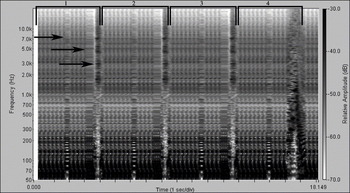
In contrast to ‘Untitled #2’ and ‘Cow Cow’, ‘Powerbookfiend’ exhibits an overall defining regular pulse of 210 beats per minute (bpm) using pop drum samples that appear throughout much of the composition. Indeed, Kid606 is the most pop-influenced of the three composers. Mixed into this sound palette are distinct texture shifts, which result in moments of extreme contrast, and a few spoken voice samples. Like ‘Untitled #2’ and ‘Cow Cow’, ‘Powerbookfiend’ layers a variety of noise loops together to produce the complex repetitive structures that create the formal shape of the track. Example 7 shows a spectrogram of the beginning of ‘Powerbookfiend’.
Kid606, Powerbookfiend, spectrographic image of opening.

As indicated by the numbered brackets at the top of the example, the piece begins with four repetitions of an extremely dense noise sound – created through shorter, faster repetitions – that covers the entire audible range. Within each of these repetitions distinct texture shifts occur (indicated by arrows), appearing as vertical bands of spectral and textural difference. The third shift, which is the loudest and most intense (seen as black from 1.5 kHz and above), signifies the end of the pattern before it is repeated.
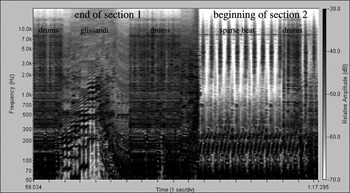
These quick, abrupt shifts between diverse textures define the overall character of the composition. Unlike the rapid texture shifts in ‘Cow Cow’, the schizophrenic nature of those in ‘Powerbookfiend’ creates in the music a constant sense of motion and surprise, thanks in part to the fast and steady pulse maintained throughout the entire piece. Example 8 shows one instance of these abrupt sonic changes – a detail of the shift from section 1 to section 2.
Kid606, Powerbookfiend, detail of the shift from section 1 to section 2.

Here the music shifts abruptly from a drum texture to synthesized glissandos, to a drum texture, to a sparse electronic beat, and then back to a drum texture. Notice that although the transition from section 1 to section 2 is clearly defined by the spectral and textural difference, sudden sonic changes occur within both sections as well. Example 9 shows a spectrogram of the complete ‘Powerbookfiend’.
Kid606, Powerbookfiend, spectrogram of complete track.

As the brackets above the example indicate, ‘Powerbookfiend’ can be divided into five sections. Section 1 is defined by the repetitive use of a noise sample with a gradual accumulation of intensity and density, seen as a shift from lighter grey to darker grey and black. Drum sounds (indicated by the arrow) do not enter until the latter part of the section. Section 2 immediately reduces the number of looped samples, which results in a decrease of intensity and density. This is shown by the absence of frequencies from 10 kHz and above, as well as a shift to lighter grey from 500 Hz and above. Section 3 reveals a return to a denser and more intense texture, while also introducing a sound that resembles an ambulance siren, indicated by the arrow and seen as black. This siren sample helps to link section 3 with section 4. Section 4 is defined by both a strong frequency band between 1.2 kHz and 1.8 kHz and the introduction of a spoken voice sample, both indicated by arrows. Notice how the siren sample, which began in section 3, sounds twice more in section 4, helping to smooth the transition between the two sections. Finally, section 5 is defined by two solo spoken voice samples, indicated by arrows, which are intersected and separated by two moments of intense percussion samples. The opposition between these spoken voice and percussion samples provides the most extreme textural change of the entire piece.
‘Powerbookfiend’ is defined throughout by moments of dramatic spectral and textural change that are intensified in both their temporal proximity and their sonic difference as the piece progresses. At the beginning, section 1 displays an accumulation of intensity with short interruptions, and at the end, section 5 displays the most extreme juxtapositions between solo voice and percussion. Like Oval and Merzbow, Kid606 uses noise in repeating loops that help define the musical structure. What differentiates ‘Powerbookfiend’ from ‘Untitled #2’ and ‘Cow Cow’ is the use of pop-influenced drum sounds and the consequent regular pulse of 210 bpm, which rhythmically unifies the entire composition.
The fusion of repetition and noise emerges as a salient compositional feature of the music of Oval, Merzbow, and Kid606. Oval's ‘Untitled #2’ uses repetition to build accumulating noise loops, creating increasingly dense, repetitive structures that define the sectional divisions and the overall three-part form of the work. Merzbow's ‘Cow Cow’ uses repetition to create seemingly static noise textures that abruptly shift to other noise textures, creating the two-part structure of the piece. Kid606's ‘Powerbookfiend’ defines an overall tempo within which repetitive noise loops are mixed and juxtaposed with pop-influenced drum sounds, creating a five-part form. While repetition and noise define the musical structure and sound of all three tracks, each composer deploys those elements in an individual and distinctive way.
Musical structure, computer technology, and philosophy
Repetition and noise can also be used to draw connections between musical structure, computer technology, and specific philosophical concepts.Footnote 55 The surface levels of the tracks discussed in the analyses above reveal layers of repeating sound loops used to create musical structure. Despite the differences in genre, style, and aesthetics, all three pieces display this structural characteristic, which can be linked to software interfaces in two ways. The first is the ability to repeat and loop sounds easily. Repeating and looping sounds is one of the most common compositional techniques coded within music software programs today, from audio editors (Wavelab, Peak) to sequencers or digital audio workstations (Logic, Digital Performer, Cubase, Pro Tools) and live performance and DJ software (Live). Repeating loops are intrinsic to the software interface.Footnote 56 The second is the ability to layer these repeating loops one on top of another. Sequencers and digital audio workstations (DAWs) provide an easy visual format for layering different sounds or tracks and mixing them together. The ability to layer tracks in DAW technology is derived from hardware mixing consoles (and can be related conceptually to the concept of staves in Western musical notation). Viewed in this light the musical structures of ‘Untitled #2’, ‘Cow Cow’, and ‘Powerbookfiend’ all reflect a consistency between the logic and structure of the technology on the one hand and the compositional techniques used for their creation on the other.
These layers of loops, existing within the musical structure and within the computer technology, point to a machine aesthetic operating on and within the activity of these composers – the idea that the machine, in this case the computer and its software, influences an aesthetic direction and/or style.Footnote 57 Paul Virilio has published extensively on the relationship between humans and technology, often highlighting specific dangers (as he sees them) in the ‘totalitarianism of modern technology’.Footnote 58 As he states in The Art of the Motor, in relation to sociopolitical cybernetics, ‘This [interactive user-friendliness] is just a metaphor for the subtle enslavement of the human being to “intelligent” machines.’Footnote 59 Virilio would no doubt see a ‘subtle enslavement’ operating on the aesthetic level for Oval, Merzbow, and Kid606.
Although the three composers may have different composing procedures and habits, they all interact with visual interfaces of music software. Stylistically, Oval and Kid606 are influenced by electronica and dance music genres, so their use of repetition could be the product of stylistic choice, software influence, or both. Merzbow's music, however, is not influenced by dance genres, making it even more interesting that his laptop compositions display such a high degree of repetition. This repetition is less prevalent in his earlier, pre-laptop music, and therefore appears to reflect a more direct influence of the software interface upon compositional choices. The machine aesthetic is manifested by all three composers in different ways. Oval helped design his own software interface for the creation of the CD Ovalprocess and the track ‘Untitled #2’, but had been using commercially available music programs up to that point. Kid606, on the other hand, continues to use commercial music software, including a variety of editors, samplers, synthesizers, and sequencers. Merzbow, at the time of ‘Cow Cow’, had recently started using laptop computers and software to create his music. The machine influence displayed by these composers is not to be seen as undesirable, since they explore repetition creatively in different ways. As Atau Tanaka writes in his article ‘Speed of Sound’, ‘Artists […] can offer a vision of these temporal features not as technical shortcomings, but as characteristics defining the creative potential of a medium.’Footnote 60
The use of noise draws attention to a paradoxical relationship. When we observe the dense, vertical bands of black or grey on the spectrographic image, we are looking at bands of noise, namely non-repeating sound waves. Yet these non-repeating waves are structured and organized by repeating loops. In other words, order (repeating loops) is generated by material that is inherently chaotic (non-repetitive noise). This paradoxical relationship draws into sharp focus the multi-layered approach behind this music. Oval, Merzbow, and Kid606 structure their music using multiple layers of repeating sound files, but as the amount of complex sound or noise increases, the conceptual opposition between the repeating sounds and the material being repeated increases. How can we understand this seemingly oppositional relationship, and are repetition and noise really that contradictory?
In addressing this question, specific concepts from the writings of the twentieth-century philosopher Gilles Deleuze provide useful avenues of thought. In Difference and Repetition Deleuze suggests that difference and repetition, rather than constituting separate categories and concepts, are symbiotically related.Footnote 61 Deleuze defines ‘difference’ as both non-repetition and a rupture within repetition, forming a strong resonance with the physical definition of sonic ‘noise’ provided in this article – a physical sound wave that is aperiodic and hence does not repeat. Conceptually aligning Deleuze's ‘difference’ with complex sound waves or ‘noise’ provides a dynamic way in which to conceive the music of Oval, Merzbow, and Kid606.Footnote 62
Deleuze asks, ‘Does not the paradox of repetition lie in the fact that one can speak of repetition only by virtue of the change or difference that it introduces into the mind which contemplates it?’Footnote 63 Although something is identically repeated (a digital sound file), the listener hears the second playing as something different from the first. In other words, a physical repetition still results in a perceptual difference. What has been experienced is retained in memory and what will be experienced is anticipated because of memory. This perceptual movement of time, which ‘goes from the past to the future in the present’, Deleuze calls ‘passive synthesis’.Footnote 64 Passive synthesis generates perceptual difference through physical repetition. For instance, at the beginning of ‘Untitled #2’ by Oval (see Example 1) layer 1 contains two physically identical statements of material. Through passive synthesis the second statement, although physically identical, will be perceptually different from the first because the first statement is already retained in memory (past) and possible future statements of the same material generate anticipation (future).
Deleuze continues, ‘Difference lies between two repetitions. Is this not also to say, conversely, that repetition lies between two differences, that it allows us to pass from one order of difference to another?’Footnote 65 Rather than as oppositions, difference and repetition can be viewed as interdependent processes, each helping to co-define the other. Difference and repetition, therefore, are joined in two ways. They are both physical phenomena, as shown by the spectrogram, which define the musical structure (repetition) and much of the characteristic sound of the music (noise). They are also percepts, experienced by the ‘passive synthesis’ of the past and future through the present. Noise and repetition delineate one another both physically and perceptually.
In this way, ‘Untitled #2’, ‘Cow Cow’, and ‘Powerbookfiend’ can be viewed as reflecting not only a type of machine aesthetic, where the macro and micro structure of the technology emerges in the musical structure, but also a conceptual coalescence of its two main musical characteristics, repetition and noise. Repetition and noise exist as a series of mutually dependent interactions, from fixed structural identities (the physical repetition of sound files) to mobile, dynamic relations (the sonic perception of ‘passive synthesis’) acting upon the listener's perception. The compositional fusion of repetition and noise can be thought of as mirroring their philosophical reconciliation.
Conclusion
This article has demonstrated the ways in which repetition and noise emerge as salient compositional features in the music of Oval, Merzbow, and Kid606. Oval's repeating sound loops, made up of both complex and harmonic sounds, shape his music through accumulation and subtraction, resulting, in ‘Untitled #2’, in a three-section form. Merzbow uses repetition to generate highly complex noise textures that suddenly shift and change, resulting in the two-section form of ‘Cow Cow’. Kid606's use of repetition and noise results in quick juxtapositions of contrasting textures within more pop-influenced compositions, and, in the case of ‘Powerbookfiend’, a five-section form. Spectrographic images enable precise frequency analysis of these repetitive noise-like sound loops, which define both the local sonic details and the large-scale structure of the tracks concerned.
Layers of repetition or loops can be viewed as reflecting a Virilio-like machine aesthetic displayed in the musical structure through the software interface used to create the music. The musical structures of ‘Untitled #2’, ‘Cow Cow’, and ‘Powerbookfiend’ mirror the structure of the technology used for their own creation. As a way of reconciling the seemingly opposed concepts of repetition and noise Deleuze proposes an interdependency between difference, or noise, and repetition, suggesting that each exists within the other: repetition exists within and is defined by difference, and difference exists within and is defined by repetition. Also, through the concept of ‘passive synthesis’, the physical repetition of a sound creates perceptual differences within the mind of each individual. Both physically and perceptually, the interdependence of difference/noise and repetition is reflected in the musical sound and structure of each piece. On multiple levels – musical, technological, and philosophical – the music of Oval, Merzbow, and Kid606 helps to define the character of laptop composition at the turn of the millennium.