Introduction
Essential tremor (ET) is one of the most common neurological disorders and the most common tremor disease among humans, with 4% of individuals age 40 and older affected.Reference Louis and Ferreira1 An estimated 7 million individuals in the United States have ET, and a large proportion of American families include 1 or more individuals with this disease.Reference Louis and Ottman2 The condition is clearly global, affecting human beings of all ethnicities, from the remote Okapa subdistrict of Papua New Guinea to the Washington Heights Inwood community in northern Manhattan.Reference Louis and Ottman2 ET is both chronic and clinically progressive, with tremor worsening over time in affected individuals.Reference Putzke, Whaley, Baba, Wszolek and Uitti3 There are only 2 front-line medications, both of which are ineffective in up to 50% of patients.Reference Zesiewicz, Elble and Louis4 Deep brain stimulation (DBS) surgery is a highly effective treatment for ET, but it is not a cure, and its role is limited. The procedure is reserved for later-stage, medically refractory ET cases.Reference Schuurman, Bosch and Bossuyt5
As ET is characterized primarily by kinetic tremor of the upper extremities (ie, tremor during voluntary movements such as eating, drinking, writing),Reference Louis6 it can result in significant loss of function,Reference Dogu, Louis, Sevim, Kaleagasi and Aral7 reduced quality of life,Reference Sengul, Sengul and Yucekaya8 and a lowering of morale.Reference Chandran, Pal, Reddy, Thennarasu, Yadav and Shivashankar9 These experiences in turn may be associated with mood or anxiety disorders. Indeed, depressive symptoms are common in ET, with an estimated prevalence of 25–35%.Reference Louis10–Reference Li, Xie and Tian14 However, there is evidence that on some level, depression is not strictly a psychological reaction to tremor in ET. First, in a cross-sectional study, severity of tremor in ET was not associated with severity of depressive symptoms.Reference Huey, Cosentino and Chapman15 Second, in a prospective study of normal, tremor-free individuals, baseline self-reported depression was associated with increased risk of developing ET during follow-up (adjusted relative risk = 1.78, p = 0.018), suggesting that in some instances the mood disorder could be a primary feature of the underlying disease, occurring prior to onset of tremor.Reference Louis, Benito-León and Bermejo-Pareja16 These data suggest that depressive symptoms may not be a mere consequence of tremor in ET, but rather a separable comorbid entity or a marker of a certain premorbid tendency.Reference Huey, Cosentino and Chapman15–Reference Musacchio, Purrer and Papagianni21
Demoralization, another manifestation of psychological distress, has been well-described in various chronic illnesses, and is characterized by feelings of helplessness, hopelessness, a sense of bewilderment, and an inability to cope in stressful situations.Reference Clarke, Kissane, Trauer and Smith22–Reference Sansone and Sansone25 Though demoralization can be associated with depression, they are distinct psychological phenomena with independent prognostic implications.Reference Frank26–Reference de Figueiredo28 For example, whereas depression includes anhedonia in the present, demoralization includes an anticipatory loss of hope and feelings of subjective incompetence.Reference Clarke and Kissane27
In the setting of some chronic diseases, demoralization does not correlate with stage of disease, time since diagnosis, or type of treatment,Reference Arts-de Jong, DeJong, Hermens, Kissane, Massuger and Hoogerbrugge29 suggesting that it may represent more than a mere product of the disease. Indeed, a tendency toward demoralization could precede the disease and dictate how a patient copes with that disease. Demoralization has been studied in the context of other movement disorders such as Parkinson’s disease (PD)Reference Koo, Chow and Shah30; however, to our knowledge, demoralization has never been studied in ET.
The objectives of this article are (1) to estimate the prevalence of demoralization in a sample of ET subjects, (2) to assess its clinical correlates, and (3) to determine whether demoralization correlates with tremor severity or dissociates from tremor severity.
Methods
Study design
Subjects were enrolled in an ongoing, prospective, longitudinal study of cognitive function in ET (Clinical-Pathological Study of Cognitive Impairment in Essential Tremor [COGNET], NINDS R01NS086736). The study tracks a cohort of older ET subjects across 3 in-person assessments (baseline, 18 months, and 36 months). All are enrolled as brain donors as well. Subjects were recruited through online advertisements based on the following eligibility criteria: (1) diagnosis of ET; (2) age ≥ 55 years old; (3) no prior DBS surgery for ET; and (4) ability to perform study measures and willingness to be a brain donor. The Yale University and Columbia University Internal Review Boards approved study procedures, and signed informed consent was obtained upon enrollment.
From November 2016 through November 2017, demoralization assessments were orally administered by trained study personnel at either the second (18 months) or third assessment (36 months), depending upon which of these occurred during that 1-year time interval. During that time period, consecutive subjects were queried using demoralization measures until a sample size of 60 was reached to provide enough power for statistical analysis. Older subjects (age ≥ 80 years) were not queried so as not to add additional strain due to prolonged testing. All assessments were performed in the subjects’ homes.
Demoralization and other psychometric assessments
The primary measure of demoralization, the Kissane Demoralization Scale (KDS-II),Reference Kissane, Wein, Love, Lee, Kee and Clarke31, Reference Robinson, Kissane and Brooker32 assesses feelings of helplessness and hopelessness during the prior 2 weeks. The KDS-II comprises 16 statements (eg, “I do not cope well with life,” “I feel helpless,” “I would rather not be alive”) that may be divided into the categories “Meaning and Purpose” and “Distress and Coping Ability.” These statements are answered as follows: never (0), sometimes (1), or often (2) (maximum = 32 points). Higher scores on the KDS-II indicate a greater tendency for demoralization.
Persons who are demoralized often lack resilience and have a poor sense of inner competence or fitness. To supplement the KDS-II, which is a direct measurement of demoralization, and to comprehensively assess these issues in our sample, we also assessed (1) subjective incompetence and (2) resilience using the scales described below. Together these 3 assessments provide a comprehensive picture of demoralization.Reference Tecuta, Tomba, Grandi and Fava33
The Subjective Incompetence Scale (SIS)Reference Cockram, Doros and de Figueiredo34 assesses subjective incompetence, the clinical hallmark of demoralization, defined as an inability to perform daily tasks and respond “appropriately” to stressful situations.Reference de Figueiredo and Frank35 SIS assesses frequency and severity of feelings of incompetence during the past week; the 12 statements (eg, “I felt I was facing a quandary, a dilemma, or a predicament” and “I was puzzled, indecisive, and uncertain as to what actions, if any, I should take”) are each scored from 0 to 3 (maximum = 36 points), with higher scores indicating greater feelings of incompetence. Inclusion of SIS provided a secondary and confirmatory measure for demoralization. In other words, because subjective incompetence is the most widely observed clinical sign of demoralization, including this scale both confirms the presence of demoralization in affected individuals and gives measurement of the extent to which the defining characteristic of demoralization is present in ET.Reference Cockram, Doros and de Figueiredo34, Reference de Figueiredo and Frank35
The Brief Resilience Scale (BRS)Reference Smith, Dalen, Wiggins, Tooley, Christopher and Bernard36 assesses the antithesis of subjective incompetence: resilience, or the ability to recover from stress.Reference de Figueiredo37 Resilience is scored through 6 statements (eg, “I tend to bounce back quickly after hard times” and “It is hard for me to snap back when something bad happens”) on a scale of 1–5, the total of which is averaged for a composite score (maximum = 5 points), with higher scores indicating higher levels of resilience. Inclusion of the BRS provides a measure of an individual’s ability to avoid demoralization by being able to cope with stressors. Higher levels of resilience may explain why certain individuals do not exhibit heightened demoralization, as subjective incompetence is lower in the presence of high resilience due to their inverse relationship.Reference Smith, Dalen, Wiggins, Tooley, Christopher and Bernard36, Reference de Figueiredo37
ET-related and additional medical assessments
Clinical questionnaires
We also administered a series of demographic and clinical questionnaires (eg, age, gender, education, duration of tremor). The Tremor Disability Questionnaire assesses difficulty on 10 daily tasks (0 = none, 5 = need to modify, 10 = has difficulty), with a maximum of 100 points.Reference Louis, Barnes and Wendt38 A modified version of the Cumulative Illness Rating Scale (CIRS)Reference Linn, Linn and Gurel39, Reference Miller, Paradis and Houck40 assesses the presence of medical conditions in 13 bodily areas: cardiac, vascular, respiratory, eye/ear/nose/throat (EENT), upper gastrointestinal (GI), lower GI, hepatic, renal, other genitourinary (GU), musculoskeletal/integumentary (MSI), neurological, hypertension, endocrine, and malignancy. A scale of 0–3 is used for each area (maximum 39 points): 0 = no problem; 1 = mild problem, which may or may not even require treatment; 2 = moderate problem, ie, treatment is definitely needed but prognosis is good; and 3 = severe problem, ie, treatment is urgently needed, and prognosis is guarded. Prescribed medications for each subject were also noted.
Videotaped neurological examination
Each subject underwent a 20- to 30-minute standardized videotaped neurological examination, which included a detailed assessment of postural tremor and 5 tests for kinetic tremor. A movement disorders neurologist (EDL) reviewed the videotaped neurological examination obtained during the in-person study visit. For each subject, kinetic or postural tremor was rated (range 0–3) on 12 items, and a total tremor score (range 0–36) was calculated. Head or voice tremor were noted when present. The Washington Heights-Inwood Genetic Study of ET (WHIGET) diagnostic criteriaReference Louis, Ottman and Ford41 were used to confirm ET diagnoses; these criteria have previously shown to be reliableReference Louis, Ford and Bismuth42 and validReference Louis, Wendt, Albert, Pullman, Yu and Andrews43 across numerous clinical and epidemiological studies.
Additional cognitive, psychiatric and functional assessments
Cognitive questionnaires from the in-person visit utilized in this analysis included the Mini-Mental State Examination (MMSE)Reference Folstein, Folstein and McHugh44 and the Montreal Cognitive Assessment (MoCA).Reference Nasreddine, Phillips and Bédirian45 In each of these global cognitive assessments, higher scores indicated better cognitive performance. Psychological questionnaires included the Geriatric Depression Scale (GDS)Reference Yesavage, Brink and Rose46 and the Generalized Anxiety Disorder 7-Item Scale (GAD-7)Reference Spitzer, Kroenke, Williams and Löwe47; higher scores on each indicated more psychological distress.
Following the in-person visit, informants designated by study subjects were queried via telephone regarding the subject’s level of functioning in assessments of behavior, cognition, and everyday function, including the Lawton Instrumental Activities of Daily Living Scale (IADL)Reference Lawton and Brody48 and the Clinical Dementia Rating (CDR).Reference Morris49 CDR score was confirmed during a consensus conference with a neuropsychologist and psychiatrist.
Sample size
Our sample size (n = 60) was powered to provide > 80% power to detect a correlation, r, between KDS-II score and total tremor score of 0.4 or greater (assuming alpha = 0.05 and 2-tailed testing).
Statistical analysis
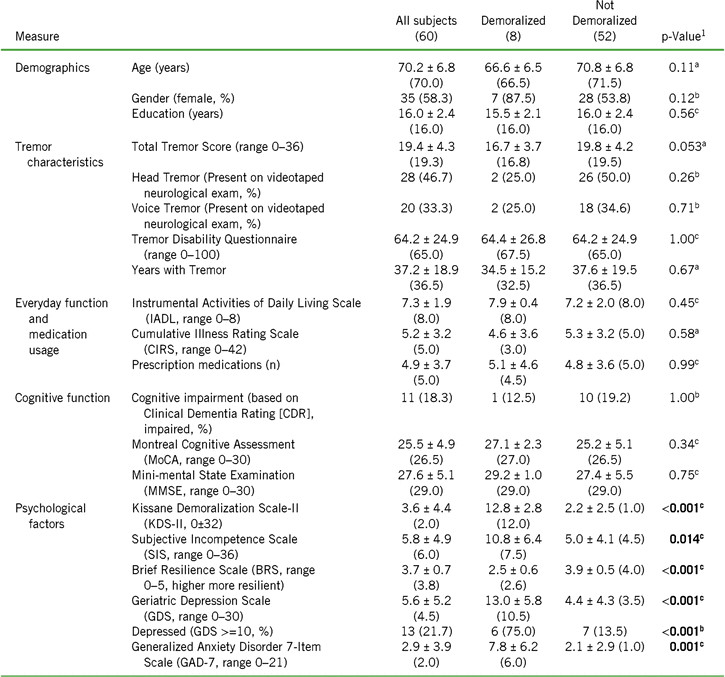
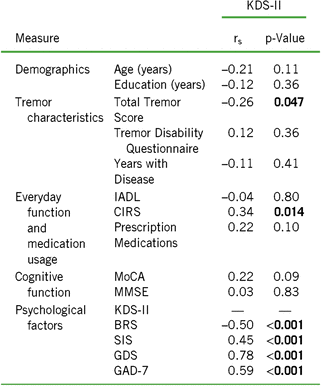
Presence of demoralization was identified according to the previously described cutoff (KDS-II > 8) of the 24-item KDS, as described below.Reference Koo, Chow and Shah30, Reference Mehnert, Vehling, Höcker, Lehmann and Koch50–Reference Koo, Chow and Shah52 Age, total tremor score, years with tremor, and CIRS were normally distributed (Kolmogorov-Smirnov test, p > 0.05); therefore, parametric tests were used for these variables. Demoralized (KDS-II > 8) and Not Demoralized (KDS-II ≤ 8) groups were compared using Fisher Exact tests (categorical variables), t-tests (normally distributed variables), and Mann-Whitney U tests (non-normally distributed variables) (Table 1). Cutoffs of CDR ≥ 0.5 and GDS ≥ 10 were used to define significant cognitive impairment and depression, respectively.Reference Benito-León, Louis, Mitchell and Bermejo-Pareja53–Reference Van Marwijk, Wallace, De Bock, Hermans, Kaptein and Mulder58 Spearman’s correlations, rs, were used to assess correlates of continuous measures (Table 2).
Sample characteristics and comparison of demoralized versus not demoralized subjects

a2-sample t-test, variances equal; bFisher Exact Test; cMann-Whitney U-Test. All values represent mean ± standard deviation (median) or number (percentage). Bolded values are statistically significant (p < 0.05). 1Comparing demoralized to not demoralized.
Correlations between demoralization and other demographic, clinical, and psychological factors

rs = Spearman’s correlation coefficient. BRS (Brief Resilience Scale), CIRS (Cumulative Illness Rating Scale), GAD-7 (Generalized Anxiety Disorder 7-Item Scale), GDS (Geriatric Depression Scale), IADL (Lawton Instrumental Activities of Daily Living Scale), KDS-II (Kissane Demoralization Scale), MoCA (Montreal Cognitive Assessment), MMSE (Mini-Mental State Examination), SIS (Subjective Incompetence Scale).
Bolded values are statistically significant.
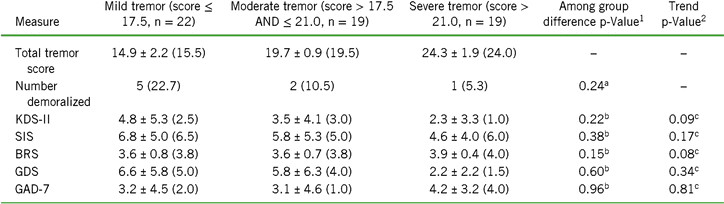
Tremor severity subgroups were created by dividing tremor scores into tertiles: “mild” (tertile 1, scores ≤ 17.5), “moderate” (tertile 2, scores > 17.5 and ≤ 21.0), or “severe” (tertile 3, scores > 21.0). Data across these 3 tremor severity groups were compared using chi-square tests, Kruskall-Wallis H-tests (assessing an overall group difference), or Jonckheere-Terpstra tests (assessing a trend across groups) (Table 3). p-Values < 0.05 were considered significant. All analyses were performed in SPSS 24.
Demoralization across strata of tremor severity

aPearson Chi-Square Test, bKruskall-Wallis H-Test, cJonckheere-Terpstra Test. All values represent mean ± standard deviation (median) or number (%).1 Assessing difference in distribution among tremor severity strata.2 Assessing trends along tremor severity strata.
Results
Prevalence of demoralization
Among 60 subjects (mean age = 70.2 ± 6.8 years, Table 1), the prevalence of demoralization was 13.3% (8 of 60), 95% confidence interval = 6.9–24.2%.
Clinical correlates of demoralization
We first compared subjects who were demoralized to those who were not (Table 1). Subjects who were demoralized differed with respect to those who were not demoralized by showing greater subjective incompetence (SIS), less resilience (BRS), and greater depression (GDS) and anxiety (GAD-7), with demoralized cases exhibiting more psychological distress, including higher SIS scores and lower BRS scores (Table 1). The 2 groups did not differ to a significant degree with respect to demographics, general health, or cognitive measures (eg, age, gender, education, IADL, CIRS score, number of prescription medications, MMSE, MoCA, or CDR) (Table 1).
We then assessed the correlation between KDS-II score and demographic, clinical, and psychological factors. Though 7 out of 8 demoralized subjects were female, there was no significant difference between males and females with respect to KDS-II score (p = 0.83, data not shown) or proportion with demoralization (p = 0.12). There was no statistically significant correlation between KDS-II score and age, education, IADL, MMSE, MoCA, or number of prescription medications (Table 2). KDS-II was robustly correlated (rs 0.45–0.78, all p values < 0.001) with psychological factors (Table 2). Of nonpsychological factors, only CIRS was moderately positively correlated with KDS-II (rs = 0.34, p = 0.014), yet even in the lowest tertile of CIRS score, 4/18 (22.2%) subjects were demoralized.
Although there was overlap between demoralization and depression (10% of the sample meeting criteria for both), 54% of subjects meeting criteria for depression did not meet criteria for demoralization, and 25% of demoralized subjects did not meet criteria for depression.
Demoralization and tremor severity
Interestingly, rather than being higher, total tremor score was marginally lower in demoralized subjects (Table 1). Also, there was an inverse correlation between KDS-II scores and total tremor score (ie, greater tremor was associated with less demoralization) (Table 2). However, tremor disability questionnaire score did not differ between demoralized and nondemoralized subjects (Table 1), and KDS-II scores did not correlate with tremor disability questionnaire scores (Table 2). Demoralized subjects were no more likely to have head tremor or voice tremor on examination than were subjects who were not demoralized (Table 1). When stratified into tertiles of “mild” (tertile 1, n = 22), “moderate” (tertile 2, n = 19), and “severe” (tertile 3, n = 19), total tremor score was marginally associated with KDS-II (ie, less demoralization with greater tremor severity) (p = 0.09, Table 3). A difference in BRS across tremor severity strata was also marginally significant (ie, greater resilience with greater tremor severity) (p = 0.08, Table 3).
Discussion
Our study is the first to investigate demoralization in ET, with the overarching goal of improving current understanding of the psychological and psychosocial constructs of the disease. Through assessing a cohort of subjects with ET, we were able to measure the prevalence and correlates of demoralization in ET. Based on a score of above 8 on the KDS-II, demoralization was found to have a prevalence of 13.3% in ET in our cohort. Demoralization was not associated with tremor severity, similar to that which is seen in studies of depression in ET,Reference Huey, Cosentino and Chapman15–Reference Musacchio, Purrer and Papagianni21 where tremor severity did not positively correlate with depression.Reference Louis, Huey, Gerbin and Viner13 Rather, as expected, demoralization was associated with related constructs including high levels of subjective incompetence and low levels of resilience. Finally, demoralization was associated with, but distinct from, depression and anxiety.
The prevalence of demoralization in healthy older adults is approximately 8.1% (controls with mean age = 69.0 years).Reference Koo, Chow and Shah30 In contrast, the prevalence of demoralization in ET, 13.3%, is similar to that observed in other chronic or terminal illnesses. In patients with cancer, demoralization had a prevalence of 13–18%,Reference Robinson, Kissane, Brooker and Burney59, Reference Vehling, Kissane and Lo60 and in those with acute coronary heart disease (CHD), a prevalence of 20%.Reference Rafanelli, Roncuzzi and Milaneschi61 The extent to which demoralization is associated with clinical features of the condition varies. Among oophorectomized BRCA1/2 mutation-carriers, in whom demoralization had a prevalence of 18%, it was not associated with any clinical correlates.Reference Arts-de Jong, DeJong, Hermens, Kissane, Massuger and Hoogerbrugge29 By contrast, demoralization in PD, which also had a prevalence of 18.1%, was associated with greater motor dysfunction.Reference Koo, Chow and Shah30
The current data suggest that demoralization, like depression, is not related to increased tremor severity in ET. Thus, demoralized subjects do not have significantly higher total tremor scores, tremor disability scores, or years with tremor, nor was there any positive correlation between demoralization and any other tremor characteristics (eg, presence of head or voice tremor). In fact, our data suggested that demoralized individuals with ET had marginally less severe tremor than their non-demoralized counterparts. Demoralization does not correlate with the stage of disease, time since diagnosis, or type of treatment in the setting of some chronic diseases, thus implying that demoralization may be more than a product of those diseases.Reference Arts-de Jong, DeJong, Hermens, Kissane, Massuger and Hoogerbrugge29 Indeed, a tendency toward demoralization could precede the disease and dictate how a patient copes with that disease.
Knowledge regarding the nature and correlates of demoralization in ET is valuable because demoralization may have prognostic implications for individuals with a medical disorder.Reference Kissane, Wein, Love, Lee, Kee and Clarke31, Reference Lee, Fang and Yang62 In particular, vulnerability to disease may be impacted by the “giving-up” complex that has been described in the context of major depressive disorders.Reference Mangelli, Fava and Grandi63–Reference Fava and Sonino69 Indeed, demoralization can be comorbid with depression,Reference de Figueiredo70, Reference Kissane, Clarke and Street71 and in the current study, these conditions overlapped to a similar degree to that observed in other chronic illnesses, with 10% of the ET sample meeting criteria for both depression and demoralization. For CHD, this was 12%, and for PD, 12.8%.Reference Koo, Chow and Shah30, Reference Rafanelli, Roncuzzi and Milaneschi61 However, because demoralization involves distinct and sometimes severe symptoms unrelated to depression, psychotherapy or other treatment that specifically addresses these concerns in ET patients is necessary.Reference Clarke and Kissane27, Reference Griffith and Gaby72, Reference Clarke, Alarcón and Frank73 It will be valuable to assess additional correlates of demoralization in ET, such as reduced quality of life,Reference Arts-de Jong, DeJong, Hermens, Kissane, Massuger and Hoogerbrugge29, Reference Robinson, Kissane, Brooker and Burney59 to further understand the characteristics of individuals who evidence demoralization in ET.
There are several factors (ie, age, medical comorbidity) that could be expected to influence the prevalence of demoralization in the current cohort. First, ET is a disease of advancing age, and our cohort had a median age of 70 years. It is therefore possible that demoralization was merely a function of aging. However, demoralized subjects were no older than their counterparts who were not demoralized (Table 1), and interestingly, KDS-II scores were marginally inversely correlated with age (ie, older age was associated with a marginal reduction in demoralization, p = 0.11, Table 2). In prior cohorts of similar age, in which KDS was administered to normal controls, the prevalence of demoralization was 8.1% (controls with mean age = 69.0 years).Reference Koo, Chow and Shah30 The enrollment in future studies of a control group would allow one to assess the prevalence of demoralization in ET relative to that of similarly-aged controls. Second, demoralization could primarily reflect medical comorbidity in our ET cases. However, when demoralized subjects were compared to their counterparts who were not demoralized, their CIRS scores and number of prescription medications were no greater (Table 1). While KDS-II score was correlated to a significant degree with CIRS score (Table 2), even in the lowest tertile of CIRS score, 4 of 18 (22.2%) subjects were demoralized. Hence, it is not likely that demoralization was merely a function of medical comorbidity in our ET cases.
This study should be interpreted within the context of several limitations. First, no age-matched controls were involved in this analysis, and inclusion of these subjects in the future would improve our understanding of the contributions of normal aging to demoralization. Second, the sample size was modest (n = 60); despite this, we were able to detect numerous significant correlates of demoralization within our sample. Third, collecting data from older ET participants could expand the understanding of demoralization beyond age 80.
Conclusion
In summary, demoralization in ET has a prevalence of 13.3%, similar to that in other chronic or terminal illnesses (eg, cancer 13–18%, Parkinson’s disease 18.1%, coronary heart disease 20%). Demoralization was not a function of increased tremor severity, and it overlapped with depression in only 10% of the sample. These results therefore suggest that demoralization in ET is a separable construct that could dictate how a patient copes with his/her disease. These data further our understanding of the non-motor features of ET, including its psychological and psychosocial constructs.
Disclosures
The authors have nothing to disclose.