In 1897, the citizens of the town of Edmonton in the Northwest Territories of the Dominion of Canada, like many of their colonial counterparts around the British imperial world, celebrated the Diamond Jubilee of Queen Victoria's reign. Given that Edmonton had been incorporated as a town only five years earlier, and that it boasted a population of only 1,638 in the year of the celebration, this may seem a peculiar place to begin a study of the role of music in establishing a sense of urban society.Footnote 1 But against this understandable scepticism we must balance what Carl Abbott has described as ‘the ubiquity of the city-building imagination and city-building impulse in shaping western North America’.Footnote 2 Those qualities allowed the ambitious residents of cities from Winnipeg to Denver and Los Angeles, but also of the likes of Bismarck, Boise, Spokane and, as will become clear, Edmonton, to imagine grand metropolitan futures for their settlements. Edmonton's Jubilee celebration, as well as other civic and musical events that marked the city's history until World War I, provide a case study of a phenomenon both widespread and highly variable according to local circumstances: the remarkably compressed development of both cities and urban musical cultures during a period of settlement and explosive growth. Above all, we will see how both the social and cultural realities of settler colonization and the urge to create distance from those realities figure in the musical history of one new colonial city.
The Diamond Jubilee: ‘the best celebration that Edmonton has ever had’Footnote 3
Edmonton's Jubilee festivities began on June 22, after their planning had been reported for more than a month in the Bulletin, Edmonton's only newspaper. A further event planned for the previous evening, a ‘vocal chorus of adult voices’ under the direction of Anglican church musician A.G. Randall, apparently never took place.Footnote 4 The first day began with a procession of bands, the North-West Mounted Police (NWMP), citizen's groups, students and floats containing figures in historical costume, representing both explorers and the Queen at various stages of her life. Because several surrounding communities were represented, the parade participants may have outnumbered the population of the town in which it took place; the Bulletin wrote proudly of ‘the big procession, with its police in full dress parade, its bands, its cars, its societies and its thousand children’. After the procession wound its way from the centre of town to the track where the afternoon's athletic events were held, ‘the children were formed in a semi-circle with the bands in the centre and the national anthem was sung’. A variety of track and field events and a baseball game occupied the afternoon, and a bonfire and fireworks brought the first day to a close. The second day was dominated by horse races, followed in the evening by a more modern form of celebration, ‘an illuminated bicycle parade, which made a very pretty display, each bicycle being decorated with three or four Chinese lanterns’. Almost as an afterthought, the article added that ‘a pow-wow by [local Cree Chief] Alexander's Indians was also another important part of the evening's programme’.Footnote 5
Although the official festivities ended that evening, the town's celebrations continued. The next week, the Bulletin reported tea dances that had taken place on the following day and a police parade and festive dinner on Friday. At this last event, Edmonton Mayor John A. McDougall congratulated all the participants, but singled out one group in particular, while engaging in the confident claims of achievement that were so characteristic of civic boosters of the era: ‘Our demonstration was, undoubtedly, the largest and most successful of any held between Winnipeg and the coast, and for its success we are largely indebted to the mounted police of G division in general, and their splendid band in particular.’ After further congratulatory speeches, ‘many good songs were sung and stories told until midnight’; a chorus of ‘He's a jolly, good fellow’ for host Mayor McDougall, three cheers, and the national anthem brought ‘to a pleasant close the last act of Edmonton's memorable celebration of Victoria's jubilee’.Footnote 6
Claims of superiority for local events were routine in an era of boosterism, but if there was substance to Mayor McDougall's claim about the scale of Edmonton's jubilee celebration, it is a testimony to the extent to which the town had built on origins around the fur-trading post that by the mid-nineteenth century had become the administrative centre of trade in the northern plains.Footnote 7 Translating that status into a role as an urban centre was by no means a certainty by 1897, especially since Edmonton had been bypassed in 1882, when the Canadian Pacific Railroad chose a southern route that established Calgary as a permanent rival. By 1897, there was still no railroad in Edmonton proper, although it had reached Strathcona, on the south side of the North Saskatchewan River across from Edmonton, in 1891. But Edmonton's ability to draw participants from the surrounding area, including the French mission town of St Albert to the north and Fort Saskatchewan to the east, suggests that it was still the acknowledged centre of the region, remote and lightly settled though that region remained.
In musical terms, that centrality is apparent primarily in the presence of not one but three bands: the NWMP band, Edmonton's own band and St Albert's. (A fourth band, from rival South Edmonton [Strathcona], had been contacted, but was available for only one of the days, at a price of 20 dollars; the organizing committee declined its services.)Footnote 8 If anything, this suggests, Edmonton was at best first among equals within its region. At a time when virtually every town had its own band, Edmonton could attract a larger aggregate but did not distinguish itself in the nature of its festivities; even the attempt to pull together a celebratory chorus seems to have come to nothing.
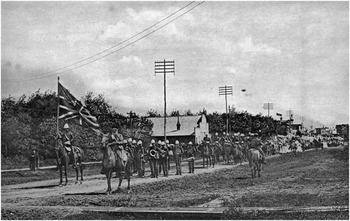
But it was not only local prestige that was at issue. It was, after all, the jubilee of an Empress that was being celebrated, so the Bulletin made clear that the parade proceeded under appropriate auspices: ‘In the van went “The flag that's braved a thousand years, the battle and the breeze”‘.Footnote 9 The souvenir booklet of the event published by photographer C.W. Mathers makes this imperial context even more explicit. Its opening composite of the three ages of the Queen is followed by ‘Britannia and Colonies’, in which children represent the empire herself and its constituent members: Australia, Canada, India, the West Indies, Africa and Newfoundland. Pictures of the parade follow: the Mounted Police and their band lead the way (see Fig. 1), and after a succession of images of students, bands, floats and local politicians and dignitaries, the societies representing the citizens follow: St Jean Baptiste, St Andrew's, and St George's – an order that recognizes the French and Scots, but reserves the final position for the English.Footnote 10
‘General View of the Procession’, Diamond Jubilee Celebration, Edmonton, 22 June 1897. Photograph by C. W. Mathers. From Souvenir of the Queen's Diamond Jubilee Celebration at Edmonton, N.W.T. June 22–23, 1897 (New York: Albertype Co., 1897).

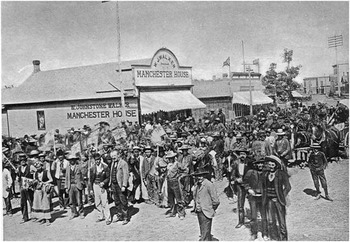
Immediately before its concluding group portrait of the event's organizers, the booklet includes a single photograph from the following day: ‘Indian Loyalty – Chief Alexander and his Band, next day’ (see Fig. 2). The contrast between this picture and those of the procession itself could hardly be greater. The parade, ordered, linear and led by flag and police, organized the citizens of the area to trace, physically and sonically, the lines of the town they were building on what was often figured as previously featureless open space. The Indian band, by contrast, shows no such order or direction; the photographic subjects simply stand, a disorganized crowd that disrupts the linear order that the procession so strongly reinforced. If there is any question that this contrast was something that Edmonton's settlers were aware of, or that music contributed to it, the Bulletin's account of the following days’ tea dances dispels it. This account, in fact, is the most musically explicit of any the paper published concerning the celebrations:
‘Indian Loyalty – Chief Alexander and his Band, next day’, Diamond Jubilee Celebration, Edmonton, 23 June 1897. Photograph by C.W. Mathers. From Souvenir of the Queen's Diamond Jubilee Celebration at Edmonton, N.W.T. June 22–23, 1897 (New York: Albertype Co., 1897).

Alexander's band of Indians from the Riviere Qui Barre Agency attracted a large crowd to the locality in which they were holding their tea dance. The wild attire of the Indians, the weird music of their tom-toms and the uncanny and incessant hi hi with which they accompany their wild eccentric dance, certainly makes a striking scene and one essentially barbarian. This morning the dance was repeated down the front street, the Indians decked in their wildest garb, with heads adorned with bear-skin caps and great bunches of twigs and grass, led by their old chief ‘Alexander.’ After treating the public to an open air concert and firing several volleys a la Salvation Army, and receiving numerous donations of the coveted tea; they returned happy to their camp.Footnote 11
This was not the first time the Bulletin had brought the dancing and music of local indigenes to the attention of Edmonton; already in the 1880s it reported similarly on dances at what was then called Bears’ Hill, south of Edmonton (now the Ermineskin Reserve), and it would note that at the Dominion Day celebrations of South Edmonton (which, like the Edmonton Jubilee celebration, also included sporting events for Indians) ‘Ermine Skin's band of Indians also assisted by their presence and tom-tom music to enliven the day and also the ensuing night’.Footnote 12 Although by the 1890s, local Cree bands had been displaced from the land now occupied by Edmonton, they were plainly still an active, visible and audible part of the larger society in which the town existed. Their musical practices could serve as a means to formalize their participation in a culture that largely sought to exclude them, but at the same time to mark them as fundamentally different and ‘essentially barbarian’.
Looking at the Jubilee in these terms begins to place Edmonton's musical life in a context that has been the exception in studies of North American musical life, in which local histories have often traced the development of ‘key elements of a mature musical life’, while larger studies have most often been framed in terms of nation building.Footnote 13 But Edmontonians were quite clear about their participation not only, and perhaps not even primarily, in the nation of Canada, but also in the worldwide entity that was the British Empire. And they were also quite conscious of participating in a colonial process in which the formation of a new community required the displacement of an existing one.Footnote 14 Like the musical processions in early Latin America discussed by Geoffrey Baker, the Jubilee parade and its accompanying festivities enacted a colonial urban ideal – to be sure, one now more commercial than religious – in a territory in which that ideal was still only partially realized.Footnote 15
The Capital of a New Land: The Provincial Inauguration of 1905
Only eight years later, in 1905, Edmonton celebrated another event: the inauguration of Alberta as a province, with Edmonton as its capital. The railroad had finally reached the city proper in 1902 (prompting a civic holiday and rail excursions accompanied by the Fire Brigade Band), and its population had increased at least fourfold.Footnote 16 Although an article in the Edmonton Journal (the Bulletin's first enduring competitor, begun in 1903) assured readers on the eve of the event that ‘Edmonton has had no boom: every increase in land prices has resulted from the growing importance of the city in the commercial world and the consequent advance in urban land values’, it was in fact in the midst of the sustained boom that developed much of western Canada and reached its pinnacle in 1913.Footnote 17 The 1914 enumeration would set Edmonton's population at 72,516, more than 40 times that of 1897. The economic downturn of 1913, followed immediately by World War I and a river valley flood in 1915, brought about a significant decline in population; not until 1929 would the city's population again exceed 70,000.
The pattern of a boom dramatically transforming a period of relatively lacklustre growth, followed by a dramatic downturn, was not unique to Edmonton. Indeed, its near-ubiquity in the history of predominantly Anglophone settler colonization during the long nineteenth century is one of the principal reasons that the musical practices of a growing but peripheral city like Edmonton are of interest. As James Belich has persuasively argued, the pattern of ‘sporadic and frenetic’ booms, despite their chaotic appearance in each local occurrence, was governed by a remarkably consistent logic: ‘a series of regional booms and busts, followed by an “export rescue” in which shattered settler economies were saved by long-range exports to their oldlands’.Footnote 18 The boom that brought Alberta into being came at the end of a century of such booms, which had shaped both the British Empire and the United States. Although they differed according to local circumstances, national and regional institutions, and the state of transportation and communication technologies at the time, they uniformly resulted not only in the opening of enormous agricultural and other resources that fed metropolises like New York and London, but also in the near-instantaneous growth of regional cities, born of the boom but determined to establish their own metropolitan status.Footnote 19 And as the case of Edmonton – which, again according to the Journal, occupied ‘a position of vantage that will assuredly make it not only a political centre, but a great railroad centre, and one of the great commercial cities of Western Canada’Footnote 20 – makes clear, music was one of the phenomena that both supported and testified to this status.
Before turning to the music associated with the inauguration, however, it is important to take note of what was not associated with it: programmes, souvenirs and newspaper accounts make no mention of performance by the area's original inhabitants. Indeed, the only mention of them that I have located occurs in the city's souvenir booklet of the occasion, again prepared by local photographer C.W. Mathers.Footnote 21 Here, after an essay promoting the city, photographs represent it, frequently by contrasting old practices or buildings with impressively modern new ones.Footnote 22 To establish this progressive theme on the largest scale, the collection of images begins with a plate of a bison (‘The Vanished Monarch’) followed by one of a First Nations family, horses and tipi in the background (‘Wanderers of the Prairie’). This combination of silencing indigenous peoples in the present and projecting them to an imagined natural past contributed to what would become a standard image of settlement: the transformation of a land inhabited only by a few nomadic tribes into a modern, progressive component of a larger civilization.
The displacement that this representation both illustrates and enacts is another common feature of the settler booms that Belich describes: native cultures with long histories of interaction were often effectively overwhelmed by the enormous influx of settlers that booms brought about.Footnote 23 The stark contrast between the audible presence of the Cree in 1897 and their silence in 1905 reveals how quickly the change could occur – within less than a decade it had become possible to substitute an imagined historical separation between a simple, lost Native past and a forward-looking settler present for the reality of decimation and segregation brought about by superior force and numbers.Footnote 24 This fiction radically simplified a long history of interaction through trade and the existence of a significant Métis community also dispossessed or absorbed by the settlers who built the new city.Footnote 25 But the myth was alluring and durable. By 1924, Provincial Librarian John Blue could capture the ‘marvelous transformation’ in a single sentence: ‘less than fifty years ago the Blackfeet and the Crees roamed the plains and camped on the sites of the principal cities of the province’. After describing the dramatic changes since that time, he concluded that Alberta's future place would depend on ‘its vast resources and the energy of its people—drawn from the great races of the world’.Footnote 26 He did not need to specify that his ‘great races’ were represented by the immigrants whose massive influx had displaced those original peoples.
The tenor of the 1905 celebration can be gathered from the citizen's meeting held to endorse the expenditure of $8,000 on the festivities. Introducing the matter, Mayor Kenneth W. MacKenzie ‘said an occasion had come when it was necessary for the town to spend some money. It was an occasion of a life-time, and one in which the city could not be small’. According to J.A. McDougall, ‘it was a chance for us to show our provincial growth and progress’. Mr. A.T. Cushing echoed him: ‘it would be a great loss to our prestige if we did not celebrate in a way to bring credit to the city’. Businessmen, aldermen, a ‘representative of the German citizens of the city’ – all spoke in favour of the expenditure; the motion to support it passed unanimously. The Bulletin summarized, ‘everyone seemed determined that Edmonton should do herself proud on the First [of September], if it did cost a few dollars’.Footnote 27
Doing herself proud meant presenting citizens and visiting dignitaries with events of a type that bespoke a degree of sophistication and culture that would set the city apart from its surroundings, enhance its chances of making its title as provisional capital permanent and establish its distinction as the ‘emporium of the vast Peace River and Mackenzie River regions.’Footnote 28 This could not be accomplished with the city's band, nor even by bringing together several local bands, as the Jubilee had done. As Trevor Herbert has noted, brass bands had effectively embodied social and industrial modernity in the Victorian era, and they continued to be an important presence in town and city musical life well into the new century.Footnote 29 Precisely their ubiquity, however, reduced their effectiveness in setting the local centre apart from the periphery. If every town had its band, that ensemble could do little to demonstrate that Edmonton in particular was a place in which, ‘while the foundations of future material greatness have been duly and truly laid, the citizens have not been unmindful of other things that are necessary to all true greatness’.Footnote 30 Accordingly, the provincial inaugural ceremony, while still including a parade and sports events, included both a greater variety of musical events and far more ambitious ones than the Jubilee had attempted.
Still, a parade was an essential element of the festivities. Musically the inaugural parade differed only minimally from that of the Jubilee. Four bands marched instead of three (including one from both distant rival Calgary and local rival Strathcona, the latter deciding not to forego this opportunity as it had in 1897), but accounts make no more mention of their music than they had of those that marched in the Jubilee parade. The structure of the parade, however, now including farmers’ and labourers’ organizations along with the nationally based citizen societies (now also including a German Society), reveals a community not only more populous but also more willing to draw attention to varied social distinctions.Footnote 31
Social distinctions arose less amicably as another of the celebration's events – the inaugural ball – was being planned. In 1897, dance had been a relatively simple affair; the Bulletin had informed its readers of the construction of a ‘mammoth dancing booth where lovers of the art terpsichorean may congregate and pass the hours away to the inspiring strains of the Red River Jig’.Footnote 32 For the 1905 event, the Bulletin's announcement was couched in the mandatory superlatives employed for coverage of the entire festivity, but even allowing for hyperbole, increased ambition is clear:
The inaugural celebration will conclude with a grand ball in Thistle rink. The rink has been elaborately decorated for the occasion. Excellent music has been arranged and the ball is expected to surpass all events of the kind yet held in the Territories.Footnote 33
After the fact, the Journal waxed even more enthusiastic:
The inaugural ball was a brilliant and enjoyable close to the inaugural festivities. In the magnificent rink auditorium, ablaze with light, a riot of color, there gathered an assemblage that would grace any similar affair ever held in the federal capital. Upwards of one thousand guests were present, and even with such a large attendance the dancing space was not crowded. An orchestra under the direction of Walter Clark furnished music that could not be excelled, and the floor was perfect.Footnote 34
During planning, however, a letter writer styling himself ‘Fair Play’ found the ball – and particularly a motion to limit its attendance to 800 – problematic, and claimed that his view was shared ‘by a very large majority of the citizens of Edmonton’: ‘Is this a time to lay emphasis on class distinctions, which are hateful at all times, or is it not a time when all the festivities of whatever nature, should be just as free to the humblest taxpayer, as to the high-toned society man?’Footnote 35 Notwithstanding such objections, however, the ball went ahead as a ticketed event, albeit with more than 800 in attendance. The need for distinction, to compete in displaying an elite as well as in every other respect, apparently outweighed Fair Play's democratic values.
An overview of the musical activities surrounding the inauguration suggests that the festivity's organizers were indeed seeking to be inclusive, but in a way that was in keeping with the image of a growing and increasingly sophisticated city that they were determined to project. In addition to the parade and the ball, events included a smoking concert for visiting non-commissioned officers and constables of the NWMP as well as members of the Imperial Medal Association, with music also provided, like that for the ball, by Clark's Orchestra, the leading local ensemble for hire (August 29); a military parade (August 30); a musical ride of some two hundred NWMP officers;Footnote 36 and a ‘patriotic meeting’ at McDougall Methodist Church, in which an oration was preceded by a programme of British and Canadian patriotic standards performed by vocal soloists and a male chorus. Rather than providing an image of a single community celebration, the musical offerings integrated throughout the event project variety and choice, albeit with a markedly military and masculine emphasis.
The musical centrepiece of the inauguration, though, went some way towards redressing that imbalance, while also demonstrating a level of sophistication that had been unattainable in 1897. The inaugural concert, which took place on the eve of the inauguration in the same Thistle Rink that hosted the next night's ball, inspired the most extensive and enthusiastic discussions of any of the event's music. The Journal's almost breathless account, in particular, makes clear that both performance and setting were calculated to demonstrate achievement:
The inaugural festivities opened … with a grand concert which was a splendid success. It started the celebration so happily, so brilliantly, so successfully that it was a bright augury of the success of the entire proceedings. The magnificent rink auditorium was aglow with hundreds of electric lights, the decorations were on a highly artistic and elaborate display with gay bunting and the fur pelts of the north, the foundation of Edmonton's commercial greatness, and above all and before all there blazed forth the word ‘Alberta.’
The hall was packed with a great audience, five thousand it is estimated being present, and hundreds looked for entrance.
His Excellency [Governor General] Earl Grey accompanied by Lieutenant Governor designate Bulyea, entered at 8:45 and shortly afterwards were followed by Sir Wilfrid Laurier and Lady Laurier, both the distinguished guests being cheered.
Of the excellence of the concert[,] how admirably it was rendered, how pleased was His Excellency with the opening of the inaugural[,] with the imposing gathering that impressed visitors from far and near[,] with the advancement and prosperity of Alberta, pages could not properly describe. It was truly an auspicious opening for the historic occasion …
From the south city came a sweet singer [Mrs R.B. O'Sullivan] who won the hearts and called forth the applause of the vast and cultured audience. The singers of Edmonton each received a warm and appreciative welcome. The work of the orchestra and chorus was beyond criticism and reflected the greatest credit on the capable conductor, Mr. Vernon Barford.Footnote 37
The musical programme, given here as it was presented to its audience,Footnote 38 consisted largely of sentimental and patriotic favourites, by composers either English or enthusiastically adopted by English performers and audiences (whether coincidentally or not, it omits the composer of the concert's only American piece, Ethelbert Nevin's popular song, ‘The Rosary’):
God Save the King.
“Alpha,” (Overture) … Warwick Williams
The Orchestra
“God Prosper Him—Our King” … Joseph Barnby
Chorus and Orchestra
a. “Beloved, it is Morn”… Florence Aylward
b. “The Rosary” …
Mrs. R. B. O'Sullivan
“There's a Land” … Frances Allitsen
Mr. Howard Stutchbury
“Song of the Vikings”… Eaton Faning
Chorus and Orchestra
“O, that we two were Maying” .Alice M. Smith
Miss Ethel Webster and Mr. Jackson Hanby
“La Couronne d'or” (Overture) … A. Herman
The Orchestra
a. “Damon” … Max Stronge
b. “Coo!” … Paul Rubens
Mrs. A. H. Bennett
“The Soldiers’ Chorus” (Faust) … Gounod
Male Chorus and Orchestra
“Chanson Provencale” … E. Del'Acqua
Miss Ethel Webster
“Good Bye” … Paolo Tosti
Mrs. R. B. O'Sullivan
“Bridal Chorus” (From The Rose Maiden) … F. H. Cowen
Chorus and Orchestra
The concert's mixture of light classical selections and popular songs aligns it more closely with the previous century's promenade concerts than with the classical tradition.Footnote 39 More remarkable, though, is the way in which this mix of sentimental with patriotic and popular with serious gives rise to a gender dynamic that served the programmatic purpose of the concert as a celebration of the new province and its settlers.
The concert's opening – ‘God Save the King’ and, after the overture, a patriotic chorus – set an unsurprisingly nationalistic tone. The following two songs, however, shift to religiously tinged sentimentality (the chorus of ‘Beloved it is Morn’ reads: ‘Pray, Sweet, for me/ That I may be/ Faithful to God, and thee’, while ‘The Rosary’ begins with a parallel between hours with the beloved and the beads of the rosary.)Footnote 40 The following two numbers shift back to the masculine realms of English freedom and empire and seafaring warriors. The next three songs (interrupted by the second overture) return, respectively, to love, pastoral reverie and domestic bliss, before an emphatic return to the martial with Gounod's soldiers’ chorus. Sentiment returns in the French and English songs that follow, but the concert ended not with a return to the martial, but with the popular wedding chorus from Cowen's The Rose Maiden, a cantata first premiered in London in 1870:
‘Tis thy wedding morning
Shining in the skies,
Bridal bells are ringing,
Bridal songs arise,
Opening the portals
Of thy Paradise.
‘Tis the last fair morning
For thy maiden eyes—
‘Tis thy marriage morning—
Rise, sweet maid, arise.
This seeming incongruity was no accident of available music, for the image of the new province, and especially its capital city, as a bride waiting to be claimed recurs in the essay accompanying the inaugural souvenir booklet:
The city chosen as the provisional capital of this virgin province is beautiful for situation and is such as to command attention and elicit interest. Her beginning no man knows and no record shows, but for fully a century she kept her lonely vigil in the north before her worth was recognized, and suitors began to claim her hand and sought to share her heritage.Footnote 41
Concluding the concert's alternation of martial and domestic with a wedding chorus, then, reinforced the naturalization of the colonial process. Not only were male and female settlers respectively linked to masculine and feminine roles and virtues, but the appropriation of land comes to figure not as dispossession nor even as the result of a long process of trade, settlement and treaty negotiation, but as the most natural and hopeful of events, a monogamous marriage that is the happy ending of courtship on a grand scale.Footnote 42
Women and an Urban Culture of ‘Good’ Music
Although the programme gave voice to masculine and feminine roles and values, this by no means implied equal participation of men and women: only three women appear among the concert's 19-member orchestra, and even in the choir men outnumbered women by a ratio of 29 to 12 (presumably due to the need for a strong male presence for the chorus from Faust). But as soloists, women were essential for the songs of love and family – seven songs featured female soloists, while men appeared in only two. More surprising, perhaps, is the presence of female composers: Florence Aylward, Frances Allitsen, Alice M. Smith and Eva Del'Acqua all appear on the programme, so that fully of third of its identified composers were women. Their presence was unnoticed by the press, though; if a programme was to devote such attention to feminine values, it was apparently unremarkable that a significant proportion of the songs giving voice to those values were both written and performed by women.
Within the next few years, however, women became increasingly visible in Edmonton in relation to what its supporters unproblematically characterized as ‘good’ music, just as they had in many parts of North America.Footnote 43 After the 1905 inaugural celebration, the next highly visible large ensembles in Edmonton were those of the provincial music festivals, begun in 1908. Not only do the (much larger) choruses for these events show a more standard gender balance, but women also increased their presence in the events’ orchestras: in 1908, men outnumber women by 37 to 4, but by the following year, the ratio moderates to 34 to 10, and is not drastically different in 1910, standing at 38 to 8.Footnote 44 This increased presence, however, was by no means evenly distributed. Wind instruments continued to be monopolized by men, as they were in most brass bands, and the larger strings remained inappropriate, so women were effectively limited to the violin section (and the piano). As a result, in both 1909 and 1910, almost half of the violins (respectively 10 of 22 and 8 of 20) were women.
Again, none of this received the attention of the press. Both the Journal and the Bulletin not only reported on the festivals but also praised it in editorials, but their attention focused on cultural achievement. According to the Journal, ‘Alberta is only in its infancy, but when it can gather a chorus of some 200 voices who are competent to render such an excellent programme … then the people have reason to feel proud of their province’.Footnote 45 The Bulletin's boosterism was more blatant:
The pioneers of a new country are necessarily concerned first in the development of its resources, and the creations of the material conditions of life. … But those who think the people of this country are concerned with nothing but the business of making money are badly mistaken. Amid the rush and whirl of rapid material development there is still found time for attention to those means of culture without which no degree of commercial success could redeem the people of a country from poverty of spirit.
As an instance of this, the first Provincial musical festival ever held in Canada is being conducted this week in the City of Edmonton. … It is intended that the event shall be made annual, thus establishing a permanent incentive to Provincial musicians, and a permanent means for the development of a taste for good music.Footnote 46
‘Culture’ and ‘good music’ thus helped certify the civilized status of a still peripheral city, and in the following years, cultural institutions proliferated. The Ladies’ Musical Club of Edmonton was founded in October 1908, holding recitals by members and eventually sponsoring lectures and visiting artists;Footnote 47 the Edmonton Orchestral Society, ‘organized by a number of the professional musicians for the purpose of holding regular Sunday concerts’ with the goal of ‘advancement of musical culture in Edmonton’, was announced in June 1912 and performed for several years;Footnote 48 Vernon Barford had already founded an Operatic Society in 1903, and was announced in 1918 as leader of a short-lived Mendelssohn Choir;Footnote 49 and the supporters of the Edmonton Symphony Orchestra, founded in 1920 after the wartime demise of the Orchestral Society, again made explicit the link between urban achievement and music: ‘no city of any size or musical standing is quite complete without a symphony orchestra; it has been felt therefore that Edmonton should not remain behind other cities in this matter’.Footnote 50
The Other Side of Urban: Popular Music in the City
The image of the growing cultural and commercial metropolis cultivated by such coverage is of course partial; it largely overlooks the musical life of the city's, and especially the still largely rural province's, non-Anglophone settlers, in addition, of course, to silencing its indigenous population. But even the mainstream city media could not overlook another aspect of urban musical life, which also contributed to the image of Edmonton as ‘the Permanent Metropolis of Central and Northern Alberta, North Central Saskatchewan and Central Eastern British Columbia’Footnote 51 : the presence of popular music, which, as Derek Scott has made clear, is not only an essentially urban phenomenon, but one associated with the great metropolises, world centres like Paris, Vienna, London and New York.Footnote 52
In a remote but ambitious city like Edmonton, these associations gave popular music a significant if rarely explicitly recognized role. First, the very presence of professional musicians beyond church organists, choir masters and music teachers was largely the result of demand for dance orchestras, vaudeville musicians, and eventually silent film theatre orchestras. To be sure, the railroad brought touring popular performers and troupes as it did classical artists (and the line between the two is not always clear), but resident musicians paid to entertain provided the backbone of professionals for the Orchestral Society and Edmonton Symphony.
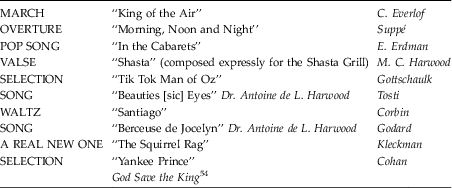
Equally important, though, was what popular music could contribute to the image of the city in its own right. Unlike ‘good’ music, it rarely received the editorial support of the newspapers or figured centrally in civic events, but its increasing presence in the entertainment pages, as each new film or vaudeville show was promoted and each dinner or dance with orchestra announced, makes clear that its social and economic significance was very real. And occasionally, this role could indeed receive acknowledgment. One such occasion was the opening of the Shasta Grill, a restaurant in the basement of the Pantages vaudeville theatre. In November 1913, the celebratory banquet marking that event was attended by the Mayor and, the Journal revealed, ‘other people of prominence’.Footnote 53 As this observation suggests, the Journal's coverage focused on the presence of leaders of local society, but it did note that ‘the music for the occasion was excellent. Under the leadership of Weaver-Winston, the orchestra for the grill rendered several delightful selections’. Albert Weaver-Winston, leader of the Pantages and the Shasta Grill orchestras, was also the leader of the Orchestral Society in 1913 and would conduct the Edmonton Symphony on its founding in 1920. For this occasion, though, the souvenir menu (here given with the categories identified in the original programme) reveals that although Weaver Winston drew on light classical standards that also figured in the repertoire of the serious orchestras, he also drew on other musical styles (see Table 1).
Musical Programme for the Opening of the Shasta Grill, Edmonton, 26 November 1913

Franz von Suppé's overture and the two selections by nineteenth-century French composers Albert Corbin and Benjamin Godard are typical of the light repertoire featured in many of Edmonton's orchestral concerts, and a march (possibly performed with its accompanying two-step), a popular song by Tosti (who had found enormous success in England), and a specially composed waltz represent equally familiar elements of such mixed programmes.Footnote 55 What sets this commercially motivated event apart, though, is the prominence of recent American popular music, including vaudeville composer Ernie Erdman's ‘pop song’; a selection by Louis F. Gottshalk from L. Frank Baum's Tik Tok Man of Oz, which had premiered in Los Angeles in March 1913;Footnote 56 a rag plainly conceived as a novelty; and George M. Cohan's ‘Yankee Prince,’ whose immediate juxtaposition with ‘God Save the King’ is striking. The song texts also printed in the menu, likely for a sing along following the formal programme, are even more dominated by American songs, including two (‘Down in Dear Old New Orleans’ and ‘Floating Down the River’) whose evocations of idyllic images of ‘darkies’, cotton and strumming banjos in the American South serve as reminders that the heritage of minstrel songs was a part of the urban popular song culture that this programme plainly emulates.Footnote 57
While it might be tempting to figure such popular music as less ‘artificial’ than the European art music performances that I have discussed above, the will to emulate metropolitan models is equally clear in this realm of enterprise and entertainment. The recent American selections on the concert, many premiered or published in 1913, attest to the importance of being up to date; indeed, ‘In the Cabarets’ suggests the allure of an urban musical locale that scarcely existed in the booming provincial capital. The promoters of the Shasta Grill were quite aware of the attractiveness of this urban image: when they advertised a New Year's Eve celebration just a few weeks later, it offered ‘A Little Bit of New York and London Transplanted/A REAL NEW YEAR'S EVE/ To Be Celebrated in Metropolitan Style’.Footnote 58 The cities singled out here are also worth noting: they give direct expression to a basic fact of Edmonton's existence, growing on the periphery of not one but two empires. Both the imperial metropolis and the economic one clearly exercised an attraction, but their presence also serves as a reminder of an open debate within Canada at the time over whether its future economic, national and racial security would lie with Britain or the United States.Footnote 59
But there remained tensions between popular music practices and efforts to establish classical performing organizations. So, for instance, less than a month before it approvingly reported the music performed for the opening of the Shasta Grill, the Journal had had this to say about the Orchestral Society programmes:
Nothing but the very highest class of vocal and instrumental numbers are rendered, and the aim of the Orchestral society is to get away from the trashy rag-time. This has merited a certain amount of success in the fact that a better class of music is being played now than two years ago, and the majority of Edmontonians, and particularly those who attend these concerts, derive more pleasure by listening to this better class of music.Footnote 60
The discourse of ‘good’ music indeed depended on the presence of another music to threaten propriety – even when, as in this case, the same leader directed both performances. More than that, though, this discourse aligned easily with racial and cultural fears. Although western Canada had a far smaller population of African origin than did many parts of the United States, the increasing association of American popular musics – ragtime and before long, jazz – with racial Others gave its threat particular strength. In a city in which amateur minstrel shows remained popular well into the 1920s, and in which fear that non-Western European immigrants (including both Chinese labourers and eastern European settlers [especially, in Alberta, from the Ukraine]) might overwhelm Blue's ‘great races of the world’, metropolitan popular culture evoked both desire and fear.Footnote 61
From a more general perspective, though, both developing classical institutions and thriving commercial music establishments were vital to the musical image of a real city with ambitions to develop into a centre in its own right. And the tension between those musics was a significant enough element of urban life that it arose even when, as in Edmonton, the same musicians were necessarily involved in efforts of both types. As a cultural corollary of the economic booms that developed city after city, the booming musical institutions of all types, and the discourse around and between them, contributed to activities that could be represented as a genuinely urban soundscape. That soundscape – part audible, but part imagined by association – contributed to the image of a progressive, forward-looking metropolitan present in a settlement where the musical order of the day in the very recent past had been brass bands and reels. More than that, it had replaced another soundscape – that of the physical and musical presence of the indigenous peoples who had been displaced by the new city but who, not long before, had been an integral part not only of daily life but also of defining civic events. One of the tasks of a history of music in settler colonization is to recover the memory of that soundscape and of the processes by which it was obscured.