Euthanasia has been debated for millennia in the Western world; however, it was not until the early 20th century that a political movement to secure access to euthanasia and assisted suicide began the United States (Lewy, Reference Lewy2011). The organizations associated with this effort have been numerous and have undergone a bewildering array of mergers, splits, and name changes, but the goals of the successor organizations remain largely the same. A few chronologies are available, but they are not comprehensive, lack consistency, are not rigorously validated, and are not accessible in the medical literature. We offer a comprehensive and definitive history to aid those interested in knowing the roots of these organizations. As debates about these practices continue, understanding this history can be helpful.
The Euthanasia Society of America and its progeny
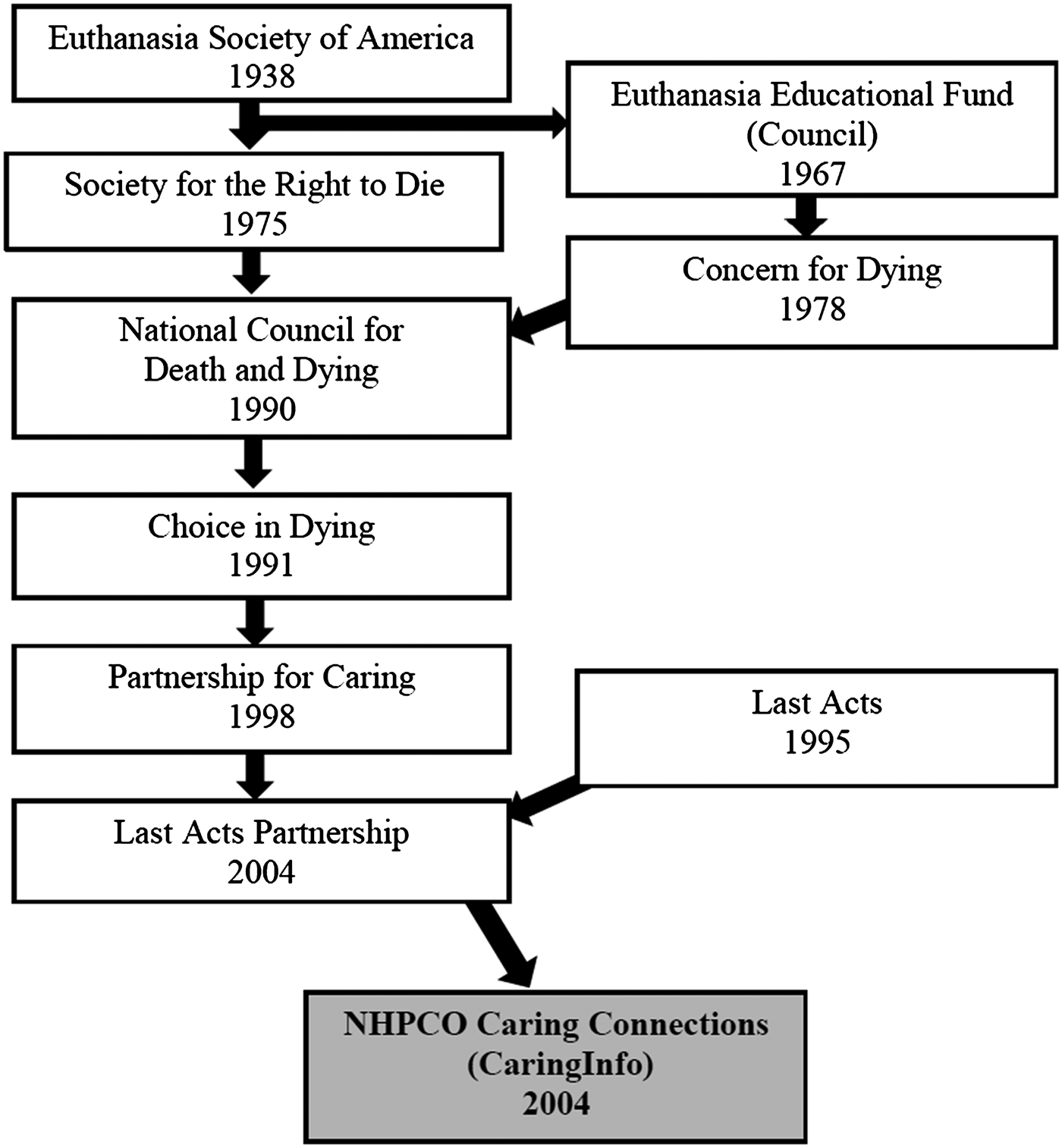
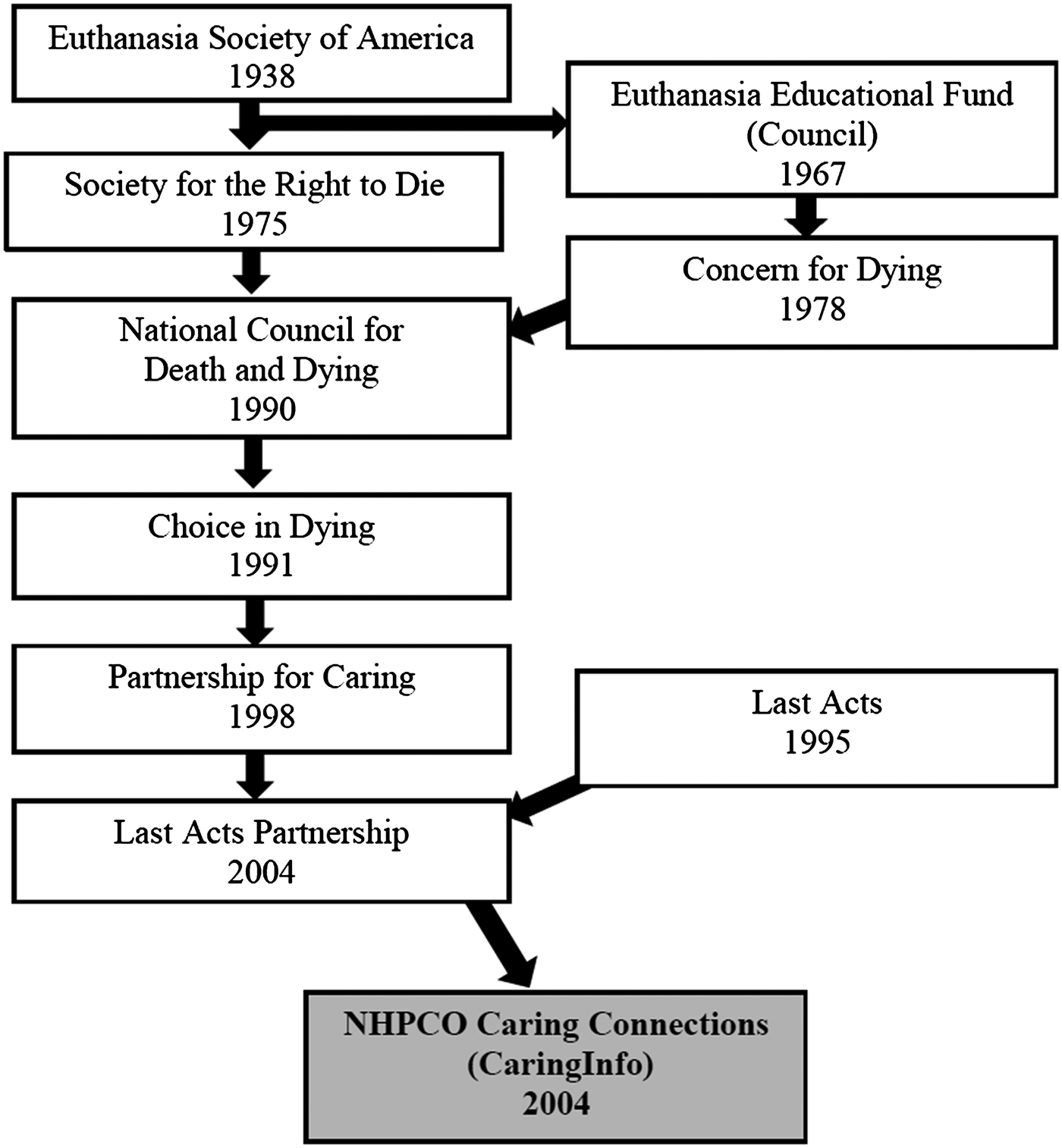
As early as 1906, bills to legalize euthanasia were introduced in Ohio and Iowa, but failed without a movement behind them (Lavi, Reference Lavi2005). In the 1920s, social welfare reformers increasingly invoked the ideas of human choice and control to support their causes. Eugenicists and birth control advocates promoted control over reproductive matters and birth. Euthanasia proponents adopted the same approach touting control in death (Dowbiggin, Reference Dowbiggin2002). In 1938 (Figure 1), the National Society for the Legalization of Euthanasia was founded, becoming the first organization of its kind in America, and was renamed the Euthanasia Society of America (ESA) in the same year (Dowbiggin, Reference Dowbiggin2003, p. 53; Sanction is sought for ‘mercy deaths,’ 1938).
Euthanasia Society of America and its successor organizations
ESA's leader, Charles Potter, was an ex-Unitarian minister who rejected the traditions of religion built into American life that imposed limitations on human liberty (Potter, Reference Potter1930). Although he soon left his role as president in late 1938, the ESA's leading members continued to advance Potter's aims to legalize euthanasia, advocating mercy killing to relieve suffering, first for competent, terminally ill patients, but soon thereafter also for the incompetent as a eugenic method for eradicating genetic disorders (Dowbiggin, Reference Dowbiggin2003, pp. 53–58). Efforts were directed to design model euthanasia bills to be introduced at the state level, drawing from the work of Inez Philbrick, who pushed for legalization in Nebraska in 1937 (Gorsuch, Reference Gorsuch2006). Although the formation of the organization itself was revolutionary, advocates were soon halted in their progress, hindered by the association of euthanasia with National Socialism during and after World War II. Euthanasia had become a primary tool of eugenics, and both had become associated with racism and prejudice against the disabled. “Euthanasia” could no longer mean “good death,” having been tainted with the now negative term “eugenics” and associated with genocide (Grodin et al., Reference Grodin, Kelly and Miller2018). Because of this association, the US movement stalled between 1940 and 1960.
It was only after Potter's death in 1962 that the ESA began to change its strategic course. The society's resident theologian, Joseph Fletcher, began to reshape the society's emphasis from the eugenically oriented goals of euthanasia to focus again on patient suffering (Dowbiggin, Reference Dowbiggin2003, pp. 97–106). As a prominent figure in the emerging field of bioethics and strong proponent of euthanasia, Fletcher had written extensively on what he called “the personal dimensions of morality in medical care,” giving attention to patient autonomy and rights in dictating care (Fletcher, Reference Fletcher1954). Taking this new direction, the ESA began to advocate more generally for “choice” and a “right to die,” as one saw fit. Under this broader rubric, the ESA began to de-emphasize its stance on active euthanasia in its public pronouncements. Although not relinquishing its commitment to euthanasia, the ESA strategically positioned itself as a public champion of the relief of suffering through stopping any unnecessary prolongation of the dying process (Dowbiggin, Reference Dowbiggin2003, pp. 106–110).
In an effort to educate the public on their rights as patients, and to aid the ESA's dwindling finances, former ESA president Pauline Taylor formed a separate, tax-exempt fund in 1967, the Euthanasia Educational Fund, which was renamed the Euthanasia Educational Council (EEC) in 1972 (Concern for Dying, 1967; Dowbiggin, Reference Dowbiggin2003, p. 107). Teaming with attorney Luis Kutner, the creator of the first living will, the EEC worked to distribute information about options for dying (Kutner, Reference Kutner1979). Living wills were widely circulated, intended for use by patients to delineate their wishes for care in the end of life.
Throughout the next few years, the EEC brought both success and controversy to the movement. A new wave of public support for choice in dying emerged with the popularization of living wills, but the ESA and EEC battled through disagreement, both financially and philosophically. The ESA rebranded itself to reflect its new direction as an advocate for the foregoing of life sustaining treatments, becoming the Society for the Right to Die (SRD) in 1975 (Encyclopedia of Associations, 1978). With the history of euthanasia no longer burdening their title, they were able to more effectively advocate for patient refusal of life-prolonging treatments and living wills. Despite the name change, the SRD never lost sight of the organization's pro-euthanasia agenda. As conversations surrounding the right to die livened, Fletcher saw an opportunity to push again for more active measures in assisting death, deciding that the time of “soft-pedalling” the debate had come to an end (Dowbiggin, Reference Dowbiggin2003, p. 139). Although avoiding a public campaign, Fletcher and the SRD leadership began to lobby politicians and the courts for legislative progress in enacting euthanasia and physician-assisted suicide (PAS) laws.
This produced problems for their relationship with the EEC, then under the leadership of Donald McKinney. The EEC had also rebranded, assuming the new name, Concern for Dying (CFD) in 1978 (Concern for Dying, 1978). The primary goals of CFD involved educating the public on the promotion of patient rights and advance directives. McKinney was hesitant to return to the ESA's origins, no longer convinced that “death control” should be exercised through asking physicians to induce death, but that legislative efforts should instead remain focused on living wills (Dowbiggin, Reference Dowbiggin2003, pp. 137–138). This philosophical divide led the CFD to withdraw its financial assistance to the SRD, officially drawing a line between the organizations. With support divided, leadership of SRD began to lose momentum as membership questioned whether the country was ready for euthanasia and PAS.
In 1990, following several years of conflict over direction, the SRD and CFD settled their differences and rejoined forces, forming the National Council on Death and Dying under the leadership of Fenella Rouse (Malcolm, Reference Malcolm1990). Under this merger, the reconciled organization saw success as a patient rights advocacy group, officially sublimating its originating impulses toward euthanasia to work on more general end-of-life issues and promoting advance directives, hospice, and palliative care. The following year in 1991, this group rebranded itself as Choice in Dying to signal its goals (Dowbiggin, Reference Dowbiggin2003, p. 162). This direction was persistent through the decade. In 1998, under the direction of palliative care physician and advocate Ira Byock and president of Choice in Dying, Karen Kaplan, Choice in Dying evolved into Partnership for Caring (CaringInfo, ND; Kaplan & Byock, Reference Kaplan and Byock1998). Then, in early 2004, this partnership officially joined with the Robert Wood Johnson–sponsored program, Last Acts, to form the Last Acts Partnership. The goal of this merger was to focus on improvement of quality of life for the dying, managing pain and suffering, and assisting in complex decision-making. This partnership did not last, however, and the organizations dissipated later the same year, with their resources being subsumed under the National Hospice and Palliative Care Organization group Caring Connections, now called CaringInfo (CaringInfo, ND).
The Hemlock Society and its progeny
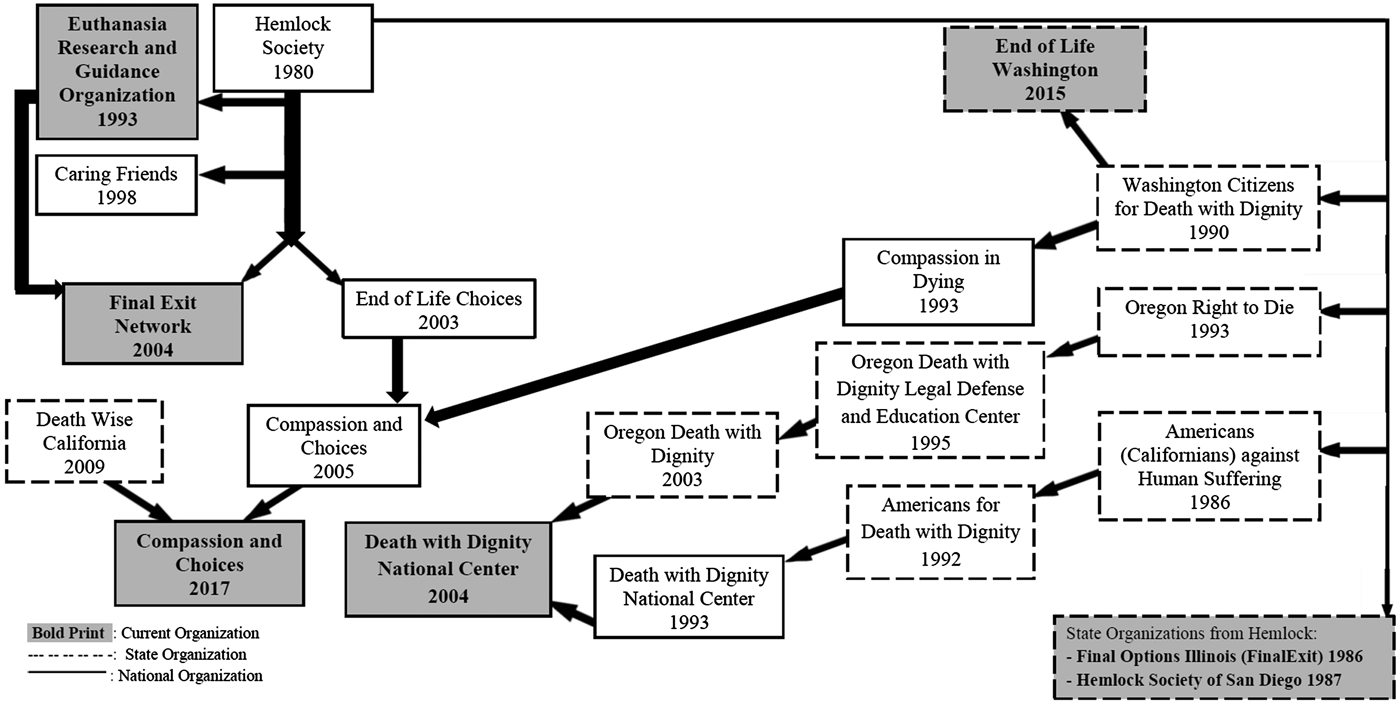
Unsatisfied that the ESA's successor organizations had shifted their focus toward advance directives and education, drifting away from the promotion of euthanasia and assisted suicide, a new organization emerged in 1980 (Figure 2). The Hemlock Society, led by former British journalist Derek Humphry, was established with the goal of redirecting the right to die movement back to its roots (Cox, Reference Cox1993). Although the ESA had softened its position on euthanasia to gain public appeal, the Hemlock Society advanced with a fixed stance in favor of PAS and active euthanasia. Humphry, who had assisted his first wife in ending her life in 1975 after a battle with cancer, was determined to legalize one or another form of medically induced and supervised dying so that others could be offered resources in choosing when to die. However, because of its government status as an educational organization, the Hemlock Society was unable to effectively pursue legislative efforts, and instead looked to assist the public directly (Kamakahi et al., Reference Kamakahi, Fox and Čapek1999).
The Hemlock Society and its successor organization

In 1981, Humphry, with the help of the Hemlock Society, released and widely distributed his book, Let me die before I wake, a manual for how to access a “good death” in America through “taking control” of one's end (Humphry, Reference Humphry1983). Following this release, the Hemlock Society began to attract new members. In 1993, responding to increasing support, the Euthanasia Research and Guidance Organization (ERGO) was formed to make educational progress through developing and publishing guidelines aimed to assist physicians and patients in discussing life-ending decisions (Final Exit Network, 2013). With increased membership, the Hemlock Society established groups of “helpers” who could be called upon to assist those they deemed qualified to commit suicide, even though doing so was still illegal. In 1998, the national program Caring Friends was formed to formalize the work of these “helpers,” advertised as a program of volunteers enlisted to help individuals hasten their deaths through “more humane methods” (Humphry, Reference Humphry2004, pp. 112–115).
As the Hemlock Society grew, other right-to-die organizations sprang up and the focus of the movement shifted to legalizing PAS at the state level. In 1986, two Los Angeles lawyers, Robert Risley and Michael White, initiated efforts toward legalization in California (“Californians push right to die issue,” 1987). Risley, who witnessed his wife die after suffering through cancer, responded similarly to Humphry. With support from the Hemlock Society, Risley and White established Americans Against Human Suffering (AAHS) with goals of collecting signatures in support of legalizing PAS in California (Hillyard & Dombrink, Reference Hillyard and Dombrink2001). In 1992, AAHS became Americans for Death with Dignity and introduced Proposition 161, California's first legalization attempt through referendum, which failed at the ballot box (Death With Dignity, NDa; Hastings College of the Law, 1992). The following year, the Death with Dignity National Center (DDNC) was established to compile research and create model legislation as a successor to California's project (Death With Dignity, NDb).
During this time, as interest spread along the West Coast, Ralph Mero, a member of the National Hemlock Society, together with technical resources provided by the Society, founded Washington Citizens for Death With Dignity in 1990 (Cook, Reference Cook2017). Soon after its founding, in 1993, Mero rebranded the organization to Compassion in Dying (Belkin, Reference Belkin1993). In the same year, another group of Oregon citizens formed Oregon Right to Die, focusing on legislative efforts with leadership from lawyer Eli Stutsman, physician Peter Goodwin, and lawyer, physician assistant, and nurse Barbara Coombs Lee (Death With Dignity, NDc; Humphry, Reference Humphry2004, p. 104). Stutsman then established the Oregon Death with Dignity and Legal Defense Education Center in 1995 (Death With Dignity, NDd). In 1996, Coombs Lee left Oregon Right to Die to become president of Compassion in Dying as it expanded into a national organization (Rockey, Reference Rockey1998). Both organizations continued their political efforts to legalize PAS in Oregon with additional aid from the DDNC. In 1997, Oregon became the first state to officially legalize PAS through a referendum called the Death with Dignity Act (Oregon Health Authority, 2014). In 2003, the Death with Dignity and Legal Defense Education Center was renamed Oregon Death with Dignity, and in 2004, merged with the California DDNC to expand the Death with Dignity National Center (Death With Dignity, NDe). This center was successful in initiating and promoting the new terminology of “physician assisted death” or “medical aid in dying.”
Although the turn of the century had brought about legalization of PAS in one US state, the movement was losing ground elsewhere. Referenda and legislative initiatives had failed in several other states. The infamous proponent of assisted suicide, Dr. Jack Kevorkian, had been convicted of homicide and imprisoned (Johnson, Reference Johnson1999). The Supreme Court had declared that there was no legal right to PAS (Vacco v Quill, 1997; Washington v Glucksberg, 1997). These occurrences signaled to the Hemlock Society a need for change. Having garnered negative attention in this new political era, in 2003, the Hemlock Society was renamed End-of-Life Choices, stirring conflict amongst its leadership (Humphry, Reference Humphry2004, p. 147).
End-of-Life Choices, like the ESA, began to open its door more generally to issues in care at the end-of-life, causing conflict regarding its goals as the successor organization to the Hemlock Society. Humphry, again unsatisfied with the “selling out” of pro-euthanasia organizations, formed the Final Exit Network in 2004 to refocus the movement toward assisting persons in ending their lives (Majchrowicz, Reference Majchrowicz2016). With some support from the network of volunteers previously gained through Caring Friends, Final Exit began training additional personnel for assisting those who wished to commit suicide, while continuing its research and educational efforts through ERGO (Colt, Reference Colt2006; Final Exit Network, ND).
Meanwhile, End-of-Life Choices began to see how it could achieve more political success by advancing both a pro-palliative care and a pro-PAS agenda, and merged with Washington's Compassion in Dying to form Compassion and Choices (C&C) in 2005 (Compassion & Choices, 2016a). This organization grew to be the largest, most disciplined, most focused, and best-funded organization advocating for the legalization of PAS in the country. C&C has focused on local state-based networks and advocacy initiatives, and, in 2017, subsumed a California nonprofit and end-of-life care planning organization called DeathWise, continuing to expand its influence (Compassion & Choices, 2017).
Far and away, C&C has been the most successful of all these organizations, having achieved a national presence while focusing on the development of affiliated advocacy networks at the state level, lobbying for state-based legislative initiatives, and lobbying medical organizations to drop their opposition to PAS (Compassion & Choices, 2016b). It has attracted significant financial support, including major donations from billionaire George Soros (Galewitz, Reference Galewitz2015). They adopted Brittany Maynard, a young woman with terminal brain cancer who opted for PAS in 2014, as the “poster child” of their cause, financing, producing, and marketing a highly professional series of videos including interviews with her and her husband, replete with emotional musical soundtracks, which were readily taken up by a sympathetic national media (Maynard, Reference MaynardND).
Today, the national organizations, C&C, Final Exit Network, and the DDNC, continue the work of the initial Hemlock Society through legislative efforts, direct assistance in suicide, and research and education, respectively. These national organizations are accompanied by several independent state organizations, including Final Options of Illinois and the Hemlock Society of San Diego, which both formed to share in carrying on the legacy of the Hemlock Society (Final Options Illinois, ND; Hemlock Society of San Diego, ND). The efforts of these organizations have been far more successful than those of the advocates who first introduced euthanasia initiatives in Ohio and Iowa more than a century ago.
Conclusion
US organizations advocating for the legalization of euthanasia and assisted suicide have a history dating back to the early 20th century. Although undergoing an astonishing number of splits, mergers, name changes, shifting goals, and tactical adjustments, their fundamental mission has persisted. It is instructive and useful to understand the history of these organizations and their contributions to the current state of discourse and debate regarding PAS.