


Introduction
Public participation in constitution-making processes has become an international norm being practiced in varying degrees around the world (Maboudi and Nadi Reference Maboudi and Nadi2016). Despite the normative or “epistemic superiority” of participatory processes (Landemore Reference Landemore2017b), there is still a debate about the democratic outcomes of such processes and whether the inclusion of different societal interests at the negotiating table generates more stability and democracy than individual-level citizen participation (Saati Reference Saati2020; Negretto and Sánchez-Talanquer Reference Negretto and Sánchez-Talanquer2021). In this study, we examine the impact of participatory and inclusive constitution-making processes on the durability of constitutions. Viewing constitutions as social contracts, a participatory process should yield a longer-lasting document, as the people have a higher stake in protecting their self-written constitution. However, our research shows that inclusive constitution-making processes, where every group is represented at the negotiating table, are more likely to lead to constitutional durability than participatory processes.
Previous studies have suggested that three main factors are essential for the durability of constitutions: time, environment, and design (see, for example, Hardin Reference Hardin1989; Przeworski Reference Przeworski1991; Ordeshook Reference Ordeshook1992; Colomer Reference Colomer2001; Negretto Reference Negretto2008; Elkins, Ginsburg, and Melton Reference Elkins, Ginsburg and Melton2009). Some studies suggest that constitutions become more stable as they age (Hardin Reference Hardin1989), but time itself has been criticized for its inefficiency in explaining the replacement of old constitutions, such as the replacement of Sweden’s Constitution of 1809 after enduring for 165 years (Negretto Reference Negretto2008). The environment surrounding constitutions, such as economic crises, revolutions, and coups (Elster Reference Elster1995), as well as the design of the constitution itself, such as its flexibility for amendments (Elkins, Ginsburg, and Melton Reference Elkins, Ginsburg and Melton2009), are believed to be better explanations for constitutional durability (Negretto Reference Negretto2008). In this paper, we suggest a fourth element that can contribute to the durability of constitutions, arguing that the process of constitution-making itself has important implications for the durability of constitutions. Two distinctive elements of constitution-making processes, which are subjects of this study, are the extent to which the process is inclusive by including all the major political groups and the extent to which it is participatory by allowing all citizens to contribute to the drafting of constitutions.
Building on Eisenstadt and Maboudi’s (Reference Eisenstadt and Maboudi2019) measure of constitution-making processes, this study uses two measures for participation and inclusion for 209 constitutions adopted in 118 countries from 1974 to 2023. In the data set used in this study, the median age of constitutions with nonparticipatory processes is ten, meaning that 50 percent of constitutions drafted via nonparticipatory means survived less than ten years. By contrast, participatory constitutions have a median age of fourteen years. Inclusion also has a similar correlation with durability. While the median age of constitutions with noninclusive processes is ten years, the median age of inclusive constitutions is sixteen years. However, the estimate of a Cox proportional hazard survival model shows that only inclusive processes yield statistically more durable constitutions, while the participation variable has no correlation with the durability of constitutions. The results show that the risk of constitutional replacement is 54 percent lower if the constitution was drafted via an inclusive process than if the process was noninclusive. The results confirm only our inclusion hypothesis, showing that an inclusive constitution-making process is a significant contributor to constitutional durability. This is very important because the process precedes the design (content) of the constitution. An inclusive process can generate consensus among various stakeholders over the rules of the game and garner support for more stable political institutions and a more durable constitution.
This paper proceeds as follows. After briefly conceptualizing constitutions, we discuss theories of constitutional durability, including contractual and self-enforcing theories. Contractual theories suggest that constitutions are contracts, and their durability depends on the enforcement of the terms of those contracts by a third-party player (such as the Supreme Court acting as constitutional arbiter). Self-enforcement theories, however, posit that constitutions are devices through which citizens coordinate action and that a durable constitution should be self-enforcing. Following these theories, several exogenous and endogenous factors have been introduced as important for constitutional stability. After a review of these factors, we discuss the two measures of constitution-making processes (inclusion and participation) and the theoretical importance of these factors for the durability of constitutions, and raise our two hypotheses. The inclusion hypothesis states that “constitutions drafted via broad inclusive processes are more likely to endure than noninclusive constitutions,” and the participation hypothesis states that “constitutions drafted via broad participatory processes are more likely to endure than nonparticipatory constitutions.” These hypotheses are tested using a cross-national statistical analysis of all constitutions promulgated between 1974 and 2023. Finally, we discuss the results and their importance for understanding constitutional processes and optimal outcomes.
Toward a Theory of Constitutional Stability
A central question in democratic theory concerns the mechanisms by which the rules and institutions (especially those identified in the constitution) that constrain a government are maintained and enforced (Ordeshook Reference Ordeshook1992, 138). In the last three decades, at least two models have emerged to address this concern, which, following their central arguments, can be labeled as “contractual” and “self-enforcing” models.
Deriving from the modern social contract theory, which views the state as the product of a social contract among citizens (Hobbes 1651/Reference Hobbes1968; Locke 1690/Reference Locke1988; and Rousseau 1763/Reference Rousseau1997), constitutions in general are considered a contract between the state and society or even among citizens (Brennan and Buchanan Reference Brennan and Buchanan1985). Economists mostly employed this conceptualization in the 1980s to address questions regarding limits on the exploitative power of governments and the problem of maintaining the constitutional contract (see, for example, Buchanan and Faith Reference Buchanan and Faith1987; Aranson Reference Aranson1988; Grossman and Noh 1988; Epple and Romer Reference Epple and Romer1989; Wagner Reference Wagner1989). Niskanen (Reference Niskanen1990, 57) asserts that a constitution is a unique form of “contract among various parties to form a government in which the government—the object of the contract—has the dominant power to interpret the rules and resolve any disputes in its favor.” Hence, an effective constitution is a “set of rules that serve the interests of the current dominant coalition” (Niskanen Reference Niskanen1990, 58). Based on this logic, a constitution and its rules are maintained if the benefits of maintaining the set rules exceed the costs for the dominant coalition.
However, these studies fail to explain how such a contract is enforced (Ordeshook Reference Ordeshook1992). And merely considering a third party, the Supreme Court, as the enforcer of the constitution complicates the matter because it raises the question of how society enforces the rules and regulations that define the Supreme Court’s (or any other third party’s) jurisdiction (Niskanen Reference Niskanen1990; Ordeshook Reference Ordeshook1992). One criticism of this understanding is a dearth of theoretical justification for the Supreme Court’s incentives and authority to play an enforcer’s role. Also, the Supreme Court as a third-party arbiter might be relevant to the USA, but in many countries, the highest court does not have any constitutional role (Niskanen Reference Niskanen1990).
Using game theory models, another strand of literature views constitutions not as contracts but as devices by which a society coordinates to achieve particular outcomes (see, for example, North and Weingast Reference North and Weingast1989; Przeworski Reference Przeworski1991; Ordeshook Reference Ordeshook1992; Weingast Reference Weingast1997). Based on this model, a constitution endures only if it is self-enforcing (Ordeshook Reference Ordeshook1992), and to be self-enforcing, it should overcome the coordination problem (Weingast Reference Weingast1997). The coordination problem mimics a Prisoner’s Dilemma game; however, the game is played repeatedly an indefinite number of times (Ordeshook Reference Ordeshook1992). The repetition of the game is crucial and implies that the only way to achieve a mutually agreeable outcome is for players (i.e., citizens, politicians, or political entities) to coordinate their strategies. Rather than the exogenous enforcer (third party), it is the repetition of the game that allows the establishment of outcomes as equilibria. As such, the agreement (constitution) will be self-enforcing if each person (or player) believes that the other has the incentive to abide by the rules and act accordingly (Ordeshook Reference Ordeshook1992, 147).
While both “contractual” and “self-enforcing” models provide invaluable insights about limitations on government’s arbitrary use of power—or constitutionalism—and constitutional stability, they only focus on democracies and democratic constitutions. Following a rationalist approach, Elkins and his colleagues introduce the “theory of renegotiation” to explain constitutional endurance as well as constitutional formation and adjustment (Elkins, Ginsburg, and Melton Reference Elkins, Ginsburg and Melton2009) in any setting. Deriving from the “contractual” model, they assume that constitutions are a specific type of contract that they call “bargains,” which are meant to endure. Unlike the “contractual” model, they assume that constitutional bargains are self-enforcing and are not enforced by a third player (Elkins, Ginsburg, and Melton Reference Elkins, Ginsburg and Melton2009, 76–77). They contend that “a constitution will be maintained only if it makes sense to those who live under its dictates…, so a crucial quality of any successful constitution is that it will be self-enforcing” (Elkins, Ginsburg, and Melton Reference Elkins, Ginsburg and Melton2009, 7). Based on this model, a constitutional bargain, once adopted, will endure as long as there are no endogenous or exogenous shocks that would change the cost-benefit analysis for groups considering remaining in or exiting from the bargain (Elkins, Ginsburg, and Melton Reference Elkins, Ginsburg and Melton2009). However, considering that shocks always happen, the main question regarding constitutional stability is whether there are any aspects of constitutions or their environment that make them resilient in the face of these shocks. Elkins, Ginsburg, and Melton (Reference Elkins, Ginsburg and Melton2009) focus on three such features: flexibility (a constitution’s ability to adjust to the changing environment), inclusiveness (the degree to which a constitution contemplates all relevant social and political groups both at the time of drafting and thereafter), and specificity (the scope and breadth of constitutional provisions). Unlike contractual and self-enforcing models, this theory is not specific to any regime type and, for the first time, allows for empirically testing which specific variables make constitutions stable worldwide.Footnote 1
What Makes Constitutions Stable?
Based on extant theories on constitutional durability, scholars have examined various factors affecting the durability of constitutions. These factors can be divided into three broad categories: time, environment, and constitutional design. Building on theoretical propositions discussed above, we suggest a fourth category, i.e., the process through which the constitution is generated. Each of these four categories is briefly discussed below.
First, several studies suggest that as constitutions age, they become more stable. Self-enforcing theories suggest that the stability of constitutions depends on the maintenance of a self-enforcing equilibrium. A stable constitution is one that generates incentives and expectations, making it more costly to withdraw from the arrangements (Hardin Reference Hardin1989, 113). This concept implies that constitutional stability is time-dependent. As constitutions age, they become more self-enforcing. This thesis can be used to explain the US Constitution and its longevity. However, it fails to explain the replacement of Sweden’s Constitution of 1809 after 165 years, or Liberia’s Constitution of 1847 (at the age of 133), and Colombia’s Constitution of 1886 (at the age of 105). Elkins, Ginsburg, and Melton (Reference Elkins, Ginsburg and Melton2009, 129) find that 30 percent of all constitutional replacements happen in constitutions older than seventeen years. And Negretto (Reference Negretto2008, 24) finds a negative relationship between time and constitutional durability in Latin America. Contrary to the normative assumption that constitutions become more stable as they age, Negretto finds that as Latin American constitutions (promulgated between 1946 and 2000) age, they are more at risk of being replaced.
Second, some studies suggest that the stability of political, economic, and social environments has serious implications for the stability of the constitution. Constitutional changes almost always occur in the context of crises or some sort of “exceptional circumstances” (Russell Reference Russell1993, 106; Elster Reference Elster1995, 370). Elster (Reference Elster1995, 370–71) identifies eight situations for constitutional change, including social and economic crisis, revolution, regime collapse, fear of regime collapse, defeat in war, reconstruction after war, the creation of a new state, and liberation from colonial rule. Diffusion is another factor that can be added to the list of exceptional circumstances. Elster (Reference Elster1995, 368) suggests that constitution-writing is more likely to occur in waves. Perhaps the latest wave of constitution-making was the Arab Spring, during which five new constitutions were drafted, and four others were amended in less than three years. Elkins, Ginsburg, and Melton (Reference Elkins, Ginsburg and Melton2009) also argue that through diffusion, external factors influence the content of constitutions and the decision-making of states. As such, diffusion is another environmental factor with significant implications for constitutional durability. The last important environmental factor is the homogeneity of the society. Weingast’s self-enforcing model predicts that in most divided societies, instability undermines democracy and democratic institutions (e.g., the constitution) because ethnic divisions hinder coordination and make it more difficult to reach a self-enforcing equilibrium (Weingast Reference Weingast1997, 246).
The third category of factors explaining the durability of constitutions is the design of the constitution itself. Przeworski (Reference Przeworski1991, 38) suggests that “constitutions that are observed and last for a long time are those that reduce the stakes of political battles.” Colomer (Reference Colomer2001) takes a similar position and argues that pluralistic institutions are more stable than restrictive ones. Following James Madison, political scientists argue that constitutional stability is a function of specific institutions that the constitution creates (Negretto Reference Negretto2008; Elkins, Ginsburg, and Melton Reference Elkins, Ginsburg and Melton2009). For instance, constitutions that distribute power rather than restrict it in the hands of specific groups are more likely to endure. Furthermore, Watson (Reference Watson1982) suggests that economic considerations of benefits that a constitution accrues to a group of people can affect the decision to change a constitution. However, as Watson (Reference Watson1982, 94) acknowledges, it is difficult to quantify such factors as “signaling, mobility, administration, and coordination.” As such, a consideration of the legal, administrative, or financial costs of replacing constitutions, or initiating a replacement remains at the theoretical level.Footnote 2
Lutz (Reference Lutz1995) argues that durable constitutions are neither amended too frequently nor too rarely. Elkins, Ginsburg, and Melton (Reference Elkins, Ginsburg and Melton2009) similarly argue that durability of a constitutions is a matter of its flexibility (constitution’s ability to adjust to the changing environment), inclusiveness (the degree to which the constitution includes all relevant social and political groups both at the time of drafting and thereafter), and specificity (scope and breadth of constitutional provisions).
Deriving from democratic theory’s participatory model, we argue that we should also consider the process through which a constitution comes into force as an important mechanism in determining its endurance. Our approach is similar to self-enforcing theories in that a constitution is self-enforcing if it solves the coordination problem. An act of transgression will have consequences for the transgressor only if (1) a consensus exists among citizens or societal groups about the boundaries of legitimate state behavior and (2) citizens/groups are willing to withdraw support from the transgressor for violating those boundaries (Weingast Reference Weingast1997). To draw public support, a constitution should be deemed “fair” and beneficial by everyone (Ordeshook Reference Ordeshook1992). We argue that the process of constitution-making is important for securing these necessary conditions for a self-enforcing constitution. An inclusive process guarantees a “fair” constitution that is deemed beneficial to every group in the society. And a participatory process, following propositions of participatory constitution-making models, can create consensus among citizens and a constituency of citizens who are willing to defend and support the terms of the constitution.
The process of constitution-making
Partly inspired by Jon Elster’s works in the early 1990s, a generation of social scientists and legal scholars has started to empirically examine the relationship between the process of constitution-making and the democratic outcomes of constitutions. In their endeavor, these studies built on participatory and deliberative models of the democratic theory (e.g., Pateman Reference Pateman1970; Dryzek Reference Dryzek2000; Fishkin Reference Fishkin2009) to argue that participatory constitution-making (which became popular after the Third Wave of Democracy) yields “epistemically superior outcomes” (Landemore Reference Landemore2017b) by creating a sense of “ownership” among citizens (Widner Reference Widner2005; Wing Reference Wing2008). Positive evidence from public engagement in constitutional reforms in the 1990s and early 2000s, as documented by constitutional practitioners like Vivian Hart (Reference Hart2003) and Yash Ghai (see, for example, Cottrell and Ghai Reference Cottrell and Ghai2007), also encouraged these scholars to look for various impacts of citizen participation in constitution-making. These studies found that inclusion of citizens in different stages of constitution-making might lead to more durable (Elkins, Ginsburg, and Melton Reference Elkins, Ginsburg and Melton2009), legitimate (Moehler Reference Moehler2008; Hirschl and Hudson Reference Hirschl and Hudson2024), and democratic constitutions (Landemore Reference Landemore2017b; Maboudi Reference Maboudi2020; Fruhstorfer and Hudson Reference Fruhstorfer and Hudson2022).
Recently, however, some scholars have questioned the romanticization of participatory processes for constitutional outcomes. One of the foremost critics of participatory processes, Horowitz (Reference Horowitz2008, Reference Horowitz2013) argues that constitution-making should be protected from disruptive mass involvement. For Horowitz, the inclusion of different ethnic and societal groups is much more critical for constitutional outcomes than public participation. Departing from their earlier studies, Eisenstadt and Maboudi (Reference Eisenstadt and Maboudi2019) find that when they separate public participation and group inclusion in their measures, what matters most for democratization is the inclusion of different societal interests at the negotiation table. Similarly, Negretto and Sánchez-Talanquer (Reference Negretto and Sánchez-Talanquer2021) find that rather than direct popular involvement, a “plural agreement among elites with distinct bases of social support” is more likely to enhance liberal democracy.
These often-contradictory findings indicate the ongoing debate about the impact of the constitution-making process on constitutional outcomes. There is still not sufficient evidence as to whether public participation has any real impact on constitutional outcomes or whether the inclusion of different societal interests is the key to successful constitution-making, particularly regarding the impacts of the process on constitutional durability.
Hypotheses
Following the self-enforcing model, this study suggests that public participation and group inclusion in constitution-making processes are crucial for the durability of the constitution. As discussed earlier, an inclusive process can guarantee a “fair” constitution, which is beneficial to every group in the society and makes the cost of constitutional replacement higher than the potential benefits. Meanwhile, a participatory process can create consensus among citizens and a constituency of citizens who are willing to defend and support the terms of the constitution. If the public is involved in writing and adopting the constitution, it will have high political costs for a group to alter the people’s constitution. Similarly, if all groups and parties that represent different factions in society agree on an inclusive constitution, it will have high political costs for a group to unilaterally alter the agreement. We then expect participatory and inclusive constitutions to be more stable. As such, we raise two hypotheses:
H1: Constitutions drafted through participatory processes are more likely to endure than nonparticipatory constitutions.
H2: Constitutions drafted through inclusive processes are more likely to endure than noninclusive constitutions.
These hypotheses speak directly to the literature discussed above. More specifically, they stem from the self-enforcing literature, which predicts that a constitution can reach a self-enforcing equilibrium if citizens or societal groups are willing to withdraw support from the transgressor for violating the boundaries of the constitution (Weingast Reference Weingast1997). Proponents of participatory constitution-making suggest that participation in the constitution-making process leads to public attachment to the constitution and their willingness to defend and support the constitution (Wing Reference Wing2008). If these hypotheses hold true, they will offer support to theoretical claims about the lasting benefits of participation and inclusion (Widner Reference Widner2005; Wing Reference Wing2008) and the self-enforcing theory of constitutional durability (Weingast Reference Weingast1997; Elkins, Ginsburg, and Melton Reference Elkins, Ginsburg and Melton2009).
Data
To test these hypotheses, we created a time-series cross-national dataset of all countries that have adopted a new national constitution between 1974 and 2023. Our data includes 209 new national constitutions that were adopted in 118 countries over this fifty-year period (See Appendix Table A1 for the list of countries). Any state that has adopted a new constitution on or after 1974 enters our dataset in the year of constitution promulgation, resulting in an overall 4,194 observations. For example, Afghanistan adopted a new constitution in 1977 (hence entering the dataset from 1977) and during this period (1977–2023) adopted three more constitutions. Meanwhile, Albania adopted its constitution in 1998, hence entering our country-year analysis only since that year. If a state has not adopted a new constitution since 1974, even if it already has a constitution in place (e.g., the USA), that state is excluded from our analysis. We exclude these cases because we are mainly interested in examining the relationship between the process of writing new constitutions and the endurance of those constitutions.Footnote 3 And our data starts in 1974 because participatory constitution-making processes (our main predictors) became popular only since the Third Wave of Democracy, and most constitutions before then were nonparticipatory (Maboudi Reference Maboudi2020).Footnote 4 To identify new national constitutions as well as their promulgation and end years, we used multiple existing databases, including primarily the Comparative Constitution Project (CCP) and International IDEA’s ConstitutionNet. Below, we explain how we operationalize our main variables.
Conceptualizing and measuring the durability of constitutions
The main outcome in this study is the durability of national constitutions. Before describing our durability measure, it is imperative to briefly discuss our conceptualization of constitutional continuity or discontinuity.Footnote 5 There are at least three main mechanisms through which constitutions can change meaningfully, including: replacement, amendments, and new interpretations. Constitutional amendments and interpretations (by a constitutional body such as the Supreme Court) can change the spirit of the constitution, making it significantly different from before amendments or a new interpretation. For example, when constitutional amendments change the electoral system, it can have serious implications for the diffusion of power. But it is very difficult to identify when amendments or new interpretations change the constitution so significantly that we should mark it as constitutional discontinuity. Law and Whalen (Reference Law and Whalen2021) use language processing techniques to compare semantic similarity between constitutions and find that, in general, “amendments” introduce less drastic changes compared to “replacements.” However, they note that these labels can be misleading, and some amendments might be more drastic than complete replacements. In any case, replacement seems to be the easiest way to detect a constitutional discontinuity. Although most new constitutions replicate their predecessors in most topics. Elkins, Ginsburg, and Melton (Reference Elkins, Ginsburg and Melton2009, 57), for example, find that on average new constitutions match their predecessor in 81 percent of the topics, and in some countries like Venezuela, they find the average similarity to be 94 percent. This brings about the issue of whether a mere replacement is an adequate measure for constitutional discontinuity. Even though constitutional replacement is an imperfect measure that might not always capture discontinuity, it remains the most conventional way to detect constitutional discontinuity. As such, for the purpose of this study, we measure constitutional durability in years, from the year it was adopted to the year it was replaced.Footnote 6
The Durability variable measures how many years the constitution is/was in force. The starting point of constitutional life is the promulgation year and its end point (also referred to as failure or replacement) is the year the constitution is suspended. If a constitution is temporarily suspended (i.e., reinforced later with or without modifications), this event does not count as a constitutional replacement.Footnote 7 Similarly, if a constitution is amended, the event does not count as a constitutional replacement. Here, the end point of a constitution’s life is the year it is suspended to be replaced with a new constitution. For example, the Algerian Constitution of 1976, which was amended in 1979, 1980, and 1986, and was eventually suspended in 1988 and replaced with a new constitution in 1989, had a life of twelve years.
The Algerian Constitution of 1976 lasted about the median age of all constitutions in our dataset. Figure 1 shows that the median age of constitutions promulgated since 1974 is about twelve years. This means that 50 percent of cases in our dataset died by the age of twelve. This is seven years less than the median age of constitutions promulgated from 1789 to 2005 in Elkins, Ginsburg, and Melton’s (Reference Elkins, Ginsburg and Melton2009) study, which is expected since all stable, old constitutions, such as the United States Constitution of 1789 or the Netherlands Constitution of 1814, are excluded from our study.
Survival rate of constitutions.

Figure 1 Long description
The line graph titled Kaplan-Meier Survival Estimate displays the survival rate of constitutions over time. The x-axis represents the age of constitutions in years, ranging from 0 to 50. The y-axis represents the survival rate, ranging from 0.00 to 1.00. The graph shows a declining trend in the survival rate as the age of constitutions increases. A vertical dashed line is present at around 12 years, indicating a significant point in the data. The survival rate starts at 1.00 and gradually decreases, with notable drops at various intervals. All values are approximated.
Measuring participation and inclusion in constitution-making processes
The main predictors in this study are the extent to which the public is involved in the making of the constitution and the level of inclusiveness of the constitution-making process. Participation here means the degree to which the public is involved (participates) in constitution-making processes. Inclusiveness refers to the extent to which major groups in society, broadly defined, are included in the process.Footnote 8 The constitutional reform processes carried out in Colombia in 1991, Ecuador in 2008, and Tunisia in 2014 are examples of inclusive and participatory processes. By contrast, the constitutional reform processes in China in 1982, Saudi Arabia in 1992, and Somalia in 2012 were not participatory or inclusive. Furthermore, there are cases in our dataset, such as Portugal 1976 and Egypt 2012, that only have one element of inclusion or participation, respectively.
As the case of the Portuguese constitution-making process (1975–1976) shows, a constitution-making process can be inclusive without being participatory. Following the April 1974 military coup led by the Movement of the Armed Forces, the Portuguese citizens elected the Constituent Assembly tasked with drafting a new constitution in April 1975. However, there was no public feedback on the content of the constitution (during the deliberation stage), and the document was ratified without a public referendum. While not participatory, the process was inclusive as all major groups (from the left-wing Communist Party to the central-left Socialist Party and the far-right Social Democratic Center) were part of the constitutional negotiations in all stages of the constitutional process (Magalhães Reference Magalhães2015, 438–40).Footnote 9
For measuring participation and inclusion in constitution-making processes, we use the Constitutionalism and Democracy Database (CDD) V. 2.0, which covers 195 national constitutions promulgated between 1974 and 2014 (Eisenstadt and Maboudi Reference Eisenstadt and Maboudi2019; Maboudi Reference Maboudi2020).Footnote 10 CDD measures the participatory and inclusive nature of constitution-making processes in the three stages of origination, deliberation, and ratification.Footnote 11
The Participation variable estimates the extent to which the public is involved in the three stages of origination, deliberation, and ratification. For each stage, the level of public participation is coded 0 (nonparticipatory), 1 (mixed), or 2 (participatory). According to CDD, “a participatory process in the origination stage entails a popular election of the constitution-drafting body, and participation in the ratification stage entails a public referendum on the constitution. A participatory process in the deliberation stage, however, requires public deliberation and direct citizen input on constitutional proposals …” (Maboudi Reference Maboudi2020, 55). The Participation variable aggregates the measures of these three stages. It ranges from 0 (no public participation at all) to 6 (unrestricted public participation in all three stages). Following Eisenstadt and Maboudi (Reference Eisenstadt and Maboudi2019) and Maboudi (Reference Maboudi2020), we then recoded the Participation variable to create three ordered categories of “participatory,” “mixed,” and “nonparticipatory.” An example of a nonparticipatory process is the Chinese 1982 constitution. The constitution was not drafted by an elected body, the process did not include any form of broad public deliberation, and it was not approved through a public referendum. On the contrary, the revision and discussion of the “82 Constitution” was personally guided by Deng Xiaoping, and the draft was eventually deliberated and adopted by the National People’s Congress without any broad public input. By contrast, the Tunisian process (2012–2014) is an example of a participatory process. The National Constituent Assembly (NCA) was elected by popular vote in late 2011 and held dozens of public deliberation meetings throughout the country. And while the country did not hold a referendum, the constitution was approved by an overwhelming majority (93 percent) of the democratically elected NCA. In our dataset, the mean of public participation in the origination stage is 0.63 (on a scale of 0–2) with a standard deviation of 0.79. The mean of public participation in the second stage (deliberation) is even lower (0.4), but it is higher in the ratification stage (1.0). The mean of aggregate participation is 1.78 (on a scale of 0–6) with a standard deviation of 0.6.
Figure 2 shows the survival rate of constitutions for different degrees of Participation. As this Figure shows, the median age of constitutions with nonparticipatory processes is ten. This means that 50 percent of constitutions drafted through nonparticipatory means died by the age of 10. By contrast, the median age of constitutions drafted through participatory processes is fourteen years. In other words, the median age of participatory constitutions is 40 percent more than that of nonparticipatory constitutions.Footnote 12
Survival rate of constitutions for different degrees of participation.

Figure 2 Long description
A line graph titled 'Kaplan-Meier Survival Estimates' displays the survival rate of constitutions over time, with the x-axis representing the age of constitutions in years and the y-axis representing the survival rate. Two lines are plotted: a solid black line for non-participatory constitutions and a dashed gray line for participatory constitutions. The graph shows that participatory constitutions generally have a higher survival rate compared to non-participatory ones. Vertical dashed lines mark specific ages at approximately 10 and 14 years. The survival rate decreases over time for both types, but the decline is more gradual for participatory constitutions. All values are approximated.
Our second main predictor is group inclusion in constitution-making processes. The CDD dataset measures the inclusion variable as the absence of exclusion (Eisenstadt and Maboudi Reference Eisenstadt and Maboudi2019; Maboudi Reference Maboudi2020). As Eisenstadt and Maboudi (Reference Eisenstadt and Maboudi2019) argue, it is empirically easier to measure noninclusion or partial inclusion through available information on boycotts or “no campaigns” by major political and societal groups than attempting to create a positive measure for inclusion. For example, since all major nonIslamist groups and political parties boycotted the 2012 Egyptian constitution, the process is coded as noninclusive. By contrast, where there is no indication of political and/or social challenges (such as boycotts or ‘no campaigns’) to a constitution, the process is coded as inclusive. For example, Colombia’s 1991 Constitution (also known as the “Human Rights Constitution”) was drafted through an inclusive process since the Constitutional Assembly was representative of all major political groups, included members from every strata of society, and was not challenged by boycotts or “no campaigns” from any of these major groups.
The Inclusion variable measures the degree to which the three stages of origination, deliberation, and ratification are representative of the broader society. For each stage, the level of inclusion is coded 0 (noninclusive), 1 (mixed), or 2 (inclusive). The Inclusion variable then aggregates the measures of these three stages. It therefore ranges from 0 (noninclusive in all stages) to 6 (inclusive in all three stages). The hallmark of the “inclusive” origination stage is the inclusion of representatives from all major groups, whether elected or appointed, in the constitution-drafting body. This is different from the “participatory” origination stage, which requires a constituent assembly directly elected by citizens, because an inclusive body can also be appointed. The case in point is Zimbabwe (2013), where, after the disputed and violent elections of March and June 2008, all major political parties agreed to set up a Parliamentary Constitution Select Committee (COPAC) representing all stakeholders to draft a new constitution. The Zimbabwean COPAC was “inclusive” but not elected by the public (Hodzi Reference Hodzi2013).Footnote 13 Even inclusive assemblies sometimes behave in undemocratic manners. If a political party or group dominates the assembly, it might act in an exclusionary manner by forcing its views and not participating in constructive deliberation with the opposition. Egypt (2012) is an example of such processes, which is coded “inclusive” in the origination stage but “mixed” in the deliberation stage. Egypt is coded “noninclusive” in the ratification stage because all nonIslamist groups withdrew from the Constituent Assembly, did not ratify the constitution, and boycotted the referendum.
The mean of the Inclusion variable in the origination stage is 0.63 (on a scale of 0–2) with a standard deviation of 0.79. The mean of Inclusion is 0.79 (standard deviation of 0.81) in the second stage (deliberation) and 0.81 (standard deviation of 0.88) in the ratification stage, indicating the constitution-building processes have been slightly more inclusive in the deliberation and ratification stages compared to the origination stage. The mean of the aggregate Inclusion variable is 2.22 (on a scale of 0–6) with a standard deviation of 2.35.
As Figure 3 shows, the median age of constitutions with noninclusive processes is 10 years, indicating that 50 percent of constitutions drafted through noninclusive processes died by the age of 10, which is two years less than the median constitution age, regardless of the process. By contrast, inclusive constitutions have a median age of sixteen years, indicating that inclusive constitutions have an average durability of 60 percent more than noninclusive constitutions.
Survival rate of constitutions for different degrees of inclusion.

Figure 3 Long description
The line graph titled Kaplan-Meier Survival Estimates illustrates the survival rate of constitutions over time, comparing inclusive and non-inclusive processes. The x-axis represents the age of constitutions in years, ranging from 0 to 50. The y-axis represents the survival rate, ranging from 0.00 to 1.00. Two lines are plotted: a solid black line for non-inclusive processes and a dashed gray line for inclusive processes. The graph shows that constitutions created through inclusive processes have a higher survival rate over time compared to those created through non-inclusive processes. The survival rate for non-inclusive processes declines more steeply, indicating lower durability. The graph includes vertical dashed lines at specific points on the x-axis, likely indicating significant ages or milestones for constitutions. All values are approximated.
Control variables
We expect some states with certain political, social, and/or economic structures to have both greater inclusion and greater constitutional longevity in the first place, which we control for in our estimated model. Following the literature on constitutional durability, we identify and categorize these control variables into environmental factors (i.e., variables pertaining to the environment surrounding constitution-making) and constitutional design factors. The environmental variables include ethnic division, level of democracy, GDP, diffusion, age of the state, legacy of endurance, domestic conflict, democratic transition, and authoritarian transition. The constitutional design control variables include flexibility of amendment, head of state selection, dismissing the head of state, executive accountability, judicial independence, the right to form parties, and the existence of an electoral commission/court. Previous studies have shown that constitutions with specific designs are more likely to endure. For example, constitutions with an intermediate level of flexibility (Elkins, Ginsburg, and Melton Reference Elkins, Ginsburg and Melton2009) and those that diffuse power among different branches of the government and across different political groups (Negretto Reference Negretto2008) are expected to be more enduring than others.
Environment controls
We expect more democratic states to be more inclusive in the first place and have more constitutional longevity. As such, we control for the level of democracy using the V-Dem Liberal Democracy index, as constitutions of democratic countries might be more stable than those of authoritarian regimes. This variable ranges from 0.01 (strongly autocratic) to 0.87 (strongly democratic) with a mean of 0.3 in our dataset. The Ethnic Division variable controls for ethnolinguistic fractionalization using the Historical Index of Ethnic Fractionalization (HIEF) dataset (Drazanova Reference Drazanova2019). This continuous variable ranges from 0, indicating ethnic homogeneity, to 1, indicating significant fractionalization. This is important because ethnicity could impede democratization by breeding parochialism (Horowitz Reference Horowitz1985) or advance democracy by enabling civil society mobilization (Bessinger Reference Bessinger2008). Also, Weingast’s self-enforcing model predicts that in most divided societies, instability plagues democracy and its institutions (e.g., the constitution), because ethnic divisions exacerbate the coordination problem, making it more difficult to reach a self-enforcing equilibrium (Weingast Reference Weingast1997, 246).
The next control for the environment is the Diffusion variable. Elster (Reference Elster1995, 368) has observed that constitution-writing tends to occur in waves, the latest of which is the Arab Spring. Elkins (Reference Elkins2009) also argues that through diffusion, external factors influence the content of constitutions and the decision-making of states. To measure the diffusion effect, we use the number of countries with a new constitution in the same region for each of our country-year observations.
The age of a state is estimated using the Correlates of War (COW) dataset, and it measures the years since the state’s formation. The legacy of endurance is estimated using the Comparative Constitution Project (CCP) dataset (Elkins and Ginsburg Reference Elkins and Ginsburg2022), and it measures the average age of all previous constitutions. Since constitutional changes almost always occur in the context of crisis or some sort of “exceptional circumstances,” we also control for domestic conflict (Russell Reference Russell1993, 106; Elster Reference Elster1995, 370). The Domestic Conflict variable controls for major civil conflicts such as revolutions, civil wars, riots, coups, demonstrations, and strikes. Banks and Wilson’s (Reference Banks and Wilson2024) weighted conflict index is used for measuring average domestic conflict for each country-year observation. Banks and Wilson’s (Reference Banks and Wilson2024) conflict index combines eight indicators, including political assassinations, strikes, guerrilla warfare, government crises, purges, riots, revolutions, and antigovernment demonstrations. Following Elkins, Ginsburg, and Melton (Reference Elkins, Ginsburg and Melton2009), we recoded this variable into a binary variable with a score of 10,000 or larger indicating the existence of a domestic crisis.
Next, this study controls for democratic and authoritarian transitions using Polity’s democracy score. A five-point increase or decrease in Polity’s democracy score in any given year indicates a democratic or authoritarian transition, respectively. We also control for the level of development with the natural log of GDP (both PPP and per capita). Finally, as larger countries may be less likely to democratize due to population density or other factors (Teorell Reference Teorell2010), a natural log of population variable is included. These last two variables are taken from the World Bank’s World Development Indicators (2023).
Constitutional design controls
Several studies suggest that the design of the constitution is important for its durability. The literature reviewed above suggests that constitutions that distribute power rather than restrict it in the hands of specific groups are more likely to endure. As such, we control for selection of the head of the state (whether the head of state is directly elected by citizens), dismissal of the head of the state (whether the constitution has a provision for legally dismissing the head of state), executive accountability (whether the executive is accountable to the legislature), judicial independence (whether the constitution provide of judicial independence), right to form parties (whether the right to form political parties is stated in the constitution), and electoral commission/court (whether the constitution provides for an independent court or commission to observe the elections). All these variables are binary (1 indicating the existence of that provision), and they control for constitutional design for power distribution and protection of minority groups. Elkins, Ginsburg, and Melton (Reference Elkins, Ginsburg and Melton2009) suggest that the durability of constitutions is a matter of constitutional flexibility. As such, this study controls for the flexibility of amendment (whether amending the constitution requires more than a simple majority vote). To create all the design control variables, we used the CCP dataset (Elkins and Ginsburg Reference Elkins and Ginsburg2022).
Model specification and results
Considering that the outcome of interest is the mortality of constitutions, we estimate a Cox Proportional Hazard survival model. The equation of the general statistical model is
 ${{\rm{\lambda }}_{\rm{i}}}\left( {\rm{t}} \right) = {{\rm{\lambda }}_0}\left( {\rm{t}} \right) + {\rm{\;}}{e^{{\beta _1}Participatio{n_i} + \;{\beta _2}Inclusio{n_i} + \;{\beta _3}{Z_i}}}$
Where
 ${\lambda _i}\left(\rm t \right)$
is the hazard function at time (t). The
 ${{\rm{\lambda }}_0}\left( {\rm{t}} \right)$
is the baseline hazard function at time (t) and corresponds to the probability of constitutional replacement when all the explanatory variables are zero. As such,
 ${{\rm{\lambda }}_0}\left( {\rm{t}} \right)$
is analogous to the intercept
 ${{\rm{\beta }}_0}$
in multiple regression, with an important difference: unlike intercepts in multiple regression, which remain constant,
 ${{\rm{\lambda }}_0}\left( {\rm{t}} \right)$
is a function that changes with time. The
 ${e^\beta }$
in this equation is the exponential of regression coefficient and is the relative risk of replacement for X=1 relative to X=0 for a binary explanatory variable. Finally, Z i is a vector of covariates comprising variables controlling for both the environment and the constitutional design, in addition to binary variables for region.
Table 1 shows the results from the estimated Cox Proportional Hazard survival model. Model 1 shows the estimates of the hazard ratios, and Model 2 shows the coefficients. Negative coefficients indicate that an increase in the predictor decreases the risk of constitutional failure. Hazard ratios larger than 1.0 should be interpreted as increased odds of constitutional replacement and values smaller than 1.0 as reduced odds. In other words, a hazard ratio of 0.50 indicates that a unit increase in the explanatory variable halves the risk of constitutional replacement, and a ratio of 2.0 indicates that a unit increase in the predictor doubles the risk of constitution failure.
Participation, Inclusion, and Constitutional Endurance

Table 1 Long description
The table presents data from a Cox Proportional Hazard survival model, comparing various factors influencing constitutional endurance. It includes variables such as participation, inclusion, ethnic division, democracy, diffusion, endurance legacy, age of state, domestic conflict, authoritarian transition, democratic transition, GDP PPP, and population. The table has two models: Model 1 shows hazard ratios, and Model 2 shows coefficients. Negative coefficients indicate a decrease in the risk of constitutional failure. Hazard ratios greater than 1.0 suggest increased odds of constitutional replacement, while values less than 1.0 suggest reduced odds. The table also includes constitutional design factors like flexibility, dismissing head of state, executive accountability, head of state selection, judiciary independence, right to form parties, and electoral commission/court. Regional data for Africa, Asia, Central Europe, South America, Western Europe, and the Middle East are also provided. The table has 323 failures and 1,701 observations.
Robust standard errors in parentheses
*** p<0.01, ** p<0.05, * p<0.1
The results are statistically significant for inclusion, but not for participation. The hazard ratio for participation is 1.07, and it is not statistically significant, which means that moving one unit in the Participation variable (from nonparticipatory to participatory on a 0-6 scale) slightly increases the risk of constitution replacement, but this correlation is not statistically significant. Inclusion, by contrast, has a positive effect on constitutional durability. The hazard ratio of 0.88 indicates that moving one unit in the inclusion variable (from noninclusive to inclusive on a 0-6 scale) reduces the risk of constitutional replacement by 12 percent. In other words, inclusive constitutions (x=6) are 54 percent less likely to be replaced than noninclusive constitutions (x=0).Footnote 14 The results confirm our inclusion hypothesis, but there is no sufficient evidence supporting our participation hypothesis. In other words, while the inclusion of different societal groups in the process of constitution-making makes the outcome constitutions more durable, the inclusion of the public through participatory processes does not necessarily yield more stable constitutions.
Of the variables controlling for the environment surrounding constitution-making, Democracy, Diffusion, and GDP have a positive and statistically significant correlation with durability. More democratic states have a constitutional replacement risk that is 62 percent less than that of nondemocratic states. Higher levels of GDP (PPP) also lower the risk of constitutional replacement by 32 percent.Footnote 15 Interestingly, when neighboring countries adopt new constitutions, this constitutional diffusion effect decreases the risk of constitutional replacement by 10 percent. This finding is counterintuitive and runs against the theoretical prediction that diffusion can create momentum for constitutional change in neighboring countries (Elster Reference Elster1995). At the very least, our results question this claim and call for a more robust examination of the relationship between diffusion and longevity. The legacy of durable constitutions (average age of previous constitutions) also lowers the risk of constitutional replacement, but only by one percent. Meanwhile, the results also indicate that the risk of constitutional replacement is higher during transitions (either democratic or authoritarian transitions) in the same year.
Of the constitutional design variables, flexibility to amend the constitution, head of state selection, judicial independence, and the right to form political parties all have a negative and statistically significant correlation with the durability of constitutions. Constitutions that are more flexible for amendment (those that require only a simple majority to approve an amendment) are more likely to be replaced than rigid constitutions. This finding is perhaps not surprising, given that other studies have found the impact of constitutional flexibility on longevity to be nonlinear. That is, too flexible or too rigid constitutions are not as durable as those with an intermediate level of flexibility (see Elkins, Ginsburg, and Melton Reference Elkins, Ginsburg and Melton2009). Similarly, constitutions that guarantee an independent judiciary, guarantee the right to form parties, and envision popular elections for the head of state (all provisions with democratic face values) might have higher risks of replacement. Together, these findings question some of the arguments in the literature on the importance of democratic constitutional designs for the durability of constitutions. This can partially be explained by the fact that most new constitutions since the Third Wave are adopted in nondemocratic and less-democratic nations, where democratic constitutional provisions mostly function as window-dressing (Maboudi Reference Maboudi2020).
Finally, the constitutions of African, Asian, and South American states are significantly less durable and more prone to replacement. By contrast, those of Western European and Middle Eastern nations have a significantly lower risk of replacement, for very different reasons. As one of the most authoritarian regions in the world, the Middle East is home to some of the most stable dictatorships. Meanwhile, Western European states have some of the oldest and most stable constitutional systems in the world.
Robustness
The survival analysis presented suggests that inclusive constitution-making processes correlate with longer life spans of constitutions, while no significant relationship is found for participatory processes. Our results should be taken as associational and not causal. Constitutional durability is a complex and multi-causal phenomenon, and it is extremely difficult, if not impossible, to isolate a single factor as the major cause. Nonetheless, our analysis shows a strong and positive relationship between inclusive processes and the longevity of constitutions. It could be argued, however, that the estimated coefficients might be biased and inconsistent due to endogeneity, omitted variable bias, the outlier effect, or other estimation biases. In this section, we address some of these concerns.
First, it could be argued that the inclusion and participation indicators themselves depend on the (expected) life span of constitutions (reverse causality). Given the time difference between the constitution-making process (t) and the life of constitutions (t+1, t+2, …, t+n), which always comes after the process, we do not believe reverse causality poses a serious threat to our model. Second, it could be that inclusion and participation indicators are correlated with other drivers of durability, which we have not accounted for, leading to an omitted variable bias. One possible omitted variable is the presence of a proportional electoral system (as opposed to a majoritarian system), as it may cause constitution-making processes to be more inclusive, while at the same time making it harder to replace existing constitutions, potentially explaining the positive correlation between inclusion and durability. Similarly, it could be argued that various measures of good governance correlate with more inclusive constitution-making processes and also drive public support for and trust in the constitution. We did not include these predictors in our main model (Table 1) because they led to a significant number of missing observations (close to 95 percent of our total observations). Most of these missing observations are driven by a lack of data on good governance and electoral systems from developing countries, and this systematic omission leads to a measurement bias. Nonetheless, as a robustness measure, we also examined the effect of these variables.
We added measures for proportional representation and good governance using available data from V-Dem and the World Bank. For proportional representation, we used a dummy variable from V-Dem, which is coded 1 if the electoral system of the lower chamber of the legislature (or the only chamber in unicameral legislatures) is proportional as opposed to majoritarian or mixed.Footnote 16 For good governance, we used two proxies: government effectiveness and rule of law. We used the World Bank’s Government Effectiveness indicator, which measures the quality of public service provision, the quality of the bureaucracy, the competence of civil servants, the independence of the civil service from political pressures, and the credibility of the government’s commitment to policies from 1996–2023. We also used V-Dem’s Rule of Law index (continuous variable on a 0-1 scale), which measures the extent to which laws are transparently, independently, predictably, impartially, and equally enforced, and the extent to which the actions of government officials comply with the law.
As Table 2 shows, while adding these measures to our basic model (including only participation and inclusion) leads to a much smaller sample, the results for the Inclusion variable remain very similar to the main model. As the coefficients in Table 2 show, while Inclusion, Proportional Representation, Government Effectiveness, and Rule of Law negatively correlate with the risk of constitutional replacement (or positively correlate with more durable constitutions), Participation seems to increase the risk of constitutional replacement. We see a similar positive relationship between participation and risk of replacement in our main model (Table 1), but in that model, this relationship is not significant. The significant relationship between participation and risk of replacement in Table 2 can be due to potential multicollinearity (i.e., high correlation between the new predictors). In particular, our postestimation tests show a significant correlation between Rule of Law and Government Effectiveness variables (0.58). Indeed, when we drop these two variables, or either of them, Participation is not statistically significant anymore, while other variables remain statistically significant and in the same direction.
Participation, Inclusion, and Constitutional Endurance

Table 2 Long description
The table presents coefficients for variables affecting constitutional endurance. It includes six variables: Participation, Inclusion, Proportional Representation, Government Effectiveness, and Rule of Law. Each variable has a corresponding coefficient value and standard error. Participation has a positive coefficient of 0.36 with a standard error of 0.12, indicating it increases the risk of constitutional replacement. Inclusion has a negative coefficient of -0.15 with a standard error of 0.06, suggesting it positively correlates with constitutional durability. Proportional Representation has a negative coefficient of -0.61 with a standard error of 0.36, indicating a negative correlation with the risk of constitutional replacement. Government Effectiveness has a negative coefficient of -0.69 with a standard error of 0.21, also suggesting a positive correlation with constitutional durability. Rule of Law has a negative coefficient of -1.28 with a standard error of 0.55, indicating a strong negative correlation with the risk of constitutional replacement. The table includes data from 558 observations.
Robust standard errors in parentheses
*** p<0.01, ** p<0.05, * p<0.1
Next, one might suspect that a few outlying cases could be driving the results. To address this concern, we first estimated the model using only covariates without missing data to see if we observed the same effects in the more comprehensive model. As Table A4 in the Appendix shows, Inclusion still correlates with a lower risk of constitutional replacement (while Participation does not have any significant effect) in the large sample model. Next, after running our main Cox model, we estimated deviance residuals. Observations with extreme deviance residuals (positive or negative) might be considered outliers. Extreme positive residuals suggest that the observed event time is earlier than predicted (indicating less durability), while extreme negative residuals suggest that it is later (indicating more durability than predicted). In general, deviance residuals greater than +2 and less than -2 can be indicative of outliers.
As Figure 4 shows, we have several observations above +2, which might indicate the presence of outliers. After identifying these outliers, we dropped them and estimated our original Cox model again. As Table 3 shows, even after excluding these extreme observations, Inclusion shows a significant correlation with lower risk of constitutional replacement (i.e., more constitutional life span) while Participation does not seem to have any significant impact on constitutional durability. Together, these tests help show that our findings are not driven by outliers.
Deviance residuals.

Figure 4 Long description
A scatter plot titled Deviance Residuals by Observation displays the deviance residuals of observations against their observation IDs. The x-axis represents Observation ID ranging from 0 to 4000, and the y-axis represents Deviance Residual ranging from -2 to 3. The plot contains hundreds of data points scattered across the graph. The data points show a random distribution with no clear trend or pattern. There are clusters of points around certain observation IDs, indicating higher deviance residuals in those areas. The overall trend appears to be centered around a deviance residual of 0, with points spread both above and below this line. All values are approximated.
Estimated Model Without Extreme Observations

Table 3 Long description
The table presents hazard ratios and coefficients for multiple variables influencing constitutional durability. It includes 26 rows and 2 columns, with the first column listing variables such as Participation, Inclusion, Ethnic Division, Democracy, Diffusion, Endurance Legacy, Age of State, Domestic Conflict, Authoritarian Transition, Democratic Transition, GDP PPP, Population, Flexibility, Dismissing Head of State, Executive Accountability, Head of State Selection, Judiciary Independence, Right to Form Parties, Electoral Commission/Court, and regional categories like Africa, Asia, Central Europe, South America, Western Europe, and Middle East. The second column displays corresponding hazard ratios and coefficients. Notable trends include significant correlations for variables like Inclusion, Democracy, Diffusion, GDP PPP, Flexibility, and regional categories, indicating their impact on constitutional lifespan. The table also highlights outliers and their exclusion from the model.
Robust standard errors in parentheses
*** p<0.01, ** p<0.05, * p<0.1
Furthermore, some studies suggest that a combination of both participation and inclusion is important for a successful and legitimate constitution-making process (see, for example, Negretto Reference Negretto2013; Maboudi Reference Maboudi2022). It could be argued, for example, that if participation alone does not yield more durable constitutions, its interaction with inclusion might drive constitutional endurance (that is, the effect of participation is contingent upon inclusion). As Table 4 shows, when we add the interaction between Participation and Inclusion variables, the interaction term is not statistically significant. This means the impact of inclusion on endurance is not contingent upon participation, and vice versa.
The Interaction Effect of Participation and Inclusion

Table 4 Long description
The table presents coefficients for various variables related to constitution-making processes. It includes variables such as Participation, Inclusion, Ethnic Division, Democracy, Diffusion, Endurance Legacy, Age of State, Domestic Conflict, Authoritarian Transition, Democratic Transition, GDP PPP, Population, Flexibility, Dismissing Head of State, Executive Accountability, Head of State Selection, Judiciary Independence, Right to Form Parties, and Electoral Commission/Court. Each variable is listed with its corresponding coefficient and standard error. Notable trends include significant coefficients for Ethnic Division, Democracy, Diffusion, Authoritarian Transition, Democratic Transition, GDP PPP, Population, Flexibility, Head of State Selection, Judiciary Independence, Right to Form Parties, and Electoral Commission/Court. The table aims to analyze the impact of these variables on constitutional endurance and legitimacy.
Robust standard errors in parentheses
*** p<0.01, ** p<0.05, * p<0.1
It could also be argued that the impact of inclusion on constitutional endurance depends on regime type. That is, democratic states are more likely to adopt inclusive processes and have more stable constitutions. By contrast, authoritarian regimes are less stable, more frequently change their constitutions, and are less inclusive. While in our main model, we control for the level of democracy, as a robustness measure, we divided our dataset into democracies and nondemocracies (using Polity’s threshold of +6 and higher scores for democracies) and ran the same model. As Table A5 in the Appendix shows, regardless of regime type, inclusive processes remain associated with a lower risk of constitutional replacement. Participation, by contrast, is not a significant predictor of endurance in democracies but correlates with a higher risk of constitutional replacement in nondemocracies. This can be because of the window-dressing function of public participation in nondemocracies (Maboudi and Nadi Reference Maboudi and Nadi2016).
Finally, while survival analysis remains the most appropriate model for examining the durability of constitutions (see Elkins, Ginsburg, and Melton Reference Elkins, Ginsburg and Melton2009), we estimated a few additional models as robustness checks. First, considering that our outcome variable is left-censored, we estimated a Zero-Truncated Negative Binomial model, which is a discrete probability distribution model used for count data where zero is not possible or is excluded (such as the length of hospital stays in a study of patients who stayed at the hospital or the durability of constitutions in our study). Table A6 in the Appendix shows the results for our Zero-Truncated Negative Binomial model. The estimated model confirms that inclusion correlates with longer constitutional duration.Footnote 17 By contrast, the results show that participation has a negative correlation with the duration of constitutions.
We also conducted Structural Equation Modeling (SEM) to examine the indirect effect of participation and inclusion on the duration of constitutions. For example, it could be argued that inclusion drives endurance by leading to more inclusive or democratic constitutions, which themselves reduce conflict and other external threats to endurance. To examine the potential causal effects of inclusion (and other predictors in our model) on endurance, we use mediation analysis with Structural Equation Modeling (SEM). In our mediation analysis, we consider the content of constitutions as an intermediate variable (the mediator) that helps explain how or why inclusion impacts duration.Footnote 18
The primary hypothesis in our mediation analysis is that the effect of intervention (Inclusion) on the response (Duration) is mediated by a change in the mediating variable (Content of Constitutions). The first column in Table A7 in the Appendix shows the impact of our predictors on the Content of Constitutions, and the second column shows the impact of the predictors on Duration after the mediator (Content of Constitutions) is introduced in the model. As the results show, both Inclusion and Participation have a positive and statistically significant relationship with the Content of Constitutions. However, the Content of Constitutions does not correlate with the Duration variable. Moreover, after the introduction of our mediator in the model (column 2), Inclusion still has a positive and statistically significant impact on Duration (while Participation negatively correlates with Duration). In other words, the impact of Inclusion on constitutional durability is not mediated through the Content of Constitutions.
Next, we calculate the total impact of Inclusion on Duration by adding the direct impact and indirect impacts of Inclusion as specified in Table A7. In mediation analysis, the direct effect (γxy) is the pathway from the intervention to the response while controlling for the mediator. The indirect effect (βxz and γxy) is the pathway from the intervention to the response through the mediator. The total effect is the sum of the direct and indirect effect (γxy + βxzγxy). In other words,
(0.21**) + [(0.05***) X (-0.10)] = 0.20***
We calculate the total effect of other main predictors in Table A8 in the Appendix. Overall, our mediation analysis confirms findings from other estimated models that Inclusion seems to be directly correlated to more constitutional durability and that this effect seems to be independent from other causal factors such as the content of constitutions. Taken together, our robustness analyses emphasize the main finding that inclusive constitution-making processes seem to correlate with the endurance of constitutions. By contrast, we find mixed and inconclusive results for participatory processes, indicating that public participation might not be as important as some studies have previously suggested.
Normative Superiority vs. Empirical Outcomes
As discussed above, a durable constitution is one that is self-enforcing (Elkins, Ginsburg, and Melton Reference Elkins, Ginsburg and Melton2009). A constitution lives as long as it is beneficial to those who live under its rules (Ordeshook Reference Ordeshook1992). It should be in the interest of those living under its rule to abide by it. A self-enforcing constitution, once adopted, will endure if there are no endogenous or exogenous shocks that change the cost-benefit analysis for groups considering remaining in or exiting from the bargain (Elkins, Ginsburg, and Melton Reference Elkins, Ginsburg and Melton2009). As James Madison (1788, Federalist Paper # 48) noted, “a mere demarcation on parchment … is not a sufficient guard against those encroachments which lead to a tyrannical concentration of all the powers of government in the same hands.” Rather, the constitution should be self-enforcing, that is, it should benefit everyone not to transgress it. Transgression has consequences for the transgressor if societal groups are willing to withdraw their support from the transgressor for violating the boundaries of the constitution (Weingast Reference Weingast1997). To draw public support, a constitution should be deemed “fair” and beneficial by everyone (Ordeshook Reference Ordeshook1992). Our findings suggest that an inclusive process can create a constitution that is viewed as fair by every group in society, receive their buy-in, and result in a longer-lasting social contract. While we cannot measure “fair” or legitimate constitutions in our study (which are best estimated using public opinion surveys), some recent survey studies have found that inclusive and participatory processes generate “broader cues that give the impressions of a fair process” (Hirschl and Hudson Reference Hirschl and Hudson2024, 2074) leading to public buy in and support for the constitution (Maboudi and Nadi Reference Maboudi2022).
The importance of groups and special interests in determining the legitimacy and longevity of constitutions highlights the debate about the superiority of public participation versus group inclusion in constitutional processes. The extant literature purports that participatory constitutional processes democratize the process by engaging citizens, add legitimacy to the ensuing institutions, and generate more democratic outcomes (Pateman Reference Pateman1970; Chambers Reference Chambers2004; Landemore Reference Landemore2017b; Eisenstadt, LeVan, and Maboudi Reference Eisenstadt, Carl LeVan and Maboudi2015; Eisenstadt, LeVan, and Maboudi Reference Eisenstadt2017). Despite the normative values of public participation, its impact on legitimizing and democratizing the constitution is not settled. Horowitz (Reference Horowitz2013, 239), for example, suggests that inclusion of major groups allows for understanding among legislators and a consensual outcome. More recently, research shows that group inclusion rather than individual participation improves levels of democracy (Eisenstadt and Maboudi Reference Eisenstadt and Maboudi2019) and the liberal dimension of democracy (Negretto and Sánchez-Talanquer Reference Negretto and Sánchez-Talanquer2021).
The empirical results from this study confirm these recent findings that group inclusion and consensus might be more important for long-lasting legitimacy and democracy.Footnote 19 A more inclusive process can channel concerns and demands of various groups in society and bridge societal divisions based on ideology, identity, and religion, among others. While individual-level participation can indeed increase constitutional education (Pateman Reference Pateman1970; Chambers Reference Chambers2004) and, as a result, impact the democratic content of constitutions (Maboudi Reference Maboudi2020) or increase the inclusion of minority rights (Fruhstorfer and Hudson Reference Fruhstorfer and Hudson2022), consensus over the constitution by a plurality of groups within the society can ensure a parchment that is generally more stable and longer lasting.
In the last few decades, participatory constitution-making has gained traction, and several countries have experimented with opening the constitutional process to public consultation and deliberation—and modifying Elster’s hourglass model of constitution-making (Elster Reference Elster2012)—to allow citizen involvement in the drafting stage of constitution-making. The case of Iceland’s 2012 constitutional process is the most prominent and procedurally sophisticated attempt at allowing citizens to write their constitution. However, while the final document enjoyed popular support among the electorate, the parliament failed to approve the constitutional bill (Landemore Reference Landemore2017b). Similarly, a broad public consultation process in Chile to replace the 1980 Pinochet-era constitution did not receive the support of the conservative parties in the country, and as such, the public feedback on a new constitution never translated into a legal draft (Couso Reference Couso2021). Unlike these two cases, the 2012 Egyptian constitution, which was drafted through a broad participatory process, was approved in a referendum and promulgated. Nonetheless, the constitution could not withstand the outright opposition of nonIslamist political parties, which boycotted the assembly and campaigned for rejecting the final document. Eventually, the 2012 constitution was revoked in less than a year after its promulgation in a coup d’état that ended the administration of the first democratically elected president in Egypt’s history (Maboudi and Nadi Reference Maboudi and Nadi2016). In all these cases, marginalization of certain ideological groups and the lack of vested interest from political parties as major stakeholders caused the failure of these participatory processes to generate a long-lasting constitution (Egypt) or promulgate a constitution at all (Iceland and Chile).
The failure of these participatory constitution-making processes highlights the importance of group inclusion in ensuring a process and a constitution that is viewed as fair and legitimate and garners their support for a stable and longer-lasting social and political pact. A participatory process cannot compensate for the exclusion of major interest groups, and in the absence of support from these marginalized groups, the process and the resulting parchment suffer from broader legitimacy and commitment, hence a lesser lasting constitution.
Furthermore, these failed cases and our empirical findings highlight the importance of group representation compared to individual and direct representation. Participatory and deliberative models of democracy emerged to rectify the elitist and “undemocratic” features of representative democracy (see Manin Reference Manin1997; Barber Reference Barber1984; Avritzer Reference Avritzer2012; Landemore Reference Landemore2017a). For proponents of direct democracy, representative democracy has been in crisis for a long time because merely voting on behalf of citizens does not guarantee representation, and even weaker is the claim that voters can indirectly set the agenda through elected officials (Landemore Reference Landemore2017a). As such, participatory approaches to decision making, rather than representative ones, ensure citizen inclusion (Landemore Reference Landemore2017a). Urbinati (Reference Urbinati2011, 26), however, suggests that voting is not the end of citizens’ political engagement, and through “political parties and movements,” the demos are able to make their votes and voices more effective without a need for direct representation. Evidently, the debate on the empirical superiority of participatory democracy over representative democracy is not settled yet, and the findings of this study lend support to the importance of the representation of most citizens and interests through the inclusion of various political forces and groups. A weakness of participatory processes is self-selection bias or “participation distortion,” meaning that certain segments of society would choose to participate in a constitution-making process without representing a vast swath of society (Fishkin Reference Fishkin2009). Group inclusion can remedy this bias by ensuring that various ideologies and interests are given a platform, and representatives are able to bargain for a fair and consensual constitution that would be resilient and durable unless stakeholders withdraw their support.
Acknowledgment
The authors would like to thank Todd Eisenstadt, Zachary Elkins, A. Carl LeVan, Ryan T. Moore, and Diane Singerman for their comments and feedback on earlier drafts of this article. They are also grateful for the delicate works of Raihan Cooper, Elisa D’Amico, Rebecca Ely, Ratri Istania, and Paul Olander, who helped with different stages of data collection and coding.
Ethics Approval and Consent to Participate
This article does not contain any studies with human or animal participants performed by any of the authors.
Competing Interests
There are no competing interests.
Funding
Nadi received support from Loyola Rule of Law Institute and the College of Arts and Sciences’ Undergraduate Summer Research Experience.
Availability of Data and Materials
The dataset is available from the corresponding author upon reasonable request.
Appendix
List of Countries

Table A1 Long description
The table presents a list of countries and the number of new constitutions they adopted between 1974 and 2023. It includes 118 countries and 209 new national constitutions. The table is organized with columns for country names and the number of new constitutions adopted. Notable entries include Afghanistan with 3 new constitutions and Albania with 1 new constitution. The data is part of a study examining the relationship between the process of writing new constitutions and their endurance.
Coding Criteria for Participation

Table A2 Long description
A table with three rows and four columns compares levels of participation in constitution-making processes across stages. The rows are labeled as Participatory, Mixed, and Non-Participatory. The columns are labeled as Level of Participation, Origination, Deliberation, and Ratification. In the Participatory row, the Constituent Assembly is directly elected by citizens, broad public input is sought from the general public, and the constitution is ratified via referendum. In the Mixed row, a constitution-making body is appointed by the parliament or from within parliament, a national conference, or partially elected by citizens. Broad public input is not directly sought but people are informed through media or only constitution education workshops are held, or only civil society is consulted. The constitution is ratified by an elected Constituent Assembly. In the Non-Participatory row, an appointed body writes the constitution, there is no public input or education of any kind, and the constitution is ratified by a decree or by an appointed body.
Source: Eisenstadt and Maboudi (Reference Eisenstadt and Maboudi2019)
Coding Criteria for Inclusion

Table A3 Long description
The table outlines coding criteria for inclusion in the constitutional process, divided into three stages: origination, deliberation, and ratification. It categorizes the levels of inclusion as Inclusive, Mixed, and Non-Inclusive. For Inclusive, the constitution is written by a directly elected body or an appointed body representing all major groups, with all major groups participating in deliberation and ratification through a referendum or representative body without boycotts. For Mixed, the constitution is drafted by a partially representative body, with influence by the head of state or military, exclusion of extreme groups, and ratification influenced by the head of state or with small group boycotts. For Non-Inclusive, the constitution is written by a non-representative body, with most major groups excluded and ratification by a dominant group or with major group boycotts. The table provides a detailed comparison of these criteria across different levels of inclusion.
Source: Eisenstadt and Maboudi (Reference Eisenstadt and Maboudi2019)
Large Sample Model

Table A4 Long description
The table presents data on the coefficients for Participation and Inclusion, along with the number of observations. It has three rows labeled Participation, Inclusion, and Observations, and two columns labeled Variables and Coefficients. The Participation coefficient is 0.03 with a standard error of 0.03. The Inclusion coefficient is -0.31, marked with three asterisks indicating statistical significance, with a standard error of 0.02. The number of observations is 3,866.
Robust standard errors in parentheses
*** p<0.01, ** p<0.05, * p<0.1
Estimated (Coefficients) Model for Democracies and Non-democracies

Table A5 Long description
The table presents a comparison of coefficients for democracies and non-democracies across multiple variables. It includes two columns labeled Democracies and Non-democracies, each with corresponding coefficients and standard errors for variables such as Participation, Inclusion, Ethnic Division, Democracy Liberal, Diffusion, Endurance Legacy, Age of State, Domestic Conflict, GDP PPP, Population, Flexibility, Dismissing Head of State, Executive Accountability, Head of State Selection, Judiciary Independence, Right to Form Parties, Electoral Commission/Court, and regional indicators like Africa, Asia, Central Europe, South America, Western Europe, and Middle East. The table highlights significant differences in how these variables impact constitutional endurance between democracies and non-democracies.
Standard errors in parentheses
*** p<0.01, ** p<0.05, * p<0.1.
Zero-Truncated Negative Binomial

Table A6 Long description
The table presents the results of a Zero-Truncated Negative Binomial model, which examines the correlation of different variables with the duration of constitutions. The table includes 22 rows and 2 columns. The first column lists the variables, such as Participation, Inclusion, Ethnic Division, Democracy (Liberal), Diffusion, Endurance Legacy, Age of State, Domestic Conflict, Authoritarian Transition, Democratic Transition, GDP PPP, Population, Flexibility, Dismissing Head of State, Executive Accountability, Head of State Selection, Judiciary Independence, Right to Form Parties, Electoral Commission/Court, Constant, and Observations. The second column shows the duration values associated with each variable. Notable trends include a positive correlation between Inclusion and constitutional duration, and a negative correlation between Participation and constitutional duration. The table also highlights significant values with asterisks, indicating the level of statistical significance.
Robust standard errors in parentheses
*** p<0.01, ** p<0.05, * p<0.1
SEM Mediation Analysis

Table A7 Long description
The table presents the results of a mediation analysis examining the impact of various predictors on the content of constitutions and the duration of these constitutions. The table has two columns: the first column shows the impact of predictors on the content of constitutions, and the second column shows the impact of predictors on duration after introducing the mediator, content of constitutions. The table includes variables such as participation, inclusion, ethnic division, democracy, diffusion, endurance legacy, age of state, domestic conflict, authoritarian transition, democratic transition, GDP PPP, and population. Notable trends include the positive and statistically significant relationship of inclusion and participation with the content of constitutions, while the content of constitutions does not correlate with duration. Inclusion maintains a positive and significant impact on duration even after introducing the mediator.
Standard errors in parentheses
*** p<0.01, ** p<0.05, * p<0.1
Total Effect of Predictors on Duration

Table A8 Long description
The table presents the total effect of various predictors on the duration of constitutions. It includes variables such as participation, inclusion, ethnic division, democracy, diffusion, endurance legacy, age of state, domestic conflict, authoritarian transition, democratic transition, GDP PPP, and population. Each variable is listed with its corresponding total effect on duration and standard error. Notable trends include a significant negative effect of participation and a positive effect of inclusion on constitutional durability. Ethnic division and democracy also show substantial impacts. The table provides a comprehensive overview of how different factors influence the longevity of constitutions.
Standard errors in parentheses
*** p<0.01, ** p<0.05, * p<0.1
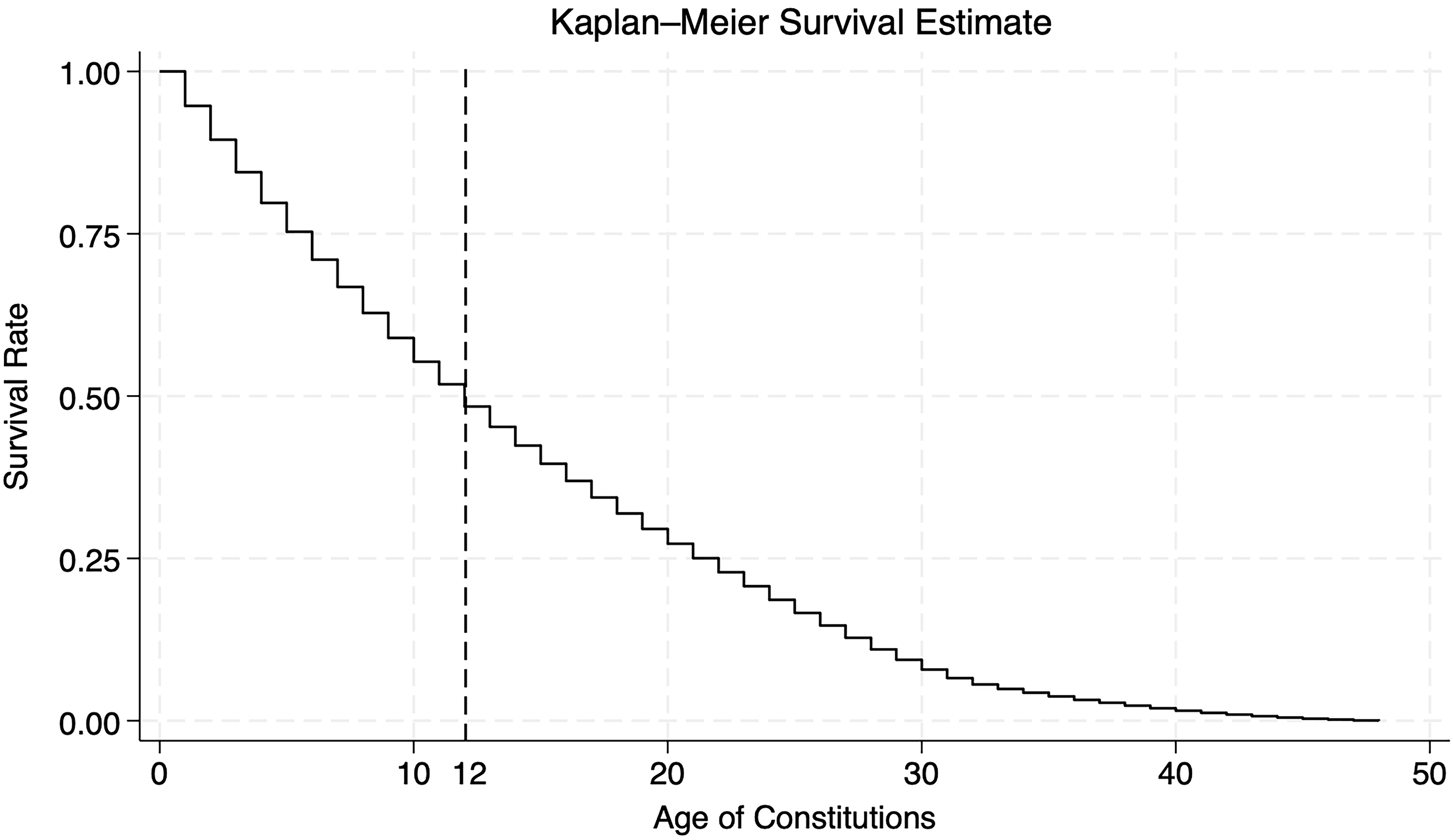
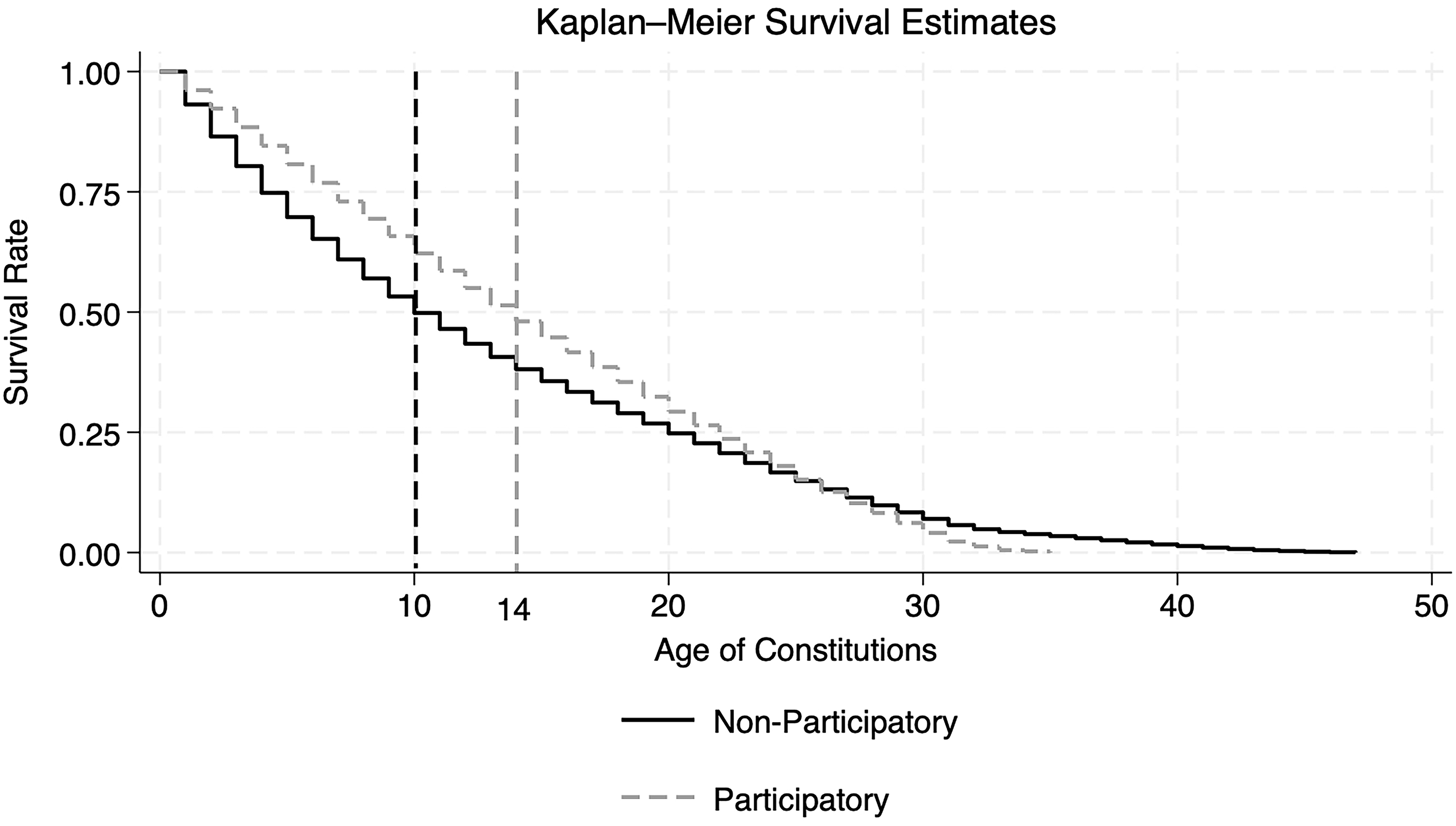
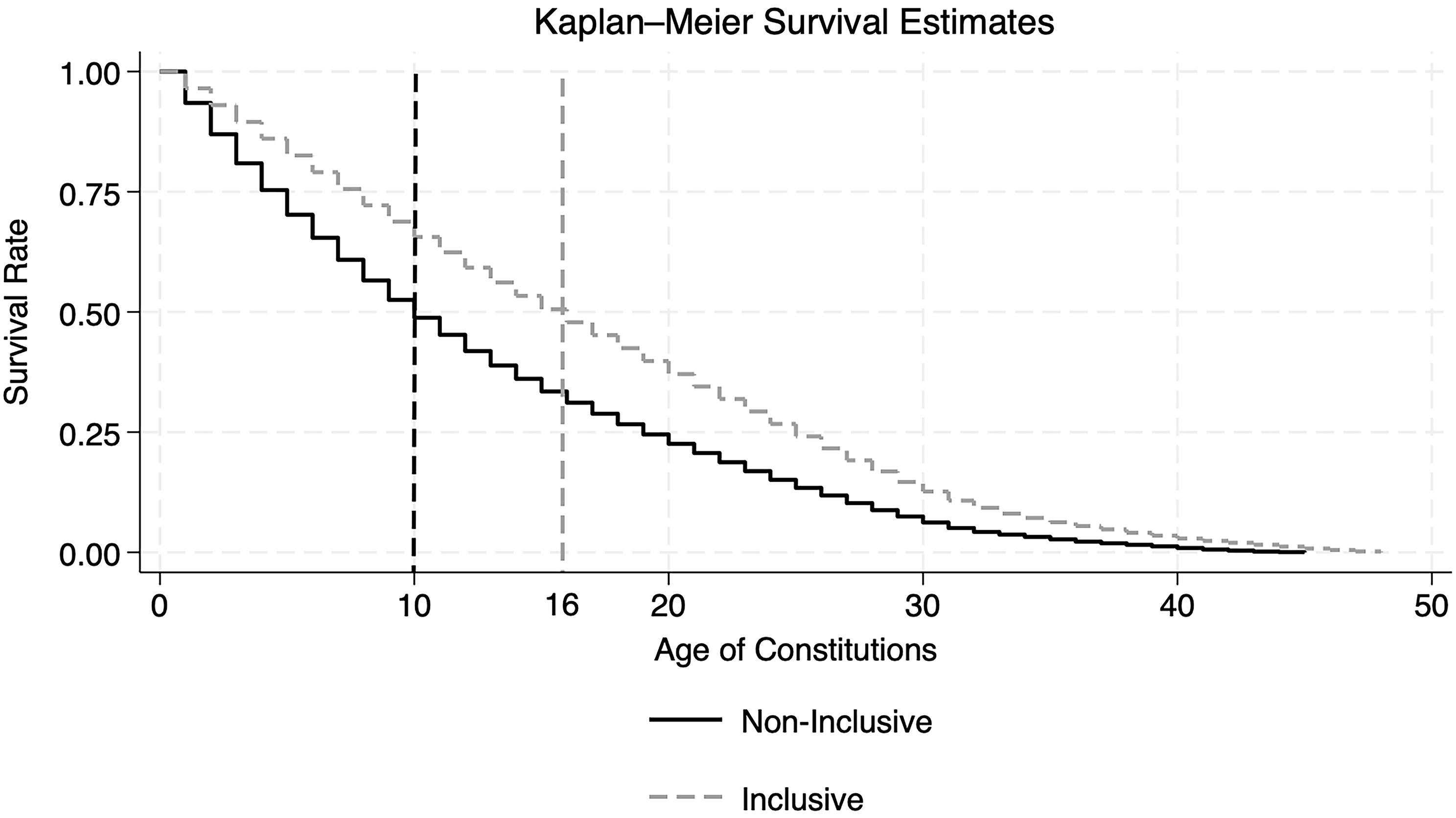
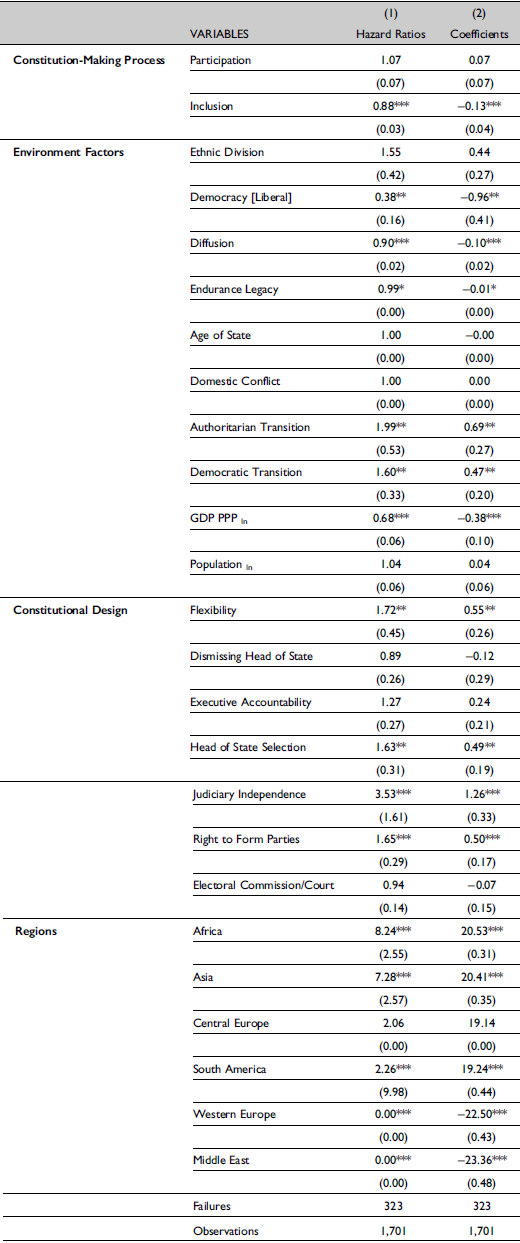
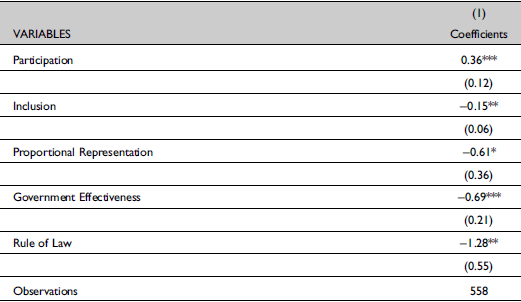

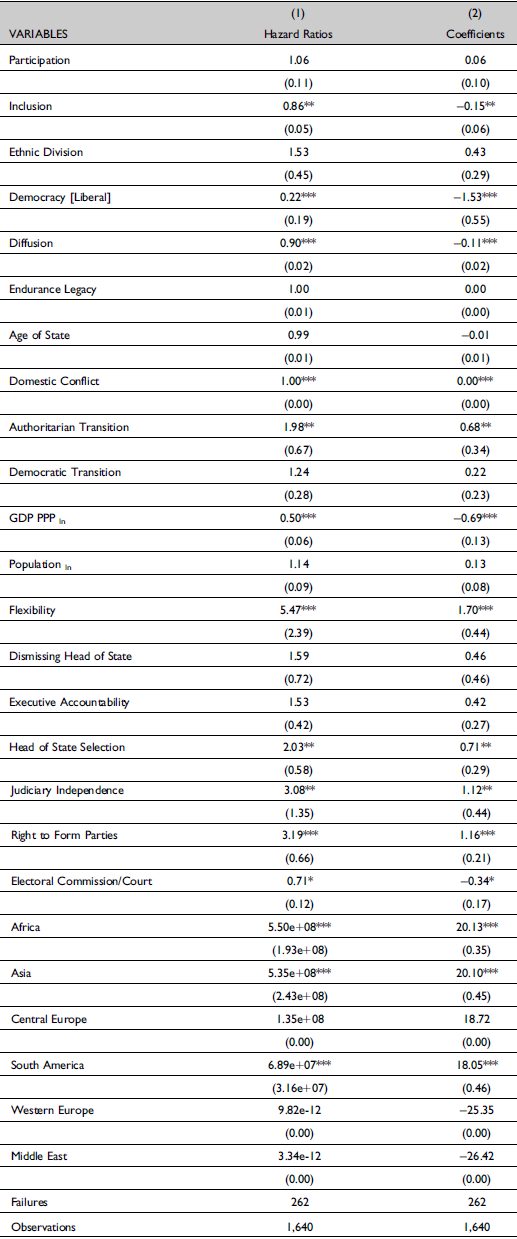
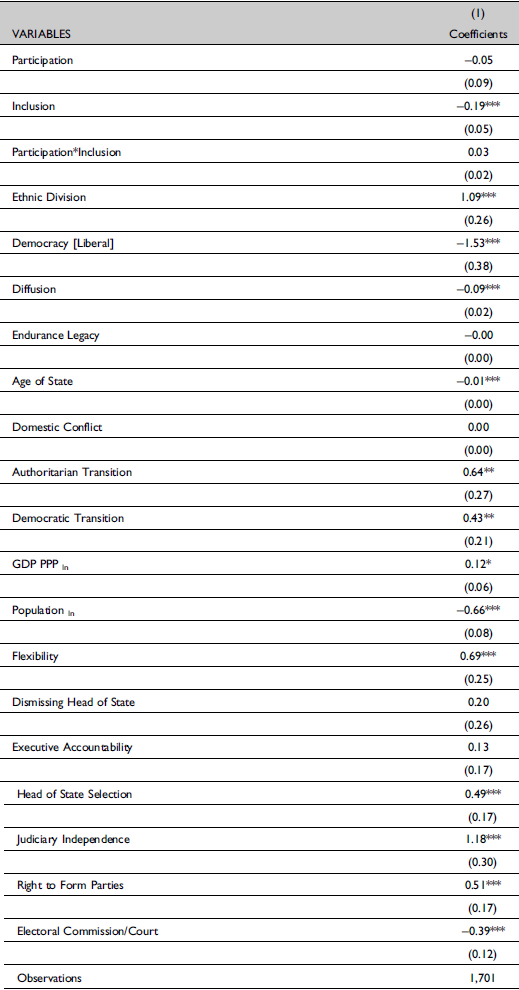

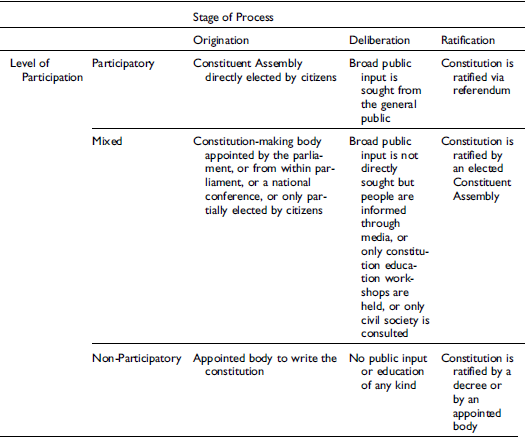
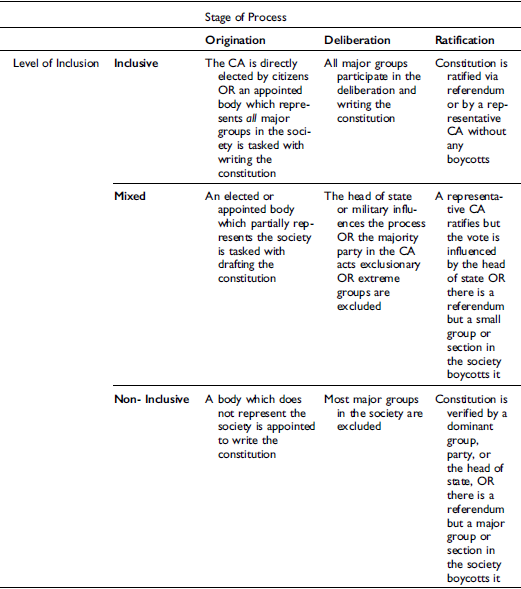
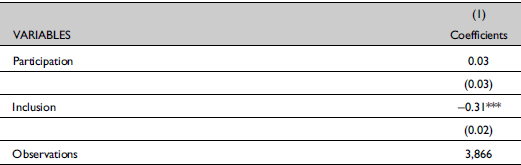
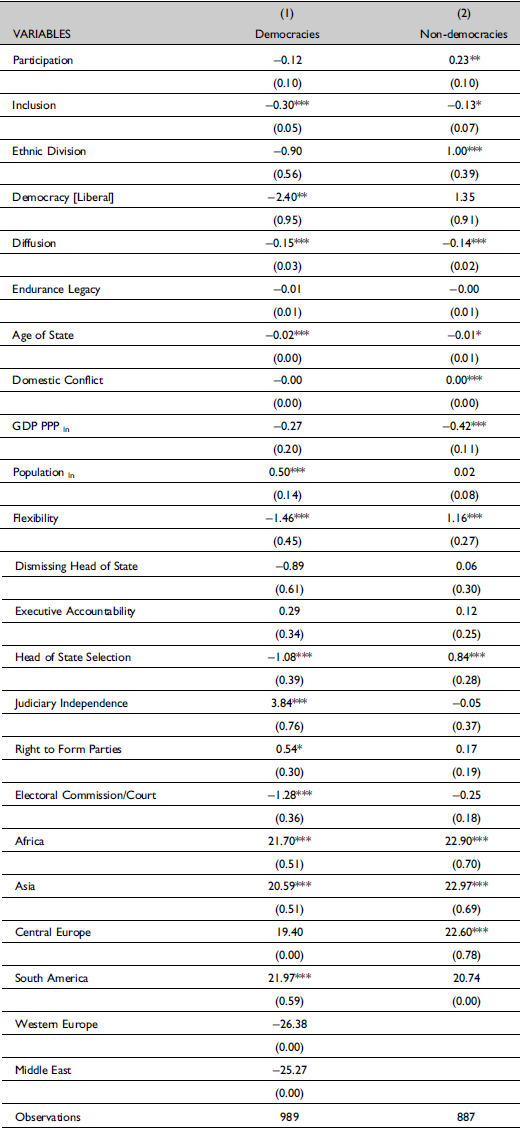
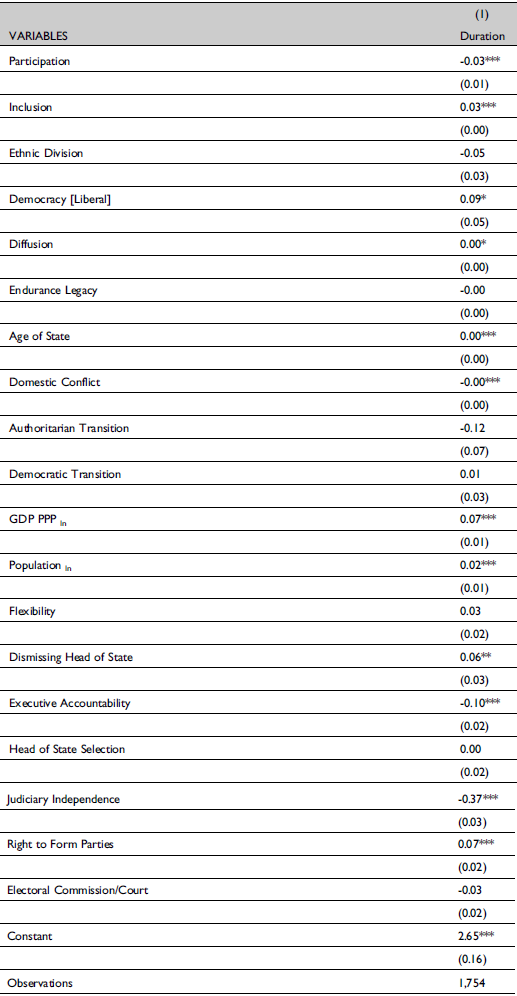
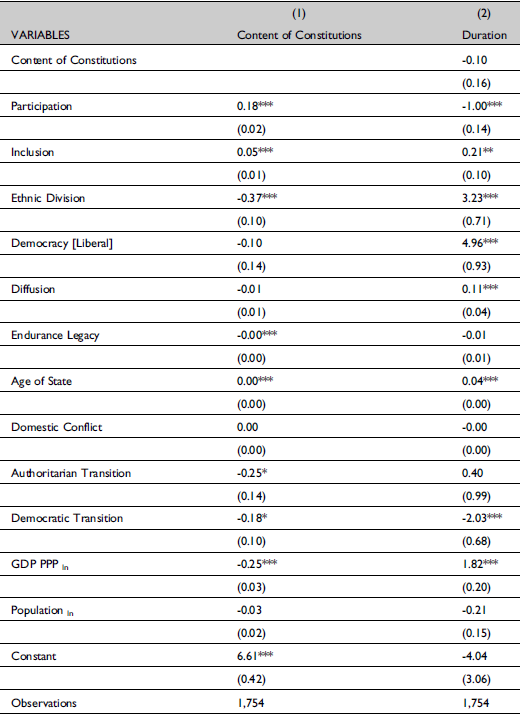
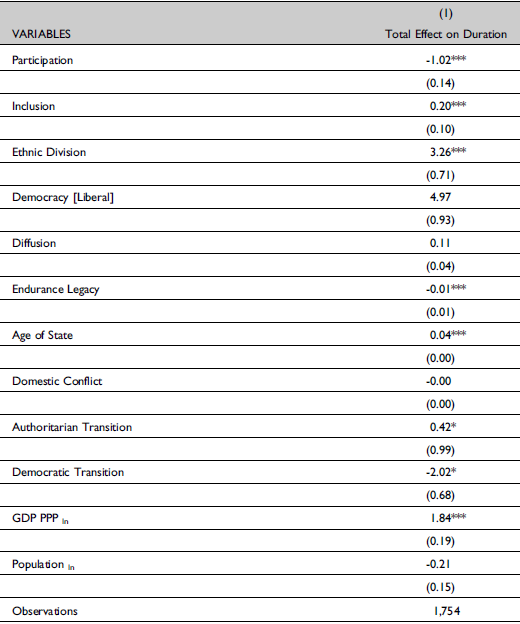

 Open access

